8
Module
Maria Teresa Siniscalco
and Nadia Auriat
Questionnaire
design
International Institute for Educational Planning/UNESCO 7-9 rue Eugène-Delacroix, 75116 Paris, France
Tel: (33 1) 45 03 77 00 Fax: (33 1 ) 40 72 83 66
e-mail: [email protected] IIEP web site: http://www.unesco.org/iiep
The designations employed and the presentation of material throughout the publication do not imply the expression of any opinion whatsoever on the part of UNESCO concerning the legal status of any country, territory, city or area or of its authorities, or concerning its frontiers or boundaries.
All rights reserved. No part of this publication may be reproduced, stored in a retrieval system, or transmitted in any form or by any means: electronic, magnetic tape, mechanical, photocopying, recording or otherwise, without permission in writing from UNESCO (International Institute for Educational Planning).
Graphic design: Sabine Lebeau Typesetting: Sabine Lebeau Printed in IIEP’s printshop September 2005 © UNESCO
Quantitative research methods in educational planning
These modules were prepared by IIEP staff and consultants to be used in training workshops presented for the National Research Coordinators who are responsible for the educational policy research programme conducted by the Southern and Eastern Africa Consortium for Monitoring Educational Quality (SACMEQ). The publication is available from the following two Internet Websites:Content
1. Introduction
1
2. Initial planning
3
Why a new questionnaire – and when? 3
Relationships between research problems,
research hypotheses, and variable construction 5
Characteristics of research hypotheses 6
Specifying variables and indicators 6
Operationalization of research questions 8
The problem of the cross-national validity of educational
concepts, definitions, and data collection instruments 12
1. What is formal education? 12
2. Distinguishing public and private service providers 14
3. What is a school? 16
4. What is a student? 17
5. What is a teacher? 18
3. The design of questions
22
Question structure 22
1. Closed questions 23
2. Open-ended questions 26
3. Contingency questions 28
Educational research: some basic concepts and terminology Module 1
Specifying the characteristics of respondents 34 A checklist for reviewing questionnaire items 35
4. Examples of questions
38
Student background 38
1. Gender and age 39
2. Socio-economic background: occupation, education, and possessions 41
Teacher characteristics 47
School location 49
Learning, teaching, and school activities 51
1. Student reading activity 51
2. Teacher activities 52
3. School head activities 53
Attitudes, opinions, and beliefs 55
1. Likert scaling 55
5. Moving from initial draft to final version
of the questionnaire
63
Two widely-used patterns of question sequence 63
General guidelines for item placement 65
Covering letters and introductory paragraphs 66
Drafting instructions for answering questions 68 Training of interviewers or questionnaire administrators 70
Pre-testing the questionnaire 72
Basic steps in pre-testing 75
Reliability and validity 76
1. Validity 76
The codebook 79
questions, examples of question types, and moving from a draft to a final questionnaire.
After reading this module, the reader should be able to design a quality survey questionnaire that is suitable for addressing the research issues at hand. He or she will know how to:
• Decide on the target population for the questionnaire.
• Identify the variables and indicators that will address the research issues and hypotheses on which data are to be collected.
• Develop demographic, knowledge, attitude, and practice questions.
• ‘Close’ open ended quantitative and qualitative questions and design skip, filter, and contingency questions, where appropriate.
• Decrease response bias and maximize response rates.
• Design probe questions and interviewer or respondent instructions on the questionnaire.
Questionnaire design
Module 8
• Conduct a pilot test of the questionnaire, and adjust its final design according to the results.
This section reviews the steps required to determine the need for a new questionnaire, and looks at how a general research problem needs to be translated into a number of specific research questions and hypotheses. It examines the problem of valid cross-national instruments and provides helpful hints and recommendations for using comprehensive and precise definitions of key educational concepts.
Why a new questionnaire – and when?
This module addresses the planning and design of standardized questionnaires. A formal standardized questionnaire is a
survey instrument used to collect data from individuals about themselves, or about a social unit such as a household or a school. A questionnaire is said to be standardized when each respondent is to be exposed to the same questions and the same system of coding responses. The aim here is to try to ensure that differences in responses to questions can be interpreted as reflecting differences among respondents, rather than differences in the processes that produced the answers.
Standardized questionnaires are often used in the field of
educational planning to collect information about various aspects of school systems. The main way of collecting this information is by asking people questions – either through oral interviews (face to face or telephone), or by self-administered questionnaires, or by using some combination of these two methods.
Questionnaire design
Module 8 Initial planning
Although survey research, by definition, implies the use of some form of questionnaire to be administered to a sample of respondents, the questionnaire is simply one instrument that can be employed in the study of a research problem. As such, it may or may not be the most suitable tool for the task at hand.
Hence, before deciding on the need for a new questionnaire, one should consider whether or not some of the required information may already be available from other sources, for example, from statistics compiled by governments or research agencies, or from survey research archives. One should also consider whether a suitable questionnaire already exists that could be wholly or partially used.
The planner should also consider whether other means of data collection are more appropriate. These can be (a) field experiments, where people in ‘treatment’ and ‘control’ groups respond to a scenario devised by the investigators, (b) content analysis of newspapers or articles, (c) direct observation (such as counting the number of schools in a district, the number of blackboards in a school or the number of students per teacher in a given area), or (d) non-directive interviews where there are no pre-specified questions and the interviewer has a great deal of freedom in
probing areas and specific issues during the course of the interview. Among the types of information that can be collected by means of a questionnaire are facts, activities, level of knowledge, opinions, expectations and aspirations, membership of various groups, and attitudes and perceptions. In the field of educational planning, the information that is collected can be classified broadly into: (a) inputs to education (such as school resources or various background characteristics of schools, teachers or students), (b) learning and teaching processes, and (c) the outcomes of education (such as pupil achievement, attitudes towards school, and measures of school efficiency such as survival rates etc.).
Relationships between research
problems, research hypotheses,
and variable construction
The development of a questionnaire commences with the
transformation of general educational research and policy concerns into specific research questions for which the data are intended to supply an answer. Some examples of general educational policy and research concerns are: (a) policy-makers want to assess the supply of resources in their primary schools, (b) a curriculum expert wants to determine to what extent teaching methods explain differences in reading literacy among 9-year-old students, and (c) a national evaluation agency wants to investigate student attitudes towards science at the end of secondary school.
In the case of the above three examples, it would be necessary to establish empirical evidence for decisions through the collection of data on facts (school resources), activities (teaching methods), and attitudes (students’ views towards science), respectively.
A research hypothesis is a tentative answer to a research problem expressed in the form of a clearly stated relation between
independent (‘cause’) and dependent (‘effect’) variables. Hypotheses are built around a more general research problem.
Examples of educational research problems derived from the general issue of ‘equity’ are:
• How large are differences in the stability of school staff between schools in urban and rural areas?
• Is the provision of equipment and supplies distributed to schools dependent on public and private funding?
Questionnaire design
Module 8 Initial planning
These research problems can be translated into research hypotheses as follows:
• The stability of school staff is greater in rural schools than in urban schools.
• Equipment and supplies are more widely available in schools dependent on private funding than they are in schools dependent on public funding.
Characteristics of research hypotheses
Educational research hypotheses should have the following characteristics.
• Describe clearly, and provide identification of the most important variables in operational terms.
• Specify expected relationships among independent, dependent, and control variables.
• Present a statement in a form that is testable with available research methods.
• Be value free in the sense that they exclude the personal biases of the researcher.
Specifying variables and indicators
Following the identification of the research problem and the
formulation of researchable hypotheses, it is necessary to prepare a tentative list of variables and indicators for measuring the specific research questions and hypotheses of interest.
A variable is a characteristic that can assume two or more
properties. If a property can change either in quantity or quality, then it can be regarded as a variable. There are five main types of variable.
• Dependent variables
Variables that the researcher is trying to explain (for example, student achievement).
• Independent or explanatory variables
Variables that cause, or explain, a change in the dependent variable.
• Control variables
Variables that are used to test for a spurious relationship between dependent and independent variables. That is, to test whether an observed relationship between dependent and independent variables may be explained by the presence of another variable.
• Continuous variables
Variables that take all values within a particular range.
• Discrete variables
Variables that take a number of specific values.
An indicator is an empirical, observable, measure of a concept. When an indicator is composed of a combination of variables involving only simple calculations (such as addition, subtraction, division, multiplication, or a combination of these) it is called a ‘simple indicator’. When more complex analytical methods, such as factor analysis or regression are used to develop an indicator, the result is referred to as a ‘complex indicator’. Examples of simple indicators are: number of school library books per pupil; or teacher/ pupil ratio. An example of a complex indicator is a factor score
Questionnaire design
Module 8 Initial planning
entitled ‘emphasis on phonics’ in the teaching of reading formed from three variables: learning letter-sound relationships; word attack skills; and assessment of phonic skills.
Operationalization of research
questions
When operationalizing a specific research question to identify an appropriate indicator it is necessary to specify the indicator according to the following components.
• The statistics that will be reported (for example, means or percentages).
• The level of analysis at which the statistics will be calculated (for example, at the student, teacher, or school level).
• The target population and, if any, the sub-populations considered (for example, all primary school students, with the data presented by region, and urban/rural location of the school).
• The specific measure to be used (for example, the number of school library books per student).
• The variables needed in order to calculate a measure on the indicator to be obtained (for example, total school enrolment and number of books in the school library).
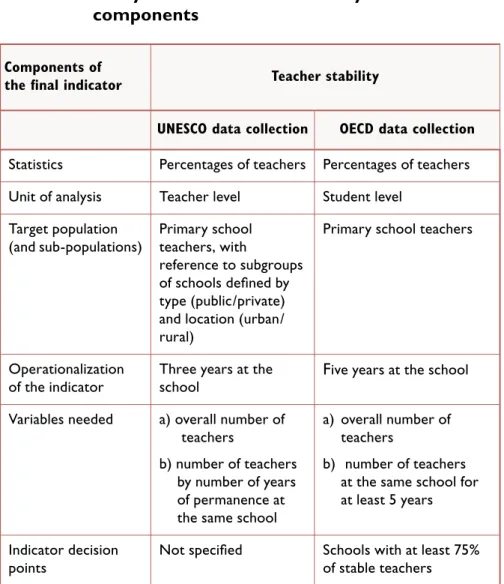
Two different indicators of teacher stability were operationalized in data collections conducted by UNESCO and the OECD during mid 1990’s. The UNESCO study examined the conditions of primary schools in the least developed countries (Schleicher et al., 1995, pp. 56-59) and the OECD study was focussed on the development of a
broad range of indicators (OECD, 1996, pp. 150-152). These studies offer interesting examples of different approaches to indicator construction. For example, staff stability was defined on the basis of the number of years teachers had been at the school, but the indicator was constructed differently in the two surveys. In the UNESCO study it was hypothesized that most of the participating countries would be characterized by a high level of staff instability due to population growth and resulting increases in school enrolment rates. Teachers were considered to be ‘stable’ if they had been at the school for at least three or more years. The level of staff stability for nations was represented by the percentage of teachers in each country who ‘had been at the same school for three or more years’. The following variables were needed for this calculation: the overall number of full-time equivalent teachers in the school; the number of teachers having joined the school by year; and, the year of construction of the school building – which functioned as a validity check variable.
In contrast, the indicator of staff stability used by the OECD for developed countries measured the percentage of primary school students enrolled in schools where more than 75 percent of teachers had been employed at the same school for at least five years. In order to build this indicator the following variables were needed: total enrolment per school, the number of teachers per school, and the number of years each teacher had been employed at the school. Three aspects distinguish these two indicators of school staff stability. First, in the OECD indicator the percentage of stable teachers was weighted by the number of students enrolled. This approach was taken because the goal of the analysis was to provide an indication of how many students were affected by the stability of the teaching force – rather than concentrating on teachers as the unit of analysis. In contrast, the UNESCO study aimed at giving a picture of the teaching body as a whole and therefore employed
Questionnaire design
Module 8 Initial planning
teachers as the unit of analysis. Second, stability was defined as teachers being at the school for a minimum of five years in the OECD indicator, and for at least three years in the UNESCO indicator. The reason for the difference between five and three years was that the first study was dealing with a group of the world’s most developed countries and the second study concerned developing countries. Third, the OECD indicator defined ‘stable’ schools as those where more than a certain percentage of teachers (75 percent) were ‘stable’. That is, the OECD defined an indicator decision point to distinguish between stable and unstable schools. On the other hand, the UNESCO study, aimed at giving a descriptive picture of the conditions of schooling and therefore did not need to adopt an indicator decision point.
The following table presents the components of the
above-mentioned indicators on teacher stability, and highlights the main differences between them.
Table 1 Analysis of the teacher stability indicators’ components
Components of
the final indicator Teacher stability
UNESCO data collection OECD data collection Statistics Percentages of teachers Percentages of teachers Unit of analysis Teacher level Student level
Target population (and sub-populations) Primary school teachers, with reference to subgroups of schools defined by type (public/private) and location (urban/ rural)
Primary school teachers
Operationalization of the indicator
Three years at the
school Five years at the school Variables needed a) overall number of
teachers
b) number of teachers by number of years of permanence at the same school
a) overall number of teachers
b) number of teachers at the same school for at least 5 years Indicator decision
points
Not specified Schools with at least 75% of stable teachers
Questionnaire design
Module 8 Initial planning
The problem of the cross-national
validity of educational concepts,
definitions, and data collection
instruments
The specification of variables and indicators presupposes a general and common agreement on the exact meaning and scope of the terms and concepts employed. However, given the diversity that characterizes different education systems, not to mention the disparities that can sometimes be found among regions, and even among schools within the same system, there is a need for a clear and comprehensive definition of these kinds of terms.
In the following paragraphs some key educational concepts and terms are examined to exemplify the kind of definitional problems that arise when dealing with education issues. Some solutions that can be used to address problems in this area have also been described. The definitions and classifications presented draw mainly on UNESCO, OECD, and EUROSTAT work.
1. What is formal education?
a. Problem/issues to be resolvedA number of questions on the scope of education need to be addressed before meaningful data can be collected on key aspects of education systems. For example, when does formal education start and should a data collection on education
statistics include the pre-primary level? How should activities in the field of vocational education and training be accounted for? Is special education provided within or outside regular schools, and should it be covered by the data collection? Should adult education be included in the statistics?
b. Helpful hints
Some directions helping to answer these questions can be drawn from the following comprehensive definition of education proposed within the International Standard Classification of Education (ISCED).
Education is ‘organized and sustained communication designed to bring about learning’ (UNESCO, 1976). ‘Communication’ in this context refers to the relation between two or more persons involving the transmission of information. ‘Organized’ means planned in a sequence including established aims and/or curricula and involving an educational agency that organizes the learning situation and/or teachers who are employed (including unpaid volunteers) to consciously organize the communication. ‘Sustained’ means that the learning experience has the characteristics of duration and continuity. ‘Learning’ indicates any change in behaviour, information, knowledge, understanding, attitudes, skills, or capabilities that can be retained and cannot be ascribed to physical growth or to the development of inherited behaviour patterns.
According to this definition, pre-primary school should be included within the specification of education because, not only does it serve the purpose of giving the child daily care while the parents are at work, it also contributes towards the child’s social and intellectual development. One solution to keeping track of differences among primary programmes is to distinguish between ‘all
pre-primary programmes’ and ‘pre-pre-primary programmes with special staff qualifications requirements’. The first area covers all forms of organized and sustained activity taking place in schools or other institutional-settings (as opposed to services provided in households or family settings). The second refers to programmes where at least one adult has a qualification characterized by training covering psychological and pedagogical subject matter.
Questionnaire design
Module 8 Initial planning
In the area of vocational training one solution is to exclude
vocational and technical training that is carried out in enterprises, with the exception of combined school and work programmes that are explicitly deemed to be part of an education system.
The above definition of education also suggests that special
education programmes, whether provided by regular schools or by special institutions, are to be included in the data collection as long as the main aim of the programme is the educational development of the individual.
‘Adult’ or ‘non-regular’ education programmes should be included in the statistics only if they involve studies with a subject matter content similar to regular education studies or whose qualifications are similar to those of regular education programmes.
Each of the above points provides some idea of the kind of
definitional and classificatory work necessary to overcome national and/or regional differences in definitions and thereby to construct data collection instruments which guarantee the comparability of the data that are collected.
2. Distinguishing public and private service
providers
a. Problem/issues to be resolved
Most national and cross-national data collections gather information that will enable schools to be classified according to the education service provider. In many data collections for school systems, this classification is often referred to as ‘school type’. This is a complex task because of the need to take variety into account. In some countries virtually all education activities and institutions are public. In other countries private agencies play a substantial role. However, the label ‘private’ covers
a number of different educational configurations. In some countries ‘private schools’ are entirely or mostly funded by the central authority, but they are run privately. In other countries ‘private schools’ are entirely or mostly funded and managed privately.
When information concerning ‘school type’ is collected it is not sufficient to ask the respondent (for example, the school head) to classify the school either as public or private. When developing questions in this area, whether the questionnaire is to be addressed to a central authority or to school heads, it is necessary to specify what it is intended by ‘private’ vs. ‘public’, or by ‘government’ vs. ‘independent’.
b. Helpful hints
An approach often adopted is to distinguish between the following three categories of schools: schools controlled by public authorities; schools controlled by private authorities but depending on substantial government funds; and schools controlled and funded by private authorities.
Alternatively, it is helpful to distinguish between the ‘control’ and ‘funding’ of schools. The terms ‘public’ and ‘private’ can be used to indicate control. That is, whether it is a public or a private agency which has the ultimate power to make decisions concerning the institution (in particular the power to determine the general programme of the school and to appoint the
officers who manage the school). The terms ‘government’ and ‘independent’ can be used to indicate the source of funding. For example, a government school could be defined as one that receives more than 50 per cent of the funds to support its basic educational services from government agencies and/or whose teaching personnel are paid by a government agency; whereas an independent school could be defined as one that receives less than 50 per cent of its overall funding from government agencies.
Questionnaire design
Module 8 Initial planning
3. What is a school?
a. Problem/issues to be resolved
A school is often difficult to define in a manner that is consistent for a cross-national data collection. In some cases a school consists of several buildings, managed by the same head-teacher. In other cases, the same building hosts different schools in different shifts at different times of the day. In some cases a school has a well-defined structure, consisting of separate classrooms – with each classroom being endowed with one teacher table and chair, one desk and chair for each student, and a chalkboard in each classroom. In other cases the school is in the open air, perhaps under a tree, where teachers and students sit on the ground, and the students use their knees as writing places. When collecting comparative information on schools, these different scenarios have to be taken into account.
b. Helpful hints
Suppose, for example, that ‘school crowdedness’ – expressed as square metres of classroom space per pupil – is being measured. The result obtained by dividing the number of square metres by the total enrolment will be correct (and comparable across schools) only in a situation where all schools have one shift. But if some schools operate more than one shift, then the results will be misleading.
One solution in this case would be to ask whether the school has shifts, and how many students there are per shift. The crowdedness measure could then be calculated by taking into account the overall number of students for schools with no shifts, but only the students in the largest shift for schools with more than one shift.
4. What is a student?
a. Problem/issues to be resolved
Suppose that student enrolment figures are being investigated. How will the corresponding statistics be calculated and
reported? When the focus of the analysis is on rates of participation, what should be done with repeaters, and how should they be distinguished from students enrolling regularly for the first time in a grade or year of study? All these issues need to be taken into account when designing questions on student enrolment figures for an education system.
b. Helpful hints
A distinction should be made between the number of students and the number of registrations. The number of students enrolled refers to the number of individuals who are enrolled within a specific reference period, while the number of
registrations refers to the count of enrolments within a specific reference period for a particular programme of study. The two measures are the same if each individual is only enrolled in one programme during the reference period, but the measures differ if some students are enrolled in multiple programs. Each measure is important: the number of students is used to assess participation rates (compared to population numbers) and to establish descriptive profiles of the student body. The number of registrations is used to assess total education activities for different areas of study.
One solution for calculating student enrolment figures would be to choose a given date in the education programme of interest and then to present the number of students enrolled on that date. Another solution would be to report the average number of students enrolled during the academic year. Yet a third possibility would be to report the total number of students
Questionnaire design
Module 8 Initial planning
enrolled during the academic year, with the possibility of double counting multiple entrants and re-entrants.
With respect to identifying repeaters, one commonly applied solution is that students are classified as repeaters if they are enrolling in the same grade or year of study for a second or further time.
5. What is a teacher?
a. Problem/issues to be resolved
How can teachers be defined in order to distinguish them from other educational personnel? One approach would be to base the definition on qualifications. However, this could result in an overestimation of the number of teachers because a number of personnel employed in schools may have a teacher qualification but do not actually teach. Another approach would be to define teachers on the basis of their activities within schools, but this alone would not be sufficient to distinguish professionals from those who may act as teachers occasionally or on a voluntary basis. A further issue is the reduction of head-counts to full-time equivalents (if part-full-time employment applies). How can part-time teachers be converted into full-time equivalents? No questionnaire concerning teacher characteristics can be designed before these issues have been clarified.
b. Helpful hints
The following definition of a teacher provides a useful framework for overcoming ambiguities:
A teacher is a person whose professional activity involves the transmission of knowledge, attitudes, and skills to students enrolled in an educational programme.
The above definition is based on the concepts of (a) activity (excluding those without active teaching duties), (b) profession (excluding people who work occasionally or on a voluntary capacity in educational institutions), and (c) educational programme
(excluding people such as some school principals who provide services other than formal instruction to students).
Note that according to this definition, principals, vice-principals, and other administrators without teaching responsibilities as well as teachers without active teaching responsibilities for students in educational institutions are not classified as teachers.
For the reporting of head-counts, individuals who are linked to multiple educational programmes, such as teachers who divide their work between public and private institutions, or between levels of education, or between different functions (for example, teaching and administration) should be pro-rated between those levels, types of institutions and functions. Suppose, for example, that there are 100 full-time teachers that (on the average) devote 80 per cent of their statutory working time to teaching and 20 per cent to the function of headmaster. In this case 80 full-time teachers should be reported under the category ‘teacher’ and 20 full-time teachers should be reported under the category ‘other professional personnel’. If countries cannot pro-rate educational personnel, the classification could be based on the activity to which they devote the majority of their working time.
With respect to part-time conversion, the distinction between full-time and part-full-time teachers, as well as the calculation of full-full-time equivalents, is based on the concept of statutory working time. One solution to this conversion problem is to classify as ‘full-time’ those teachers employed for more than 90 percent of their statutory working time, and as ‘part-time’ those teachers employed for less than 90 percent of the statutory working time. The classification of individuals linked to multiple educational programmes as full-time
Questionnaire design
Module 8 Initial planning
or part-time teachers will depend on the total number of working hours over all levels, types of institutions, and functions.
In some cases the solutions found will be used to define the target population for which data will be collected – as shown in the examples given in the paragraph on formal education. In other cases the definitional work will contribute directly to the design of questionnaire items – as shown in the examples given in the previous section on service provider. In yet other cases definitions and explanations will be used to prepare accompanying notes that provide instructions on how to answer specific questions – as shown in the examples given for the conversion of part- time teachers and students into full-time equivalents).
EXERCISES
1. Prepare three research hypotheses concerning factors that influence student achievement, and then identify some appropriate independent, dependent, and control variables. 2. Specify the variables needed to construct each indicator in the
following list.
a. Time spent daily for homework by students. b. Teacher academic education.
c. Availability of school library.
d. Yearly instructional time in Grade 1. e. Average class size in school.
f. Teacher/pupil ratio.
3. An educational planner has defined an “Indicator of the Level of Qualifications for Primary School Teachers” as the percentage of primary school pupils in schools with at least 50 percent of teachers having completed secondary school. For this indicator specify (a) the statistical units used, (b) the unit of analysis, (c) the target population, and (d) the variables required to construct the indicator.
4. Suppose you have prepared a questionnaire to be answered by all teachers in a sample of schools. How would you specify what is a teacher in the notes accompanying the questionnaire in order to prevent the questionnaire being filled in by other educational personnel?
Questionnaire design Module 8
Once the indicators and variables of interest have been identified and their components have been defined, one may begin designing the corresponding questionnaire items. It is important to note that the number of questions in a questionnaire does not coincide necessarily with the number of variables. Sometimes more than one question needs to be asked to operationalize one variable.
This section is concerned with types of questions and response formats. It examines and discusses the advantages and
disadvantages of three key types of question structure: open, closed, and contingency. It then gives writing tips for structuring questions and the response categories that accompany them. The section ends with advice on how to avoid response bias and pitfalls in question writing.
Question structure
Two important aspects of questionnaire design are the structure of the questions and the decisions on the types of response formats for each question. Broadly speaking, survey questions can be classified into three structures: closed, open-ended, and contingency
questions.
1. Closed questions
Closed (or multiple choice) questions ask the respondent to choose, among a possible set of answers, the response that most closely represents his/her viewpoint. The respondent is usually asked to tick or circle the chosen answer. Questions of this kind may offer simple alternatives such as ‘Yes’ or ‘No’. They may also require that the respondent chooses among several answer categories, or that he/she uses a frequency scale, an importance scale, or an agreement scale.
The main advantage of closed questions are:
• the respondent is restricted to a finite (and therefore more manageable) set of responses,
• they are easy and quick to answer,
• they have response categories that are easy to code, and
• they permit the inclusion of more variables in a research study because the format enables the respondent to answer more questions in the same time required to answer fewer open-ended questions.
How often do your parents ask you about your homework? (Please, circle one answer only)
Never . . . 1 1 or 2 times a week . . . 2 3 or 4 times a week . . . 3 Nearly every day . . . 4
Questionnaire design
Module 8 The design of questions
The main disadvantages with closed questions are:
• they can introduce bias, either by forcing the respondent to choose between given alternatives or by offering alternatives that otherwise would not have come to mind,
• they do not allow for creativity or for the respondent to develop ideas,
• they do not permit the respondent to qualify the chosen response or express a more complex or subtle meaning,
• they can introduce bias, where there is a tendency for the respondent to tick systematically either the first or last category, to select what may be considered as the most socially desirable response alternative, or to answer all items in a list in the same way, and
• they require skill to write because response categories need to be appropriate, and mutually exclusive.
The response format for closed questions can range from a simple yes/no response, to an approve/disapprove alternative, to asking the respondent to choose one alternative from 3 or more response options.
The possibility of format effects or response bias for this type of question can be reduced by changing the sequence of response categories and values. For example, if responses to an item range from 1 to 5, going from negative to positive, then a number of items in the questionnaire can be designed to have 1 as the most positive alternative and 5 as the most negative. This is a particularly important technique for the construction of attitude scales.
What is your sex? (Please tick one box only) p Male
p Female
Some closed questions may have a dichotomous response format, which means only two mutually exclusive responses are provided.
For the above example a dichotomous response format is
appropriate. However, this type of format should not be overused in a survey because it elicits much less information than multiple choice formats. For example, if seeking information on degree of interest in public affairs, the question “Do you read a daily newspaper?” yields a yes/no response. This could be reworded to: “How many times per week do you read a daily newspaper?”, to which multiple choice responses could be:
1. Seven times a week
2. Five to six times a week
3. Three to four times a week
4. One to two times per week
5. Less than once per week
6. Never
Such a multiple category response format would provide more specific and more useful information than the dichotomous one.
Questionnaire design
Module 8 The design of questions
What are your favourite TV programmes? (Please specify their titles)
. . . . . . What do you like most about school?
. . . . . .
2. Open-ended questions
Open-ended or free-response questions are not followed by any choices and the respondent must answer by supplying a response, usually by entering a number, a word, or a short text. Answers are recorded in full, either by the interviewer or, in the case of a self-administered survey, the respondent records his or her own entire response.
The main advantages of open-ended questions are:
• they allow respondents to express their ideas spontaneously in their own language,
• they are less likely to suggest or guide the answer than closed questions because they are free from the format effects associated with closed questions, and
• they can add new information when there is very little existing information available about a topic.
The main disadvantages of open-ended questions are:
• they may be difficult to answer and even more difficult to analyze,
• they require effort and time on behalf of the respondent,
• they require the development of a system of coded categories with which to classify the responses,
• they require the respondent to have some degree of writing ability, and
• respondent handwriting can be illegible.
There is always the possibility with open-ended questions that responses may come in very different forms, and these may lead to answers that cannot be systematically coded for analysis. For example, if asked “When did you leave school?”, the respondent may answer in a variety of ways: “Seven years ago”. “When I got my first job”. “When my brother started going to high school”. “When my parents moved into this house”.
If the survey is administered by an interviewer, appropriate probing helps clarify such answers. In the case of a self-administered
survey, guidance by writing specific instructions on how to answer the question can often minimize the number of responses that have very different dimensions.
Care should be taken in writing open-ended questions so as to avoid formats that elicit a dichotomous yes/no or agree/disagree response. In addition, the wording of questions should seek to reduce the possibility of eliciting responses that are aligned along very different dimensions and therefore cannot be systematically coded. For example, asking “What do you think about your school?” can elicit responses such as ‘nothing’ or ‘school is useless’. However, asking “What recommendations would you have for improving your school?” would be more likely to elicit informative answers.
A good case for using open-ended questions is when the aim is to have the respondents reply spontaneously, or when the investigator
Questionnaire design
Module 8 The design of questions
is pilot testing the first version of the questionnaire, or when the investigator wants to collect evidence on the parameters of an issue with the aim of later formulating a multiple choice or closed version of a question.
Generally, open-ended questions can produce useful information in an interviewer administered survey, provided that the
interviewers are alert and trained to probe ambiguous responses. In self-administered surveys, it is useful to provide instructions on the format of the response that is required so as to minimize opportunities for the respondents to answer the question according to very different dimensions.
3. Contingency questions
A contingency question is a special case of a closed-ended question because it applies only to a subgroup of respondents. The relevance of the question for a subgroup is determined by asking a filter question. The filter question directs the subgroup to answer a relevant set of specialized questions and instructs other respondents to skip to a later section of the questionnaire.
The advantage of contingency questions is that detailed data may be obtained from a specific subgroup of the population. Some questions may apply only to females and not to males; others may apply only to people in school, and not to those who are employed. At the base of good contingency questions are clear and specific instructions to respondents.
The formats for filter and contingency questions can vary. One option is to write directions next to the response category of the filter question.
Are you enrolled in secondary school? 1. Yes (answer the following question) 2. No (skip to question 5)
Alternatively, the contingency question can be placed at the end of the questionnaire set apart from ordinary questions that are to be answered by everybody:
Guidelines for writing questions
There are no all-purpose rules that, if followed, will automatically result in a well-written questionnaire. There are, however, some basic principles that, when violated, usually result in respondent confusion, misunderstanding, lack of comprehension, or response bias.
a. Keep the vocabulary simple
A first rule concerns the vocabulary used in writing questions and answer categories. The rule is ‘keep it as simple as possible’. This implies using simple words, avoiding acronyms, abbreviations, jargon, technical terms, and abstract or general words.
ANSWER THIS FINAL SET OF QUESTIONS ONLY IF YOU PLAN ON ENTERING AN ADULT EDUCATION COURSE NEXT YEAR.
Questionnaire design
Module 8 The design of questions
• If a rare or technical term has to be used, then its meaning should be explained. For example, a question concerning the frequency with which teachers teach their students to understand different styles of text should be accompanied by a definition of each kind of text.
Narrative:
texts that tell a story or give the order in which things happen. Expository:
texts that provide a factual description of things or people or explain how things work or why things happen.
Documents:
tables, charts, diagrams, lists, maps.
• Acronyms and abbreviations should always be spelled out in the questionnaire. Do not assume that respondents will or should know what an acronym represents.
• When a general term is used, concrete examples should be given to clarify its meaning. For example, a question on learning activities included in the International Educational Achievement (IEA) Reading Literacy Teacher Questionnaire included the following items, for which the respondent had to answer on a four-point frequency scale.
How often are your students typically involved in the following activities?
• silent reading in class
• learning new vocabulary systematically (for example, from lists) • learning to use illustrations (for example, graphs, diagrams, tables)
The words ‘systematically’ and ‘illustrations’ were too general to be understood in the same way by all respondents. Examples were therefore provided to clarify their intended meaning.
Finally, it is recommended to avoid words that may have an ambiguous meaning. In education, the word ‘hour’ may have different meanings. For example, many education systems refer to a lesson length or period as an hour even though the lesson is only forty-five minutes long. In order to measure the yearly instructional time at a given educational level, it is therefore necessary to know the length (in minutes) of an ‘hour’ of instruction, the number of minutes of instruction per week, and the number of school weeks per year. If this information is known, then calculations can be made later for instructional time per day, or week, or year.
b. Keep the question short
Closely related to keeping vocabulary simple is avoiding lengthy questions. Generally, it is recommended to hold questions to 25 words or less. If a longer sentence is used then it should be broken up so that there will be several shorter sentences.
c. Avoid double-barrelled questions
These are single questions that ask for two things and therefore require two answers. “Do you have your own table or your own room to do your homework?” “Do you think it is good idea for children to study geography and history in primary school?” In such instances, respondents do not know what to do if they want to say ‘Yes’ to one part of the question but ‘No’ to the other.
d. Avoid hypothetical questions
Evidence has shown that hypothetical questions such as “Would you use this resource in your class if it were available?” are not good for the prediction of behaviour. People are generally poor predictors
Questionnaire design
Module 8 The design of questions
of their own behaviour because of changing circumstances and because so many situational variables intervene. Investigators are able to collect more valid data if they question respondents’ about their past behaviour and present circumstances, attitudes, and opinions.
e. Don’t overtax the respondent’s memory
It is risky to ask the respondent to recall past behaviour over a long retrospective period. This is true especially when recurrent events or behaviours are concerned. No student, especially young students, will be able to answer reliably a question such as “In the last month how many hours of homework did you do on an average day?” because the time is just too long to remember what happened in detail. If such a question must be asked, a one-week recall period might be more appropriate for this type of event.
f. Avoid double negatives
Double negatives, either in the question or an answer category (or both), create difficulties for the respondent. For example a statement such as ‘Student self-evaluation should not be allowed’ followed by agree/disagree is problematic to answer for respondents who are in favour of students’ self-evaluation, that is those who do not agree that students’ self evaluation should not be allowed. It is usually possible to solve problems of this kind by formulating the initial statement in a positive way.
g. Avoid overlapping response categories
Answer categories should be mutually exclusive. It should not be possible to agree with or choose more than one category – unless the instructions explicitly allow the respondent to check more than one alternative. Examples of questions with overlapping categories are:
The categories of the first question could be made mutually exclusive by removing the qualifiers ‘usually’ and ‘sometimes’. In order to avoid overlap in the second question it should be modified as follows.
Do teachers generally receive their salaries: (Check one only)
usually on time . . . 1 sometimes a week late . . . 2 more than a week late . . . 3 How old are you?
under 20 . . . 1 20-30 . . . 2 30-40 . . . 3 40-50 . . . 4 50-60 . . . 5 60 or more . . . 6
How old are you?
under 20 . . . 1 20-30 . . . 2 31-40 . . . 3 41-50 . . . 4 51-60 . . . 5 61 or more . . . 6
Questionnaire design
Module 8 The design of questions
h. Beware of ‘leading’ questions
A leading question is a question phrased in such a way that it seems to the respondent that a particular answer is expected. For example:
Specifying the characteristics
of respondents
Before beginning to write the questionnaire it is important to consider the characteristics of the respondents.
A clear definition of the target population helps to adapt question wording and response formats and also helps to ensure that respondents have experienced what is being asked of them, or at least have sufficient knowledge to be able to respond to the questionnaire items.
In deciding on the sample design, and the population from which the sample is to be drawn, it is helpful to consider whether the population is of individuals, households, institutions, transactions, or whatever. The source from which the data are to be collected is not necessarily identical to the population definition. For example, if a mail questionnaire is sent to school presidents asking about school finance, the population is of schools and not of school presidents.
“Do you favour or oppose school on Saturday morning?” might read in a leading question as:
“You wouldn’t say that you were in favour of school on Saturday morning, would you?”,
or in a more subtle form:
“Would you say that you are not in favour of school on Saturday morning?”
One of the most important considerations for the researcher is whether respondents consist of a heterogeneous or a homogeneous group. The former consists of individuals who differ from one another in some way that might influence the phenomenon of interest. A heterogeneous group may consist of people from different ethnic backgrounds, different levels of income, and different urban or rural areas. By contrast, homogeneous groups consist of individuals from similar socio-spatial backgrounds. Research has shown that response rates are usually higher for homogeneous or select groups (for example, high school teachers, university professors, physicians) because they are more likely to identify with the goals of the study. Beyond this distinction, it is known that interest and familiarity with the topic has a positive effect on response rates.
A checklist for reviewing questionnaire
items
The following list of questions provides a framework for reviewing each item that is to be included in a questionnaire.
1. Will the item provide data in the format required by the research questions or the hypotheses?
2. Is the item unbiased?
3. Will the item generate data at the level of measurement required for the analysis?
4. Is there a strong likelihood that most respondents will answer the item truthfully?
Questionnaire design
Module 8 The design of questions
5. Do most respondents possess sufficient knowledge to answer the item?
6. Will most respondents be willing to answer the item, or is it too threatening or too sensitive?
7. Does the item avoid ‘leading’ respondents to a specific answer?
8. Is the language used in the questionnaire clear and simple – so that all respondents are able to understand all of the questions?
EXERCISES
1. Explain the uses of closed, open, and contingency questions. 2. Draft five closed and open questions related to some aspect of
educational research.
3. Formulate a contingency question with accompanying instructions.
4. Here are some ‘bad’ questions which contain some of the problems presented in the above discussion. List the main problems and then redraft each question to address these problems and explain the changes that you have made.
… EXERCISES Question 1
How many teachers are there in your school who have been at the school for at least five years and who are involved in special initiatives outside the normal class activities at least once per week?
. . . teachers Question 2
Do you enjoy studying English and Mathematics? Yes . . . 1
No . . . 2 Question 3
If you could attend university which subjects would you like to study?
. . . Question 4
In the last six months how many times did you teach your students to read expository materials?
. . . Question 5
Sometimes teachers do not give me sufficient attention. Definitely Mostly Mostly Definitely
Disagree disagree agree agree
1 2 3 4
Question 6
What is the condition of each of the following in your school?
Bad Good
Lighting 1 2
Water 1 2
Questionnaire design Module 8
In the following discussions some examples have been presented of the main types of questions that are often used in educational planning and educational research data collections. These questions cover the areas of student background, teacher characteristics, school location, learning/teaching activities, and attitudes. The examples related to attitude scales include a discussion of the principles of Likert scaling and the method used for the calculation of the discrimination power of attitude scale items.
Student background
Demographic questions are designed to elicit information from respondents concerning their personal characteristics and social background. This type of information is important for explaining variations in educational outcomes and behavioural patterns. The most frequently used demographic questions focus on gender, age, level of education, income level, marital status, level of parents’ education, religion, and ethnic background. A number of these areas cover sensitive and personal issues and therefore need to be handled carefully.
1. Gender and age
Data on student gender is critically important for examining issues of gender equity in all school systems. This information can be gathered from the class attendance register or can be asked as part of a student questionnaire.
While a question on gender can be asked irrespective of the student’s age, for younger students the question can be more suitably phrased in the following manner.
If the same information is to be obtained from teachers, the
question form and the phrasing of the response alternatives can be more direct.
Whether the question is phrased as a standard question or a more direct enquiry, it is always important to seek advice concerning the wording of this type of question so as to respect local customs and culture.
Are you a boy or a girl? (Tick one box only)
p Boy p Girl
Your sex: p Male p Female
Questionnaire design
Module 8 Examples of questions
Student age is another important variable for explaining the structure and evolution of an education system, and for examining the educational development of students over time. Data on student age can also be obtained from the class register or from a question included in a student questionnaire.
There are various ways in which information on student age can be collected. One way is to ask for the age at a specific reference date; another is to ask for the actual birth date. In this latter case, depending on the degree of accuracy needed, the respondent can be asked to specify the year, or the year and month, or the year, month, and day as in the following example.
Research has shown that the most accurate way to obtain information about age is to ask both date of birth and age at last birthday:
What is your date of birth?
(Please write the corresponding numbers in the spaces below)
Day Month Year
_ _ _ _ _ _ _ _
How old were you at your last birthday? Age: . . .
2. Socio-economic background:
occupation, education, and possessions
Another type of background characteristic concerns the socio-economic background of the student. Indicators can be developed using information obtained directly from the individual, or by using either objective or subjective responses. Some common indicators of student socio-economic background are the parents’ level of income, their occupational status, their level of education, and the personal possessions in the home. The measurement of parent income is always a difficult task in all countries of the world – and for many different reasons. Most school-aged children cannot answer such questions accurately. Similarly, adults sometimes have difficulty answering income questions because they are not in an occupation with a regular salary or because questions in this area represent an invasion of personal privacy. It is usually not useful to include a question on parent income when the respondent is under 15 years of age. For this reason, parents’ level of education, occupational status, and home possessions are the most frequently-used proxy indicators of household wealth.
a. Parent occupations
Parent occupations are usually grouped into ‘occupational status’ categories based on levels of education, skill, and income. The categories are then ranked from lowest occupational status to highest. The categories used to group the occupations must reflect the range of occupations existing in society, and they must also be comprehensible to the respondent. Terms such as white-collar, blue-collar, professional, skilled, semi-skilled, unskilled are not easily understood by younger children if left undefined.
The following is an example of a set of questions directed to students on their father’s occupation. The question begins with a filter to ascertain that questions 11 and 12 are asked only
Questionnaire design
Module 8 Examples of questions
of students whose father is working. In Question 11 the open responses will later be coded by the survey researcher. The third question in the series helps check for consistency between responses.
Before the non-compulsory level of education is reached (but after the age of 10 years), it is often recommended to use a classification of occupations with no more than 4 categories. For example, (a) professional and managerial, (b) clerical, (c) skilled blue-collar, (d) semi-skilled and unskilled. Each category should have a definition and/or examples that correspond to the type of occupation.
10. Does your father work for pay now?
Yes, he now works full time . . . 1 (GO TO 11) Yes, he now works part time . . . 2 (GO TO 11) No, he is now looking for work . . . 3 (GO TO 13) No, he is not working at present
(unemployed, retired) . . . 4 (GO TO 16) 11. What is the occupation of your father (or the male
person responsible for your education)? (Please, describe as clearly as possible)
. . . . . . . . . . . . 12. In your opinion, how can the occupation of your father
be defined? (Please tick only one box) p professional and managerial p clerical and sales
p skilled blue-collar
Obtaining useful information on parent’s occupation is very difficult in self-administered questionnaires. For most children under the age of 14 years an interviewer or data collector should assist with this question so as to improve the quality of the children’s responses. Some examples of interviewer probes are presented below.
In the absence of interviewers, the following guidelines can improve response quality in self-administered questionnaires: (i) avoid simply asking the name of the place where the parent works since this is insufficient in detail. For example, a response ‘in a hospital’ could mean the father is a doctor, a nurse, an administrator, or a janitor; (ii) avoid asking vague job titles, such as ‘engineer’, (iii) look into the job classifications used in a recent census or national
Response:
My father works in a factory Probe:
What kind of machine does he operate? Response:
My father is a teacher Probe:
What level does he teach (or, alternatively, what age students does he teach?)
Response:
My father works in a shop Probes:
Does he own the shop? Or does he manage the shop? Or does he work for someone else in the shop?
Questionnaire design
Module 8 Examples of questions
population surveys and see if they can be adapted for use in a student questionnaire, (iv) when asking the mother’s occupational status, remember to include the option ‘housewife’ (or home duties), and (v) a combination of open and closed questions is often more effective since it permits a check to be made of the consistency of the responses.
b. Parent’s education
Open-ended questions that ask directly for the number of years of a parent’s education are very difficult to answer because they imply that students remember not only the level of education completed by their parents, but also the sequence of levels of education, and that they know the duration of each of these levels. For these reasons, questions on parent’s education should be given in multiple choice format.
In this case the only task required is to recognize the correct
information, rather than to remember it. Once the responses to this question are collected, the first six options can be ranked during coding, from one to six, or they can be converted into the number of years corresponding to each option (perhaps using a median value for the second, and fourth option).
What is the highest level of education that your father (or the male person responsible for your education) has completed?
(Please tick one box only) p Never went to school
p Completed some primary school p Completed all of primary school p Completed some secondary school p Completed all of secondary school
p Completed some education/training after secondary school p Don’t know
Where possible, the researcher should make a prior request for information from the parents. This could be achieved by asking the students to consult with their parents – or by having the students take the following question home for completion by parents.
c. Possessions in the home
Possessions in the home has become a useful alternative approach to collecting information on socio-economic background from students. The number of books in the home also provides
information about possessions that are more closely linked to the educational level of parents. Variables based on this information usually yield a strong relationship with educational outcomes – even when reported by younger students.
The items included in the list must relate to the context in which the questionnaire is administered, and to the level of development and characteristics of the society. It is important that the list include possessions that denote high, medium, and low economic status in order to discriminate among students with different socio-economic backgrounds.
One of the most important possessions related to the social (and educational) climate of the home is the number of books. This information is usually collected in approximate categories – which must de defined with a detailed knowledge of prevailing societal conditions.
How many years of academic education has your father/ guardian completed?
. . . years of primary school . . . years of secondary school
Questionnaire design
Module 8 Examples of questions
About how many books are there in your home? (Do not count newspaper or magazines. Please tick one box only)
p None p 1-10 p 11-50 p 51-100 p 101-200 p More than 200
The data gathered using this kind of question are at best very approximate. However, experience has shown that these data are generally highly correlated with educational outcomes.
An alternative approach is to develop a ‘checklist’ of possessions. The items presented on the list need to acknowledge the general economic development level of the countries where data are being collected. For example, the following list of items would be less useful in wealthy countries (because most homes have all of the items) and much more useful in developing countries where a summarization of the total number of items in each home would provide a good level of discrimination among relatively poorer and relatively wealthier homes.
Which of the following items can be found in your home? (Please, circle one number for each line)
No Yes
Radio 1 2
TV set 1 2
Video cassette recorder 1 2
Telephone 1 2
Refrigerator 1 2
Car 1 2
When investigating home conditions the possibility that some students do not live at home while attending school needs to be considered. In this case the term ‘home’ may need to be replaced with a more generic expression such as ‘the place where you stay during school week’.
A number of issues have to be taken into account when using socio-economic background data in educational research. One, that has already been mentioned, is the limited capacity of young children to provide an accurate report of this kind of information. Another issue has to do with the confidential nature of the information requested. The kind of questions that can be asked in this area without risking the validity of the data depends on local culture and customs. Yet another issue is related to social changes that have occurred over the last two or three decades. In particular, the increasing participation of women in the labour force requires a revision of occupational status scales (and of their meaning). Existing scales were mostly developed with data from samples of adult males in developed countries. Similarly, the increased incidence of divorce and of single-parent families requires a major revision in terminology when asking questions that refer to the father and/or to the mother.
Teacher characteristics
Among the teacher’s characteristics of interest in educational data collection are gender, age, education, and years of teaching experience. At the school level this information can be collected either from teachers themselves or from school heads. However, asking teachers to answer a question such as ‘How many years of education have you completed?’ provides very little information. Such a question neither specifies whether pre-service training is to be included in the ‘years of education’, nor provides information on years of grade repetitions (if any) or on whether part-time years of