ETSI TR 1
Universal Mobile Tel
Packet-switch
Improved support
ov
(3GPP TR 26.9
TECHNICAL REPORT
126 938
V13.0.0
(2016
elecommunications System (
LTE;
ched Streaming Service (PSS)
rt for dynamic adaptive strea
over HTTP in 3GPP
.938 version 13.0.0 Release 13
16-01)
(UMTS);
S);
eaming
13)
Reference RTR/TSGS-0426938vd00
Keywords LTE,UMTS
ETSI
650 Route des Lucioles
F-06921 Sophia Antipolis Cedex - FRANCE Tel.: +33 4 92 94 42 00 Fax: +33 4 93 65 47 16
Siret N° 348 623 562 00017 - NAF 742 C Association à but non lucratif enregistrée à la
Sous-Préfecture de Grasse (06) N° 7803/88
Important notice
The present document can be downloaded from: http://www.etsi.org/standards-search
The present document may be made available in electronic versions and/or in print. The content of any electronic and/or print versions of the present document shall not be modified without the prior written authorization of ETSI. In case of any
existing or perceived difference in contents between such versions and/or in print, the only prevailing document is the print of the Portable Document Format (PDF) version kept on a specific network drive within ETSI Secretariat. Users of the present document should be aware that the document may be subject to revision or change of status.
Information on the current status of this and other ETSI documents is available at http://portal.etsi.org/tb/status/status.asp
If you find errors in the present document, please send your comment to one of the following services: https://portal.etsi.org/People/CommiteeSupportStaff.aspx
Copyright Notification
No part may be reproduced or utilized in any form or by any means, electronic or mechanical, including photocopying and microfilm except as authorized by written permission of ETSI.
The content of the PDF version shall not be modified without the written authorization of ETSI. The copyright and the foregoing restriction extend to reproduction in all media.
© European Telecommunications Standards Institute 2016. All rights reserved.
DECTTM, PLUGTESTSTM, UMTSTM and the ETSI logo are Trade Marks of ETSI registered for the benefit of its Members. 3GPPTM and LTE™ are Trade Marks of ETSI registered for the benefit of its Members and
of the 3GPP Organizational Partners.
Intellectual Property Rights
IPRs essential or potentially essential to the present document may have been declared to ETSI. The information pertaining to these essential IPRs, if any, is publicly available for ETSI members and non-members, and can be found in ETSI SR 000 314: "Intellectual Property Rights (IPRs); Essential, or potentially Essential, IPRs notified to ETSI in respect of ETSI standards", which is available from the ETSI Secretariat. Latest updates are available on the ETSI Web server (https://ipr.etsi.org/).
Pursuant to the ETSI IPR Policy, no investigation, including IPR searches, has been carried out by ETSI. No guarantee can be given as to the existence of other IPRs not referenced in ETSI SR 000 314 (or the updates on the ETSI Web server) which are, or may be, or may become, essential to the present document.
Foreword
This Technical Report (TR) has been produced by ETSI 3rd Generation Partnership Project (3GPP).
The present document may refer to technical specifications or reports using their 3GPP identities, UMTS identitiesor GSM identities. These should be interpreted as being references to the corresponding ETSI deliverables.
The cross reference between GSM, UMTS, 3GPP and ETSI identities can be found under http://webapp.etsi.org/key/queryform.asp.
Modal verbs terminology
In the present document "shall", "shall not", "should", "should not", "may", "need not", "will", "will not", "can" and "cannot" are to be interpreted as described in clause 3.2 of the ETSI Drafting Rules (Verbal forms for the expression of provisions).
Contents
Intellectual Property Rights ... 2
Foreword ... 2
Modal verbs terminology ... 2
Foreword ... 8
Introduction ... 8
1 Scope
... 9
2 References
... 9
3 Definitions
and
abbreviations
... 10
3.1 Definitions ... 10
3.2 Abbreviations ... 11
4 Relevant
Specifications ... 12
4.1 Overview ... 12
4.2 3GP-DASH as a profile of MPEG-DASH ... 13
4.2.1 General ... 13
4.2.2 Media Codecs ... 13
4.2.3 Media Presentation Description constraints ... 13
4.2.4 Segment format constraints ... 13
4.2.5 Extensions ... 14
4.2.5.1 Media Presentation Description Delta ... 14
5 Deployment
Guidelines
... 15
5.1 Introduction ... 15
5.2 Content Authoring Guidelines ... 15
5.3 Client implementation and client operation guidelines ... 15
5.3.1 Guidelines for rate adaptation ... 15
5.3.1.1 Introduction ... 15
5.3.1.2 Rate adaptation in DASH ... 15
5.4 Operational and deployment guidelines ... 16
5.4.1 General ... 16
5.4.2 Proxy/cache switch for DASH service... 17
5.4.2.1 Assumptions ... 17
5.4.2.2 Description ... 17
5.4.2.3 Working assumption ... 17
5.4.2.4 Recommended Requirements ... 17
6 General
Use Cases ... 17
6.1 Introduction ... 17
6.2 Advanced Support for Live Services ... 17
6.2.1 Description ... 17
6.2.1.1 Setup ... 17
6.2.1.2 Use Case A: Start-up latency ... 17
6.2.1.3 Use Case B: Aligned Presentation ... 17
6.2.1.4 Use Case C: End-to-end latency... 18
6.2.1.5 Use Case D: Time-Shift Buffer ... 18
6.2.1.6 Use Case E: Infrastructure Upgrade ... 18
6.2.1.7 Use Case F: Ad Insertion ... 18
6.2.2 Operation with MPD dynamic Mode ... 18
6.2.2.1 Introduction ... 18
6.2.2.2 Problem Statement ... 18
6.2.2.3 Existing Technologies ... 18
6.2.2.4 Consequences with Existing Technologies ... 19
6.2.2.5 How does DASH solve this? ... 19
6.2.2.5.2 Benefits of this approach ... 19 6.2.2.6 MPD Times ... 20 6.2.2.7 General Derivation ... 21 6.2.2.8 Derivation of MPD Times ... 21 6.2.2.9 Addressing Methods... 21 6.2.2.9.1 Introduction ... 21 6.2.2.9.2 Playlist-Method ... 21 6.2.2.9.3 Number-Based Template ... 22 6.2.2.10 Scheduling Playout... 22 6.2.2.11 Validity of MPD ... 22
6.2.3 Mapping Use Cases to Live Operation ... 22
6.2.3.1 Use Case A ... 22 6.2.3.1.1 Description ... 22 6.2.3.1.2 MPD example ... 22 6.2.3.1.3 Client Procedure ... 23 6.2.3.2 Use Case B ... 23 6.2.3.2.1 Description ... 23 6.2.3.2.2 MPD example ... 23 6.2.3.2.3 Client Procedure ... 23 6.2.3.3 Use Case C ... 23 6.2.3.3.1 Description ... 23 6.2.3.3.2 MPD example ... 24 6.2.3.3.3 Client Procedure ... 24 6.2.3.4 Use Case D ... 24 6.2.3.4.1 Description ... 24 6.2.3.4.2 MPD example ... 24 6.2.3.4.3 Client Procedure ... 24 6.2.3.5 Use Case E ... 24 6.2.3.5.1 Description ... 24 6.2.3.5.2 MPD example ... 24 6.2.3.5.3 Client Procedure ... 25 6.2.3.6 Use Case F ... 25 6.2.3.6.1 Description ... 25 6.2.3.6.2 MPD example ... 25 6.2.3.6.3 Client Procedure ... 26 6.2.4 Gap Analysis ... 26 6.2.5 Working Assumptions ... 26
6.3 Use Cases for Content Protection ... 26
6.3.1 Use Case A – Efficient Caching for Multiple DRM Systems ... 26
6.3.1.1 Description ... 26
6.3.1.2 Actors' issues ... 26
6.3.1.3 Analysis in the Context of Rel-10 TS 26.247 ... 27
6.3.2 Use Case B – Signalling of Rights/License Acquisition Information in MPD ... 27
6.3.2.1 Description ... 27
6.3.2.2 Actors' issues: ... 27
6.3.2.3 Analysis in the Context of Rel-10 TS 26.247 ... 27
6.3.3 Use Case C – Time-Varying Decryption Keys ... 28
6.3.3.1 Description ... 28
6.3.3.2 Actors' issues: ... 28
6.3.3.3 Analysis in the Context of Rel-10 TS 26.247 [2] ... 29
6.4 Fast Media Start-up ... 29
6.4.1 Description ... 29
6.4.2 Analysis in the Context of Rel-10 TS 26.247 ... 29
6.5 Advanced Trick Modes ... 29
6.5.1 Description ... 29
6.5.2 Analysis in the Context of MPEG-DASH and Rel-10 TS 26.247 ... 30
6.5.2.1 Overview ... 30
6.5.2.2 Sub-Representations ... 30
6.5.2.3 MPD authoring ... 30
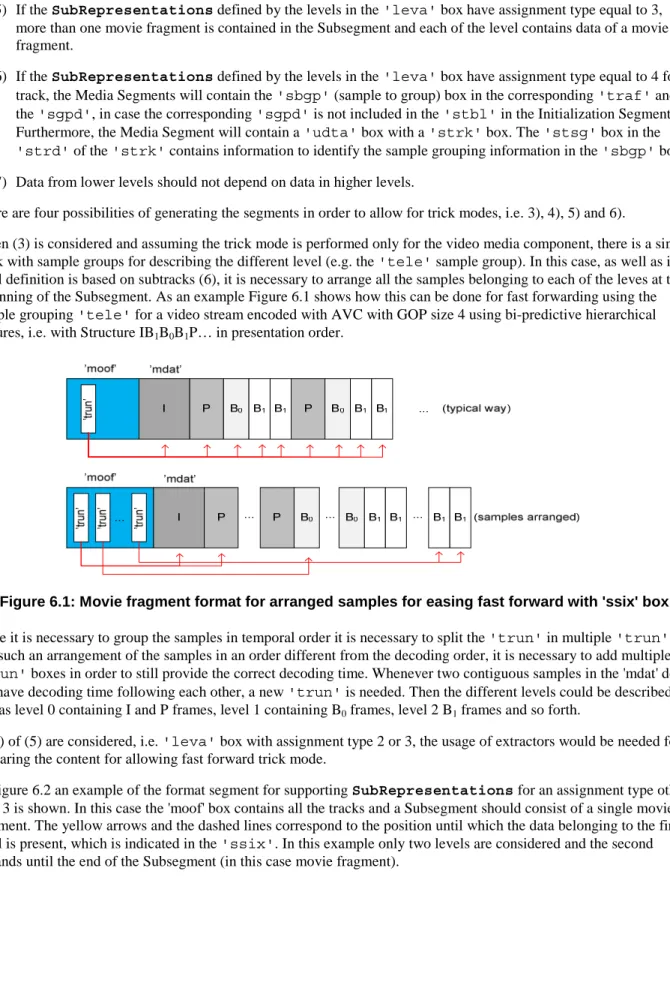
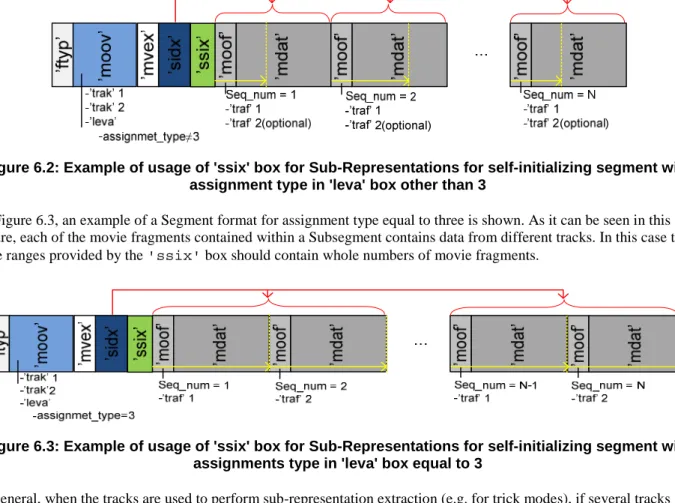
6.5.2.4 Segment generation ... 30
6.5.2.5 Summary ... 32
6.6.1 Use Case Description ... 32
6.6.2 Working Assumption ... 33
6.6.3 Gap Analysis ... 33
6.7 Advanced Support for Live Services ... 33
6.7.1 Description ... 33
6.7.2 Working Assumption ... 33
6.7.3 Gap Analysis ... 33
6.8 Consistent QoE/QoS for DASH users ... 34
6.8.1 Description ... 34
6.8.2 Proposed Work ... 34
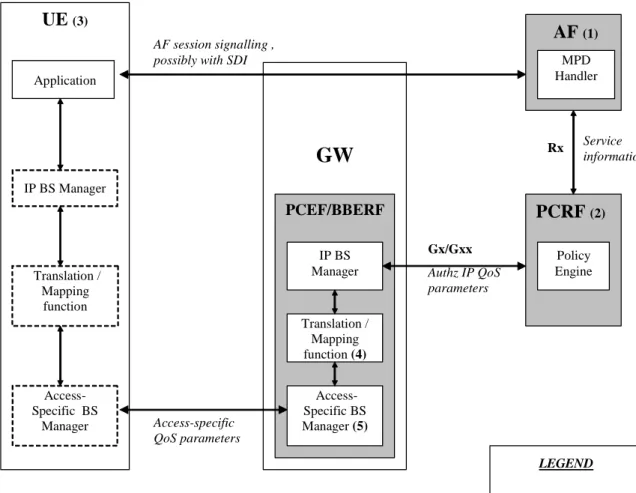
6.8.3 Utilization of QoS Information in DASH ... 34
6.9 DASH as download format ... 36
6.9.1 Description ... 36
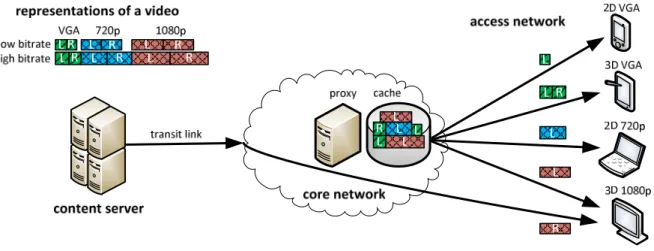
6.10 Use Case: Use case description for Efficiency of HTTP-caching infrastructure on DASH ... 38
6.10.1 Description ... 38
6.11 Use Case: Multiple Spectator Views offered with DASH ... 40
6.11.1 Description ... 40
6.11.2 Gap Analysis ... 40
6.11.2.1 File support for timed position/location ... 40
6.11.2.2 MPD indication of position/orientation for a Representation or Segment ... 42
6.11.2.3 Synchronization of media content from different devices ... 43
6.11.2.4 MPD indication of key highlights of the event ... 43
6.11.2.5 MPD indication of capturing parameters ... 43
6.12 Use cases for operator control of video streaming services ... 44
6.12.1 Introduction... 44
6.12.2 Description ... 44
6.12.2.1 Operator control of video services ... 44
6.12.2.2 Operator control using mobile network subscription ... 44
6.12.2.3 Operator management of video streaming service over the radio network ... 44
6.12.3 Working assumptions ... 44
6.12.4 Conclusions and Gap Analysis ... 45
6.13 Use Cases for DASH Operation with Network Proxy Caches ... 45
6.13.1 Introduction... 45
6.13.2 Use Case Description ... 45
6.13.2.1 Use Case 1: Fast Startup ... 45
6.13.2.2 Use Case 2: Partial Representation Caching ... 46
6.13.2.3 Use Case 3: Network mobility ... 46
6.13.2.4 Use Case 4: Mobility and Coverage Extension for MBMS-based service ... 46
6.13.3 Solution Analysis: Usage of TS 26.247 ... 46
6.13.3.1 MPD Update ... 46
6.13.3.2 Redirections ... 47
6.13.3.3 Bandwidth Throttling ... 48
6.13.3.4 Control Events ... 49
6.13.3 Gap Analysis and Problem Statement ... 50
6.14 Services with caching of DASH content at UE functions ... 51
6.14.1 Use Case Description ... 51
6.14.1.1 Use case 1: HTTP Proxy Cache in UE for transparent reception of DASH content over unicast or broadcast ... 51
6.14.1.2 Use case 2: HTTP Proxy Cache in a home GW (gateway), capable of serving multiple DASH players in the home ... 51
6.14.1.3 Use case 3: Pre-Caching on UE ... 51
6.14.2 Working assumptions ... 52
6.14.3 Gap Analysis ... 52
6.14.4 Recommended Requirements ... 52
6.15 Handling special content ... 53
6.15.1 Description ... 53
6.15.1.1 Enabling users to skip some repetitive/low importance content ... 53
6.15.1.2 Preventing users from skipping special content ... 53
6.15.1.3 Network/Content provider control of special content ... 53
6.15.2 Working assumptions ... 53
6.15.3 Analysis against TS 26.247: Dynamic Services ... 53
6.15.3.2 Tools and Evidence ... 54
6.15.3.3 Just-in-Time Content Insertion... 54
6.15.3.4 Client Behaviour ... 55
6.15.3.5 More complex rules... 55
6.15.3.6 Addressing the Use Cases ... 55
6.15.3.6.1 Repetitive Content ... 55
6.15.3.6.2 Forced Play-out ... 55
6.15.3.6.3 Flexible Ad Insertion ... 56
6.15.3.4 Gap Analysis and Recommendations ... 58
6.16 Use Cases on DASH Authentication ... 58
6.16.1 Use Case 1 ... 58
6.16.2 Use Case 2 ... 58
6.16.3 Use Case 3 ... 59
6.16.4 Use Case 4 ... 59
6.16.5 Use Case 5 ... 59
6.16.6 Gap Analysis on the Use Cases ... 59
6.16.6.1 Analysis of Use Cases 1-3 on content access authorization ... 59
6.16.6.2 Analysis of Use Cases 4-5 on application-level content/metadata integrity validation: ... 60
6.17 Consistent Quality for DASH users... 60
6.17.1 Use Case Description ... 60
6.17.2 Gap Analysis ... 60
6.17.3 Overview of Potential Solution Space ... 61
6.17.4 Additional Simulation Results on DASH over GBR and Non-GBR bearers ... 62
7 Advertisement Insertion Use Cases ... 64
7.1 Introduction ... 64
7.2 Use Cases ... 64
7.2.1 Use Case 1: Fixed duration advertisement in On-Demand Content ... 64
7.2.2 Use Case 2: Variable duration advertisement in On-Demand Content ... 65
7.2.3 Use Case 3: Trusted Client Playback ... 65
7.2.4 Use Case 4: Advertisement in Live Content ... 65
7.2.5 Use Case 5: Accessing Live Content ... 65
7.3 Working Assumptions ... 65
7.3.1 Introduction... 65
7.3.2 Generic assumptions ... 65
7.3.3 Single Media Presentation ... 66
7.3.4 Presentation Layer controlled Ad Insertion ... 66
7.4 Analysis in the Context of TS 26.247... 66
7.4.1 Single Media Presentation ... 66
7.4.2 Presentation Layer controlled Ad Insertion Analysis ... 71
7.4 Examples ... 73
7.4.1 Fixed Duration in On-Demand ... 73
7.4.2 Targeted Advertisements ... 73
7.4.3 Example call for Ad insertion for DASH ... 75
7.6 Advanced Advertisement insertion in the operator network ... 76
7.6.1 Description ... 76
7.6.1.1 Advertisement insertion based on user subscription ... 76
7.6.1.2 Targeted advertisement insertion ... 76
7.6.1.3 Bandwidth-related advertisement/message ... 76
7.6.2 Working assumptions ... 76
7.6.3 Solution based on TS 26.247 and Gap Analysis ... 76
8
Conclusions and Recommendations ... 77
Annex A:
Detailed Performance Evaluation Results on Quality-Driven Rate Adaptation
Algorithms ... 79
A.1 Introduction
... 79
A.2 Simulation
Setup
... 79
A.3 Content
Preparation
... 80
A.4 DASH Rate Adaptation Algorithms ... 82
A.4.2 Adaptation based on per-segment bitrate and quality information (Quality-based) ... 83
A.4.3 Bandwidth Model ... 84
A.4.4 Experimental Results ... 85
Annex B:
Evaluation of QoS-Driven DASH Client Adaptation ... 88
Annex C:
Change history ... 98
Foreword
This Technical Report has been produced by the 3rd Generation Partnership Project (3GPP).
The contents of the present document are subject to continuing work within the TSG and may change following formal TSG approval. Should the TSG modify the contents of the present document, it will be re-released by the TSG with an identifying change of release date and an increase in version number as follows:
Version x.y.z where:
x the first digit:
1 presented to TSG for information; 2 presented to TSG for approval;
3 or greater indicates TSG approved document under change control.
y the second digit is incremented for all changes of substance, i.e. technical enhancements, corrections, updates, etc.
z the third digit is incremented when editorial only changes have been incorporated in the document.
Introduction
3GPP's Dynamic Adaptive Streaming over HTTP (DASH) specifications were developed in Rel-9 and Rel-10 and are available in TS 26.247 [2]. Despite being integrated into the PSS architecture, the specifications have significant flexibility for deployments also outside the 3GPP services. This has been recognized by other organizations such as MPEG and Open IPTV Forum. In continuous alignment efforts, 3GPP and MPEG have developed a generic format for Dynamic Adaptive Streaming over HTTP (DASH).
These specifications serve an urgent need: With the evolution of radio access technologies towards HSPA & LTE higher data rates are provided allowing more feature rich services with higher quality and access to multimedia services has grown significantly. And the most popular multimedia services today are services delivered over HTTP. Serving content from standard HTTP-servers has many advantages in terms of deployment costs and convergences with regular web services.
With the completion of the specifications, first deployments of services based on DASH and similar technologies are happening. The experiences from initial deployments of massively scalable video streaming delivery over HTTP and advanced radio access technologies result in new use cases, demands and requirements. Improvements for the support of DASH when delivered over 3GPP networks and architectures are expected to be necessary and deployments guidelines are important. Considered improvements are in the area of improved user experience, improved bandwidth efficiency or more efficient delivery over HTTP-caching infrastructures. Furthermore, the combination of DASH with other services and technologies is an ongoing challenge and effort. Not limited to this, but some examples are the delivery of DASH over different 3GPP radio access networks, the combination with presentation technologies such as HTML-5, the support of advanced content protection schemes, or the support for QoS in 3GPP networks.
Service improvements might not require additional TS 26.247 [2] specification work, but do require a detailed analysis of the envisaged use cases, the resulting requirements, the ability to solve these use cases with the existing 3GPP and/or other existing specifications and provide guidelines and deployment examples. The analysis of the use cases may lead to additional specification work, but this should first be identified and justified from the above analysis.
1 Scope
The present document covers- deployment guidelines for DASH in 3GPP networks and architectures,
- use cases for the improved support of DASH in 3GPP networks and architectures as well as requirements to support those use cases,
- recommendations for potentially necessary normative specification work in 3GPP, - recommendations for the documentation of potentially informative guide lining work.
2 References
The following documents contain provisions which, through reference in this text, constitute provisions of the present document.
- References are either specific (identified by date of publication, edition number, version number, etc.) or non-specific.
- For a specific reference, subsequent revisions do not apply.
- For a non-specific reference, the latest version applies. In the case of a reference to a 3GPP document (including a GSM document), a non-specific reference implicitly refers to the latest version of that document in the same Release as the present document.
[1] 3GPP TR 21.905: "Vocabulary for 3GPP Specifications".
[2] 3GPP TS 26.247: "Transparent end-to-end Packet-switched Streaming Service (PSS); Progressive Download and Dynamic Adaptive Streaming over HTTP (3GP-DASH)".
[3] 3GPP TS 26.234: "Transparent end-to-end packet switched streaming service (PSS); Protocols and codecs".
[4] 3GPP TS 26.346: "Multimedia Broadcast/Multicast Service (MBMS); Protocols and codecs". [5] 3GPP TS 26.244: "Transparent end-to-end packet switched streaming service (PSS); 3GPP file
format (3GP)".
[6] IETF RFC 2616: "Hypertext Transfer Protocol – HTTP/1.1", Fielding R. et al., June 1999. [7] ISO/IEC 14496-12 | 15444-12:2012 "Information technology – Coding of audio-visual objects –
Part 12: ISO base media file format" | "Information technology – JPEG 2000 image coding system – Part 12: ISO base media file format".
[8] IETF RFC 6726 (November 2012): "FLUTE - File Delivery over Unidirectional Transport", T. Paila, M. Luby, R. Lehtonen, V. Roca, R. Walsh.
[9] ISO/IEC 23009-1:2012/Cor1:2013 " Information technology -- Dynamic adaptive streaming over HTTP (DASH) -- Part 1: Media presentation description and segment formats".
[10] ISO/IEC 23009-3:2013 "Information technology -- Dynamic adaptive streaming over HTTP (DASH) -- Part 3: Implementation and Deployment Guidelines".
[11] ISO/IEC 23009-2:2013 " Information technology -- Dynamic adaptive streaming over HTTP (DASH) -- Part 2: Conformance and Reference Software".
[12] W3C Working Draft, "XMLHttpRequest", January 30, 2014. [13] (void)
[14] ITU-R Recommendation BT.500-11: "Methodology for the Subjective Assessment of the Quality of Television Pictures", 2002.
[15] 3GPP TS 23.203: "Policy and Charging Control Architecture".
[16] 3GPP TS 23.207: "End-to-End Quality of Service (QoS) Concept and Architecture".
[17] 3GPP TS 29.213: "Policy and charging control signalling flows and Quality of Service (QoS) parameter mapping"
[18] 3GPP TS 29.214: "Policy and charging control over Rx reference point"
[19] 3GPP TS 23.401: "General Packet Radio Service (GPRS) enhancements for Evolved Universal Terrestrial Radio Access Network (E-UTRAN) access"
[20] 3GPP TS 33.220: "Generic Authentication Architecture (GAA); Generic Bootstrapping Architecture (GBA)"
[21] 3GPP TR 36.814: "Further advancements for E-UTRA physical layer aspects".
[22] ISO/IEC 23009-1:2014: "Information technology -- Dynamic adaptive streaming over HTTP (DASH) -- Part 1: Media presentation description and segment formats".
[23] 3GPP TR 23.705: "System Enhancements for User Plane Congestion Management". [24] 3GPP TS 23.228: "IP Multimedia Subsystem (IMS); Stage 2".
[25] IAB VMAP: "Digital Video Multiple Ad Playlist (VMAP) 1.0", July 2012, www.IAB.net. [26] SCTE 35: "Digital Program Insertion Cueing Message for Cable", 2013, http://www.scte.org [27] IAB VAST: "Digital Video Ad Serving Template (VAST) 3.0", July,2012, www.IAB.net. [28] ISO/IEC 23001-10:2014 "Information technology – MPEG systems technologies --
Part 10: Carriage of Timed Metadata Metrics of Media in ISO Base Media File Format". [29] IETF RFC 4337: "MIME Type Registration for MPEG-4," March 2006.
[30] IETF RFC 6381: "The 'Codecs' and 'Profiles' Parameters for "Bucket" Media Types," August 2011.
[31] IETF RFC 6265: "HTTP State Management Mechanism". [32] IETF RFC 2109: "HTTP State Management Mechanism".
[33] Recommendation ITU-T P.1202.1: "Parametric non-intrusive bitstream assessment of video media streaming quality - Lower resolution application area".
[34] ISO/IEC 23001-9: " Information technology -- MPEG systems technologies -- Part 9: Common encryption of MPEG-2 transport streams".
[35] IETF RFC 5681: "TCP Congestion Control".
[36] Recommendation ITU-T J.181: "Digital program insertion cueing message for cable television systems".
3 Definitions
and
abbreviations
3.1 Definitions
For the purposes of the present document, the terms and definitions given in TR 21.905 [x] and the following apply. A term defined in the present document takes precedence over the definition of the same term, if any, in TR 21.905 [1].
digital zoom: number indicating the enlargement scale factor of the image due to cropping and interpolating the pixel
dimensions back to the original size.
latitude: number indicating the latitude in degrees. Negative values represent southern latitude. longitude: number indicating the longitude in degrees. Negative values represent western longitude. optical zoom: number indicating the optical magnification scale factor.
pan: number measured in degrees and corresponding to the compass direction of the component in the plane parallel to
the earth's surface of any vector which points in the same direction that the camera is facing. For example, North corresponds to 0 degrees, East corresponds to 90 degrees, etc. If the camera is pointing in a direction perpendicular to the earth's surface (either straight up at the sky or straight down at the ground), then the value of Pan is undefined. For the direction corresponding to Pan, it is useful to have an indication of whether the direction is "true" or "magnetic".
rotation: number measured in degrees corresponding to the rotational position about the axis in the direction that the
camera is facing. Since Tilt and Rotation are independent parameters, Rotation is defined for a Tilt value of 0, i.e. the camera is first tilted to be pointing parallel to the earth's surface in the direction that would correspond to Pan. Rotation is then the amount of counter-clockwise rotation about the axis that the camera is facing needed to bring a vector initially pointing straight up towards the sky into alignment with the camera "up" direction. In the event that Pan is undefined as the camera is either pointing straight up or straight down, Rotation can be defined as the amount of rotation needed to bring a vector initially pointing North into alignment with the camera "up" direction.
tilt: number measured in degrees corresponding to the rotational position about the axis in the plane of constant
amplitude through the camera centre that is perpendicular to the Pan direction. For example, if the camera is pointing parallel to the earth's surface, Tilt is 0. If the camera is pointing straight up towards the sky, the Tilt is 90 degrees and if the camera is pointing straight down towards the earth Tilt is -90 degrees.
3.2 Abbreviations
For the purposes of the present document, the abbreviations given in TR 21.905 [1] and the following apply. An abbreviation defined in the present document takes precedence over the definition of the same abbreviation, if any, in TR 21.905 [1].
3GP 3GPP file format
3GP-DASH 3GPP Dynamic Adaptive Streaming over HTTP
ACDC Application specific Congestion control for Data Communication
AHS Adaptive HTTP Streaming
AJAX Asynchronous JavaScript and XML
AVC Advanced Video Coding
AVP Attribute-Value Pairs
BMW Bayerische Motoren Werke CAS Conditional Access System CBP Constrained Baseline Profile CDN Content Delivery Network CoD Content-on-Demand
DASH Dynamic Adaptive Streaming over HTTP (DASH)
DRM Digital Rights Management
DVD Digital Versatile Disc
FLUTE File Delivery over Unidirectional Transport
GPS Global Positioning System
HD High Definition
HTML Hypertext Markup Language
HTTP Hypertext Transfer Protocol HTTPS Hypertext Transfer Protocol Secure MPD Media Presentation Description
MOS Mean Opinion Score
MSS Maximum Segment Size
MS-SSIM Multi-Scale Structural SIMilarity
P-GW PDN Gateway
PDN Packet Data Network
PSS Packet-switched Streaming Service QoE Quality-of-Experience QoS Quality-of-Service
RAT Radio Access Technology
RTT Round-Trip Time
SAP Stream Access Point
SSIM Structural SIMilarity
TCP/IP Transmission Control Protocol / Internet Protocol TV TeleVision
UE User Equipment
UPCON User Plan Congestion control URI Uniform Resource Identifier
URL Uniform Resource Locator
URN Uniform Resource Name
UTC Coordinated Universal Time
VBR Variable Bit Rate
VGA Video Graphics Array
VoD Video-on-Demand WLAN Wireless Local Access Network WQVGA Wide Quarter Video Graphics Array WVGA Wide Video Graphics Array
XML EXtended Markup Language
4 Relevant
Specifications
4.1 Overview
MPEG had initiated a standardization process to provide specifications to enable scalable and flexible video distribution that addresses fixed and mobile networks. The work had been in close coordination with a parallel effort in 3GPP such that the two standards are aligned for broad industry support across different access networks. 3GPP's Release-9 specification on Adaptive HTTP Streaming (AHS) [3], section 12 completed in 2010 served as a baseline for MPEG's DASH [9] (MPEG-DASH) as well as for 3GPP's Release 10's DASH specification [2] (3GP-DASH).
In addition to the format specification, MPEG provides additional specifications as part of MPEG-DASH, namely: - ISO/IEC 23009-2: Conformance and Reference software [11]
- ISO/IEC 23009-3: Implementation and Deployment Guidelines [10]
Due to the close coordination in the development of 3GP-DASH it is achieved that 3GPP Release 10 DASH can be viewed as a profile of MPEG-DASH with minor extensions. Clause 5.2 provides a description on how 3GP-DASH may be represented as a profile of MPEG-DASH. Beyond the formats defined in both specifications, 3GP-DASH also defines the transport protocol when deployed within PSS as being HTTP [6]. Furthermore, 3GPP also supports the delivery of DASH formats within MBMS [4] using FLUTE [8] as the delivery protocol.
Both specifications rely for the segment formats on the ISO base media file format [7]. In 3GPP, compatibility is achieved with the 3GPP file format [5].
In addition, during 2012 and 2013 MPEG has conducted work on a second edition of DASH [22] that includes additional technologies. These technologies are currently not part of 3GP-DASH, but some the technologies are discussed in the present document as they may serve as a candidate technology to fulfil advanced use cases.
4.2
3GP-DASH as a profile of MPEG-DASH
4.2.1 General
The 3GP-DASH Release-10 profile as defined in TS 26.247 [2], section 7.3.3 and identified by the URN "urn:3GPP:PSS:profile:DASH10" may be described as an MPEG-DASH profile as follows: The 3GP-DASH Release-10 profile is identified by the URN "urn:3GPP:PSS:profile:DASH10".
The @mimeType attribute of each Representation is expected to be provided according to RFC 4337 [29]. Additional parameters may be added according to RFC 6381 [30].
4.2.2 Media
Codecs
For the 3GP-DASH Release-10 profile clients supporting a particular continuous media type, the corresponding media decoders are specified in TS 26.234 [3], clause 7.2 for speech, clause 7.3 for audio, clause 7.4 for video, clause 7.9 for timed text and clause 11 for timed graphics.
4.2.3
Media Presentation Description constraints
The Media Presentation Description are expected to conform to the following constraints:
- The rules for the MPD and the segments as defined in ISO/IEC 23001-9 [34], section 7.3, apply.
- Representations with value of the @mimeType attribute other than video/mp4, video/3gp, audio/3gp or audio/mp4 may be ignored. Additional profile or codec specific parameters may be added to the value of the MIME type attribute. For details refer to specific parameters below.
- The Subset element may be ignored.
- Any SegmentBase, SegmentTemplate or SegmentList element that contain a SegmentTimeline element may be ignored.
- Any Representation that contains a FramePacking element may be ignored.
- Any Representation that contains an @scanType attribute with value other than "progressive" may be ignored.
4.2.4
Segment format constraints
Representations and Segments referred to by the Representations in the profile-specific MPD for this profile, the following constraints are expected to be met:
- Representations are expected to comply with the formats defined in clause 7.3 in ISO/IEC 23009-1.
- Representations are expected to comply with a 3GP file format profile in a sense that the profile parameter of the @mimeType attribute will contain the '3gh9' brand.
4.2.5 Extensions
4.2.5.1
Media Presentation Description Delta
If the x3gpp:DeltaSupport element is present in the MPD element, the content provider indicates that MPD delta files, as defined in this clause, are supported on the server. The URI of the MPD delta is provided in
x3gpp:DeltaSupport@sourceURL. The x3gpp:DeltaSupport@availabilityDuration element, if present, indicates that the MPD delta file referenced by the URI is available for at least the value of the
@availabilityDuration attribute (after this time, the server may redirect the client to the full MPD). If x3gpp:DeltaSupport@availabilityDuration is not present, then no information is conveyed about the availability of the MPD delta. If a client request for an MPD delta file results in an error, the client should request a full MPD.
The semantics of the attributes within the x3gpp:DeltaSupport element are provided in Table 4.1. The XML-syntax of x3gpp:DeltaSupport element is provided in Table 4.2.
Table 4.1: Semantics of x3gpp:DeltaSupport element
Element or Attribute Name Use Description
x3gpp:DeltaSupport If present, this element indicates that MPD delta files are supported by the server.
@sourceURL M The source string providing the URL of the MPD delta. The
URL may be relative to any BaseURL on MPD level and reference resolution according to clause 8.2.3 of TS26.247 [2] will be applied.
@availabilityDuration O When provided, indicates the duration that the server guarantees the availability of the MPD delta file referenced in @sourceURL after the MPD has been updated. After that the client may be redirected to the full MPD.
Legend:
For attributes: M=Mandatory, O=Optional, OD=Optional with Default Value, CM=Conditionally Mandatory. For elements: <minOccurs>...<maxOccurs> (N=unbounded)
Elements are bold; attributes are non-bold and preceded with an @.
Table 4.2: XML-Syntax of x3gpp:DeltaSupport element <!--DeltaSupport for the MPD -->
<xs:complexType name="DeltaSupportType">
<xs:sequence>
<xs:any namespace="##other" processContents="lax" minOccurs="0" maxOccurs="unbounded"/>
</xs:sequence>
<xs:attribute name="sourceURL" type="xs:anyURI" use="required"/>
<xs:attribute name="availabilityDuration" type="xs:duration"/>
<xs:anyAttribute namespace="##other" processContents="lax"/>
</xs:complexType>
An MPD delta is a text file that includes the delta between the MPD that references it and the latest provided MPD. Note that the value of @sourceURL in successive MPDs is necessarily different because it is impossible for the delta between two different MPDs and the most recent MPD to be the same.
The output format consists of one or more structures, each corresponding to a change. The changes are in decreasing line number order. The structure format looks like:
change-command to-file-line to-file-line... .
There are three types of change commands change-command. Each consists of a line number or comma-separated range of lines in the first file and a single character indicating the kind of change to make. All line numbers are the original line numbers in the file. The types of change commands and the instructions are provided in Table 4.3.
Table 4.3: Change commands and the instructions for delta MPD files Change
command
Instruction Example
la Add text from the second file after line l in the first file. '8a' means to add the following lines after line 8 of file 1
rc Replace the lines in range r in the first file with the following lines. Like a combined add and delete, but more compact.
'5,7c' means change lines 5–7 of file 1 to read as the text file 2.
rd Delete the lines in range r from the first file. '5,7d' means delete lines 5–7 of file 1. NOTE: This is the format supported by the GNU diff utilities, see
http://www.gnu.org/software/diffutils/manual/#Detailed-ed
Regardless of the presence of a x3gpp:DeltaSupport element, the full MPD will always be available to clients for regular MPD updates. MPD Delta related procedures are optional at the client.
5 Deployment
Guidelines
5.1 Introduction
Deployment guidelines include:- instructions on how content may be offered using the DASH formants, - instructions on relevant client implementation and operation aspects, - operational guidelines on how operate a DASH-based service.
5.2
Content Authoring Guidelines
For generic content authoring guidelines please refer to ISO/IEC 23009-3 [10]. In order to address 3GPP-specific aspects the capabilities of 3GPP PSS codecs as well as bitrates mapped to typical 3GPP networks should be considered.
5.3
Client implementation and client operation guidelines
5.3.1
Guidelines for rate adaptation
5.3.1.1 Introduction
DASH merely specifies the formats for Media Presentation Description (MPD) and media segments, while client operations, such as rate adaptation algorithms, are not specified. The operation of the rate adaptation algorithm might affect the perceived presentation quality as media segments from different representations within one Adaptation Set could be selected to present the same media content component. The perceived quality might be affected by the bitrate of the selected media rate as well as potentially experienced interruptions from buffer underruns due to non-timely arrival of the media segments.
5.3.1.2
Rate adaptation in DASH
When designing rate adaptation algorithm for DASH, one should consider among others:
- that the rate adaptation algorithm is efficiently utilizing the sharable network capacities, which affects playback media quality,
- that the rate adaptation algorithm is capable of detecting network congestion and is able to react promptly to prevent playback interruption,
- that the rate adaptation algorithm can provide stable playback quality even if the network delivery capacities fluctuate widely and frequently,
- that the rate adaptation algorithm is able to tradeoff maximum instantaneous quality and smooth continuous quality, for example by smoothing short-term fluctuation in the network delivery capacities by using buffering, but still switch to better presentation quality/higher bitrates if more long-term bandwidth increase is observed, - that the rate adaptation algorithm is able to avoid excessive bandwidth consumption due to over-buffering media
data.
When implementing rate adaptation in DASH, one could balance between different criteria listed above to improve the overall Quality of Experience (QoE) perceived by the user. The guideline of rate adaptation in DASH is summarized based on the QoE metrics specified in 3GPP TS 26.247 [2].
In absence of other information, e.g. from the radio network status, the measurement for certain QoE metrics may be used in rate adaptation in DASH, e.g.:
- average throughput: average throughput measured by a client in a certain measurement interval;
- Segment Fetch Time (SFT) ratio: the ratio of Media Segment Duration (MSD) divided by SFT. MSD and SFT denote the media playback time contained the media segment and the period of time from the time instant of sending a HTTP GET request for the media segment to the instant of receiving the last bit of the requested media segment, respectively;
- buffer level: buffered media time at a client.
In conjunction with rate adaptation, client implementations can include a request cancellation functionality in order to address stalled or expiring HTTP requests, i.e. if the client identifies that the requested segment/subsegment cannot be received in time., or the case that the data is no longer needed due to user interaction. This is relevant to avoid buffer under-runs and to be reactive to user interactions. However, cancelling an HTTP request does have a disadvantage, as this typically requires tearing down and re-establishing a TCP connection. This should be taken into account before cancelling a TCP connection. Any improvements to support HTTP request cancellation may be suitable.
For improving throughput especially during media startup, HTTP pipelining as defined in RFC 2616 [6] may be used by the client. HTTP servers used for DASH distribution preferably support HTTP pipelining.
Further rate adaptation enhancements based on the availability of quality and QoS information are discussed in clauses 6.8 and 6.17.
5.4
Operational and deployment guidelines
5.4.1 General
For general operational and deployment guidelines see ISO/IEC 23009-3 [10].
As access bandwidth on 3GPP networks is typically shared among many users and is precious, DASH clients are recommended avoiding excessive download of non-consumed data as well as downloading data that is unsuitable for the consumption. DASH clients are recommended avoiding building large download buffers, for example in the range of several minutes, as user may decide to terminate the viewing or apply fast forwards and so on. In addition a DASH client is recommended avoiding downloading Representations that it is not expected to consume, for example alternate languages etc. Furthermore, DASH clients are recommended not downloading Representations for which no quality gains are obvious under the current consumption model. For example, DASH clients are recommended avoiding downloading full resolution video if video is only played as a thumbnail in an application.
Content authoring is recommended to be such that downloading of unnecessary data can be avoided, for example by not multiplexing multiple languages into a single Representation.
5.4.2
Proxy/cache switch for DASH service
5.4.2.1 Assumptions
It is assumed that many HTTP proxy/cache that also support DASH are physically located at or close to different P-GWs or for different RATs, can be deployed within the operator domain.
5.4.2.2 Description
Operator A owns both LTE and WLAN networks and proxy caches are provided for both LTE and WLAN network. Robert accesses a DASH service over an LTE network of operator A. A proxy cache is placed inside the LTE network to reduce latency and scalability in order to optimize HTTP delivery over TCP/IP. Robert enters the office covered by the WLAN network also owned by operator A. The operator A knows LTE traffic surging in the office area and the WLAN network is available for traffic offloading. Robert's UE switches to WLAN for the DASH service. The content is served from another proxy cache within the WLAN network as the proxy cache physically close to the UE and therefore provides higher TCP/IP throughput due to reduced latency.
NOTE: It is assumed that mobility events may cause a change in proxy cache.
5.4.2.3 Working
assumption
DASH client may be served by another proxy cache after a mobility event occurs
5.4.2.4 Recommended
Requirements
A change in proxy cache should have minimum impact on the user experience of the DASH service.
6
General Use Cases
6.1 Introduction
This clause introduces use cases that are either supported by 3GP-DASH [2], possibly in combination with other 3GPP technologies, or the use cases are in the context of DASH, but may require extensions in 3GP-DASH or other
technologies. Therefore, the use cases are analysed, potential solutions reusing existing technologies are provided and potential gaps are identified.
6.2
Advanced Support for Live Services
6.2.1 Description
6.2.1.1 Setup
A service provider wants to provide a live soccer event using DASH that can potentially be accessed by millions of users. The service provider provides redundant infrastructure in terms of encoders and servers to enable a seamless switch-over in case any of the components fail during the live event or get overloaded.
6.2.1.2
Use Case A: Start-up latency
Anna accesses the service in the bus with her mobile DASH-enabled device, and the service is available immediately.
6.2.1.3
Use Case B: Aligned Presentation
Continuing Use Case A, across from her sits Paul, who watches the event on his DASH-enabled laptop. A goal is scored and both, despite watching on different screens, celebrate this event at the same time.
6.2.1.4
Use Case C: End-to-end latency
Continuing Use Case B, other people that follow the game on a 3GPP Rel-6 PSS terminal observe the goal within a similar time.
6.2.1.5
Use Case D: Time-Shift Buffer
Continuing Use Case C, Another goal is scored. Paul tells Anna that the first goal in the game was even more exciting and Anna uses the offering that she can view the event 30 minutes back in time on her DASH-enabled device. After having seen the goal she goes back to the live event.
6.2.1.6
Use Case E: Infrastructure Upgrade
Continuing Use Case D, the football match gets into overtime, the star player of CF Anolacrab, Lenoil Issem, is brought into the game by the coach of the year, Aloidraug, hits twice the post, but cannot score. Due to the extraordinary tension in the match, more and more users join such that the service provider requires migrating the service to the redundant infrastructure without interrupting the service to the users.
6.2.1.7
Use Case F: Ad Insertion
Continuing Use Case E, finally penalty shooting is necessary. The live event is interrupted by a short break during which advertisement is added. The exact timing of the ad breaks is unknown due to the extra time of the extension and the start of the penalty shooting is delayed.
6.2.2
Operation with MPD dynamic Mode
6.2.2.1 Introduction
This section provides an overview on using the MPD dynamic mode and how a client can make use of MPD offerings. The focus is on the client operation here. Details on a possible service offering to fulfil the use cases in clause 6.2.1 is provided in clause 6.2.3.
6.2.2.2 Problem
Statement
Generally, an HTTP streaming client accesses and downloads a manifest, based on which it would like to initiate the live session. Based on this manifest, and for each selected Representation, the client needs to take several decisions:
1) Determine what is the latest segment that is available on server.
2) Determine the segment availability start time of the next segment and possibly future segments.
3) Determine when to start playout the segment and from which presentation timeline in the segment in order to be as close as possible to the live edge.
4) Determine when to check for an updated manifest.
6.2.2.3 Existing
Technologies
In existing non-DASH streaming technologies these issues are solved as follows: - for each segment that is made available, the server publishes a new manifest;
- the client, once joining the service, gets the latest manifest, looks at the playlist and then can access the latest segment;
- the client starts playing out the segment and expects, when playing the segment from the beginning, that it can continue accessing the next segment in time;
- before fetching a new segment (or requiring to fetch one), the client fetches a new manifest providing the location where to get the latest segment.
6.2.2.4
Consequences with Existing Technologies
The following consequences result from this basic live operation as documented in clause 6.2.2.3: - The manifest is updated on the server with each newly available segment:
- This requires the client to fetch the manifest and use the information in the manifest whenever they join, i.e. joining means manifest fetching and the manifest needs to be the latest.
- This requires that the server needs to update the manifest to accommodate the change whenever a new Segment if produced. The manifest renewal is especially critical in cases where the manifest is distributed through FLUTE [8] or needs to be pushed into caches. In this case along with each new segment, a new manifest needs to be pushed.
- The client does not have any insight at what time the next segment is available/published on the server: - It will expect that the next segment is published, at the latest, after segment duration time. This can be verified
by updating the manifest prior to fetching a new segment.
- The client does not have any insight if any presentation time later than the earliest presentation time of the latest available segment can be played out in order to get closer to the live edge without a risk of rebuffering later:
- As a fact of the loose timing model, and the client not knowing when the next segment becomes available, it can only assume that the earliest presentation time can played.
- The client does not have any insight if playout of other clients that download the same segment is synchronized.
- The client needs to fetch a new manifest when joining the service to obtain the latest information. This "fetching" requires at least one manifest fetch round-trip time and may increase start-up.
In summary, the main reason for all these issues is that existing solutions do not provide a good idea on the exact time schedule of the manifest and media segment creation. As an example, if one operates on 10-second segments, the client has little insight whether the manifest had just been published, or whether it will be published shortly after. So the DASH client may still be off by 10 seconds. In addition, it requires updating the manifest frequently with every segment. No reference clock is available to the client that enables a playout that is closer to the live edge or enables playout synchronized with other clients. At the same time, hiding the publish time from the clients typically provides ensures that the requests for segments from different clients are spread.
6.2.2.5
How does DASH solve this?
6.2.2.5.1 Overview
DASH attempts to address the above-mentioned weaknesses, namely: - to operate closer to the live edge,
- to synchronize playout of clients that are consuming the same media presentation, - to avoid regular updates of the MPD on the server and fetches by the client, and - to avoid fetching the MPD in real-time when joining the service.
DASH uses a wall-clock time documented in the MPD, which sets up the live Media Presentation. DASH assumes that the MPD is generated such that the MPD generation process does have access to an accurate clock. This enables that clients that are synchronized to the wall-clock time by any means can operate closer to the live edge.
6.2.2.5.2
Benefits of this approach
In case the template construction with @duration is used, the above approach provides several advantages compared to existing solutions:
1) The MPD does not have to be updated on the server as long as the segment construction can be continued. As long as the client records the fetch time of the MPD, it can download the MPD ahead of time (or keep it in the buffer) for several different services that are anticipated to be accessed, for example different channels. 2) Also, in a multicast environment, the MPD can be distributed only once or at least with a much smaller
frequency than for every new segment.
3) The client knows exactly the time when the next segment is available/published on the server. This permits operation closer to the live edge as the client can request the segment as soon as it gets available.
4) In order to accurately tune to the live edge, the client may start presentation of the first segment not from the start, but even somewhere in the middle. The exact timing is obtained by mapping the presentation time to the live edge time.
5) The client can synchronize its playout with other clients.
6) Server operation is simple, i.e. no special server beyond HTTP is required.
DASH uses a wall-clock time documented in the MPD, which sets up the live Media Presentation. DASH assumes that the MPD is generated such that the MPD generation process does have access to an accurate clock. This enables that clients that are synchronized to the wall-clock time by any means can operate closer to the live edge.
Specifically, the following information is available in the MPD when using a number-template-based Representations and using the using the @duration attribute:
- MPD@availabilityStartTime: the start time is the anchor for the MPD in wall-clock time. The value is denoted as AST.
- MPD@minimumUpdatePeriod: the minimum update period of the MPD. The value is denoted as MUP. - MPD@suggestedPresentationDelay: suggested presentation delay as delta to segment availability start
time. The value is denoted as SPD.
- MPD@minBufferTime: minimum buffer time, used in conjunction with the @bandwidth attribute of each Representation. The value is denoted as MBT.
- MPD@timeShiftBufferDepth: time shift buffer depth of the media presentation. The value is denoted as TSB.
- Period@start: the start time of the Period relative to the MPD availability start time. The value is denoted as PS.
- SegmentTemplate@startNumber: number of the first segment in the Period. The value is denoted as SSN. - SegmentTemplate@duration: the duration of a segment in units of a time. The value divided by the value
of @timescale is denoted as d.
Also assume that the client did fetch the MPD at fetch time FT. Note that a reasonable estimate on the lower value of FT is the time when the request for then new MPD is issued and for the higher value FT when the MPD is received.
6.2.2.6 MPD
Times
For using the same concept with different addressing schemes, the following two values are introduced according to ISO/IEC 23009-1:
- the position of the segment in the Period denoted as k with k=1,2,... - The MPD start time of the segment at position k, referred to as MST(k). - The MPD duration of a segment at position k, referred to as MD(k).
Assuming now that the wall-clock time at the client is denoted at WT, and then the client can derive the following information:
2. The segment availability start time of any segment at position k within the Period, denoted as SAST(k). 3. The position of the latest segment that is available on server in the Period, referred to as k*
4. The address of the latest segment that is available on server
5. The time when to fetch a new MPD based on the current presentation time, or more specifically, the greatest segment position k' within this Period that can be constructed by this MPD.
6. The media presentation time within the Representation that synchronizes closest to the live edge, MPTL. 7. The media presentation time within the Representation that synchronizes to other clients, MPTS.
6.2.2.7 General
Derivation
Using these times, the values from above can be derived as:
1. The latest Period is obtained as the Period for which AST+PS+MD(1) <= NTP. 2. The segment availability start time is obtained as:
SAST(k) = AST + PS + MST(k) + MD(k)
Specifically, For the number-based template with d the value for the @duration attribute and SSN the value of the @startNumber attribute this results in:
SAST(k) = AST + PS + ( k - SSN + 1 ) * d
1. Within this Period the latest segment available on the client is the segment at the position k* which results in the greatest value for SAST(k*) and at the same time is smaller than NTP. For the number based template with d the value for the @duration attribute and SSN the value of the @startNumber attribute this results in:
k* = floor ( (NTP - ( AST + PS ) - d )/ d ) + SSN
2. The address of the latest segment is obtained by using the position information k* and then the segment address can be derived. The segment address depends on the addressing method.
3. Within this Period the greatest segment position k' that can be constructed by this MPD is the one that results in the greatest value for SAST(k') and at the same time is smaller than FT + MUP.
k' = ceil ( FT + MUP - ( AST + PS ) - d )/ d ) + SSN
6.2.2.8
Derivation of MPD Times
If the @duration attribute is present and the value divided by the value of @timescale is denoted as d then the MPD times are derived as:
- MD(k) = d - MST(k) = (k-1)*d
6.2.2.9 Addressing
Methods
6.2.2.9.1 Introduction
The addressing method is independent of the usage of the timeline generation. The interpretation of the @startNumber depends on the addressing method.
6.2.2.9.2 Playlist-Method
If the Representation contains or inherits one or more SegmentList elements, providing a set of explicit URL(s) for Media Segments, then the position of the first segment in the segment list is determined by @startNumber. The segment list then provides the explicit URLs.
6.2.2.9.3 Number-Based
Template
If the Representation contains or inherits a SegmentTemplate element with $Number$ then the URL of the media segment at position k is obtained by replacing the $Number$ identifier by (k-1) + @startNumber in the
SegmentTemplate@media string.
6.2.2.10 Scheduling
Playout
The client schedules the playout based on the available information in the MPD.
The media presentation time in a Period is determined for each Representation as presentation time value in the media segments minus the value of the @presentationTimeOffset, if present, for each Representation.
Each segment at position k has assigned an earliest media presentation time EPT(k). By offering an MPD it is guaranteed that:
1. each segment in this Period is available prior to its earliest presentation time and its duration, i.e. for all k, 2. SAST(k) <= EPT(k) + (AST + PS) + MD(k),
3. If each segment with segment number k is delivered starting at SAST(k) over a constant bitrate channel with bitrate equal to value of the @bandwidth attribute then each presentation time PT is available at the client latest at time PT + (AST + PS) + MBT + MD(k),
4. A recommended playout-time MPTS (PT) for a presentation time when operating in sync with other clients is MPTS(PT) = (AST + PS) + PT + SPD,
5. Each segment in this Period is available at least until SAST(k) + TSB + MD(k).
Using this information, the client can now start scheduling playout taking into account the information in the MPD as well the download speed.
A suitable playout time is POT(PT) = MPTS(PT), if the attribute @suggestedPresentationDelay is present. If not, then a suitable playout time takes into account the first, second and fourth constraints, i.e. the segment availability times at the server as well as the bitrate variation of the media stream.
6.2.2.11
Validity of MPD
The MPD can be used to construct and request segments until media time FT + MUP. The greatest segment position k' that can be constructed by this MPD is the one that results in the greatest value for SAST(k') and at the same time is smaller than FT + MUP. Note that the latest segment may be shorter in duration than the other ones.
6.2.3
Mapping Use Cases to Live Operation
6.2.3.1
Use Case A
6.2.3.1.1 Description
Anna accesses the service in the bus with her mobile DASH-enabled device, and the service is available immediately.
6.2.3.1.2 MPD
example
Below is a snippet of an MPD example. This MPD may have been distributed out-of-band and ahead of time. The DASH client when accessing the service can generally use the MPD to immediately determine the segment information. <MPD availabilityStartTime="2011-12-25T12:30:00" minimumUpdatePeriod="30s" timeShiftBufferDepth="60s" minBufferTime="5s"/> <BaseURL>http://www.example.com/</BaseURL> <Period start="PT0S"/> ...
</Period>
<Period start="PT0.10S> ...
<SegmentTemplate timescale="48000" startNumber="22" presentationTimeOffset="2016000" duration="96000"
initialization="audio/fr/init.mp4a" media="audio/fr/$Number$"/> ...
</Period>
6.2.3.1.3 Client
Procedure
Assume further that the client has fetched the MPD at fetch time FT="2011-12-25T12:30:17" and the wall-clock time is NTP="2011-12-25T12:30:27" the DASH service to be accessed. The latest segment number is:
k* = floor ( (NTP - ( AST + PS ) - d )/ d ) + SSN = floor (15/2) + 22 = 29
The URL for the latest segment is http://www.example.com/audio/fr/29.mp4. The client access the segment and may start playout with the media time PT = (29-22+1)*96000/48000 = 16 at time MPTS(PT) = (AST + PS) + PT + MBT = "2011-12-25T12:30:31", i.e. in 5 seconds. The client may also download earlier segments and may start earlier with the playout process, for example with segment 27.
6.2.3.2
Use Case B
6.2.3.2.1 Description
Continuing Use Case A, across from her sits Paul, who watches the event on his DASH-enabled laptop. A goal is scored and both, despite watching on different screens, celebrate this event at the same time.
6.2.3.2.2 MPD
example
Below is a snippet of an MPD example with the suggested presentation delay added.
<MPD availabilityStartTime="2011-12-25T12:30:00" minimumUpdatePeriod="30s" suggestedPresentationDelay="10s" timeShiftBufferDepth="60s" minBufferTime="5s"/> <BaseURL>http://www.example.com/</BaseURL> <Period start="PT0S"/> ... </Period> <Period start="PT0.10S> ...
<SegmentTemplate timescale="48000" startNumber="22" presentationTimeOffset="2016000" duration="96000"
initialization="audio/fr/init.mp4a" media="audio/fr/$Number$"/> ...
</Period>
6.2.3.2.3 Client
Procedure
The same procedure as in 2.3.1.3 to extract the MPD information is carried out. For synchronized playout, the client accesses the segment and may start playout with the media time PT = (29-22+1)*96000/48000 = 16 at time MPTS(PT) = (AST + PS) + PT + SPD = "2011-12-25T12:30:36", i.e. in 10 seconds. If both clients adhere to the SPD value, synchronized playout can be achieved.
6.2.3.3
Use Case C
6.2.3.3.1 Description
Continuing Use Case B, Other people that follow the game on a 3GPP Rel-6 PSS terminal observe the goal within a similar time.
6.2.3.3.2 MPD
example
The same as in clause 6.3.2.2 applies,6.2.3.3.3 Client
Procedure
The same procedure as in 6.2.1.3 and 6.2.2.3 to extract the MPD information is carried out. However, instead of downloading and playing only segment 29, the client may already download segment 24 or 25 and start playout earlier. While starting playout, the client may gradually fill the buffer with segments up to the segment availability start time.
6.2.3.4
Use Case D
6.2.3.4.1 Description
Continuing Use Case C, Another goal is scored. Paul tells Anna that the first goal in the game was even more exciting and Anna uses the offering that she can view the event 30 minutes back in time on her DASH-enabled device. After having seen the goal she goes back to the live event.
6.2.3.4.2 MPD
example
Below is a snippet of an MPD example with the minimum time shift buffer depth of 1 hour is added.
<MPD availabilityStartTime="2011-12-25T12:30:00" minimumUpdatePeriod="30s" suggestedPresentationDelay="10s" timeShiftBufferDepth="3600s" minBufferTime="5s"/> <BaseURL>http://www.example.com/</BaseURL> <Period start="PT0S"/> ... </Period> <Period start="PT0.10S> ...
<SegmentTemplate timescale="48000" startNumber="22" presentationTimeOffset="2016000" duration="96000"
initialization="audio/fr/init.mp4a" media="audio/fr/$Number$"/> ...
</Period>
6.2.3.4.3 Client
Procedure
The time has moved forward to at NTP="2011-12-25T13:32:57". The operation is based on an MPD that was fetched at time FT="2011-12-25T13:32:32". The client is downloading segment with segment number 1959. The event of the goal happened 30 minutes ago. With the above MPD, the segments are available far into the time-shift buffer of one hour. The client computes the segment with has presentation time roughly 30 minutes back and understands that this 1 059 and starts fetching this to playout the presentation time 30 minutes ago. After watching this for 2 minutes, the user wants to move forward into the future again. Based on an updated MPD (necessary as the live edge is no longer presented in the MPD above, the client can then compute the latest segment at the live edge and perform the same operations as in cases documented in clauses 6.2.1.3, 6.2.2.3 and 6.2.3.3.
6.2.3.5
Use Case E
6.2.3.5.1 Description
Continuing Use Case D, the football match gets into overtime, the star player of CF Anolacrab, Lenoil Issem, is brought into the game by the coach of the year, Aloidraug, hits twice the post, but cannot score. Due to the extraordinary tension in the match, more and more users join such that the service provider requires migrating the service to the redundant infrastructure without interrupting the service to the users.
6.2.3.5.2 MPD
example
<MPD availabilityStartTime="2011-12-25T12:30:00" minimumUpdatePeriod="30s" suggestedPresentationDelay="10s" timeShiftBufferDepth="3600s" minBufferTime="5s"/> <BaseURL>http://www.example.com/</BaseURL> <BaseURL>http://www.example-massive-scalable.com/</BaseURL> <Period start="PT0S"/> ... </Period> <Period start="PT0.10S> ...
<SegmentTemplate timescale="48000" startNumber="22" presentationTimeOffset="2016000" duration="96000"
initialization="audio/fr/init.mp4a" media="audio/fr/$Number$"/> ...
</Period>
6.2.3.5.3 Client
Procedure
Clients updating the MPD may observe that a new server location is available. Based on poorer download experience with the original server location, the clients are expected to probe the new server location and when observing better download experience, they are expected to use this new server location and move away from the old one.
6.2.3.6
Use Case F
6.2.3.6.1 Description
Continuing Use Case E, finally penalty shooting is necessary. The live event is interrupted by a short break during which advertisement is added. The exact timing of the ad breaks is unknown due to the extra time of the extension and the start of the penalty shooting is delayed.
6.2.3.6.2 MPD
example
Below is a snippet of an MPD example with a new Period added for ad insertion and then the live program is continued. <MPD availabilityStartTime="2011-12-25T12:30:00" minimumUpdatePeriod="30s" suggestedPresentationDelay="10s" timeShiftBufferDepth="3600s" minBufferTime="5s"/> <BaseURL>http://www.example.com/</BaseURL> <BaseURL>http://www.example-massive-scalable.com/</BaseURL> <Period start="PT0S"/> ... </Period> <Period start="PT0.10S> ...
<SegmentTemplate timescale="48000" startNumber="22" presentationTimeOffset="2016000" duration="96000"
initialization="audio/fr/init.mp4a" media="audio/fr/$Number$"/> ...
</Period>
<Period start="PT1H.45M.15S"> ...
<SegmentTemplate timescale="44100" duration="44100" initialization="http://adserver.com/audio/fr/init.mp4a" media="http://adserver.com/audio/fr/audio/fr/$Number$"/> ... </Period> <Period start="PT1H.46M.10S"> ...
<SegmentTemplate timescale="48000" startNumber="189030" presentationTimeOffset="18146784000" duration="96000"
initialization="audio/fr/init.mp4a" media="audio/fr/$Number$"/> ...
</Period>
6.2.3.6.3 Client
Procedure
With another update the client obtains an MPD with a new Period that points to an ad server. The advertisement is scheduled for 60 seconds and after this it returns to the main program.
6.2.4 Gap
Analysis
Despite the improved timing control and the advantages of the DASH solution, the following aspects are crucial and may need more considerations, especially when operating on a low-latency live service:
1) The server and the client need to have accurate UTC timing. There is no requirement how to implement this, but it still requires implementation of a globally accurate timing standard on both ends. NTP is considered as one option, but the NTP protocol may not be accessible to clients that rely on the HTTP protocol only. Simpler methods for client-server synchronization may be desired.
2) Server overload as all clients may access the segment at the same time as the segment availability time is exposed explicitly. This problem needs further investigation.
3) A more accurate resolution of time is necessary (seconds may be to coarse to operate on at the live edge). 4) Drift of the video source compared to UTC.
5) Leap seconds.
6.2.5 Working
Assumptions
As MPEG has ongoing work and core experiments on improved live services, it is proposed to complete the work in MPEG, but potentially send 3GPP specific requirements to MPEG in order to ensure that these aspects are taken into account.
6.3
Use Cases for Content Protection
6.3.1
Use Case A – Efficient Caching for Multiple DRM Systems
6.3.1.1 Description
Service provider "WebMedia" acquires various video contents from movie studios and TV broadcasters for delivery over DASH to its registered subscribers. Some of these programs, such as newly-released movies and hit-series TV episodes, are premium content for which the content providers assign usage rights or licenses through WebMedia for access by its subscribers. WebMedia employs three popular DRM systems, Playball, Fairgame and Grapewine to provide the requisite content protection. Furthermore, a common encryption mechanism "FooCrypt", featuring the use of a single encryption algorithm (but changeable across programs) and common encryption parameter values for any given content item, is implemented by all three of these DRM systems. This enables distribution and caching of the same segments despite different DRM systems are used. WebMedia specifies the use of FooCrypt for content encryption, and ensures that all WebMedia-capable end user devices support FooCrypt in conjunction with one of Playball, Fairgame or Grapewine DRM Agents. Upon DASH-based consumption of such encrypted content, the DRM Agent grants the security key for content decryption and rendering in accordance to the DRM rights or license
associated with that content item. WebMedia passes content usage information and any payments to its content providers as dictated by business agreements.
6.3.1.2 Actors'
issues
- Content Provider – Wants to ensure controlled (and possibly paid) access premium content delivered by its designated service provider, in accordance with assigned usage rights.
- Service Provider – Wants the ability to honour business contract with content provider for rights-based content access. Desires the simplicity and cost effectiveness of providing a single encrypted version of protected content that is compatible with multiple DRM systems to be supported.
- User device vendors – want to implement content protection which meet service provider requirements with minimum complexity.
- End user – wants seamless user experience in viewing HTTP streamed content, and be fully agnostic of any underlying DRM and decryption mechanisms.
6.3.1.3
Analysis in the Context of Rel-10 TS 26.247
TS 26.247 [2] is agnostic to the DRM that is used. However, neither in TS 26.247 nor in 3GPP file format TS 26.244 [5] is there explicit support for common encryption.
6.3.2
Use Case B – Signalling of Rights/License Acquisition Information in
MPD
6.3.2.1 Description
The MLF (Major League Football) via its designated DASH service provider, wishes to make available live
transmission of the 2012 SuperBall game to its subscribers. The game event is targeted to Snoozzz.com enabled clients, all of which support the OpraDRM content protection standard, on devices equipped with the OpraDRM Agent. The OpraDRM related protection information, i.e. the URL to the rights issue operated by Snoozzz.com for acquiring the associated rights and keys, is nominally contained