Air Force Institute of Technology
AFIT Scholar
Theses and Dissertations Student Graduate Works
3-22-2018
Securing Critical Infrastructure: A Ransomware
Study
Blaine M. Jeffries
Follow this and additional works at:https://scholar.afit.edu/etd
Part of theControls and Control Theory Commons, and theInformation Security Commons
This Thesis is brought to you for free and open access by the Student Graduate Works at AFIT Scholar. It has been accepted for inclusion in Theses and Dissertations by an authorized administrator of AFIT Scholar. For more information, please [email protected].
Recommended Citation
Jeffries, Blaine M., "Securing Critical Infrastructure: A Ransomware Study" (2018).Theses and Dissertations. 1808.
SECURING CRITICAL INFRASTRUCTURE: A RANSOMWARE STUDY
THESIS
Blaine M. Jeffries, 2d Lt, USAF AFIT-ENG-MS-18-M-034
DEPARTMENT OF THE AIR FORCE AIR UNIVERSITY
AIR FORCE INSTITUTE OF TECHNOLOGY
Wright-Patterson Air Force Base, OhioDISTRIBUTION STATEMENT A
The views expressed in this document are those of the author and do not reflect the official policy or position of the United States Air Force, the United States Department of Defense or the United States Government. This material is declared a work of the U.S. Government and is not subject to copyright protection in the United States.
AFIT-ENG-MS-18-M-034
SECURING CRITICAL INFRASTRUCTURE: A RANSOMWARE STUDY
THESIS
Presented to the Faculty
Department of Electrical and Computer Engineering Graduate School of Engineering and Management
Air Force Institute of Technology Air University
Air Education and Training Command in Partial Fulfillment of the Requirements for the
Degree of Master of Science in Cyber Operations
Blaine M. Jeffries, B.S.E.E. 2d Lt, USAF
March 2018
DISTRIBUTION STATEMENT A
AFIT-ENG-MS-18-M-034
SECURING CRITICAL INFRASTRUCTURE: A RANSOMWARE STUDY
THESIS
Blaine M. Jeffries, B.S.E.E. 2d Lt, USAF
Committee Membership:
Barry E. Mullins, Ph.D., P.E. Chair
Scott R. Graham, Ph.D. Member
Stephen J. Dunlap Member
AFIT-ENG-MS-18-M-034
Abstract
Recently, ransomware has become widely publicized by news agencies, as strains likeWannaCry continue to wreak havoc across major organizations. This recent shift from targeting the home computer to large-scale organizations raises concerns for the security of critical infrastructure. This thesis reviews traditional ransomware attack trends in order to present a taxonomy for ransomware targeting industrial control systems.
After reviewing a critical infrastructure ransomware attack methodology, a cor-responding response and recovery plan is described. The plan emphasizes security through redundancy, specifically the incorporation of standby programmable logic controllers. This thesis describes a set of experiments conducted to test the viabil-ity of defending against ransomware attacks with a redundant controller network. Three experiments are conducted on two different testbeds. The first experiment tests the efficacy of standby programmable logic controllers when defending against a ransomware attack targeting a specific controller. A custom ransomware strain is developed and launched against a redundant controller network. The redundant controller network is capable of detecting system failure and engaging a switchover to a standby controller. Results support that redundancy schemes are effective in recovering from ransomware attacks targeting specific controllers.
The remaining two experiments explore alternative attack paths for ransomware. The second experiment analyzes the effect of denial of service attacks on the I/O re-sponse time of a controller. Both UDP and TCP denial of service attacks are launched against two different controllers. Results show that flooding the network interface of a programmable logic controller does not have a significant effect on its I/O response
time. Consequently, the final experiment shifts the attack target from the controller to other devices on the control network. A second testbed is used for the final ex-periment to test the effects of several network attacks targeting intelligent electronic devices. Four different attacks are tested, each targeting the network adapter of a variable frequency drive. Of the four attacks, the UDP flood was able to successfully disrupt the industrial process. This result supports that intelligent electronic devices do have communication link vulnerabilities that expose industrial control networks to traditional network attacks. Ultimately, should ransomware target industrial control networks, it will likely utilize network attacks that victimize a wide range of devices.
Acknowledgements
A great many thanks to all those that supported my research efforts while at AFIT. Special thanks to my advisor, Dr. Mullins, for his mentorship throughout the thesis process. Your continual guidance and directed input ensured my success. And to Mr. Dunlap, for helping me overcome numerous research hurdles. Your expertise in my field of study was invaluable, thank you for sharing your knowledge with me.
I shall pass this way but once; any good, therefore, that I can do or any kindness that I can show, let me do it now, for I shall not pass this way again. - Etienne De Grellet
Table of Contents
Page
Abstract . . . iv
Acknowledgements . . . vi
List of Figures . . . x
List of Tables . . . xii
I. Introduction . . . 1 1.1 Overview . . . 1 1.2 Problem Statement . . . 2 1.3 Research Path . . . 2 1.3.1 Hypothesis . . . 2 1.3.2 Goals . . . 2 1.4 Approach . . . 3 1.5 Assumptions/Limitations . . . 3 1.6 Research Contributions . . . 3 1.7 Thesis Overview . . . 4 II. Background . . . 5 2.1 Motivation . . . 5
2.2 Industrial Control Systems . . . 5
2.3 Programmable Logic Controllers . . . 7
2.4 Industrial Control Networks . . . 8
2.5 Firewalls . . . 10
2.6 Threat Landscape . . . 11
2.7 Vulnerabilities . . . 12
2.8 Historical Events . . . 14
2.9 Information Technology Ransomware . . . 15
2.10 Operational Technology Ransomware . . . 17
2.11 LogicLocker . . . 20
2.12 Critical Infrastructure Defensive Strategies . . . 23
2.13 A Ransomware Response and Recovery Plan . . . 24
III. Testbed Design . . . 28
3.1 Testbed 1: Prison . . . 28
3.1.1 Ransomware Agent . . . 28
3.1.2 Industrial Control System . . . 31
3.1.3 Engineering Workstation . . . 34
Page
3.2 Testbed 2: Water Storage . . . 36
3.2.1 Network Attack . . . 36
3.2.2 Industrial Control System . . . 38
3.2.3 Engineering Workstation . . . 42
3.2.4 Data Collection Mechanism . . . 42
IV. Methodology . . . 43
4.1 Experiment 1: Security Through Redundancy . . . 43
4.1.1 Problem Statement . . . 43 4.1.2 Scenario . . . 43 4.1.3 Assumptions . . . 43 4.1.4 Response Variable . . . 44 4.1.5 Design Factors . . . 44 4.1.6 Constant Factors . . . 45
4.1.7 System Under Test . . . 46
4.1.8 Statistical Method . . . 46
4.1.9 Test Matrix . . . 47
4.1.10 Testing Process . . . 47
4.2 Experiment 2: PLC I/O Stability during DoS . . . 48
4.2.1 Problem Statement . . . 48 4.2.2 Scenario . . . 49 4.2.3 Assumptions . . . 49 4.2.4 Response Variable . . . 49 4.2.5 Design Factors . . . 49 4.2.6 Constant Factors . . . 50
4.2.7 System Under Test . . . 50
4.2.8 Statistical Method . . . 51
4.2.9 Test Matrix . . . 52
4.2.10 Testing Process . . . 52
4.3 Experiment 3: Process Stability during DoS . . . 53
4.3.1 Problem Statement . . . 53 4.3.2 Scenario . . . 53 4.3.3 Assumptions . . . 54 4.3.4 Response Variables . . . 54 4.3.5 Design Factors . . . 54 4.3.6 Constant Factors . . . 54
4.3.7 System Under Test . . . 55
4.3.8 Statistical Method . . . 56
4.3.9 Test Matrix . . . 57
Page
V. Results and Analysis . . . 59
5.1 Experiment 1 . . . 59
5.2 Experiment 2 . . . 61
5.3 Experiment 3 . . . 64
VI. Conclusions and Recommendations . . . 69
6.1 Overview . . . 69
6.2 Research Conclusions . . . 69
6.2.1 Problem Statements Revisited . . . 69
6.2.2 Goals Revisited . . . 70
6.2.3 Hypothesis Revisited . . . 70
6.3 Research Significance . . . 71
6.4 Limitations of this Research . . . 71
6.5 Recommendations for Future Work . . . 72
Appendix A. Experimental Results . . . 74
Appendix B. Testbed 1 Expanded Block Diagram . . . 75
Appendix C. Python Attack Scripts . . . 76
Appendix D. C++ Ransomware Code . . . 85
List of Figures
Figure Page
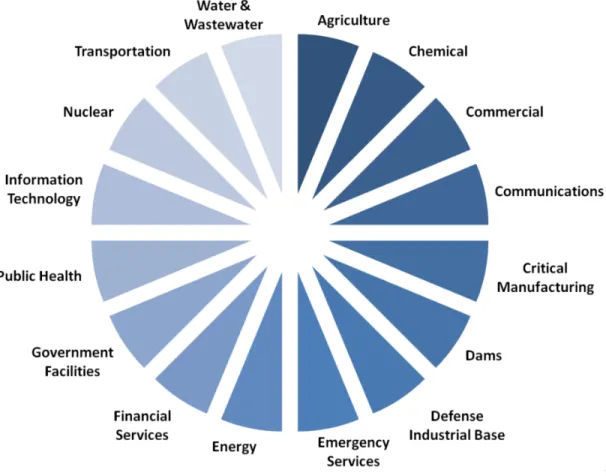
1. Critical infrastructure sectors as defined by the DHS. . . 6
2. ICS operational flow [4]. . . 7
3. A conceptual representation of network segmentation in ICSs [5]. . . 9
4. Firewall with DMZ between Corporate Network and Control Network [4]. . . 11
5. PLC device hierarchy. . . 18
6. ICS ransomware attack framework [18]. . . 20
7. ICN attack progression [18]. . . 21
8. NIST Critical Infrastructure Cybersecurity Framework. . . 24
9. Screen capture of custom ransomware application. . . 30
10. Photograph of upper-half of prison testbed. . . 31
11. Photograph of lower-half of prison testbed. . . 32
12. Relationship between the Y-box and PLC. . . 33
13. Screen capture of human machine interface for prison system. . . 34
14. Block diagram of system under test. . . 35
15. Overview of water storage testbed. . . 40
16. Testbed 2 Block Diagram. . . 41
17. Diagram of ICS with redundancy. . . 44
18. Experiment 1 System Under Test. . . 46
19. Process diagram of a trial for Experiment 1. . . 48
20. Experiment 2 System Under Test. . . 51
Figure Page
22. Experiment 3 System Under Test. . . 55
23. Process diagram of a trial for Experiment 3. . . 58
24. Boxplots comparing standby recovery times. . . 60
25. Boxplots comparing cold recovery with baseline boot time. . . 61
26. Boxplots comparing I/O response time during Allen-Bradley DoS. . . 62
27. Boxplots comparing I/O response time during Siemens DoS. . . 63
28. Network attacks that had no significant effect on water level. . . 64
29. Network attacks that had no significant effect on flow rate. . . 65
30. UDP Flood causing significant change in water level. . . 66
31. UDP Flood causing significant change in flow rate. . . 66
32. VFD fault after UDP DoS Attack. . . 68
List of Tables
Table Page
1. Top ransomware strains defined by the MMPC. . . 16
2. Anatomy of LogicLocker. . . 22
3. Relative time and cost of ransomware mitigation strategies. . . 25
4. Testbed components. . . 32
5. TCP SYN flood packet characteristics. . . 38
6. UDP flood packet characteristics. . . 38
7. Water storage testbed IP addresses. . . 42
8. Test matrix for experiment 1. . . 47
9. Test matrix for experiment 2. . . 52
10. Test matrix for experiment 3. . . 57
11. Summarized results for experiment 1. . . 59
12. Summarized results for experiment 2. . . 62
13. Summarized results for experiment 3. . . 64
14. UDP flood experimental results. . . 67
SECURING CRITICAL INFRASTRUCTURE: A RANSOMWARE STUDY
I. Introduction
1.1 Overview
Humans from an early age have learned to live and thrive together in large soci-eties. In the modern world, people live in large cities capable of providing a variety of services to the average citizen. These services deliver a variety of functions ranging across the hierarchy of need. Some provide basic needs like water or removing waste. While others provide less vital needs like public transportation or broadcast televi-sion. Ultimately, public infrastructure encompasses a plethora of items, some more essential than others.
As technology continues to advance, the world has become greatly connected. With the advent of the Internet and cellular networks, information can be transmit-ted across the planet in seconds. Geographical separation is no longer a hurdle for attackers to overcome. The Internet has made it possible for a hacker living on the other side of the world to impact territories thousands of miles away.
The communication networks that support essential public services are becoming more vulnerable. Society must secure these networks to ensure threats are unable to impact their livelihood. Every day, attackers are developing new methods to fulfill their objectives at the cost of others’ health, wealth, and happiness. The focus of this research is to investigate current attack trends, such as ransomware, and to propose defensive solutions that counter threats.
1.2 Problem Statement
This research aims to provide Industrial Control System (ICS) operators with a means to protect their networks from ransomware attacks. This is done by validating possible attack scenarios and testing defensive solutions. Investigating each of the three problems below will provide insight into both future attacks and corresponding defensive solutions.
1. What defensive techniques improve ICS availability by limiting ransomware capability?
2. What effect does a network-based Denial of Service (DoS) attack targeting a Programmable Logic Controller (PLC) have on its Input Output (I/O) response time?
3. How do network-based DoS attacks targeting Intelligent Electronic Devices (IEDs) across an Industrial Control Network (ICN) affect process stability?
1.3 Research Path
A hypothesis and three goals guide this research in answering the proposed prob-lem statements.
1.3.1 Hypothesis
If a PLC redundancy scheme is implemented within an ICS then the effects of ransomware attacks targeting that system will be mitigated.
1.3.2 Goals
1. Investigate the current state of ransomware and how it may impact ICSs. 2. Develop and test a ransomware strain unique to ICSs.
3. Provide and validate defensive methods for critical infrastructure operators to secure their networks from ransomware.
1.4 Approach
This research starts by analyzing the current ransomware threat environment. By reviewing the state of the art, a more accurate ransomware strain can then be devel-oped as a test case. Once the threat is legitimized, research continues by developing a defensive strategy. Specifically, a redundant PLC architecture is tested as a solution to defend against a targeted attack. The redundant network is created by modifying a previously built testbed with relay banks. Finally, research concludes by analyzing alternative attack paths for ransomware. Specific attention is given to communication channels linking IEDs to process controllers.
1.5 Assumptions/Limitations
This research does not focus on defending an ICS from threats that have not gained a foothold in the network. It is assumed that the threat has a presence on the network, has identified vulnerable devices, and is attacking. This research focuses on how the attacker exploits the system from inside the ICN and what defensive measures can prevent such an attack from disturbing the industrial process.
1.6 Research Contributions
The following research contributions were made:
Programmed a custom strain of ICS ransomware.
Implemented a PLC switchover mechanism as a defensive solution.
Validated the efficacy of network attacks targeting IEDs within an ICN.
1.7 Thesis Overview
Chapter II provides a background on critical infrastructure. This includes the major hardware and software components which comprise ICSs and the networks that support them. The chapter then transitions to the threat environment surrounding critical infrastructure and how ransomware could make an appearance in the future. Chapter II concludes by investigating a ransomware study published by the Georgia Institute of Technology and presenting a new ICS response and recovery plan geared towards ransomware. Chapter III discusses the two testbeds used during research. The first testbed simulates a prison facility and is used to implement and test the PLC standby mechanism. The second testbed is a training platform used to simulate a water storage system. This testbed is used to determine the efficacy of network attacks targeting IEDs. Chapter IV discusses the three experiments conducted during the research. The first experiment focuses on defensive measures, while the remaining two analyze attack methods. Chapter V presents the results of each experiment. Last, Chapter VI provides research conclusions and recommendations for future work.
II. Background
2.1 Motivation
Modern societies are built upon critical infrastructures that deliver necessary ser-vices to the whole. These serser-vices provide for fundamental needs “serving as the backbone of a nation’s economy, security, and health” [1]. The United States’ de-pendence on infrastructure availability has led to a demand for security. On 12 Feb 2013, Presidential Policy Directive (PPD) 21 was published emphasizing the need to “strengthen and maintain secure, functioning, and resilient critical infrastructure” [2]. In direct response to the President’s call to action, the Department of Homeland Security (DHS) divided critical infrastructure assets into 16 sectors; see Figure 1. A specialized protection plan was written for each sector based on its unique threat landscape [3]. As adversaries continue to exploit the new technologies which comprise national infrastructure, the confidentiality, integrity, and availability of these critical services becomes paramount.
2.2 Industrial Control Systems
The foundation of critical infrastructure is built upon highly-specialized control equipment known as ICSs. These operational technology systems are directly linked to the physical processes they control. A typical ICS contains four components:
Sensor: a device that produces an analog signal based on a measured physical property. For example, a temperature sensor may output a linear voltage within
the range of 0 V to 5 V based upon a temperature range of 0 °C to 100 °C.
a)
Actuator: a device that modifies the industrial control process based upon inputs from a controller. A valve controlling the flow of water into a tank is an example of an actuator.
Figure 1. Critical infrastructure sectors as defined by the DHS.
Controller: the computer responsible for driving actuator inputs based upon algorithms informed by sensor outputs. In effect, the controller is the heart of the control process, making it a priority target for an attacker.
c)
Human Machine Interface (HMI): the combination of hardware and soft-ware that provides operators with a utility to interact with system controllers. A typical HMI is presented to an operator with an engineering workstation running a desktop operating system.
d)
Figure 2 visually portrays the relationship of each component within the ICS [4]. The inputs to the controlled process are managed by the system actuators. The corresponding outputs of the controlled process are then monitored by the sensors.
Figure 2. ICS operational flow [4].
The system operator uses the HMI to manage the controller which commands the actuators based on feedback from sensors. Modern systems include redundant con-trollers and data historians in addition to aforementioned components. Redundant controllers are used as a measure to protect system availability should the primary controller become inoperable. Data historians are responsible for archiving system data and informing system algorithms with trending statistics. While ICSs are built with the same core components, the organizational makeup of each system is charac-teristic of the controlled process.
2.3 Programmable Logic Controllers
The majority of ICSs utilize PLCs as their primary controller. A PLC is a device programmed to control a systematic process with predefined logic. These devices are characterized by the number and type of I/O ports supported. Most often, PLCs are programmed using ladder logic or ladder diagrams. These diagrams serve as
functional blocks that inform the controller’s decision making process by defining algorithms that relate sensor inputs to actuator outputs. PLCs are produced by a wide-variety of manufacturers across the globe to include: Siemens, ABB, Schnei-der/Modicon, and Rockwell/Allen-Bradley. The diversity in manufacturers has led directly to the lack of controller interoperability. For example, a ladder logic pro-gram created for a Siemens PLC may not readily transfer to one produced by ABB. From a cyber security standpoint, diversity enhances critical infrastructure security by increasing attack complexity. Conversely, a defensive countermeasure created for one system, may not be applicable to another. As the centerpiece of the automated process, security of the PLC is a priority. If the primary controller is compromised, the entire process under control is placed at risk.
2.4 Industrial Control Networks
ICNs provide the communication channels that link the process to command and control systems. Securing the ICN is of utmost importance when preparing for attacks against the ICS. Good practice calls for ICN defenders to use network segmentation as a security measure. Network segmentation is the process of dividing a network into zones, each with their own unique characteristics. Figure 3 shows an example of an ICN utilizing network segmentation [5]. By segmenting the ICN, network messages are not easily transferred between distant zones. For example, in order for a message sent on the Business Network to reach any of the Process Networks, it must pass
between five zone interfaces. Furthermore, secure network design enforces traffic
filtering at each zone.
The National Institute of Standards and Technology (NIST) recommends that at a minimum, the corporate network be separated from the control network [4]. This is due to the diversity of traffic required by each network. Corporate network traffic
re-Figure 3. A conceptual representation of network segmentation in ICSs [5].
quires protocols used by typical enterprise operating systems to include: Simple Mail Transfer Protocol (SMTP), Post Office Protocol (POP), and Internet Message Access Protocol (IMAP) for electronic mail, Hypertext Transfer Protocol (HTTP) and Hy-pertext Transfer Protocol Secure (HTTPS) for Internet, and File Transfer Protocol (FTP) for file transfer. Control network traffic should be limited to ICS command and control protocols such as Modbus. Network defenders should implement segmenta-tion within both corporate and control networks through the establishment of security domains. Security domains/enclaves minimize access to sensitive systems from unau-thorized users while ensuring system availability. Domains can be established based on “management authority, uniform policy/level of trust, critical functionality, and boundary communication traffic levels” [4]. Failure to isolate these networks with segmentation opens the control network to corporate network attack vectors.
Networks are separated using logical network separation, physical network sepa-ration, and network traffic filtering [4]. Logical network separation is implemented using encryption or device-enforced partitioning through: Virtual Local Area
Net-work (VLAN), Virtual Private NetNet-work (VPN), and Unidirectional Gateways. This methodology ensures traffic destined for one network is not accessible by another when the same transmission channel is being used. Physical network separation iso-lates network domains through lack of any physical connection, including wireless. Unlike logical network separation, the only way for physically-separated networks to communicate is by bridging the connection. Traffic filtering is a subset of logical network separation that relies on packet analysis in lieu of encryption/tunneling tech-nologies. Traffic filtering can be implemented at various levels of the network stack. At the transport layer, Transmission Control Protocol (TCP) & User Datagram Pro-tocol (UDP) port filters can be used. Within the network layer, items can be filtered by Internet Protocol (IP) address. Finally, at the application layer, firewalls may permit or deny programs access to the network.
2.5 Firewalls
Industrial control networks use firewalls as a method of network segregation through traffic filtering. Firewalls can be compared to traditional network routers, but with the added functionality of packet inspection. Firewalls can be classified into three subdivisions: packet filtering, stateful inspection, and application-proxy gateway [4]. The most basic firewalls utilize packet filtering by inspecting network packets at Open Systems Interconnection (OSI) layers three and four (network and transport). These firewalls are governed by a rule set that informs decisions to drop or forward packets. The rule set reviews packet data such as the IP source, IP destination, port source, and port destination. More advanced firewalls utilize memory in the form of stateful inspection. Stateful firewalls have memory of past and present network connections which can be used when advising packet forwarding decisions. These firewalls have greater security and performance, but require extra administration and computational
resources. Finally, application-proxy gateways focus on application layer filtering to include application types (browsers) and/or protocols (e.g., FTP or SMTP).
A typical ICN employs use of firewalls between security domains (e.g., between the corporate and control network). A combination of both host and hardware-based firewalls may be used. Several different methodologies exist to deploy firewalls within an ICN. Defenders can use any number of firewalls and demilitarized zones (DMZs) to segment their network. Figure 4 shows an example of an ICN that utilizes two firewalls to segment the corporate and control networks, and a single DMZ to manage shared network resources [4].
Figure 4. Firewall with DMZ between Corporate Network and Control Network [4].
2.6 Threat Landscape
There are several reasons why an adversary may target critical infrastructure in a cyber attack. ICSs, unlike Information Technology (IT) systems, uniquely give the attacker the ability to create a kinetic impact. A hacker looking to harm public welfare
the damage an enemy of the state may cause by infiltrating any one of the critical infrastructure sectors. How many lives would be put at risk if a water treatment facility was commandeered by hackers? Aside from public safety, an attacker may seek monetary gain. Such a threat may hold an ICS hostage and return control to the rightful owner only after receiving a ransom payment. The cost in potential damages alone can provide enough motivation for system defenders to comply with adversary demands. Finally, the attacker may not have any motivation aside from curiosity. Thrill seeking hackers with little to no experience are often referred to as script kiddies. No matter the motivation, it is evident that critical infrastructure is a bountiful target for adversaries and should be treated likewise by network defenders.
2.7 Vulnerabilities
The convergence of today’s communication networks toward IP-based technolo-gies has noteworthy implications. Like other industries, ICNs have adopted use of IP networks in lieu of dated proprietary protocols. From an interoperability stand-point, IP networking has helped bridge the gap between different equipment providers creating a shared communications protocol. This has granted critical infrastructure providers greater flexibility in incorporating devices from different manufacturers. Unfortunately, from the standpoint of network security, IP convergence allows ex-ploits crafted for personal computers to be transferable to ICNs. Attackers who are already privy to IT systems can adapt their exploits to critical infrastructure net-works. Macaulay and Singer describe six different vulnerability classes that threat agents are likely to target on an ICN [6].
Denial of View: a temporary failure in the HMI leads to disruption of pro-duction and/or control.
Loss of View: a sustained failure in the HMI leads to loss of production and/or control.
b)
Manipulation of View: forged information is presented via the HMI encour-aging inappropriate operator response.
c)
Denial of Control: a temporary inability to control the process resulting from a dysfunctional I/O interface.
d)
Loss of Control: a sustained inability to control the process resulting from a dysfunctional I/O interface.
e)
Manipulation of Control: operator commands are overwritten, changed, or adapted to apply inappropriate control sequences to the production process. f)
They continue to describe four attack methodologies threat agents employ to exploit said vulnerabilities [6].
Man in the Middle: the attacker positions himself between two devices to sniff the traffic between them. By analyzing the traffic the attacker may perform reconnaissance and ultimately hijack the session placing the entire system at risk.
a)
Denial of Service: the attacker attempts to make a resource unavailable. Common methodologies to execute this attack include: denying communication channels, overloading device services, and crashing the device OS.
b)
Replay: the attacker captures a stream of legitimate network traffic and replays the traffic in order to achieve a desired effect.
c)
HMI Compromise: the attacker can misinform the system operator by dis-playing incorrect status information. This creates a disparity between the actual process and the operator’s knowledge of the process.
The vulnerability classes and attack methodologies presented by Macaulay and Singer provide a robust foundation of understanding.
2.8 Historical Events
Due to the sensitive nature of critical infrastructure security, little has been pub-lished on real-world attack scenarios. However, there have been a few case studies within the past decade worth mentioning. In 2007, a team of researchers from Idaho National Laboratories (INL) conducted a vulnerability assessment on the United
States electrical grid titledProject Aurora[7]. Their study revealed a flaw in electrical
breakers implemented in rotational-based systems (e.g., generators). INL theorized that the electrical breakers/relays put in place as a protective measure, could be used by adversaries to wreak havoc on critical infrastructure. The INL research team con-ducted an experiment to test their hypothesis; they successfully demonstrated the ability to destroy a generator by exploiting a relay on the ICN. This story was the first widely-publicized study on critical infrastructure security and forced the creation of defensive strategies.
Three years later the world got its first glimpse at highly-targeted critical
infras-tructure malware. The Stuxnet worm, discovered in 2010, propagated throughout
the Internet by infecting various Windows kernels with multiple zero-day exploits [8].
Stuxnet was unique; it infected all possible computer systems, but only weaponized after finding a specific control system (classified by unique model numbers and device vendors). This industrial malware made worldwide news after successfully
sabotag-ing Iranian nuclear centrifuges by compromissabotag-ing variable frequency drives. Stuxnet is
widely cited due to the novelty of its effort. Never before had a computer virus had such glaring physical effects on a real-world system.
Night Dragon, targeting the global oil, energy, and petrochemical industries [9]. The attacks started in 2009, primarily originating from China. McAfee revealed that hack-ers initially targeted Internet-accessible corporate web servhack-ers. Once the advhack-ersaries gained a foothold, they pivoted onto internal systems and installed remote administra-tion toolkits. With a command and control channel established, attackers exfiltrated
sensitive production and financial data. UnlikeStuxnet,Night Dragon did not induce
physical effects, as its primary purpose was reconnaissance. Project Aurora,Stuxnet,
and Night Dragon solidify the growing importance critical infrastructure cybersecu-rity.
2.9 Information Technology Ransomware
Scareware is a form of malware designed to take advantage of a victim’s fear
of losing privacy, capability, or money [10]. A subset of scareware, ransomware,
holds the victim’s computer or computer files hostage until a payment is sent to the attacker. Ransomware has become a profitable method employed by cyber criminals popularizing a variety of strains seen across the Internet. Attacks against IT systems generally target the file system using a combination of two methodologies: encryption and deletion [11]. If the attacker chooses to use encryption, they often are able to utilize algorithms supplied by the target platform (e.g., Windows provides the CryptoAPI allowing developers to directly encrypt and decrypt files). Alternatively, attackers may choose to implement their own encryption schemes to subvert malware detection techniques. Deletion mechanisms forgo encrypting the user’s files altogether. Instead, the user is presented with a countdown timer until their files are removed.
The Microsoft Malware Protection Center (MMPC) has published extensive mate-rial on the top ransomware strains identified from 2015-2016 [12]. Microsoft revealed that the top five ransomware families were as follows: Tescrypt, Crowti, Fakebsod,
Brolo, and Locky. Table 1 shows details for each family. Three of the families target Windows operating systems while the others victimize Javascript-enabled browsers. The Windows variants all employ encryption schemes and delete shadow copies to prevent restoration from local backups. The Javascript ransomware families do not employ encryption nor deletion mechanisms, but rather lead the victim to assume their data is at risk. The victim’s web browser is locked via a malicious script which displays a message attempting to scare the user into paying a ransom. The victim
can regain control by starting a task manager and ending the browser process.
Wan-naCrypt is the most recent family of ransomware to wreak havoc on the Internet [13].
In contrast to the aforementioned families, WannaCrypt is characterized by its rapid
deployment via a worm that exploits the Server Message Block (SMB) Eternal Blue
vulnerability. This ransomware strain was able to affect a large amount of computer
systems due to the number of Windows OS versions affected by Eternal Blue
(Win-dows 7 or earlier and Win(Win-dows Server 2008 or earlier). While Microsoft released a patch in March of 2017 mitigating the vulnerability, it did little to impede the growth of WannaCrypt as the majority of vulnerable machines were never patched.
Table 1. Top ransomware strains defined by the MMPC.
Family Target Mechanism File Extension
Tescrypt Windows Encryption .ecc, .exx, .ezz
Crowti Windows Encryption
Fakebsod Javascript Browser Lock
Brolo Javascript Browser Lock
Locky Windows Encryption .locky, .zepto, .odin
While ransomware has continuously developed over the past decade, it has rarely targeted devices outside of the personal computer ecosystem. A report published by SOPHOS in February of 2017 details a paradigm shift as ransomware attacks begin targeting critical infrastructure [14]. The report states that eight years’ worth of dig-ital evidence was lost after the Cockrell Hill Police Department failed to comply with
attacker demands. One can imagine the implications of losing sensitive data within an emergency services department. Similar attacks targeted other police departments as early as 2013. As ransomware attacks victimize a broader range of targets, crit-ical infrastructure network defenders must be cognizant of the types of ransomware attacks they may encounter.
2.10 Operational Technology Ransomware
A taxonomy of ransomware capable of affecting critical infrastructure can be adapted from known attacks against IT systems. Implementation aside, traditional IT ransomware affects the target computer by modifying the file system through encryption or deletion mechanisms. While most ransomware strains are legitimate threats, there are forms of ransomware which claim to have the capability to encrypt or delete files, but do not. These strains only attempt to scare the user into paying a ransom, with no real leverage on the victim. When dealing with the gravity of pro-cesses controlled within ICNs, defenders must consider both legitimate and superficial forms of ransomware as serious threats.
Strains of ransomware developed to infiltrate IT networks can have equally dev-astating effects on ICNs. This is due to the use of desktop computers in both IT and Operational Technology (OT) environments. The proprietary hardware used within PLCs to control critical processes can potentially reduce the impact of such an attack. However, this does not preclude the possibility of specialized ransomware strains ca-pable of impacting the process controllers. Previous research has been done detailing how custom malware can be created to affect a PLC amongst various levels in the device hierarchy shown in Figure 5.
At the highest level, malware can disrupt the process by sending rogue messages across command and control channels. One example of a command and control attack
is to switch the PLC between Run and Stop modes remotely. Below the command and control layer, is the programmable layer of the PLC. The programmable layer is responsible for storing the high-level code written to control the process (ladder logic). Malware can modify this level by rewriting the programmable layer with new code, or deleting the contents altogether. Firmware level attacks require modification of the low-level code such as the PLC kernel. Schuett demonstrated several firmware based DoS attacks against a PLC in a 2014 study [15]. The final level of the PLC device hierarchy is the hardware. Attacks against this layer require the attacker to modify the physical device. This can be done by inserting compromised hardware into the device during any stage of the manufacturing process to include delivery and post-installation. The Australian Department of Defense published a
substan-tial literature review of the topic entitled Hardware Trojans - Prevention, Detection,
Countermeasures [16]. Ultimately, malware developed to compromise lower layers in the device hierarchy can be more expensive for attackers to implement, however they are equally difficult for defenders to detect and respond to.
Figure 5. PLC device hierarchy.
a successful attack, this methodology does not necessarily lend itself to ransomware, as the primary motivation behind a ransomware attack is profitability. The attacker aims to maximize profits while minimizing costs. The variability not only in PLC manufacturers, but also models and firmware versions, can severely limit the number of devices susceptible to a specialized attack. For this reason, it is in the attacker’s best interest to develop an attack that is compatible with the largest number of
devices. An attack targeting weaknesses in the network rather than the devices
themselves, hits a broader range of targets with a similar development cost. The idea being that most PLCs utilize IP-based communication schemes that have well-researched security flaws. Listed below are a few practical methods of disrupting communications within an ICN.
Address Resolution Protocol (ARP) Spoofing: the attacker sends spoofed mes-sages onto the Local Area Network (LAN) aiming to associate the Media Access Control (MAC) address of another device on the LAN with the attacker’s IP address. This attack causes messages destined for the victim device to be routed to the attacker instead, effectively disrupting all inbound messages to the victim [17].
a)
Flooding: the attacker attempts to overwhelm the victim machine by sending a large number of network packets (e.g., TCP, UDP, Internet Control Message Protocol (ICMP) etc.). The victim is then forced to allocate slots in it’s con-nection queue from all the bogus traffic. Eventually, all slots in the concon-nection queue are filled preventing legitimate users from connecting with the victim [17].
b)
ARP Spoofing and Flooding are two ways an attacker can leverage network attacks against an ICN. In either scenario, the attacker targets either the PLC or HMI in order to cause a significant effect. To adapt one of these attacks for a given ICN, the attacker
only needs to configure the target addresses properly. When compared to a specialized attack requiring knowledge of device specific protocols, firmware, and software, the development cost disparity becomes evident. For this reason, ransomware targeting ICSs is more likely to use traditional network attacks.
2.11 LogicLocker
Researchers at the Georgia Institute of Technology hypothesize that ransomware may soon target ICNs [18]. As a result, the team developed an ICN ransomware threat model and attack methodology, and implemented a proof of concept dubbed
LogicLocker. The Georgia Tech research team led by David Formby presents a frame-work for ICS ransomware and claims to have produced the first known example of ransomware to target PLCs within ICNs [18]. Given the increase in ransomware popularity as described in Section 2.9, it is only a matter of time until national in-frastructure is victimized by a ransomware strain adapted to target ICNs. As a result,
tools likeLogicLocker give ICN defenders an idea of what future attacks may look like.
The five stages of Georgia Tech’s ICS ransomware attack framework are displayed in Figure 6 [18].
Figure 6. ICS ransomware attack framework [18].
The first stage of the attack is to infiltrate the ICN. An attacker can obtain a connection to the network by targeting various attack surfaces. ICNs connected to a corporate network with Internet-facing servers and workstations are high-value targets for attackers. Alternatively, if the ICN is not accessible by Internet, the attacker may use social engineering or physical access to create the connection. After
establishing a connection to the ICN, the next step is network traversal. During this stage, the attacker performs network reconnaissance and attempts to bridge corporate and control networks. Ultimately, the attacker is seeking to locate devices responsible for managing the ICS process, such as PLCs. Figure 7 provides an example of how an attacker can infiltrate an ICN by first compromising the Internet-facing corporate network and then pivoting to the control network [18]. Where level 4 consists of workplace computers and servers, level 3 contains the HMIs, and level 2 contains the PLCs.
Figure 7. ICN attack progression [18].
Once the attacker has pivoted across the ICN and has located a PLC, he must obtain access to the device. Many PLCs do not enforce strong authentication mea-sures. Furthermore, most password protection schemes can be subverted as they are implemented on the application layer. In addition to gaining access themselves, the attacker must also prevent the victim from re-accessing the device. The fourth stage
of the attack is to encrypt the control program on the PLC. By encrypting the con-trol program, attackers attempt to prevent the victim from recovering or replacing the compromised device. The final stage is to negotiate the ransom. The success of the attack is dependent on the delivery of the ransomware message to the victim. In an ICN, the attacker has a few delivery options. For one, the attacker may send a ransom email from a compromised workstation on the network or even from an embedded email client on a PLC. Another option would be for the attacker to deliver the ransom message to an operator over the HMI.
Table 2. Anatomy of LogicLocker.
Stage Action
1. Infiltrate Network Direct, Bypass password
2. Traverse Network Worm
3. Obtain Access Change password, OEM lock
4. Encrypt Program Manual, Remote
5. Negotiate Ransom Email from attacker
The anatomy of LogicLocker follows the methodology presented in Figure 6;
Ta-ble 2 provides a summary [18]. For stage one, the team assumes the attacker has
already infiltrated the network. After gaining initial access, LogicLocker traverses
the network via a worm that targets vulnerable PLCs. Compromised controllers are then locked by enforcing new passwords, preventing legitimate users from utilizing of-ficial programming software. In stage four, the attacker manually encrypts the stolen ladder logic from the compromised controllers at a remote location. After successful encryption, the attacker negotiates a ransom by sending an email from a personal computer notifying the victim of the attack. If the victim is not compliant with de-mands, the attacker may begin altering the controlled process by manipulating the
ladder logic stored on the compromised controller. LogicLocker’s execution of the
ransomware attack framework illustrates the feasibility of future attacks on ICNs. Formby et al. conclude that there will be a wave of ransomware attacks that target
critical infrastructure in the near future [18]. Consequently, network defenders must adapt their ICNs to prepare for this rapidly developing threat.
2.12 Critical Infrastructure Defensive Strategies
Facing an array of possible attacks, ICN operators must adequately defend their systems. The National Institute of Standards and Technology (NIST) published a
framework to aide ICN defenders in establishing a mitigation plan entitled
Frame-work for Critical Infrastructure Cybersecurity [19]. The plan includes a five-step
process shown in Figure 8. The first step calls for the defenders toidentify the assets
at risk within the organization. After conducting a risk assessment, efforts must be
made toprotect the entities at risk. This can be accomplished by implementing
mea-sures ranging from traditional network defenses like firewalls, to specialized personnel training like cyber awareness. The third step of the process calls for the development and implementation of a threat detection infrastructure. Systems must be put in
place to detect threats targeting the ICN. Once the threat has been detected and
identified, operators must respond. A successful response plan should inform actions
which correlate to a specific threat. A key component of threat response is the ability to contain the threat, mitigating additional damage to the network. The final step
of the NIST cybersecurity framework is recovery. ICN maintainers must have the
ability to restore any services that may have been affected due to the attack. When dealing with networks supporting critical infrastructure, any amount of time where services are offline can be devastating. For this reason, timeliness is paramount when recovering from a detected threat. Taking into account the critical infrastructure
defensive strategies proposed by NIST, consider - How does an ICN defender best
Figure 8. NIST Critical Infrastructure Cybersecurity Framework.
2.13 A Ransomware Response and Recovery Plan
The proposed ransomware defensive plan strictly focuses on steps 4 and 5 of the NIST Critical Infrastructure Cybersecurity Framework. A plan focused only on re-sponse and recovery is justified by the characteristics of the attack, as ransomware makes itself known to the victim in order to motivate payment. Consequently, de-tection of the threat is trivial. By following the proposed plan, critical infrastructure defenders are able appropriately respond to and recover from ransomware attacks.
A victim of a ransomware attack should first observe the current state of the system before making a decision. Comparisons must be made between what the attacker has claimed to have compromised and what is actually being affected. In some cases, the defender may be unable to confirm or deny the claims of the attacker. As a result, the defender may be forced to assume the worst case scenario. After establishing the current state of the system, critical infrastructure defenders may begin developing courses of action to either meet the attacker’s demands or nullify the attack. Decisions should be informed by at least two measures:
Cost: the amount of capital required to implement the solution.
a)
Time: the time required to enact the the solution (system unavailability).
b)
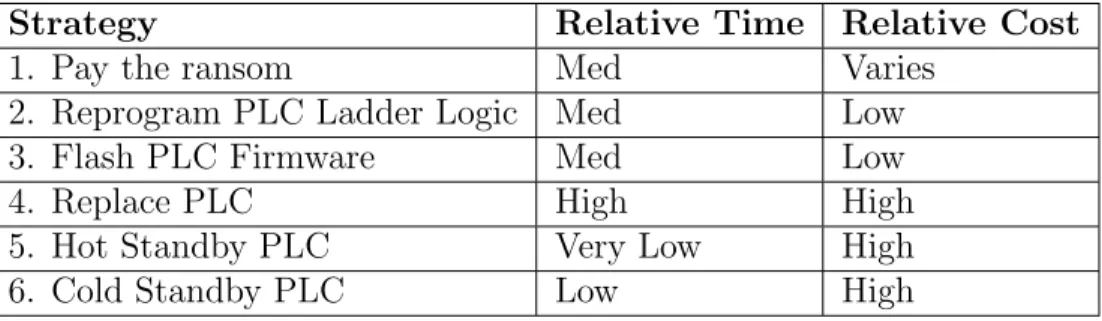
Table 3 proposes six potential courses of action to counter a ransomware threat tar-geting critical infrastructure. The first, and most obvious course of action, is to pay
the ransom requested by the attacker to regain control of the compromised system. Ransomware agents often require a payment in the form of cryptocurrencies like Bit-coin. As a result, victims must previously possess or acquire the requested currency. In either instance, payment can be accomplished in a relatively short amount of time.
However, the Federal Bureau of Investigation (FBI) reported inHow to Protect Your
Networks from Ransomware that ransom payment does not guarantee compliance from the attacker. In fact, the FBI reported on cases in which the victims were never provided decryption keys, were asked to pay an additional ransom, or were targeted again by the same entity after sending the initial payment [20]. While these results are definite possibilities, attackers are incentivised to return control to the victim. If attackers never followed through on their promises, victims would never pay the ransom, cutting all profits in the criminal scheme. If the victim refuses to pay the ransom, they must pursue methods to nullify the threat.
Table 3. Relative time and cost of ransomware mitigation strategies.
Strategy Relative Time Relative Cost
1. Pay the ransom Med Varies
2. Reprogram PLC Ladder Logic Med Low
3. Flash PLC Firmware Med Low
4. Replace PLC High High
5. Hot Standby PLC Very Low High
6. Cold Standby PLC Low High
Defenders may choose to use either reactive (reprogram, flash, or replace PLCs) or proactive solutions (use standby PLCs to counter the attack). Reactive solutions do not require the defender to invest any money or time upfront. If the controlled process is behaving improperly after the ransomware agent has been deployed, defenders may attempt to reprogram the PLC. For this reason, defenders should keep backup copies of ladder logic files. If attempts to reprogram the PLC fail, the next logical step is to flash the PLC firmware. Section 2.10 describes how more sophisticated
attacks are able to modify the controller’s firmware. If both reprogramming and flashing the PLC fail to recover the system, ICS maintainers have to consider replacing the PLC entirely. Not only are replacement costs very high, but the time involved is substantial. Defenders must ensure the ransomware threat is neutralized before considering replacing the PLC. If not, a persistent threat can compromise the new controller.
Defenders can expedite the response and recovery process by investing resources in a proactive defensive scheme prior to a ransomware attack. An example of one proac-tive defense scheme is the implementation of security through redundancy. Chaves
et al. introduce such a strategy in their paper titled, Improving the cyber resilience
of industrial control systems [21]. Within an ICS, owners may choose to invest in back-up PLCs. Not only does redundancy defend against intentional attacks from intruders, but it also protects the system from hardware failures. Strategies 5 and 6 of Table 3 are examples of redundancy through incorporation of a standby PLC. Standby PLCs can be configured in one of two modes:
Hot: the secondary PLC is always on and has the ability gain control of the
system instantaneously. a)
Cold: the secondary PLC remains off until triggered to control the system.
b)
There are advantages and disadvantages to each option. The primary benefit of using a hot standby is the ability to “hot swap” the secondary PLC into the role of the primary controller. Because the hot standby is always on, it has knowledge of the current and previous system states. However, because the secondary PLC is always on, the attacker may be able to detect its presence on the network and degrade its availability as well. In lieu of using a hot standby controller, ICS owners may elect to use a cold standby. By using a cold standby, the attacker has a greater challenge identifying the secondary PLC due to the controller being powered down when not in
use. A disadvantage of using a cold standby is the time it takes for the controller to boot up and gain complete control of the process. This time varies depending on the complexity of the controlled process. Security through redundancy can be an effective option when defending ICSs, however costs are relatively high (owners must invest in additional controllers and a switchover mechanism). In Chapter IV, a methodology is presented to test both methods of redundancy against a ransomware attack.
III. Testbed Design
3.1 Testbed 1: Prison
A ransomware testbed was created to demonstrate both the feasibility of a ran-somware attack against ICSs and the effectiveness of corresponding defensive strate-gies. The testbed is comprised of four core components:
Ransomware Agent: the ransomware application that attempts to take control of the industrial process from the victim.
a)
Industrial Control System: the combination of hardware and software that mod-els the industrial process.
b)
Engineering Workstation: the computer that provides both the programming and human machine interface to the operator.
c)
Switchover Mechanism: the mechanism that provides the capability to select which PLC is controlling the industrial process.
d)
The following subsections describe each component of the testbed in further detail.
3.1.1 Ransomware Agent
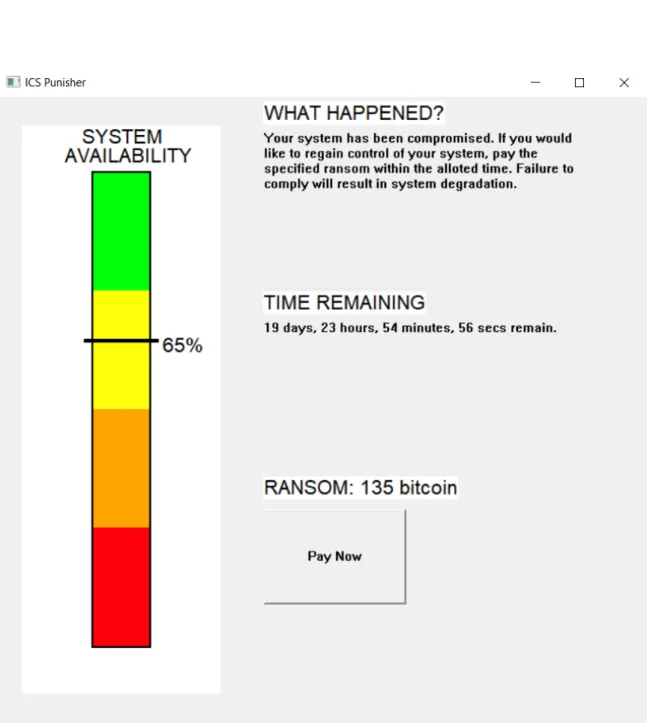
The ransomware agent uses legitimate command and control methods to gain control of the industrial process from the victim. The application contains two in-dependent files written using the C++ programming language. Source code can be found in Appendix D. The first file, ransom gui.cpp, contains the graphical interface that communicates with the victim. Figure 9 shows the graphical component of the ransomware application. The user interface was designed to immitate known
the controlled process availability. A system availability of 65% means the system is online for 65% of the time and offline for 35% of the time. By default, availability starts at 100% and decreases at a rate proportional to the time remaining. On the right side of the window are three sections that provide the victim with information regarding the attack. The section titled “What Happened?” informs the user with general information regarding the attack. The section titled “Time Remaining” tells the victim how much time is left to pay the ransom. The final section, “Ransom”, provides the ransom amount. By clicking on the “Pay Now” button, the victim is redirected to a payment webpage.
The second file, ab exploit.cpp, contains the logic that communicates directly with the PLC. The connection method was developed by analyzing network traffic captures between the PLC programming interface (RSLogix 5000) and the PLC. In effect, the program sets up a TCP connection with the PLC by acting like the RSLogix programming software. Once the program establishes a connection with the target PLC, the program intermittently switches the controller between Stop and Run modes. By controlling when the PLC is in Stop or Run mode, the agent can control the system availability. The program also has the capability to lock other RSLogix program instances out from communicating with the PLC. This prevents the victim from recovering the process via the HMI.
3.1.2 Industrial Control System
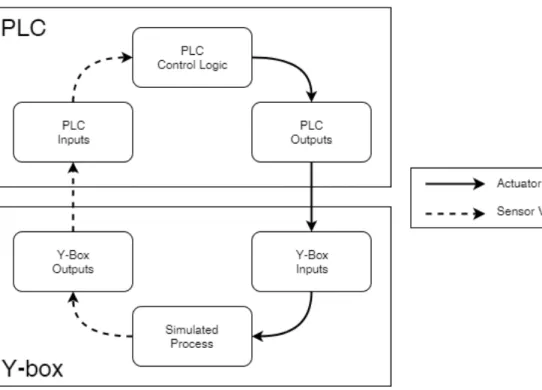
The experiment is conducted using an ICS modeled from a modern-day prison. The modeled process simulates three lockable prison cells, in addition to a mantrap. The testbed is housed inside a Pelican 1610 case containing three different PLCs alongside an array of sensors (buttons) and actuators (locks). Figure 10 shows the upper-half of the testbed and Figure 11 shows the lower-half. Table 4 lists the key components used to create the testbed. Rather than directly connect the PLCs to the sensors and actuators, a device is placed in-between to allow for improved capability; this device is called the Y-box. Figure 12 shows the relationship between the Y-box, the PLC, and the process.
Figure 11. Photograph of lower-half of prison testbed.
Table 4. Testbed components.
Component Qty Component Qty
Allen-Bradley CompactLogix L23E/QBFC1B 1 Solid State Relay 3
Allen-Bradley ControlLogix Logix5555 1 Power Supply (12 V, 24 W) 1
Siemens S700 CPU315-2 PN/DP 1 Power Supply (24 V, 240 W) 1
Y-box 1 Circuit Breaker (10 A) 1
Netgear GS108E Switch 1 Pushbutton 5
Sainsmart 16 Relay Module 2 Cabinet Lock 5
Electromechanical Relay 5 Red LED 4
The Y-box is a physical process simulation tool for PLCs. The platform runs on an Arduino micro-controller fitted with several I/O modules, but relies on a workstation connected via a serial COM channel. The Y-box interfaces with both the inputs and outputs of the PLCs through the I/O modules. Acting as the man-in-the-middle, the Y-box relays PLC outputs to the workstation via the COM channel. The workstation then processes the PLC output signals with simulation code and sends appropriate
sensor signals back to the PLC through the Y-box interface. Both the Arduino
simulation. The workstation component of the Y-box provides three functions:
Process Simulation: output signals from the PLCs are interpreted as actuator inputs and run through the process simulation to generate appropriate sensor outputs.
a)
HMI: a graphical interface is provided to the user to allow operators to remotely
view and control the testbed, see Figure 13. b)
Intrusion Prevention System (IPS): by monitoring the output signals from the PLCs, the Y-box can detect abnormal system behavior and trigger defensive mechanisms.
c)
Figure 13. Screen capture of human machine interface for prison system.
3.1.3 Engineering Workstation
There are two variants of the engineering workstation, one for each make of PLC (Allen-Bradley and Siemens). Both operate on Windows XP Service Pack 3 and op-erate inside Virtual Machines (VMs). The VMs are run within VMWare Workstation Pro Version 12.5.7 Build 5813279. Each VM is configured with 2 processors, 4 GB of RAM and 60 GB of hard drive space. The engineering workstation allows the operator to configure the PLC with the corresponding software package (RSLogix 5000 for Allen-Bradley, Step7 for Siemens). These VMs are primarily used to down-load the ladder logic to the PLCs. However, in order to simulate a plausible attack scenario, the ransomware agent also runs on the engineering workstation. The ran-somware agent must be run from a computer connected to the target PLC in order to function.
3.1.4 Switchover Mechanism
Figure 14 provides a block diagram detailing a high level overview of system
test is security through redundancy. Each of the three PLCs in the testbed can be configured as a the primary or standby PLC via software. The Y-box serves as the IPS, detecting the failure of the primary PLC and initiating the switchover to the standby PLC. Switchover is accomplished by controlling both the output and power relays with the Y-box. The figure below simplifies the mechanism by only including the output relays. A PLC in cold standby needs to have its power supplied by engaging the power relay. After a successful boot, the output relay can then be triggered to complete the change of control from the primary PLC to the standby. Alternatively, a PLC in hot standby is already powered on, thus the Y-box need only trigger the output relay to complete the switchover. For a highly detailed version of the system under test, see Appendix B.
3.2 Testbed 2: Water Storage
The LabVolt Series 3531 Pressure, Flow, Level, and Temperature Process Training System is used as the second testbed. This system simulates a water storage facility that actively manages the water level of a tank. The testbed is comprised of four core components:
Network Attack: the program responsible for launching a network attack variant against the active process.
a)
Industrial Control System: the combination of hardware and software that mod-els the industrial process.
b)
Data Collection Mechanism: the program responsible for running the experi-ment and collecting sensor data.
c)
Engineering Workstation: the computer that permits the operator to configure ladder logic and program tags on the PLC.
d)
The following subsections describe each component of the testbed in further detail.
3.2.1 Network Attack
Each network attack is programmed in Python using the Scapy library. The
attack code is run from a separate Linux workstation connected to the network switch. The workstation runs Linux version 4.9.0-kali3-686-pae. The hardware configuration consists of 7.6 GB of RAM, a quad-core Intel i5-5200U CPU, and 22.7 GB of hard drive space. All attack script source code is located in Appendix C; see files acp.py, flood.py, and smurf.py. Four different methodologies are tested to span a variety of attacks. The following methods are used:
ARP Spoofing: the attacker sends spoofed messages onto the LAN aiming to associate the MAC address of another device on the LAN with the attacker’s IP address. This attack causes messages destined for the victim device to be routed to the attacker instead, effectively disrupting all inbound messages to the victim [17]. For this experiment, the attacker targets both the PLC and Variable Frequency Drive (VFD) with the ARP cache poison attack. The goal being to completely disrupt all communication between the VFD and acplc by having both devices direct their traffic to the blackhat machine instead.
a)
TCP Flood: the attacker sends a large number of TCP SYN packets to the victim device within a short period of time; the goal being to disrupt inbound and outbound communication to the device by attacking the connection queue. If the device expects a TCP-based connection, it will set aside resources after receiving a valid TCP SYN packet [17]. The flood.py script is capable of
trans-mitting TCP packets to the victim machine at rates greater than 103 packets per
second. The flood.py script is configured to send packets with the parameters described in Table 5.
b)
UDP Flood: the attacker sends a large number of UDP packets to the victim device within a short period of time; the goal being to disrupt inbound and out-bound communication to the device. Because UDP is a connectionless protocol, this attack works by spoofing valid messages or confusing the target device with with random messages [17]. The flood.py script is configured to send packets with the parameters described in Table 6.
Smurf Attack: this amplification attack results in the victim receiving a large number of ICMP echo replies from other machines on the subnet within a short period of time. This is possible if the attacker sends ICMP echo requests to all other machines on the subnet with the spoofed source address of the victim [17]. The smurf.py script is capable of causing ICMP echo replies to arrive at the victim machine at rates greater than 400 packets per second.
d)
Table 5. TCP SYN flood packet characteristics.
Source IP 192.168.2.20
Dest IP 192.168.2.50
Source Port 0-65535
Dest Port 44818
Transfer Rate ≥400 (p/s)
Table 6. UDP flood packet characteristics.
Source IP 192.168.2.20
Dest IP 192.168.2.50
Source Port 2433
Dest Port 44818
Transfer Rate ≥400 (p/s)
Packet Size 70 bytes
Payload Contents Static
3.2.2 Industrial Control System
The LabVolt Series 3531 Pressure, Flow, Level, and Temperature Process Training System models the ICS and is pictured in Figure 15. For this experiment, the system manages the flow rate and level of a water storage tank. A real-world example would be the management of a water tower which would feature similar control mechanisms. A complete detailing of the LabVolt 3531 training system can be found in the product datasheet [22]; however, key components of the system are described below.
PLC: An Allen-Bradley ControlLogix PLC is used as the primary controller of the industrial process. This device reads sensor data and forwards control signals to actuators using IP-based connections.
a)
HMI: Two panels on the training system allow the operator to actively
mon-itor and control the process. The Allen-Bradley PanelView Plus 600 allows the operator to monitor and control several devices within the system using a touch-screen panel. The Color Paperless Recorder serves as the data historian, acquiring and displaying analog sensor data on a color display.
b)
Storage Tank: A 30 L cylindrical column is used to hold a specified volume of water. Together, the pump and release valve control the water level of the storage tank.
c)
VFD: The VFD is the IED that sends a signal that varies in frequency to the
pump. The flow rate of water into the storage tank is directly proportional to the frequency of the signal. The VFD model is the Allen-Bradley Power Flex 40 1.0-HP AC Drive. This VFD includes the Power Flex Ethernet/IP adapter. d)
Pump: A single centrifugal pump is controlled by the VFD. It is the mechanical
device responsible for controlling the flow rate of water into the storage tank. e)
Release Valve: The release valve is the mechanical device at the bottom of the storage tank that controls the rate at which water leaves the storage tank. f)
Sensors: Two differential-pressure sensors are used to measure the rate at which water is flowing into the storage tank and the current water level.
Figure 16 shows the relationships between the main components of the water storage testbed. A Netgear ProSAFE Plus Switch GS108E connects four devices via Ethernet on the testbed. Table 7 details the IP address of each network device.
1. Blackhat: The blackhat workstation is responsible for launching each network attack variant and sniffing all traffic on the network via a mirrored port on the switch. The mirrored port is configured to mirror traffic from both the PLC and VFD to the Blackhat. This is done purely for data analysis purposes. 2. Engineering Workstation: The engineering workstation is runs the data
collec-tion mechanism which communicates with the PLC via Ethernet.
3. PLC and VFD: The PLC is responsible for establishing a connection with the VFD over Ethernet, ultimately allowing for the control of the water pump.
Table 7. Water storage testbed IP addresses.
Device PLC VFD Blackhat Eng. Workstation
IP Address 192.168.2.20 192.168.2.50 192.168.2.136 192.168.2.136
The PLC is also in constant communication with the sensors. However, these com-munication channels utilize analog signals and are not accessible via Ethernet. The VFD however, receives commands from the PLC over Ethernet. These commands control the VFD output frequency. This frequency controls the speed of the motor that pumps water into the storage tank. By disrupting this link, the attacker can affect the industrial process.
3.2.3 Engineering Workstation
The engineering workstation runs on a Windows XP Service Pack 3 VM. The VM is run within VMWare Workstation Pro Version 12.5.7 Build 5813279. The VM is configured with 2 processors, 4 GB of RAM and 60 GB of hard drive space. The workstation allows the operator to configure the PLC with RSLogix, primarily by downloading the ladder logic to the PLCs. However, the workstation may also be used as a supplement to the HMI by actively monitoring ladder logic and tags.
3.2.4 Data Collection Mechanism
Data is collected from the process using a Python script (net attack.py in Ap-pendix C) running on a separate workstation that interfaces with the PLC over Ethernet. The workstation runs Linux version 4.9.0-kali3-686-pae. The hardware configuration consists of 31.6 GB of RAM, a quad-core Intel i7-4910MQ CPU, and 460 GB of hard drive space. The script allows experimental data to be collected in real time from the PLC at a rate of 10 samples per second. For this experiment, data is collected on flow rate and water level.
IV. Methodology
4.1 Experiment 1: Security Through Redundancy
4.1.1 Problem Statement
A popular method of modeling computer security is with the Confidentiality, In-tegrity, and Availability (CIA) triad. Unlike IT systems that traditionally value con-fidentiality over the other components, the primary concern of critical infrastructure systems is availability. Consequently, malware compromising a controlled process will often have an impact proportional to the time it renders the system unavailable. This
experiment answers the problem statement: What defensive techniques improve ICS
availability by limiting ransomware capability?
4.1.2 Scenario
This experiment is conducted on the prison testbed described in Section 3.1. An advanced persistent threat deploys a ransomware attack against the ICS under test. The attack attempts to seize control of the process and bring the system offline. Defensive measures attempt to thwart the attack and return control of the process back to the ICS.
4.1.3 Assumptions
This research assumes that the attacker has already compromised a node on the ICN. Additionally, it is assumed they have scanned for and identified the controllers to target. From this position, the attacker can readily initiate the ransomware attack against the PLCs. The targeted PLC is assumed to be in Remote mode.
4.1.4 Response Variable
The response variable of this experiment is system downtime. In other words, if
the attack is able to compromise the ICS, how long does it take to regain control of
the process? The response variable is measured at a precision of 10−8 seconds.
4.1.5 Design Factors
The defensive method under test is security through redundancy. Redundancy is implemented through incorporation of a standby PLC. Figure 17 presents a block diagram that describes an ICS using a redundant controller architecture. The addition of a backup PLC requires the use of a relay to manage which PLC is controlling the process at any given time. In this case, an IPS handles the ransomware detection and consequent switchover to the standby PLC. Two categorical factors are manipulated in this experiment in regard to the standby PLC.
![Figure 2. ICS operational flow [4].](https://thumb-us.123doks.com/thumbv2/123dok_us/970861.2627317/21.918.218.705.109.487/figure-ics-operational-flow.webp)
![Figure 3. A conceptual representation of network segmentation in ICSs [5].](https://thumb-us.123doks.com/thumbv2/123dok_us/970861.2627317/23.918.161.760.97.456/figure-conceptual-representation-network-segmentation-icss.webp)
![Figure 4. Firewall with DMZ between Corporate Network and Control Network [4].](https://thumb-us.123doks.com/thumbv2/123dok_us/970861.2627317/25.918.247.667.442.777/figure-firewall-dmz-corporate-network-control-network.webp)
![Figure 7. ICN attack progression [18].](https://thumb-us.123doks.com/thumbv2/123dok_us/970861.2627317/35.918.213.685.397.810/figure-icn-attack-progression.webp)