Leveraged Buyout
Master Thesis
Authors: supervisor:
Abstract
Leveraged buyout transaction is the most familiar PE investment technique in financial market. It is controversial for high debt financing since some companies go to bankruptcy for it, and some companies achieve another boom. Debt financing is cheaper than equity financing, and tax shield would also be attractive for choice of high debt capital structure. Potential LBO companies should be mature, stable cash generation since high debt induces high interest payment. Thus cash flow plays important role in LBO transaction, many company goes to bankruptcy due to interest payment delay.
The table of content
Introduction: ... 3
Purpose of study:... 4
Problem formulation: ... 5
Limitation:... 5
Chapter 1: Private equity market... 6
1.1 Definition of private equity ... 6
1.2 Development of private equity market ... 8
1.3 The characteristic of Private equity ... 8
Chapter 2: Leverage buyouts... 11
2.1 Process of a typical LBO transaction ... 12
2.2 Exit LBO ... 14
2.3 Potential LBO firms ... 15
2.4 Motivation for LBO... 16
2.5 Successful factors for LBO... 18
2.6 Negative impact of LBO ... 18
2.7 Partial Conclusion ... 21
Chapter 3: Capital Structure of LBO... 22
3.1 Modigliani & Miller ... 22
3.2 Financial efficiency of leveraged ... 23
3.3 Cash flow plays an important role ... 25
3.4 Cost of financial distress ... 25
3.5 Trade-off theory... 27
3.6 Optimal debt structure ... 28
Chapter 4: Conclusion ... 28 Reference... 30 Books: ... 32 Thesis: ... 33 Internet Source: ... 33 Lecture Note:... 35
Introduction:
Private Equity (PE) is also called buyout fund which is helping some companies to develop business except for traditional bank loan. Generally, PE investments are mainly including Venture Capital, Buyout funds and Mezzanine capital. We can distinguish between Buyout fund and Venture Capital by exit strategy.
During 1980s, PE was growing very fast due to the improvement in financial technique and credit risk management.1 LBO was defined as a legend in financial market since it achieved over 1400 “privatization” deals. The most significant deal was Wometco2 in 1984 which successful finished the first over $1 billion leveraged buyout transaction for its corporate restructuring. Before this transaction, most corporate raiders only applied LBO for small size companies due to conservative investment principle. Thus, investors began to look for large size companies as potential LBO transaction.3 For example, in 1989 there were $76.5 billion for 20 LBOs4, which shown that each transaction was $3.8 billion on averaged, and it was larger than previous transactions. Meanwhile, corporate raiders found company could gain tax benefit from high debt financing due to revolution of tax law. However, LBO was still a new financial technique since investors did not have much experience and research on this area study. Fund raisers only paid attention on tax benefit of high debt financing, they did not realize that high debt would easily induce high probability of financial distress due to high interest payment. Thus high debt financing company would be more risk on project selection since they need stable cash flow for interest payment in every certain period. If project were failure, company would decrease predictability of cash flow, and they would have high probability to delay interest payment. From 1989 to 1992, the world economic was in the recession, there were 31 companies’ bankruptcy since they did not have cash flow for debt
1
Gaughan, V. (1999) “Mergers, Acquisitions, and Corporate Restructureings”. 2nd Ed. New York: John Wiley & Sons, Inc., ISBN: 0-471-31670-9. Ch. 7, PP. 291-326
2 Wometco Enterprises Inc. a television company in USA.
3
We research the first over $1 billion LBO transaction from internet source: http://wiki.mbalib.com/wiki/Leveraged_Buyout t
4
obligation, and these LBO transaction involved in more than $27 billion total debts.5
But financial market does not abandon LBO, and investors cumulate a lot of experience from its failure. Today the private equity market is approximately one-sixth the size of the commercial bank loan in terms of outstanding6, especially leveraged buyout market development, it has entered the another new boom period7.
Purpose of study:
We found that leveraged buyout connects with several different areas of macro-economics, corporate governance and corporate finance. So we are really curious what are drivers and consequences for the increased activity in the LBO today? In this paper, we are going to use three steps to explore LBO transaction.
Step 1: We will introduce private equity market which includes definition, development, and characteristic of PE. In this part, we hope readers could have a general idea about PE fund since LBO is one of the most important investment techniques in PE fund. Thus we could build an initial impression for LBO transaction in terms of introduction of PE.
Step 2: We will introduce the detail of LBO transaction. This part consists of 6 sections which are LBO structure, exit strategy, motivation, factors for a successful LBO, and negative impact on LBO. We are going to construct common sense on LBO transaction, in order to infer drivers and consequence for LBO transaction.
Step 3: From the last step, we found drivers of LBO could be traced by capital structure, and financial situation would be influenced by high debt capital structure. In this part, we would firstly adopt M&M theory to analyze high debt capital structure in order to figure out
5
“During 1990s world economic recession, there are a lot of LBO companies went to bankruptcy due to interest payment delay…” pick up from internet source: http://wiki.mbalib.com/wiki/Leveraged_Buyout
6
Vinten, F. & Thomsen, S. (2008) “A Review of Private Equity.” Working Paper no. 1, 2008. Copenhagen Business School.
7
advantage and disadvantage of LBO transaction. And then, we are going to focus on cash flow of company since high debt financing company is required stable cash flow for its interest payment. At last, we will conclude the optimal debt structure in terms of trade-off theory since we want to remind company should evaluate their debt capability before adopting LBO transaction.
Here, we are going to use the deductive method to explain problem formulation in this thesis. All the theoretical analysis will base on the existing literature study, which includes relevant reports, books, journals, articles and E-sources.
Problem formulation:
This paper is trying to figure out what are drivers for LBO, and what are the financial consequences of the transaction?
High debt financing would induce high probability of financial distress, but there are still a lot of companies adopting LBO transaction for business development. According to Pecking order theory, debt financing is cheaper than equity financing. Meanwhile, company could gain tax benefit from high debt capital structure. High debt would require stable cash flow to pay its interest payment in every certain period, so company would be risky to choose business project since project’s success or failure would influence cash flow generation. From the introduction above, we know many LBO companies went to bankruptcy during 1989 to 1992 of world economic recession, and it was due to interest payment delay. We are really interested about drivers of LBO transaction, and what kind of financial consequence would be under the condition of high debt capital structure.
Limitation:
In this paper, we are not going to do an empirical analysis due to limited information. There is not the explanation of economic climate, although LBO can be affected by their external environment.
Chapter 1: Private equity market
In this chapter, we will present a general background to leveraged buyout, and explain the key fundamentals of the transaction and some of the trends in the market.
Private equity becomes a hot topic day by day, and you can see it on every famous financial magazine’s front page frequently. It is the legend of capital market as well as a controversial financing. Superficially, private equity and hedge fund look like twins. But they have significantly difference characters under surface. Hedge fund is typically doing short term investment, such as short-term speculation. Vinten & Thomsen (2008)8 mention, although hedge fund tries to influence corporate governance as activist investor, they would not have any voting right within ownership Company. Private equity does, they are generally in control more than 50% shares of the target firm
1.1 Definition of private equity
“Private equity is not quoted on a public exchange. Private equity consists of investors and funds that make investments directly into private companies or conduct buyouts of public companies that result in a delisting of public equity. Capital for private equity is raised from retail and institutional investors, and can be used to fund new technologies, expand working capital within an owned company, make acquisitions, or to strengthen a
balance sheet.” (Source fromhttp://www.investopedia.com/terms/p/privateequity.asp)
In a broad sense, Private Equity investment includes all the stages of development within a company before their initial public offer (IPO). The stages of development can be typically divided into eight stages: (1) Seed financing, (2) Start-Up, (3) Early Development, (4) Expansion, (5) Profitable but Cash Poor, (6) Rapid Growth toward Liquidity point, (7) Bridge stage, and (8) Harvest.9 Thus, PE investment could be involved in Venture Capital (Development Capital), leveraged buyout, Mezzanine Capital, turnaround, Pre-IPO, private investment in public equity (PIPE), distressed debt, and real estate, in terms of venture
8
Vinten, F. & Thomsen, S. (2008) “A Review of Private Equity.” Working Paper no. 1, 2008. Copenhagen Business School. 9
This definition is based on book: Ogden, J. (2002) Advance Corporate Finance: policy and strategy. 1st edition, Upper Saddle River, NJ: Prentice Hall, cop. ISBN: 0-13-091568-8. Ch. 16. PP. 571
development and financing,10
However, venture capital and leveraged buyout are mainly representing private equity industry due to their distinct characters. Venture capital is a traditional investment in small private companies for financing start-up firms with potential growth. Normally, venture capitalist will get the return through IPO or trade sale in their invested company and their fund are formed by institutional investors and wealthy individual. Prowse (1998)11 mentions many young companies could not reach the requirement for bank loan, so enterprisers would adopt venture capitals for business development. But leveraged buyout prefers mature companies which are under performing with high levels of free cash flow, i.e, firms in the cash-cow industry.
In a narrow term, PE focuses on the mature companies who have accumulated considerable experience in the market place, and have stable cash flow, but unfavorable opportunities for the long-term development, so Buyout funds and Mezzanine Capital primarily represent Private Equity.12
Chart 1: Private Equity
(Source: http://wiki.mbalib.com/wiki/Private_equity)
10
Vinten, F. & Thomsen, S. (2008) “A Review of Private Equity.” Working Paper no. 1, 2008. Copenhagen Business school.
11
Prowse, S. D. (1998) “The economics of the private equity market”. Federal Reserve Bank of Dallas, Economic Review the 3rd Quarter 1998, ISSN: 07321414, pp.21-35
12
This definition collect from book: Ogden, J. (2002) Advance Corporate Finance: policy and strategy. 1st edition, Upper Saddle River, NJ: Prentice Hall, cop. ISBN: 0-13-091568-8. Ch. 16.
1.2 Development of private equity market
Private equity is a relatively new concept to the financial world. There have been major epochs marked by three boom and bust cycles13. As classified by the academic professionals, these booms are respectively 1. 1982-1993; 2. 1992-2002; 3. 2003-before subprime.
Each of the above periods has specific contexts behind the rapid growing private equity industry. The 1st boom was due to a dramatic surge in leveraged buyout activity financed by junk bonds and culminating in the massive buyout of RJR Nabisco. The 2nd boom emerged as a result of recovery of the recession in the early 1990s marked as crisis of loan and savings and collapse of real estates. It ended as soon as Nasdaq dot.com bubble had busted. The 3rd boom is somewhat having the similar path of the 2nd boom-bust cycle as it started from the ashes of the dot.com relics and reach enormous size and becoming institutionalized such as Blackstone, whose IPO was successfully done in the U.S, 2007. However, subprime crisis swept the financial world suddenly, private equities also got affected and leverage buyout activities are not as profitable as it was during the past 5 years.
By tracing private equity market development, we found private equity investment is tightly connected with the global macroeconomic context, especially leveraged buyout transaction. Large multi-billion USD buyouts were highly financed by the high yield debt. According the statistics, the Carlyle Group, Welsh, Carson, Anderson & Stowe, along with other private investors, led a $7.5 billion buyout of QwestDex, not to even speaking about the buyouts of Dollarama(2004), The Hertz Corporation (2005), Metro-Goldwyn-Mayer (2005) and SunGard (2005)14.
1.3 The characteristic of Private equity
Private equity firms are looking for capital from a few wealthy individuals, institutional investors and other accredited investors through private contacts. Therefore, they do not need
13
We research development of PE from internet:
http://en.wikipedia.org/wiki/History_of_private_equity_and_venture_capital
14
to register with Security and Exchange Commission, and avoid attendance from regulation of securities market. Within private equity market, there are limited private equities offerings data for public.
BVCA explanatory notes for limited partners agreement (2002) mentions that private equity funds are mainly organized by general partners (GPs) and limited partners (LPs). GPs work for management of PE funds, their responsibility generally involves in finding potential target company, making a plan for buyout process, and choosing exit strategy. Meanwhile, GPs need to handle corporate governance events, such as board work, management incentives. In order to motivate GPs hard working, they must join PE investment by personal money. Because there are not any explicit rule to require how much they should invest, GPs often contribute a small part of capital for investment. In contrast, the main private financing is from LPs. But they do not have voting right on management level. Prows (1998) mentions LPs are formed by wealthy individual, professional investors, banks, insurance companies, pension funds, hedge funds, and endowments or even public institutions. According to old school of investment, high risk bearing should be with high expected return. LPs shoulder large part of financing which are high risk bearing, but they only get a minor fraction of total return. This is often a controversial problem in PE investment.
General partners are management level of private equity funds, so they are formed by a few members which compared with the number of limited partners. Meanwhile, GPs only provide small part of capital in company, each of them contributes less than the individual of LPs. Therefore, general partners getting a large amount of compensation for low risk bearing would be a controversial problem in PE investment. Prowse (1998) 15concludes that GPs fee are usually taking 1.5%-2.5% of asset plus extra interest of performance. For instance, we assume there are five GPs to manage $100 million assets, expected return is 15%, and the
15
Prowse, S. D. (1998) “The economics of the private equity market”. Federal Reserve Bank of Dallas, Economic Review the 3rd Quarter 1998, ISSN: 07321414, pp.21-35
actual ROI16 is 30%. Thus GPs will gain:$100million* 2.5%+$100million* (30% 15%)− =$17million , and then each member will earn $17 $3.4
5
million
million
= . About LPs’ compensation, they will be paid the return which has already deducted GPs fee from total return. As we assume above, the GPs fee is $17million, and total return is$100million*30%=$30million . Therefore, LPs fee will be$30million−$17million=$13million, and the number of LPs is always larger than GPs. Here we assume there are 20 limited partners, so each LP will earn
$13
$0.65 20
million
million
= which is much lower than GPs.17 Why does general partner get much more compensation than limited partner? Actually, GPs compensation is mainly representing their salary payment. If company pays GPs’ salary as compensation, GPs could avoid paying tax of salary in terms of tax policy. Tax payment will be paid by company, and it is called tax of capital gain. Thus compensation for GPs is including return of investment and salary.
PE fund normally invests in target companies for a certain period, and they would gain return of investment by exit strategies, such as IPO, trade sale, and merger & acquisition.18 This certain period will take 3 to 5 years19, or even more time, it must depend on whether target companies finish value creation. Meanwhile, fund manager should report their performance during a period of time in order to build a trust between GPs and LPs. This reporting is very important for PE investment, because it would influence LPs for whether they should continuously support this project. Managers’ performance is crucial to attract the second financing for project, thus a high quality fund manager should be required in PE investment. Therefore, the manager of private equity funds should report performance to their LPs on schedule, in order to avoid information asymmetry.
16
ROI: return on investment, a performance measure used to evaluate the efficiency of an investment or to compare the efficiency of a number of different investments.
17
This assumption is based on Vinten & Thomsen (2008) “A Review of Private Equity.” Working Paper no. 1, 2008. Copenhagen Business School
18
See textbook: Povaly, s. (2007) Private Equity Exits. Ch. 4 PP. 182-209
19
However, LPs would earn more risk premium than traditional securities due to high risk bearing. PE belongs to unlisted securities which mean there are not any public markets for private equity trade. If LPs wants to quit investment before expiration date, they should find another private investor to instead of, otherwise they would not get back initial investment fund until PE exits from project. Weak liquidity is weakness for PE investment. George, Liang and Prowse (1997) mention that LPs is very difficult to gain access to their money as it is closed down for long-term investment, the period is approximately 12 years.20 But the final year, LPs would get back initial fund and return of investment.
Chapter 2: Leverage buyouts
This chapter will explain what types of firms are likely to be target candidates for a leveraged buyout, and what is the investment rationale or motivation in the deal. Then we will address the fundamental successful factors and critiques towards the LBO.
Buyout transactions could be transformed to Management buyout, Management buy-in, Institutional buyouts, and Leveraged buyout. Generally, Leveraged buyout is mainly financed by bank loan to obtain the domination of a mature company, so financial institutions need to audit the assets of the LBO candidates and their cash flow, in order to evaluate whether this company has capability to adopt high debt financial restructuring.
“Transaction that affects the ownership and control of a firm take many forms, including not only M&A and takeovers, but also several types of buyouts. If a buyout is facilitated in part by the issuance of debt claims against the focal firm’s assets, the transaction is called a
leveraged buyout (LBO”).21(Ogden, Joseph P. Advanced corporate finance: policies and
strategies. Chapter 16 Mergers, Acquisitions, Takeovers, and Buyouts, P571)
The characteristics of LBO are primary high debt, incentive and private ownership. High debt often implicates high interest payment that is why LBO transaction prefers mature company which has stable cash flow generation. Meanwhile, PE fund mangers only focus on exploiting
20
Liang, N., Prowse, S., & George W. (1997) mention that LPs should typically involve in 10-13 years for private equity investment.
21
Definition of LBO is from the book: Ogden, Joseph P. Advanced corporate finance: policies and strategies. Chapter 16 Mergers, Acquisitions, Takeovers, and Buyouts, P571
business area, creating company value and improving operation efficiency. During the period of LBO, company would be private ownership, even though it used to be the listed stock company, their stock would be stopped trade. After a few years, company creates more value from LBO, and they have capability to pay down debt. PE funds would consider to exit, company going public again, trade sales, and merger & acquisition are normally chose as “happy ending” of LBO transaction. And then, company would pay a “charming compensation” to reward PE fund managers’ hard working.
2.1 Process of a typical LBO transaction
Looking for deal source is the first step in LBO transaction, so PE fund manager is going to find out some LBO candidate companies. In order to choose a suitable candidate for LBO, we require fund manager’s diligence which is working hard on researching target firm. Normally, they would observe whether this target firm is legal existing, and then fund manager would figure out candidate’s current tax payment and financial situation in terms of financial annual report. Because high debt financing could reduce company’s tax payment which is the most attractive reason to adopt LBO, fund manager must calculate whether this tax shield could really help target firm development. However when they consider about tax shield benefit, he must observe company’s debt capability which could be traced by candidate financial performance. Choosing target firm is crucial to determine whether this LBO transaction would be successful or not, so you should be sure there are not any information asymmetries in research.
After fund manager determines candidate for LBO transaction, they would make a plan for improving company’s business, and forecast the future financial performance in order to determine the potential expiration date for exit. When fund manager selects target firm for LBO transaction, they should construct an initial exit strategy in terms of current financial situation. Then PE fund manager would figure out how much financing will be invested in this transaction, they must determine new capital structure in this candidate company.
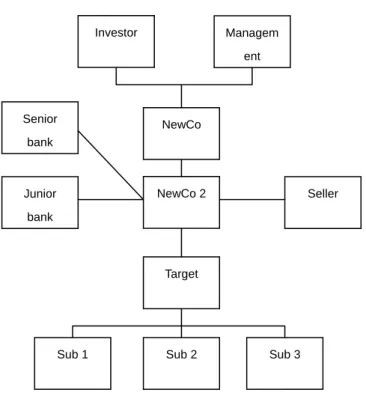
As we mention above, fund providers are formed by wealthy individual, bank, pension fund, insurance, hedge fund, and other public institution. When fund manager figure out the budge for this LBO transaction, they would negotiate with fund providers in order to acquire financial support. Bank loan is the primary source of acquisition financing which could follow fixed interest payment. And then, mezzanine debt would be the secondary financing source for LBO which is required higher expected return than bank loan. According to characteristic of mezzanine debt, it is often repaid when company is sold. Thus mezzanine debt bears much higher risk, and the risk premium would be comparatively higher than bank loan. In negotiation, fund manager must determine the final loan agreement which is flexible in expiration date. The loan agreement would be negotiable to extend the date for financial support in case LBO transaction could not achieve target performance within initial period. However fund manager should often report their performance during transaction, it can help investors to follow up their investment, and will be easier for the second financing. In Figure 1, we have a clear view about a typical LBO structure. NewCo is representing PE firm which consists of general partners and limited partners. LBO is one of private equity investment techniques in financial market which is described by NewCo2. Responsibility of LBO fund manager is looking for Target for LBO transaction, and their financing is mainly from bank loan, mezzanine debt and other source. Banks will be senior loan in NewCo2, thus bank loan would be ranked before PE firm. Mezzanine debt and other sources are belonging to junior loan which is ranked after senior loan. Normally, PE firm and LBO fund may provide security for loans, but their assets are only the shares in LBO fund and Target firm respectively. If there were something going wrong in LBO transaction, the bank will get its money first.
Fund manager would adjust capital structure of target after they have sufficient capital for LBO transaction, and they would process investment plan to create value adding. If company achieves final target performance in certain period, fund manager would push company exiting from LBO transaction. Otherwise, this transaction has to be extended expiration date. As we mention above, fund manager should construct an initial exit strategy when they determines target firm. This exit strategy would be changed due to variable economic
environment, thus fund manager should trace internal environment and external environment in order to find out the most beneficial exit strategy.
Figure 1. Structure of a typical leveraged buyout 22
2.2 Exit LBO
During the period of LBO, the listed company would be the unlisted which means company will be stopped shares trade in the public stock market. Thus, PE funds would push this target company going public again in order to exit from LBO transaction, and gain the return of investment. This is the typical exit strategy for LBO companies which used to be the listed. The choice of exit strategy is important to determine how much return you will gain from this PE investment, funds managers would decide exit strategy according to company’s condition. Except for company going public again, there are flotation, trade sale, and share repurchasing as well.23
22
Andersen, T. K. (2008) Buyout Transaction. Merc. Private equity and Hedge fund. Copenhagen of University. 25th May 2008
23
See book: Povaly, s. (2007) Private Equity Exits: divestment process management for leveraged buyout. Heidelberg: Springer-Verlag Berlin Heidelberg. ISBN: 9-78-3-540-70953-4. Ch.4 PP. 181-276
NewCo Senior bank Junior bank NewCo 2 Seller Managem ent Investor Target Sub 3 Sub 2 Sub 1
z Floatation is initial public offer (IPO), and the original shareholders may choose to sell all or part of their shares, in hope of a substantial growth further into the future.
z Trade sale is mainly used on companies which have no ability to issue IPO, but trade sale often gets the high price.
z Share repurchasing is the rare way to exit. Company does not go public due to the management insisting on independence while a small group of investors wish to exit. Then they will purchase their shares from other new private investors. Typically, these kinds of share purchasing are private deals.
z Going public again is also called refinancing, and company issues new shares to pay debt in order to completely quit LBO.
A successful LBO investment based on when company should exit, and how to exit. Fund mangers often identify the scheduler of exiting from company’s internal and external environment, and try to gain return as high as possible. For internal environment observation, we focus on company annual financial report which reflects financial performance, and fund mangers would figure out whether company create value after LBO, and how much value are created. The suitable exit strategy is often determined by company financial situation. For external environment observation, we typically use porter five forces24 to define industry risk exposure which analyzes business cycle from supplier power, buyer power, threat of substitutes, barriers to entry, and rivalry. According to predictability industry trend, LBO companies could decide the scheduler of exit.
2.3 Potential LBO firms
The LBO candidates could be unlisted mature companies which already have stable market share, and company need to pay a lot of tax for income. According to the theory of trade off, the high debt ration would be the optimal choice for company due to tax shield. But Brealey & Myers (2003) concluded that the trade-off theory accepts that target debt ratios may vary
24
Porter's five forces analysis is a framework for the industry analysis and business strategy development developed by Michael E. Porter of Harvard Business School in 1979 .
from firm to firm25.A positive debt-equity ratio could be determined by evaluation of tax shields and costs of financial distress.
But there is another kind of companies which could be the potential of LBO firm as well, and these candidates are normally the listed companies. Because company wants to diversify business divisions which are lacking of high quality management team and sufficient financial support, LBO could be a good choice for development in order to avoid antitrust legislation. During transaction, company would switch the listed to the unlisted situation. Thus their exit strategies are generally trade sale and shares repurchasing.
In order to evaluate whether the firm has ability to fulfill the debt obligation, we should check the revenue of company which represents the capacity of cash generation. If the EBITDA (earnings before interest, taxes, depreciation and amortization) was in situation of slumps, this company could not perform their debt payment well. Thus the company may face financial distress even bankruptcy.
In Scandinavia, there are 6 primary investment criteria of the private equity26:
High (relative) market share (market leader position or strong follower)
High underlying market attractiveness
Strong management team and prudent business plan
Predictable cash flow
Potential need for growth capital
Restructuring and/ or growth opportunities
2.4 Motivation for LBO
Tax shield is one of the attractive reasons to LBO. Brealey & Myers (2003)27 mentioned the risk of the tax shields is equal to the interest payment, and then the present value of the tax
25
Brealey, R. A. & Myers, Stewart, C. (2003) Principles of Corporate Finance. 7th edition. The Irwin/McGraw-Hill series in Finance, Insurance, and Real Estate. Boston: McGraw-Hill/Irwin, cop. ISBN: 0-07-294043-3. Ch. 4-6
26
This primary investment criteria of PE is picked up from Jacob Andersson (2005) “An Insight to the dynamics of the Leveraged buyout” Master thesis, Copenhagen Business College. Jacob collected this information from among the key Nordic PE funds (CVC, EQT, Industri Kapital and Nordic Capital. (All information available on their respective websites.))
27
Brealey, R. A. & Myers, Stewart, C. (2003) Principles of Corporate Finance. 7th edition. The Irwin/McGraw-Hill series in Finance, Insurance, and Real Estate. Boston: McGraw-Hill/Irwin, cop. ISBN: 0-07-294043-3. Ch. 6
shield would be the corporate tax multiply with the amount of debt. Therefore, if company has more debt, they would gain more tax benefit which is following the theory of trade off. However, in fact, too much debt would bring high interest payment, and company would be much easier to meet financial distress or bankruptcy in this kind of capital structure unless the firm has excess debt capacity which is applicable for firms with safe cash flows and relatively low operating risk. Increased tax shield is always the core reason for adopting LBO since the seller could get more benefit form the selling price. On the other hand, debt financing is cheaper than equity financing due to Pecking order theory.
Conglomerate discount is another important incentive which could provide sufficient financial support and high quality management team to company for business division development. As we know diversification of business could reduce the market risk for predictable earning, but some listed companies are afraid their small part divisions’ development would negatively affect the whole company value in stock market. Once company adopts LBO, the listed would be unlisted in order to avoid legislation interference. Brealey & Myers (2003)28 claimed that the market value of the whole conglomerate is less than the sum of the values of its parts. Leveraged buyout could help target firm to improve their individual division value.
Free cash flow could be other reason to adopt LBO, because debt is cheaper financing which is following pecking order theory. Each company needs free cash flow to support new profitable project, when company is impossible to gain internal financing, debt will be the optimal choice due to cheaper cost. As we know, debt would decrease the agency costs of free cash flow, and increase tax shield. But high leveraged are always following high interest payment, manager will do the new project more considerate and thoughtful sine they bear much more pressure about free cash generation. Thus LBO not only provides sufficient financial support, it also incentives manger to put more diligence in their job.
28
Brealey, R. A. & Myers, Stewart, C. (2003) Principles of Corporate Finance. 7th edition. The Irwin/McGraw-Hill series in Finance, Insurance, and Real Estate. Boston: McGraw-Hill/Irwin, cop. ISBN: 0-07-294043-3. Ch. 4-6
2.5 Successful factors for LBO
How can we handle a successful LBO? It has to depend on some key factors: a prospect company, financial statement, management team, financiers, the exit strategy, and other exogenous factors.
As we mention above, leveraged buyout is not suitable for every companies. The prospect firms of LBO only focus on mature companies who have steady cash flow generation but few profitable opportunities for long-term development. We also call this kind of company as cash cow.29 Then LBO candidates should be checked by financial statement, in order to figure out whether company has capability to fulfill debt obligation. Furthermore LBO target firm should hold tangible assets much more than intangible, because company with a lot of tangible assets could be gain more tax benefit from high debt capital structure, and tangible asset would be much easier to sell under any buyout intention.
A qualified management team is another crucial factor for a successful LBO. Because managers’ diligence would positively affect company financial performance which is relative to sustain stable cash flow for high interest payment and debt obligation, fund conductor must require plenty of working experience, and professional knowledge. Otherwise, management team would lose their reputation from fund raisers, and it will be difficult to inject new capital. The selection of exit strategy is relative to managers’ diligence effect as well, there are many ways to exit LBO transaction which are flotation, trade sale, refinancing, going public again, and IPO. Then it is timing, managers should balance the view of internal and external environment to consider what the best time to implement exit strategy is, in order to reach the final victory.
2.6 Negative impact of LBO
Leveraged buyout is not perfect in the real life, although they are helping company to exploit their potential value. In this section, we have to talk about critique of LBO.
29
Leveraged buyout always needs a stable cash flow for interest payment and amortization on debt, so it may risk essential investment capital for long term strategy. Furthermore, LBO also needs an efficient team work to bring a positive impact on financial performance, it needs to handle well incentive problem within management team.
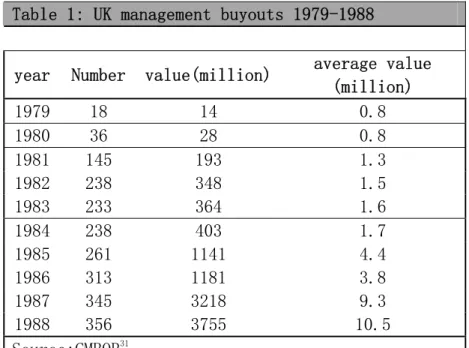
Lloyd (1997) recorded 149 management buyout companies from 1979 to 1988 which was observed by Chiplin 30. You can see the table below:
Chiplin (1992) used yearly data to evaluate the long-term financial performance on management buyout companies. It showed fluctuation year by year, since each company considered to do better than the averaged of industry sector.
“On averaged, buy-out firms performed better over the medium term (up to 3 years), but over
the longer term (4-7 years) financial performance was worse than the industry average”.32
30
Lloyd, B. (1997) Creating value through acquisitions, demergers, buyouts and alliances. 1st edition. Oxford: Pergamon. ISBN: 0-08-043055-4. pp.135
31
Chiplin, B., Wright, M., & Robbie, K. (1992) “U.K. Management buy-outs 1990-Brian Chiplin, Mike Wright and Ken Robbie, The centre for Management Buy-Out Research Unviersity of Nottingham”. Long Range Planning, Vol. 25, No 3,
pp.124
32
Lloyd, B. (1997) Creating value through acquisitions, demergers, buyouts and alliances. 1st edition. Oxford: Pergamon. ISBN: 0-08-043055-4. P137
Table 1: UK management buyouts 1979-1988
year Number value(million) average value
(million) 1979 18 14 0.8 1980 36 28 0.8 1981 145 193 1.3 1982 238 348 1.5 1983 233 364 1.6 1984 238 403 1.7 1985 261 1141 4.4 1986 313 1181 3.8 1987 345 3218 9.3 1988 356 3755 10.5 Source:CMBOR31
At the beginning of LBO transaction, fund manger would face pressure of financial performance since company only depends on free cash flow to serve debt obligation. Thus, fund mangers should have a clear view of company’s situation, strengthen strongpoint, and improve weakness. As we mention before, expiration date of PE funds is determined by company’s financial performance, and this certain investment period will be normally taken 3-5 years. But if company could not reach target financial performance, LBO transaction would extend the date of management. In contrast, if fund mangers spend more effort to help company value creation, LBO transaction would gain return on the certain period. Extending the date of LBO transaction, company would be more pressure to face financial distress since the period of interest payment will be extended as well. Furthermore, long-term debt payment will increase risk of management since company should be more considerate and thoughtful to choose every new project in this variable economic environment. Therefore, manager’s effort would be the most important factor to influence result of LBO transaction, and their diligence process determines whether LBO transaction would be successful or not. If PE investment recruits wrong person who does not qualify as a fund managers to manage funds investment, it would be a negative impact of PE investment.
After the buy out, most of companies just work on short-term cash flow generation since they hurry to decrease leveraged in capital structure. Therefore, they would often abandon some long-term profitable investment in order to cumulate current cash flow for the payment of debt. Then company will miss some important development opportunities for long-term, it is easily going into receivership.
IPO would be one of important exit strategy which is suitable for mature privacy company. The first important factor is the scheduler of IPO which must be consistent with positive signal effect in financial market. Because many investors do not know the real condition of company, and they often collect information from financial annual report, media entertainment, or company announcements, there would be information asymmetric existing. If company issues IPO under the negative signal effect, company’s true value would be destroyed. Another factor is about financial support before IPO. As we mention before, fund
managers should report their performance to fund providers in order to acquire the second financing in LBO transaction. If fund providers found there is not any value creation in this investment, they would stop financing for the next period investment in order to avoid the threat of exit value. Just like Industri Kapital exited companies through IPO’s, which have been very unsuccessful and raised considerable media-debate about corporate raiders.33
2.7 Partial Conclusion
The character of leveraged buyout is high debt, thus high interest payment and debt repayment would motivate managers working hard for cash flow generation. Bank loan would be the primary financing in LBO transaction. Except for bank loan, there are Mezzanine debt and equity providers as well. Exit strategy is crucial to determine how much return will be acquired in this investment. Fund managers would identify the scheduler of exit from LBO investment which is based on company’s financial performance and industry environment. Exit strategies include IPO, trade sale, share repurchasing, and going public again, fund manager would determine specific strategy in terms of company’s condition. The prospect of LBO must be a mature company which has stable cash flow generation, tangible assets, and lots of taxable income to shield. These target companies adopt LBO transaction, because high debt financing would reduce tax payment due to tax shield, and it is cheaper than equity financing. Fund manager effort is the most important factor to influence benefit of LBO transaction, and high return reflects their diligence process. Meanwhile, fund manager should have unique perception of economic environment, and have plenty working experience, because LBO transaction would increase debt ratio within capital structure, and the high interest payment and debt repayment need managers’ efficient working plan to fulfill. Thus if PE investment does not recruit a right person to manage fund, LBO companies would much easier go to bankruptcy due to heavy interest and debt payment.
33
Chapter 3: Capital Structure of LBO
This chapter will discuss the capital structure in the LBO, including issues such as the debt-equity, trade- off, costs of financial distress and bankruptcy. This is complemented by existing research on the cost of distress.
Leveraged buyout means high weight of debt within capital structure, increased tax shield and reduction of agency cost are the positive views of LBO. On the other hands, the high leveraged would be easy to lead to financial distress and bankruptcy.
3.1 Modigliani & Miller
In the first beginning, Modigliani & Miller (1958)34 explained that the company was independent of the financial structure, which were without tax shield on the interest payment and bankruptcy costs. But after five years study in this topic, they argued the existence of tax subsidies on interest payment would cause the value of the firm to raise with the amount of debt financing. Therefore, Modigliani & Miller (1963)35:
“In real world problems of financial strategy, which are not fully comprehended within the framework of static equilibrium models, there is a “need for preserving flexibility” as will normally be implied by the maintenance by the corporation of a substantial reserve of
untapped borrowing power” (from: Modigliani, F. & Miller, M. (1963) “Corporate income taxes and
the cost of capital: A correction”. American Economic Review, (June), PP.442)
We image a company which is full of debt in capital structure, thus management level would bear heavy pressure when they choose new project for business development. Because high debt induces high interest payment, company requires sustaining stable cash flow for its debt obligation. If company failed in investment project, they would be high probability to delay interest payment. Thus high debt capital structure often pushes company to work harder, such as a man is walking on the tightrope, he should play attention anytime, and otherwise he would fall accidently. LBO transaction would be much easier to motivate management level
34
Modigliani, F. & Miller, M. (1958) “The cost of capital, corporate finance and the theory of investment”. American Economic Review, Vol. 74, No. 4, Fall, pp. 509-522
35
Modigliani, F. & Miller, M. (1963) “Corporate income taxes and the cost of capital: A correction”. American Economic Review, Vol. 53, No. 3, June, pp. 433-443
working hard in order to avoid an extremely precarious situation.
However, Jensen (1998)36 argued that the bankruptcy costs would be changed by fluctuation of future cash flow. That is opposed for M&M theory who thought the company value will be increased by tax shield, sometime high debt will induce high possibility of financial distress or bankruptcy. Interest and principal payment are obligations, thus if these obligations are not met, the ultimate distress is bankruptcy. In reality, the firm can not ignore bankruptcy cost when it has bankruptcy risk. The probability of bankruptcy has a negative effect on the value of the firm. So the optimal debt-equity ratio would be higher in a world with agency cost of equity than in a world without these costs.
Fama and Miller (1972)37 also supported this idea:
“At this point, there is little in the way of conceiving research, either theoretical or empirical,
that explains the amounts of debt that firms do decide to have in their capital structure.” (from:
Fama, E. F. & Miller, M. (1972) “The theory of finance”. Holt, Rhinehart and Winston. PP. 173)
High debt financing would reduce free cash flow since company must do obligation for interest payment and debt repayment. The free cash flow hypothesis38 implies that debt reduce the opportunity for managers to waste resource. In fact, there are not companies with capital structure of 100% debt due to risk aversion.
3.2 Financial efficiency of leveraged
High leverage capital structure could be promoted by increased tax shield and operational efficiency.
Tax shield – direct effects
36
Jensen, M. (1998) Foundations of organizational strategy. Cambrigdge, Mass. USA: Harvard University Press, ISBN: 067-464-3429. Ch. 12. pp. 345-362
37
Fama, E. F. & Miller, M. (1972) “The theory of finance”. Holt, Rhinehart and Winston. PP. 173
38
“A manager can only pad his expense account if the firm has the cash flow to cover it. Thus, we might expect to see more wasteful activity in a firm with a capacity to generate large cash flows than in one with a capacity to generate only has recently attracted the attention of the academic community.” From The seminal article is Michael C. Jensen, “the agency costs of free cash flow: corporate finance and takeovers,” American Economic Review (May, 1986). P323-39
Tax shield can be a powerful incentive for LBO, because companies always have a lot of taxable income. High financial leveraged would bring the tax benefit, which regards to U.S. tax regulation: government provides subsidy for debt financing within company39. Tax shield is under the financial leveraged, so leveraged company would receive additional subsidy which doesn’t exist for unleveraged company.
Management incentives – indirect effects
Within LBO Company, fund raisers will work closely with the senior management of the business, who is supported and relied on efficiency improvement. If they are not able to perform well, they will be replaced for who can be appropriate incentives by a profit-related bonus. On the other hand, high Financial leveraged would push managers more efficient to create value due to debt payment. Thus, management will not only focus on revenue enhancement, but also the cost reduction.
High revenues usually could be from more aggressive pricing, more effective marketing, re-designed product, and advanced market research, but these should consistently rely on high quality specialist management and industry expertise. About cost reduction, company should cut back working capital under the long-term strategy, don’t just for the current free cash flow. Generally, all these strategic decisions must base on manager’s diligence, which is involving in day-to-day management of company.
Palepu, Healy and Bernard (2004) 40described about the characteristic of value-eroding due to managers’ performance:
1. High ratios of general and administrative expenses and overheads to sales, (which should
be compared to that of competitors)
2. Significant new investments in unrelated areas.
3. High levels of expected operating cash flows from pro forma income and cash flow
statements.
4. Poor management incentives to create additional shareholder value, evidenced by a weak
linkage between management compensation and firm performance.
39
Ross & Stephen, A. (2005) “Corporate Finance” 7th ed. The McGraw-Hill/ Irwin series in finance, insurance, and real estate. ISBN: 007-282920-6. Ch 15.5, PP. 419
40
Palepu, Krishna, G., Healy, Paul, M., Bernard, & Victor, L. (2006) “Business analysis and valuation using financial statements” Ch. 6
3.3 Cash flow plays an important role
We have been repeated many times about free cash flow in previous sections. It is not doubt that cash flow plays an extremely important role in LBO, since high debt is always with high interest payment. Except for this, free cash flow also needs to fulfill the principal payment. Company should sustain stable free cash flow generation to serve debt obligation, otherwise, they will face financial distress.
The value of firm’s assets is always formed by the value of liabilities and the value of the equity, so the cash flows received from the firm’s asset, CF(A), must be equaled the cash flow to the firm’s creditors, CF(B), and equity investors, CF(S): CF(A)= CF(B)+ CF(S)41
3.4 Cost of financial distress
Brealey and Myers (2003)42 argued that cost of financial distress will appear when company could not fulfill payment to creditor or lost reputation. The costs of financial distress depend on the probability of distress and the magnitude of costs encountered if distress occurs. Typically, cost of financial distress is divided into direct cost and indirect cost, as Altman (1993)43 found that the direct cost and indirect cost of bankruptcy amount to approximately 15% of predistress firm value for industrial firms and about 7% for retailers.
Generally, companies predict the financial distress cost which should be based on the total market value before distress occurs. So the firm’s pre-distress value is
PDV = LCD + CDD + GVR ①
Where: PDV = the predistressed value of the bankruptcy firm; LCD = the loss causing the distress; CDD = the firm’s cost of dealing with the distress; GVR = the gross value recovered by claims holders.
41
This formula is based on balance sheet regulation, debt and equity must be equaled to the total asset of company.
42
Brealey, R. A., Stewart, C. & Myers (2003) “Principles of Corporate Finance” Ch. 4-6
43
Altman, E. I. (1993) Defaulted bonds: demand, supply and performance. Financial analysis journal, Vol. 49, No 3, May/June, pp. 55-61
Altman (1993) and Franks & Torous (1994)44 used this equation to estimate the PDV. However, this standpoint will ignore the beginning of distress happening, which can not be reflected on the financial report in time.
Andrade & Kaplan (1998)45 researched that many companies are involved in financial distress due to leveraged buyout in 1980s, and they redefined the cost of financial distress. From the view of qualitative analysis, financial distress cost should include: cutting back working capital on consistent profitable investment, assets only accepted as partial payment for a new purchase, and cost form the delay of bankruptcy process. So we modify the equation ① as below:
GVR = NVR + CRC ② and TDC = CDD + CRC ③
Which: NVR = the net value recovered by claims holders, CRC = claims holders’ cost of obtaining that recovery, TDC = the total bankruptcy- related cost borne by claims holders in dealing with bankruptcy.
Then we substitute Equation ② and ③ into Equation ①, we can get : PDV = LCD + CDD + NVR + CRC → PDV = LCD + TDC + NVR Direct cost of financial distress
Direct cost of financial distress is from legislation, administration costs of liquidation. These costs are actually small as a percentage of firm value. If company achieves a good performance currently, the probability of bankruptcy would be small percentage, and the cost of bankruptcy would not be large part of firm value.
Within this part of financial distress cost, the largest payment is for professional fee which is paid to the creditors’ committee’s legal counsel and certain other expense. Lubben (2000)46
44
Franks, J., & Torous, W. (1994) A comparison of financial restructuring is distress exchanges and Chapter 11 reorganizations. Journal of Financial Economics,Vol. 35, pp. 349-370
45
Andrade, G., & Kaplan, S. N. (1998) How costly is financial (Not Economic) distress? Evidence from highly leveraged transactions that became distressed. The journal of finance, Vol. 53, No. 5, October, PP.1443-1493
46
Lubben, S. J. (2000) “The Direct Costs of Corporate Reorganization: An Empirical Examination of Professional Fees in Large Chapter 11 cases”. American Bankruptcy Law Journal, Vol. 74, No. 2, Fall, pp. 509-522
estimated the averaged cost of legal fees along to be about 1.5 % of total assets for bankrupt firms. Furthermore, Warner (1977)47concluded the expected cost of bankruptcy:
“Suppose, for example, that a given railroad picks a level of debt such that bankruptcy would occur on average once every 20 years (e.g. the probability of going bankrupt is 5 % in any given year). Assume that when bankruptcy occurs, the firm would pay a lump sum penalty equal to 3% of its now current market value…, the firm’s expected cost of bankruptcy is equal
to fifteen one-hundredths of one percent of its now current market value.” (from:Warner, J.B.
“Bankruptcy Cost: Some Evidence,” Journal of Finance, (May 1977) PP.126-135)
Indirect cost of financial distress
Though these indirect costs clearly exist, it is quite difficult to estimate them quantitatively. Bankruptcy affects customers and suppliers. Sales are frequently lost due to both fearing of impaired service and lost of trust. Cheng & McDonald (1996)48 explained that company will decrease the profit by reduction of market share, and they will face financial distress thereafter.
However, the probability of financial distress increases rapidly with additional borrowing. We should be sure that company can get the benefits form tax shield. Otherwise, the profit will be eroded.
3.5 Trade-off theory
Trade-off theory is helping company to decide how much debt and equity should be financing in capital structure. They should estimate whether the target debt ratio will bring the tax benefit compared with interest payment.49 However, trade-off theory could not exactly measure firm’s debt structure, since intangible assets always rely on equity financing, and only tangible asset needs debt financing.
47
Warner, J.B. “Bankruptcy Cost: Some Evidence”. The Journal of Finance, Vol. 32, No. 2, May, PP.337-347
48
Cheng, T., & McDonald, J. (1996) “Industry structure and ripple effect of bankruptcy announcements”. Financial Review, Vol. 31, No 4, November, pp. 783-807
49
Kraus, A. and Litzenberger, R.H. (1973) A State-Preference Model of Optimal Financial Leverage. The Journal of Finance, Vol. 28, No 4, September, pp. 911-922.
We have discussed the potential LBO candidate before, these target company should be mature, a lot of tangible assets, cash-cow business in the market-leading position, but with unfavorable opportunities for long-term development. Base on the analysis of trade-off theory, this kind of company could through high debt ratio to improve organization efficiency.
3.6 Optimal debt structure
Managers should choose the capital structure that they believe will have the highest firm value, because this capital structure will be most beneficial to firm’s stockholders.
If a firm is considering issuing debt to buy back some of its equities, the amounts of share holders will be decreased. So the variability of EPS (Earning per share) increases, the risk increases, and the required return increases as well. In other words, any increases in EBI (Earning before interest) leads to a greater risk in EPS for the leveraged firm, because the increased earning is distributed over fewer shares.
Although, debt reduces free cash flow, the firm must make interest and principal payment. The free cash flow hypothesis implies that debt would reduce the opportunity for managers to waste resources
So the optimal debt structure should depend on business risk and the type of assets. We can estimate the situation of cash flow, degree of business risk and other specific measurement from firm.
Chapter 4: Conclusion
As we know, the target firm for LBO should be mature with stable cash flow, but few net present value investment opportunities. Through capital structure, we can clearly know whether a company could be a LBO target company or not. The situation of the cash flow is helping to distinguish cash-cow industry, which is a necessary condition for leveraged buyout candidate. Meanwhile, cash flow is relevant for the prediction of financial distress, which includes direct cost and indirect cost. Direct cost includes the legal cost, administration of
liquidation, and indirect cost is about credit crisis due to financial distress. Base on the cost forecast, we can minimize the uncertainty level in the future.
Therefore, value creation in leveraged buyout is from operating improvement and utilization of assets of the company, which are direct drivers for LBO. Meanwhile, the incentive of management is playing the role as indirect.
Leveraged buyout mainly represents the private equity, and it can be seemed as an important financial technique during the business cycle. We think that the real primary driver of the private equity market will be the availability of investor capital and the attractiveness of expected return. A successful LBO not only needs suitable economic climate, but also concerns about the company internal factor.
Reference
1. Altman, E. I. (1993) “Defaulted bonds: demand, supply, and performance, 1987-1992”.
Financial Analysis Journal. Vol. 49, No 3, pp.55-61
2. Andrade, G., & Kaplan, S. N. (1998) “How costly is financial (Not Economic) distress? Evidence form highly leveraged transactions that became distressed”. The Journal of
Finance, Vol. 53, No 5, October, pp.1443-1493
3. Anonymous (2002) “BVCA sets fund raising guidelines”. European Venture Capital
Journal, ISSN: 09541675, Feb 2002, pp. 6
4. Anonymous (2002) “Leveraged loans make slow recovery”. European Venture Capital
Journal, ISSN: 09541675, Feb 2002, pp. 6
5. Agrawal, A. & Mandelker, G. (1990) “Large Shareholders and the Monitoring of Managers: The Case of Antitakeover Charter Amendments”. Journal of Financial &
Quantitative Analysis, Vol. 25, No 2, June, pp.143-161
6. Borokhovich, K., Brunarski, K., & Parrino, R. (1997) “CEO Contracting and Antitakeover Amendments”. The journal of finance. Vol. 52, No 4, September, pp.1495-1517
7. Cheng, T., & Mc Donald, J. (1996) “Industry structure and ripple effect of bankruptcy announcements”. Financial Review, Vol. 31, No 4, November, pp. 783-807.
8. Chiplin, B., Wright, M., & Robbie, K. (1992) “U.K. Management buy-outs 1990-Brian Chiplin, Mike Wright and Ken Robbie, The centre for Management Buy-Out Research Unviersity of Nottingham”. Long Range Planning, Vol. 25, No 3, pp.124
9. Cuny, C. & Talmor, E. (2007) “A theory of private equity turnarounds”. Journal of
Corporate finance, Vol. 13, No 4, pp. 629-646.
10. DeAngelo, H. & Rice, E. (1983) “Antitakeover Charter Amendments and Stockholder Wealth”. Journal of Financial Economics, Vol. 11, No 1-4, April, pp. 329-59
11. Engleman, K. & Cornell, B. (1988) “Measuring the costs of corporation litigation: Five case studies”. Journal of Legal Studies, Vol. 17, No 2, October, pp. 377-399
12. Fenn, G., Liang, N., & Prowse, S. (1995) “The Economics of the Private Equity Market”.
Staff studies with number 168.
13. Franks, J., & Torous, W. (1994) “A comparison of financial restructuring is distress exchanges and Chapter 11reorganizations”. Journal of financial Economics, Vol. 35, pp. 349-370
14. Fung, W., & Hsieh, D. (2006) “Hedge Funds: An Industry in Its Adolescence”.Economic
Review. Feberal Reserve Bank of Atlanta, Fourth Quarter. pp. 1-34
15. Garvey, G. & Hanka, G. (1999) “Capital Structure and Corporate Control: The Effect of Antitakeover Statutes on Firm Leverage”. Journal of Finance, Vol. 54, No 2, April, pp. 519-46
16. Czerwinski, S. J. (2000) “Small Business: Expectations of Firms in SBA’s 8(a) program are not being met”. United States General Accounting Office, GAO/T-RCED-00-261, July 20. pp. 1-17
17. Hoyem, G. &Yen, R. (2007) “Catch a ride on the tech buyout wave”. Venture Capital
journal, No 8, pp. 33-34.
18. Kraus, A. & Litzenberger, R. H. (1973) “A State-Preference Model of Optimal Financial Leverage”. Journal of Finance,Vol. 28, No 4,September, pp. 911-922
19. Linn, S. & McConnell, J. (1983) “An empirical investigation of the impact of ‘anti-takeover’ amendments on common stock prices”.Journal of Financial Economics,
Vol. 11, No. 1-4, pp. 361-399.
20. Lubben, S. J. (2000) “The Direct Costs of Corporate Reorganization: An Empirical Examination of Professional Fees in Large Chapter 11 cases”. American Bankruptcy Law
Journal, Vol. 74, No. 4, Fall, pp. 509-522
21. Modigliani, F. & Miller, M. (1958) “The cost of capital, corporate finance and the theory of investment”. TheAmerican Economic Review, Vol. 48, No. 3, June, pp.261-297 22. Modigliani, F. & Miller, M. (1963) “Corporate income taxes and the cost of capital: A
Correction”. An American Review, Vol. 53, No. 2, June, pp.433-443
23. Myers, S. (2001) “Capital Structure”. The Journal of Economic Perspectives, Vol. 15, No. 2, Spring, pp. 81-102.
24. Prowse, S. D. (1998) “The economics of the private equity market”. Federal Reserve
25. Shleifer, A. & Robert, W. (1997) “A Survey of Corporate Governance”. The Journal of
Finance, Vol. 52, No. 2, June, pp. 737-783
26. Vinten, F. & Thomsen, S. (2008) “A Review of Private Equity.” Working Paper no. 1, Copenhagen Business School.
27. Warner, J. B. (1977) “Bankruptcy cost: some evidence”. The Journal of Finance, Vol. 32, No. 2, May, pp.337-347
Books:
1. Brealey, R. A. & Myers, Stewart, C. (2003) Principles of Corporate Finance. 7th edition. The Irwin/McGraw-Hill series in Finance, Insurance, and Real Estate. Boston: McGraw-Hill/Irwin, cop. ISBN: 0-07-294043-3. Ch. 4-6
2. Fama, E. F. & Miller, M. (1972) The theory of finance. Holt,Rhinehart and Winston. Ch. 4, pp.145- 187
3. Fraser-Sampson, G., (2007) Private Equity as an Asset Class. 1st edition. The Wiley Finance Series. Chichester. : Wiley, J. & Sons, incop. ISBN: 9-780-4700-6645-4
4. Greve J. (1990) How to do a leveraged buyout. 3rd edition, Englewood Cliffs, NJ: Prentice Hall, Cop. ISBN: 0-13-404906-3. Ch. 7-12.
5. Jensen, M. (1998) Foundations of organizational strategy. Cambrigdge, Mass. USA: Harvard University Press, ISBN: 067-464-3429. Ch. 6, 7, 8, 9, 10 & 12. pp. 153- 300 & pp. 345-362
6. Lloyd, B. (1997) Creating value through acquisitions, demergers, buyouts and alliances.
1st edition. Oxford: Pergamon. ISBN: 0-08-043055-4. pp. 137 & PP.135
7. Loos, N. (2006) Value Creation in Leveraged Buyouts: analysis of factors driving private
equity investment performance. 2nd edition. Germany: Deutscher University-Verlag.
ISBN10: 3-8350-0488-3 or ISBN13: 9-78-3-8350-0488-7. Ch. 4-6. pp. 89-390
8. Logue A. (2007) Hedge Funds for Dummies.1st edition. Hoboken, N.J.: Wiley. ISBN13: 978-0-470-04927-3 or ISBN10: 0-470-04927-8. Ch. 10-14.
9. Ogden, J. (2002) Advanced corporate finance: policies and strategies. 1st edition. Upper Saddle River, NJ: Prentice Hall, cop. ISBN: 0-13-091568-8. Ch. 16. pp. 571
10.Palepu, Krishna, G., Healy, Paul, M., Bernard, & Victor, L. (2004) Business analysis and
valuation using financial statements. Mason, Ohio: Thomson/South-Western. ISBN:
0-32-411894-5. Ch. 6
11.Povaly, S. (2007) Private Equity Exits: divestment process management for leveraged
buyout. 1st edition. Heidelberg: Springer-Verlag Berlin Heidelberg. ISBN:
9-78-3-540-70953-4. Ch. 2-5, pp. 15-366
Thesis:
1. Andersson, J. (2005) An Insight to the Dynamics of the Leveraged Buyout. Master Thesis, Copenhagen Business College.
2. Blom, M., Kadiri, Y., & Stendahl, D. (2004) Factors influencing the internationalization of Swedish Private Equity Firms. Master Thesis, Lund University.
3. Wilmes, R. (2007) Choosing the best Private Equity fund. Master Thesis, Lund Unversity.
Internet Source:
1. Bary, A. (2007), “The month of reckoning”. Barron’s, September 3, 2007.
http://online.barrons.com/article/SB118860639155915293.html [viewed 11/04/2008]. 2. Cuff, Daniel F. (1989), “Business People: Deal for Prime Pleases Partners at Whitney”.
New York Times, June 26, 1989.
http://www.nytimes.com/1989/06/26/business/business-people-deal-for-prime-pleases-pa rtners-at-whitney.html?sec=&spon= [viewed 11/04/2008].
3. Kinn, B. A. & Zaff, A. M. (2001), “VCs Tap New Funding Source: The SBIC Equity Leverage Program and the Reasons for Its Growing Popularity”. Venture Capital Journal, July 1, 2001
http://www.foleyhoag.com/~/media/Files/Publications/Generic/VC%20s%20Tap%20New %20Funding%20Source%20%20%20Kinn.ashx [viewed 16/05/2008]
4. Kirsner, Scott. (2008), “Venture capital's grandfather”. The Boston Globe, April 6, 2008. http://www.boston.com/business/articles/2008/04/06/venture_capitals_grandfather/
[viewed 11/04/2008].
5. Oppel JR. R. A. (1999) “Benno C. Schmidt, Financier, Is Dead at 86”. New York Times,
October 22, 1999
http://www.nytimes.com/1999/10/22/business/benno-c-schmidt-financier-is-dead-at-86. ml [viewed 16/05/2008]
6. Thornton, E., Grover, R. & Lowry, T. (2004) “Those Bulging Buyouts; LBO firms are getting bolder, thanks to the strong economy and cheap money”. Business Week, Feb. 9, pp. 74. ISSN: 07398395
http://proquest.umi.com.ludwig.lub.lu.se/pqdlink?did=541115891&Fmt=7&clientId=536 81&RQT=309&VName=PQD [viewed 16/05/2008]
7. “The New Kings of Capitalism, Survey on the Private Equity industry” The Economist, November 25, 2004
http://www.economist.com/PrinterFriendly.cfm?Story_ID=3398496 [viewed 16/05/2008] 8. N. Y. / Region (2000) “Metro Business; A Change of Identity for J. H. Whitney”. New
York Times, June 14, 2000.
http://www.nytimes.com/2000/06/14/nyregion/metro-business-a-change-of-identity-for-j h-whitney.html?n=Top/Reference/Times%20Topics/People/S/Sherman,%20Michael [viewed 16/05/2008]
9. http://www.investopedia.com/terms/p/privateequity.asp (development of private equity) 10. http://wiki.mbalib.com/wiki/Private_equity (introduction of Private equity)
11.http://wiki.mbalib.com/wiki/Leveraged_Buyout (introduction of LBO)
12.http://vcexperts.com/vce/library/encyclopedia/documents_view.asp?document_id=15 Joseph W. Bartlett, "What Is Venture Capital?"
13.http://en.wikipedia.org/wiki/History_of_private_equity_and_venture_capital
Lecture Note:
Andersen, T. K. (2008) Buyout Transaction. Merc. Private equity and Hedge fund. Copenhagen of University. 25th May 2008