S T R A T E G I C W H I T E P A P E R
The Worldwide Web Consortium (W3C) defines a Web Service as a software system designed to support interoperable machine-to-machine interaction over a network. A Web Service system benefits service providers by enabling the creation of new services through the blend-ing of legacy, IP multimedia subsystem (IMS), Internet, IPTV, and other new and existblend-ing service delivery platform (SDP) capabilities. It also enables quick reaction to market changes and lowers required service adoption thresholds. The use of Web Services allows service providers to reduce and simplify operation support system/business support system (OSS/BSS) integration time, abstract network capabilities (call control, presence, location), and create personalized and blended services (both internally and with third-party partners).
This paper examines the nature of Web Services and how service providers can use them to deliver new services and applications to subscribers. It reviews the benefits a Web Services system brings to service provider networks, and explains how those benefits can be aug-mented by balancing Web Services with real-time network protocols. The paper concludes with a review of the Alcatel-Lucent Service Delivery Environment (SDE), which combines real-time policy and call control capabilities with the benefits of Web Services to deliver new value from existing network assets.
Table of Contents
1 Understanding Web Services
1 What is a Web Service?
2 How Web Services Work
2 Using Web Services
4 The Benefits of Web Services
5 Balancing Web Services with Real-Time Network Protocols
6 Alcatel-Lucent’s Approach to Web Services
6 Using Web Services in a Service Delivery Environment (SDE)
6 Alcatel-Lucent SDE
8 Conclusion
8 Acronyms
Understanding Web Services
Technology, specifically Internet protocol (IP), has lowered market entry barriers for voice, video, commerce, and a range of other communication services. It has enabled a multitude of companies, from many domains (broadcast, web, IT, telephony), to compete for subscribers and for wallet share. In fact, analysts predict that by 2010, 30 percent of US households will have chosen to discontinue wireline service from their local phone company1. It is expected that by that time, customers will have moved solely to a wireless carrier or other competing voice and broadband provider such as cable. For wireless carriers, subscriber growth has slowed as regions like Western Europe and North America have approached saturation (projected at 114.5 percent and 85.5 percent respectively for 2007)2. Analysts predict that mobile minutes used globally will reach 9.5 trillion in 2007, a 27 percent increase over 2006, and 19 trillion minutes used by 2012 (340 minutes per month in 2007 to 465 minutes per month in 2012). However, despite the increase in usage, average revenue per user (ARPU) worldwide will continue to fall and is expected to be 12 percent below 2007 levels2.
Service providers need a means to move beyond the commoditization of services that is taking place in the market. The blending of multiple value-added services (for example, caller ID on TV or mobile video conferencing) allows service providers to focus on consumer value, to differentiate within the market, and to grow. Utilization of Web Services, within a Service Delivery Environment (SDE) offers service providers a way to deliver new services to a demanding subscriber base, retain existing custom-ers, attract new customers and develop revenue opportunities. The key to achieving these objectives lies in how service providers integrate Web Services in their existing network infrastructures.
What is a Web Service?
As confusing as the competitive landscape can be, the different technologies, buzz words, and termi-nology used to describe the value propositions of different platforms and frameworks for new service creation and delivery can often be more confusing.
For example, what is the difference between a Web Service, a blended service, and a converged service? What is the difference between a service delivery platform (SDP) and a service delivery environment (SDE)? To answer these questions, it is important to understand what is considered a Web Service.
The Worldwide Web Consortium (W3C) defines a Web Service as a software system designed to support interoperable machine-to-machine interaction over a network. In practical terms, Web Services are application capabilities that can be used as standalone software components in a network. These standalone capabilities can subsequently be linked or combined together without the need to understand the specific programming language, platform or application providing the information or functionality required.
Web Services are explicitly defined, self-contained, and do not depend on the context or state of other interfaces. They currently offer one of the preferred methods for implementing service oriented architecture (SOA) principles:
• Services are autonomous
• Services have well-defined interfaces
• Services can be reused to build composite variations • Services are loosely coupled
• Services are discoverable
1 Yankee Group, “One in 7 US Households say ‘No Thanks’ to Wireline Phone Service in 2010”, Dec. 2006 2 Strategy Analysis, “Worldwide Cellular User Forecasts, 2007-2012”, July 2007
• Services are highly interoperable
• Interoperability is based on a formal definition, such as a Web Services profile, and is independent of the underlying platform, programming language and vendor
• Services enable the reuse of components and network assets
By using Web Services to implement SOA principles, service providers can abstract network capabili-ties, create new end user services that consist of multiple capabilities from different applications, and subsequently speed OSS/BSS integration of those new services. In short, using Web Services reduces complexity and enables new revenue opportunities.
How Web Services Work
To illustrate how Web Services might be used, consider what happens when an end user purchases an airline ticket from an online travel service. To facilitate the process, many public web sites and internal company portals will provide multiple flight options and prices from several airline carriers. The web sites and company portals take the user’s information (travel dates, origin, destination and so on), share it with multiple airline databases, and receive airline flight numbers, times, connections, and other pertinent data. The user’s web site/portal then consolidates this information and displays it on screen.
The ability to seamlessly share information between the web site/portal and the many airlines running different flight databases is one example of how Web Services can be used. The website/portal organizes the data into a usable and recognizable view, but a Web Services system makes it possible for the website/ portal to communicate with and understand the different types of information received, without needing to know the underlying database protocols and syntax of each database.
To make this possible, a Web Service uses a standard envelope that:
• Defines requests and replies, and is standardized as a simple object access protocol (SOAP) message expressed in extensible markup language (XML)
• Describes features using web services description language (WSDL), also expressed in XML and standardized to define what the service does (for instance, its coarse-grained features), how it communicates (typically using SOAP or HTTP), and where to find it (typically a URL) Web Service standards such as SOAP, XML, WSDL, WS-Security and security assertion markup language (SAML) are defined by the Organization for the Advancement of Structured Information Standards (OASIS), World Wide Web Consortium (W3C) and WS-I standards bodies. Additional standards include universal description, discovery, and integration (UDDI) for Web Services. While the technical definition of a Web Service continues to evolve as the multiple standards bodies continue their work, many companies have adopted a Web Services profile that is based on the work of these organizations. A Web Services profile indicates the selection and support of a given Web Service standard by a certain product or solution and allows companies to design guidelines that ensure interoperability.
Alcatel-Lucent has adopted the WS-I 1.1 Web Services profile to synchronize product development with standards. This profile benefits service providers by reducing integration time and ensuring consistency, standardization and interoperability of multiple products. As a result, new services can be brought to market quickly and there can be a shorter time-to-revenue.
Using Web Services
The use of Web Services by IT organizations to expose Java EE and .NET application capabilities is well established. Bu there are a few uses of Web Services that can be applied by wireline, wireless and converged service providers to reduce operational complexity and generate new revenue opportunities.
Abstract network capabilities
In the telecommunication domain, Web Services can be used to extract network capabilities. With Web Services network elements (call control, location, messaging among others), OSS/BSS functions (including billing, customer relationship management (CRM), and provisioning), presence, and subscriber profile models can be securely shared with third party developers to jointly develop and/or provide new services to a service provider’s customers. In fact, some service providers are already providing voice calling, conference calling, messaging, authentication, location, contact information and subscriber profile information to registered developers.
The abstraction of network capabilities using Web Services allows service providers to leverage their network’s value for new revenue opportunities, revenue that does not come directly from a subscriber but from third parties using the service provider’s network resources. Presenting network capabilities in a form that is easy for outside developers not familiar with more complicated and powerful proto-cols — such as session initiation protocol (SIP), Internet group management protocol (IGMP) and Diameter — is one way for service providers to use third-party developers and over-the-top players (Google, Yahoo) for new revenue generation.
For example, consider a situation where a concert provider wishes to market audio files, images, and other related products to patrons of a concert. With Web Services, a service provider could expose the real-time presence and location information of subscribers attending the concert and subsequently receive a fee (for example, a percentage of the sale) for each subscriber who chooses to purchase content from the vendor. By abstracting presence and location information to third-party content providers, the service provider is now a part of the real-time value chain of concert merchandising, and at a time where impulse purchasing is highest.
Enable OSS/BSS integration
Globally, service providers are spending an average of 65 cents of every dollar in revenue on opera-tions, administration, maintenance and procurement (OAM&P)3. By using Web Services, service providers can significantly reduce complexity and OPEX costs, and thereby lower their OAM&P. As service providers acquired companies and introduced services, they also implemented hundreds of different provisioning, billing, assurance and inventory management systems. This has created a very complicated and time-consuming process for the integration of new services. Many service providers are now developing an OSS/BSS plan that will no longer require the traditional point-to-point means of integration that has led to the exponential rise in the number of communication and validation paths required. But Web Services enable the lowering of OAM&P by offering a standard means of integrating new services with existing OSS/BSS systems.
Because Web Services expose service capabilities without needing to understand the underlying application or protocols, integration of new services becomes easier. This means that a given process, such as service provisioning, can be standardized and stored in a library. The library, or repository, can then be accessed by other applications that need to use the same process, which subsequently reduces operational complexity and cost.
Create blended services
A service provider’s need to deliver services is now more complicated then ever. Enterprise and/or consumer end users are no longer satisfied with a single new service or capability. Today’s end users expect to have a choice of multiple services and that these services can be seamlessly integrated and combined to satisfy their lifestyle and productivity needs.
Within the web and IT domains, the process of bringing multiple services together is often referred to as a mashup. Within the broadcast and telephony domains, the process of bringing multiple services together is referred to as a converged or blended service. Examples of blended services include:
• Interactive IPTV (TV plus web browsing, shopping, voicemail, e-mail) • Video conferencing across multiple screens (PC, TV, Mobile handset) • Multi-screen content delivery (music, video, news)
• Dual- mode service (cellular to Wi-Fi handoff) • Push-to-X capabilities (talk, instant messaging (IM)) • Voice IM
• Directional and location-based services (show map from points A to B, find the nearest restaurant or theater)
Many of these blended services demonstrate the power of Web Services to combine the service provider’s network capabilities and assets with partner information from other domains. For example, a service provider might provide a subscriber’s geographic location information as a Web Service to a global map program such as Google Maps. As a result, mobile end users can use the service to see their proximity to points of interest (restaurants, banks, museums and so on). The concept also works for someone who is in a fixed location, such as at home watching TV, and wants to know the location of mobile family members.
Blended services allow service providers to position themselves as a vendor of value and not just a “dumb pipe”. Revenue from blended services can replace lost line access charges and provides a means for competitive differentiation.
Blended services that are personalized to the end user’s needs increase loyalty. From the end user’s perspective, the service provider is no longer a commodity vendor of voice, video and data.
The Benefits of Web Services
Beyond enabling the abstraction of network capabilities, easy OSS/BSS integration of new services, and the delivery of blended and personalized services, the use of Web Services by service providers has additional benefits.
Improving the ability to react to market changes
As markets evolve and end-user tastes change, being able to react quickly is vital to a service provider’s ability to compete. A case in point is the explosion of IM traffic over service provider networks. Global IM traffic in 2002 was reported at only 685.4M events, which generated only $1.4M. Today, global IM traffic is expected to grow at a compound annual growth rate (CAGR) of 84 percent, with a corresponding CAGR growth rate in revenue of 65 percent4.
By establishing a network that enables quick reaction to changes in market demand for a service or multiple services, service providers are able to take full advantage of high growth opportunities rather than being late to market on a service that has already reached maturity. Because Web Services are reusable and they do not require knowledge of the underlying application’s protocols and syntax, new services can be created, tested and marketed quickly to take advantage of increasing demand. Lowering subscriber adoption thresholds for profitability
Under the traditional silo approach to the network, service development, integration and launch requires months or years of in-house effort. The resulting incurred costs necessitate a high level of subscriber adoption to ensure payback and eventual profitability.
By taking advantage of large third-party development communities that reuse Web Service compo-nents, new services can be brought to market at a much lower cost. Therefore, a lower number of subscribers are required to justify the investment.
By lowering their costs, adoption threshold and risk, service providers could, theoretically, launch multiple new services for half of what it used to cost to introduce one.
Enabling subscriber access to preferred third-party content
Used in a similar way to the concert promotion example illustrated in Section 1.3, service providers could use Web Services to identify specific end-user preferences (likes and dislikes) to third-party vendors whose products might appeal to the end user. For example, a subscriber who is interested in a particular sports team would only receive promotions related to that team, such as ticket discounts or sales on apparel.
Sharing of specific subscriber preferences through secure and standardized Web Services allows access to target and context-aware third-party content. This can build customer loyalty and reduce churn because subscribers are only exposed to products they have expressed interest in.
Balancing Web Services with Real-Time Network Protocols
It is important to realize that a Web Service system is only one tool developers can leverage when creating new end-user services. Figure 1 demonstrates the tradeoffs between Web Services and traditional telecommunication protocols.
Different technologies cater to the needs of different applications and provide a variety of control and sophistication. Therefore, the more abstracted the network capability (such as through Web Services or Parlay X), the easier it is for developers to use, but with less control and less power. Because Web Services are simple and do not require knowledge of underlying application protocols and syntax, the greater the number of third-party developers that can be leveraged to deliver services. However, this comes at the expense of having less real-time capability and scalable capacity.
Figure 1. Balancing Web Services with Network Protocols
Control/Powe r # Developers/Applications Ease of Une Real-T ime, Scal e SS7, SIP, XCAP Parlay/OSA Parlay X Web Services APIs Service APIs Network Protocols
At the other end, and closer to the end user, lie the underlying network protocols. While more com-plex than Web Services and hence with a smaller developer community, they offer greater real-time, scalable control and power to leverage the underlying applications’ complete capabilities.
To properly take advantage of Web Services and all other technologies and tools available to them, service providers need to balance their need to rapidly and cheaply launch blended services to market with the expectations of their customers for real-time quality and reliability.
Alcatel-Lucent’s Approach to Web Services
Using Web Services in a Service Delivery Environment (SDE)
While some service providers pursue a bundled strategy as a means to decrease churn, global market data suggests that consumers actually expect to pay less for bundled services (Japan 62 percent less, North American region 75 percent less, Korea 74 percent less)5. Within the North American region this translates to an average of $40 per month less revenue for bundled services. Yet when asked whether they would switch providers in order to obtain blended services, 24 percent of North Ameri-can enterprise customers said they would. In addition, 36 percent of enterprise customers indicated they would be willing to pay more. The data for consumers suggests a willingness to pay “over and beyond what they would pay for core communications” for their “ideal package” of blended services (NAR $43 to $77 more per month, UK € 11 to € 25 more per month, China ¥254 or $32 more per month). Clearly, there is a market for blended services.
With an SDE, service providers could move beyond bundling strategies and grow revenue by offering differentiated, personalized and blended services. And they could transform the way they create and deliver these new services.
Because of its very nature, an SDE embraces SOA principles and uses Web Services to realize all the benefits outlined earlier in this document. An SDE makes common use of network resources across all applications, reducing network complexity and lowering OAM&P. At the same time, an SDE brings in real-time policy and call control capabilities to ensure low latency applications, such as voice and video, and maintain a high quality of service. It enables service level agreement enforcement through control of access and transport delivery systems.
The SDE’s use of Web Services allows service providers to offer end users their “ideal package” of blended services by lowering integration times, embracing third-party developers, and by providing access to content providers.
Alcatel-Lucent SDE
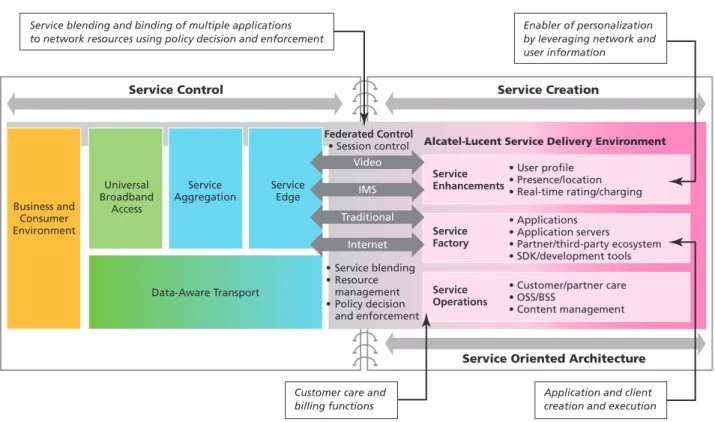
The Alcatel-Lucent Service Delivery Environment (Figure 2) enables service providers to accelerate service innovation for personalized and blended services through an open framework that links operator and partner applications with network resources, service enhancements and operations. This framework incorporates a variety of hardware and software solutions and products:
• IMS core • IPTV control • Application servers
• Subscriber databases (home location register (HLR), home subscriber service (HSS), authentication, authorization and accounting (AAA))
Figure 2. Alcatel-Lucent Service Delivery Environment
It also includes specific products related to Web Services, such as the Alcatel-Lucent 5400 Intelligent Services Gateway (ISG) and the Alcatel-Lucent 8550 Web Services Gateway. These products allow service providers to embrace third-party partners in a secure and controlled manner.
The 5400 ISG provides Parlay X Web Services interfaces to a service provider’s network resources (SMS, MMS, wireless application protocol (WAP), presence, location, call control, charging, IMS/ SIP). With the 5400 ISG, a service provider does not need to replace or upgrade embedded network elements to add Web Services capabilities. The 5400 ISG provides real-time, geo-diverse carrier-grade translation between Web Services and the native protocol of each network element.
The 5400 ISG, together with the Alcatel-Lucent 8550 WSG, offers a secure, controlled network interface that records event data and makes it easier for service providers to monitor, manage and monetize their network.
The Alcatel-Lucent ISG is only one product within the Alcatel-Lucent SDE framework that leverages Web Services capabilities. It is a powerful means for service providers to embrace third-party partners and to start transforming the way services are created and delivered within the larger framework of a SDE.
Business and Consumer Environment Universal Broadband Access Service
Aggregation ServiceEdge
Data-Aware Transport
Service Creation
Service Oriented Architecture Service Control
Federated Control
• Session control Alcatel-Lucent Service Delivery Environment
• User profile • Presence/location • Real-time rating/charging • Applications • Application servers • Partner/third-party ecosystem • SDK/development tools • Customer/partner care • OSS/BSS • Content management • Service blending • Resource management • Policy decision and enforcement Service Enhancements Service Factory Service Operations
Service blending and binding of multiple applications to network resources using policy decision and enforcement
Enabler of personalization by leveraging network and user information
Application and client creation and execution Customer care and
billing functions
Video IMS Traditional
Conclusion
Web Services offer service providers a way to deliver new services to a demanding subscriber base, retain existing customers, attract new customers and develop revenue opportunities. But the key to achieving all these objectives lies in how service providers integrate Web Services in existing network infrastructures.
Service providers can adapt quickly to market conditions and create a competitive advantage by combining the benefits of Web services with a SDE framework.
A properly implemented SDE pulls new value from existing assets, shares common enablers, and uses Web Services as one of the elements to expedite the creation of new blended services. In this way, it allows service providers to profit from exposing network capabilities to third parties, while at the same time reducing the operational complexity, risk and costs associated with delivering blended services.
This is especially important as service providers open up their networks to third-party developers and partners who can supply valuable content to end users. Through this process service providers must be able to define and manage network exposure, ensure security and maintain service level agreements.
By enabling an SDE with Web Services, service providers can be flexible and agile, decrease opera-tional complexity and bring new revenue generating services to market quickly and securely.
Acronyms
AAA authentication, authorization and accounting ARPU average revenue per user
BSS business support system CAGR compound annual growth rate CRM customer relationship management HLR home location register
HSS home subscriber service HTTP hypertext transfer protocol IGMP Internet group management protocol IM instant messaging
IMS IP multimedia subsystems IP Internet protocol
MMS multimedia messaging service
OAM&P operations, administration, maintenance, and procurement
Additional Information
• Main page – http://www.alcatel-lucent.com/wps/portal
• Services Transformation – http://www.alcatel-lucent.com/wps/portal/competitivetransformation/
services
• Alcatel-Lucent Intelligent Services Gateway (ISG) – http://www.alcatel-lucent.com/wps/portal/
products/detail?LMSG_CABINET=Solution_Product_Catalog&LMSG_CONTENT_ FILE=Products/Product_Detail_000088.xml
OSS operations support system SOA service oriented architecture SAML security assertion markup language SOAP simple object access protocol SDE service delivery environment SDP service delivery platform SIP session initiation protocol SMS short messaging service URL uniform resource locator W3C Worldwide Web Consortium WAP wireless application protocol WSDL web services description language XML extensible markup language
www.alcatel-lucent.com
Alcatel, Lucent, Alcatel-Lucent and the Alcatel-Lucent logo are trademarks of Alcatel-Lucent. All other trademarks are the property of their respective owners. The information presented is subject to change without notice. Alcatel-Lucent assumes no responsibility for inaccuracies contained herein. © 2008 Alcatel-Lucent. All rights reserved. CPM219707100 (02)