Repository and Information Exchange
Electronic Theses and Dissertations2018
Development of Texture Weighted Fuzzy C-Means
Algorithm for 3D Brain MRI Segmentation
Ji Young Lee
South Dakota State University
Follow this and additional works at:https://openprairie.sdstate.edu/etd
Part of theElectrical and Computer Engineering Commons
This Thesis - Open Access is brought to you for free and open access by Open PRAIRIE: Open Public Research Access Institutional Repository and Information Exchange. It has been accepted for inclusion in Electronic Theses and Dissertations by an authorized administrator of Open PRAIRIE: Open Public Research Access Institutional Repository and Information Exchange. For more information, please [email protected].
Recommended Citation
Lee, Ji Young, "Development of Texture Weighted Fuzzy C-Means Algorithm for 3D Brain MRI Segmentation" (2018).Electronic Theses and Dissertations. 2946.
DEVELOPMENT OF TEXTURE WEIGHTED FUZZY C-MEANS ALGORITHM FOR 3D BRAIN MRI SEGMENTATION
BY JI YOUNG LEE
A thesis submitted in partial fulfillment of the requirements for the Master of Science
Major in Computer Science South Dakota State University
ACKNOWLEDGEMENTS
I would like to say thank you to my advisor, Dr. Sung Shin for his considerable and continuous advice to me while I am doing my degree program. He gave me the valuable feedback not only for my research, but also on my way to be a researcher.
I also cannot say thank again to committee members of my thesis, Dr. Kwnaghee Won, Dr. Alireza Salehnia, and my graduate faculty representative, Dr. David Wiltse for their help to my thesis in the final defense. With their contributions, I could improve the quality of my thesis an even deeply and rationally. Also, I would like to thank CCT Lab members. I will never forget the day we studied together.
Finally, I do not have enough thanks to my family for their invaluable support that gave to me. Without their help, I could not continue my academic career.
TABLE OF CONTENTS
ABBREVIATIONS………... vi
LIST OF FIGURES/TABLES……….. vii
LIST OF EQUATIONS………... viii
ABSTRACT……… x
INTRODUCTION……….. 1
BACKGROUND……… 3
RELATED WROK………... 11
MATERIALS AND METHODS………. 13
RESULT AND ANALYSIS……… 25
CONCLUSION……… 29
ABBREVIATIONS CSF cerebrospinal fluid
FCM Fuzzy C-Means
GM gray matter
INU Intensity Non-Uniformity LBP Local Binary Pattern
LBP-TOP Local Binary Patterns on Three Orthogonal Planes MRI Magnetic Resonance Image
TFCM Texture weighted Fuzzy C-Means VOI Volume of Interest
LIST OF FIGURES/TABLE
Figure 1. Membership function of FCM with Iris dataset. ……… 5
Figure 2. Cluster center of FCM with Iris dataset. ……… 7
Figure 3. Encoding process of LBP operator. ……….…... 9
Figure 4. Examples of 2D encoded patterns by histogram bins when 𝑃 = 8. ……….….. 9
Figure 5. Overview of the methodology. ………. 13
Figure 6. VOI extraction using 3D Skull Stripping. ……… 14
Figure 7. Extracted LBP-TOP histogram of each tissue. ………. 16
Figure 8. T1-weighted normal brain MRI from BrainWeb database. ……….. 26
LIST OF EQUATIONS Equation 1 ……….. 3 Equation 2 ……….. 4 Equation 3 ……….. 4 Equation 4 ……….. 6 Equation 5 ……….. 8 Equation 6 ……… 15 Equation 7 ……… 17 Equation 8 ……… 18 Equation 9 ……… 18 Equation 10 ……….. 18 Equation 11 ……….. 19 Equation 12 ……….. 19 Equation 13 ……….. 19 Equation 14 ……….. 19 Equation 15 ……….. 20 Equation 16 ……….. 20 Equation 17 ……….. 21 Equation 18 ……….. 21 Equation 19 ……….. 21 Equation 20 ……….. 21 Equation 21 ……….. 21 Equation 22 ……….. 22
Equation 23 ……….. 22 Equation 24 ……….. 22 Equation 25 ……….. 22 Equation 26 ……….. 22 Equation 27 ……….. 22 Equation 28 ……….. 23
ABSTRACT
DEVELOPMENT OF TEXTURE WEIGHTED FUZZY C-MEANS ALGORITHM FOR 3D BRAIN MRI SEGMENTATION
JI YOUNG LEE 2018
The segmentation of human brain Magnetic Resonance Image is an essential component in the computer-aided medical image processing research. Brain is one of the fields that are attracted to Magnetic Resonance Image segmentation because of its importance to human. Many algorithms have been developed over decades for brain Magnetic Resonance Image segmentation for diagnosing diseases, such as tumors, Alzheimer, and Schizophrenia. Fuzzy C-Means algorithm is one of the practical
algorithms for brain Magnetic Resonance Image segmentation. However, Intensity Non-Uniformity problem in brain Magnetic Resonance Image is still challenging to existing Fuzzy C-Means algorithm.
In this paper, we propose the Texture weighted Fuzzy C-Means algorithm performed with Local Binary Patterns on Three Orthogonal Planes. By incorporating texture constraints, Texture weighted Fuzzy C-Means could take into account more global image information. The proposed algorithm is divided into following stages: Volume of Interest is extracted by 3D skull stripping in the pre-processing stage. The initial Fuzzy C-Means clustering and Local Binary Patterns on Three Orthogonal Planes feature extraction are performed to extract and classify each cluster’s features. At the last stage, Fuzzy C-Means with texture constraints refines the result of initial Fuzzy C-Means.
The proposed algorithm has been implemented to evaluate the performance of segmentation result with Dice’s coefficient and Tanimoto coefficient compared with the ground truth. The results show that the proposed algorithm has the better segmentation accuracy than existing Fuzzy C-Means models for brain Magnetic Resonance Image.
INTRODUCTION
Magnetic Resonance Imaging is one of the most popular non-invasive imaging techniques for human brain [1]. Segmentation of brain Magnetic Resonance Image (MRI) is useful for clinical purposes according to the characteristics of each part [1-6]. The segmentation has been performed for three types of tissues: cerebrospinal fluid (CSF), gray matter (GM), and white matter (WM). The segmented MRI helps medical experts in diagnosing various diseases such as tumors, Alzheimer, and Schizophrenia [7].
Various segmentation methods have been suggested for brain MRI segmentation due to its complicated structure and absence of a well-defined boundary between
different tissues [8] such as edge detection [10], region growing [11], classification method [12], and clustering method [1][9]. Fuzzy C-Means (FCM) clustering is one of the most popular clustering methods because of its robust characteristics for segmentation [9,13].It assigns each pixel to one of the pre-defined classes according to the similarities to the clusters. Ahmed et al. [15] and many researchers introduced various spatial FCM methods that consider not only the pixel itself but also its neighboring pixels [15,17-21]. However, spatial FCM methods still suffer from Intensity Non-Uniformity (INU)
problem in brain MRI because FCM easily falls into local minima [22]. In this paper, we propose the Texture weighted Fuzzy C-Means (TFCM) which considers not only
intensities of local neighbors but also texture patterns of them. It makes use of Local Binary Patterns on Three Orthogonal Planes (LBP-TOP) feature to represent texture information of each pixel and neighboring region and embed the information into the objective function of FCM.
The rest of this paper is organized as follows: BACKGROUND section briefly introduces fundamental of related algorithms; RELATED WORK section briefly reviews related methodologies and applications; MATERIAL AND METHODS section describes the proposed algorithm; RESULT AND ANALYSIS presents the evaluated results; CONCLUSION shows the conclusions.
BACKGROUND
Fuzzy C-Means Clustering Algorithm
Clustering is an unsupervised technique which analyzes and finds the hidden patterns from the raw and unlabeled data. Clustering partitions the data into groups (or clusters) based on some measurements for similarities and shared characteristics among the data. So, the data in the same clusters have similar characteristics after clustering, while the data in the different clusters have rare characteristics.
FCM clustering algorithm is developed by Dunn[37]. In image processing, FCM assigns each pixel (or voxel) to one of the pre-defined classes according to the similarities to the clusters. Different from K-Means clustering algorithm, one of the most famous clustering algorithms, FCM allows one piece of data to belong to two or more clusters which is called the soft clustering, while K-Means allows the data to belong to only one clusters which is called the hard clustering.
FCM aim to minimize the objective function which is called cost function in machine learning. The objective function of FCM is consist of two parts, membership function and similarity between measured data and center of the cluster.
𝐽𝑚 = ∑ ∑ 𝑢𝑖𝑗𝑚𝑑2(𝑥𝑗, 𝑣𝑖) 𝐶 𝑖=1 𝑁 𝑗=1 (1)
where 𝑁 indicates the number of pixels in the whole image, 𝐶 indicates the number of clusters, 𝑢𝑖𝑗 represents the membership function of the jth pixel to respect cluster i, m
indicates the fuzzification factor that controls the effect of fuzziness,and 𝑑2(. ) represents the Euclidian distance between the measured data 𝑥𝑗 and the cluster center 𝑣𝑖.
The membership function 𝑢𝑖𝑗 refers to the probability that each pixel (or voxel) is belongs to each cluster. The range of the membership function is 0 to 1. Thus, 𝑢𝑖𝑗 satisfy the constraints ∑𝐶 𝑢𝑖𝑗
𝑖=1 = 1 for ∀𝑗 1 ≤ 𝑗 ≤ 𝑁. To minimize the objective function,
taking the derivative of Equation 1 respect to membership function 𝑢𝑖𝑗. Then, 𝑢𝑖𝑗 is obtained as 𝑢𝑖𝑗 = 1 ∑ (𝑑(𝑥𝑑(𝑥𝑗, 𝑣𝑖) 𝑗, 𝑣𝑘) 2/(𝑚−1) 𝐶 𝑘=1 (2)
Euclidian distance is typically used to represent the similarity between measured data and center of the cluster as Equation 3.
𝑑2(𝑥
𝑗, 𝑣𝑖) = ‖𝑥𝑗− 𝑣𝑖‖2 (3)
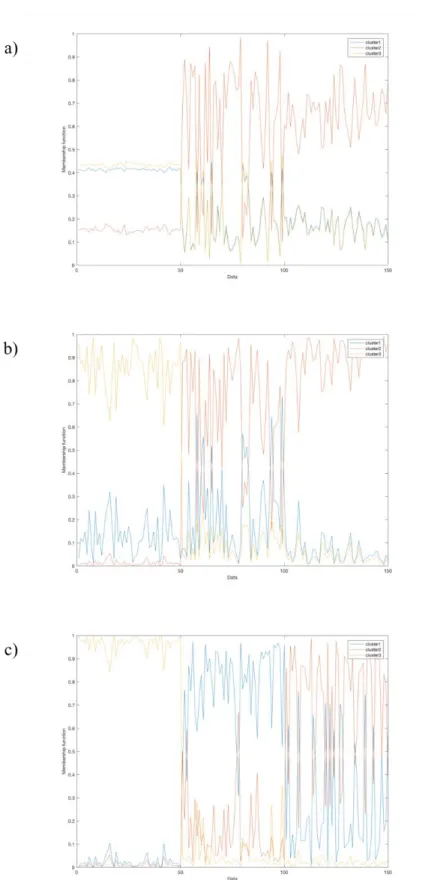
Figure 1 shows the updating progress of membership function during the FCM iteration with Iris flower dataset provided from MATLAB library [38]. This is a multivariate dataset which consists of 150 observations with 3 species; Iris setosa, Iris virginica, and Iris versicolor with 4 features; sepal length, sepal width, petal length, and petal width. The graph plotted the membership function of the data for each cluster 1 to 3 with different colors. Figure 1 (a) shows the randomly initialized membership function. Through Figure 1 (b) to (c), membership functions of the data are being gradually rearranged to the end.
Figure 1. Membership function of FCM with Iris dataset. a) iteration = 1, b) iteration = 6, and c) iteration = 32.
For example, the membership function of data 1 at 1st iteration is
𝑋 = [0.4138 0.1519 0.4344⋮ ⋮ ⋮ ]
At 6th iteration, the membership function of data 1 is
𝑋 = [0.0349 0.0030 0.9621⋮ ⋮ ⋮ ]
At 32nd iteration, the membership function of data 1 is
𝑋 = [0.0023 0.0011 0.9966
⋮ ⋮ ⋮ ]
The data 1 is clustered to 3rd cluster, since the highest membership value for each cluster
of data 1 is 0.9966 for 3rd cluster.
Similar to membership function, taking the derivative of Equation 1 respect to cluster center 𝑣𝑖, then we obtained
𝑣𝑖 = ∑ (𝑢𝑖𝑗) 𝑚 𝑥𝑗 𝑁 𝑗=1 ∑𝑁 (𝑢𝑖𝑗)𝑚 𝑗=1 (4)
Equation 2 and 4 are the two necessary conditions for 𝐽𝑚 to be at its local optimization. Every iteration, FCM update the membership function and the cluster center based on Equation 2 and 4, respectively, and calculate the new objective function based on Equation 1 to aim to minimize it.
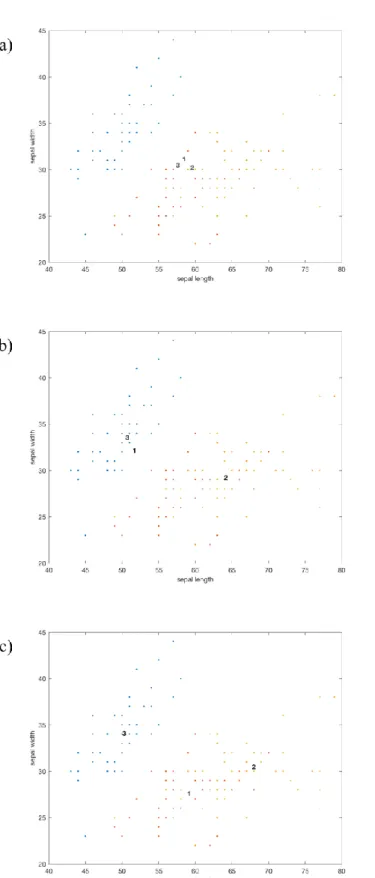
Figure 2. Cluster center of FCM with Iris dataset. a) iteration = 1, b) iteration = 6, and c) iteration = 32.
Figure 2 shows the updating progress of cluster center during the FCM iteration with Iris flower dataset. The graph scattered the data based on sepal length and sepal width in centimeters unit. The bold number from 1 to 3 indicates the cluster center of each 1st to 3rd cluster. Figure 2 (a) shows the randomly initialized cluster centers. Through
Figure 2 (b) to (c), we can visually notice that cluster centers are being gradually relocated to the end.
Local Binary Pattern Feature Extraction Operator
Ojala et al. [27,28] introduced Local Binary Pattern (LBP), which is a very simple and efficient discriminative texture descriptor to extract texture patterns from the image [29]. The LBP operator in [28] was defined as
𝐿𝐵𝑃 = ∑ 𝑠𝑖𝑔𝑛(𝑣𝑝− 𝑣𝑐)2𝑃
𝑃−1
𝑝=0
𝑠𝑖𝑔𝑛(𝑥) = {0,1, 𝑥 < 0𝑥 ≥ 0
(5)
where 𝑃 is the total number of neighboring pixels, 𝑣𝑐 and 𝑣𝑝 are the intensity values of the center pixel and its neighborhood pixels respectively.
Figure 3. Encoding process of LBP operator.
Figure 3 shows the example of how LBP value is encoded. Pixel with 27 intensity value threshold neighbor pixels within 3x3 window and multiply power of 2 matrix. The final encoding LBP value is 195. The LBP value is used as a bin of histogram that count the number of pixels who have the LBP value.
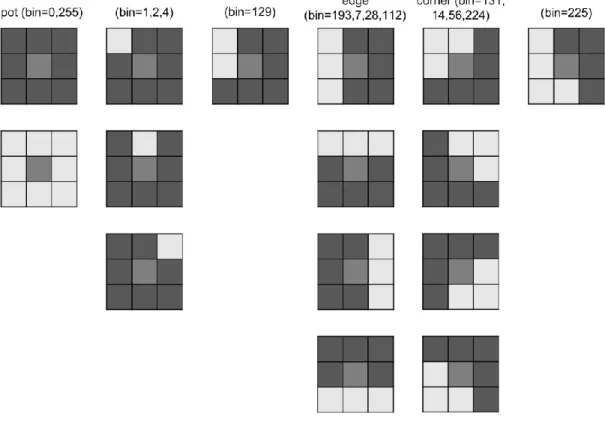
Each unique LBP value is used as a minimal unit of texture representation and refers to the value of the x-axis of the histogram. Figure 4 shows the labeled pixels with computed LBP value. For example, LBP value (or bin number of histogram) 193, 7, 28, or 112 indicates edges. These computed LBP values would be used as a texture descriptor for the pixels (or voxels) within the image.
RELATED WORK
FCM is a soft clustering method based on fuzzy set theory [1,9,14,16]. It performs similar with K-Means algorithm but allows each pixel to belong to multiple classes according to a certain membership value [1]. Local minima is one of the well-known drawbacks of FCM method [22]. To deal with the problem, various spatial FCM methods have been proposed.
Ahmed et al. [15] introduced the first spatial FCM method FCM_S by modifying the objective function to compensate intensity inhomogeneity. In this method, each pixel in a whole image was labeled with considering its immediate neighborhood. However, FCM_S is sensitive to noise and time-consuming. Chen et al. [17] proposed FCM_S1 and FCM_S2 based on FCM_S by applying mean filter and median filter in advance
respectively. They also simplified the neighborhood term of the objective function of FCM_S. FCM_S1 and FCM_S2 improved the immunity to Gaussian noise and impulse noise. However, they are still weak to salt and pepper noise. Szilágyi et al. [18] proposed EnFCM with the reconstructed image prior to segmentation. Linear weighted sum
method performed clustering the image based on the gray-level histogram instead of pixels in an image. Time complexity was greatly reduced with this algorithm, but it requires prior knowledge for choosing major parameters and only works on gray-level images. Cai et al. [19] proposed FGFCM by incorporating local spatial and gray information. They enhanced the flexibility to select the spatial term control parameter, but still dependent on another parameter selection. Krinidis et al. [20] proposed FLICM with a new fuzzy factor, which does not require pre-processing. It is a parameter
determination free algorithm, but FLICM is time-consuming for large-scale image since it requires several iteration steps on the same window. With previous work, we proposed TFCM algorithm. The proposed algorithm suggested a global and accurate model by incorporating texture terms to intensity distance.
MATERIAL AND METHODS
In this section, our proposed algorithm and its preliminary are introduced. Figure 5 shows the overview of the proposed algorithm. The algorithm firstly pre-processes the original image for Volume of Interest (VOI) extraction using 3D Skull Stripping. Then, the feature extraction and classification are performed using LBP-TOP and initial FCM. The classified texture information of each White Matter, Gray Matter, and Cerebrospinal Fluid cluster are used as texture constraints of final TFCM segmentation algortihm.
Figure 5. Overview of the methodology.
3D Skull Stripping
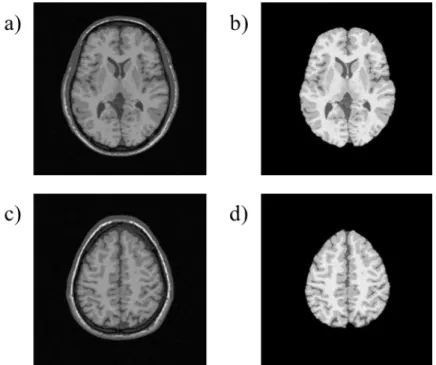
In order to reduce the effect of background noise and time complexity, extra-cranial tissues were removed from the input image before segmentation. To extract the VOI region, several pre-processing techniques such as thresholding, morphological operation [24], and skull stripping algorithm were performed. In this paper, we used
3DSkullStrip by Smith et al. [23,25,26] as a skull stripping method to extract the VOI region.
Figure 6. VOI extraction using 3D Skull Stripping: (a), (c) Original image. (b), (d) VOI extracted image.
Initial Fuzzy C-Means
The conventional Fuzzy C-Means algorithm was performed to classify the
features from each type of tissue such as WM, GM, CSF, and background. Segmentation refinement was performed with the proposed algorithm introduced in following sections after extracting classified features.
Feature Extraction
Zhao et al. [30] proposed LBP for spatiotemporal data by concatenating LBP on three orthogonal planes, i.e., the xy-, xt-, and yt-planes. We applied LBP-TOP to brain volume image as in [23], we also used z-dimension instead of t-dimension. In the proposed algorithm, a histogram of each plane was summed up rather than concatenated to exaggerate the distribution of the encoding values. The modified histogram could obtain more distinct features since brain volume image has similar texture patterns in xy-, xz-, and yz-planes.
The LBP operator in (5) could not distinguish each tissue since the key factor to classify the brain volume is the intensity values. The proposed algorithm modified LBP-TOP by incorporating texture patterns and intensity values to specify the estimating intensity range of tissues. The equation (5) is modified as
𝐿𝐵𝑃 = ∑ 𝑠𝑖𝑔𝑛(𝑣𝑝− 𝑣𝑐)2𝑃 𝑃−1 𝑝=0 𝐿𝑐 𝑠𝑖𝑔𝑛(𝑥) = {0,1, 𝑥 < 0𝑥 ≥ 0 (6)
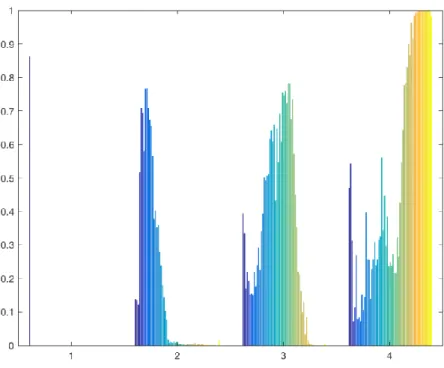
where 𝐿𝑐 denotes the initially extracted class index by Fuzzy C-Means. Figure 6 shows the derived normalized histogram of each cluster after feature classification. The x-axis of the histogram represents the LBP value obtained from (6), and the y-axis represents the probability of occurrence. The extracted features are classified into 4 clusters by using
initial FCM as described in previous section. The normalized encoding value is used as a texture membership probability of each voxel to each cluster.
Figure 6. Extracted LBP-TOP histogram of each tissue: 1 is background, 2 is cerebrospinal fluid, 3 is gray matter, and 4 is white matter.
3D Fuzzy C-Means with Texture Constraints
Preliminaries
Various Fuzzy C-Means improved invariants algorithms have been developed by many researchers as we researched in related work section. Many researchers have studied to enhance the models’ performance in 2 ways: Segmentation accuracy and speed. The very first model of modification to the conventional FCM to improve the segmentation accuracy was proposed by Ahmed et al. [15] which is called FCM_S by introducing neighbor term to the original objective function. The introduced neighbor term allows the influence of its immediate neighboring pixels when labeling the pixel. This term regularizes the intensities within the neighborhood window so that can get the piecewise homogeneous labeling solution. The objective function of conventional FCM (1) is modified as 𝐽𝑚 = ∑ ∑ 𝑢𝑖𝑘m‖𝑥 𝑘− 𝑣𝑖‖2+ 𝑁 𝑘=1 𝑐 𝑖=1 𝛼 𝑁𝑅∑ ∑ 𝑢𝑖𝑘m ∑ ‖𝑥𝑟− 𝑣𝑖‖2 𝑟∈𝑁𝑘 𝑁 𝑘=1 𝑐 𝑖=1 (7)
where 𝑐 is the number of cluster, 𝑁 is the number of pixels in image, 𝑥𝑘 is the intensity value of the kth pixel, 𝑣𝑖 represents the center value of the ith cluster, 𝑢𝑖𝑘 represents the fuzzy membership of the kth pixel to respect cluster i, 𝑁𝑅 is its cardinality, 𝑥𝑟 represents the neighbor of 𝑥𝑘, and 𝑁𝑘 represents the set of neighbor within a window around 𝑥𝑘. The parameter 𝑚 is a weighting exponent on each fuzzy membership that determines the
amount of fuzziness of the resulting classification. The parameter 𝛼 is used to control the effect of the neighbor term.
By the definition, each sample point 𝑥𝑘 satisfies the constraint that ∑𝑐 𝑢𝑖𝑘 = 1
𝑖=1 .
Two necessary conditions for 𝐽𝑚 to be at its local optimization will be obtained as
𝑢𝑖𝑘 = (‖𝑥𝑘− 𝑣𝑖‖ 2+ 𝛼 𝑁𝑅∑ ‖𝑥𝑟− 𝑣𝑖‖ 2 𝑟∈𝑁𝑘 ) −1/(𝑚−1) ∑ (‖𝑥𝑘− 𝑣𝑗‖2+ 𝛼𝑁 𝑅∑ ‖𝑥𝑟− 𝑣𝑗‖ 2 𝑟∈𝑁𝑘 ) −1/(𝑚−1) 𝑐 𝑗=1 (8) 𝑣𝑖 = ∑ 𝑢𝑖𝑘𝑚(𝑥 𝑘+ 𝛼𝑁 𝑅∑𝑟∈𝑁𝑘𝑥𝑟) 𝑁 𝑘=1 (1 + 𝛼) ∑𝑁 𝑢𝑖𝑘𝑚 𝑘=1 (9)
But there was a trade-off that FCM_S improved the segmentation accuracy compared to conventional FCM model but resulted with the high computational cost since every pixel has to compute the neighborhood influence when labeling the pixel.
Szilágyi et al. [18] proposed a modified spatial FCM algorithm EnFCM by speeding up the segmentation process for the gray-level image. In order to accelerate the time performance of previous spatial FCM methods, a linearly-weighted sum image is formed in advance from the original image. The local neighbor average image is obtained in terms of 𝜉𝑘 = 1 1 + 𝛼(𝑥𝑘+ 𝛼 𝑁𝑅𝑗∈𝑁∑ 𝑥𝑗 𝑘 ) (10)
where 𝜉𝑘 denotes the gray value of the kth pixel of image 𝜉, 𝑥𝑘 is the intensity value of the kth pixel, 𝑁𝑅 is the cardinality, 𝑁𝑘 represents the set of neighbors within a window around 𝑥𝑘, and 𝑥𝑗 represents the neighbors of 𝑥𝑘. The parameter 𝛼 is used to control the effect of the neighbor term. EnFCM is performed on the gray-level histogram of the generated image 𝜉. The objective function of the EnFCM is defined as
𝐽𝑠 = ∑ ∑ 𝛾𝑙𝑢𝑖𝑙𝑚(𝜉 𝑙− 𝑣𝑖)2 𝑞 𝑙=1 𝑐 𝑖=1 (11)
where 𝑢𝑖𝑙 represents the fuzzy membership of gray value 𝑙 with respect to cluster i and𝑣𝑖 represents the center value of the ith cluster. The parameter 𝑚 is a weighting exponent on
each fuzzy membership that determines the amount of fuzziness of the resulting
classification. 𝑐 denotes the total number of cluster and q denotes the number of the gray-levels of the given image, and N is the number of pixels in an image. 𝛾𝑙 is the number of the pixels having the gray value equal to l where 𝑙 = 1, … , 𝑞. So, one of the constraints of l is defined as
∑ 𝛾𝑙
𝑞
𝑙=1
= 𝑁 (12)
By the definition, each pixel 𝑥𝑘 satisfies the constraint that ∑𝑐 𝑢𝑖𝑘 = 1
𝑖=1 for any l. Two necessary conditions for 𝐽𝑠 to be at its local optimization will be obtained as
𝑢𝑖𝑙 = (𝜉𝑙− 𝑣𝑖)−2/(𝑚−1) ∑𝑐 (𝜉𝑙− 𝑣𝑗)
𝑗=1
𝑣𝑖 = ∑ 𝛾𝑙𝑢𝑖𝑙𝑚𝜉𝑙 𝑞 𝑙=1 ∑𝑞 𝛾𝑙𝑢𝑖𝑙𝑚 𝑙=1 (14)
Texture weighted Fuzzy C-Means
We designed the clustering process of TFCM with extracted texture in (6) as 𝑡𝑖𝑘 for kth voxel to cluster 𝑖. The texture membership probability 𝑡𝑖𝑘 for all k is computed in advance as described in previous section. Initially, we designed the TFCM based on FCM_S on the purpose of improving the accuracy. The objective function is modified as
𝐽𝑡1 = ∑ ∑ 𝑢𝑖𝑘m‖𝑥𝑘− 𝑣𝑖‖2 + 𝑁 𝑘=1 𝑐 𝑖=1 𝛼 ∑ ∑(𝛽𝑢𝑖𝑘+ (1 − 𝛽)𝑡𝑖𝑘)𝑚‖𝑥̅̅̅ − 𝑣𝑘 𝑖‖2 𝑁 𝑘=1 𝑐 𝑖=1 (15)
where 𝑡𝑖𝑘 represents the texture membership of the kth voxel to ith cluster, parameter 𝛽 controls the effect of the intensity features and texture features.
The constrained optimization will be solved using one Lagrange multiplier as
𝐹𝑚 = ∑ ∑(𝑢𝑖𝑘m‖𝑥𝑘− 𝑣𝑖‖2 𝑁 𝑘=1 + 𝛼(𝛽𝑢𝑖𝑘 + (1 − 𝛽)𝑡𝑖𝑘)𝑚‖𝑥̅̅̅ − 𝑣𝑘 𝑖‖2 𝑐 𝑖=1 ) +𝜆(1 − ∑(𝛽𝑢𝑖𝑗+ (1 − 𝛽)𝑡𝑖𝑗) 𝑐 𝑗=1 ) (16)
Taking the derivative of 𝐹𝑚 with respect to 𝑢𝑖𝑘 and setting the result to zero, we have, for 𝑚 > 1 𝑑𝐹𝑚 𝑑𝑢𝑖𝑘 = ( 𝛽𝜆 𝑚‖𝑥𝑘− 𝑣𝑖‖2+ 𝛼𝛽‖𝑥 𝑘 ̅̅̅ − 𝑣𝑖‖2) 1/(𝑚−1) (17) By constraints ∑𝑐 𝑢𝑖𝑘 = 1
𝑖=1 for all k, we obtained
𝜆 = 𝑚 𝛽 (∑ (‖𝑥𝑘− 𝑣𝑖‖2+ 𝛼𝛽‖𝑥̅̅̅ − 𝑣𝑘 𝑖‖2)− 1 𝑚−1 𝑐 𝑗=1 ) 𝑚−1 (18)
Substituting into equation #, the zero-gradient condition for the membership function can be written as 𝑢𝑖𝑘 = (‖𝑥𝑘− 𝑣𝑖‖2+ 𝛼𝛽‖𝑥 𝑘 ̅̅̅ − 𝑣𝑖‖2)−1/(𝑚−1) ∑𝑐 (‖𝑥𝑘− 𝑣𝑗‖2+ 𝛼𝛽‖𝑥̅̅̅ − 𝑣𝑘 𝑗‖2)−1/(𝑚−1) 𝑗=1 (19)
Similarly, cluster center is obtained as
𝑣𝑖 =∑ (𝑢𝑖𝑘 𝑚(𝑥 𝑘+ 𝛼𝛽𝑥̅̅̅)) + 𝛼(1 − 𝛽)𝑡𝑘 𝑖𝑘𝑚𝑥̅̅̅ 𝑘 𝑁 𝑘=1 ∑ ((1 + 𝛼𝛽)𝑢𝑖𝑘𝑚+ 𝛼(1 − 𝛽)𝑡 𝑖𝑘𝑚) 𝑁 𝑘=1 (20)
But the time complexity of the proposed algorithm was too high, so we redesigned the objective function based on EnFCM. The revised objective function is defined as
𝐽𝑡 = ∑ ∑ 𝛾𝑙(𝛽𝑢𝑖𝑙+ (1 − 𝛽)𝑡𝑖𝑙)𝑚(𝜉𝑙− 𝑣𝑖)2 𝑞 𝑙=1 𝑐 𝑖=1 (21)
Similar with (15), 𝑡𝑖𝑘 represents the texture membership of the kth voxel to ith cluster. The parameter 𝛽 controls the effect of the intensity distance features and texture features. The constrained optimization was solved using one Lagrange multiplier as
𝐹𝑡= ∑ ∑[𝛾𝑙(𝛽𝑢𝑖𝑙+ (1 − 𝛽)𝑡𝑖𝑙)𝑚(𝜉 𝑙− 𝑣𝑖)2] 𝑞 𝑙=1 𝑐 𝑖=1 + ∑ 𝜆𝑙(1 − ∑(𝛽𝑢𝑖𝑙+ (1 − 𝛽)𝑡𝑖𝑙) 𝑐 𝑖=1 ) 𝑞 𝑙=1 (22)
Taking the derivative of 𝐹𝑡 with respect to 𝑢𝑖𝑙 and setting the result to zero for 𝑚 > 1, we have 𝑑𝐹𝑡 𝑑𝑢𝑖𝑙 = 𝑚𝛽𝛾𝑙(𝜉𝑙− 𝑣𝑖)2(𝛽𝑢𝑖𝑙+ (1 − 𝛽)𝑡𝑖𝑙)𝑚−1− 𝛽𝜆𝑙= 0 (23) For 𝑢𝑖𝑙, we obtained 𝑢𝑖𝑙 = 1 𝛽[( 𝜆𝑙 𝑚𝛾𝑙(𝜉𝑙− 𝑣𝑖)2) 1/(𝑚−1) − (1 − 𝛽)𝑡𝑖𝑙] (24)
𝜆𝑙 = (∑ (𝑚𝛾𝑙(𝜉𝑙− 𝑣𝑗)2)1/(𝑚−1) 𝑐 𝑗=1 ) 𝑚−1 (25)
Substituting into (24), the zero-gradient condition for the 𝑢𝑖𝑙can be written as
𝑢𝑖𝑙 = 1 𝛽∑ ( 𝜉𝑙− 𝑣𝑗 𝜉𝑙− 𝑣𝑖) 2/(𝑚−1) 𝑐 𝑗=1 −1 − 𝛽 𝛽 𝑡𝑖𝑙 (26)
Similarly, taking the derivative of 𝐹𝑡 with respect to 𝑣𝑖, we have 𝑑𝐹𝑡
𝑑𝑣𝑖 = −2 ∑ 𝛾𝑙(𝛽𝑢𝑖𝑙+ (1 − 𝛽)𝑡𝑖𝑙)𝑚(𝜉𝑙− 𝑣𝑖) 𝑞
𝑙=1
= 0 (27)
Then, the cluster center is defined as
𝑣𝑖 = ∑ 𝛾𝑙(𝛽𝑢𝑖𝑙+ (1 − 𝛽)𝑡𝑖𝑙)𝑚𝜉𝑙 𝑞
𝑙=1
∑𝑞𝑙=1𝛾𝑙(𝛽𝑢𝑖𝑙+ (1 − 𝛽)𝑡𝑖𝑙)𝑚 (28)
Through the iteration, TFCM aim to minimize the its objective function (21) by revising the membership functions and cluster centers with pre-defined texture and intensity information of each voxel based on (26) and (28), respectively.
Algorithm 1 TFCM
Step 1: Set the cluster number c, maximum iteration number 𝐼,
error rate 𝜀, fuzziness parameter m, cardinality 𝑁𝑅, and the term control parameter 𝛼 and 𝛽.
Step 2: Extract features of each cluster from an original image
and set 𝑡.
Step 3: Classify the extracted features into c clusters.
Step 4: Form the new local neighbor average image 𝜉 (10) and
its histogram.
Step 5: Randomly initialize the fuzzy membership matrix as 𝑈0
(26) and objective function matrix as 𝐽𝑡0 (21).
Step 6: Set the loop counter 𝑖 to zero.
Step 7: Update the cluster centers (28).
Step 8: Update the fuzzy membership matrix 𝑈𝑖+1 at counter 𝑖
(26).
Step 9: Update the objective function 𝐽𝑡𝑖+1 at counter 𝑖 (21). Step 10: If 𝐽𝑡𝑖+1− 𝐽𝑡𝑖𝑖 < 𝜀 or loop counter met I then stop,
RESULT AND ANALYSIS
In this section, the proposed algorithm was applied to 20 anatomical models of normal brain MR image volumes provided by the BrainWeb database with ground truths [31-33]. The provided dataset is a set of T1-weighted simulated data with these specific parameters: SFLASH (spoiled FLASH) sequence with TR (repetition time)=22ms, TE (echo time)=9.2ms, flip angle=30 degree and 1 mm isotropic voxel size with a resolution of 256×256×181 per volume [34,35].
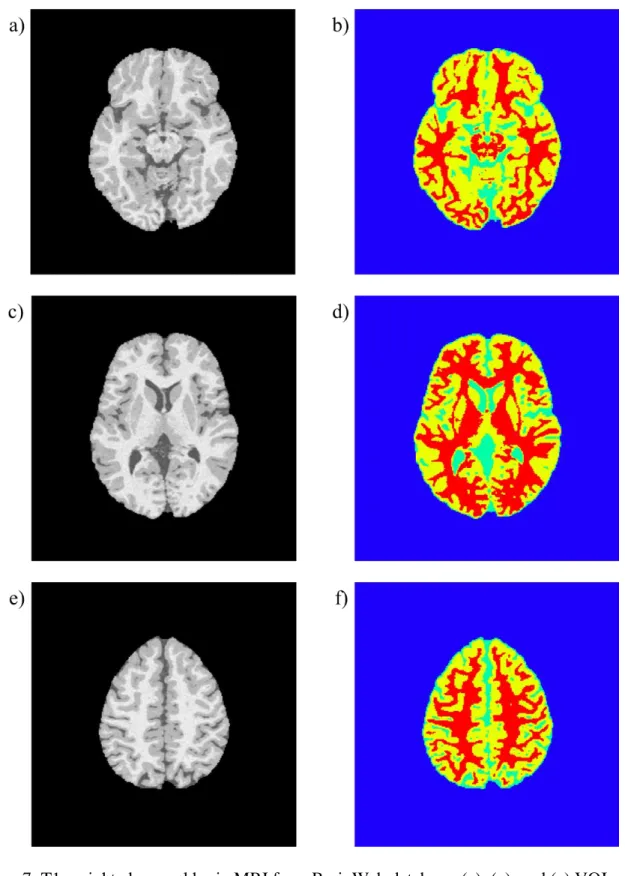
The number of clusters was set as 4 – background, CSF, GM, and WM. The number of maximum iteration number was set as 100, error threshold as 1 × 10⁻⁵, fuzziness parameter as 2, and parameter 𝛼 was set to 4.2 as same as previous methods. For 3D window, the cardinality was set to 6: ±1-pixel volume distance in each x-, y-, and z-axis. The texture and intensity constraints control parameter 𝛽 was set to 0.8 which was found empirically. Figure 7 shows the 2D sliced images for the VOI extracted and
Figure 7. T1-weighted normal brain MRI from BrainWeb database: (a), (c), and (e) VOI extracted original Image. (b), (d), and (f) segmented Image.
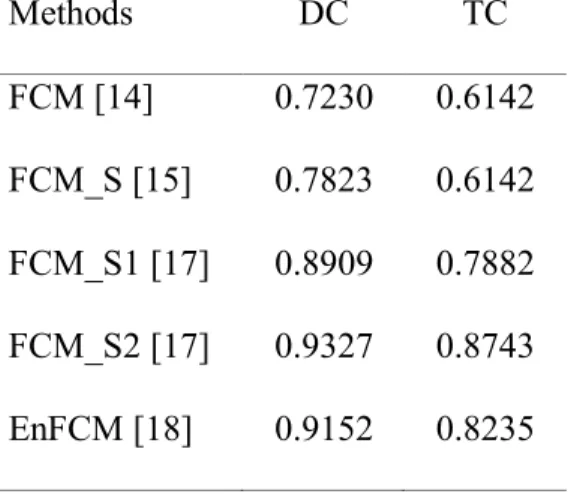
To quantitatively evaluate the performance of TFCM, Dice’s Coefficient (DC) [36] and Tanimoto Coefficient (TC) [7] were used and compared with several FCM applicants. We have programmed the operation results of the models other than the model of [7], and the operation results of the [7] are referred to the author 's paper.
The DC and TC are defined by
𝐷𝐶(𝑀𝑆, 𝐺𝑇) = 2|𝑀𝑆 ∩ 𝐺𝑇|
|𝑀𝑆| + |𝐺𝑇| (16)
𝑇𝐶(𝑀𝑆, 𝐺𝑇) =|𝑀𝑆 ∩ 𝐺𝑇|
|𝑀𝑆 ∪ 𝐺𝑇| (17)
where |. | denotes the number of pixels included in the region, MS and GT are the regions segmented by the method and by the ground truth, respectively. Both DC and TC metrics indicates higher segmentation accuracy when the value reaches 1. Our model was written with the image processing library in MATLAB, tested on 2.8GHz Intel Core i7 with 16GB 2133 MHz LPDDR3 memory, and compared with published Fuzzy C-Means methods on brain MRI segmentation.
Table 1. Comparison of DC and TC for BrainWeb dataset.
Methods DC TC FCM [14] 0.7230 0.6142 FCM_S [15] 0.7823 0.6142 FCM_S1 [17] 0.8909 0.7882 FCM_S2 [17] 0.9327 0.8743 EnFCM [18] 0.9152 0.8235
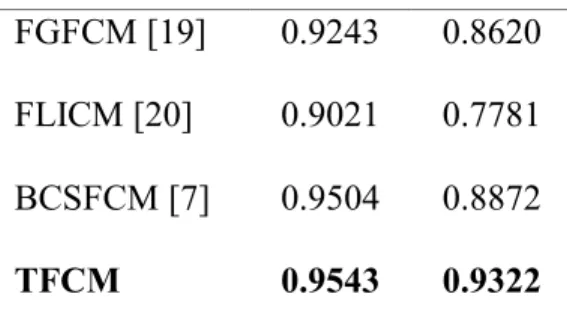
FGFCM [19] 0.9243 0.8620 FLICM [20] 0.9021 0.7781 BCSFCM [7] 0.9504 0.8872
TFCM 0.9543 0.9322
Table 1 shows the evaluated performance of TFCM and other algorithms. The results show the proposed algorithm has a noticeable improvement in TC with the well-classified intersection between segmented model and ground truth. These results suggest that the proposed algorithm is highly accurate in TC even though there was not a
significant improvement in DC. We would continue this study to improve the segmentation accuracy for both coefficients in the near future.
CONCLUSION
Accurate brain MRI segmentation is the important components for its clinical purpose [1-8]. In this paper, texture weighted TFCM method is proposed. The
experimental result shows that TFCM is meaningful to segment brain structures by reducing the effect of INU from the brain MRI by incorporating texture constraints with intensity feature distances. With this result, the proposed algorithm shows the feasibility to be used for clinical evaluation of diseases in the brain such as brain tumors, Alzheimer, and Schizophrenia. We tested and evaluated the result with normal brain datasets in this paper, but we would like to expand our study with the lesion brain datasets for future.
LITERATURE CITED
1. Despotović, I., Goossens, B., & Philips, W. (2015). MRI segmentation of the human brain: challenges, methods, and applications. Computational and mathematical methods in medicine, 2015.
2. Bauer, S., Wiest, R., Nolte, L. P., & Reyes, M. (2013). A survey of MRI-based medical image analysis for brain tumor studies. Physics in Medicine &
Biology, 58(13), R97.
3. Wen, P. Y., Macdonald, D. R., Reardon, D. A., Cloughesy, T. F., Sorensen, A. G., Galanis, E., ... & Tsien, C. (2010). Updated response assessment criteria for high-grade gliomas: response assessment in neuro-oncology working group. Journal of clinical oncology, 28(11), 1963-1972.
4. Black, P. M. (1991). Brain tumors. New England Journal of Medicine, 324(22), 1555-1564.
5. Balafar, M. A., Ramli, A. R., Saripan, M. I., & Mashohor, S. (2010). Review of brain MRI image segmentation methods. Artificial Intelligence Review, 33(3), 261-274.
6. Han, X., & Fischl, B. (2007). Atlas renormalization for improved brain MR image segmentation across scanner platforms. IEEE transactions on medical
imaging, 26(4), 479-486.
7. Prakash, R. M., & Kumari, R. S. S. (2017). Spatial fuzzy C means and
expectation maximization algorithms with bias correction for segmentation of mr brain images. Journal of medical systems, 41(1), 15.
8. Verma, H., Agrawal, R. K., & Sharan, A. (2016). An improved intuitionistic fuzzy c-means clustering algorithm incorporating local information for brain image segmentation. Applied Soft Computing, 46, 543-557.
9. Naz, S., Majeed, H., & Irshad, H. (2010, October). Image segmentation using fuzzy clustering: A survey. In Emerging Technologies (ICET), 2010 6th International Conference on (pp. 181-186). IEEE.
10. Batista, J., & Freitas, R. (1999). An adaptive gradient-based boundary detector for MRI images of the brain.
11. Fan, J., Yau, D. K., Elmagarmid, A. K., & Aref, W. G. (2001). Automatic image segmentation by integrating color-edge extraction and seeded region
growing. IEEE transactions on image processing, 10(10), 1454-1466.
12. Duda, R. O., Hart, P. E., & Stork, D. G. (1973). Pattern classification (Vol. 2). New York: Wiley.
13. Ortiz, A., Palacio, A. A., Górriz, J. M., Ramírez, J., & Salas-González, D. (2013). Segmentation of brain MRI using SOM-FCM-based method and 3D statistical descriptors. Computational and mathematical methods in medicine, 2013. 14. Bezdek, J. C. (1981). Objective Function Clustering. In Pattern recognition with
fuzzy objective function algorithms (pp. 43-93). Springer, Boston, MA. 15. Ahmed, M. N., Yamany, S. M., Mohamed, N., Farag, A. A., & Moriarty, T.
(2002). A modified fuzzy c-means algorithm for bias field estimation and segmentation of MRI data. IEEE transactions on medical imaging, 21(3), 193-199.
16. Zadeh, L. A. (1996). Fuzzy sets. In Fuzzy Sets, Fuzzy Logic, And Fuzzy Systems: Selected Papers by Lotfi A Zadeh (pp. 394-432).
17. Chen, S., & Zhang, D. (2004). Robust image segmentation using FCM with spatial constraints based on new kernel-induced distance measure. IEEE Transactions on Systems, Man, and Cybernetics, Part B (Cybernetics), 34(4), 1907-1916.
18. Szilagyi, L., Benyo, Z., Szilágyi, S. M., & Adam, H. S. (2003, September). MR brain image segmentation using an enhanced fuzzy c-means algorithm.
In Engineering in Medicine and Biology Society, 2003. Proceedings of the 25th Annual International Conference of the IEEE (Vol. 1, pp. 724-726). IEEE. 19. Cai, W., Chen, S., & Zhang, D. (2007). Fast and robust fuzzy c-means clustering
algorithms incorporating local information for image segmentation. Pattern recognition, 40(3), 825-838.
20. Krinidis, S., & Chatzis, V. (2010). A robust fuzzy local information C-means clustering algorithm. IEEE transactions on image processing, 19(5), 1328-1337. 21. Zaixin, Z., Lizhi, C., & Guangquan, C. (2013). Neighbourhood weighted fuzzy
c-means clustering algorithm for image segmentation. IET Image Processing, 8(3), 150-161.
22. Harish, B. S., Kumar, S. A., Masulli, F., & Rovetta, S. (2017). Adaptive
Initialization of Cluster Centers using Ant Colony Optimization: Application to Medical Images. In ICPRAM (pp. 591-598).
23. Chang, C. W., Ho, C. C., & Chen, J. H. (2012). ADHD classification by a texture analysis of anatomical brain MRI data. Frontiers in systems neuroscience, 6, 66.
24. Lee, J. Y., Mun J. Y., Taheri, M., Son, S. H., & Shin, S. (2017, September). Vessel Segmentation Model using Automated Threshold Algorithm from Lower Leg MRI. In Proceedings of the International Conference on Research in Adaptive and Convergent Systems (pp. 120-125). ACM.
25. Smith, S. M. (2002). Fast robust automated brain extraction. Human brain mapping, 17(3), 143-155.
26. Cox, R. W. (1996). AFNI: software for analysis and visualization of functional magnetic resonance neuroimages. Computers and Biomedical research, 29(3), 162-173.
27. Ojala, T., Pietikäinen, M., & Harwood, D. (1996). A comparative study of texture measures with classification based on featured distributions. Pattern
recognition, 29(1), 51-59.
28. Ojala, T., Pietikainen, M., & Maenpaa, T. (2002). Multiresolution gray-scale and rotation invariant texture classification with local binary patterns. IEEE
Transactions on pattern analysis and machine intelligence, 24(7), 971-987. 29. Larroza, A., Bodí, V., & Moratal, D. (2016). Texture analysis in magnetic
resonance imaging: Review and considerations for future applications.
In Assessment of Cellular and Organ Function and Dysfunction using Direct and Derived MRI Methodologies. InTech.
30. Zhao, G., & Pietikainen, M. (2007). Dynamic texture recognition using local binary patterns with an application to facial expressions. IEEE transactions on pattern analysis and machine intelligence, 29(6), 915-928.
32. Collins, D. L., Zijdenbos, A. P., Kollokian, V., Sled, J. G., Kabani, N. J., Holmes, C. J., & Evans, A. C. (1998). Design and construction of a realistic digital brain phantom. IEEE transactions on medical imaging, 17(3), 463-468.
33. Cocosco, C. A., Kollokian, V., Kwan, R. K. S., Pike, G. B., & Evans, A. C. (1997). Brainweb: Online interface to a 3D MRI simulated brain database. In NeuroImage.
34. Aubert-Broche, B., Evans, A. C., & Collins, L. (2006). A new improved version of the realistic digital brain phantom. NeuroImage, 32(1), 138-145.
35. Aubert-Broche, B., Griffin, M., Pike, G. B., Evans, A. C., & Collins, D. L. (2006). Twenty new digital brain phantoms for creation of validation image data
bases. IEEE transactions on medical imaging, 25(11), 1410-1416.
36. Yeghiazaryan, V., & Voiculescu, I. (2015). An overview of current evaluation methods used in medical image segmentation. Tech. Rep. CS-RR-15-08, Department of Computer Science, University of Oxford, Oxford, UK. 37. Dunn, J. C. (1973). A fuzzy relative of the ISODATA process and its use in
detecting compact well-separated clusters.
38. Fuzzy C-Means Clustering for Iris Data. (n.d.). Retrieved from
https://www.mathworks.com/help/fuzzy/examples/fuzzy-c-means-clustering-for-iris-data.html
![Figure 1 shows the updating progress of membership function during the FCM iteration with Iris flower dataset provided from MATLAB library [38]](https://thumb-us.123doks.com/thumbv2/123dok_us/1444878.2693414/16.918.266.805.118.1061/figure-updating-progress-membership-function-iteration-dataset-provided.webp)