APPLICATION OF WEB 2.0 TOOLS TO ENHANCE KNOWLEDGE MANAGEMENT
PRACTICES IN ACADEMIC LIBRARIES IN TANZANIA
BY
NEEMA FLORENCE MOSHA
(Student No.: 50777246)
Submitted in accordance with the requirements for the degree of
DOCTOR OF PHILOSOPHY AND LITERATURE
in the subject of
INFORMATION SCIENCE at the
UNIVERSITY OF SOUTH AFRICA, PRETORIA
SUPERVISOR: PROF. PATRICK NGULUBE
CO-SUPERVISOR: PROF. EDDA T. LWOGA
FEBRUARY 2017
i
SUMMARY
The emergence of Web 2.0 tools has transformed the operation of Knowledge Management (KM) practices in the academic libraries. This study has investigated the application of Web 2.0 tools to enhance KM practices in academic libraries in Tanzania. Eight out of twelve academic libraries located in public universities in Tanzania were purposively selected in this study. The study included two categories of respondents: ordinary library staff and senior library staff (directors, heads of libraries, library managers, and Information and Technology (IT) specialists in the library etc).
The findings of the study were determined after applying methodological triangulation within quantitative and qualitative research contexts. This included the use of questionnaires, semi-structured interviews and observations. In the first instance, questionnaires were used to collect data from 278 library staff selected using systematic sampling technique. Interviewing targeted 69 senior library staff was done using purposive sampling technique. In total, 254 (91.4%) ordinary library staff completed the questionnaire; while 57 (82.6%) senior librarians were interviewed.
The study findings have indicated the low level of KM application in academic libraries. Muhimbili University of Health and Allied Science (MUHAS) Library showed the strongest application of KM practices, followed by State University of Zanzibar (SUZA) Library. Lack of KM enablers in academic libraries was indicated as one of the significant challenges that hinder the application of KM practices in academic libraries. It was noted that most of the academic libraries visited had websites. On the other hand, the majority of respondents acknowledged that they had personal accounts of the various Web 2.0 tools. The study findings imply that most library staff had some level of experience with a variety of Web 2.0 tools. It was further established that despite the high level of familiarity and use of Web 2.0 tools, respondents were not frequent users of their library websites.
The study findings have also indicated a low level of access and use of Web 2.0 tools within academic libraries. Mzumbe University (MU) and SUZA Libraries were the main users of Web 2.0 tools; followed by University of Dar-es-Salaam (UDSM) Library. Knowledge Management System (KMS) Success Model was employed to investigate factors that affect the application of Web 2.0 tools to enhance KM practices. The study findings have demonstrated that the KMS Success Model is suitable for guiding the understanding of the contributing factors with respect to library staff‟s intention to reuse Web 2.0 tools. The study findings supported the KMS Success Model well, whereby seven of the twelve hypothesised relationships were found to be significant.
ii
The study recommends that academic libraries in Tanzania should promote and integrate KM practices in their daily operations as well as the use of KM enablers such as; reliable budget, Web 2.0 tools, reliable power supply, internet connectivity availability and adequate ICTs infrastructure.
KEYWORDS
Web 2.0 tools; Knowledge; Knowledge Management (KM); Knowledge Management (KM) practices; Academic Libraries; Innovative Service Delivery; Library Staff; SECI Model; Web 2.0 SECI Drivel Model; Knowledge Management System (KMS); Information and communication technology (ICT); Tanzania.
iii
ACKNOWLEDGEMENTS
First and foremost, I thank the Almighty God for enabling me, and giving me strength and grace towards the successful completion of my PhD studies. I am grateful to the South African Postgraduate Studies Support at the University of South Africa (UNISA) for the financial support they extended to me during my study. I would like to acknowledge the academic, administrative, and technical supports from the UNISA, particularly in the award of admission and other necessary support for my studies and for this thesis processes. My remarkable appreciation also goes to my employer, The Nelson Mandela African Institution of Science and Technology (NM-AIST) for granting me a study leave to undertake my PhD studies in South Africa.
The unforgettable support from the former Vice Chancellor of NM-AIST, Prof Burton Mwamilla, and his deputies Deputy Vice Chancellors, Prof. Lughano Kusiluka, and Prof. Patrick Ndakidemi, is highly appreciated. My fellow workers Restituta Mhina, Monna Sitayo, Honorina Mashingia, Lilian Mbowe, Monica Chionda, Lightness Mselle, Francis Kayichile, Johnson Rugoye, Agnes Yamsebo and Naomi Kulwa for their moral support and the encouragement that they gave me throughout my studies. They were always there when I needed their support and they updated and assisted me on every necessary administrative issue concerning my studies.
My profound gratitude goes to my supervisors, Prof. Patrick Ngulube and Associate Prof. Tandi Lwoga for always being tremendous mentors to me. Their commitment to this work from the early stages of proposal development, during the fieldwork in Tanzania, throughout data analysis, and report writing period is really appreciated. Their good advice, patience and guidance have been invaluable on both an academic and personal levels. Tandi, you supported me as a mentor, a promoter, a supervisor in Tanzania and sometimes as a friend especially when I felt confused with my studies. I always remember our meetings sometimes until late nights. Prof. Ngulube, when I first came to your office at Theo van Wijk Building at UNISA to ask for advice on how to plan for Chapter Three (literature review and theoretical foundations) you were very positive and supportive, in spite of your busy schedule, you spared time whenever I requested a meeting at your office. Thank you all for the support and for allowing me to grow as a researcher.
Sincere thanks to the research departments/directorates at ARU, MU, MUHAS, OUT, SUA, SUZA, UDOM, and UDSM for granting me permission to conduct my field work. I am sincerely grateful to all library staff who participated in this study, for their co-operation and willingness to share their
iv
experience. Without them, this study would not be possible. Special thanks go to Dr. Sofia (ARU), Dr. Mboni (MUHAS), Dr. Wema (UDSM), Prof. Dulle, Prof. Sife and Ms. Anajoyce Katabalwa (SUA) and Dr. Semzugi (OUT) for the support and co-operation they gave me during data collection in their academic libraries. I owe my deep gratitude to all field assistants, Shahazard Nasor (SUZA), Janeth Silayo (UDOM), Msagati (OUT), Justina Karata (UDSM), Deogratius Daniel (MU), Anajoyce Katabalwa (SUA), Tatu Muddy and Bernard Sengo (MUHAS) and Ester Momburi (ARU). Your support will always be remembered. I acknowledge the work done by my language editor.
I am indebted to my mother, Mrs. Christine Vincent Mosha and my late father, Mr. Vincent Malamia Mosha for their moral support and love, and for laying down the foundation of my education. Their prayers and encouragement are what has sustained me this far. Thank you very much for your endless love my parents. Big up to you! I appreciate the contribution of my lovely sister, Mary Vincent Mosha together with her husband, Dr. Gileard Masenga, her daughter Lina Gileard Masenga, and her son Louis Gileard Masenga, for their support and encouragement since my undergraduate studies. You are like shining stars for me in my academic and family issues. God bless you and your family, always.
I would not have gone through this academic achievement without the full support and encouragement from my beautiful and caring daughters, Sindisiwe Michael Haule and Christine Michael Haule, for their tolerance to the hardship they encountered while I was away and when I was busy with my PhD. My lovely children, I want you to remember that it is my deep love for you that made me aim for and able to accomplish my PhD studies. So please consider my absence as a challenge for you to work hard for your future life. I, unconditionally, love you so much.
v
DEDICATION
vi
DECLARATION
Student No: 50777246
I declare that this study, “Application of Web 2.0 tools to enhance knowledge management practices in academic libraries in Tanzania”, is my own work and that all the sources I have used or quoted have been indicated and acknowledged by means of complete references. This thesis does not incorporate, without acknowledgement, any material previously submitted for degree or diploma in any university.
1 March 2017
Signature Date
vii
TABLE OF CONTENT SUMMARY ... I KEYWORDS ... II ACKNOWLEDGEMENTS ...III DEDICATION... V DECLARATION ... VITABLE OF CONTENT ... VII
LIST OF TABLES ... XIX
LIST OF FIGURE ... XX
ABBREVIATIONS AND ACRONYMS ... XXI
CHAPTER ONE ... 1
INTRODUCTION TO THE STUDY ... 1
1.0 INTRODUCTION ... 1
1.1 BACKGROUND TO THE STUDY ... 6
1.1.1 KM and IM in academic libraries ... 6
1.1.2 KM practices and the role of KM enablers in academic libraries ... 11
1.1.3 The application of Web 2.0 tools in academic libraries ... 12
1.1.4 Changing academic libraries‟ roles ... 14
1.2 RESEARCH PROBLEM ...16
viii
1.3.1 Objectives of the study ... 18
1.3.2 Research questions ... 19
1.4 JUSTIFICATION FOR THE STUDY ...19
1.5 ORIGINALITY OF THE STUDY ...22
1.6 SIGNIFICANCE OF THE STUDY ...24
1.7 DEFINITION OF TERMS ...25
1.8 RESEARCH DESIGN AND METHODOLOGY ...26
1.9 SCOPE AND DELIMITATION OF THE STUDY...28
1.9.1 Scope ... 28
1.9.2 Limitation ... 28
1.10 ETHICAL CONSIDERATIONS ...28
1.11 OUTLINE OF THE THESIS ...29
1.12 SUMMARY OF THE CHAPTER ...30
CHAPTER TWO ...31
THE CONTEXT OF THE STUDY ...31
2.0 INTRODUCTION ...31
2.1 UNITED REPUBLIC OF TANZANIA: AN OVERVIEW ...31
2.2 HIGHER LEARNING INSTITUTIONS IN TANZANIA: AN OVERVIEW ...32
2.3 ACADEMIC LIBRARIES IN TANZANIA ...33
ix
2.4.1 Ardhi University (ARU) ... 34
2.4.2 Muhimbili University of Health and Allied Sciences (MUHAS) ... 35
2.4.3 Mzumbe University (MU) ... 36
2.4.4 Open University of Tanzania (OUT) ... 36
2.4.5 Sokoine University of Agriculture (SUA) ... 37
2.4.6 The State University of Zanzibar (SUZA) ... 37
2.4.7 University of Dar-es-Salaam (UDSM)... 38
2.4.8 The University of Dodoma (UDOM) ... 39
2.5 TANZANIA INFORMATION AND COMMUNICATION TECHNOLOGY (ICT) INFRASTRUCTURE: AN OVERVIEW...39
2.6 CHAPTER SUMMARY ...41
CHAPTER THREE ...42
LITERATURE REVIEW AND THE THEORETICAL FRAMEWORK OF THE STUDY ...42
3.0 INTRODUCTION ...42
3.1 THE SIGNIFICANCE OF A LITERATURE REVIEW...42
3.2 THE THEORETICAL FOUNDATIONS OF THE STUDY ...43
3.2.1 Academic Library 2.0 Concept Model ... 44
3.2.2 Knowledge Management Systems (KMS) success model ... 45
3.2.3 Knowledge Creation /SECI Model ... 47
3.2.3.1 Socialisation (conversion of tacit knowledge to new tacit knowledge) ... 48
3.2.3.2 Externalisation (conversion of tacit knowledge to new explicit knowledge) ... 49
3.2.3.3 Combination (Creation of new explicit knowledge) ... 49
3.2.3.4 Internalisation (Creation of new tacit knowledge from explicit knowledge) ... 50
3.2.4 Web 2.0 Driven SECI Model ... 52
3.2.4.1 Socialisation process ... 53
x
3.2.4.3 Combination process ... 54
3.2.4.4 Internalisation process ... 54
3.2.5 The link between the theories/models and the research problem of the study ... 55
3.3 CONCEPTUAL FRAMEWORK AND RESEARCH HYPOTHESES DEVELOPMENT ...65
3.4 EMPIRICAL REVIEW ...71 3.4.1 KM: an overview ... 71 3.4.2 KM schools of thought ... 80 3.4.2.1 Commercial school ... 81 3.4.2.2 Technocratic school ... 83 3.4.2.3 Behavioural school ... 84
3.4.3 The application of KM practices in academic libraries ... 85
3.4.4 Benefits of KM practices in academic libraries ... 86
3.4.4.1 Create knowledge repositories ... 86
3.4.4.2 Identification of knowledge expertise ... 87
3.4.4.3 Enhance knowledge innovation ... 88
3.4.4.4 Managing information overload ... 89
3.4.5 Knowledge creation and sharing in academic libraries ... 90
3.4.5.1 Knowledge creation practices ... 91
3.4.5.2 Knowledge sharing practices ... 93
3.4.6 KM enablers for the application of KM practices ... 95
3.4.6.1 Trust ... 96
3.4.6.2 KM policy and guidelines ... 96
3.4.6.3 Competencies and skills ... 97
3.4.6.4 Management support and leadership ... 99
3.4.6.5 Information and Communication Technology (ICT) infrastructure... 101
3.4.6.6 Organisational culture ... 102
xi
3.4.7 Web 2.0 tools: an overview ... 105
3.4.8 Access and uses of Web 2.0 tools in academic libraries ... 107
3.4.9 The application of Web 2.0 tools to enhance KM practices in academic libraries ... 110
3.4.10 Categorises of Web 2.0 tools to enhance KM practices ... 115
3.4.10.1 Authoring tools ... 115
3.4.10.2 Social Networking Sites (SNSs) ... 118
3.4.10.3 Productivity applications ... 119
3.4.10.3.1 Tagging ... 119
3.4.10.3.2 Social bookmarking sites ... 120
3.4.10.3.3 Video and photo sharing sites ... 121
3.4.10.3.4 Microblogging sites ... 121
3.4.11 The role of the academic libraries to support the application of Web 2.0 tools to enhance KM practices 122 3.5 CHALLENGES WHICH HINDER THE APPLICATION OF WEB 2.0 TOOLS TO ENHANCE KM PRACTICES IN ACADEMIC LIBRARIES ... 124
3.5.1 Organisational challenges ... 124
3.5.2 Individual challenges ... 127
3.5.3 Technological and technical challenges ... 128
3.6 CHAPTER SUMMARY ... 128
CHAPTER FOUR ... 130
RESEARCH METHODOLOGY ... 130
4.0 INTRODUCTION ... 130
4.1 RESEARCH PARADIGM ... 131
4.2 KEY SOCIAL SCIENCE RESEARCH PARADIGMS ... 134
4.2.1 Positivism ... 134
xii
4.2.3 Pragmatism ... 137
4.3 RESEARCH METHODOLOGY ... 139
4.2 RESEARCH DESIGN AND METHODS ... 141
4.3 STUDY POPULATION... 143
4.4 SAMPLING ... 143
4.4.1 Purposive sampling ... 144
4.4.2 Sample size ... 144
4.5 DATA COLLECTION TECHNIQUES AND INSTRUMENTS ... 145
4.5.1 Survey research ... 146 4.5.2 Research instruments ... 147 4.5.2.1 Questionnaire ... 147 4.5.2.5 Interview ... 152 4.5.3 Observation ... 154 4.5.3.1 Non-participant observation ... 156 4.5.4 Triangulation ... 157 4.5.4.1 Methodological triangulation ... 158
4.6 RELIABILITY AND VALIDITY ... 159
4.6.1 Reliability ... 159
4.6.2 Validity ... 160
4.6.3 Questionnaire, semi-structured interview guide and observation protocol pre-testing ... 161
4.6.4 Confirmatory factor analysis (CFA) ... 163
4.7 DATA ANALYSIS ... 164
4.7.1 Quantitative data ... 164
4.7.1.1 Organising quantitative data for analysis ... 164
4.7.1.2 Quantitative data analysis ... 165
4.7.1.3 Descriptive analysis ... 165
xiii
4.7.1.5 Measurement model ... 166
4.7.2 Qualitative data analysis ... 167
4.8 ETHICAL CONSIDERATIONS ... 167
4.9 EVALUATION OF THE RESEARCH METHODOLOGY ... 169
4.10 CHAPTER SUMMARY ... 170
CHAPTER FIVE ... 172
PRESENTATION AND ANALYSIS OF DATA ... 172
5.0 INTRODUCTION ... 172
5.1 DATA PRESENTATION ... 172
5.2 RESPONSE RATE AND BACKGROUND OF RESPONDENTS ... 173
5.3 KM AWARENESS ... 175
5.3.1 KM TRAINING AND KM TRAINING PROGRAMME ... 176
5.4 APPLICATION AND BENEFITS OF KM PRACTICES ... 178
5.4.1 APPLICATION OF KM PRACTICES ... 178
5.4.2 THE BENEFITS OF KM PRACTICES ... 180
5.5 KM ENABLERS FOR EFFECTIVE KM APPLICATION IN ACADEMIC LIBRARIES 181 5.6 KM PRACTICES THROUGH SECI PROCESSES ... 184
5.6.1 Socialisation process ... 185
xiv
5.6.3 Combination process ... 188
5.6.4 Internalisation process ... 189
5.7 The access and use of Web 2.0 tools in academic libraries ... 191
5.7.1 Web 2.0 tools awareness and Web 2.0 accounts ... 191
5.7.2 Websites and Web 2.0 tools in academic libraries ... 193
5.7.3 The uses of Web 2.0 tools in academic libraries ... 194
5.8 THE APPLICATION OF WEB 2.0 TOOLS FOR KM IMPLEMENTATION ... 198
5.8.1 Categories of Web 2.0 tools to enhance KM practices ... 198
5.8.2 Knowledge creation and sharing practices through Web 2.0 Driven SECI Model ... 200
5.8.2.1 Socialisation process ... 200
5.8.2.2 Externalisation process ... 201
5.8.2.3 Combination process ... 202
5.8.2.4 Internalisation process ... 203
5.9 FACTORS THAT AFFECT THE APPLICATION OF WEB 2.0 TOOLS TO ENHANCE KM PRACTICES ... 204
5.9.1 Data screening and examination ... 204
5.9.2 Measurement model ... 204
5.9.2.1 Structural Equation Modelling (SEM) ... 208
5.9.3 The direct, indirect and total effect of the variables depicted ... 213
5.10 CHALLENGES THAT HINDER THE APPLICATION OF WEB 2.0 TOOLS TO ENHANCE KM PRACTICES ... 214
5.10.1 Challenges that hinder the application of KM practices in academic libraries ... 214
5.10.2 Challenges that hinder the application of Web 2.0 tools to enhance KM practices ... 215
5.11 CHAPTER SUMMARY ... 218
CHAPTER SIX ... 219
INTERPRETATION AND DISCUSSION OF RESEARCH FINDINGS ... 219
xv
6.1 BACKGROUND OF RESPONDENTS ... 219
6.2 KM AWARENESS AMONG RESPONDENTS ... 220
6.3 THE APPLICATION AND BENEFITS OF KM PRACTICES IN ACADEMIC LIBRARIES ... 221
6.4 KM ENABLERS FOR THE APPLICATION OF KM PRACTICES ... 228
6.5 KNOWLEDGE CREATION AND SHARING PRACTICES THROUGH KNOWLEDGE CREATION (SECI) MODEL ... 233
6.5.1 Socialisation process ... 234
6.5.2 Externalisation process ... 235
6.5.3 Combination process ... 237
6.5.4 Internalisation process ... 238
6.6 THE ACCESS AND USE OF WEB 2.0 TOOLS IN ACADEMIC LIBRARIES ... 239
6.6.1 Web 2.0 tools awareness and Web 2.0 tools accounts ... 239
6.6.2 The uses of Web 2.0 tools in academic libraries ... 241
6.6.3 The uses of various Web 2.0 tools in academic libraries ... 243
6.7 THE APPLICATION OF WEB 2.0 TOOLS TO ENHANCE KM PRACTICES IN ACADEMIC LIBRARIES ... 248
6.8 KNOWLEDGE CREATION AND SHARING PRACTICES THROUGH WEB 2.0 DRIVEN SECI MODEL ... 252
6.8.1 Socialisation process ... 252
6.8.2 Externalisation process ... 252
6.8.3 Combination process ... 253
6.8.4 Internalisation process ... 253
6.9 FACTORS THAT AFFECT THE APPLICATION OF WEB 2.0 TOOLS TO ENHANCE KM PRACTICES ... 253
xvi
6.10 CHALLENGES THAT HINDER THE APPLICATION OF WEB 2.0 TOOLS TO
ENHANCE KM PRACTICES IN ACADEMIC LIBRARIES ... 260
6.10.1 Challenges which hinder the application of KM practices in academic libraries ... 260
6.10.2 Challenges that hinder the application of Web 2.0 tools to enhance KM practices ... 263
6.11 CHAPTER SUMMARY ... 266
CHAPTER SEVEN ... 268
SUMMARY OF THE STUDY FINDINGS, CONCLUSIONS AND RECOMMENDATIONS ... 268
7.0 INTRODUCTION ... 268
7.1 SUMMARY OF THE FINDINGS BASED ON RESEARCH QUESTIONS ... 268
7.1.1 Summary of the general information of the study ... 268
7.1.2 Summary of the levels of KM awareness among respondents... 269
7.1.3 Summary of the KM enablers for the application of KM practices in academic libraries .... 269
7.1.4 Summary of the knowledge creation and sharing activities through SECI processes ... 270
7.1.5 Summary of the access and use of Web 2.0 tools in academic libraries ... 272
7.1.6 The application of Web 2.0 tools to enhance KM practices in academic libraries in Tanzania 273 7.1.6.1 The access and use of Web 2.0 tools to enhance KM practices in academic libraries ... 273
7.1.6.2 Summary of knowledge creation and sharing practices through the application of Web 2.0 SECI Driven Model ... 273
7.1.7 Summary of the factors that affect the application of Web 2.0 to enhance KM practices in academic libraries ... 274
7.2 CONCLUSIONS ... 276
7.2.1 Conclusion on the background of the respondents ... 276
7.2.2 Conclusion on the KM awareness among library staff ... 277
7.2.3 Conclusion of the benefits of KM practices in academic libraries ... 278
7.2.4 Conclusion on the KM enablers for the application of KM practices ... 279
7.2.5 Conclusion on knowledge creation and sharing practices through SECI processes ... 280
7.2.6 Conclusion on the access and use of Web 2.0 tools in academic libraries... 280
xvii
7.2.8 Conclusion on the factors that affect the application of Web 2.0 tools to enhance KM practices 284
7.2.9 Conclusion on the challenges that hinder the application of Web 2.0 tools to enhance KM practices 284
7.3 RECOMMENDATIONS ... 286
7.3.1 Recommendation on the background of the respondents ... 286
7.3.2 Recommendation on the KM awareness among respondents ... 286
7.3.3 Recommendation on benefits of KM practices in academic libraries. ... 287
7.3.4 Recommendation on KM enablers for the application of KM practices ... 292
7.3.5 Recommendation on knowledge creation and sharing practices ... 294
7.3.6 Recommendation on the access and use of Web 2.0 tools in academic libraries ... 296
7.3.7 Recommendation on the application of Web 2.0 tools to enhance KM practices in academic libraries 302 7.3.8 Recommendation on the factors that affect the application Web 2.0 tools to enhance KM practices 304 7.3.9 Recommendations on the challenges that hinder the application of Web 2.0 tools to enhance KM practices... 305
7.4 PROPOSED INTEGRATED AND INCLUSIVE FRAMEWORK FOR APPLICATION OF WEB 2.0 TOOLS AND KM PRACTICES IN ACADEMIC LIBRARIES IN TANZANIA ... 305
7.4.1 Proposed framework ... 307
7.4.2 Justification of the framework ... 308
7.4.3 Explanation of the framework ... 309
7.4.3.1 KM awareness ... 309
7.4.3.2 KM enablers ... 310
7.4.3.3 KM uses and benefits ... 311
7.4.3.4 KM practices ... 311
7.4.3.5 Access and use of Web 2.0 tools ... 312
7.5 IMPLICATIONS OF THE STUDY ... 312
7.6 SUGGESTIONS FOR FUTURE RESEARCH ... 314
xviii
REFERENCES ... 316
APPENDICES ... 359
APPENDIX 1: RESEARCH OBJECTIVES, RESEARCH QUESTIONS AND DATA COLLECTION TOOLS/INFORMATION SOURCES ... 359
APPENDIX 2: SURVEY QUESTIONNAIRE FOR LIBRARY STAFF ... 361
APPENDIX 4: OBSERVATION CHECKLIST ... 373
APPENDIX 5: VARIABLES AND ITEMS INCLUDED IN THE QUESTIONNAIRE ... 375
APPENDIX 6: ACCEPTANCE LETTER OF DATA COLLECTION FROM ARU ... 380
APPENDIX 7: ACCEPTANCE LETTER OF DATA COLLECTION FROM MUHAS ... 381
APPENDIX 8: ACCEPTANCE LETTER OF DATA COLLECTION FROM MU ... 382
APPENDIX 9: ACCEPTANCE LETTER OF DATA COLLECTION FROM UDSM ... 383
APPENDIX 10: ACCEPTANCE LETTER OF DATA COLLECTION FROM UDOM ... 384
APPENDIX 11: ACCEPTANCE LETTER OF DATA COLLECTION FROM SUA ... 385
APPENDIX 12: ACCEPTANCE LETTER OF DATA COLLECTION FROM SUZA ... 386
xix
LIST OF TABLES
Table 1.1:1Differences between KM and IM ... 8
Table 3.2:1 Nonaka‟s four modes of knowledge conversion ... 51
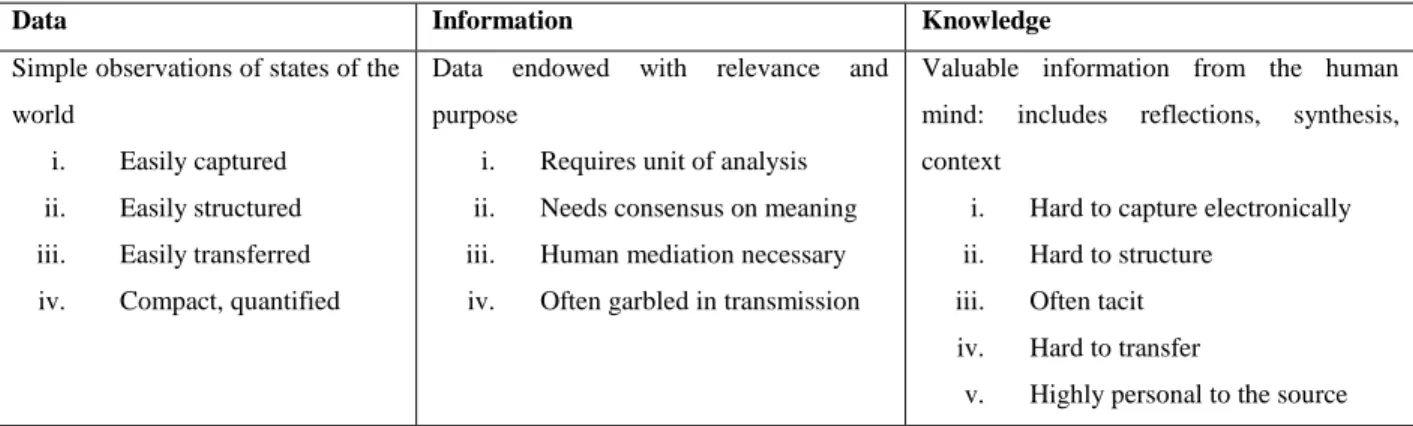
Table 3.4:1 The relationship between data, information and knowledge ... 75
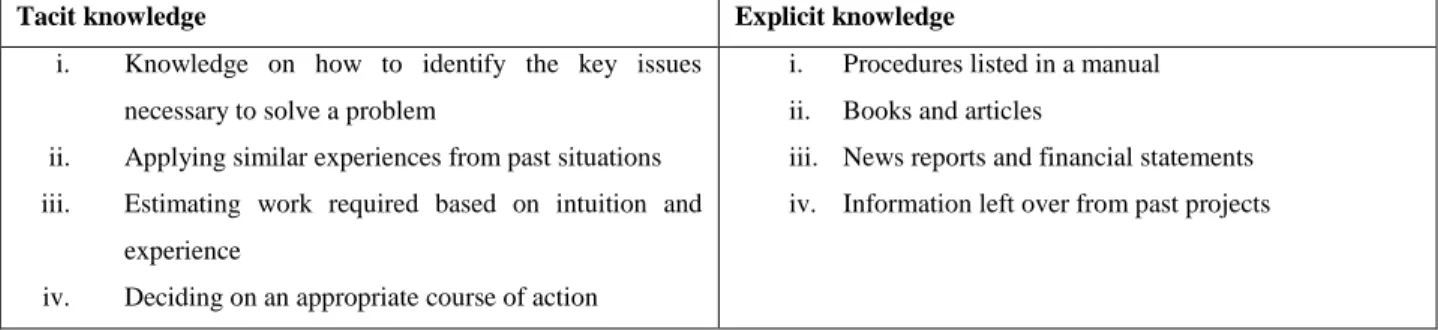
Table 3.4:2 Example of tacit and explicit knowledge ... 76
Table 3.4:3 Multiple perspectives on knowledge ... 81
Table 3.4:4 Skills and knowledge for KM implementation ... 97
Table 3.4:5 Competencies and skills for information specialists ... 98
Table 3.4:6 Comparisons between Web 1.0 and Web 2.0 ... 106
Table 3.4:7 The difference between Library 1.0 and Library 2.0 ... 107
Table 3.4:8 Application of Web 2.0 tools in academic libraries ... 108
Table 3.4:9 Comparisons between Web 2.0 tools and KM ... 113
Table 4:4.1:1 Research paradigm... 132
Table 4.4:1 Sample size for library staff ... 145
Table 5.2:1 Distribution of questionnaire in academic libraries ... 173
Table 5.2:2 Background of respondents: survey (questionnaire) (N=254) ... 174
Table 5.2:3 Background of respondents: semi-structured interview (N=57) ... 175
Table 5.3:1 KM awareness among respondents ... 176
Table 5.3.1:1 Individual KM training and KM training programmes ... 177
Table 5.4.1:1 Logistic regression for factors associated with KM application ... 179
Table 5.4.2:1 The benefits of KM practices in academic libraries (N=254) ... 180
Table 5.5:1 KM enablers for the application of KM practices ... 182
Table 5.6:1 Knowledge creation and sharing practices under socialisation process ... 185
Table 5.6:2 Knowledge creation and sharing practices through externalisation process ... 187
Table 5.6:3 Knowledge creation and sharing practices under combination process ... 188
Table 5.6:4 Knowledge creation and sharing practices under internalisation process ... 190
Table 5.6:5 Respondents‟ personal accounts in Web 2.0 tools ... 192
Table 5.6:6 Access of Web 2.0 tools in academic libraries ... 194
Table 5.6:7 The uses of Web 2.0 tools in the academic libraries ... 195
Table 5.6:8 Logistic regression for factors associated with Web 2.0 access and use ... 196
Table 5.8:1 Categories of Web 2.0 tools to enhance KM practices (N=254) ... 199
Table 5.8:2 Knowledge creation and sharing practices under socialisation ... 201
Table 5.8:3 Knowledge creation and sharing practices through externalisation process ... 202
Table 5.8:4 Knowledge creation and sharing practices under combination process ... 203
Table 5.8:5 Knowledge creation and sharing practices under internalisation process ... 203
Table 5.9:1 Model fit indices for the measurement model ... 206
Table 5.9:2 CFA results for measurement model ... 207
Table 5.9:3 Composite Reliability (CR), Average Variance Extracted and Discriminant Validity of constructs ... 208
Table 5.9:4 Model fit indices for the structural model ... 209
Table 5.9:5 Model fit indices for the modified structural model ... 212
Table 5.9:6 Hypotheses testing results ... 213
Table 5.9:7 The direct, indirect and total effect of the variables depicted ... 214
Table 5.10:1 Challenges that hinder the application of KM practices in academic libraries ... 215
xx
LIST OF FIGURE
Figure 2.1:1 Map of Tanzania. ... 32
Figure 3.2:1 Academic Library 2.0 concept model... 45
Figure 3.2:2 Jennex and Olfman KMS Success Model ... 47
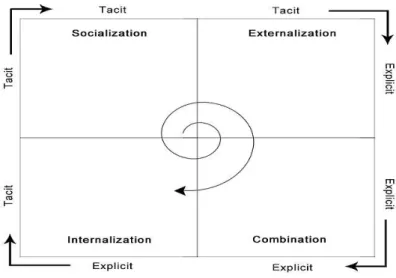
Figure 3.2:3 SECI processes ... 51
Figure 3.2:4 Web 2.0 driven SECI model ... 54
Figure 3.3:1 KMS Success Model ... 67
Figure 3.4:1 Primary sources of information ... 73
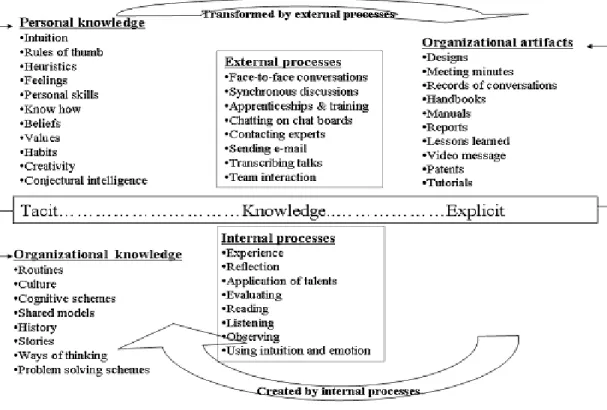
Figure 3.4:2 Tacit –explicit knowledge continuum ... 78
Figure 3.4:3 Five essentials of web 2.0 tools within libraries ... 108
Figure 4.2:1 Research design for the study ... 142
Figure 5.9:1 Measurement model ... 205
Figure 5.9:2 Structural model ... 209
Figure 5.9:3 Modified SEM ... 211
Figure 7.3:1 Knowledge creating a cycle in Web 2.0 sites ... 295
Figure 7.3:2 Example of Social media policy in a library ... 300
xxi
ABBREVIATIONS AND ACRONYMS
ACRL ALA ARU
Association of College and Research Libraries American Library Association
Ardhi University
AST Adaptive Structuration Theory AST
AUL
Adaptive Saturation Theory Australasian University Libraries AVE Average Variation Extraction
CAS Current Awareness Services
CC Computer Centre
CCE Centre for Continuing Education CFA Confirmatory Factor Analysis
CILIP Chartered Institute of Library and Information Professionals CIO Chief Information Officer
CKO Chief Knowledge Officer
CMS Content Management System
COTUL Consortium of Tanzanian University and Research Libraries
CR Composite Reliability
DIKW Data, Information, Knowledge and Wisdom EALA East African Library Association
EASSY Eastern Africa Submarine Cable System EFA Exploratory Factor Analysis
HSDPA High Speed Downlink Packet Access ICE Institute of Continuing Education
ICTs Information and Communication Technologies
IFLA International Federation of Library Associations and Institutions IHSS Institute of Human Settlement Studies
IKFL Institute of Kiswahili and Foreign Languages
ILL Inter-Library Literacy
ILT Inter- Library Training
IR Institution Repository
IS Information System
xxii
ITECH International Training and Educational Centre for Health ITU International Telecommunication Union
IUCEA Inter-University Council for East Africa
KM Knowledge Management
KMA Knowledge Management Africa
KMO Kaiser Meyer Olkin
KMS Knowledge Management System
KR Knowledge Repository
LIS Library and Information Services MCNY Metropolitan College of New York
MMC Muhimbili Medical Centre
MNH Muhimbili National Hospital
MoCU Moshi Co-operative University
MoFEA Tanzanian government under its Ministry of Finance and Economic Affairs MSTHE Ministry of Science, Technology and Higher Education
MU Mzumbe University
MUCHS Muhimbili University College of Health Sciences MUHAS
MUIR
Muhimbili University of Health and Allied Sciences Mzumbe University Institutional Repository
MWCT Ministry of Works, Communications and Transport NICTBB National ICT Broadband Backbone
NM-AIST Nelson Mandela African Institution of Science and Technology
ODL Open and Distance Learning
OECD Organisation for Economic Co-operation and Development OPAC Online Public Access Catalogue
OUT Open University of Tanzania PDA Personal Digital Assistance
QoS Quality Of Service
RSS Rich Site Summary/ Really Simple Syndication SADE School of Architecture and Design
SCEM School of Construction Economics and Management SDI Selective Dissemination of Information
SEAS School of Education, Arts and Sciences
xxiii
SEM Structural Equation ModelingSEST School of Environment Science and Technology SGST School of Geospatial Sciences and Technology SNAL Sokoine National Library
SNSs SPSS
Social Networking Sites
Statistical Package for the Social Sciences SQL
SSA STI
Structured Query Language Sub Saharan Africa
Scientific and Technical Information SUA
SUIR
Sokoine University of Agriculture
Sokoine University Institutional repository SURP School of Urban and Regional Planning SUZA State University of Zanzibar
TANESCO Tanzania Electrical Supply Company TAZARA Tanzania Zambia Railway Authority
TCRA Tanzania Communication Regulatory Authority TCU Tanzania Commissions of Universities
TENET Tanzania Education Network TLA Tanzania Library Association TLS Tanzania Library Services TLSB Tanzania Library Services Board
TRA Theory of Reasoned Action
TRC Tanzania Railways Corporation
TTCL Tanzania Telecommunications Company Limited UCC University of Dar es Salaam Computing Centre UCLAS University College of Lands and Architectural Studies
UDOM University of Dodoma
UDSM University of Dar-es-Salaam UEA University of East Africa
UMTS Universal Telecommunications Systems
UNESCO United Nations Educational, Scientific and Cultural Organization UNISA University of South Africa
xxiv
UP University of Pretoria
VLE Virtual Learning Environments VRE virtual research environments
WiMAX Worldwide Interoperability of Microwave Access ZANTEL Zanzibar Telecom Limited
1
CHAPTER ONE
INTRODUCTION TO THE STUDY
1.0 Introduction
The global knowledge-based economy has brought new challenges in various sectors worldwide. Currently, knowledge has become an important asset as compared to labour, land and capital (Maponya 2004). Drucker (1993) made it known that the basic economic resource is no longer the capital, natural resources, or labour but is and will be the knowledge. Thus, human knowledge and their capabilities have always been at the central place in the global info-economy. The study of human knowledge has been a central subject matter of philosophy and epistemology since the Ancient Greeks and the historical perspective of KM. It reveals as an old mission pursued by Eastern and Western philosophers (Kakabadse, Kakabadse, and Kouzmin 2003). Knowledge is the core concept of KM practices (Choi and Lee 2002).
KM practices began in the mid of 1990s (Hislop 2013) and it began to gain attention in profit-oriented institutions such as companies and industries where the foundation of industrialised economies has been shifted from natural resources to intellectual assets (Razi, Karim, and Lumpur 2011). Thereafter, the consequences of KM practices had spread to non-profit institutions such as government agencies, hospitals, schools, universities and libraries (Che Rusuli, Tasmin, and Takala 2012; Maponya 2004;Mavodza 2010; Townley 2001).
The majority of academic libraries have now, significantly, developed and are applying some KM practices in the provision of library services (Gandhi 2004; Singh 2007). It is also evident that most of the academic libraries have been undergoing a period of profound changes and true paradigm shift which seem to affect information access, retrieval, use and storage. This necessitates academic libraries to become not only information providers but also information/knowledge seekers which demand the libraries seeking knowledge from their users as well as in-house knowledge of their employees. Kim and Abbas (2010) assert that academic libraries‟ primary functions are to act as the Knowledge Repository (KR) and an agent of dissemination of knowledge. Thus, the basic goal of KM practices in academic libraries has been to leverage the available knowledge that may help library staff to carry out their tasks more efficiently and effectively. Trivedi (2007) has explained KM application in academic libraries as follows:-
2
Knowledge management within libraries is not just managing or organising books or journals, searching the internet for clients or arranging the circulation of materials. However, each of the activities can, in some way, be part of the knowledge management spectrum and process. Nevertheless, knowledge management is about enhancing the use of organisational knowledge through sound practices of knowledge management and organisational learning. Thus, knowledge management is an effective and functional combination of information management, communication and human resources.
Based on the explanations above, it has become evident that advantages of KM practices has been relevant to academic libraries, and most importantly to be recognised as a part of corporate advantages. Consequently, the advantages have made academic libraries speak about “managing” and “sharing” in more practical ways (Jain 2007; Kebede 2010; Maponya 2004; Mavodza 2010; Townley 2001). Hislop (2013) explains that one of the primary rationales for organisations managing their knowledge is to allow knowledge to be more widely and efficiently shared within organisations. Good KM practices help to transform academic libraries into a more efficient knowledge creation and sharing engines.
KM practices involve various knowledge handling activities such as knowledge creation, acquiring, capturing, using, storing, retrieving and sharing activities (Alavi and Leidner 2001; Karim, Razi and Mohamed 2012). However, among the mentioned KM practices knowledge creation and sharing have been given much importance among KM authors (Lee and Choi 2003). Nonaka and Toyama (2003) have defined knowledge creation as a dialectical process in which various contradictions are synthesized through dynamic interactions among individuals, organisations, and environment; while Karim, Razi, and Mohamed (2012) have defined knowledge sharing as the process through which explicit and tacit knowledge are communicated, transferred and discussed to others. This is done by individuals, groups, and across groups. Therefore, knowledge creation and sharing have also been considered as KM practices in this study. The justification for choosing knowledge creation and sharing practices are indicated below:-
(a) Knowledge production/creation in most of higher learning institutions requires and involves the application of existing bodies of knowledge and creation of new knowledge. Thus, the ongoing knowledge creation and development represents an important and intrinsic feature of the primary task of a knowledge worker (Hislop 2013);
(b) Knowledge sharing is believed by many organisations as a panacea for knowledge creation, and an important catalyst to improve innovation, productivity, and understanding among employees;
3
(c) There is, indeed, a close relationship between knowledge creation and knowledge sharing. Nonaka and Takeuchi (1995) provide that among the benefits of knowledge sharing include knowledge creation. Therefore, issues such as creativity and innovation, quality of service, employee empowerment, and better decision making could be performed under knowledge creation and knowledge sharing better than any other aspects of KM;
(d) Knowledge creation has been considered to be important, but such knowledge was not communicated and shared among members;
(e) Lack of knowledge sharing culture in the majority of academic libraries was hinted by Nonaka and Konno (1998) believed that organisation has an important role in promoting knowledge sharing;
(f) Lack of models and theories to support the creation and sharing of knowledge and to identify the factors that affect the application of Web 2.0 tools to enhance KM practices in academic libraries; and
(g) The requirements and procedures for knowledge sharing within organisations have been emphasised.
There are two basic types of knowledge, namely explicit and tacit knowledge (Hislop 2013). Academic libraries worldwide store explicit and tacit knowledge. Explicit knowledge is obtained from written documents such as books, articles, historical documents, self-study documents, conference proceedings, research articles and minutes of meetings. Research and scholarly articles/reports are among the tangible assets in academic institutions. They are also regarded as explicit knowledge.
Tacit knowledge is obtained from peoples‟ minds. It is also owned by the one who possesses such knowledge. It has intellectual property rights which allow an individual to own its creativity and innovation the same way as they can own physical properties (Hislop 2013). Academic libraries need to identify and evaluate tacit knowledge from individuals and make them explicit through codification process so that such knowledge can easily be retrieved, accessed and used. Hislop (2013) adds that knowledge is implanted in the processes, documented as explicit knowledge and stored in the heads of human beings as tacit knowledge.
Further, Hislop (2013) asserts that regardless the fact that tacit knowledge is stored in humans‟ minds, and such a knowledge can be accessed, used and shared through codification strategy. Knowledge can be
4
codified, made explicit, and separated from the person who has created it, developed it, or utilised it. Williams et al. (2004:99) explain that “...when information and knowledge flow, they can be captured, organised and made accessible for reuse. Therefore, there exists the potential for the subsequent creation of new knowledge...” Both tacit and explicit knowledge need to be stored in knowledge repositories to allow people to access, retrieve and use it. Academic libraries are, therefore, required to ensure the storage and use of explicit knowledge which is stored in various documents; and use of codified tacit knowledge extracted from peoples‟ mind (Hislop 2013).
Information and Communication Technology (ICT) has played a prominent role in KM practices and KM research. Through centuries, ICT has found their way in influencing KM practices, for example, the craft guild culture of the Thirteenth Century had introduced more explicit and systematic KM practices (Kakabadse, Kakabadse, and Kouzmin 2003). Thus, the application of ICT to enhance KM practices provides people with the potential for greatly enhanced access to knowledge combined with the challenge of how to access, retrieve and use knowledge (Hawkins 2000).
Omona, Van der Weide, and Lubega (2010) assert that the adoption of ICT brought new methods, tools and techniques in the development of KM systems‟ frameworks, knowledge processes and knowledge technologies to promote KM practices for improved service deliveries. ICT has advanced tremendously in recent times with the development of various technological tools such as Web 2.0 technologies, intranet, groupware and social media tools (Nelson 2008). Levy (2009) adds that, by the late 2000s, one of the most common ways that ICT was being argued as facilitating KM initiatives were via the use of Web 2.0 technologies. Thus, in considering the use of ICT, the focus in this study, is the application of Web 2.0 tools to enhance KM practices in academic libraries.
The term “Web 2.0” was first coined by Tim O‟Reilly in a conference during a brainstorming session between O‟Reilly and MediaLive International (O'Reilly 2005). O'Reilly (2005) has defined Web 2.0 as “the business revolution in the computer industry caused by the move to use the Internet as a platform, and an attempt to understand the rules for success on that new platform. Web 2.0 is a natural platform for the open learning materials which is also called open courseware that comprises a number of online technological tools used to facilitate online communication, participation, collaboration and sharing of knowledge (Hislop 2013). Web 2.0 tools facilitate a more socially connected web where people can easily communicate, edit, collaborate, participate, and share knowledge (Hosseini and Hashempour 2012:139).
5
Library 2.0, on the other hand, is the integration of Web 2.0 features in the library web-based services (Kim and Abbas 2010; Maness 2006). Majumdar and Shukla (2008:463) have explained that “Library 2.0 is equivalent to Web 2.0 concepts and applications in the Library and Information Services (LIS) sector”. Tarade and Singh (2013) have added that Library 2.0 is a concept taken from Web 2.0 to make information available anywhere at any time, the user requires it. Thus, in this study, most of the activities under Library 2.0 were covered in the Web 2.0 application.
Generally, the application of Web 2.0 tools in academic libraries has transformed the normal activities of such libraries to a more collaborative process in which they can easily share, use, retrieve and access information with other librarians and library users (Ram, Anbu, and Kataria 2011:453). Dave and Koskela (2009) add that in the Web 2.0 environment library users are no longer passively receiving information; they are editing information, communicating, participating and sharing information online. Kim and Abbas (2010:211) assert that the capabilities of Web 2.0 are more in enabling library users to engage the library in two-way communication and knowledge exchange. Instead of users physically coming to the library, the library delivers services to users via the access of library/university website.
The importance of Web 2.0 tools to facilitate KM practices is well acknowledged by various authors. Hislop (2013), as well as Mavodza (2010), support that KM implementation requires the use of ICT, including Web 2.0 tools. Levy (2009) provides that the application of Web 2.0 to facilitate KM practices is also known as the application of KM 2.0 which means “managing knowledge in the light of Web 2.0 existence”. The application of Web 2.0 tools to enhance KM practices provide better ways which allow knowledge to flow, communicated and shared among many users. It is also reported that the key to making KM practices work is not by managing knowledge only, but also by making such knowledge more visible through the use of Web 2.0 tools (Nelson 2008:135).
Shang et al. (2011:178) add that Web 2.0 technologies build a platform on which users can exchange information, express thoughts and reconfigure existing explicit knowledge. KM is a collaborative process; thus the application of Web 2.0 tools could provide ample prospects for both internal and external collaboration (Nelson 2008:135). It is evident that most of its activities are decentralised. Therefore, people are required to add information or knowledge voluntarily. In addition to individual knowledge generation, Kane and Fichman (2009) add that Web 2.0 platform has emerged as a visible channel of knowledge building for general and discipline-specific communication. KM practices are based on people and without people; KM practices cannot essentially take place. Thus, an active participation of users is practically necessary. Among the principles of using Web 2.0 tools is the active participation of users
6
(Hislop 2013; Levy 2009; Nelson 2008). Web 2.0 tools are used to facilitate interpersonal communication, interaction and collaboration which allow people to develop a sense of community and a shared identity within a KM environment.
Levy (2009) asserts that some of the features of Web 2.0 tools have their roots in KM practices. Wiki is an example of Web 2.0 tool which is also a part of the KM toolbox (Ram, Anbu, and Kataria 2011). In this case, Wiki allows individual to write and edit or remove information (Wagner and Majchrzak 2007). This functionality is important because virtual forms of collaboration are critical for knowledge sharing and coordination in the knowledge society (Kosonen and Kianto 2009). Additionally, library success is the best practice of Wiki (www.libsuccess.org) used by librarians across the world to share their knowledge and successful projects and to facilitate collaboration and participation across academic libraries.
Despite the advantages of Web 2.0 tools, their application to support KM practices in academic libraries in Tanzania as well as in other Sub-Saharan African (SSA) countries is still slow and unplanned (Akeriwa, Penzhorn, and Holmner 2014; Lwoga 2013; Makori 2012; Muneja and Abungu 2012). Therefore, this study has investigated the application of Web 2.0 tools to enhance KM practices (knowledge creation and sharing practices) in academic libraries. In other words, it has investigated how KM practices could be enhanced in the light of Web 2.0 tools. Therefore, there is a need for academic libraries worldwide to implement and use different types of Web 2.0 tools to enable individuals to contribute to the organisational knowledge base.
1.1 Background to the study
Tanzania comprises 29 recognised private and public universities (TCU 2014). Some of them have libraries that integrate and use Web 2.0 tools for innovative service delivery as well as to facilitate KM practices. The main aim of this study was to investigate the application of Web 2.0 tools to enhance KM practices in academic libraries. The following sub-sections provide the background to the study.
1.1.1
KM and IM in academic librariesThe question of whether libraries should consider KM and not information management (IM) was clarified by having an insightful understanding of various dimensions of KM, and the relationship between KM and IM in academic libraries. IM is seen as an essential prerequisite for KM (Chen, Snyman, and Sewdass 2005; Grey 1998). Global trends have resulted in the shift towards a knowledge-based
7
economy, necessitating KM which encompasses both the management of information and management of people (Chen, Snyman, and Sewdass 2005). Davenport (2005) noted that:
Knowledge Management is related to Information Management but is not the same thing simply because Knowledge and Information are not identical. Information is atomic and static, but knowledge is associative, rich, multi-layered, multifaceted, contextual, accessible, and dynamic. For example, Information is what you get when you run a web search on Google but knowledge is what you would get or at least get closer to if all of the results that came back from that search were relevant to what you actually wanted, and were presented consistently.
Chen, Snyman, and Sewdass (2005), as well as Grey (1998), explain that knowledge cannot be managed directly; only the information about knowledge possessed by people in organisations can be managed. Indeed knowledge is derived from information, but it is a cut above information. Jain (2007) asserts that both IM and KM involve human element, however at different levels. Jain and Nfila (2006:181) provide the differences between KM and IM as follows:
(a) IM sees information as the resource and lays emphasis on human involvement in terms of information audit, acquiring, storing, retrieving, and disseminating information. It works with objects and achieves its success on the prevention and retrieval of information; and
(b) KM is working with people. Its success depends on the use of knowledge. It emphasises on people management to take into custody the hidden knowledge from their heads. KM focuses on sharing, creating, learning and enhancing information for organisational improvement. In other words, it targets the collection and distribution of knowledge – both explicit and tacit in a contextual manner.
Jain (2007) distinguishes KM from IM by analysing work patterns that are IM works with objects (data or information) and KM works with people. IM deals exclusively with explicit representations and guarantees access, security, delivery, and storage. In this case efficiency, timeliness, accuracy, completeness, speed, the cost of storage and recoveries are the main concerns. On the other side, KM values originality, innovation, agility, adaptability, intelligence and organisational learning. Therefore, KM focuses on people and is more concerned with critical thinking, innovation, relationships, exposition of ideas, standards, skills and encouraging learning and sharing of experiences. Table 1.1:1 provides the key differences between KM and IM as summarised by Jain (2007).
8
Table 1.1:1Differences between KM and IMS/N Aspect analysed Information Management Knowledge Management
1 Work element Object (data and information). People (knowledge).
2 Validity/credibility Information has no universally accepted meaning.
The KM depends on a greater degree of certainty and validity.
3 Nature Flow of information. Knowledge is formed by these IM
information flow.
4 Formation The information is a framework for
knowledge.
Knowledge embraces organisational values, beliefs, and actions.
5 Success factors Depend on the preservation and retrieval of information.
Depend on the use of knowledge.
6 Particulars Knowledge is extrapolative and future oriented.
The information is organised data.
7 Involvement of the human element
The IM sees the information as a resource and insists on human involvement in terms of information storage, retrieval, and audit. It aims at acquisition, storage, retrieval and dissemination of information.
The KM emphasises the management of people in order to take into custody the hidden knowledge of their heads. Focuses on knowledge sharing, creating, learning and improving information for the organisation. 8 Type of knowledge Focuses primarily on explicit and
documented knowledge.
Seeks both explicit and tacit knowledge.
KM practices in academic libraries call for a paradigm shift from traditional librarians to modern information professionals, from library managers to knowledge managers, and from libraries to knowledge centres (Jain 2007:379). Jain (2007:377) explains that it is very difficult for librarians to establish whether, or not they are library managers or knowledge managers, and whether they are working in libraries or knowledge centres. As a matter of fact, librarians are ultimate knowledge operators and managers.
Librarians, as well as, libraries are still in believing that KM is simply managing information and explicit or documented knowledge. This is what they have been doing for many years (Chandra 2005; Koina 2003). The majority of libraries manage information as a starting point and then leads to KM practices. Chen, Snyman, and Sewdass (2005) add that the concept of IM has been used and discussed for many years in libraries. In addition, Jain (2007:379) asserts that both KM and IM refer to the activities and tasks which are performed by library staff to satisfy their users‟ need.
Chandra (2005), as well as Jain and Nfila (2006), add that however, the concept of KM is still new in the majority of the academic libraries, some of the elements of KM practices such as acquisition, creation,
9
renewal, organising, archiving and dissemination of knowledge are very present in academic libraries today. Further, Jain (2007) asserts that KM is not primarily about managing or organising books or magazines, and search the internet for users or making the material movement to disseminate information. KM encompasses the whole organisation, not just the bits in the library, and it includes tacit knowledge as well as explicit knowledge (Jain and Nfila 2006). The application of KM in the academic libraries employs the use of organisational knowledge through sound practices of KM and organisational learning (Mavodza 2010). Chandra (2005) adds that KM emerged to improve the use of organisational knowledge through better practices and organisational learning which could be obtained either from books, magazines, the Internet and other documents (explicit knowledge) or stored in human heads (tacit knowledge).
Chandra (2005:246) defines KM as a discipline that promotes an integrated approach towards identifying, managing and sharing of all of an enterprise‟s information assets. As such, these information assets include database, documents, policies and procedures as well as previously unarticulated expertise and experience resident in individual workers. Therefore, to access and use information, one has or needs to acquire both theoretical and practical knowledge (Kakabadse, Kakabadse, and Kouzmin 2003). KM issues include developing, implementing and maintaining the appropriate technical and organisational infrastructure to enable knowledge sharing (Chandra 2005). At this juncture, KM is defined as a “conscious strategy of getting the right knowledge to the right people at the right time and helping people to share and put information into action in ways that strive to improve organisational performance” (O‟Dell and Jackson 1998).
Practically, KM is a more holistic and wider form of IM (Jain and Nfila 2006:180) and; therefore, there is a need for academic libraries to manage knowledge rather than information. Academic libraries need to manage the knowledge of their parent organisations, thus to assist their organisations to use and apply organisational knowledge to achieve the desired organisational goals (Madge 2010). In view of the fact that KM is wider than IM in terms of activities involved, IM can be considered as the “building block” of KM (Jain and Nfila 2006:181). Chandra (2005:246) adds that the foundation of KM is the power of learning (Chandra 2005:246). Townley (2001) adds that in many ways, KM incorporates principles that academic librarians have developed and used with scholarly information for many years. It then applies these and other principles to organisational information in ways that create new knowledge to improve organisational effectiveness.
10
Academic librarians in Tanzania, as in other African countries, describe KM practices as the process of collecting, cataloguing and indexing explicit or documented knowledge (Jain 2007; Jain 2009; Mavodza 2010). Certainly, librarians already have the core IM skills required to manage knowledge once it becomes explicit. The process for explicit assets is to identify, catalogue and optimise the availability of artefacts in which the knowledge is stored (Chandra 2005). Tom Davenport believes that KM will not succeed if there are no workers and managers whose primary duties involve gathering and editing knowledge from those who have it, paving the way for operation of knowledge networks, setting up and managing technology infrastructure (Davenport 2005). Academic libraries are charged with the responsibility of carrying out all these practices. However, the question that arises is whether academic libraries have been practising KM or IM (Jain and Nfila 2006:181). Some of them may be striving to achieve that, but still remain a long way from a full KM society.
Gorman (2000:20) has formulated five laws of library science in regard to KM practices which include: (a) Libraries serve humanity;
(b) Respect all forms by which knowledge is communicated; (c) Use technology intelligently to enhance service;
(d) Protect free access to knowledge; and (e) Honour the past and create the future.
Referencing, cataloguing and other library services are designed to encourage the use of scholarly information to increase the amount of academic knowledge used in higher education. Townley (2001:46) explains that questions in a reference interview and the points of access in a catalogue are both intended to reinforce the ways that scholars work to create new academic knowledge. However, libraries have done little to use the organisational information to create knowledge that can be used to improve functionalities of libraries and their parent organisations (Townley 2001).
Jain and Nfila (2006:188) suggest that library staff can apply KM practices in their libraries, only if they are willing to transform themselves as well as transform their libraries into knowledge-driven organisations. Therefore, focusing on the application of KM practices, academic libraries serve humanity by equipping people with the right kind of knowledge and, thus, advance the well-being of humankind (Jain 2013:137). Through KM practices, academic libraries have an opportunity to collaborate with more people from various departments within and outside their organisations (Townley 2001:46).
11
1.1.2
KM practices and the role of KM enablers in academic librariesThe foundation of KM is the power of learning. No organisation can improve without learning something new (Chandra 2005). KM is very critical for the management of organisational knowledge which is created daily within higher learning institutions. The majority of academic libraries employ KM practices to improve the quality of their services in this age of the knowledge economy (Kude, Nalhe, and Mankar 2012). KM is consistent with the currently emerging models within the organisations which involve people working in teams, coming together on a project basis, and moving on the new relationships (Chandra 2005).
There are various types of KM practices which include knowledge creation, knowledge internalisation, knowledge sharing, knowledge capturing, knowledge transfer, knowledge maintenance, and knowledge acquisition (Jain and Nfila 2006:181). This study has employed knowledge creation and knowledge sharing practices only. This is because knowledge creation and knowledge sharing practices make academic libraries to a better understanding of information and knowledge needs of the library users. Even though knowledge is created daily through learning, teaching, research and innovation, there is the lack of formalised structures for knowledge creation and sharing in the majority of academic institutions (Mosha, Holmner, and Penzhorn 2015). This can be achieved through the establishment of knowledge creation and sharing culture within higher learning institutions. Jain and Nfila (2006) assert that library staff should be leading in creating and sharing their knowledge and skills among themselves and with library users. Nevertheless, practically this element is missing, which is revealed by the research findings. Additionally, academic libraries under a KM environment need to create searchable repositories, libraries and databases of knowledge which will assist people who are looking for specific topics (Hislop 2013).
Knowledge creation and sharing practices need to be enhanced through the application of KM enablers. Lack of KM enablers hinders the application of KM practices (knowledge creation and sharing) in the majority of the academic libraries. There are different types of KM enablers such as ICT infrastructure, organisational structure and culture, KM policy and procedures, competencies and skills, KM training, and management support and leadership. The majority of academic libraries in Tanzania and in other Sub-Saharan African (SSA) countries lack KM enablers for the effective creation and sharing of knowledge (Jain 2007; Mavodza 2010). For example, there is a lack of KM policies and guidelines to facilitate the application of KM practices in academic libraries (Jain 2007). Most of KM policies and procedures, missions and visions which are available in libraries are not reviewed and updated regularly to accommodate the changes (Jain 2007). In addition, academic librarians need a mix of technical and organisational skills and competencies to help them handle information services to fully manage
12
knowledge, librarians need to have multidisciplinary skills to understand KM‟s holistic approach (Hislop 2013; Jain 2007; Mavodza 2010). To stress on the matter, Chandra (2005:255) adds that managing knowledge requires a mix of technical, organisational and interpersonal skills.
Currently, IT is regarded as the central part of KM enabler to facilitate KM practices (Hislop 2013). Jain and Nfila (2006:187) assert that IT can support and enable KM practices by providing the means for people to better organise, store, retrieve, disseminate and share explicit knowledge; and also, by connecting people through collaborative tools to capture and share knowledge. On the other hand, Lack of adequate ICT infrastructure is among the major challenges which most of the academic libraries in Sub-Saharan African (SSA) are facing today. Lack of management support and motivation to library staff involved in KM practices also discourage the requisite KM practices in the majority of the academic libraries (Mosha, Holmner, and Penzhorn 2015). Therefore, to enjoy the whole potential of the academic libraries, as well as, the librarians need to be encouraged and supported to participate in KM practices.
1.1.3
The application of Web 2.0 tools in academic librariesThe application of Web 2.0 tools has become an integral part of our everyday activities. The emergence of these tools has changed the ways on how academic libraries in Tanzania and in other African countries provide services to library users. The argument was also supported by Levy (2009) who asserts that the emergence of Web 2.0 tools has changed the ways academic libraries are performing their duties by helping people to participate in dialogue and discussion and then contribute their knowledge to interpersonal and community discussions (Levy 2009). Libraries worldwide are, therefore, increasingly adopting Web 2.0 tools to improve library services. The Web 2.0 environment brings unprecedented challenges to libraries.
Tripathi and Kumar (2010:190) state that “Earlier academic libraries were “place-based” service providing institutions and users visited the library to consult the catalogue and use the physical collection of books, journals, CDs, and other products”. Therefore, with the emergence of Web 2.0 tools, academic libraries has been completely transformed (Tripathi and Kumar 2010:190). Levy (2006) asserts that the emergence of Web 2.0 tools has changed the way academic libraries are performing their duties by helping people to participate in dialogue and discussion and then contribute their knowledge to interpersonal and community discussion. Curran, Murray, and Christian (2006) add that the access and use of Web 2.0‟s principles and technology offer academic libraries opportunities to serve their audiences where they are and in association with the tasks that they are undertaking. One of the main aims of Web 2.0 tools is to encourage feedback and participation from users.
13
The access and use of Web 2.0 tools help academic libraries to improve the quality of their services to develop an interactive and content-rich web presence for libraries (Kim and Abbas 2010; Penzhorn and Pienaar 2009; Mendes, Quinonez-Skinner, and Skaggs 2009). Akeriwa, Penzhorn, and Holmner (2014) add that academic libraries worldwide are increasingly adopting a variety of Web 2.0 tools and applications to deliver more effective and accessible services to their clients. Therefore, there is an undisputed need for academic libraries in developing countries to start using Web 2.0 tools as those in the developed world. Jain (2013:134) adds that:
Today we are in the digital era...with the emergence of Web 2.0, Library 2.0, RSS, Blogs, Wikis, SMS, Podcasting, Mashups, Tagging, Folksonomies, OSS, OA, and other tools., libraries worldwide have been adjusting to a shift from the printed era to the digital era.
The application of ICT and Web 2.0 tools in the most of the academic libraries in developing countries is still slow and unplanned (Lwoga 2013; Makori 2012). Most of the academic libraries in South Africa are highly advanced in using Web 2.0 tools for the library services. For example, the University of Pretoria (UP) Library in South Africa is using Web 2.0 tools to facilitate reference services and information literacy learning (Penzhorn 2013; Penzhorn and Pienaar 2009). On the other hand, there are few libraries in Tanzania which are using Web 2.0 tools. For example, For example, MUHAS Library employed a number of Web 2.0 tools such as Blogs (for delivering health content through online search tool to search for e-resources at the library website, posting information on a training schedule and facilitate online tutorials on information searching techniques) and Wikis (to support learning and information literacy and to provide online training modules and annotated links on various topics (Lwoga 2013:291). Other library activities which could be supported by the application of Web 2.0 tools include the creation of online catalogues, social bookmarking, collaborating, and content sharing (Muneja and Abungu 2012).
Generally, the majority of academic libraries in Tanzania still operate mainly on a „traditional‟ basis where the bulk of the key functions are carried out manually. As mentioned, few academic libraries have started using various Web 2.0 tools to varying degrees (Muneja and Abungu 2012), and others have been conducting Web 2.0 tools training to equip and engage their library employees with requisite knowledge and skills about Web 2.0 tools (Lwoga 2013; Muneja and Abungu 2012). Therefore, much effort is still needed to enhance the application of Web 2.0 tools in academic libraries inTanzania, especially on facilitating KM practices.