INTERNATIONAL JOURNAL OF
ECONOMIC STUDIES
ULUSLARARASI
EKONOMİK ARAŞTIRMALAR DERGİSİ
September 2018, Vol:4, Issue:3 Eylül 2018, Cilt:4, Sayı:3 e-ISSN: 2149-8377 p-ISSN: 2528-9942
journal homepage: www.ekonomikarastirmalar.org
Economic Output and High-Technology Export: Panel Causality Analysis
Elma SATROVIC
Assist. Prof. Dr, Çağ University, [email protected]
ARTICLE INFO ABSTRACT
Article History: Received 17 June 2018 Received in revised form 8 August 2018
Accepted 13 August 2018
High-technology export is expected to have a positive impact on economic output since it is supposed to have a positive impact on job growth. The relationship between export and economic growth, as well as the relationship between foreign direct investments, export and economic growth has been a popular issue of debate in up-to-date studies. However, empirical evidence treating the direct causality between high-technology export and economic output is lacking. Therefore, this article aims to fill in this gap by providing new evidence on the relationship between aforementioned economic terms. The relevance of high-technology export on economic output is explored in three panels. The first overall panel contains 70 economies; the second contains 32 developed economies, while the third panel contains 38 developing economies over the period 1995-2015. A Granger causality test that implements a vector autoregressive (VAR) framework within the panel setting is employed. Besides this, cointegration test is applied. In order to test for the sensitivity of the results and to avoid robust errors, we employ a panel ARDL model. The findings of ARDL model indicate that there is a short- as well as long-run relationship between high-technology export and economic output in the original model in overall sample of countries as well as for developed and developing. These results are confirmed in the extended model that controls for the impact of foreign direct investments. Cointegration test reports cointegrating relationship between high-technology export and economic output. Granger causality test indicates a bidirectional relationship between economic terms of interest.
Keywords:
High-technology export, Economic output, Panel ARDL, Cointegration, Causality
INTRODUCTION
In terms of economic output, the number of determinants ranges to infinite. However, the most important factors can be summarized into: human resources, natural resources, technological development, social factors as well as political factors (Usman, 2017). Nowadays, technological development is very often considered to be one of the most important driving factors of economic output. This is since high-technology sector had the most important contribution in terms of the growth of jobs (Yoo, 2008). Moreover, Hobday (2001) indicates that this industry is considered to be one of the main driving factors in Asia-Pacific area.
Some of the developing countries have reached rapid economic growth in last decades. One of the most important reasons behind was the improvement of export performance. Export is considered to be an important determinant of economic output especially in the long-run. In addition to the role of export, much attention is given to high-technology export nowadays. Czarnitzki and Wastyn (2010) have indicated that the importance of high-technology export is recognized especially in terms of small economies.
Many countries, especially developing, actively seek to improve high-technology (HT) industry. The reason is that, this industry is expected to create new job opportunities and to improve economic output of the host country. In general, up-to-date studies on the relationship between high-technology export and economic output have focused on the role of HT in the link between FDI and economic growth. The general conclusion of these articles indicates that FDI is efficient at contributing to economic growth when certain conditions are met (e.g. developed financial system). However, a quantitative analysis on the direct causality between economic output and HT is lacking. This is why this article aims to fill in this gap in literature by using the most recent data and applying panel data ARDL methodology.
Theoretical and empirical work up to date that specifically addresses the direct link between HT and GDP is scarce. To mention some, Usman (2017) uses OLS with robust standard error to analyze the relationship between high-technology exports and economic growth in Pakistan. The obtained results indicate a significant and positive impact of high-technology exports on economic output. Similar result is found by Yoo (2008) using the data from 91 countries over the period ranging from 1988 to 2000.
The rest of the paper proceeds as follows. In Section 2 author summarizes the literature on the relationship between high-technology export and economic output. Section 3 gives a detailed description of data, variables as well as methodology. Section 4 summarizes the results of the empirical research on the matter. Finally, we conclude in Section 5.
1. Literature Review
The impact of export has been a popular issue of debate in up-to-date studies analyzing the relationship between foreign direct investments and economic output. However, empirical evidence on the direct link between (high-technology) export and economic output is scarce. Therefore, the literature review section summarizes empirical evidence on both, direct and indirect impact of (high-technology) export on economic output.
Mahmood and Mahmood (2016) have conducted panel VECM causality to examine the causal relationship between foreign direct investments, exports and economic growth. European and Asian developing countries are taken into consideration. The obtained results indicate bidirectional causal relationship between GDP and FDI in the short-run in developing countries in Europe. In terms of Asian countries, the obtained results indicate a bidirectional causal relationship between exports and economic growth in the short-run. In addition, a long-run causality running from export and FDI to economic growth is reported for both samples of the countries. Therefore, export is found to be an important determinant of economic growth in this study.
The impact of high-technology export on economic growth has explored in Yoo (2008). For this purpose the author has collected panel data from 91 countries over the period 1988-2000. The obtained results indicate that the high-technology export has a significant positive
impact on economic growth. The motivation for the research arose from the fact that high-technology export may have a critical role in economic growth especially in international setting. The obtained results are strongly significant.
Usman (2017) aimed to research the impact of high-technology export on economic growth in Pakistan over the 20 years period ranging from 1995 to 2014. For the purpose of analysis the author has used ordinary least square method with robust standard error. The obtained results indicate a significant and positive impact of high-technology export on economic growth. The result is found a bit surprising since Pakistan is agriculture country highly dependent on farming.
The development of high-technology industrial exports in emerging European countries over the past twenty years is explored by Connolly (2012). This author argues that high-technology is a key component of economic output. The paper also presents index of high-technology industrial export performance that is used to describe the high-technology export pattern in emerging European countries. The results indicate that, for low- and middle-income countries in general as well as for emerging European countries, high-technology development remains a key future challenge.
Abu Shihab and Soufan (2014) have explored the relationship between export and economic growth in the case of Jordan. The authors have used Granger causality. They have observed 13 years period ranging from 2000 to 2012. The obtained results indicate a unidirectional causal relationship running from economic growth to export. Therefore, the authors indicate that the economic growth is an important determinant of exports.
Ho (2007) has explored how high-technology industry leads to regional economic growth. For this purpose USA data are collected. The author emphasizes that a high-technology industry is a part of export sector. Empirical results of this study indicate that the high-technology industry generates a significant and positive influence on employment growth in the whole region. However, it is important to emphasize that this influence is unevenly distributed among cities with different sizes.
New evidence on the impact of the change in high-tech export on economic output is given in Falk (2009). The observed sample covers 22 OECD countries over the period ranging from 1980 to 2004. The author has estimated a system panel data dynamic growth model. Five year averaged data are used. The obtained results indicate that research and development intensity and the share of high-technology exports are having a significant positive impact on the GDP.
The papers above indicate that high-technology export tends to be a significant determinant of economic output. The positive impact is reported in general. Therefore the positive impact is expected in this paper as well. However, the papers above did not test whether there is the difference between the obtained results in terms of developed and developing countries. Moreover, the most recent data are not taken into account and estimation issues arising from the fact that the relationship between high-technology export and economic output tends to be reverse causal. Therefore, an attempt is made in this paper to deal with these issues applying panel ARDL approach.
2. Data, Variables and Methodology 2.1. Data and Variables
In order to investigate the causal relationships between economic output and high-technology export, there was a need to select appropriate proxy variables. Usman (2017) and Yoo (2008) indicate that appropriate proxy variable of technology exports is high-technology exports (current US$ - HT). The World Bank defines HT as `products with high R&D intensity, such as in aerospace, computers, pharmaceuticals, scientific instruments, and electrical machinery`. This variable is considered appropriate in this study as well. In terms of economic output it can be defined as total value of all goods and services that are produced in one economy. This measure can be used to determine whether economic progresses or contracts by comparing total value of all goods and services produced in at least two time
periods. Gross domestic product is the most commonly used measure of national economic output. For the purpose of this article GDP (current US$ - GDP) will be used as a proxy of economic output. The World Bank defines this proxy variable as the `sum of gross value added by all resident producers in the economy plus any product taxes and minus any subsidies not included in the value of the products`.
In terms of control variable, it is considered important to analyze the sensitivity of the obtained results by controlling for the impact of foreign direct investments. Bilgiç (2007) and Tapşın (2016) indicate that an appropriate proxy variable of FDI is foreign direct investment, net inflows (BoP, current US$ - FDI). Therefore, this variable is accepted in this article as well. The panel data, used to estimate the causal relationship between economic output and high-technology export are collected for the sample of 70 countries (32 developed and 38 developing) over the period 1995-2015 from the World Bank website (World Development Indicators, 2017). The list of countries is given in Appendix 1. The main selection criterion was the data availability. In addition, an attempt is made to include the most recent data.
2.2. Methodology
The econometric methodology applied in this article is summarized as follows. First, the presence of panel unit root is tested for the variables. Furthermore, cointegration is analyzed using cointegration test. The causal link between variables has been explored employing the Granger causality test. In order to test the sensitivity of the results, to avoid robust errors and to deal with the reverse causality issue, an ARDL model is employed. Fisher-type unit root test has been presented for understanding stationary properties of panel data in this article. This article uses Westerlund error-correction-based panel cointegration tests. The underlying idea is to test for the absence of cointegration by determining whether there exists error correction for individual panel members or for the panel as a whole. Dumitrescu-Hurlin (DH) test is used to estimate causal relationship between HT and GDP. As in Granger (1969), the procedure to determine the existence of causality is to test for significant effects of past values of 𝑥 on the present value of 𝑦. The null hypothesis is therefore defined as:
𝐻0: 𝜇𝑖1= ⋯ = 𝜇𝑖𝐾= 0 𝑓𝑜𝑟 𝑖 = 1, … , 𝑁 (1)
which corresponds to the absence of causality for all individuals in the panel.
The aim of our article is to explore the short- and long-run relationships between HT and GDP using an ARDL approach, as introduced by Pesaran et al. (1999). The ARDL model allows for the identification of short- and long-run relationships and can be categorized as an error correction model. This approach is relevant because it can test possible long-term relationships irrespective of the integration order of the variables, except that the dependent variable is constrained to be I(1). However, this technique cannot be applied when the series are integrated of order 2 (I(2)). In addition, this method offers consistent and efficient estimators because it eliminates the problems resulting from endogeneity by including lag length for both endogenous and exogenous variables. The ARDL (p,q) model, including the long-term relationship between variables, can be summarized as follows (Attaoui et al., 2017): ∆𝑌1,𝑖𝑡= 𝛼𝑙𝑖+ 𝛾𝑙𝑖𝑌1,𝑖𝑡−1+ ∑ 𝛾𝑙𝑖𝑋1,𝑖𝑡−1 𝑘 𝑙=2 + ∑ 𝛿𝑙𝑖𝑗∆𝑌1,𝑖𝑡−𝑗 𝑝−1 𝑗=1 + ∑ ∑ 𝛿𝑙𝑖𝑗 𝑘 𝑙=2 𝑞−1 𝑗=0 ∆𝑋1,𝑖𝑡−𝑗+ 𝜀1,𝑖𝑡 (2)
where Y is dependent variable and X is the exogenous variable with 𝑙 = 1,2,3,4. 𝜀𝑖𝑡 is the
error term while Δ represents the first difference operator. ARDL is employed in addition to Westerlund error-correction-based panel cointegration tests in order to test the existence of possible long-term relationships between variables, since the application of traditional cointegration tests in the presence of variables I(0) and I(1) remains unjustified. The methodology part follows Satrovic and Muslija (2017) and Muslija et al. (2017).
3. Empirical Results
This section starts by presenting descriptive statistics. Table 1 summarizes the obtained results. In terms of high-technology export, it is important to emphasize that higher average value is reported for developed comparing to developing countrıes. Similar conclusion can be made for the dependent variable – economic output. On average, developed countries have higher GDP comparing to developing. Moreover, higher average FDI is reported for developed comparing to developing countries. Standard deviations imply high volatility for the observed period. Due to this reason and in order to ease interpretation, all variables are expressed in natural logarithm. The results of unit root test are reported in Table 2 and it is clear from the results that the null hypothesis on unit root is rejected for all variables in terms of 70 observed countries as well as for developed and developing countries (for 1% level of significance).
Table 1: Descriptive statistics
All countries Developed countries Developing countries
Statistics HT GDP FDI HT GDP FDI HT GDP FDI
Mean 1.96E+10 6.47E+11 1.71E+10 2.53e+10 1.06e+12 2.68e+10 1.48e+10 3.01e+11 8.94e+09
Sd 4.96E+10 1.81E+12 4.80E+10 4.29e+10 2.43e+12 6.30e+10 5.42e+10 8.94e+11 2.73e+10
Max 5.60E+11 1.80E+13 7.30E+11 2.20e+11 1.80e+13 7.30e+11 5.60e+11 1.10e+13 2.90e+11
Min 457 1.20E+09 -2.50E+10 3400000 3.40e+09 -2.50e+10 457 1.20e+09 -4.60e+09
Skewness 5.586 5.837 6.326 2.366 4.372 5.046 7.008 7.835 6.984
Kurtosis 47.594 43.086 59.448 8.263 24.437 38.140 60.831 77.563 60.554
Countries 70 32 38
Source: Author
Table 2: Fisher-type unit root test
All countries Developed countries Developing countries
Statistic p-value Statistic p-value Statistic p-value
HT P 434.934 0.000 P 162.055 0.000 P 261.075 0.000 Z -12.376 0.000 Z -7.315 0.000 Z -9.877 0.000 L* -13.509 0.000 L* -7.318 0.000 L* -11.148 0.000 Pm 17.626 0.000 Pm 8.667 0.000 Pm 15.012 0.000 GDP P 272.640 0.000 P 152.847 0.000 P 230.375 0.000 Z -6.814 0.000 Z -6.787 0.000 Z -9.186 0.000 L* -6.870 0.000 L* -6.770 0.000 L* -9.789 0.000 Pm 7.927 0.000 Pm 7.853 0.000 Pm 12.521 0.000 FDI P 388.274 0.000 P 195.008 0.000 P 239.420 0.000 Z -12.221 0.000 Z -9.055 0.000 Z -10.021 0.000 L* -12.353 0.000 L* -9.389 0.000 L* -10.408 0.000 Pm 15.065 0.000 Pm 11.944 0.000 Pm 13.255 0.000 Source: Author
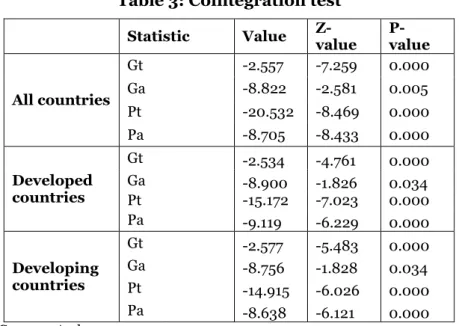
Table 3: Cointegration test
Statistic Value Z-value P-value
All countries Gt -2.557 -7.259 0.000 Ga -8.822 -2.581 0.005 Pt -20.532 -8.469 0.000 Pa -8.705 -8.433 0.000 Developed countries Gt -2.534 -4.761 0.000 Ga -8.900 -1.826 0.034 Pt -15.172 -7.023 0.000 Pa -9.119 -6.229 0.000 Developing countries Gt -2.577 -5.483 0.000 Ga -8.756 -1.828 0.034 Pt -14.915 -6.026 0.000 Pa -8.638 -6.121 0.000 Source: Author
Moreover, Westerlund ECM panel cointegration test has been applied to test the cointegration. Table 3 summarizes the obtained results. Based on the results, the assumption on cointegrating relationship between variables of interest cannot be rejected. The cointegrating relationship is confirmed for overall sample of countries as well as for both developed and developing countries. To identify the causality links between the variables we have applied the Wald statistics tests. Table 4 summarizes the obtained results.
Table 4: DH Granger non-causality test results
Dependent
variable Independent variable W-bar Z-bar Z-bar tilde Decision All countries GDP HT 3.8773 7.8533 (0.0000)* 4.6789 (0.0000)* HT causes GDP. Granger HT GDP 4.4627 10.3021 (0.0000)* 6.4529 (0.0000)* GDP causes HT. Granger Developed countries GDP HT 3.1737 3.3197 (0.0009)* 1.7219 (0.0851)* HT causes GDP. Granger HT GDP 3.5983 4.5206 (0.0000)* 2.5918 (0.0095)* GDP causes HT. Granger Developing countries GDP HT 2.774 7.7328 (0.0000)* 5.6880 (0.0000)* HT causes GDP. Granger HT GDP 3.4223 10.5587 (0.0000)* 7.9356 (0.0205)* GDP causes HT. Granger Note: * - p value Source: Author
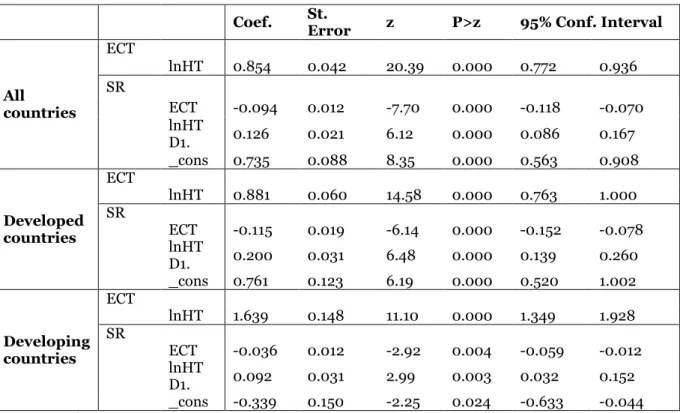
Table 5: ARDL framework (GDP is dependent variable)
Coef. St. Error z P>z 95% Conf. Interval
All countries ECT lnHT 0.854 0.042 20.39 0.000 0.772 0.936 SR ECT -0.094 0.012 -7.70 0.000 -0.118 -0.070 lnHT D1. 0.126 0.021 6.12 0.000 0.086 0.167 _cons 0.735 0.088 8.35 0.000 0.563 0.908 Developed countries ECT lnHT 0.881 0.060 14.58 0.000 0.763 1.000 SR ECT -0.115 0.019 -6.14 0.000 -0.152 -0.078 lnHT D1. 0.200 0.031 6.48 0.000 0.139 0.260 _cons 0.761 0.123 6.19 0.000 0.520 1.002 Developing countries ECT lnHT 1.639 0.148 11.10 0.000 1.349 1.928 SR ECT -0.036 0.012 -2.92 0.004 -0.059 -0.012 lnHT D1. 0.092 0.031 2.99 0.003 0.032 0.152 _cons -0.339 0.150 -2.25 0.024 -0.633 -0.044 Source: Author
The bidirectional causal relationship between HT and GDP is reported for the 70 observed countries as well as for both developed and developing, implying that HT is expected to improve economic output (Table 4). In addition, the results suggest that economic output is expected to contribute to the high-technology export.
Moreover, ARDL approach is adopted. Table 5 summarizes the obtained results. The error correction is significant (for 1% level of significance). This result proves that the process converges over the long-term. The study reveals a positive and significant relationship between GDP and HT in both, short- and long-run for the overall sample of countries. The obtained results are also supported in terms of developed as well as developing countries in original model. The higher responsiveness of GDP to the change in HT is reported for developing countries in long-run and developed in short-run. This result is expected taking into account the fact that developing countries need more time to fund the development of high-technology products, therefore GDP is more responsive to HT in long- comparing to the short-run.
In order to analyze the sensitivity of the results, the extended model controls for the impact of foreign direct investments. The obtained results are in accordance with those obtained in the original model in terms of significance and the sign. Therefore, the selected model can be considered stable. The obtained results are consistent with Yoo (2008) and Tapşın (2016).
CONCLUSION
This article analyses the relationship between high-technology export and economic output. The motivation arises from the possibility of reverse causality relationship between the economic terms of interest. In addition, it is important to emphasize that not many studies have rigorously investigated the causal and long-run relationship between HT and GDP. A quantitative analysis on the matter is lacking since most studies of the relationship between GDP and HT have focused on the role of HT in the link between FDI and economic growth, with no deep understanding of direct causality between HT and GDP.
Hence, this paper attempts to fill in the gap in previous studies by examining the link between HT and economic output using panel data methodology as well as by conducting causality and cointegration analysis. The existence of a long-run relationship between
variables is tested using a Westerlund ECM panel cointegration approach while a panel Granger causality is examined applying Dumitrescu and Hurlin (DH) Granger non-causality test. The relevance of HT on GDP is explored in three panels. The first overall panel contains 70 economies; the second contains 32 developed economies, while the third panel contains 38 developing economies over the period 1995-2015.
The results of unit root test indicate that the null hypothesis on unit root is rejected for all variables in terms of 70 observed countries as well as for developed and developing countries (for 1% level of significance). Moreover, cointegration test reports cointegrating relationship between variables of interest. Granger causality test reports a bidirectional relationship between variables of interest in all three samples. In order to control for the possible estimating issues arising from bidirectional causality, ARDL approach is employed.
The results indicate that the error correction is significant (for 1% level of significance). This result proves that the process converges over the long-term. The study reveals a positive and significant relationship between GDP and HT in both, short- and long-run for the overall sample of countries. The obtained results are also supported in terms of developed as well as developing countries in original model. The higher responsiveness of GDP to the change in HT is reported for developing countries in long-run and developed in short-run. This result is expected taking into account the fact that developing countries need more time to fund the development of high-technology products, therefore GDP is more responsive to HT in long- comparing to the short-run. In order to analyze the sensitivity of the results, the extended model controls for the impact of foreign direct investments. The obtained results are in accordance with those obtained in the original model in terms of significance and the sign. Therefore, the selected model can be considered stable.
REFERENCES
Abu Shihab, R. and Soufan, T. (2014). The Causal Relationship between Exports and Economic Growth in Jordan, International Journal of Business and Social Science,
Vol. 5 (3), pp. 302-308.
Attaoui, I. Ammpurim B. and Gargouri, I. (2017). Causality Links among Renewable Energy Consumption, CO2 Emissions, and Economic Growth in Africa: Evidence from a
Panel ARDL-PMG Approach. Online article, source:
https://www.ncbi.nlm.nih.gov/pubmed/28382444.
Bilgiç, E. (2007). Causal relationship between Foreign Direct Investment and Economic Growth in Turkey, master thesis, source: http://www.diva-portal.org/smash/get/diva2:2485/FULLTEXT01.pdf
Connolly, R. (2012). Climbing the Ladder? High-Technology Export Performance in Emerging Europe.Eurasian Geography and Economics, Vol. 53, No. 3, pp. 356-379. Czarnitzki, D., and Wastyn, A. (2010). Competing Internationally: On the Importance of R&D
for Export Activity. ZEW-Centre for European Economic Research Discussion Paper (10-071).
Falk, M. (2009).High-Tech Exports and Economic Growth in Industrialized Countries,
Applied Economics Letters, Vol. 16, pp. 1025-1028.
Granger, C. W. (1969).Investigating Causal Relations by Econometric Models and Cross-Spectral Methods.Econometrica, Vol. 37(3), pp. 424-438.
Ho, Y. (2007). Contribution of High-Technology Industry to Regional Economic Growth at Different Positions in the Distribution of a Region’s Size, International Review of Public Administration, Vol. 12 (1), pp. 41-50.
Hobday, M. (2001). The Electronics Industries of the Asia-Pacific: Exploiting International Production Networks for Economic Development, Asian-Pacific Economic Literature, Vol. 15, pp. 13-29.
Mahmood, M. and Mahmood, E. (2016).Foreign Direct Investment, Exports and Economic Growth: Evidence Two Panels of Developing Countries, Economic Research-EkonomskaIstraživanja, Vol. 29(1), pp. 938-949.
Muslija, A., Satrovic, E. and UnverErbas, C, (2017). Panel Analysis of Tourism -Economic Growth Nexus, International Journal of Economic Studies, Vol. 3(4), pp. 535-545. Pesaran M.H., Shin Y., Smith R.P. (1999). Pooled Mean Group Estimation of Dynamic
Heterogeneous Panels. Journal of the American Statistical Association, Vol. 94, pp. 621-634.
Satrovic, E. and Muslija, A. (2017). Foreign Direct Investments and Tourism: Empirical Evidence from Turkey, ICPESS Proceedings, Vol. 2, pp. 88-100.
Tapşın, G. (2016). The Relationship between Foreign Direct Investment, Export and Economic Growth in Turkey, Journal of Business Management and Economics, Vol. 4 (5), pp. 1-6.
Usman, M. (2017).Impact of High-Tech Exports on Economic Growth: Empirical Evidence from Pakistan,Journal on Innovation and Sustainability, Vol. 8 (1), pp. 91-105. Yoo, S.H. (2008). High-Technology Exports and Economic Output: An Empirical