CUT GENERATION BASED ALGORITHMS FOR
UNRELATED PARALLEL MACHINE SCHEDULING PROBLEMS
by HAL˙IL ¸SEN
Submitted to the Graduate School of Engineering and Natural Sciences in partial fulfillment of the requirements for the degree of
Doctor of Philosophy
Sabancı University, ˙Istanbul August 2015
c
Halil ¸Sen, 2015 All Rights Reserved
ABSTRACT
CUT GENERATION BASED ALGORITHMS FOR
UNRELATED PARALLEL MACHINE SCHEDULING PROBLEMS
HAL˙IL ¸SEN
Ph.D. Dissertation, August 2015
Dissertation Supervisor: Assoc. Prof. Dr. Kerem Bülbül
Keywords: unrelated parallel machine scheduling, Benders decomposition, logic-based Benders decomposition, exact method, heuristics
Research on scheduling in the unrelated parallel machine environment is at best scarce. Moreover, almost all existing work in this area is focused on the minimization of completion time related performance measures and the solution approaches available in the literature suffer from scalability issues. In this dis-sertation, we leverage on the success of the mathematical programming based decomposition approaches and devise scalable, efficient, and effective cut gener-ation based algorithms for fourN P-hard unrelated parallel machine scheduling problems.
In the first part, we develop a new preemptive relaxation for the total weighted tardiness and total weighted earliness/tardiness problems and devise a Benders decomposition algorithm for solving this preemptive relaxation formulated as a mixed integer linear program. We demonstrate the effectiveness of our approach with instances up to 5 machines and 200 jobs.
The second part deals with the problem of minimizing the total weighted completion time and proves that the preemptive relaxation developed in part one is an exact formulation for this problem. By exploiting the structural properties of the performance measure, we attain an exact Benders decomposition algorithm which solves instances with up to 1000 jobs and 8 machines to optimality within a few seconds.
In the last part, we tackle the unrestricted common due date just-in-time scheduling problem and develop a logic-based Benders decomposition algorithm. Aside from offering the best solution approach for this problem, we demonstrate that it is possible to devise scalable logic-based algorithms for scheduling prob-lems with irregular minsum objectives.
ÖZET
ALAKASIZ PARALEL MAK˙INE Ç˙IZELGELEME PROBLEMLER˙INE KES˙I TÜRETME TABANLI ALGOR˙ITMALAR
HAL˙IL ¸SEN
Doktora Tezi, A˘gustos 2015 Tez Danı¸smanı: Doç. Dr. Kerem Bülbül
Anahtar Kelimeler: alakasız paralel makine çizelgeleme, Benders ayrı¸stırma, mantık tabanlı Benders ayrı¸stırma, pekin yöntem, sezgizel yöntem
Alakasız paralel makine ortamındaki çizelgeleme problemleri üzerindeki ara¸stırmalar en iyimser bakı¸s açısıyla sınırlı durumdadırlar. Dahası, bu alanda var olan çalı¸smaların neredeyse tümü i¸s tamamlanma zamanıyla alakalı performans ölçütlerinin enküçüklenmesine yo˘gunla¸smı¸s durumdadır ve literatürdeki mev-cut çözüm yakla¸sımları ölçeklenebilirlik sorunlarından muzdaripdirler. Bu tezde, matematiksel programlama tabanlı ayrı¸stırma yakla¸sımlarının ba¸sarısından güç alınarak, dört adetN P-zor alakasız paralel makine çizelgeleme problemine ölçek-lenebilir, etkili ve yüksek verimli kesi türetme tabanlı algoritmalar tasarlanmı¸stır. ˙Ilk kısımda, toplam a˘gırlıklandırılmı¸s gecikme ve toplam a˘gırlıklandırılmı¸s erkenlik/gecikme problemleri için yeni bir geçi¸sli gev¸setme geli¸stirilmi¸s ve bir karı¸sık tamsayılı do˘grusal program olarak formüle edilmi¸s bu geçi¸sli gev¸setmeyi çözmek için bir Bender ayrı¸stırma algoritması tasarlanmı¸stır. Yakla¸sımımızın etkinli˘gini göstermek üzere 5 makine ve 200 i¸s büyüklü˘güne kadar örnekler çözülmü¸stür.
˙Ikinci kısım toplam a˘gırlıklandırılmı¸s tamamlanma zamanı problemini ele al-makta ve ilk kısımda geli¸stirilen geçi¸sli gev¸setmenin bu problem için pekin bir gösterim oldu˘gunu ispatlamaktadır. Dahası, bu performans ölçütünün yapısal özelliklerinden faydalanılarak, 8 makine ve 1000 i¸s büyüklü˘güne kadar örnek-lerin eniyi çözümörnek-lerine saniyeler içerisinde ula¸san pekin bir Benders ayrı¸stırma algoritması elde edilmi¸stir.
Sonuncu kısımda ise kısıtlandırılmamı¸s ortak termin zamanlı tam zamanında çizelgeleme problemi ele alınmakta ve mantık tabanlı Benders ayrı¸stırma algorit-ması geli¸stirilmektedir. Bu problem için en ba¸sarılı çözüm yakla¸sımını sunmanın yanı sıra, bu kısım, düzenli olmayan enküçük-toplam performans ölçütlü çizel-geleme problemleri için ölçeklenebilir bir mantık tabanlı algoritma tasarlamanın mümkün oldu˘gunu göstermektedir.
to Babik, my love and muse and
Acknowledgments
First and foremost I would like to express my gratitude and appreciation to my advisor, Kerem Bülbül, who continued to believe in me despite me not giving him a reason to. I have been lucky enough to work with him, and without his substantial help, support and encouragement, this dissertation would not have been possible.
I would like to express my deepest love and gratitude to Babik, without whom I wouldn’t be the person I am today. Her love, support, and encouragement nurtured my spirit and soul. I will be eternally in her debt. I would also like to thank ˙Inci and Öncel Koca who opened their home to me and treated me as one of their own.
Many thanks to all of my friends for being there whenever I needed, and for tolerating me at my bad moments. I cannot possibly state all, but I would like to mention some of them for sharing important moments of my life. Belit and Ozan Da˘gdeviren, Sezen and Anıl Can, Nur¸sen and Ömer M. Özkırımlı, Neva Özcü, Selin Erçil, Arda Kurto˘glu, U. Mahir Yıldırım, Gülnur Kocapınar, Belma Yelbay, Koray Kuvvet, and Funda Aktan, I am very happy to have you in my life. I would not be able to keep my sanity if it weren’t for you.
I also would like to thank the people of VanDerSal – especially, Barı¸s Özgür Çıtır, Eren Kozluca, Mert Soykan, and ˙Ilhan ¸Sahiner – for the occasionally wasteful, but nevertheless wonderful times we have spent all together.
Many thanks to Sinem Aydın, Banu Akıncı, Barı¸s Tümer, and Osman Rahmi Fıçıcı for all of their help with the bureaucratic and technical university matters.
Finally, I would like to thank the Scientific and Technological Research Council of Turkey (TÜB˙ITAK) for financially supporting me throughout my graduate life within the frameworks of the 2210- and 2211-National Scholarship Programme for Graduate Students.
TABLE OF CONTENTS
1 INTRODUCTION 1
1.1 Outline . . . 3
2 A STRONG PREEMPTIVE RELAXATION FOR TOTAL WEIGHTED TARDINESS AND EARLINESS/TARDINESS 5 2.1 Introduction . . . 6
2.2 Review of Related Literature . . . 8
2.3 Problem Statement and Preemptive Relaxation . . . 17
2.4 Benders Decomposition . . . 23
2.4.1 Validity and Strengthening of the Benders Cuts . . . 26
2.5 Computational Results . . . 32
2.5.1 Results forRm-TWT . . . 35
2.5.2 Results forRm-TWET . . . 42
3 AN EXACT EXTENDED FORMULATION FOR TOTAL WEIGHTED COMPLETION TIME 48 3.1 Introduction . . . 49
3.2 Review of Related Literature . . . 51
3.3 Formulation and Solution Approach . . . 54
3.3.1 Benders Decomposition . . . 62
3.4 Computational Results . . . 72
4 LOGIC-BASED BENDERS DECOMPOSITION FOR COMMON DUE DATE TOTAL WEIGHTED EARLINESS/TARDINESS 80 4.1 Introduction . . . 81
4.2 Review of Related Literature . . . 82
4.2.1 Parallel Machine Scheduling . . . 83
4.2.2 LBBD in Scheduling . . . 85
4.3 Solution Approach . . . 87
4.3.1 Overview of LBBD . . . 88
4.3.2 LBBD forRm-UCDD . . . 90
4.3.3 Strengthened Bounding Functions . . . 92
4.4 Computational Results . . . 101
5 CONCLUSION AND FUTURE RESEARCH 109
LIST OF TABLES
2.1 Summary of the important points in Section2.2. . . 15
2.2 Instance generation parameters. . . 33
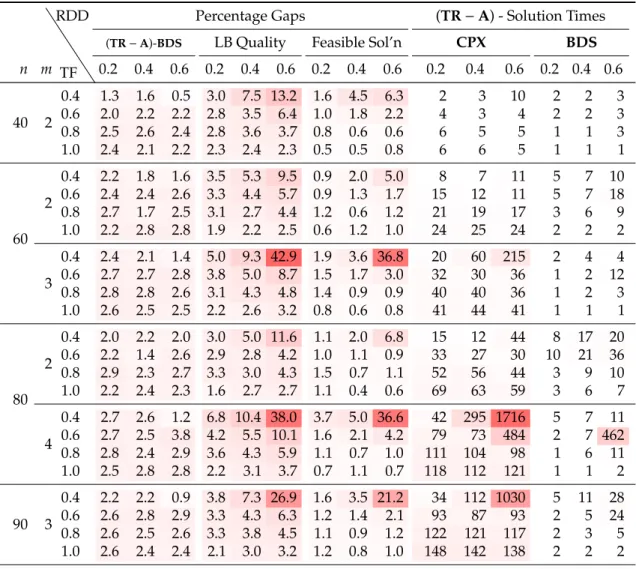
2.3 Results forRm-TWT. . . 36
2.4 Results forRm-TWET. . . 44
3.1 Average optimality gap and solution time results forRm-TWCT. . . 75
LIST OF FIGURES
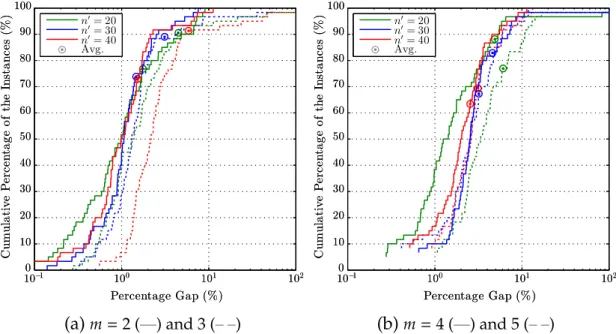
2.1 The empirical distributions of the optimality gaps of the upper bounds by (TR−A)-BDSforRm-TWT. . . 39
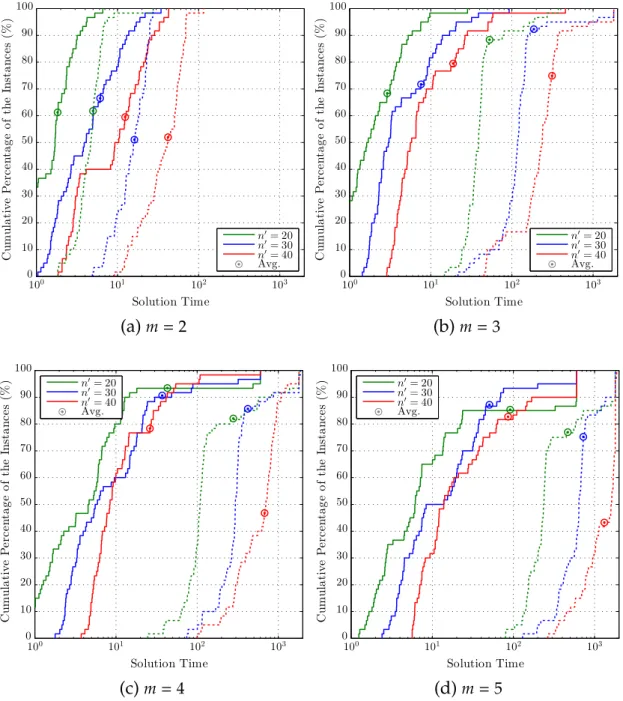
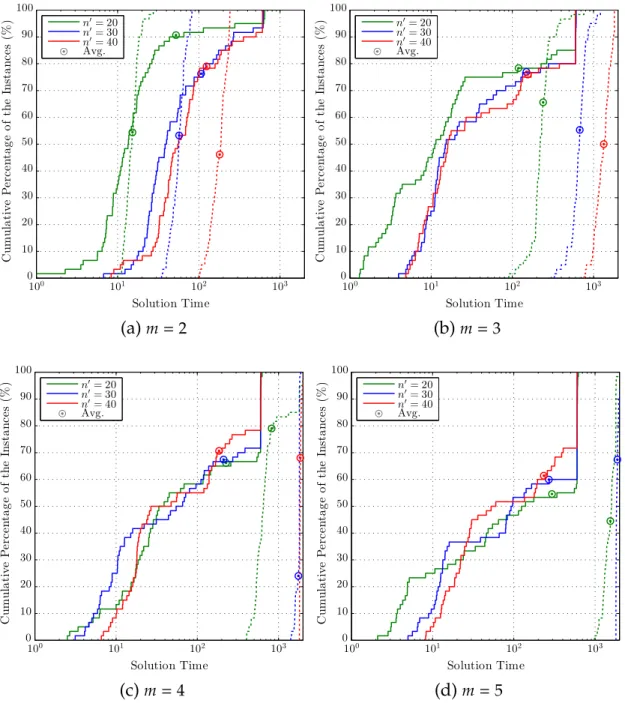
2.2 The empirical distributions of the solution times of (TR−A)-BDS and (TR−A)-CPXforRm-TWT. . . 41 2.3 The empirical distributions of the optimality gaps of the upper
bounds by (TR−A)-BDSforRm-TWET. . . 45
2.4 The empirical distributions of the solution times of (TR−A)-BDS and (TR−A)-CPXforRm-TWET. . . 46
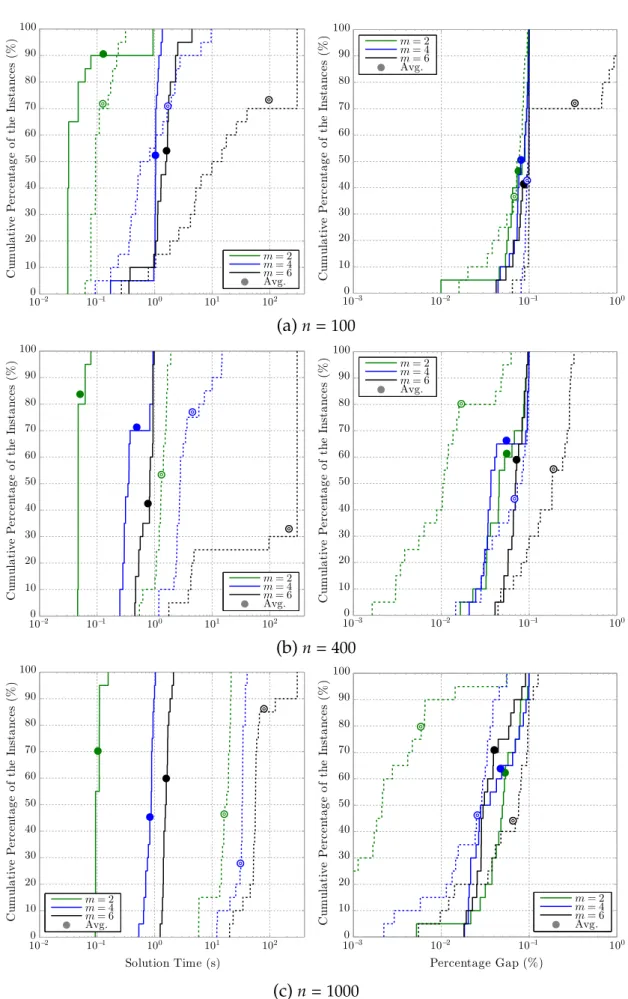
3.1 The empirical distributions of the solution times and the optimality gaps of (TR−A)-BDS (—) and (CQ) -CPLEX (– –) for Rm-TWCT
instances with 2, 4, and 6 machines. . . 77 3.2 The empirical distributions of the solution times and the optimality
gaps of (TR−A)-BDS (—) and (CQ) -CPLEX (– –) for Rm-TWCT
instances with 8, 16, and 30 machines. . . 78 4.1 The empirical distributions of the solution times and the optimality
gaps of BDS(—) and CPX (– –) for Rm-UCDDinstances with 50, 60, and 80 jobs. . . 106 4.2 The empirical distributions of the solution times and the optimality
gaps ofBDS(—) andCPX(– –) forRm-UCDDinstances with 100, 400, and 1000 jobs. . . 107
LIST OF ABBREVIATIONS
Notation Description Page List
B&B Branch-and-bound 2,6,8,9,15,51,52,109
CG Column generation 10,52,86
CP Constraint programming 84,85,86
CQIP Convex quadratic integer programming 15,52,54,72,81,84,88,90, 100 LBBD Logic-based Benders decomposition 2,4,80,81,82,84,86,88,89, 90,99,105,110 LP Linear programming 6,10,12,19,22,23,38,40,41, 43,50,52,54,57,61,62,63, 83,84,85,89 LR Lagrangian relaxation 1,10,11,12,15 MIP Mixed integer linear
programming 2,3,5,6,22,25,48,49,50,52, 54,57,84,85,86,109 Rm-UCDD Rm/dj =dl/PjǫjEj+πjTj 81,82,83,84,87,88,89,90, 100,104,105,108,110 Rm-TWCT Rm//P jwjCj 48,49,50,51,52,53,54,55, 56,57,58,59,61,64,69,72, 74,76,109 Rm-TWET Rm//P jǫjEj+πjTj 5,6,12,17,18,19,21,22,24, 25,26,28,30,32,33,34,35, 40,41,42,43,45,46,49,50, 57,58,109,110 Rm-TWT Rm//P jπjTj 5,6,12,17,18,19,21,22,23, 24,25,26,30,31,32,33,34, 35,37,40,41,42,43,45,46, 49,50,57,58,109,110
Notation Description Page List
TWCT Total weighted completion time 3,4,48,50,51,57,61,62,68, 84
TWET Total weighted earliness/tardiness 3,5,6,47,49,50,53 TWT Total weighted tardiness 3,5,6,9,49,50,53 UCDD Unrestrictive common due date
total weighted earliness/tardiness
3,4,80,90 WLPT Weighted longest processing time 90,100
WSPT Weighted shortest processing time 49,55,59,61,65,68,69,70,
CHAPTER 1
INTRODUCTION
The prevalence of actual manufacturing environments where a set of tasks has to be executed on a set of alternate resources attests to the practical relevance of the parallel machine scheduling environment. For instance, many production steps in semiconductor manufacturing feature unrelated parallel machines because ex-isting machines are augmented over time with machines of newer technology for ramping up production (Shim and Kim,2007a). Another setting observed in the inspection operations in semiconductor manufacturing creates the context for a recent work by Detienne et al.(2011) on unrelated parallel machines with step-wise individual job cost functions. Several other industries, such as the beverage, printing, and pharmaceutical industries, require processing steps performed by a set of parallel machines (Biskup et al.,2008). Therefore, a thorough understanding of the trade-offs that govern the parallel machine environment is fundamental for the successful operation in many different manufacturing settings.
The scheduling literature is often criticized for its emphasis on the single-machine environment which is arguably not encountered frequently in today’s complex shop floors. However, virtually every scheduling algorithm conceived for multi-stage production systems does either generalize or depend upon the fun-damental principles derived from the basic single-machine scheduling problems. A similar argument is valid for the parallel machine environment as well (Pinedo, 2008, p.111). Decomposition algorithms devised for multi-stage systems, such as Lagrangian relaxation (LR), Dantzig-Wolfe reformulation, Benders decompo-sition, and the shifting bottleneck heuristic, give rise to either single- or parallel machine scheduling subproblems that have to be solved many times in an
iter-ative framework. The ultimate performance of such decomposition approaches depends critically on our ability to solve these machine scheduling subproblems with a high solution quality in short computational times. Moreover, the study of parallel machines is the immediate logical extension of single-machine schedul-ing from a theoretical perspective and for a given partition of the set of jobs over the set of machines, a parallel machine scheduling problem is just a collection of independent single-machine scheduling problems. Therefore, parallel machine scheduling problems are generally regarded as set partitioning problems where the complexity of calculating the cost of a partition depends on the difficulty of the underlying single-machine scheduling problem. Furthermore, our specific interest in unrelated parallel machines is also prompted by a simple observation – i.e., capacity expansions over time naturally result in production steps performed on a set of unrelated parallel machines as equipment technology evolves. Shim
and Kim(2007a), for instance, discuss this issue in the context of semiconductor
manufacturing. Thus, there is a clear need for good algorithms tailored to the un-related parallel machine environment. However, the literature reviews presented in Sections2.2,3.2, and4.2reveal that the research on unrelated parallel machine scheduling is at best scarce in the fullest sense of the word.
Multi-machine scheduling problems may be modeled as mixed integer linear programming (MIP) problems in which all necessary decisions – e.g., assignment, sequencing, scheduling – are handled simultaneously by a monolithic formula-tion. However, exploiting the aforementioned set partitioning nature of the prob-lem and separating some of these decisions from each other and tackling them synchronously may go a long way in terms of computational efficiency. It turns out that similar exact solution procedures – that rely on mathematical program-ming based decomposition techniques – proposed for identical parallel machine scheduling problems and their performances are far more promising compared to those of monolithic formulations and custom branch-and-bound (B&B) proce-dures. Furthermore, this is true for both completion time and the due date related performance measures.
Another line of successful solution methods for multi-machine scheduling problems is due to the logic-based Benders decomposition (LBBD) framework developed in recent years. The basic principle of this framework is to find a
validbounding functionwhich represents a lower bound on the optimal objective function value of the problem. Then, this bounding function is used to create cuts in the Benders decomposition algorithm. The efficacy of this type of solution procedure is demonstrated in the literature on several scheduling problems with basic objective functions – such as finding a feasible solution, minimizing job to machine assignment costs, etc. – and on those with regular minmax performance measures – e.g., minimizing makespan, maximum lateness.
Motivated by these practical and theoretical considerations, our primary objec-tive in this dissertation is to devise scalable, efficient, and effective cut generation based algorithms for unrelated parallel machine scheduling problems. To this end, we study four N P-hard unrelated parallel machine scheduling problems, tree of which are proven to be N P-hard in the strong sense. More specifically, the performance measures considered in this dissertation are total weighted tardi-ness (TWT), total weighted earlitardi-ness/tardiness (TWET), total weighted completion time (TWCT), and last but not least, unrestrictive common due date total weighted earliness/tardiness (UCDD).
The specific motivations behind the selection of each performance measure and their significance are outlined in the introduction section of their respective chapters. Nevertheless, the common thread to all these performance measures is that even though they all are very fundamental scheduling objectives and studied extensively under other machine scheduling settings, they are not well studied in the unrelated parallel machine environment.
1.1
Outline
To facilitate the possibility of studying each problem independently, the results of this dissertation are presented in three separate main chapters. Each chapter is designed to be self contained in the sense that they can be read with little to no smattering from other chapters. In each chapter, we first present a brief summary of the work carried out, then introduce the problem and the motivation behind studying this specific performance measure. This is followed by the sections in which we present our main theoretical and methodological contributions, and we conclude each chapter with the results of the computational experiments.
In Chapter 2, we study TWT and TWET, and develop a new preemptive relaxation which provides tight lower bounds and near-optimal job to machine partitions. This relaxation turns out to be a hard to solve MIP problem and we devise a computationally effective Benders decomposition algorithm which can handle very large instances of this formulation. This chapter has been published
as (¸Sen and Bülbül,2015b).
Chapter 3 is dedicated to one of the most frequently studied fundamental scheduling objectives – i.e., TWCT. We prove that the preemptive relaxation of Chapter 2 is an exact formulation when the performance measure is TWCT. By exploiting the structural properties of TWCT, we attain a very fast and scalable exact Benders decomposition-based algorithm for solving this formulation. This chapter has been submitted as (Bülbül and ¸Sen,2015).
In Chapter 4, we consider the unrestricted common due date just-in-time scheduling problem and devise an exact LBBD algorithm by studying the combi-natorial structure of UCDD. The proposed solution approach turns out to be very efficient, and it is by far the best performing exact algorithm up to date for solving this hard scheduling problem. The manuscript of this chapter is in preparation
(¸Sen and Bülbül,2015a).
We conclude the dissertation in Chapter5with a summary of the conclusions drawn from Chapters2–4and indicate possible future research directions.
CHAPTER 2
A STRONG PREEMPTIVE
RELAXATION FOR TOTAL
WEIGHTED TARDINESS AND
EARLINESS
/
TARDINESS
Research on due date oriented objectives in the parallel machine environment is at best scarce compared to objectives such as minimizing the makespan or the completion time related performance measures. Moreover, almost all exist-ing work in this area is focused on the identical parallel machine environment. In this chapter, we leverage on our previous work on the single-machine total weighted tardiness (TWT) and total weighted earliness/tardiness (TWET) prob-lems and develop a new preemptive relaxation for the TWT and TWET probprob-lems on a bank of unrelated parallel machines. The key contribution of this study is devising a computationally effective Benders decomposition algorithm for solv-ing the preemptive relaxation formulated as a mixed integer linear programmsolv-ing (MIP) problem. The optimal solution of the preemptive relaxation provides a tight lower bound. Moreover, it offers a near-optimal partition of the jobs to the machines, and then we exploit recent advances in solving the non-preemptive single-machine TWT and TWET problems for constructing non-preemptive solu-tions of high quality to the original problem. We demonstrate the effectiveness of our approach with instances up to 5 machines and 200 jobs.
2.1
Introduction
Most of the studies in the scheduling literature are typically concerned with de-veloping algorithms for a single objective function. The proposed approaches tend to be highly specialized and not easily extensible to other objectives and settings. Ultimately, scheduling software is tailored to individual settings, and scheduling research is fragmented. In this context, we emphasize that in this chapter we attack two popular scheduling objectives TWT and TWET within a single algorithmic framework. The TWT objective is a special case of the TWET objective; however, observe that TWET is non-regular while TWT is regular. It is well-established that non-regular objectives give rise to new theoretical and computational issues (Baker and Scudder,1990,Kanet and Sridharan,2000), and we point out that it is uncommon to tackle both objectives simultaneously. For-mally, we characterize the problems we consider asRm//P
jπjTj (Rm-TWT) and
Rm//P
jǫjEj +πjTj (Rm-TWET) for minimizing the TWT and TWET on a set of
munrelated parallel machines, respectively, following the three field notation of
Graham et al.(1979) in classifying scheduling problems. The notationRmin the
first field stands for a bank ofmunrelated machines. The earliness and tardiness of job jare represented byEjandTj, respectively, andǫjandπj are the associated unit weights. Both Rm-TWT and Rm-TWET are strongly N P-hard because the stronglyN P-hard single-machine scheduling problem 1//P
πjTj (Lenstra et al., 1977) is a special case of both of these problems. We next summarize briefly our motivation and main contributions in this chapter.
The review of the related literature in Section2.2 identifies the lack of strong lower bounds as a major impediment to the development of exact algorithms and the performance analysis of heuristics for the TWT and TWET objectives in the parallel machine environment. Shim and Kim(2007a) attack the unweighted version ofRm-TWT, and their branch-and-bound (B&B) algorithm does not scale beyond 5 machines and 20 jobs. In their concluding remarks, the authors state that “..., further research is needed if one needs to solve problems of larger or practical sizes. One way may be to develop more effective or tighter lower bounds since the lower bound used in the B&B algorithm suggested in this study does not seem to be very tight.” More generally, in their effort to compute
strong linear programming (LP) based bounds for a class of parallel machine scheduling problems with additive objectives,van den Akker et al.(1999) observe that “additive objective functions pose a computational challenge because it is difficult to compute strong lower bounds.” These comments provide a strong motivation for the study in this chapter. All promising existing results assume that the machines are identical and often exploit this fact in some way; e.g., by aggregating the machine capacity constraints. Clearly, such approaches do not necessarily extend to or yield similar results for unrelated parallel machines. In this chapter, we set out to provide tight lower bounds and near-optimal solutions for the TWT and TWET objectives in the unrelated parallel machine environment. To this end, we propose a new preemptive relaxation that explicitly assigns jobs to specific machines. This preemptive relaxation generalizes and builds upon the success of the related previous studies on the single-machine weighted tardiness and weighted earliness/tardiness scheduling problems (Bülbül et al., 2007, Pan
and Shi, 2007, ¸Sen and Bülbül, 2012, Sourd and Kedad-Sidhoum, 2003). The
resulting lower bound is tight, and perhaps more importantly, the job partition retrieved from the (near-)optimal solution of the preemptive relaxation provides us with sufficient information to construct feasible non-preemptive schedules of high quality for the original problem. That is, we recognize that the main practical difficulty of solving Rm-TWTandRm-TWETto (near-)optimality is determining
a good job partition, and we directly incorporate this aspect of the problem into our rationale for developing this particular relaxation. Once a job partition is available, we rely on recent advances by Tanaka et al. (2009) and Tanaka and
Fujikuma(2012) to solvemindependent single-machine TWT or TWET problems,
respectively, to construct a non-preemptive solution of high quality to the original unrelated parallel machine scheduling problem. The downside of our preemptive relaxation is that it is formulated as a difficult MIP problem. A key contribution of this chapter is devising a computationally effective Benders decomposition algorithm that can handle very large instances of this formulation. Here, thelazy constraintgeneration scheme ofIBM ILOG CPLEX(2011) proves instrumental for a
successful implementation. Moreover, as we point out in the previous paragraph, both objectives TWT and TWET are tackled successfully by the same algorithm.
perspective. We introduce and formulate the proposed preemptive relaxation in Section 2.3 and then develop our solution approach based on Benders decom-position in Section 2.4. This is followed in Section 2.5 by an extensive set of computational experiments.
2.2
Review of Related Literature
Early research on parallel machine scheduling is primarily concerned with the makespan and total (weighted) completion time objectives (Cheng and Sin,1990). We refer the reader toPinedo(2008) for a comprehensive discussion of the polyno-mially solvable cases and structural results of interest for these problems. Some of the more recent and well-known examples of the papers that studyN P-complete problems in this domain include van den Akker et al. (1999), Chen and Powell (1999b), Azizoglu and Kirca (1999a), and Azizoglu and Kirca (1999b). Studies on due date related performance measures in the parallel machine environment commenced in earnest in the 1990’s and picked up more significantly during the last decade. In this review, we mainly restrict our attention to the literature on parallel machine tardiness and earliness/tardiness scheduling problems with job dependent due dates. This part of the literature creates the context for our study, and we provide a few important pointers otherwise. The great majority of the existing studies on due date related performance measures assumes that the ma-chines are identical, and only a handful of papers consider the case of unrelated parallel machines. For most of the proposed exact approaches, computational scalability remains an issue due to the lack of strong lower bounds. Therefore, we also specifically elaborate on the existing lower bounding methods for paral-lel machine scheduling problems with additive tardiness and earliness/tardiness objective functions in order to justify our alternate lower bounding scheme intro-duced in Section 2.3. See Table 2.1 at the end of this section for a summary of the important points in this section. Note that the performance figures presented in this section are obtained by their respective authors on different computing platforms.
The first exact approach for minimizing the total tardiness with distinct due dates on identical parallel machines is due to Azizoglu and Kirca (1998). The
authors integrate some dominance rules and a simple bounding technique into a B&B procedure for this problemPm//P
jTj, wherePmin the first field indicates a set ofmidentical parallel machines. The algorithm is able to handle instances with up to 15 jobs and 3 machines. The lower bound ofAzizoglu and Kirca belongs to a very common and simple set of lower bounds which rely on determining a lower bound for the jth smallest job completion time C[j], j = 1, . . . ,n, among the set of all feasible schedules. These lower bounds on the completion times are then matched with the weights and the due dates in some appropriate order so that the resulting expression yields a lower bound for the problem under consideration. Lower bounding techniques based on such minimal completion timesare developed or employed in several other papers with tardiness related objectives (Koulamas, 1997, Liaw et al., 2003, Shim and Kim, 2007a,b, Souayah
et al.,2009,Yalaoui and Chu,2002). There is a consensus in the literature that this
class of lower bounds is not strong in general. Furthermore, in problems with earliness/tardiness objectives the presence of unforced idle time renders similar lower bounding techniques invalid. For the same problem Pm//P
jTj, Yalaoui
and Chu(2002) devise another B&B scheme. The limit of this algorithm appears
to be 20 jobs and 2 machines within a time limit of 30 minutes.
The series of papers by Liaw et al. (2003), Shim and Kim (2007a), and Shim
and Kim (2007b) develop a set of closely related optimal methods. Liaw et al.
(2003) attack the problemRm//P
jπjTjof minimizing TWT on unrelated parallel machines. This study appears to be the first exact approach for this problem. The lower bounding scheme is very similar to that inAzizoglu and Kirca(1999b) with a simple enhancement based on the structure of the tardiness objective; however, the method does not scale beyond 4 machines and 18 jobs. Shim and Kim(2007a) tackle the unweighted versionRm//P
jTjin the same machine environment. The proposed B&B method employs some of the existing dominance properties in ad-dition to new ones. The lower bounding technique ofLiaw et al.(2003) is adopted, and an alternate lower bound is obtained by reducing the original problem into a single-machine problem by modifying the processing times appropriately and using a previously existing result for the single-machine total tardiness problem. The largest problem size that can be handled successfully within 1 hour is 5 ma-chines and 20 jobs. In a similar work,Shim and Kim(2007b) address the problem
Pm//P
Tj, and instances with up to 5 machines and 30 jobs are solved optimally within 1 hour. Jouglet and Savourey(2011) devise dominance rules and filtering methods for the problemPm/rj/P
jπjTj, where the notationrjin the second field indicates that the release dates may be non-identical, and embed these into a B&B procedure along with an existing lower bound. The authors argue that the lack of good lower bounds prevents them from solving instances with more than 20 jobs and 3 machines.
All of the optimal methods discussed so far base their lower bounding ef-forts on combinatorial arguments that rely on simple properties of the scheduling objectives under consideration. The resulting bounds are generally loose. How-ever, the most promising lower bounds for parallel machine total (weighted) tardiness and earliness/tardiness problems are derived through mathematical programming techniques. For instance, the LP relaxations of the set partition-ing formulations of common due date/common due window earliness/tardiness problems solved by column generation (CG) yield a prominent class of tight lower bounds (Chen and Lee,2002,Chen and Powell,1999a). Bounds obtained from var-ious relaxations of time-indexed formulations are also popular in parallel machine scheduling. An arc-time-indexed formulation whose LP relaxation is tackled by CG is at the heart of the highly efficient branch-cut-and-price algorithm of
Pes-soa et al. (2010) for Pm//P
πjTj. This study is by far the most successful exact
algorithm to date on parallel machine tardiness problems and delivers optimal solutions to instances with up to 100 jobs and 4 machines. Tanaka and Araki (2008) apply Lagrangian relaxation (LR) to the time-indexed formulation of the problemPm//P
Tj in an effort to develop tight lower bounds. Instances with up to 25 jobs and 10 machines are solved optimally. The average gap of the initial lower bound is 2.4% for the instances not solved at the root node. Souayah et al. (2009) take on the weighted version of the problem and studyPm//P
jπjTj. With a mix of combinatorial, mathematical programming, and LR based lower bounds, about half of the instances with up to 35 jobs and 2 machines are solved to op-timality within 20 minutes. We refer the interested reader to the review paper
Sen et al.(2003) where the tardiness literature on multi-machine systems is briefly
addressed as well.
literature. First, there is a clear need for studying the tardiness related objectives in the unrelated parallel machine environment; we can pinpoint only two studies which focus on the unrelated parallel machine environment. Second, more than 20 to 30 jobs and a few machines seems to be generally beyond the reach for the existing exact methods, attributed to the lack of strong lower bounds. We hope to provide a potential remedy to this issue in this chapter.
Several heuristics have been proposed for minimizing the total (weighted) tardiness on identical parallel machines. Many of them apply list scheduling based on some priority index and sometimes enhance the initial schedule by local search. Yalaoui and Chu(2002) review several heuristics of this kind. An interesting deviation from the mainstream here is the decomposition heuristic by
Koulamas(1997). The author heuristically extends the well-known decomposition
principle valid for 1//P
Tj to the problemPm//PTj with very good results. At each iteration, the position of one job in the overall schedule is fixed, where the subproblems in the decomposition are solved by a fast and effective heuristic for Pm//P
Tj that observes the decomposition principle for the individual machine schedules. Furthermore, a hybrid simulated annealing heuristic is devised which is outperformed by the decomposition heuristic based on the solution quality and time trade-off. The results for 100-job instances indicate that the proposed heuristics are on average about 10-11% away from optimality with respect to a lower bound. A recent list scheduling heuristic byBiskup et al.(2008) forPm//P
Tj yields somewhat better results than those ofKoulamasfor large instances with up to 5 machines and 200 jobs. An absolute assessment of the solution quality is not available due to the lack of a good lower bound or a scalable exact method. For the weighted version, i.e., the problem Pm//P
πjTj, Armentano and Yamashita
(2000) design a tabu search heuristic. For evaluation purposes, they benchmark their feasible solutions against the LR based lower bound by Luh et al. (1990). This lower bound is obtained by dualizing the machine capacity constraints in an integer programming formulation of the problem, similar to that by Tanaka
and Araki (2008) discussed in the main text. In the original paper, Luh et al.
include very limited computational experience, but the results ofArmentano and
Yamashita(2000) for instances with up to 10 machines and 150 jobs are promising.
bound ofLuh et al.(1990) is 8.14% which drops to 5.80% for 150-job instances. On the flip side,Armentano and Yamashitareport that computing the lower bound
ofLuh et al. takes about 3 hours for 100- and 150-job instances.
For unrelated parallel machines, we are aware of only three papers by Zhou
et al. (2007), Mönch (2008), and Lin et al. (2011) which focus on heuristics for
Rm//P
jπjTj. The first two studies rely on ant colony optimization and benchmark their algorithms against simple heuristics which makes it difficult to evaluate the solution quality in absolute terms. Lin et al. propose a genetic algorithm and two simpler heuristics. The genetic algorithm outperforms all others in the computational experiments and deviates from the optimal solution by 1.8% on average for small instances with 4 machines and 20 jobs. The heuristic that we develop in this chapter is scalable to large instances with up to 200 jobs and simultaneously produces both lower and upper bounds of high quality. As evident from the discussion here, this is a significant edge over those in the literature, and we make a valuable contribution to the (unrelated) parallel machine scheduling research with tardiness objectives.
To the best of our knowledge, no exact algorithm has been designed to date for the problem of scheduling a set of independent jobs on a bank of unrelated parallel machines with the objective of minimizing the total (weighted) earliness and tardiness. However, various studies investigate special cases of this problem – see the literature review given in Section4.2.1of Chapter4. The most closely re-lated works to our problemRm-TWETare byKedad-Sidhoum et al.(2008),Mason
et al.(2009), andM’Hallah and Al-Khamis(2012). Kedad-Sidhoum et al.
experi-ment with various relaxations of the problemPm/rj/P
jπjTj+ǫjEjby recognizing that the main difficulty in solving earliness/tardiness scheduling problems stems from the lack of strong lower bounds. The authors extend two classes of lower bounds originally proposed for the single-machine case to the identical parallel machine environment. Their discrete assignment-based lower bound is discussed further in Section2.3because it is closely related to our preemptive lower bound-ing method for Rm-TWT and Rm-TWET. Kedad-Sidhoum et al. report that the
LR obtained by dualizing the machine capacity constraints in the time-indexed formulation outperforms others, taking into account both the solution quality and
Pm//P
Tj. The best bound attained by solving the Lagrangian dual problem in these relaxations is equivalent to that provided by the LP relaxation of the time-indexed formulation. However, solving the Lagrangian dual problem – generally by subgradient optimization – is often computationally more efficient. We also attest to the rapidly increasing computational effort required to solve the LP relax-ation of the time-indexed formulrelax-ation in Section2.5. Kedad-Sidhoum et al.obtain upper bounds through a simple local search. Experimental results attest to the quality of both the lower and upper bounds. The average optimality gap attained for instances with up to six machines and 90 jobs is around 1.5%. However, we cite two good reasons for not following a similar path to that ofKedad-Sidhoum et al.
andTanaka and Araki. First, the machine capacity constraints in the time-indexed
formulation may be aggregated in the identical parallel machine environment by defining a single resource with a capacity of performingm jobs simultaneously, and this renders the number of dual variables in the LR independent from the number of machines in the problem. This, however, is not possible forRm-TWT
andRm-TWET, and relaxing the machine capacity constraints – one for each
com-bination of time period and machine – would result inmHdual variables instead of just H. Consequently, solving the Lagrangian dual problem would quickly
become a formidable task with an increasing number of machines. Second, the solution retrieved from the LR does offer little information on how to identify near-optimal job to machine assignments. The job start times provided by the LR for a given set of dual multipliers form the basis for a dispatch rule in Tanaka
and Araki(2008); however, both these authors andKedad-Sidhoum et al. need to
devise independent heuristics in order to obtain feasible solutions of high-quality for their original problems.
The moving block heuristic of Mason et al.(2009) forPm//P
Ej+Tj is tested against an integer programming formulation over instances with up to 40 jobs and 4 machines. The heuristic identifies feasible solutions which are on average better than the incumbent for 20- and 40-job instances. Like Kedad-Sidhoum
et al.,M’Hallah and Al-Khamistackle the weighted version of the problem. Their
integer programming formulation points out and corrects an error in that of
Mason et al.(2009). The limit of the formulation appears to be instances with no
performing contender turns out to be a hybrid heuristic which is benchmarked against the lower and upper bounds ofKedad-Sidhoum et al.(2008). The hybrid heuristic improves some of the best known solutions for the instances of Kedad-Sidhoum et al.; however, it yields slightly worse solutions on average. The median gap of the hybrid heuristic ranges from 1.4% to 6.1% with respect to the lower bounds of Kedad-Sidhoum et al. (2008) depending on the problem size. It is evident that there is a gap in the literature with respect to the parallel machine earliness/tardiness scheduling problems with distinct due dates. To the best of our knowledge, our work provides the first viable solution approach for the unrelated parallel machine environment in this context.
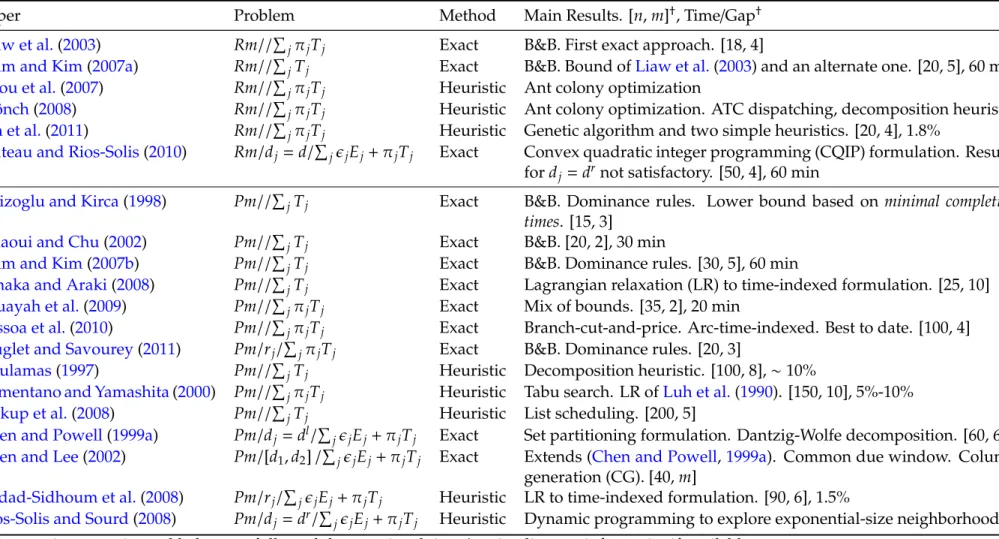
Table 2.1Summary of the important points in Section2.2.
Paper Problem Method Main Results. [n,m]†, Time/Gap†
Liaw et al.(2003) Rm//P
jπjTj Exact B&B. First exact approach. [18, 4]
Shim and Kim(2007a) Rm//P
jTj Exact B&B. Bound ofLiaw et al.(2003) and an alternate one. [20, 5], 60 min
Zhou et al.(2007) Rm//P
jπjTj Heuristic Ant colony optimization
Mönch(2008) Rm//P
jπjTj Heuristic Ant colony optimization. ATC dispatching, decomposition heuristic
Lin et al.(2011) Rm//P
jπjTj Heuristic Genetic algorithm and two simple heuristics. [20, 4], 1.8%
Plateau and Rios-Solis(2010) Rm/dj=d/PjǫjEj+πjTj Exact Convex quadratic integer programming (CQIP) formulation. Results
fordj=drnot satisfactory. [50, 4], 60 min
Azizoglu and Kirca(1998) Pm//P
jTj Exact B&B. Dominance rules. Lower bound based on minimal completion
times. [15, 3]
Yalaoui and Chu(2002) Pm//P
jTj Exact B&B. [20, 2], 30 min
Shim and Kim(2007b) Pm//P
jTj Exact B&B. Dominance rules. [30, 5], 60 min
Tanaka and Araki(2008) Pm//P
jTj Exact Lagrangian relaxation (LR) to time-indexed formulation. [25, 10]
Souayah et al.(2009) Pm//P
jπjTj Exact Mix of bounds. [35, 2], 20 min
Pessoa et al.(2010) Pm//P
jπjTj Exact Branch-cut-and-price. Arc-time-indexed. Best to date. [100, 4]
Jouglet and Savourey(2011) Pm/rj/PjπjTj Exact B&B. Dominance rules. [20, 3]
Koulamas(1997) Pm//P
jTj Heuristic Decomposition heuristic. [100, 8],∼10%
Armentano and Yamashita(2000) Pm//P
jπjTj Heuristic Tabu search. LR ofLuh et al.(1990). [150, 10], 5%-10%
Biskup et al.(2008) Pm//P
jTj Heuristic List scheduling. [200, 5]
Chen and Powell(1999a) Pm/dj=dl/PjǫjEj+πjTj Exact Set partitioning formulation. Dantzig-Wolfe decomposition. [60, 6]
Chen and Lee(2002) Pm/[d1,d2]/PjǫjEj+πjTj Exact Extends (Chen and Powell,1999a). Common due window. Column
generation (CG). [40,m]
Kedad-Sidhoum et al.(2008) Pm/rj/PjǫjEj+πjTj Heuristic LR to time-indexed formulation. [90, 6], 1.5%
Rios-Solis and Sourd(2008) Pm/dj=dr/PjǫjEj+πjTj Heuristic Dynamic programming to explore exponential-size neighborhood
†: Largest instance size tackledsuccessfully and the associated time/optimality gap informationif available.
Continued on next page. . .
Table2.1continued. . .
Paper Problem Method Main Results. [n,m]†, Time/Gap†
Mason et al.(2009) Pm//P
jEj+Tj Heuristic Moving-block heuristic. [40, 4]
M’Hallah and Al-Khamis(2012) Pm//P
jǫjEj+πjTj Heuristic Two constructive and three meta-heuristics. [90, 6], 1.4%-6.4%
Cheng and Sin(1990) “A State-of-the-Art Review of Parallel-Machine Scheduling”
Baker and Scudder(1990) “Sequencing with Earliness and Tardiness Penalties: A Review”
Kanet and Sridharan(2000) “Scheduling with Inserted Idle Time: Problem Taxonomy and Literature Review”
Sen et al.(2003) “Static Scheduling Research to Minimize Weighted and Unweighted Tardiness: A State-of-the-Art Survey”
Lauffand Werner(2004) “Scheduling with Common Due Date, Earliness and Tardiness Penalties for Multimachine Problems: A Survey”
†: Largest instance size tackled successfully and the associated time/optimality gap information if available.
2.3
Problem Statement and Preemptive Relaxation
We consider a bank of m unrelated parallel machines and n jobs, which are allready at time zero. Each job is processed on exactly one of the machines, where the processing of job jon machinekrequires an integer duration ofpjktime units. The completion time of job j is denoted by Cj. A due date dj – also assumed to be integral – is associated with each job j, and we incur a cost πj per unit time if job j completes processing after dj. Thus, the total weighted tardiness over all jobs is determined asP
jπjTj, where the tardiness of job jis calculated as
Tj =max(0,Cj−dj). For the problemRm//PjπjTj+ǫjEj, the objective additionally penalizes the completion of job j prior to its due date dj at a rate of ǫj per unit time, where the earliness of job jis defined asEj =max(0,dj−Cj). All machines are available continuously from time zero onward, and a machine can execute at most one operation at a time. An operation must be carried out to completion once started, i.e., preemption is not allowed.
In this section, we introduce our preemptive lower bounding scheme for Rm-TWT and Rm-TWET. We define two primary design goals for our preemptive
relaxation. The tightness of the lower bound is clearly a major concern. Equally important is the information that can be extracted from the optimal solution of the preemptive relaxation to construct feasible solutions of high quality for the original non-preemptive problem. We attain both of these goals – somewhat more successfully for Rm-TWT than for Rm-TWET from a computational perspective – and demonstrate the effectiveness of the proposed lower and upper bounds in
Section2.5.
A class of highly efficient lower bounds based on a particular preemption scheme was developed for single-machine tardiness and earliness/tardiness sched-uling problems during the last decade (Bülbül et al.,2007, ¸Sen and Bülbül, 2012,
Sourd and Kedad-Sidhoum,2003). The key idea of these preemptive relaxations
is to divide up jobs with integer processing times into jobs of unit-length and associate a cost with the completion of each of these unit-length jobs. That is, jobs may only be preempted at integer points in time. In this setting, the prob-lem of solving the preemptive relaxation is formulated as an assignment or a transportation problem, where the length of the planning horizon depends on the
magnitude of the due dates and the sum of the processing times. Therefore, the formulation size is pseudo-polynomial. On the up side, the availability of very fast algorithms for the assignment and transportation problems does still render this lower bounding technique viable. The formulation (TR) below is due to
Kedad-Sidhoum et al.(2008), where the original approach in the single-machine
environment is extended tomidentical parallel machines.
(TR) minimize n X j=1 H X t=1 c′jtxjt (2.1) subject to H X t=1 xjt =pj, j=1, . . . ,n, (2.2) n X j=1 xjt ≤m, t=1, . . . ,H, (2.3) 0≤xjt ≤1, j=1, . . . ,n, t=1, . . . ,H. (2.4) In the model (TR), the time period t represents the time interval (t−1,t], and
consequently in any optimal schedule all jobs finish processing no later than in periodH, where H = n X j=1 max k pjk /m
+pmax forRm-TWT, and n X j=1 max k pjk /m
+pmax+dmax forRm-TWET.
(2.5)
The end of the planning horizonHis determined based on the following
observa-tion. ForRm-TWTwith a regular objective function, all machines are continuously busy until some timet′ ≤ lPnj=1maxkpjk
/mm if at leastm jobs are still not
com-pleted. Therefore, after time t′ the remaining m−1 jobs are finished in at most pmax=maxj,k
pjk
time periods. The end of the planning horizon may thus be set to the value in the first row of (2.5). An optimal solution of Rm-TWET, on the other hand, may include unforced idleness, and the argument just described is only valid if we conservatively assume that all jobs are started atdmax = maxjdj. Clearly,pmaxmay be omitted from (2.5) in the case of a single-machine.
variablexjt assumes the value one, and the objective is charged a cost ofc′jt. The constraints (2.2) mandate that each jobjreceivespjunits of processing. To observe the machine capacities, constraints (2.3) require that no more thanmunit jobs are processed simultaneously in a given period. Note that the machine index is omitted from the processing times because they are all identical for a given job. Furthermore, no integrality is imposed on the decision variables due to the total unimodularity of the constraint matrix of (TR). The optimal objective function value of (TR) is a lower bound on that ofPm//P
jπjTj+ǫjEj, as long as the objective function coefficients satisfy
t X
s=t−pj+1
c′js ≤ǫj(dj−t)++πj(t−dj)+, j=1, . . . ,n, t=pj, . . . ,H. (2.6) That is, the total cost incurred in (TR) by any job that is scheduled non-preemp-tively is no larger than that in the original non-preemptive problem (Bülbül et al.,
2007). Naturally, the strength of the lower bound depends on the objective coeffi
-cientsc′jt, and this is where the existing works in the literature take different paths. For instance, the cost coefficients ofSourd and Kedad-Sidhoum(2003) satisfy (2.6) as an equality. Bülbül et al.(2007) characterize and develop an expression for the cost coefficients that are the best among those with a piecewise linear structure with two segments. For these cost coefficients, (2.6) holds as a strict inequality for some values oft. For the one machine problem, these authors also show that the lower bound retrieved from (TR) is no better than that provided by the LP relaxation of the time-indexed formulation. Conversely,Pan and Shi(2007) prove the existence of a set of objective coefficients for (TR) so that the LP relaxation of the time-indexed formulation and (TR) yield identical lower bounds. However, computing the values of these cost coefficients is no less time consuming than solving the LP relaxation of the time-indexed formulation. We also note that the empirical performance of the algorithms based on this set of relaxations is more than satisfactory (Bülbül et al., 2007, Pan and Shi, 2007, ¸Sen and Bülbül, 2012,
Sourd and Kedad-Sidhoum,2003). They strike a good balance between solution
quality and time.
discussed in the previous paragraph emerges as a strong candidate for deriving strong lower bounds for our problems of interestRm-TWTandRm-TWET.
How-ever, one hurdle remains in the pursuit of our second design goal of constructing non-preemptive solutions of high quality directly based on the information re-trieved from the optimal solution of the preemptive relaxation. In the optimal solution of (TR), the unit jobs of job j cannot overlap in time, but they can be
processed on different machines. Consequently, no explicit assignment of the jobs to the machines is available. This is a major drawback because it complicates the task of obtaining a non-preemptive feasible solution to the original problem. In the sequel, we demonstrate that overcoming this difficulty allows us to attain good upper bounds in addition to good lower bounds.
The downside of (TR) is that the optimal solution does not guarantee that we can assign all unit jobs of a job to the same machine. Such a requirement is incorporated in the following model (TR−A) at the expense of additional variables and destroying the desirable polyhedral structure of the transportation problem. The binary variable yjk takes the value 1 if job jis assigned to machine
k, and is zero otherwise. In addition, thex−variables and the associated objective coefficients are supplemented with a machine indexkto allow us to assign a unit
job of job jexplicitly to machinekin periodt.
(TR−A) minimize n X j=1 m X k=1 H X t=1 cjktxjkt (2.7) subject to H X t=1 xjkt=pjkyjk, j=1, . . . ,n, k=1, . . . ,m, (2.8) n X j=1 xjkt≤1, k=1, . . . ,m, t=1, . . . ,H, (2.9) m X k=1 yjk=1, j=1, . . . ,n, (2.10) xjkt ≥0, j=1, . . . ,n, k=1, . . . ,m, t=1, . . . ,H, (2.11) yjk∈ {0,1}, j=1, . . . ,n, k=1, . . . ,m. (2.12) (TR−A) differs from (TR) in two main aspects. The capacity constraints (2.9) appear in a disaggregated form, and all unit jobs of job j are performed on the
same machine by constraints (2.8) and the job partitioning constraints (2.10). As we hinted at earlier, the cost coefficients c′jkt are of critical importance for the
strength of the lower bounds provided by the preemptive relaxation. In this research, we stick with the cost coefficients byBülbül et al.(2007) given in (2.13) and adapted in an obvious way to the unrelated parallel machine environment for two reasons. They empirically outperform those bySourd and Kedad-Sidhoum (2003) on average (Bülbül et al.,2007,Kedad-Sidhoum et al.,2008), and computing the best set of cost coefficients for a given instance by the method ofPan and Shi (2007) is expensive. c′jkt= ǫj pjk h (dj− pjk 2 )−(t− 12) i fort≤dj, and πj pjk h (t− 12)−(dj− pjk 2 ) i fort>dj. (2.13) We next provide a proposition that the optimal solution of (TR−A) with the cost coefficients given above provides a lower bound on the optimal objective function value of the original problem Rm-TWT or Rm-TWET. The result is a
corollary of Bülbül et al. (2007, Theorem 2.2), where the authors show that the cost coefficients in (2.13) satisfy (2.6).
Proposition 2.1. The optimal objective function value of (TR−A)with the cost coeffi -cients given by equation(2.13)is a lower bound on the optimal objective function value of the original non-preemptive problemRm-TWTorRm-TWET.
Proof. Let SP represent a feasible schedule for problem (P) with a total cost of TCSP. The notation (P(y)) stands for problem (P) in which the jobs are assigned
to the machines a priori, but the individual machine schedules for this job partition y are to be optimized. An optimal schedule is denoted by an asterisk in the superscript.
For any given fixed job partition y, both the original non-preemptive prob-lemsRm-TWTandRm-TWET– denoted by (NP) – and the preemptive relaxation
decompose into m independent single-machine problems. Therefore, we have
TC S∗ NP(y) = Pmk=1TC S∗ NP(yk) and TC S∗ TR−A(y) = Pmk=1TC S∗ TR−A(yk) , where S∗ NP(yk)andS ∗
TR−A(yk)stand for the optimal non-preemptive and preemptive sched-ules on machine k under y, respectively. By Bülbül et al. (2007, Theorem 2.2),
TC S∗ TR−A(yk) ≤TC S∗ NP(yk)
fork=1, . . . ,m, and we have
TC S∗TR−A (y) = m X k=1 TC S∗TR−A (yk) ≤ m X k=1 TC S∗NP (yk) =TC S∗NP (y) .
This relationship is independent from y and does also hold for the optimal job
partition y∗which concludes the proof.
Our overall strategy for obtaining near-optimal feasible solutions and good lower bounds forRm-TWTand Rm-TWETis now clear. We first solve (TR−A), retrieve the job partition, and then build m individual machine schedules
inde-pendently. Several heuristics with excellent empirical performance are available for both 1//P
jπjTj and 1//PjπjTj + ǫjEj to perform the latter task. However, in this work we rely on the recent powerful optimal algorithms ofTanaka et al. (2009) and Tanaka and Fujikuma (2012) to handle the single-machine problems as we mentioned in Section 2.1. Our computational experiments in Section 2.5 ultimately support this decision. Thus, only one major challenge remains. The formulation (TR−A) is an MIP problem that is time consuming to solve based on our preliminary computational experiments. However, for a fixed job partition it decomposes intomindependent LP problems –mindependent transportation problems –, and these LP problems are solved to optimality very efficiently. These observations suggest that (TR−A) is amenable to Benders decomposition
(Ben-ders,1962), and developing a Benders decomposition algorithm withstrengthened
cutsfor (TR−A) is our main methodological contribution in this chapter.
One final remark is due before we delve into the specifics of our solution method for (TR−A). ForRm-TWT, the formulation may be strengthened by the load balancing constraints (2.14) which assert that the workloads of two machines cannot differ by more thanpmaxin an optimal solution of the original non-preemp-tive parallel machine scheduling problem. Otherwise, we could transfer the final job on one of these machines to the other one without degrading the objective function value. Note that similar concepts have been incorporated into various properties and dominance rules elsewhere in the literature (Azizoglu and Kirca,
we can easily create instances for which no optimal solution satisfies (2.14). −pmax≤ n X j=1 pjkyjk− n X j=1 pjlyjl≤pmax, k=1, . . . ,m−1, l=k+1, . . . ,m. (2.14)
These cuts are added to the preemptive formulation (TR−A) when solving Rm-TWTand help speed up the solution process for large instances.
2.4
Benders Decomposition
Parallel machine scheduling problems have a partitioning and a scheduling com-ponent. That is, if we assign jobs to machines by fixing the variables yjk,j = 1, . . . ,n,k = 1, . . . ,m, so that the constraints (2.10) are satisfied, then the model (TR−A) decomposes intom independent transportation problems. We exploit
this key observation to design an algorithm based on Benders decomposition for solving (TR−A) efficiently. To this end, we reformulate (TR−A) for a fixedyby replacing the right hand side of the set of constraints (2.8) bypjkyjkand dropping the set of constraints (2.10) and (2.12) from the model. In the resulting LP problem
TR−A(y)
, ujk, j = 1, . . . ,n, k = 1, . . . ,m, and vkt, k = 1, . . . ,m, t = 1, . . . ,H, are the dual variables associated with the set of constraints (2.8) and (2.9), respec-tively. The dual of TR−A(y)
is then stated below, where the decomposition intomindependent transportation problems is made explicit:
z(y)= m X k=1 zk(y), (2.15) where DSk−F zk(y)=maximize n X j=1 pjkyjkujk+ H X t=1 vkt (2.16) subject to ujk+vkt ≤cjkt, j=1, . . . ,n, t=1, . . . ,H, (2.17) vkt ≤0, t=1, . . . ,H, (2.18)
is the dual of the transportation problem TRk for machine k. In the sequel,
TRk
andDSk−Fare also referred to as thecut generation subproblemand the
dual slave problem, respectively, by following the common terminology for Benders
decomposition.
Based on the objective function (2.16) of DSk−F, we obtain the following relaxed Benders master problem (RMP), where C denotes the current number of times the cut generation subproblems TRk, k = 1, . . . ,m, have been solved.
The optimal values of the dual variablesujk,j =1, . . . ,n,k = 1, . . . ,m, andvkt,k = 1, . . . ,m,t=1, . . . ,H, in roundcof the cut generation are represented byuc
jkandv c kt, respectively. The auxiliary variableηk indicates a lower bound on the total cost incurred by the jobs assigned to machinek, and the objective function valuePmk=1ηk of (RMP) is therefore a lower bound on the optimal objective values of (TR−A) and the original non-preemptive scheduling problemRm-TWTorRm-TWET.
(RMP) minimize m X k=1 ηk (2.19) subject to m X k=1 yjk=1, j=1, . . . ,n, (2.20) ηk ≥ n X j=1 pjkucjkyjk+ H X t=1 vckt, k=1, . . . ,m, c =1, . . . ,C, (2.21) yjk∈ {0,1}, j=1, . . . ,n, k=1, . . . ,m. (2.22) Note that TR−A(y)
is feasible andDSk−F,k = 1, . . . ,m, is bounded for any ythat satisfies the constraints (2.10). Therefore, no feasibility cuts are required, and only optimality cuts are generated and added iteratively to (RMP) during the course of the algorithm. Furthermore, the cut generation subproblemTRk for machinekincludes all jobs and is solved by considering the full length of the planning horizon. From a computational point of view, however, we are better off by defining the set of jobs to be processed on machinekasJk ={j|yjk =1}, setting the last period of processing on machine k – designated byHk – as appropriate based on (2.5), and then solving a restricted version ofTRkover these jobs and time periods only. This restricted cut generation subproblem formulation and the corresponding dual slave problem are referred to as TRk−R and DSk−R,
respectively. Obviously, the optimal solution ofTRk−Rmay be extended to an optimal solution ofTRk
trivially by settingxjkt =0 forj∈ Jk, t=Hk+1, . . . ,H, and
j6∈ Jk, t= 1, . . . ,H. The relationship between the optimal solutions ofDSk−F andDSk−Rand its implications for the dynamic generation of the constraints (2.21) require a deeper discussion which is relegated to the next section.
In themulti-cutrelaxed master problem formulation (RMP) above, we approx-imate the objective function of (TR−A) by estimating the cost accumulated on each machine separately as evident from the set of constraints (2.21). Alterna-tively, we could have employed a weakersingle-cutversion of the relaxed master
problem by aggregating all m cuts generated after solving TRk, k = 1, . . . ,m, and replacingPm
k=1ηkby a single variableηin the formulation as appropriate. The single-cut version results in fast solution times for the relaxed master problem at the expense of more iterations overall. Ultimately, the trade-offbetween these two alternatives is only decided during the computations. In our preliminary testing, the cut generation algorithm based on (RMP) was clearly superior to that based on the single-cut version in terms of speed. Thus, the rest of the chapter is focused exclusively on (RMP). The pseudo-code of the cut generation procedure is stated in Algorithm1.
Algorithm 1:Procedure generate_cuts.
input : A feasible partitionyof jobs to machines.
output: Returnszk(y) and the strengthened cuts of the form (2.24) fork=1, . . . ,m.
1 fork=1to mdo
2 SolveTRk−R
, retrievezk(y) and the optimal solution (uk,vk) for the dual
slaveDSk−R;
/* Calculate an alternate optimal solution (u′k,vk′) for DSk−R
that satisfies Lemma 2.2 by following the construction in the
proof. */
3 vmaxk =maxt=1,...,Hkvkt;
4 ifvmaxk <0then u′jk=ujk− |vmaxk |, j∈ Jk,v′kt=vkt+|vmaxk |, t=1, . . . ,Hk else
(u′k,v′k)=(uk,vk);
// Construct an optimal solution (u′′k,vk′′) for DSk−F .
5 v′′kt =v′kt, t=1, . . . ,Hk, andv′′kt =0, t=Hk+1, . . . ,H;
6 u′′jk=u′jk, j∈ Jk, andu′′jk,j6∈Jk, is calculated based on either (2.29) or (2.30),
respectively, depending on whether we solve an instance ofRm-TWTor
Rm-TWET;
2.4.1
Validity and Strengthening of the Benders Cuts
The validity of Benders decomposition (Benders,1962) derives from the indepen-dence of the feasible region of the dual slave problem from the values of the inte-ger variables. For an MIP problem of the form minimize
gx+hy: Gx+Hy≥b, x∈R+,y∈Z+ , where all matrices and vectors have appropriate dimensions, the dual slave problem for a given y is stated as maximize
wT(b−Hy) : wTG≤ g, w∈R+}, where w is the vector of dual variables of appropriate size. In other
words, the dual slave problem is always solved over the same dual polyhedron
wTG≤ g, w∈R+}, and only the objective function depends on the values of the
integer variables. As a consequence, the maximum number of cuts to be generated is bounded from above by the number of extreme points of the dual polyhedron. These issues need a closer look, however, if we opt for solvingTRk−Rinstead ofTRkbecause this amounts to solving the dual slave problem over different fea-sible regions every time and contradicts the basic pillar of Benders decomposition. Observe that a cut of the form
ηk ≥X j∈Jk pjkujkyjk+ Hk X t=1 vkt (2.23)
produced directly out of an optimal solution ofDSk−Rrelies on the assumption that augmenting this solution trivially with ujk = 0 for j 6∈ Jk and vkt = 0 for
t = Hk +1, . . . ,H, is feasible with respect to
DSk−F. It is a simple matter to show that as long as the optimal solution ofDSk−Rsatisfies maxt=1,...,Hkvkt =0
(see Lemma2.2), this augmented solution is feasible with respect to DSk−Fif we are solving an instance of Rm-TWT because the cost coefficientsc′
jkt are non-negative and non-decreasing over time. However, the trivial augmentation is not necessarily feasible for every instance of Rm-TWET, and (2.23) might therefore be an invalid Benders cut. To illustrate, consider an instance of Rm-TWET and
assume that for some assignmentyof the jobs to the machines we solveTRk−R with Hk ≤ dj −1, where j 6∈ Jk and pjk > 1. In the trivially augmented solution for DSk−F, constraint (2.17) for job j and time period dj is violated because
c′jkd j = ǫj pjk 1 2 − pjk 2
< 0 for ǫj > 0 and pjk > 1, and ujk +vkdj = 0+0 ≤ c
′
jkdj does
solution ofDSk−Rto an optimal solution ofDSk−F. Proposition2.3proves that the cut strengthening procedure described next fulfills this goal. This ensures that the dual slave problem is always solved over the same feasible region and the generated Benders cuts are valid.
Several papers in the literature report that a straightforward implementation of Benders decomposition yields a dismal performance from a computational point of view (Fischetti et al.,2010,Magnanti and Wong,1981,Üster and Agrahari,2011,
Van Roy, 1986, Wentges, 1996). This is often rooted in the primal degeneracy in
the cut generation subproblem which implies the existence of multiple optimal solutions to the dual slave problem. That is, possibly several alternate cuts may be generated based on the same master problem solution, and the particular choice has a profound impact on the computational performance. These concerns are also valid for us because the transportation problem suffers from a well-known primal degeneracy. To address these issues, we initially adapted the generic Benders cut strengthening method introduced recently by Fischetti et al. (2010) to our problem. These authors argue that identifying a small set of constraints in the subproblem that allows us to cut the current master solution is of practical interest to enhance the computational performance. To this end, they pose the cut generation subproblem as a pure feasibility problem and look for a minimal infeasible subsystem of small cardinality. However, applying this technique to our problem does not preserve the transportation problem structure in the cut generation subproblems. This results in substantially prolonged subproblem solution times with ultimately uncompetitive overall performance for Benders decomposition. Instead, here we follow an approach that is similar to those of
Van Roy (1986) and Üster and Agrahari (2011) to strengthen our Benders cuts,
which also resolves the issue pointed out in the previous paragraph regarding the validity of the cuts constructed based on an optimal solution of DSk−R. We reap great savings in solution time from this enhancement. In fact, our algorithm exhibits very poor convergence without this cut strengthening.
The key to showing the validity of our cut generation as well as strengthening the Benders cuts is to prove that we can always augment an optimal solution of DSk−Rto obtain a feasible solution of DSk−Fwith the same objective function value. This would establish that the augmented solution is optimal for
DSk−F because yjk = 0 for all j 6∈ Jk and vkt ≤ 0 for all t = Hk + 1, . . . ,H (see Proposition 2.3). Compared to (2.21), the benefit is that we can produce a strengthened Benders cut of the form
ηk ≥ n X j=1 pjku′′jkyjk+ H X t=1 v′′kt (2.24)
from an optimal solution (u′′ k,v ′′ k) of DSk−Fso thatu′′ jk 6=0 for j6∈ Jk in general. We first need the following result to attain our goal.
Lemma 2.2. There exists an optimal solution(u′ k,v ′ k)to DSk−Rsuch that max t=1,...,Hk v′kt =0.
Proof. Assume that an optimal solution (uk,vk) to DSk−R is available. The claim holds trivially if there are idle periods in the schedule – which would typically be true for an instance ofRm-TWET– because for any idle periodtwe
havevkt =0 due to complementary slackness. We set (u′k,v′k)=(uk,vk). Otherwise, assume that there is no idleness in the schedule, i.e.,Hk =
P j∈Jkpjk.
Define vmaxk = maxt=1,...,Hkvkt ≤ 0 and construct a new solutionu
′
jk = ujk− | v max k | , j∈ Jk,v′kt =vkt+|vkmax |, t=1, . . . ,Hk. Observe that (u′k,v′k) belongs to the feasible region ofDSk−Rbecause
u′jk+v′kt =ujk− |vmaxk |+vkt+|vkmax|=ujk+vkt ≤c′jkt, j∈ Jk, t=1, . . . ,Hk, by the feasibility of (uk,vk) for DSk−R, and v′
kt = vkt+ | v max
k |≤ 0 for all t = 1, . . . ,Hk, by the definition of vmaxk . Furthermore, the objective function value associated with (u′
k,v ′
k) is identical to that of (uk,vk): P j∈Jk pjkyjku′jk+ Hk P t=1v ′ kt = X j∈Jk pjk ujk− |vmaxk | + Hk X t=1 vkt+|vmaxk | =X j∈Jk pjkujk− |vmaxk | X j∈Jk pjk+ Hk X t=1 vkt+|vmaxk |Hk =Xpjkyjkujk+ Hk X vkt.
Therefore, (u′ k,v
′
k) is an alternate optimal solution, and max t=1,...,Hk