2014-2015
UW-Madison
&
ii
Contents
Introduction ... 1
The Au.D. Program and the University Mission ... 1
History of the Program ... 2
Directory ... 4
Department Information ... 4
Faculty & Academic Staff ... 4
UWSP Support Staff ... 5
UW-Madison Support Staff ... 5
UWSP Emeritus Faculty and Academic Staff ... 6
UW-Madison Emeritus Faculty and Academic Staff ... 6
Web Pages ... 6
Admissions Requirements ... 7
Academic ... 7
Grade Point Average (GPA) ... 7
Graduate Record Examination (GRE) ... 7
Clerkship ... 7 Graduate Advising ... 7 Program Description ... 8 Mission ... 8 Objectives ... 8 Curriculum ... 8 Course Sequence ... 9 Course Descriptions ...11
Breadth Requirements and Procedures for Au.D. Students (UW Madison students only) ... 15
Capstone Requirements ... 16
Clerkships and Fourth-Year Externships ... 16
Off-Site Clerkships ...16
Fourth-Year Externships ...18
Au.D./PhD program ... 20
Requirements and Satisfactory Progress ... 20
Au.D. Program Probation - Academic ...21
Clinical Alert ...21
Au.D. Program Probation - Clinical ...22
Clinical Clerkship Hours ...22
Clinical Exams...22
Certification and Licensing ... 23
ASHA Certification ...23
State Licensure ...23
iii
Library Resources ...24
Additional Support Resources ...24
Access to Library and Learning Resources ...24
Access to Student Services ...24
Technical Support ...25
Miscellaneous and General Information ... 25
Class Attendance Policies ...25
Committees ...25
Computer Requirements ...25
Departmental Facilities Assignments ...26
Disabilities and Accessibility ...26
Financial Assistance ...26
Grades ...26
Grade Conflicts ...27
Grievance Policies & Procedures ...27
Professional Recommendations ...27
Sexual Harassment ...28
Professional Behaviors Code of Conduct ... 29
Guidelines and Responsibilities ...30
Procedures for Alleged Infractions ...31
UW-Madison Department Specific Information ... 33
Bulletin Boards ...33
Instructional Technology Laboratory ...33
Mail/Email ...33
Permits and Passes ...33
Student Files ...34
Telephones ...34
Vending Machines ...34
UW-Stevens Point Department Specific Information ... 35
Bulletin Boards ...35
Equipment and Supplies ...35
Graduate Student Rooms and Keys ...35
Mail/Email ...36
Student Files ...36
Telephones ...36
Vending Machines ...36
Appendix A: Clerkship/Externship Hour Log ... 37
Appendix B: Evaluation of Clinic Clerkship Form for 891 ... 38
Appendix C: Evaluation of Clinic Clerkship Form for 892, 893, 894 ... 42
Appendix D: ASHA Code of Ethics ... 46
pleasure for us to provide this handbook as a guide to your plan of study. You will find information that is the same at both campuses, and where there are differences the policies and practices at each campus will be listed. This handbook is not intended to replace the Course catalogs. There will be additions and modifications as needed. If changes are made, we will inform you either via email or in a meeting of the change. The information contained in the handbook should assist you in answering questions you may have. It should also help all of us operate more efficiently and effectively during the course of your stay with us.
Students are also responsible for all information in the clinic handbook for their respective campus. The clinic handbooks will be given out during the first month of the students’ first year.
The Au.D. Program and the University Mission
The Au.D. program is consistent with the vision of the future for the UW-Madison as specified in the document, “Targeting Tomorrow: The UW-Madison as the 21st Century Begins.” The Au.D. degree promotes goals of maintaining the integrity of the research doctoral program and redeveloping other kinds of graduate education. The Au.D. program was developed to fit with the unique professional goals of the students. We provide leadership in the training of
professional audiologists by combining a firm foundation in science and technology with clerkships and on-site mentoring to assure superior clinical skills. The Au.D. students can focus on their goals of developing practical knowledge and skills for future clinical practice and the Ph.D. students can focus on developing knowledge and skills for designing and implementing scholarly research.
The existence of clinical and research programs within the Department of Communication Sciences and Disorders at UW-Madison facilitates the exchange of knowledge between clinic and research components, and gives both types of students a greater appreciation of the needs and knowledge of the other. Better-trained clinical students are able to apply research findings to their clinical practice within the community. The preservation of a distinct research track leading to a Ph.D. degree will allow research to maintain a separate identity within the Department of Communication Sciences and Disorders and the UW-Madison.
The Au.D. program is also consistent with the mission of the UW-Stevens Point. UW-Stevens Point has identified as part of its select goals and responsibilities to provide strong
undergraduate pre-professional and professional programs and to provide corresponding graduate programs in the areas of its undergraduate strengths. One of the select areas is communicative disorders, the parent discipline of audiology. The professional doctoral degree allows the current graduate program in communicative disorders to continue to thrive and grow in the area of audiology. Also, the strong audiology graduate program will have a positive impact on both the undergraduate and graduate programs in communicative disorders. Close
2
ties to the UW-Madison research programs will offer these students new opportunities to deepen and enrich their studies in Communicative Disorders, building on an already strong foundation of scholarship and study.
History of the Program
The purpose of the Au.D. program is to prepare future graduates in the state of Wisconsin for the practice of clinical audiology. The field of audiology has undergone considerable broadening of its scope of practice since it was established to treat hearing-impaired veterans at the end of World War II. The scope of audiology practice has expanded dramatically over the ensuing 60 years as a result of rapidly increasing technological advances and knowledge in the fields of audiology and hearing science, and their applications to the diagnosis and rehabilitation of persons with hearing and balance impairments. Although the M.S. or M.A. degree was
considered sufficient for practice for many years, considerable advances in the technology and science of audiology have rendered the current two-year M.S. program inadequate for training future practitioners of audiology. As a result, the professional associations responsible for oversight and accreditation of clinical training programs in audiology have revised their recommendations for entry-level practitioner credentials.
The American Speech-Language-Hearing Association (ASHA), the American Academy of Audiology (AAA), and the Academy of Doctors of Audiology (ADA) endorse a professional doctorate as the entry degree for practicing audiologists. ASHA is designated by the U.S. Department of Education as the organization qualified to accredit educational programs in speech pathology and audiology. ASHA promulgates guidelines and requirements for clinical training and certification in audiology (CCC-A) and its Council for Academic Accreditation regulates academic programs. ASHA’s CCC-A serves as the basis for licensure of audiologists in most states. ASHA has mandated that students preparing for a professional career in audiology must earn 75 academic credit hours and a minimum of 1820 hours of supervised practice in a graduate academic program. As of 2012, students are required to earn a doctoral degree for these credits, with the designator, the Au.D. as the preferred degree. The University of Wisconsin has upgraded our current M.S. degree to a doctorate in audiology to continue training audiologists in Wisconsin. The Ph.D., a research degree culminating in the doctoral dissertation, will continue to be offered at the UW-Madison for students who wish to pursue a program leading to a research and/or academic career.
The Au.D. program has been developed by merging the resources of the M.S. programs at UW-Madison and UW-Stevens Point. Both the UW-UW-Madison Department of Communication
Sciences and Disorders and the UW-Stevens Point School of Communicative Disorders previously offered an M.S. degree with a concentration in audiology.
At UW-Madison, the Department of Communication Sciences and Disorders began in the School of Public Speaking in 1914, when it established the first curriculum in speech correction and the first university speech clinic in the country. In the mid 1950s, offerings were expanded to include courses in audiology. The evolution of speech pathology and audiology into unique
3 Department of Communicative Disorders in 1967. The UW-Madison Department of Communication Sciences and Disorders currently offers M.S. and Ph.D. degrees with a concentration in language and speech pathology, and Au.D. and Ph.D. degrees with a concentration in audiology.
At UW-Stevens Point, the School of Communicative Disorders developed out of the Department of Speech and Drama in the fall of 1962. Faculty and university leaders at that time realized the importance of this area of study, and established an undergraduate major in speech correction. Because of the unique nature of this discipline, approval was granted in 1967 for the
development of an M.S. program in Communicative Disorders with concentrations in speech pathology and audiology. In 1969-70, a major in deaf education was established, and was the first undergraduate program in deaf education in the Wisconsin University System.
Communicative Disorders is one of the select programs in the UW-Stevens Point Mission Statement. The School of Communicative Disorders currently offers an M.S. degree in speech-language pathology and an Au.D. degree in Audiology.
The Au.D. program is accredited by the Council on Academic Accreditation in Audiology and Speech-Language Pathology. The program was granted accreditation status until 2015, at which time the program will go through the re-accreditation process.
4 Directory
Department Information Office Number Phone
UW-Madison Department of Communication Sciences and
Disorders 110 GH 608-262-3951
UW-Stevens Point School for Communicative Disorders 038 CPS 715-346-2328
Faculty & Academic Staff Office Number Phone
Buhr-Lawler, Melanie, Au.D., CCC-A 365 GH 608-890-1504
Clinical Associate Professor – Clinical Faculty UW-Madison
Douglas, Jon, Au.D., CCC-A 374 GH 608-318-3493
Clinical Associate Professor – Clinical Faculty UW-Madison
Elliott, Jane, M.S., CCC-A 042A CPS 715-346-3216
Clinical Assistant Professor–Academic Staff UWSP
Forster, Cynthia, M.S., CCC-SLP 042B CPS 715-346-4517
Clinical Associate Professor – Academic Staff UWSP
Fowler, Cynthia, Ph.D., CCC-A, FAAA 382 GH 608-262-6483
Professor – Faculty UW-Madison
Gilbert, Jaimie, Ph.D., CCC-A 046B CPS 715-346-2095
Assistant Professor – Faculty UWSP
Amy Hartman, Au.D., CCC-A 373 GH 608-262-6481
Au.D. Program Coordinator/Clinical Associate Professor Clinical Faculty UW-Madison
Henning, Becky, Ph.D., CCC-A, FAAA 050 CPS 715-346-2351
Associate Professor & UWSP Audiology Clinic Director Faculty UWSP
5 Associate Dean and Chair
Professor – Faculty UWSP
Kroll, Amy, Au.D., CCC-A, FAAA 331 GH 608-890-0992
Clinical Associate Professor - Clinical Faculty UW-Madison
Litovsky, Ruth, Ph.D. 378 GH 608-262-5045
Professor – Faculty UW-Madison
Lutfi, Robert, Ph.D. 482 GH 608-262-6485
Professor – Faculty UW-Madison
Osborne, Charlie, M.A., CCC-SLP 044A CPS 715-346-4960
Clinical Assistant Professor – Academic Staff UWSP
Terrell, Pamela, Ph.D., CCC-SLP 034 CPS 715-346-3423
Coordinator of Graduate Academic Programs & Associate Professor–Faculty UWSP
UWSP Support Staff Office Number Phone
Juhnke, Kay 01 CPS 715-346-3667
University Services Program Associate
Malay, Dave 047 CPS 715-346-4515
Electronics Technician
Zinda, Christine 038 CPS 715-346-2328
Academic Department Associate
UW-Madison Support Staff Office Number Phone
Keating, Andrew 310 GH 608-262-1505
Information Processing Consultant
6
Garity, Maureen 318 GH 608-262-6464
Student Status Examiner
Grossman, Dennis 302 GH 608-262-6465
Financial Specialist
CPS – College of Professional Studies Building, Stevens Point GH – Good Night Hall, Madison
WC – Waisman Center, Madison
UWSP Emeritus Faculty and Academic Staff
Balas, Robert, Ph.D., Professor Cumley, Gary, Ph.D., Professor
Henry, David, Ph.D., Associate Professor
UW-Madison Emeritus Faculty and Academic Staff
Chial, Michael, Ph.D., Professor
Hirsch, Judith, Ph.D., CCC-A, Clinical Professor Karlovich, Raymond, Ph.D., Professor
Nellis, Robert, M.A., Clinical Professor Peterson, John, Ph.D., Professor
Tweed, Theodore, M.A., CCC-A, Clinical Instructor Wiley, Terry, Ph.D., Professor
Web Pages UWSP - http://www.uwsp.edu/comd/Pages/default.aspx UW-Madison – www.comdis.wisc.edu UW-Au.D. – www.comdis.wisc.edu ASHA - www.asha.org WSHA - www.wisha.org
UWSP School Services - www.uwsp.edu/education
7
Admissions Requirements
Academic
The UW Au.D. program is interested in recruiting strong students from a variety of backgrounds who are interested in a rewarding career as an audiologist. A communicative disorders
undergraduate major is not required for admission to the Au.D. program but is recommended. Potential applicants who do not have an undergraduate degree in communicative disorders must make up any deficiencies during their Au.D. program.
Grade Point Average (GPA)
Admission to the Doctor of Audiology program requires at least a 3.0 cumulative undergraduate GPA (4.0=A) and a 3.0 in the major; however the grade point average of students accepted into the Au.D. program is typically much higher than this. In rare circumstances a student whose GPA is below 3.0 may be considered for admission. For a special review, the student with a GPA below 3.0 must submit a Letter of Appeal stating reasons for the low GPA (including a rationale for an exception) in addition to the Statement of Professional Intent. If accepted, a student with a cumulative undergraduate GPA below 3.0 will enter the program on probation for one
academic semester. During this probationary enrollment, the student must complete a minimum of nine (9) academic credits with a grade of B or better in each course taken. If students fail to meet this requirement, they will be dismissed from the program.
Graduate Record Examination (GRE)
GRE scores must be submitted and the Au.D. Admissions Committee will use results from the verbal, quantitative and written assessment subtests to determine acceptance criteria.
Clerkship
The applicant should have completed a minimum of 25 guided clinical clock hours of observation. If this requirement has not been met, the applicant will be required to obtain observation hours prior to enrollment or during his/her first semester of Au.D. clerkship.
Graduate Advising
When students are admitted to the Au.D. program, they are provided with a course sequence for the entire program. It is strongly recommended that students adhere to this sequence, although modifications to the plan may be made in consultation with the Graduate Academic Advisor and Coordinator(s) of Clinics. The Graduate Academic advisors are Dr. Amy Hartman and Dr. Ruth Litovsky on the UW-Madison campus and Dr. Pamela Terrell on the UW-Stevens Point campus.
8
Program Description
MissionThe mission of the Au.D. program is to prepare future audiologists with a strong clinical and theoretical background to practice in a variety of settings and to be life- long learners.
The professional program consists of a four-year program of coursework and clinical clerkship culminating in the Au.D. degree.
Objectives
The academic objectives of the program are:
1. To prepare students to enter the profession of audiology fully able to function as independent audiologists in private practice, medical clinics, and school settings.
2. To provide a strong theoretical, technical, and scientific base for the clinical practice of audiology.
3. To prepare students to meet certification and licensure requirements for the practice of clinical audiology.
4. To prepare students to be life-long learners.
Students will:
1. Describe the theoretical and scientific bases for disorders of the auditory and vestibular systems.
2. Elicit appropriate case history information and use that information to determine a diagnostic and rehabilitative strategy for that patient.
3. Perform appropriate diagnostic tests and rehabilitative services for a wide range of clinical disorders.
4. Perform professional tasks in a manner consistent with nationally adopted guidelines and standards of best practice.
5. Counsel patients and refer patients when necessary to the appropriate health professional.
6. Read the relevant literature critically and engage in continuing education activities.
7. Monitor their professional performance.
8. Describe the basics of the business aspects of audiology.
Curriculum
Entering students are required to meet all the requirements of the Department of
Communication Sciences and Disorders at UW-Madison, and the School of Communicative Disorders at UW-Stevens Point. The curriculum assumes an undergraduate major in
9 capstone project in an area of clinical audiology during the second and third years of study.
Course Sequence
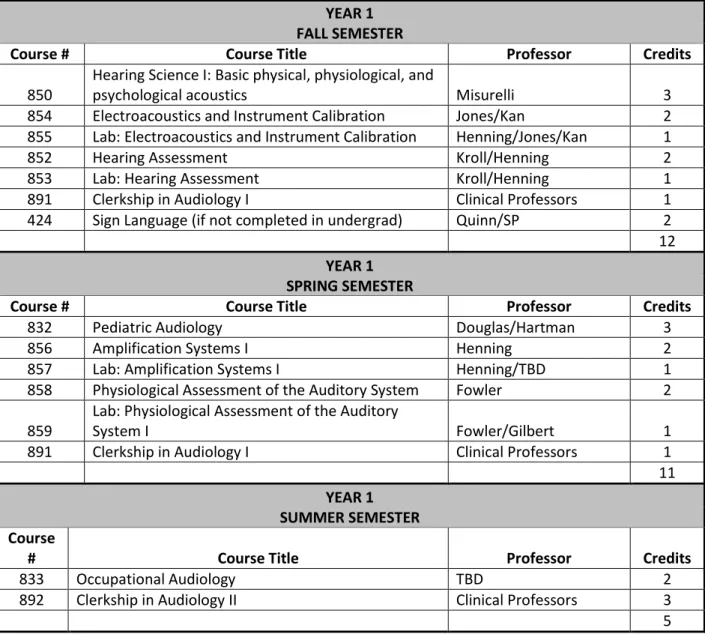
Courses within the program are described below in Table 1. The numbering system for the courses is common for both campuses. Course sequence and course availability may be subject to change.
Table 1. Courses in the Au.D. program
YEAR 1 FALL SEMESTER
Course # Course Title Professor Credits
850
Hearing Science I: Basic physical, physiological, and
psychological acoustics Misurelli 3
854 Electroacoustics and Instrument Calibration Jones/Kan 2 855 Lab: Electroacoustics and Instrument Calibration Henning/Jones/Kan 1
852 Hearing Assessment Kroll/Henning 2
853 Lab: Hearing Assessment Kroll/Henning 1
891 Clerkship in Audiology I Clinical Professors 1 424 Sign Language (if not completed in undergrad) Quinn/SP 2
12
YEAR 1 SPRING SEMESTER
Course # Course Title Professor Credits
832 Pediatric Audiology Douglas/Hartman 3
856 Amplification Systems I Henning 2
857 Lab: Amplification Systems I Henning/TBD 1
858 Physiological Assessment of the Auditory System Fowler 2 859
Lab: Physiological Assessment of the Auditory
System I Fowler/Gilbert 1
891 Clerkship in Audiology I Clinical Professors 1
11
YEAR 1 SUMMER SEMESTER Course
# Course Title Professor Credits
833 Occupational Audiology TBD 2
892 Clerkship in Audiology II Clinical Professors 3
10
YEAR 2 FALL SEMESTER Course
# Course Title Professor Credits
835 Research Methods Henning 3
860 Physiological Assessment of the Auditory System II Fowler 2 861
Lab: Physiological Assessment of the Auditory System
II Fowler/Gilbert 1
845
The Human Balance System: Structure, Assessment
and Rehabilitation Gilbert 2
846 Lab: The Human Balance System Douglas/Gilbert 1 892 Clerkship in Audiology II Clinical Professors 1
10
YEAR 2 SPRING SEMESTER Course
# Course Title Professor Credits
849 Geriatric Diagnostics/Rehabilitation Fowler 2
862 Auditory and Vestibular Pathologies Gilbert 3
865 Practice Management (alternate years) TBD 2
866 Amplification Systems II Henning 2
899 Capstone Study in Audiology Independent Study 1 892 Clerkship in Audiology II Clinical Professors 1
11
YEAR 2 SUMMER SEMESTER Course
# Course Title Professor Credits
806 Professional Issues: Medical Setting Osborne 1
893 Clerkship in Audiology III Henning/Hartman 3
4
YEAR 3 FALL SEMESTER Course
# Course Title Professor Credits
863 Implantable Auditory Prostheses Misurelli 2
834 Counseling in Audiology Hartman 2
899 Capstone Study in Audiology Independent Study 3
893 Clerkship in Audiology III Hartman/Henning 2
11 YEAR 3
SPRING SEMESTER
Course # Course Title Professor Credits
865 Practice Management (alternate years) TBD 2
836 Pediatric Habilitation /Rehabilitation Henning/Gilbert 3
867 School Methods Gilbert 1
899 Capstone Study in Audiology Independent Study 3 893 Clerkship in Audiology III Henning/Hartman 2
11
YEAR 3 SUMMER SEMESTER
Course # Course Title Professor Credits
921 Seminar: Problems in Audiology Rotates campuses 2
894 Externship in Audiology Henning/Hartman 3
5
YEAR 4 FALL SEMESTER
Course # Course Title Professor Credits
921 Seminar: Problems in Audiology Buhr-Lawler 3
894 Externship in Audiology Henning/Hartman 3
6
YEAR 4 SPRING SEMESTER
Course # Course Title Professor Credits
921 Seminar: Problems in Audiology TBD 3
894 Externship in Audiology Henning/Hartman 3
6
Course Descriptions
342 Basic Manual Communication (UWSP) or 424 Sign Language (UW-Madison). 2 cr.
Proficiency in beginning Manually Coded English (MCE) through the comprehension and use of fingerspelling and manual signs. Other areas covered include history of sign language,
descriptions of signing systems, and issues related to sign language in schools.
806 Professional Issues: Medical setting. 1 cr. Evaluation and management of persons with communication disorders within a medical setting. Information regarding various medical settings, ethics, functional goals, and documentation (e.g. billing, reporting, etc.).
832 Pediatric Audiology. 3 cr. Study of the normal physical, social, cognitive, speech and language, and auditory development in children, the causes and effects of childhood hearing
12
loss, hearing screening and the principles of early intervention, and the behavioral and objective assessment of hearing in children
833 Occupational Audiology. 2 cr. Consideration of principles and issues regarding the effects of noise on people, of federal and state regulation of workplace noise, and of the practical aspects of hearing conservation for those exposed to occupational noise, non-occupational noise, or both.
834 Counseling in Audiology. 2 cr. Study of various roles of counseling in the rehabilitative process, and the ethical obligations of those who serve such roles. Awareness and skill are developed in how to build a trusting relationship, convey diagnostic information, inform and empower the patient/consumer as to his/her rights and community resources, and respond to the way hearing loss impacts the person's social-economic life.
835 Research Methods. 3 cr. Critical analysis of research in speech-language pathology and audiology including theoretical support, research design, statistical levels of measurement, methods of reporting research results, and drawing conclusions from the results. Students will be encouraged to pursue research interests during the course.
836 Pediatric Habilitation/Rehabilitation. 3 cr. Study of the principles and techniques of intervention with hearing impaired children, including the selection and fitting of amplification, the effect of hearing impairment on speech perception, speech production, and language, communication and educational options, and the re/habilitation of communication skills.
845 The Human Balance System: Structure, Assessment, and Rehabilitation. 2 cr. Study of human balance function with emphasis on the vestibular system, including neurophysiology, testing, and rehabilitation. Clinical experience performing the electronystagmography (ENG) and videonystagmography (VNG) examination and analyzing the results, and familiarity with rotational and posturography tests, and various techniques for treatment.
846 The Human Balance System: Laboratory. 1 cr. The focus will be on training the student to perform and analyze the results of electronystagmography (ENG) and videonystagmography (VNG) examinations, and practice the canalith repositioning maneuver. If possible, students will observe the administration of rotational and posturography tests.
849 Geriatric Diagnostics/Rehabilitation. 2 cr. A study of basic theories of aging, anatomical and physiological effects of aging on the auditory and balance systems, and resulting
communication difficulties associated with aging. The course emphasizes both the diagnostic and rehabilitative challenges in working with elderly patients.
850 Hearing Science: Basic Physical, Physiological, and Psychological Acoustics. 3 cr. Study of anatomy and physiology of the human auditory system, with an emphasis on the peripheral system. Basic concepts in psychoacoustics are discussed with reference to the normal and pathological auditory systems.
13 852 Hearing Assessment. 2 cr. Diagnostic audiology familiarizes students with the bases,
purpose, rationale and procedures for tests of auditory function. A major focus is examining the available evidence as bases for test selections and realizing the objectives of diagnostic
procedures.
853 Hearing Assessment Laboratory. 1 cr. Lab experience focusing on performance of basic audiology tests.
854 Electroacoustics & Instrumentation Calibration. 2 cr. Systematic review of physical concepts of acoustics and electronics underpinning the practice of audiology, as well as formally adopted standards by which clinical environments, instruments and procedures are calibrated.
855 Lab: Electroacoustics & Instrumentation Calibration. 1 cr. Laboratory application of
physical concepts of acoustics and electronics underpinning the practice of audiology, including measurement standards by which clinical environments, instruments and procedures are calibrated.
856 Amplification Systems I. 2 cr. Study of hearing aid function, fitting strategies and repair. Use of probe microphone measures in hearing aid fitting and electroacoustic evaluation of the hearing aid. Cerumen removal and ear impression technique.
857 Laboratory in Amplification Systems I. 1 cr. Testing, fitting, and repairing hearing aids, performing basic hearing aid tests and repairs, proper cerumen removal and ear impression techniques, and using appropriate strategies in fitting. Electroacoustic evaluation and use of probe microphone measures in hearing aid fitting.
858 Physiological Assessment of the Auditory System I. 2 cr. Study of concepts and procedures in physiological assessment of the auditory system, with emphasis on otoacoustic emissions and auditory brainstem responses. Clinical applications and case studies integrate these recordings with behavioral assessment of the auditory system.
859 Laboratory in Physiological Assessment of the Auditory System I. 1 cr. Laboratory experience in the procedures and interpretation of physiological assessment of the auditory system, with the major emphasis on otoacoustic emissions and the auditory brainstem response. Clinical applications and case studies integrate these recordings with behavioral assessment of the auditory system.
860 Physiological Assessment of the Auditory System II. 2 cr. Advanced study of physiological measures used by audiologists in threshold and diagnostic evaluations, including acoustic immittance, middle and long latency auditory evoked potentials, P300, and MMN. Course includes an introduction to evaluation of the balance system.
14
861 Laboratory in Physiological Assessment of the Auditory System II. 1 cr. Laboratory
experience in objective measures used by audiologists for threshold and diagnostic evaluations, including acoustic immittance, middle and long latency auditory evoked potentials, P300, and MMN. Demonstrations, projects, and case studies prepare students to administer and interpret these tests.
862 Auditory and Vestibular Pathologies. 3 cr. Major disorders of the auditory and vestibular systems, with an emphasis on differential diagnosis of disorders of the endorgan and neural systems, and multisystem disorders. Causal factors, treatment, and prognosis are included. Didactic lectures and student presentations focus on case studies.
863 Implantable Auditory Prostheses. 2 cr. The audiological management of hearing loss using implantable auditory prostheses, including the cochlear implant, auditory brainstem implant, middle ear implant, and BAHA.
865 Practice Management. 2 cr. Consideration of non-profit and for-profit practice models with emphasis on organizational structure, legal and tax implications, financial performance, policies and practices of personnel management, marketing strategies, risk management and
professional ethics.
866 Amplification Systems II. 2 cr. Strategies for fitting hearing aids, including selection and recommendation, use of prescription gain formulas, and verification of gain. Considerations in geriatric and pediatric hearing aid fitting and ethical issues. Basic techniques in determining patient satisfaction with hearing aids.
867 School Methods for Audiologists, 1 cr. This course is designed to fulfill Wisconsin’s
Department of Public Instruction (DPI) licensing requirements for audiologists. This course will help students apply their knowledge and skills in assessment and intervention of hearing related disorders to the public school setting.
891 Clerkship in Audiology I. 1 cr. per semester. An introductory clerkship focusing on the acquisition of beginning skills in both screening and diagnostic audiology. It provides initial training in the use of audiometric instruments and software, patient interactions, and reporting procedures.
892 Clerkship in Audiology II. 1 cr. per semester. The second year of clerkship focuses on the physiologic assessment of the vestibular and the peripheral and central auditory systems. It also provides continued development of skills in the assessment of hearing and the implementation of treatment plans across ages.
893 Clerkship in Audiology III. 1-3 cr. per semester. The third year of clerkship provides
opportunities to practice skills in settings outside of the university clinics. The goal is to develop all skills beyond the introductory stage so that the student can perform assessments and treatment with less supervision.
15 development of skills in the assessment of hearing and the implementation of treatment plans across all ages. The goal is to develop skills to the Mastery level where the student can perform competently with a minimum of supervision.
899 Capstone Project. 2-3 cr. per semester. Independent work on capstone project.
921 Seminar: Problems in Audiology. 2-3 cr. per semester. Etiology, nature, and rehabilitation implications of specific hearing impairments.
Breadth Requirements and Procedures for Au.D. Students (UW Madison
students only)
The Au.D. program does not require students to complete a doctoral minor, however the option is available to those who wish to do so. Acceptance of the minor requires the approval of the Au.D. program advisor and respective department in which the minor is administered.
For students who do not complete a minor, breadth requirements will be fulfilled with the following requirements and opportunities. All students will meet with the AuD program advisor on an annual basis to discuss the breadth requirements and will complete the AuD breadth requirement form and have it signed by their advisor.
Alternate breadth training resources requirements
Students must attend and participate in the proseminar series which will introduce them to broader topics in psychology, speech language pathology, sociology, biomedical engineering, linguistics, human ecology and otolaryngology. Students will be required to attend this seminar series during the fall semester of their first year in the Au.D. program.
Students are required to complete a capstone research project. The capstone project is designed to provide depth and breadth. Through this project, students are exposed to many additional disciplines. Please see the section on capstones for more information.
Students are required to obtain clinical training in a wide diversity of sites, ranging from hospitals, clinics, schools, and/or private practices. All students obtain at a minimum 1820 clinical practicum hours. Each student will be assigned a clinical placement at the Waisman Center (or similar site) where they are involved in an interdisciplinary team including speech pathologists, pediatricians, geneticists, social workers, nurses and nutritionists.
Additional breadth training resource opportunities
Students may apply to participate in the Wisconsin Maternal and Child Health (MCH)
16
This program provides interdisciplinary and disciplinary leadership training in order to improve systems of care that promote the prevention of disabilities and assure access to
family-centered, community-based services and supports for children with neurodevelopmental disabilities and their families.
Each year students will be given the opportunity to participate in a number of outreach activities which provide them experience in community building in the allied health sciences. These outreach activities may include but are not limited to: the plain clothes clinics, early childhood hearing outreach, health fairs and the hearing health care public symposium.
Capstone Requirements
A capstone project will be completed during the second and third years of study. This project may involve an in-depth literature review to probe a clinical topic or a clinically relevant, limited scope investigation, case study or large scale clinical project. The nature and focus of the
capstone project must be accepted by a committee of three faculty and/or academic staff with at least one faculty members and representation from both campuses. Each student will work with his/her committee in developing the project.
At the end of the third year, the student will produce a final paper for the committee and will present a report on the project at a meeting of colleagues and faculty. The student’s advisor will determine whether the student passes this exercise and will make appropriate
recommendations if the work is less than satisfactory. This project is a substantial, summative report on a clinical or research topic, with a close connection to clinical experience, knowledge, and practice. The quality of the project should render it acceptable as a presentation at a clinical meeting but it will not necessarily be of publishable quality.
The specific requirements and timeline for the capstone project are included in a separate document that will be handed out to second-year students before they begin the project.
See the Au.D. website or your capstone advisor for capstone timelines.
Clerkships and Fourth-Year Externships
Off-Site ClerkshipsDr. Amy Hartman will be responsible for assigning and monitoring off-site clerkships for the Madison students. Dr. Rebecca Henning will be responsible for assigning and monitoring off-site clerkships for the UWSP students. Dr. Henning may also assign UWSP audiology faculty
members to act as the University Liaison Supervisor to monitor each off-site placement and maintain contacts with the UWSP students and off-campus supervisors. Dr. Hartman and Dr. Henning will check the credentials and experience of the supervisor, and form the agreement as to the amount and nature of the supervision and the evaluation process to be followed by the supervisor.
17 The Au.D. consortium has the following expectations:
I. Credentials and experience of the supervisor(s)
a. We will require for our files a vita of the primary supervisor at the site. b. All supervisors should have their Certificate of Clinical Competence (CCC) and
required state license, including DPI licensure for any educational placement. We will need a copy of the current ASHA card and applicable licenses. If a supervisor does not have their Certificate of Clinical Competence, the hours obtained under their supervision will not count towards certification.
c. We will contact the primary supervisor to assess the willingness of the supervisor to mentor a student and to check if they have realistic expectations of a student’s abilities.
d. There should be at least one full-time supervisor available at the same site as the student.
e. We prefer that the primary supervisor have previous experience in supervision or training on the supervision process.
f. For students placed in educational off-campus settings, the Wisconsin Department of Public Instruction (DPI) requires that supervisors of students in educational settings have at least three years of experience and have supervision training.
II. Clerkship experience
a. The typical placement will be 2-4 days per week for the semester. A one day/week placement is possible, particularly if another part-time experience (clinical or clinical research on or off campus) is pursued the same semester.
b. We expect that the placements will result in experiences in a number of different settings with exposure to all ages, and will provide a variety of clinical knowledge and skills. No one placement is expected to achieve this, but each successive placement should build on the previous placement(s) to achieve this goal. c. Attendance during the clerkship is mandatory. The days and hours of office
attendance may be arranged with your supervisor and are subject to the schedule of the facility. All absences, with the exception of illness, must have prior approval granted by the clinical supervisor and Dr. Hartman and/or Dr. Becky Henning. It is the discretion of the clinical supervisor and Dr. Hartman and/or Dr. Becky Henning to grant this request. Any absences should be made up and arranged with the clinical supervisor.
d. Track ASHA clock hours so they can be transferred and signed off on the clock hour forms. See Appendix A for an example clock hour form.
18
III. Evaluation of clerkships
a. A formal evaluation of the student should occur at the end of each semester. b. This evaluation should include a rating of skills as outlined on our evaluation form
for each clerkship and a recommendation of a letter grade. An equivalent form that has been mutually agreed upon can be substituted.
c. Any problems that arise with the student should be communicated to the student and either Dr. Hartman for Madison students or Dr. Henning at UW SP for Stevens Point students as soon as possible. At UWSP, it would be the assigned university liaison supervisor as a first contact, if problems arise during the semester. d. See Appendices B and C for evaluation forms.
Fourth-Year Externships
Dr. Hartman at the Madison campus will have the responsibility of assisting students in
obtaining and monitoring all 4th year externships for the Madison students. Dr. Henning at the UWSP campus will be responsible for assisting students in obtaining and monitoring all 4th year externships. Dr. Hartman and Dr. Henning will check the credentials and experience of the supervisor, and form the agreement as to the amount and nature of the supervision and the evaluation process to be followed by the supervisor. The Au.D. consortium has the following expectations:
I. Credentials and experience of the supervisor(s)
a. We will require for our files a vita of the primary supervisor.
b. All supervisors should have their Certificate of Clinical Competence (CCC) and required state license, including DPI licensure for any educational placement. We will need a copy of the current ASHA card and applicable licenses.
c. The primary supervisor should have at least 3 years of experience and at least 6 months of experience at that site.
d. We will contact the primary supervisor to assess the willingness of the supervisor to mentor a student and to check if they have realistic expectations of a student’s abilities.
e. There should be at least one full time supervisor available at the same site as the student.
f. We prefer that the primary supervisor have previous experience in supervision or training on the supervision process.
g. We prefer more than one supervisor at the site so that the student has supervision during the primary supervisor’s vacations and sick leaves and the student gains an additional or more viewpoints.
19 a. The Au.D. externship will be full time and defined as at least 35 hours per week for a
full 52 weeks.
b. Attendance during the externship is mandatory. The days and hours of office
attendance may be arranged with your supervisor and are subject to the schedule of the facility. All absences, with the exception of illness, must have prior approval granted by the externship supervisor and Dr. Hartman and/or Dr. Henning. It is the discretion of the externship supervisor and Dr. Hartman and/or Dr. Henning to grant this request.
c. During the externship year, the student may miss no more than 10 days pending the approval of their externship facility and supervisor. (The maximum of 10 days does
not include federal holidays when the site is closed). If the student is absent any more than 10 days, the student absences must be made up. In the event that these absences are not made up to the satisfaction of the externship supervisor and Dr. Hartman and/or Dr. Henning, the student will receive an incomplete grade for that semester of the externship experience. Upon satisfactory completion of the make-up of any absences, the appropriate grade will be assigned.
d. The externship can be split between two different sites pending approval of Dr. Hartman and/or Dr. Henning.
e. If the experience is only at one site, that site should provide the additional
complementary experiences to those obtained in the third year so that the student will have mastered skills in all important areas.
f. Dr. Hartman and/or Dr. Henning will contact the primary supervisor to discuss the actual amount and nature of the supervision and the experiences the student will receive. These should be a good fit with the student’s level of skills and need for skills as documented in his/her third year clerkship evaluations.
g. Track ASHA clock hours so they can be transferred and signed off on the clock hour forms. See Appendix A for an example clock hour form.
III. Evaluation of externships
a. A formal evaluation of the student should occur at the end of summer, fall semester and spring semester.
b. This evaluation should include a rating of skills as outlined on our evaluation form for the externship and a recommendation of a letter grade. An equivalent form that has been mutually agreed upon can be substituted.
c. Any problems that arise with the student should be communicated to the student andDr. Hartman and/or Dr. Henning as soon as possible. At UWSP, it would be the assigned university liaison supervisor as a first contact, if problems arise during the semester.
20
d. See Appendices B and C for evaluation forms.
Au.D./PhD program
The Au.D./Ph.D. program is designed for students who wish to pursue both the Ph.D. degree and professional training/clinical certification in Audiology obtained via the Au.D. Doctor of Audiology degree.
The clinical doctoral degree program in Audiology (Au.D.) meets the requirements for: • the ASHA Certificate of Clinical Competence;
• fellowship in the American Academy of Audiology; and
• a license to practice as an Audiologist in the state of Wisconsin
The Ph.D. program in Communication Sciences and Disorders prepares students to pursue a career in academia or in a clinical/academic career path. Excellence in research is emphasized through an individualized mentored approach with one of our faculty members. Students are exposed to faculty members in numerous departments to pursue studies in broad areas related to hearing science.
Au.D./Ph.D. students take a modified sequence of the same courses as students in the Au.D. program, which allows time for commitment to research throughout their studies in the program.
This Au.D./Ph.D. program is only available for students on the UW Madison campus. Students who are interested in this program should set up an advising meeting with Dr. Litovsky and Dr. Hartman.
Requirements and Satisfactory Progress
Academic performance is defined by course grades, including those earned in clinical clerkship. The Doctor of Audiology program defines the minimum academic performance as:
a. A cumulative grade-point average (GPA) of no less than 3.0 (B) across all graduate-level courses, and
b. No more than two instances of course grades less than “B” in graduate courses, and c. No course grade less than “C” in any graduate course.
Note: A grade of BC at Madison or a B- at Stevens Point is considered less than a “B”.
If a student fails to maintain minimum academic performance they will be dismissed from the program.
If a student is having difficulty in courses and/or clinic an improvement plan will be developed to outline the steps needed to show improvement in order to satisfy ASHA’s knowledge and skills as highlighted on the ASHA knowledge and skills assessment (KASA) form.
21 determine whether the student has met the standards. If the student does not meet each standard on the improvement plan after a full 15-week semester, he/she will be dismissed from the program.
Students who wish to appeal dismissal must submit a letter to the Au.D. Program Director on their respective campus detailing why they should be readmitted to the program. The Au.D. faculty will then meet to discuss the appeal.
Au.D. Program Probation - Academic
A student failing to maintain a minimum GPA of 3.0 will be placed on academic probation and will be required to raise his/her GPA to 3.0 or above in the following semester. If the GPA is not raised to 3.0 or above in the following semester, the student will be dismissed from the
program. A student receiving a course grade less than “B” shall receive a written warning reminding the student of the “no more than two grades below a “B” rule and shall be placed on academic probation.
Students who are having difficulty with essential abilities and/or meeting competencies in coursework will receive a written improvement plan. An improvement plan specifies the ASHA standards and competencies that the student has not met, as well as a statement explaining what the student must do to meet competency level and a statement explaining what the faculty will do to provide opportunities for improved performance. An improvement plan may require the student to retake an examination or even repeat an entire course if deemed necessary by the academic instructor. If a student has an improvement plan, he/she should communicate regularly with each academic instructor to discuss the plan each semester the plan is in place. The student is responsible for scheduling these communications.
Clinical Alert
A student may be placed on clinical alert at any point during the semester when the student's clinical performance is below the minimum expected standard and would warrant a grade lower than a “B.” Typically, however, a student will be placed on clinical alert at mid-term to allow adequate time to resolve problems prior to the end of the semester. The intent of the clinical alert process is to assist the student in bringing his or her performance to an acceptable level. An improvement plan will be developed by the clinical professor and reviewed with the student, the Au.D. Program Director on their respective campus, and the Au.D. Program Coordinator. If the problems are not resolved, and the student receives lower than a B for the clinical clerkships the student will be placed on Au.D. program probation.
22 Procedures:
1. The clinical alert process may be initiated by one or more of the student's clinical supervisors during a semester. These supervisors along with the Au.D. faculty will identify areas of concern and specific changes that must be made by the student in order to meet the minimum expected standard of performance.
2. The relevant supervisors and Au.D. faculty will meet with the student to discuss the areas of concern, obtain the student's perspective on the problems, identify the specific changes that the student needs to make, and develop strategies to facilitate making the changes. This information will be used to complete an
improvement plan and is given to the student and the Au.D. Program Coordinator, and is placed in the student's departmental file.
3. At the end of the semester, the student's clinical performance is reviewed. If problems are not resolved, the student will be assigned the grade BC (Madison)/B- (Stevens Point) or below, depending on the quality of clinical performance, and will be placed on Au.D. program probation inclusive of an improvement plan for the following semester.
Au.D. Program Probation - Clinical
A student whose clinical performance in one semester received a grade lower than a B will be placed on program probation prior to beginning clinical clerkship the next semester. Typically, students who are on probation will have been on clinical alert during the previous semester. If the student does not meet each standard on the improvement plan after a full 15-week semester, he/she will be dismissed from the program. See the previous section for guidelines on the appeal process for dismissal.
Clinical Clerkship Hours
Students receive a grade for each clinical assignment. Clinical clock hours will be signed and applied toward the graduate degree and ASHA certification requirements if the student earns a grade of B or better. A non-passing grade of BC (Madison)/ B- (Stevens Point) or below for any clinical assignment will likely result in an extension of the student’s academic program since the hours obtained during that semester will not be applied toward the graduate degree and ASHA certification requirements.
Clinical Exams
First year students in their Spring Semester must pass at a B level or higher on both a written exam and a practical exam as designated by their 891 clerkship in order to be eligible for off-site clinical placements and continuation in the Au.D. program. If the student does not pass the written or practical exam at a B level, an improvement plan for the student’s performance on one or both of the exams will be executed, discussed and approved to assist the student in obtaining the required level of performance.
23 student must complete the retake(s) at the end of the summer session. If the student does not pass the exam(s) at the end of the summer, the following actions will be taken:
a. They will be required to sit in on the hearing assessment course and lab (CD 852 and 853) in the fall semester.
b. They will be required to register for CD 891 instead of CD 892 for the fall semester and will not be assigned as a clinic mentor.
c. They will be required to retake the exam(s) at the end of the fall semester of their second year. If they do not pass the exam at this time, they will be dismissed from the program. They will have the option to go through the normal channels of appeal. See the AuD handbook for details on this process.
Students will not be assigned to an offsite clinical placement until they have passed both the written and clinical exam.
Certification and Licensing
ASHA CertificationThe American Speech-Language-Hearing Association (ASHA) is designated by the U.S. Department of Education as the organization qualified to accredit educational programs in speech pathology and audiology. ASHA’s Certificate of Clinical Competence in Audiology (CCC-A) serves as the basis for licensure of audiologists in most states. By 2007, ASHA has mandated that students preparing for a professional career in audiology must earn 75 academic credit hours and a minimum of 1820 hours of supervised practice in a graduate academic program. As of 2012, students will also be required to earn a doctoral degree for these credits, with the designator, the Au.D. as the preferred degree. Go to www.asha.org or current information on ASHA certification. (See Appendix D for the ASHA Code of Ethics.)
State Licensure
Licensing requirements and state statutes vary for different states. Students interested in licensing requirements should contact the licensing board for each state in which they are interested. For licensing in the State of Wisconsin, the pertinent state statutes and licensing requirements are listed at the following website: http://drl.wi.gov/profession.asp?profid=4&locid=0
Wisconsin Department of Instruction (DPI) Certification
The requirements for licensure through the Wisconsin DPI are in accordance with the state of Wisconsin. To work as an audiologist in the public schools in Wisconsin you must obtain the DPI license in audiology. The additional Au.D. curriculum requirements are:
a. Educational Psychology course that includes principles and theories of learning b. School Methods course
24
c. Sign Language course
d. 50 clinical hours in a school setting
Other states may have different requirements. It is up to the students to find out the requirements in the states they wish to work.
Academic Support Services
Library ResourcesInter-campus library services are available to all students in the UW system. Students should go to the library web sites to familiarize themselves with the services offered by the libraries on both campuses.
Additional Support Resources
A number of classrooms on both campuses are equipped with computer projection systems. There are several computers available on each campus for student use. All computers are equipped with word processing and spreadsheet software, and all have access to the Internet. Courses are given in a special distance education classroom with internet-based video
teleconferencing.
Access to Library and Learning Resources
All students will have e-mail and Internet access to the university libraries and departmental resources whether they are local or placed at distant clinical sites. Students should go to the web site for the libraries at their respective campuses for a description of the services provided by the library.
Access to Student Services
A committee of faculty representatives from both campuses and the Program Coordinator will form the admissions committee. Students submit one application to the program and pay one application fee. Students may request a home campus and efforts will be made to honor the request, but the admissions committee reserves the right to assign the home campus in the interest of maintaining a balance in student numbers at the two campuses.
Academic and clinical advising is readily available to all the students throughout the program. An academic advising committee will be composed of the Au.D. Program Directors on both campuses, the Au.D. Program Coordinator and the Graduate Student Coordinator and will provide coordinated academic advising across the two campuses. A faculty member at each campus is available for local advising access for students. Any issues that affect both campuses are brought to the advising committee. The Program Coordinator for UW Madison and the Clinic Director at UW SP will be responsible for issues related to clinical experience and placement sites. The Program Coordinator at UW Madison and the Graduate Coordinator at UW SP will be responsible for tracking academic and clinical progress of students to assure that all requirements are met.
25 situation occurs, the student should seek the advice of the faculty advisor. The faculty advisor will then evaluate the status of the student’s program and assist the student in making any transition that is necessary at that point. Again issues involving the two campuses will be brought to the advising committee.
Delivery of course materials is the responsibility of the individual faculty. Normally course material such as the syllabus, reading lists, handouts for each class, and other supplemental material will be delivered by email or posted on the Web. Reading material will be available through the use of electronic library reserve services at both campuses.
Technical Support
Students will obtain needed technical services at their home campus. They will have access to the services on the other campus when they are there. Faculty help will be available by phone and e-mail for academic questions and project consultation when necessary.
Miscellaneous and General Information
Class Attendance PoliciesStudents are expected to be present at all classes; however, it is understood that it is
sometimes necessary to miss a class. Please think of class attendance as you would think of job attendance. When you are ill, notify your supervisor/instructor as quickly as possible. If you have an obligation that requires you to miss one or more classes, this must be arranged with the instructor prior to the absence. The instructor is under no obligation to allow you to make up missed classes when you have not made arrangements to do so prior to being absent.
Please note that this attendance policy is also in force for the online classes. Just because the class is online does not mean you can “miss,” or not check in, for large blocks of time. Regularly scheduled chats, or threaded discussions need to be attended, just like you are in a classroom situation. Not checking in is the same thing as missing a class and needs to be arranged in advance with the instructor.
Committees
The University of Wisconsin is a faculty-governed University. It is the responsibility of the Chair of the Department to manage the affairs of the program. Various committees administer academic, clinic and research policies. Student participation on departmental committees is encouraged.
Computer Requirements
For all classes, it is assumed that you have access to a computer with internet access to download information posted by instructors. It is expected that you will have daily access to a computer with an internet connection when enrolled in one of the program’s online classes.
26
While slower dial-up connections are generally adequate for regular classes, we recommend a higher speed internet connection for the online classes.
Departmental Facilities Assignments
Space assignments are made by the Department Chair, based on the University Space Policy and the department Facilities-Equipment-Computer Committee. All offices are for the use of the occupant only. Please do not enter them without permission. Staff offices also contain confidential information and files that are under the jurisdiction of the occupants and are not to be used without their specific permission.
Disabilities and Accessibility
The University of Wisconsin System Policy on Individuals with Disabilities
(Rev. December, 1996)
The University of Wisconsin System is committed to making individuals with disabilities full participants in its programs, services and activities through its compliance with Section 504 of the Rehabilitation Act of 1973 and the Americans with Disabilities Act (ADA) of 1990… It is the policy of the University of Wisconsin System that no otherwise qualified individual with a disability shall be denied access to or participation in any program, service, or activity offered by the universities. Individuals with disabilities have a right to request accommodations. Individuals will receive appropriate accommodations to their needs in order to fully participate in or benefit from the university’s programs, services, and activities in a non-discriminatory, integrated manner.
The complete University of Wisconsin System Policy is available upon request or can be downloaded from the web site: http://www.uwsa.edu/acss/disability/policy96-6.htm
Information about accessibility and accommodations for students is available from the McBurney Center at www.mcburney.wisc.edu or by phone at (608) 263-2741. The McBurney Disability Resource Center is located on the UW-Madison campus at 905 University Avenue.
In accordance with the University of Wisconsin-Stevens Point policy, if a student has a documented disability and requires accommodations to obtain equal access in a class or in clinical clerkship, the student should contact the Disability Services office at (715) 346-3365 to verify his/her eligibility for accommodations.
Financial Assistance
See Appendix E.
Grades
All grades will be awarded based upon the percentage score earned. Because UW – Madison and UW – Stevens Point have different grading scales, grades will be assigned based upon the home campus of the student using the table on the following page:
27 Letter Grade Percentage 100-92 91.9-90 89.9-88 87.9-82 81.9-80 79.9-78 77.9-72 71.9-70 69.9-68 67.9-60 <60 UW-Madison Letter Grade A A-B B B-C C C-D D F
Instructors reserve the right to use an alternate grading scale if stated as such in the course syllabus.
Grade Conflicts
Talk with the instructor. If the difference in opinion is not resolved, write out the specific charges and differences with documentation and submit them to the Au.D. Program Director on the student’s home campus. The issues that were submitted in writing will then be discussed by the Au.D. Program Director, the Au.D. Program Coordinator, the instructor, and the student.
Grievance Policies & Procedures
The formal procedure for handling student concerns and grievances requires the student to begin at the source of the problem, and then to work up the administrative structure in a manner appropriate to the nature of the problem. All efforts will be made to achieve a resolution within the program; if this level of resolution is not reached, the complaint will be addressed to the affected Department. The preferred channels in order are as follows: (1) the affected faculty member or clinical supervisor, (2) the Au.D. Program Coordinator or Program Director on the student’s home campus, who may refer the matter to the full Au.D. Faculty, (3) the Chair of the involved department who may refer it to the appropriate Associate Dean or Dean from the relevant campus. Although this route is normal, there is no policy that would prevent any individual student or faculty member from seeking input at higher administrative levels.
If the student has a complaint about the program or its accreditation, the student is referred to the following ASHA website for information on how to lodge a complaint with the Council on Academic Accreditation (CAA): http://www.asha.org/academic/accreditation/accredmanual/section8.htm.
Professional Recommendations
The appropriate procedure in seeking professional recommendations for future employment or additional academic training is to ask the instructor for permission to use his/her name as a reference, and then request the letter of recommendation. If a general recommendation is sought, it is appropriate to state such. Otherwise, it is appropriate to indicate the type of position for which the recommendation is to be made and to whom it should be sent.
If you wish to forward to other persons or institutions letters of recommendation that were written by faculty and staff for your application to the UW-Madison graduate program, you will need to contact the writer of the original document, inform him/her of your request, and secure written permission to copy documents for forwarding to a named person or institution. It would also be advisable if you would inform the faculty or staff member of the intent (e.g.,
28
admission to graduate school, employment recommendation). It is the combined permission (the original writer and you) that allows the department to proceed with the request without violating the Buckley Amendment. After we have permission from all sources we will forward the information you request at the cost of 5 cents per page for copying plus the postage cost. Charges will be made available to you at the time the information is mailed. To avoid future problems of whether we can or cannot duplicate materials, we urge you to avail yourself of the services offered at various campus Placement Offices.
Sexual Harassment
Sexual harassment is defined as any unwelcome sexual advances, requests for sexual favors and any other verbal or physical conduct of a sexual nature.
Current policies expressly prohibit:
Part I. Sexual favors as a Basis for Actions Affecting an Individual’s Welfare as a Student or Employee
I. A member of the University faculty or academic staff is subject to discipline if he or she behaves, while engaged in official University business, toward another
University employee, student, or recipient of University services in any of the following ways:
A. Uses, offers to use, or threatens to use one’s status as a member of the University faculty or academic staff to bring about decisions or assessments affecting an individual’s welfare on the basis of submission to, or rejection of requests for sexual favors.
B. Accepts an offer of sexual favors in exchange for an agreement to use one’s status as a member of the University faculty or academic staff to bring about favorable decisions or assessments affecting an individual.
Part II. Flagrant or Repeated Sexual Advances, Requests for Sexual Favors, and Physical Contacts Harmful to Another's Work or Study Performance or to the Work, Study or Service Environments.
II. A member of the University faculty or academic staff is subject to discipline if, in a work or learning-related setting, he or she makes sexual advances, requests sexual favors, or makes physical contacts commonly understood to be of a sexual nature, and if:
A. The conduct is unwanted by the person(s) to whom it is directed.
B. The actor knew or a reasonable person could clearly have understood that the conduct was unwanted.
29 whom the conduct was directed.
2. Makes the University work, learning, or service environment intimidating or hostile, or demeaning to the person of average sensibilities.
A student who believes that sexual harassment has occurred is urged to contact the
department contact person for such complaints. The UW-Madison department contact person is Meenu Verma. The UWSP department contact person is Dr. Julia King.
Professional Behaviors Code of Conduct
All students enrolled in the graduate Doctor of Audiology Program at UW-Madison and UW- Stevens Point must adhere to the highest standards of professional behavior and ethics. Students should avoid even an appearance of improper behavior or lack of ethical standards while a student in the Au.D. Program, in all professional settings, and in their personal lives. Students should conduct themselves according to the standards expected of members of the professional community to which the student aspires.
A. Students must adhere to the rules and regulations contained in UWS 14
(see http://www.legis.state.wi.us/rsb/code/uws/uws014.pdf). “The board of regents, administrators, faculty, academic staff and students of the university of Wisconsin system believe that academic honesty and integrity are fundamental to the mission of higher education and of the university of Wisconsin system. The university has a responsibility to promote
academic honesty and integrity and to develop procedures to deal effectively with instances of academic dishonesty. Students are responsible for the honest completion and representation of their work, for the appropriate citation of sources, and for respect of others’ academic
endeavors. Students who violate these standards must be confronted and must accept the consequences of their actions.” (UWS 14.01 Statement of Principals). Violation of the Wisconsin Administrative Code UWS 14 may result in University disciplinary action such as disciplinary probation, suspension, or expulsion.
B. Students must adhere to the rules and regulations contained in UWS 17
(see http://www.legis.state.wi.us/rsb/code/uws/uws017.pdf). “The board of regents, administration, faculty, academic staff and students of the university of Wisconsin system believe that the teaching, learning, research and service activities of the university can flourish only in an environment that is safe from violence and free of harassment, fraud, theft,
disruption and intimidation. The university has a responsibility to identify basic standards of nonacademic conduct necessary to protect the community, and to develop procedures to deal effectively with instances of misconduct while observing the procedural and substantive rights of students. Any person who violates state or federal laws on university property may face prosecution in the appropriate courts. In addition, students, faculty or staff who violate university standards are subject to university disciplinary action.” (UWS 17.01 Policy