A MICRO LEVEL MODEL FOR ASSESSING COMMUNITY
DEVELOPMENT TOWARDS IMPROVED WELLBEING
by
CORNELIA SUSANNA HART
submitted in accordance with the requirements for the degree of
DOCTOR OF PHILOSOPHY
in the subject
DEVELOPMENT STUDIES
at the
UNIVERSITY OF SOUTH AFRICA
SUPERVISOR: PROF F C DE BEER
i
DECLARATION
Name: Cornelia S. Hart
Student Number: 31643124
Degree: Doctor of Philosophy In the subject of Development Studies
A MICRO LEVEL MODEL FOR ASSESSING
COMMUNITY DEVELOPMENT TOWARDS IMPROVED WELLBEING
I declare that the above dissertation/thesis is my own, original work, and that all the sources that I have used or quoted have been indicated and acknowledged by means of complete reference.
Signature: ……… Date: ……….
Copyright © 2018 Cornel Hart; University of South Africa (UNISA) All rights reserved
ii
ACKNOWLEDGEMENTS
This study would never have reached completion without the help and support of many people. I wish to thank, with the deepest appreciation, all who have contributed in any way.
There are, however, some to whom particular thanks are due:-
To my study leader Prof Frik de Beer for his guidance, critical support and thoroughness in advising my research. His expertise and passion for community development were my reason for embarking on my PhD journey. I first met him as an undergraduate student in Development Studies, more than 27 years ago, and it was then already that he laid the foundation for what became my lifelong commitment and passion, to work in communities.
To Prof De Wet Schutte for assisting me in that critical moment when I wanted to ‘uncomplicate’ the complicated statistics needed to ensure that the purpose of this study would be achieved in every way, so that communities (the ‘insiders’ of community development) could drive their own wellbeing assessment and development processes.
To Mr. Hewu and his team at the Western Cape Department of Social Development who, in the true sense of ‘community spirit’, offered to assist with my study in testing the applicability of my model in the public-sector (the ‘outsiders of community development) and, to date, for not having stopped using it as a tool to empower staff and communities alike.
To my language editor, Bryan de Robeck who has done a crucial job under great pressure. I am grateful for the professional and friendly way in which you have contributed to this thesis. We have done both Masters and PhD ‘together’, and I will be forever grateful to you for your skill and guidance, during all these years, in developing my academic writing skills.
iii
To my family and friends for their understanding and loving support and, more often than not, for their patience and constant willingness to encourage me to reach completion.
Lastly but not least, to my friend and lifetime partner, Luan Lausberg for his moral support and encouragement to always believe in myself and to finish my studies, irrespective of what I have had to give up in order to achieve this degree. We share almost two decades of community development drive and passion together; once again you have succeeded in developing an electronic tool which is now available to assist communities with having the ‘power’ to drive their own community development processes.
“If there is no struggle there is no progress”
(Frederick Douglass; 1870
–
An American slave)
This thesis is dedicated to the communities (my actual university of study) who have taught me and shaped me to become the person and community development practitioner that I am today. I learned early on the importance of “…Do not judge me by my successes, judge me by how many times I fell down and got back up again…”(Nelson Mandela). I honour, too, the endurance, patience, courageous efforts and unconditional sacrifices made by communities and community development practitioners in seeking to fulfil a vision towards an improved quality of life in a sustainable wellbeing for all.
iv
ABSTRACT
Developments since the 20th century indicate that the wellbeing of communities makes for healthy national welfare in strong countries. Community wellbeing is thus a priority for policy makers and service providers. Conceptualization of a meaningful, holistic multidimensional measurement of community wellbeing at micro (community) level has been lacking. Such a concept and its measurement are essential when addressing social exclusion and development issues in the enhancement of community wellbeing is to produce worthwhile results. There is growing recognition that earlier understanding of community wellbeing failed to address development needs and processes at community level. Outsider stakeholder driven top-down one-dimensional community wellbeing (‘silo’) measurements did not address human development needs at community level. Meaningful measurement requires integrated frameworks addressing multi-dimensional issues conceptualizing wellbeing measurement at community level. Such measurement needs to be combined with the integrated inclusion of social capital influence through ‘insider-outsider’ partnerships.
The research study purpose was to develop a community driven holistic, integrative wellbeing assessment model. This model could assist ‘insiders’ (community members) and ‘outsiders’ (policy makers, service providers and community development practitioners) in developing and implementing community driven initiatives towards improved wellbeing. The two main research questions were: 1) which macro level wellbeing assessment factors to consider in an aligned micro level wellbeing assessment? and 2) what is the associative relationship between wellbeing and social capital?
Two descriptive sample surveys were conducted utilizing a structured questionnaire. Primary data findings contributed to finalization of a community level wellbeing assessment model. This model would enable estimation of the potential (push and pull) factors that influence the targeted success of suggested community development processes. The assessment model is community driven and owned, with spider and quadrant diagram graph tools indicating first the status of community wellbeing and social capital, then the associative relationships of wellbeing and social capital in ‘insider-outsider’ initiatives for wellbeing enhancement.
Key Terms: Community Wellbeing; Social Capital; Socio-ecological Systems
Theory; Wellbeing Assessment Model; Community Development; Insider-Outsider Partnerships; Wellbeing Measurement; Wellbeing Dimensions; Social Capital Dimensions; Quality of Life.
TABLE OF CONTENTS
LIST OF ABBREVIATIONS ...
LIST OF CONCEPTS ... 1
CHAPTER ONE ... 1
INTRODUCING THE STUDY ... 1
1.1. INTRODUCTION ... 1
1.2. PROBLEM STATEMENT AND PURPOSE ... 2
1.3. OBJECTIVES OF THE STUDY ... 4
1.4. RESEARCH QUESTIONS ... 5
1.4.1. Part One: Research Question ... 5
1.4.2. Part Two: Research Question ... 6
1.5. OPERATIONALIZATION ... 6
1.5.1. Part One ... 6
1.5.2. Part Two ... 7
1.5.3. Part Three ... 9
1.6. SIGNIFICANCE OF THE STUDY ... 9
1.7. DELIMITATIONS AND LIMITATIONS OF THE STUDY ... 10
1.8. CHAPTERS OUTLINES ... 10
1.9. CONCLUSION ... 12
CHAPTER TWO ... 13
WELLBEING MEASUREMENT: A LITERATURE REVIEW... 13
2.1. INTRODUCTION ... 13
2.2. DEVELOPMENT THEORY AND PRACTICE ... 14
2.3. MODERNIZATION THEORY ... 17
2.4. DEPENDENCY THEORY ... 18
2.5. COMMUNITY DEVELOPMENT THEORY ... 21
2.5.1. Systems Theory ... 22
2.5.2. Socio-Ecological Systems Theory ... 24
2.5.2.1. Micro Ecosystem ... 25
2.5.2.2. Meso Ecosystem ... 26
2.5.2.3. Exo Ecosystem ... 26
2.5.2.4. Macro Ecosystem ... 27
2.5.2.5. Chrono Ecosystem ... 28
2.6. DEFINING COMMUNITY AND COMMUNITY DEVELOPMENT ... 31
2.7. COMMUNITY DEVELOPMENT APPROACHES... 34
2.8. CONCEPTUALISING WELLBEING ... 38
2.9. CONCEPTUALISING SOCIAL CAPITAL ... 39
2.10. SOCIAL AND COMMUNITY INDICATORS ... 43
2.11. INDEXES AND MODELS TO MEASURE COMMUNITY WELLBEING ... 48
2.12. CONCLUSION ... 50
CHAPTER THREE ... 52
THEORETICAL AND CONCEPTUAL DISCOURSE FOR A PROPOSED COMMUNITY LEVEL WELLBEING MEASUREMENT MODEL ... 52
3.1. INTRODUCTION ... 52
3.2. ASSET BASED COMMUNITY DEVELOPMENT ... 53
3.3. SUSTAINABLE LIVELIHOODS FRAMEWORK ... 56
i
3.3.1.1. International and National Livelihoods Frameworks ... 58
3.3.2. Benefits of Livelihoods Frameworks ... 62
3.3.3. Critique of Livelihoods Frameworks ... 63
3.4. INTEGRATING THE ABCD AND SLAAPPROACHES ... 63
3.5. SOCIAL CAPITAL ... 65
3.6. MANIFESTATIONS OF SOCIAL CAPITAL ... 67
3.6.1. Structural and cognitive appearance of social capital ... 68
3.6.2. Bonding and bridging appearance of social capital ... 68
3.7. WELLBEING DIMENSIONS AND INDICATORS ... 69
3.7.1. Dimensions of the OECD wellbeing framework ... 71
3.8. INTERNATIONAL AND NATIONAL DEVELOPMENT INITIATIVES ... 77
3.8.1. UN Sustainable Development Goals (SDGs) ... 77
3.8.2. Agenda 2063 ... 79
3.8.3. The National Development Plan (NDP): Vision 2030 of South Africa ... 81
3.8.4. South Africa’s country objectives and government clusters... 83
3.9. CONCEPTUALIZATION OF THE PROPOSED COMMUNITY LEVEL WELLBEING ASSESSMENT MODEL ... 85
3.9.1. Purpose of the proposed wellbeing model ... 87
3.9.2. Linking national priorities, plans and clusters ... 88
3.9.3. Proposed community level wellbeing dimensions ... 89
3.9.4. The community level wellbeing model conceptual aspects ... 90
3.10. OPERATIONALIZATION OF THE PROPOSED COMMUNITY LEVEL WELLBEING ASSESSMENT MODEL ... 92
3.10.1. Stage 1: Community organizing ... 93
3.10.2. Stage 2: Data collection and capturing training ... 94
3.10.3. Stage 3: Data results conceptualization ... 94
3.10.4. Stage 4: ‘Insider-outsider’ partnership formation ... 96
3.11. CONCLUSION ... 96
CHAPTER FOUR ... 98
RESEARCH STUDY METHODOLOGY: CONDUCTING A COMMUNITY LEVEL WELLBEING ASSESSMENT SURVEY ... 98
4.1. INTRODUCTION ... 98
4.2. RESEARCH METHODOLOGY ... 98
4.3. RESEARCH SETTING ... 99
4.4. STUDY POPULATION AND SAMPLING PROCESS ... 100
Figure 1: Wazimaps Landing Page ... 100
4.4.1. Urban Community Sample ... 102
4.4.2. Rural Community Sample ... 104
4.5. STUDY DESIGN ... 106
4.6. RESEARCH QUESTION (PART 1) ... 108
4.7. PART 2:RESEARCH QUESTION ... 109
4.8. DATA COLLECTION INSTRUMENT AND FIELDWORKER TRAINING ... 109
4.9. DATA PROCESSING AND ANALYSES ... 112
4.10. ETHICAL CONSIDERATIONS ... 114
4.11. CONCLUSION ... 115
CHAPTER FIVE ... 117
SURVEY DATA FINDINGS: PRESENTING COMMUNITY WELLBEING AND SOCIAL CAPITAL LEVELS. ... 117
ii 5.1.1. Health ... 119 5.1.2. Food ... 119 5.1.3. Education ... 119 5.1.4. Transport ... 119 5.1.5. Communication ... 120 5.1.6. Income ... 120 5.1.7. Security ... 120 5.1.8. Recreation ... 120 5.1.9. Housing ... 121 5.1.10. Energy ... 121
5.1.11. Water and Sanitation ... 121
5.1.12. Environment ... 121
5.2. URBAN AND RURAL COMMUNITY WELLBEING PROFILES ... 122
5.3. SOCIAL CAPITAL AND ITS ASSESSMENT DIMENSIONS ... 134
5.3.1. Groups and Networks... 135
5.3.2. Trust and Solidarity ... 135
5.3.3. Collective Action and Cooperation ... 135
5.3.4. Information Sharing and Communication ... 135
5.3.5. Social Cohesion and Inclusion ... 136
5.3.6. Empowerment and Political Action ... 136
5.4. URBAN AND RURAL COMMUNITY SOCIAL CAPITAL PROFILES ... 136
5.5. INTEGRATED WELLBEING AND SOCIAL CAPITAL LEVELS ... 146
5.6. SUMMARY OF RESULTS ... 150
5.7. CONCLUSION ... 151
CHAPTER SIX ... 153
STUDY CONCLUSIONS AND RECOMMENDATIONS FOR FURTHER RESEARCH. ... 153
6.1. INTRODUCTION ... 153
6.2. REVISITING THE STUDY OBJECTIVES: KEY OBSERVATIONS AND CONCLUSIONS ... 154
6.2.1. Study Problem Statement and Purpose ... 154
6.2.2. Study Objective 1: A literature review of wellbeing measurement conceptualization ... 155
6.2.2.1. Theoretical discourse for an ‘insider-outsider’ development approach to wellbeing enhancement ... 156
6.2.2.2. Socio-ecological systems theory and wellbeing measurement... 158
6.2.2.3. Community development and its approaches to wellbeing enhancement ... 160
6.2.2.4. Wellbeing measurement and participatory assessment approaches ... 161
6.2.2.5. The relational influence between social capital and wellbeing ... 163
6.2.3. Study Objective 2: A descriptive sample survey for integrative community level wellbeing and social capital contextualization ... 165
6.2.3.1. Study research methodology ... 166
6.2.4. Study Objective 3: Community level wellbeing assessment model finalization: Lessons learned and recommendations for further research ... 169
6.2.4.1. Wellbeing and social capital dimensional assessment ... 170
6.2.4.2. Relational association between social capital and wellbeing ... 170
6.3. CONCLUDING STATEMENT ... 172
6.4. RECOMMENDATIONS FOR FURTHER RESEARCH ... 172
BIBLIOGRAPHY ... 173
ANNEXURES Annexure 1: Community Wellbeing Questionnaire ... 194
iii DIAGRAMS
Diagram 1: Schematic Changing Development Trends and Themes Summary ... 15
Diagram 2: Interdependent Ecological Systems Shaping Human Development both Directly and Indirectly ... 29
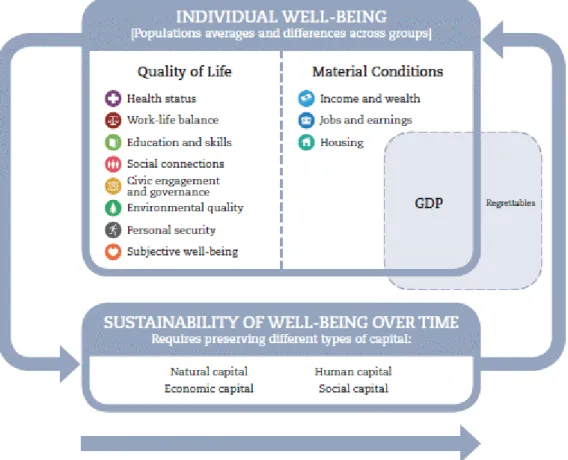
Diagram 3: The OECD Wellbeing Conceptual Framework ... 72
Diagram 4: A SA example community level wellbeing assessment model ... 91
TABLES Table 1: ABCD Principles of Practice ... 55
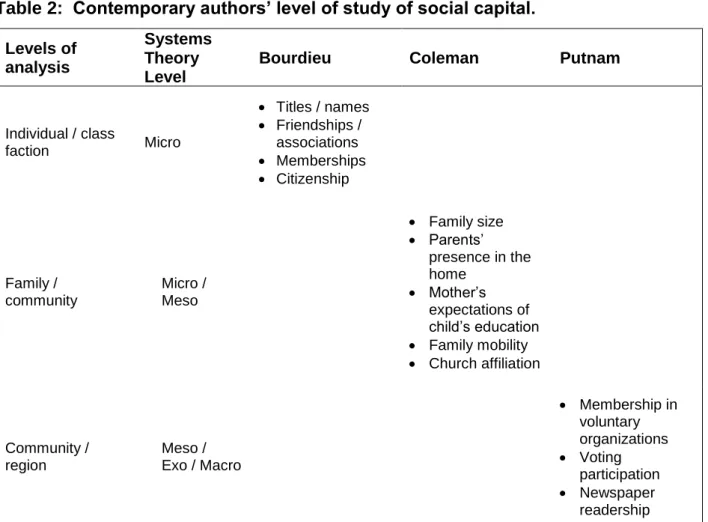
Table 2: Contemporary authors’ level of study of social capital. ... 66
Table 3: A Wellbeing Framework for Developing and Emerging Countries. ... 73
Table 4: Linking National Priorities, NDP Chapters and Government Clusters. ... 88
Table 5: CCT Region, Metro East: Urban Community Example Sample Composition ... 102
Table 6: Urban Community Groups Composition ... 104
Table 7: Rural Community Groups Composition ... 105
Table 8: Survey Questionnaire Content ... 113
SPIDER GRAPHS Spider Graph 1: Urban Female Youth Community Wellbeing Profile ... 123
Spider Graph 2: Rural Female Youth Community Wellbeing Profile ... 123
Spider Graph 3: Urban Female Adult Age Community Wellbeing Profile... 124
Spider Graph 4: Rural Female Adult Age Community Wellbeing Profile ... 125
Spider Graph 5: Urban Female Senior Age Community Wellbeing Profile ... 126
Spider Graph 6: Rural Female Senior Age Community Wellbeing Profile ... 127
Spider Graph 7: Male Urban Youth Community Wellbeing Profile ... 128
Spider Graph 8: Male Rural Youth Community Wellbeing Profile ... 128
Spider Graph 9: Male Urban Adult Age Community Wellbeing Profile ... 129
Spider Graph 10: Male Rural Adult Age Community Wellbeing Profile ... 130
Spider Graph 11: Male Urban Senior Age Community Wellbeing Profile ... 131
Spider Graph 12: Male Rural Senior Age Community Wellbeing Profile ... 131
Spider Graph 13: Overall Urban Community Wellbeing Profile ... 132
Spider Graph 14: Overall Rural Community Wellbeing Profile ... 133
Spider Graph 15: Urban Female Youth Age Social Capital Profile ... 137
Spider Graph 16: Rural Female Youth Age Social Capital Profile ... 137
Spider Graph 17: Urban Female Adult Age Social Capital Profile ... 138
Spider Graph 18: Rural Female Adult Age Social Capital Profile ... 138
Spider Graph 19: Urban Female Senior Age Social Capital Profile ... 139
Spider Graph 20: Rural Female Senior Age Social Capital Profile ... 140
Spider Graph 21: Male Urban Youth Social Capital Profile... 141
Spider Graph 22: Male Rural Youth Social Capital Profile ... 141
Spider Graph 23: Male Urban Adult Age Social Capital Profile ... 142
Spider Graph 24: Male Rural Adult Age Social Capital Profile ... 142
Spider Graph 25: Male Urban Senior Age Social Capital Profile ... 143
Spider Graph 26: Male Rural Senior Age Social Capital Profile ... 143
iv
Spider Graph 28: Overall Rural Community Social Capital Profile... 145
QUADRANT DIAGRAM GRAPHS
Quadrant Diagram Graph 1: Urban Community Quadrant Diagram ... 147 Quadrant Diagram Graph 2: Rural Community Quadrant Diagram ... 149
List of Abbreviations
ABCD : Asset Based Community Development
AU : African Union
CARE : Cooperative for Assistance and Relief Everywhere CCT : City of Cape Town
CLD : Citizen Led Development CPI : Consumer Price Indices
DFID : Department for International Development
EU : European Union
GDP : Gross Domestic Product GPI : Genuine Progress Indicator
GST : General Systems Theory; better known as ‘Systems Theory’
HDI : Human Development Index
IACD : International Association of Community Development IMF : International Monetary Fund
IRDP : Integrated Rural Development Planning ISH : Fordham Index of Social Health
LAL : Learning About Livelihoods
LSMS : Living Standards Measurement Surveys
NDP:2030 : National Development Plan: Vision 2030 of South Africa NGO : Non-Governmental Organization
NPO : Not-for-Profit Organization
OECD : Organization for Economic and Cooperation Development OSS : Open Source Software
OXFAM : Oxford Committee for Famine Relief
PGIEP : Policy Guidelines for Integrating Environmental Planning PM : Participatory methods
PRA : Participatory Rural Appraisal
QOL : Quality of Life (also Social Quality of Life (SQL) RDP : Reconstruction and Development Plan
i
SC-IQ : Social Capital Integrated Questionnaire SCS : Social Capital Surveys
SDGs : Sustainable Development Goals SID : Society for International Development SLF : Sustainable Livelihoods Framework SLP : Sustainable Livelihoods Project
SQL : Social Quality of Life (also Quality of Life (QOL) UK : United Kingdom
UN : United Nations
UNDP : United Nations Development Programme UNISA : University of South Africa
1
List of Concepts
Asset Based Community Development (ABCD) emphasizes the building of
existing assets in the community. It is also known as Citizen Led Development, and forms part of the participatory methodologies that are people-centred or people-driven development. ABCD favours a bottom-up approach, with an empowerment perspective that values collaboration and partnerships (derived from Mathie, Cameron & Gibson, 2017:54; Nel, 2015:512; MacLeod & Emejulu, 2014:435; Pretorius & Nel, 2012:9; O’Leary, 2005:3; Mathie & Cunningham, 2003:474; Chambers & Conway, 1991:37).
Community Development is defined by the community development practice
policy framework of South Africa (2014) as “…an active long-term and holistic citizenry empowerment practice with set values and practices which plays a special role in addressing inequality in society to bring about change and deepening democracy that are founded on social justice, equality, and inclusion towards improved wellbeing for members of society...”.
Community Indicators, also referred to as community Quality of Life
indicators, assist communities in developing a better understanding of where they are with regard to their own ability and capacity for wellbeing achievement, as well as in relation to other communities and their levels of wellbeing achievement. If they are formulated and applied correctly, they could not only monitor change and progress but could also contribute towards making change happen in communities (derived from Davern, et.al. 2017:568-569; Miles, et.al., 2008:77; Greenwood, 2001:5-7; Norris & Adkisson, 1997:i-ii).
Community Wellbeing is a state of being measured against a set of wellbeing
indicators that assesses the financial, socio-ecological, physical, and infrastructural status of a community (derived from Miles, et.al., 2008:75; Swanepoel & De Beer, 2016:12).
2
Community Wellbeing Dimensions are clustered into the physical (i.e. natural
capital), social, economic (i.e. financial capital), political (i.e. social and human capital), and psychological (i.e. also social and human capital) environments. There are 12 wellbeing dimensions for community wellbeing assessment namely: i) health; ii) income; iii) education; iv) housing; v) energy; vi) sanitation; vii) environment; viii) transport; ix) security; x) food; xi) recreation; and xii) communication (derived from Boarini, Kolev & McGregor, 2014:43-44; ABS, 2002:12-18; Graczyk, 2002:12-18).
Quality of Life (QOL) is a measurement concept which includes happiness, life
satisfaction and social capital. This measurement is based on four conditions: 1) socio-economic security, 2) social inclusion, 3) social cohesion and solidarity between generations, and 4) autonomy and empowerment level of citizens (Miles, et.al., 2008:75). Ribova (2000:2) defines QOL (also SQL) as: “...a concept focused on understanding the contribution of the economic, social, cultural and political components of a community in maintaining itself and fulfilling the various needs of local residents...”.
Social Capital generally refers to the reliable network upon which one can ‘draw’ during difficult times and/or for improvement of wellbeing. Social Capital is thus the extent to which one has ‘control’ over access to participating in and depending upon the influence of system level networks. The Social Capital network is founded on a basis of norms and values which require trust and equal sharing. This sharing takes on the form of a barter exchange system towards common goals by all who are participating and contributing to the system in different ways at different levels (derived from Tzanakis, 2013:2; Gauntlett, 2011:132-333; Vermaak, 2009:401; Woolcock & Narayan, 2000:226; Claridge, 2004:24; Mansuri & Rao, 2004:8 Falk & Kilpatrick, 2000:88; Portes, 2000:3; Putnam, 1995; Putnam, 1993).
Social Capital Dimensions are used to measure the networks and
associations that exists within communities. There are 6 overall dimensions for social capital assessment: 1) groups and networks; 2) trust and solidarity; 3)
3
collective action and cooperation; 4) information sharing and communication; 5) social cohesion and inclusion; and 6) empowerment and political action (derived from Grootaert et al. 2004:2).
Social Indicators contribute to a significant measurement of the quality of life (Sirgy, Michalos, Ferriss, et.al, 2006: 344). Raymond Bauer invented the basic conceptualization for the term ‘social indicators’, defining them as: “...statistics, statistical series, and all other forms of evidence that enable us to assess where we stand and are going with respect to our values and goals... (Bauer, 1966:1).
Socio-ecological Systems Theory is a human development theory that
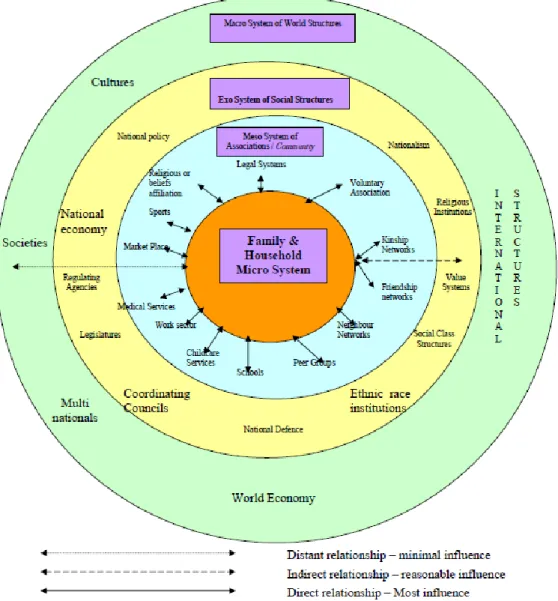
applies socio-ecological models postulated to understand human development, as well as the entire ecological system in which growth occurs. It emphasises the nature of the transactional relations between the human environment (individuals, families, communities, societies) and the greater environment. It indicates that human development cannot be taken in isolation from the environment in which it occurs. It therefore needs to be within the context of the relationships which exist between and within each of the units within a system. Socio-ecological models therefore incorporate the following system levels within the human environment: 1) micro; 2) meso; 3) exo; 4) macro; and 5) chrono. (derived from Neal & Neal, 2013: 722-723; Friedman & Allen, 2011:9-10; Walker, Holling, Carpenter & Kinzig, 2004:6; Stanger, 2011:169).
Sustainable Livelihoods Framework (SLF) focuses on livelihoods instead of
household assessments. The SLF aims to increase the effectiveness of communities and community based organisations in addressing poverty issues. The framework assists with the conceptualization of the capabilities and assets which households can apply (activate) to develop a strategy for sustaining their livelihoods. It provides clarity with regard to the factors (assets, capabilities, threats and vulnerabilities) within the different dimensions of society (social, political, economic and physical). It provides this at all levels (micro to macro) which impact positively or negatively on the sustainable wellbeing of the
4
households (derived from Morse & McNamara, 2013:18; De Haan, 2012:347-349; De Haan & Zoomers, 2006:122; De Satgé, 2002:3; Hussein, 2002:48).
Wellbeing Measurement is the empirical measurement of community
wellbeing, in both its economic status and in its quality of life status of people. It incorporates 5 dimensions for measurement, identified by Narayan et al. (2002): 1) “…material wellbeing, 2) bodily wellbeing, 3) social wellbeing, 4) security, and 5) freedom of choice and action…”.
1
CHAPTER ONE
Introducing the Study
1.1. Introduction
Community wellbeing has become a priority for policy makers and service providers around the world. A central aim of contemporary public policies is to focus more than previously on community wellbeing. This focus requires human centred holistic and integrated approaches which address the multi-dimensional character issues of community wellbeing: physical, social, economic, political, and psychological. The wellbeing of a community depends on the balanced and vigorous functioning of these characteristics, applied in a holistic and integrated manner (Elson & Cagatay, 1999:1; Christakopoulou, Dawson & Gari, 2001:321,323; Duxbury, 2003:3,4).
These holistic and integrated approaches to community wellbeing require policies that are linked to comprehensive regeneration strategies, in order to regenerate the provision of community service. This, in turn, requires analytical tools that communities can use to assess their own wellbeing status in an integrated and comprehensive manner. Community profiles which identify all the wellbeing categories of communities in detail, in order to establish a comprehensive data baseline, are of the utmost importance if service providers are in future to make relevant and meaningful contributions in processes designed to improve community wellbeing. Detailed community wellbeing profiles are the best tools for providing a clear picture of the strengths and weaknesses in a community that could affect the measurement of prospects when identifying interventions and their impacts. More specifically, if community members themselves collect and apply the baseline data, then they could take the lead during community development planning and development interactions with service providers (Christakopoulou, Dawson & Gari, 2001:321-322; Duxbury, 2003:4).
2
Interventions impacts relate to the challenges in communities which have a multiple and interrelated nature. These challenges comprise a mixture of interrelated environmental, social and economic problems, such that public policy initiatives in one sphere can have unanticipated consequences in another sphere if they are not based on a holistic and integrative approach (Christakopoulou, Dawson & Gari, 2001:322). Policy makers and service providers both need to comprehend the multidimensional character of communities from the perspectives of those communities. Service providers, as well as community members, need to realise the influence of social capital on the multidimensional character of communities. This in turn requires holistic and integrative community development approaches, in partnership with communities, to move towards improved community wellbeing.
1.2. Problem Statement and Purpose
Developments from the 20th and 21st centuries indicate that the wellbeing of strong and vibrant communities makes for the healthy wellbeing and national welfare of strong countries. However, until fairly recent times, there has been a lack of conceptualization of meaningful, integrated and multidimensional measurement of community wellbeing at micro (community) level. Such a concept and its measurement are essential in addressing development issues, service delivery and the enhancement of community wellbeing. Whilst other countries, such as Australia, the Netherlands, the United Kingdom (UK) and Canada, are now showing evidence of starting to address this need, there has so far been a lack of any such evidence of conceptualization in South Africa.
Governments are increasingly coming to recognize that both political and socio-economic necessities dictate the need to make community wellbeing a worldwide priority. With this recognition has come the realisation that earlier attempts to understand the wellbeing of communities have failed (Duxbury 2003:4; Blair & Greene, 2007). For example, simply using Gross Domestic Product (GDP) as a measurement tool by which to gauge community wellbeing is to use a relatively one-dimensional statistic to measure a multidimensional concern. Thus, the time has come to start conceptualising the measurement of
3
community wellbeing at a community level in a community led multi-dimensional manner which incorporates the influence of social capital on the achievement of improved community wellbeing. These multi-dimensional character factors are: 1) physical, 2) socio-ecological, 3) economical, and 4) political (Elson & Cagatay, 1999:1; Christakopoulou, Dawson & Gari, 2001:321,323; Duxbury, 2003:3,4).
Another facet of the problem is that community wellbeing has so far been measured mostly from a liberal perspective by the ‘outsider expert’ using means of quantitative measurement (Fraser, 2005:286). This approach has been shown to be inadequate in dealing with the strong relationship of wellbeing to the levels of social capital (networks) within communities. This relationship is, in turn, linked to the formulation of partnerships within and between communities, which collectively influence community development processes. Although integrative multi-dimensional measurement of wellbeing has started in recent years, in countries such as Australia, the Netherlands, the UK and Canada, this has not yet happened in a micro community led manner (Sigry, Michalos, Ferriss, Easterlin, et.al. 2006:344-345; Noll, 2004:154; Veenhoven, 2001:3).
The measurement of community development processes towards improved wellbeing therefore needs to follow a more radical approach. ‘Insider’ and ‘outsider’ perspectives in the conceptualization of community wellbeing both need to be utilised at their different levels. However, just as a liberal community development approach can have too much of an ‘outsider’ perspective, caution is needed in using a too radical ‘insider’ approach; this could result in communities being seen as capable of addressing and improving their levels of wellbeing by themselves for themselves, without ‘outsider’ support (Fraser, 2005:286). A combined ‘insider-outsider’ partnership is therefore required for an integrative and holistic measurement of a community development approach towards improved wellbeing. This approach needs to be quantitatively justified and measured in an aligned manner from micro level community wellbeing assessment to national macro level and international chrono levels. Such a
4
systems level assessment and alignment should also be cognizant of the comprehensive influence of social capital on wellbeing achievement.
A further problem is that community development initiatives are mainly designed and implemented in isolation and without base-line data. Integrative community wellbeing status profiles, conducted in partnership with, and driven by, communities, are needed. Such profiles should include the social capital status of communities in relation to wellbeing indicators. It is thus essential for analytical wellbeing measurement to look both ‘outside-in’ and ‘inside-out’, taking into account a range of data sets relating to financial-, physical-, human-, natural- and social capital. The data collection method and findings should be both acceptable to and usable by communities, community development practitioners, and service providers.
There is thus a need for a community driven, comprehensive, scientific and acceptable measurement tool which builds on international developments whilst factoring in social capital and human diversity. The purpose of this study was therefore to develop an integrative community level wellbeing assessment model, (with aligned potentials to national, regional and international development drivers). The wellbeing profiles within this model are: a) it is community owned; and b) it could inform and assist policy makers, service providers and community development practitioners alike. The model aim is to establish ‘insider-outsider’ design, implementation and evaluation partnerships for integrative community development processes.
1.3. Objectives of the Study The objectives of this study are to:
1) conceptualise wellbeing measurement based on a literature review;
2) conduct a survey in communities to contextualize wellbeing and its relationship with social capital levels for the purpose of community wellbeing profiling with alignment potentials to national, regional and international drivers for wellbeing improvement; and
5
3) based on the literature review and field research; develop an integrated community level wellbeing model, based on an ‘insider-outsider’ partnership approach, for the design, implementation and evaluation of community led processes towards improved wellbeing.
1.4. Research Questions
The study research questions stem from the significance of the study and its stated objectives, which in turn indicated the requirement for a study in two parts.
1.4.1. Part One: Research Question
The part one research question was exploratory in nature: “What are the macro level wellbeing assessment factors to be considered for an aligned micro level wellbeing assessment?” A structured community wellbeing questionnaire was designed from the thematic literature review data gathered in part one of the study. The questionnaire was based on the validated World Bank questionnaire templates for measuring social capital and living standards (i.e. wellbeing). The reason for utilizing existing validated meso-macro level assessment questionnaires was to further address the second objective. This objective was aimed at the probable alignment between community level wellbeing assessment profiles and the profiles of national (meso level) and international (macro level) wellbeing. The structured questionnaire was used to attain the wellbeing and social capital level profiles from the two participating communities in the study. This was done in order to finalize an integrated community level and led wellbeing assessment model. This model would indicate the wellbeing levels, as well as the extent of social capital influence on wellbeing achievement. The model would also indicate the prospective alignment relevant to the dimensions and indicators of national, regional and international development drivers.
6
1.4.2. Part Two: Research Question
The descriptive question of part two of the study was: “What is the status of community wellbeing and its relationship with social capital levels when measured from a community led perspective?” A structured community wellbeing questionnaire was designed from the thematic literature review data gathered in part one of the study. The questionnaire was based on the validated World Bank questionnaire templates for measuring social capital and living standards (i.e. wellbeing). The reason for utilizing existing validated meso-macro level assessment questionnaires was to further address the second objective of the study. This objective related to the probable alignment between community level wellbeing assessment profiles and the profiles of national (meso level) and international (macro level) wellbeing. The structured questionnaire was used to attain the wellbeing and social capital level profiles from the two participating communities in the study. This was done in order to finalize an integrated community level and led wellbeing assessment model which would be both associated with the level of social capital influence as well as relevant to the dimensions and indicators of national, regional and international development drivers.
1.5. Operationalization
Data collection and analysis were done in a logical three-part process relating to the three stated objectives of the study. The first objective relates to part one of the study and is addressed in chapters two and three. The second and third objectives relate to parts two and three of the study. These two parts are discussed in chapter three, which proposes a community level wellbeing model, in chapter four, which provides the study methodology, and in chapter five which presents the survey findings. Collectively, chapters three to five contributed towards the finalization of the proposed wellbeing model set forth in chapter three.
1.5.1. Part One
In this first phase a thematic review of the literature was conducted to inform the development of the proposed community level wellbeing assessment model to
7
be applied in the design of the structured wellbeing and social capital assessment survey questionnaire. The literature review consisted of publications in the field, ranging between economical-, socio-ecological- and community development and the manner in which these are related to, and influenced by, social capital towards improved community wellbeing. The literature review furthermore investigated relevant articles related to the means and scales of wellbeing measurement. This was done to conceptualize the wellbeing descriptions for these existing quantitative wellbeing assessment approaches and methods. The aforementioned provided the data for a comparison analysis of the different macro level wellbeing instruments, their dimensions and respective indicators. These data results were then used for the viability inclusion assessment in designing the community micro level wellbeing assessment instrument for this study.
1.5.2. Part Two
Data gathered from the first part of the study was analysed to design the survey questionnaire for the second part of the study. These data findings informed the design of the questionnaire to determine the overall community wellbeing levels and social capital status within the sampled communities. The two most significant sets of wellbeing and social capital instruments analysed were the Living Standards Measurement Surveys (LSMS) from the World Bank, and the framework for measuring wellbeing by the Organisation for Economic and
Cooperation Development (OECD) [http://www.oecd.org/];
[http://econ.worldbank.org]. These instruments were selected due to their relevance to developing a community (micro) level wellbeing model that could be aligned to national (meso) level and international (macro) level wellbeing assessment models. The survey instrument was translated into the three official languages of the Western Cape (English, Afrikaans and Xhosa) and piloted by the researcher to ensure content validity and reliability. The questionnaire data was analysed by means of descriptive statistical analyses, using Microsoft Office Excel (Babbie & Mouton, 2008). The reason for making use of Microsoft Office Excel for the statistical analyses was so that in future community members could not only capture their wellbeing and social capital data but also
8
interpret (describe) their community profile statistics. This would furthermore empower them to lead during community development planning and design discussions with service providers, such as Government.
The University of South Africa (UNISA) code of ethical conduct was applied in this study, implemented through: a) prior written permission from all relevant stakeholders and community members; b) voluntary participation on the part of all involved in the research, without financial inducement or coercion; c) complete anonymity for all data providers and sources; d) effective security over all data gathered; and e) full disclosure of information and findings to all participants. Use of data and resultant findings derived in and from this study, and in any future publication, is not and will not be attributable to any person or source other than the author of this study. To this end, all necessary permissions were obtained, all participants were necessarily informed of the reason, purpose and method for and of this study, data and its sources were held confidential, and there was full exchange and disclosure of information. As a result, this study both achieved its aims and purposes and provided perceived benefit to its community member participants. Implementation of the UNISA code of ethics is set out in chapter four, which shows the contribution made by this code.
The results of the statistical analysis enabled the researcher to finalize the proposed community level wellbeing assessment model that illustrated probable alignment with national, regional and international wellbeing development drivers (part three of the study). This model serves as a contribution to the ‘world of science’ for: a) future profiling of community level wellbeing and social capital influence assessment; and b) characterized by an ‘insider-outsider’ partnership approach for community wellbeing development processes. Thus, the model presents the wellbeing status and the influence of social capital from a community (‘insider’) perspective for communities to take the lead in community development processes with ‘outsider’ (e.g. government) partners.
9
1.5.3. Part Three
Data findings from parts one and two were applied to develop an integrative community level wellbeing assessment and social capital status model. This model serves as a contribution to future planning of community development processes that require community wellbeing assessment, and the influence of social capital data from an ‘insider-outsider’ led perspective. The model could, in other words, contribute to ‘insider-outsider’ partnership approaches for the design, implementation and evaluation of integrative citizen driven community development processes towards improved community wellbeing.
1.6. Significance of the Study
International evidence suggests that holistic solutions and integrated approaches can be measured in relation to the improvement of community wellbeing (Christakopoulou, Dawson & Gari, 2001:347; Duxbury, 2003:4-5). However, there is little evidence of research in South Africa on such solutions and approaches. There is no integrative wellbeing assessment model for South African communities, with alignment potential to national, regional and international development drivers. The study therefore aimed to present a community level wellbeing assessment model that could be applied in community development. Developing multi-dimensional and integrative community development processes towards improved community wellbeing should thereby become much more effective.
The study was conducted within two communities, one urban and one rural, in the Western Cape. Responses from participants were confined to the personal reflections and conceptualizations of both the indicators and the levels of their social capital and wellbeing. The study provided a primary data perspective for wellbeing indicators and levels from the sampled communities. This data was then compared with existing (secondary data) perspectives collected from the literature review (content analysis phase) of international research. Commonalities and dissimilarities in wellbeing conceptualization were established, with indicators for community wellbeing profiling between the two communities (urban and rural), and the influence of social capital on wellbeing
10
improvement. The study then proposed a model for community level wellbeing measurement which could contribute to integrated community development processes towards improved community wellbeing. This proposed model included the comprehensive measurement and influence of social capital, based on common input standards and output measurements, in a simplistic and participatory (partnership) manner between the relevant communities and service providers.
1.7. Delimitations and Limitations of the Study
As the study was confined to two communities in the Western Cape, one urban and one rural, its findings may not be generalizable to all communities in South Africa and further afield. The descriptive sample survey purpose was to collect data with which to assess the discriminatory ability, but not yet the reliability, of the model when applied to a population proportionate sample. Participant responses were reflections of personal conceptualizations, providing a primary data perspective for comparison with existing (secondary data) perspectives collected from the thematic literature review. Using the primary data, the study highlighted commonalities in social capital status, wellbeing conceptualization and the indicators for profiling between the two participating communities.
1.8. Chapters Outlines
Chapter 1: Introducing the Study provides a statement of the problem linked
to the study purpose. It includes the study rationale, significance, objectives and related research questions. In this chapter the two phases of the study are indicated, together with its three-part operationalization.
Chapter 2: Wellbeing Measurement: A Literature Review covers pertinent
literature on community development and its approaches, socio-ecological systems theory, community wellbeing and social capital. The review also dealt with literature related to community wellbeing indicators and its models and measurement indexes. In the literature review a new form of wellbeing profiling and measurement is proposed, based on participatory ‘insider-outsider’ partnership wellbeing measurement at community level.
11
Chapter 3: Theoretical and Conceptual Discourse for a Proposed
Community Level Wellbeing Measurement Model describes the components
required for inclusion in a community level wellbeing assessment model. This model could support insider-outsider partnerships in developing, implementing and evaluating community development processes, based on community led and owned partnership principles. Elaboration is provided on the micro level assessment proposed with this model in relation to its alignment with the exo and macro level assessments of socio-ecological systems theory discussed in chapter two. The dimensions for wellbeing and social capital assessment are integrated and presented in a proposed model that could be applied in participatory ‘insider-outsider’ processes towards improved community wellbeing.
Chapter 4: Research Study Methodology: Conducting a Community Level
Wellbeing Assessment Survey delineates the empirical part of the study.
This chapter presents the research methodology and design used to obtain and analyse the data for this research and the study results. The study methodology is discussed in relation to a description of the instruments used for each part of the study; i.e. the sample population as well as the data analysis procedures. Specific detail is provided on the sampling technique, data collection and the conceptualization methods followed, as they form an integral part of the proposed community level model in chapter three.
Chapter 5: Survey Data Findings: Presenting Community Wellbeing and Social Capital Levels describes the data results of the descriptive sample survey, specifically with regard to the relational influence between wellbeing and social capital. It provides the final conceptualization of community wellbeing and social capital. This conceptualization is presented in spider graphs showing the summative wellbeing status and social capital levels for each of the two participating communities. This adheres to the study purpose on ‘insider-outsider’ partnership driven community development towards wellbeing enhancement. The chapter concludes with a quadrant diagram graph
12
integration of the wellbeing and social capital levels (profiles). This graph presents the relational association between wellbeing and social capital in each of the respective communities. The relationship status is important for prospective processes to be taken up for community wellbeing improvement. This integration ensured for the finalization of the proposed model, in chapter three.
Chapter 6: Study Conclusions and Recommendations for Further
Research summatively describes the study conclusions in relation to the
problem statement and objectives of the study. Any limitations in the study and recommendations for further research are reported, specifically with regard to the model application and its reliability.
1.9. Conclusion
Chapter one has established the need for the measurement of community wellbeing. The need for a measurement tool that is easy to use and understand at community level has also been established. This tool is designed for use by community members (‘insiders’) in partnership with service providers (‘outsiders’). The purpose of the tool is to ensure that there is equal community participation in ‘insider-outsider’ partnerships during collective planning and implementation of community development processes.
In this study the model framework has been verified in the context of the history of community development, as it relates to both developed and developing countries. This context lies in the realms of country, regional and international citizenry (i.e. democratic participation) wellbeing. The problem and purpose of the study have thus been established, together with its significance, scope and limitations. All these aspects come together in the following chapters, to show how members of communities could become empowered ‘leaders’ in partnership development of their own communities in sustainable wellbeing enhancement in a better life for all.
13
CHAPTER TWO
Wellbeing Measurement: A Literature Review
2.1. Introduction
The objective of this study was to develop a community level wellbeing assessment model which could assist community members, together with policy makers, service providers and community development practitioners, to establish ‘insider-outsider’ partnerships. These partnerships would be characterized by their integrative and multi-level design, implementation and evaluation approach for community development. Drawing on the lessons and developments identified in the relevant literature, this proposed model is community-based in both origin and focus. It highlights the reason for, and the significance of, developing and following a more radical approach to the harnessing of social capital. Such an approach would harnesses active community member participation in, and ownership of, community wellbeing development and enhancement processes.
The ever-changing development needs and circumstances of people are why community development theories and approaches are constantly evolving, so that they remain appropriate when applied during the design, implementation and evaluation of development policies and processes. The wellbeing status of a community provides its policy and decision makers with critical information as to what development interventions are required for community regeneration. The recent global trend towards developing tools that measure community wellbeing in a holistic and integrative manner is a move away from the traditional ‘silo’ and other assessment models of community wellbeing. These earlier assessments had an economic focus and were reliant (perhaps over-reliant) on complex statistical modelling measurements, such as Gross Domestic Product (GDP) data and Consumer Price Indices (CPI) (Miles, et.al., 2008; Kusago & Kiya, 2009; Blair & Greene, 2007; Duxbury, 2003). The narrow ‘silo’ focus was found to have poor regional applicability, leading to errors of interpretation in comparative feedback information. Economic wellbeing measurement needs to focus on economic prosperity and market participation.
14
Social wellbeing measurement needs to focus on the ‘Social Quality of Life’ (SQL), described below and in chapter three, as evidenced in happiness and social capital. Both measurements are largely influenced by the notion of diversity. Thus, an integrative and multi-level model should base its community wellbeing measurement on economic, environmental, infrastructural and social community indicators that are both reliable and statistically robust. The model should furthermore explain SQL accurately and completely, irrespective of the multidimensional economic and social status of a community (Davern, et.al. 2017:568; Miles, et.al., 2008:73-75; Duxbury, 2003).
This chapter addresses the first objective of this study (as stated in Chapter one), namely to conceptualize the notion of integrative and multi-level wellbeing measurement, based on a literature review. Development theory is discussed and community development defined. This discussion is followed by a description of related community development approaches and concepts of participation, citizenship and empowerment. Wellbeing, social capital and current wellbeing indicators are then conceptualized, together with models and indexes for their profiling measurement.
2.2. Development Theory and Practice
There can be no one final development theory, for they come and go as needs and circumstances change. Some theories become popular for a time, just to be critiqued and replaced by new or alternative more popular theories. These new theories then influence policy and practice for their time. Two such theories, discussed further below, are: i) modernization theory; and ii) dependency theory. Both are macro theories which have had a huge influence on development, leading to several new development approaches for development practice.
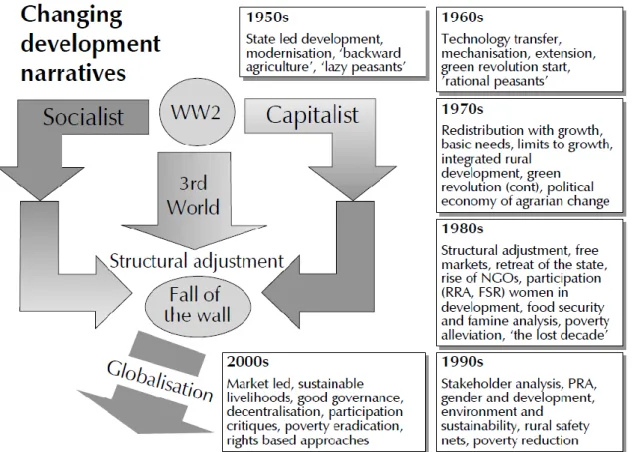
De Satgé (2004:24-28) provides the most fitting schematic theory summary (see Diagram 1), adapted from Ellis and Biggs (2001), of the changing development trends and themes that took place between the 1950s and 2000s. This schematic is derived from the macro theories that then existed.
15
Diagram 1: Schematic of Changing Development Trends and Themes Summary
De Satgé (2004:25)
Diagram 1 above indicates that a major period of modernization and technology transfer took place after World War II. This was inspired by the post war US Marshall Plan, which from 1948 to 1952 provided reconstructive economic aid for Western Europe. During the 1950s, in both the ‘capitalist bloc’ and the ‘socialist bloc’, the emphasis was on the need for a strong state. Economic policies dominated, with much confidence placed on the benefits of modernization and development planning, dominated by a positivist paradigm. This era was also characterized by top-down or blueprint approaches, with ‘development’ something done by the state for the people, measured against centrally determined economic growth ratings. Whilst it was a time when the modernization theory emerged, very little priority was given to how poor people actually lived, or to their priorities in life (De Satgé, 2004:25-26).
16
The 1960s were increasingly characterized by liberation struggles, resulting in the emergence of more radical social agendas. This was a period of ’questioning’ the existing norms and standards, which led to a shift in mainstream thinking and ideas on factors such as basic needs and how redistribution of growth came about. This ‘shift’ gave rise, in the 1970s, to integrated rural development by national governments and international agencies, with integrated initiatives in sectors such as health, education, infrastructure, water supply, job creation and agricultural production (Veltmeyer & Delgado Wise, 2018:8; Protopsaltis, 2017:1735-1377; De Satgé, 2004:26-27; Haines, 2000: 31-50).
The 1980s, labelled also as ‘the lost decade’, saw the signs of the soon-to-follow collapse of the hitherto prevalent socialist project. This was soon-to-followed by a renewed prominence of the World Bank and the International Monetary Fund (IMF). In essence, it was a period of economic liberation and free trade, where subsidies on food, health and education were removed, followed by currency devaluation, lower wages and the privatisation of services. Domestic economies were opened up to international trade, with diminution of the power of the state. Consequently, in this period the developing countries suffered increasing poverty, exclusion and inequality, giving rise to the contemporary narratives from the 1990s. The focus shifted to participatory, human centred, integrative and sustainable development, from poverty alleviation to poverty reduction, then to the current poverty eradication approach (Veltmeyer & Delgado Wise, 2018:5; Protopsaltis, 2017:1735-1377; De Satgé, 2004:26-27; Haines, 2000: 31-50). This focus on poverty eradication has resulted in a more comprehensive understanding of the meaning and nature of poverty. The result is that poor people are no longer regarded as mere ‘consumers of services’, but rather as citizens with social and economic rights (De Satgé, 2004:27-28). This focus on the social and economic rights of citizens has triggered the current focus on wellbeing and social capital. Both are discussed in the second half of this chapter.
17
2.3. Modernization Theory
The founding fathers of the social sciences are Karl Marx, Emile Durkheim, Ferdinand Tönnies and, to some extent, Max Weber. As sociologists they provided the classical examples of how modernization theories follow the premise that all societies develop from a traditional civilisation to a modern civilisation (La Placa & Knight, 2017:2-3; Anderson & Taylor, 2004:16-18). Within the macro theoretical paradigm, modernization theory first originated amongst economists. To this day the terms ‘development’ and ‘economic development’ are often used interchangeably by politicians, civil society organisations and groups (Veltmeyer & Delgado Wise, 2018:3-4; Klinger, 2017: 696-697; Protopsaltis, 2017:1733; Adjibodou, 2012:491; Mckay, 2008:50; Anderson & Taylor, 2004: 296-297; Goulet, 1996:2).
Modernization theory emerged in the climate of the Cold War fought between Communism and the West; by the 1960s it was recognised as an alternative to the Marxist account of social development. This theory was later expanded by contributions from the sociological, psychological and political discourses, each with its own emphasis variant within the modernization tradition (Klinger, 2017: 694-697; La Placa & Knight, 2017:2-3; Pieterse, 2010: 7, 22, 23, 24; Crewe & Harrison, 2004:27; Haines, 2000:31-36). The theory underpinned a three-pronged approach to change, namely: 1) infrastructural change (e.g. dams and highways; 2) social change (e.g. improved education and welfare); and 3) political change (e.g. efficient and accountable governance by the state bureaucracy). This followed on from the developments of the 1960s, seen as the first ‘development decade’, which emphasised sectoral and regional development planning (Joshi, 2005:1-3).
Most modernization theories assume that societies progress naturally from a traditional state to a modern state. This progression is best described in the following ‘stages of economic growth’ by Rostow in 1960: i) the traditional society, ii) the preconditions for take-off, iii) the take-off, iv) the drive to maturity, and v) the age of high mass-consumption (Klinger, 2017: 692-694, 706; La Placa & Knight, 2017:3-4; Protopsaltis, 2017:1733-1734; Rostow, 1990:4; Browett, 1985:793). Modernization theory views traditional societies as a
18
series of negatives or deficiencies This theory sees poorer countries as stagnant and unchanging, not innovative, not focused on profit-making and not progressing or growing. Modernization theorists are of the opinion that the so-called Third World (the underdeveloped world) needs to undergo both the political and economic transformations that the West underwent 500 years ago, following the example set by the West (Klinger, 2017: 691-692; Haines, 2000:36-37; Adelman & Morris, n.d.:1; Joshi, 2005:1-3). Modernization theory placed a strong emphasis on values, with a change in values seen as leading to the growth and expansion of a middle class (Protopsaltis, 2017:1735; Haines, 2000:37).
The theory is however not homogeneous, as there are disagreements on several key features amongst its proponents. A major criticism of the modernization theory relates to its inability to take the overall global picture into account; for example: 1) it does not consider the possibility that the resources of the world might be limited, so that the accumulation of wealth by some might actually reduce the development chances of others; and 2) the processes of western industrialised societies could therefore not be duplicated in the Third World as they stand (Klinger, 2017: 692-698; Protopsaltis, 2017:1735-1736; Haines, 2000:36-37, 39; Crewe & Harrison, 2004:27; Joshi, 2005:1-3). A formalised critique on modernization theory is that of dependency theory.
2.4. Dependency Theory
Dependency theory was formulated alongside modernization theory, as a critical response by the South, first emerging in Latin America amongst social scientists. Dependency theorists, strongly influenced by neo-Marxism, argued that development and underdevelopment are intertwined. They held that, as a result, some parts of the world are underdeveloped because others are developed (Veltmeyer & Delgado Wise, 2018:3-4; Protopsaltis, 2017:1733; Ziai, 2017:2727; Adjibodou, 2012:497; Joshi, 2005:2; Vercillo, 2012:2; Browett, 1985:790; Grosfoguel, 2000:357, 367; Cardoso, 1976:7). Dependency theorists do not see underdevelopment as a product of internal deficiencies, as do modernization theorists. Dependency theorists see underdevelopment as
19
something created within a pre-capitalist society, which then begins to have economic and political relations with one or more capitalist societies (Veltmeyer & Delgado Wise, 2018:3-4; Haines, 2000:41; Palma, 1978:898).
In essence, dependency theorists argue that the origins of global poverty should be understood within the context of an entire international economic system. They contend that underdevelopment is not a condition but rather an active process of impoverishment due to development, and the global market system of the First World. They argue that the international system is the result of modern economic growth, because around 500 years ago the major world regions were not so densely inter-connected in their extensive trade networks. The spreading of capitalism, with its search for profit, sparked the sourcing of raw materials from the Third World. In seeking to produce value added commodities in the First World it fundamentally changed the social structures of the Third World. Assumption of a ‘trickle down’ effect from the ‘core’ (First World) to the ‘periphery’ (Third World) actually resulted in First World exploitation of raw materials from the Third World for value-added commodities. This created a dependency of the ‘periphery’ on the ‘core’ instead of a ‘trickle down’ benefit (McKay, 2008:47, 52). The term ‘dependency’ comes from this First World exploitation link with the Third World supply of raw materials and cheap labour. Some theorists argue that exploitation was what impoverished the Third World, making it dependent on the First World for development. Poverty in the Third World is not seen as ‘traditional’, as is underdevelopment, at the cost of development (Veltmeyer & Delgado Wise, 2018:3-4; Protopsaltis, 2017:1734; Ziai, 2017:2726-2727; Leys, 1996:10-11; Joshi, 2005:2-3; McKay, 2008:54; Vercillo, 2012:2; Browett, 1985:790; Cardoso, 1976:7).
Meanwhile, as in the case of modernization theory; dependency theory has not been without criticism. Dependency theory is also not a homogeneous theory, as several serious analytical differences exist amongst dependency theorists (Veltmeyer & Delgado Wise, 2018:3-4; Protopsaltis, 2017:1737; Ziai, 2017:2727-2728; Leys, 1996:14-15; Joshi, 2005:2; Browett, 1985:789; Palma, 1978:881, 898). Those who oppose dependency theory argue that the Third
20
World has benefited from its industrialised First World contacts, and that inequality is a precondition for economic progress. On the one hand there are the theorists who state that dependency theorists have oversimplified the pre-capitalist history of society. On the other hand there are the dependency theorists who, it is claimed, have over-generalised the contemporary Third World. In the eyes of their opponents, dependency theorists: a) are seen as too pessimistic about Third World economic development possibilities; and b) do not comprehend that the central policy recommendation of a socialist revolution has been unhelpful to those countries which opted for it (Protopsaltis, 2017:1737; Haines, 2000:44; Leys, 1996:14-16; Browett, 1985:790; Palma, 1978:881).
Modernization theory can therefore be said to see capitalism as a force which causes growth and progress by development from centre to periphery. Dependency theory, meanwhile, sees capitalism as the ruin of the Third World through stripping out its resources and holding it in thrall. Modernization theory holds that rich countries are the helpers of poor countries. Whereas dependency theory is premised on the belief that it is the main obstacle to the wellbeing of poorer countries. Thus, the macro theoretical paradigms started as early as 1930 within the structuralist tradition, followed by modernization theory in the 1950s. This led to the neo-liberalism of the 1970s that has since influenced our development practice by different approaches developed in response to the earlier theories. These different approaches all claim to be similar in purpose: ‘to ensure development’. However, it is the dichotomy between modernization and development theories which has brought about the ‘split’ in liberal and radical approaches.
In this study it is argued that the importance of following a radical approach is due to its emphasis on the importance of community member (citizen) participation in community development. The influence of social capital is thus pertinent for successful achievement of improved community wellbeing. However, it is also argued that an extreme radical approach will not be successful, due to: a) the importance of partnerships; and b) a need to follow an