MALARDALEN UNIVERSITY
Information Technology and Organizational Learning
The IT Role on OL at Accenture and ABB
Faseeh Ul Quresh, 760805 Wipawee Uppatumwichian, 840926
Supervised by Dr. Peter Ekman
Master Thesis in IT Management
School of Sustainable Development of Society and Technology (HST) Mälardalens Högskola – Malardalen University
Abstract
Date: Program: Course: Authors: Supervisor: Title: Definition: Problem: Purpose: Method: Target group: Conclusion: Keywords: 2008-06-04Master of Science in IT Management Master Thesis, EIK034
Faseeh UI Quresh [email protected]
Wipawee Uppatumwichian [email protected] Peter Ekman
Information Technology and Organizational Learning: The IT role on OL at Accenture and ABB
Organizational learning (OL) is a social affair of individual’s knowledge, experiences, routines, relationships and organizational rules to increase organizational capacity to take effective actions to change the range of organizational behavior. Information technology (IT) is an infrastructure to Information system in promoting organizational learning.
What is the IT role on OL?
Identify the relationship between IT and OL and describe the role of IT on OL. Qualitative research
Parties involve in OL debates
It is clear from this study that information technology has an impact over organizational learning as IT facilitates OL at both the individual level and the organizational level in creating knowledge which ultimately enables organizations to improve capabilities and enhance performances to cope with change. Companies are using various IT application or tools to promote OL either through knowledge depository database, online training, staff rotation planning or various IT based communication channels. The use of knowledge management strategy and the role of IT on OL coincide with the strategic objective set by the company. Companies also use different combinations between tacit and explicit knowledge in respond to the strategic goal. Both tacit and explicit knowledge are always used in all companies but the mixture produces different results. It is the management that has to determine the right combination between them to create the maximum impact on OL. IT can be a tool help managing tacit and explicit knowledge but people are more important in the process of knowledge creation as it is individuals who possess the critical minds led to learning. It is important to realize a fact that organization will never learn if its people do not learn.
Organizational Learning (OL), Information Technology (IT), Knowledge, Knowledge Management
Acknowledgment
The authors would like to use this opportunity to sincerely thank people who have helped us in several ways in conducting the study.
This study would have never been completed without the help of Peter Ekman, our thesis supervisor, and Ole Liljefors who provided us insights on the organizational learning area. Also we would like to show appreciation to Lena Mindus of Accenture and Marie Bello Yngveson of ABB for their useful information and time spent with us during the interviews. We are grateful for your contributions to the study.
We would like to thank our family members for their supports and understandings throughout our stay in Sweden. Last but not least, we would like to express our thankfulness to our colleagues here at Malardalen University who assisted us in several ways throughout the study.
It has been a great academic year and we hope that the study result will be useful to those interested in the organizational learning area.
Faseeh UI Quresh
Wipawee Uppatumwichian
Table of contents
1 INTRODUCTION... 1 1.1 Background... 1 1.2 Problem Discussion... 3 1.3 Problem question... 3 1.4 Purpose... 3 1.5 Delimitation... 4 1.6 Target Group... 4 2 METHODOLOGY... 5 2.1 Research Approach... 5 2.2 Data Collection... 52.3 Gaining Access to Information... 7
2.4 Research Model... 8
2.5 Validity and Reliability... 8
3 THEORETICAL FRAMEWORK... 9
3.1 Data, Information and Knowledge... 9
3.1.1 Tacit and Explicit Knowledge ... 10
3.2 Organizational Learning... 10
3.2.1 Defining Organizational Learning (OL)... 10
3.2.2 Organizational Learning perspectives ... 11
3.2.3 Learning in organizations... 12
3.2.4 Managing knowledge in organizations... 13
3.3 Information Technology... 15
3.4 Relationship between IT and OL... 15
3.5 Conceptual Model... 16
4 EMPIRICAL DATA... 18
4.1.2 Learning at Accenture ... 19
4.1.3 Knowledge Management Tools... 21
4.2 ABB... 22
4.2.1 ABB - Company Background ... 22
4.2.2 Learning at ABB ... 22
4.2.3 Knowledge Management Tools... 24
5 ANALYSIS... 26
5.1 Accenture... 26
5.1.1 Information Technology... 26
5.1.2 Learning at Individual level ... 27
5.1.3 Learning at Organizational level ... 28
5.2 ABB... 29
5.2.1 Information Technology... 29
5.2.2 Learning at Individual level ... 30
5.2.3 Learning at Organizational level ... 32
6 CONCLUSION... 33
6.1 Study Result Summary... 33
6.2 Recommendation... 35
REFERENCES... 37
APPENDICES... 41
Table of Figures
Figure 1: The Study Structure... 8
Figure 2: Data, Information and Knowledge ... 9
Figure 3: The SECI Model... 12
Figure 4: Huber’s Learning Process... 13
Figure 5: Relationship between IT and OL... 16
Figure 6: Authors’ Conceptual Model ... 16
Figure 7: A matrix relationship between Service Lines and Operating Group... 19
Figure 8: The T-Profile to Knowledge Management... 20
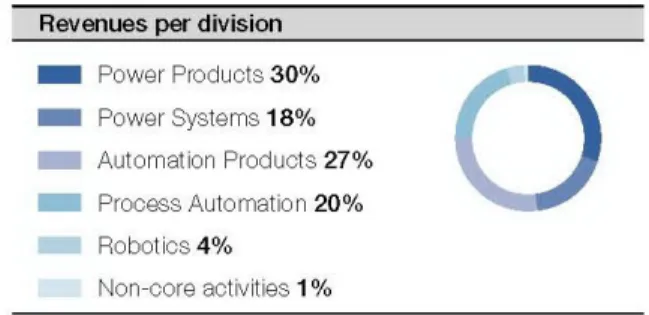
Figure 9: ABB’s revenues per division 2007... 22
Table List
Table 1: Unstructured and structured approach to the main research models ... 6Table 2: IT tools in Accenture’s Knowledge Management Strategy ... 26
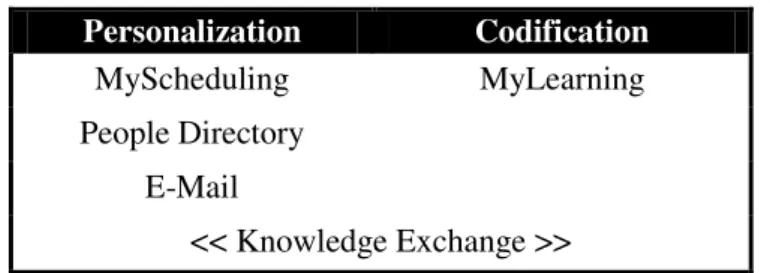
Table 3: IT tools in ABB’s Knowledge Management Strategy ... 30
1 INTRODUCTION
In this chapter, the authors present the problem background serving as an inspiration to our study, the study purpose, the study problem, the study delimitation and the target audience intended.
1.1 BACKGROUND
For the last two hundred years, neo-classical economics has recognised only two factors of production: labour and capital. Knowledge, productivity, education, and intellectual capital were all
regarded as exogenous factors that is, falling outside the system. New Growth Theory is based on work by Stanford economist Paul Romer and others who have attempted to deal with the causes of long-term growth, something that traditional economic models have had difficulty with. Following from the work of economists such as Joseph Schumpeter, Robert Solow and others, Romer has proposed a change to the neo-classical model by seeing technology (and the knowledge on which it is
based) as an intrinsic part of the economic system. Knowledge has become the third factor of production in leading economies.
Source: Romer (1986) in Ernst & Young (1999)
The excerpt above points out the importance of knowledge in today’s highly competitive business environment. Knowledge has become the fundamental in increasing productivity, exploiting growth opportunities in emerging markets and creating knowledge driven competitive advantage (Forfas, 2004). In other words, Knowledge is the most basic form of capital as knowledge accumulation generates economic growth at both micro and macro economics levels. The rise of the term “Knowledge Economies” indicates the growing awareness of knowledge during the past recent years. The implication of Knowledge Economies is that there is no other way to prosperity other than to make knowledge and knowledge creation the ultimate goal (Ernst & Young, 1999). Similarly, the notion of Organizational learning (OL) is gaining its popularity among many organizations with different purposes - schools, the military, small family business, high technology companies, global business, government and non-profit organizations - as a mean to capture and nourish knowledge (Marsick and Watkins, 1999, p.9).
Dodgson (1993) describes organizational learning (OL) as "the way firms build, supplement, and organize knowledge and routines around their activities and within their cultures and adapt and
develop organizational efficiency by improving the use of the broad skills of their workforces". The
concept of OL has received a widespread attention from organizations which focus on how they can learn in order to increase their performances and capabilities to gain competitive advantage, innovativeness, and effectiveness (Balasubramaniam, n.d.). OL is not an end process by itself, rather it is a tool to help an organization better satisfy its customers, create state-of-the-art products or services and win its war or improve the quality of life (Marsick and Watkins, 1999, p.9). Organizations have always had to learn, but the rapid pace of changes in market conditions has
must learn to understand the environmental change (business and technological) in order to effectively sense and respond to it as quickly as possible (Lyytinen and Rose, 2006).
Schein (1992) exposes that technology profession has received a wide criticism on its inability to perform business functions as technology has been changing at a rapid pace and organizations could not meet the pace by assimilating the new technology. This demands the organizations to employ the learning in order to build capabilities to rapidly adopt the change. Today, Information Technology (IT) is capable enough to offer a great support to the OL by creating an environment for both employees and organizations to learn in new, innovative ways which mobilizes them to share, distribute, transfer knowledge and experiences and ultimately enhance the overall organization’s performance to accept the challenges. However, proper and effective implementation of IT to support OL functions can change the nature of business and the way it is managed leading the organizations towards strategic advantage (Daniels, 1994, p.1). In fact, IT not only affects how organizations learn but also indirectly affects their capabilities and performances via OL. This suggests that IT improves the organization’s capability to recognize the new knowledge, adopt it in a rapid manner and apply it to enhance the organization’s performance responding to changes which, further, enables employees to better help themselves as well as improve collaboration with partners and relationship with customers helping the organizations to gain competitiveness. There is no other phrase that better draw attention to the importance of IT than that mentioned by Bjorn Boldt-Chirstmas, Director of strategies at Scandinavian Airlines in Daniels (1994) that “To be a competitive player, IT is a must”.
The issue of organizational learning is not entirely new as many researchers has written much about the key issue, then why other study on the same subject should appear. The reason is that in this study, the authors’ interest in the use of IT to improve OL at both the individual and organizational levels develops a strong motivation to understand the internal organizational mechanism in the use of IT to manage knowledge in order to sustain competitive advantages (Lyytinen and Rose, 2006). In order to have a thorough understanding of the research topic, the authors represent the concept of knowledge management using Hansen et al. (1999)’s knowledge management strategies focusing on the use of IT. As far as OL is concerned, the authors intend to divide OL at two levels; learning at individual
level to know that how individuals learn in an organization and how IT affect them and learning at
organizational level to better understand the learning process of an organization and how IT affects it.
To study the learning at individual level, the authors use the SECI model of knowledge creation developed by Nonaka (1994), whereas the concept of Huber (1991) represents learning at the organizational level. The authors refer to the study result on the IT role per the Nonaka’s SECI model from Xue and Zhang (2006) and per Huber’s model from Malhotra (1996) that IT can be used in all learning processes. The authors examine all the learning processes and reconfirm previous researches that IT has impact over OL. However, the authors see that IT does not directly have an impact on all learning processes but rather assist the learning, the IT role is then divided in primary and secondary role depending if IT directly or indirectly promote OL. Direct means that IT is the platform to store knowledge while indirect means that IT assists knowledge creating through various means such as communications among people. The study aims at giving recommendation for those interested in how to use IT to promote OL capacity.
1.2 PROBLEM DISCUSSION
The concept behind this research is to place IT in a management context and examine its role on OL within organizations. Earlier section depicts that OL is an effective theory for the development of organizations to improve capabilities and performances thus gain competitive advantage. Equally, organizations are increasingly dependent on IT which set the new platform for business operations. The speed and increased efficiency gained from effective IT implementation are not only changing the attitude of employees but also the way organizations perform their businesses. This suggests that IT can play a major role in enhancing OL.
In the same way, learning occurs due to the influence of different factors like structure, strategy, technology, culture and cognitive factors. Accordingly, in this competitive environment it is an urgent requirement that organizations develop and utilize IT in a more efficient way so that they can enhance the functions and performance concerning to said factors, create a sustained learning environment so that employees can learn in new ways and organizations can increase their capabilities to cope with any unexpected change (Balasubramaniam, n.d.).
The above discussion recognizes that a sound connection exists between IT and OL, but the question remains how IT impacts OL in such a way that organizations can improve performances and capabilities complying with organization’s strategic goals.
1.3 PROBLEM QUESTION
The authors’ interest in finding out how the selected companies use IT to promote OL at both the individual and organizational levels leads to investigate ‘What is the IT role on OL’. However, the authors think it is important to identify several relevant sub-questions that will be answered in this study to reach the conclusion:
• Sub-question 1: How do companies use IT to manage knowledge? • Sub-question 2: How does IT affect learning at individual level? • Sub-question 3: How does IT affect learning at organizational level?
1.4 PURPOSE
The purpose of this study is to identify the relationship between IT and OL and describe the role of IT in promoting OL through the study of two selected companies employing the OL concept.
Since the authors perceive OL as learning at both individual and organizational level, the study will represent IT impact on OL at both levels. The authors will conclude the study result with recommendation to companies interested in employing OL concept and/or those would like to enhance learning within their organizations.
1.5 DELIMITATION
This study is designed on the principle of validity and it is the authors’ goal to investigate and better understand the role of IT on OL. The authors do not intend to develop a study that is replicable within other contexts. Thus, other factors that promote learning such as structure, strategy, and culture are out of scope of this study.
As graduate students at Mälardalen University, the authors are given ten weeks to develop and complete this study. In order to complete the study within such a limited time frame, the authors selected to focus the study on two companies pursing different knowledge management strategies. In addition, the authors believe that the narrow focus on these two companies will help them developing a thorough and well-researched study.
The limited time constrain in the study also influences the authors to study research questions from an internal perspective only. To conduct this study the authors intend to gather information by interviewing organizations working within the OL area to know that how IT enhance learning capabilities of their employees and how these organizations improve performance through enhanced learning capabilities. Further, the authors recognize that with additional time and resources, it would be useful to include a study of the efficiency and effectiveness on the use of IT in promoting OL by further collecting information from the intended users of OL theory; the company’s employees.
1.6 TARGET GROUP
This study will be of interest to a wide base of actors involved in OL debates. In particular, the authors believe it will have the greatest appeal to those consider trying to influence the level of OL within organizations and those trying to introduce and/or implement OL concept within organizations.
2 METHODOLOGY
This chapter describes the different methodological aspects used throughout the study in order to create a better understanding. It starts with the description of qualitative research approach selected for this study following the data collection process will be discussed to explain how data is gathered from the respondents. After presenting the research model developed for this study, the authors discuss the validity and reliability of the study to assure the authenticity and truthfulness of the data.
2.1 RESEARCH APPROACH
The research approach is a strategy to describe how a data is collected and analyzed, how the experiment is conducted and how the conclusion is drawn in a research process. It is impossible to know how to conduct a research unless the researcher knows what to investigate. Once the topic of the research has been chosen it is now easy for a researcher to select the method of how to follow the research. The choice of research approach is an important stage which influences the way data is collected and which is ultimately crucial to the outcome of the study (Myers, 1997). Therefore, it is important to decide whether to use an existing theory or develop a new theory at the beginning of a research. There are two research approaches researchers can follow when conducting a research; the qualitative and the quantitative.
The qualitative research approach is an unstructured approach and aims to understand a phenomenon by collecting, analyzing and interpreting data through personal experiences and observations with the emphasis on unique, while the quantitative research is a structured approach which refers to counting and measuring data. In quantitative research data is quantified and expressed in numbers. According to Yin (2003) qualitative research helps people to have a worldview of the studies as it simulates their experiences and observations of the world. The purpose of this study demands a deeper insight on the role of IT in organizational learning and the concepts of organizational learning and information technology have broader definitions in which progress of the processes is hard to measure in figures and statistics. Further, in the past few years, there has been a significant shift in the way organizations evolve in the network economy as their focus has moved from traditional neo-classical economy and personnel development to new knowledge economy and organizational development (Balasubramaniam, n.d.). This leads the authors to view the research with an explorative approach and thus develop an increasing interest in the qualitative research method as it allows the authors to gain a deeper understanding of the organizational learning and information technology than if they would be measured and shown statistically.
2.2 DATA COLLECTION
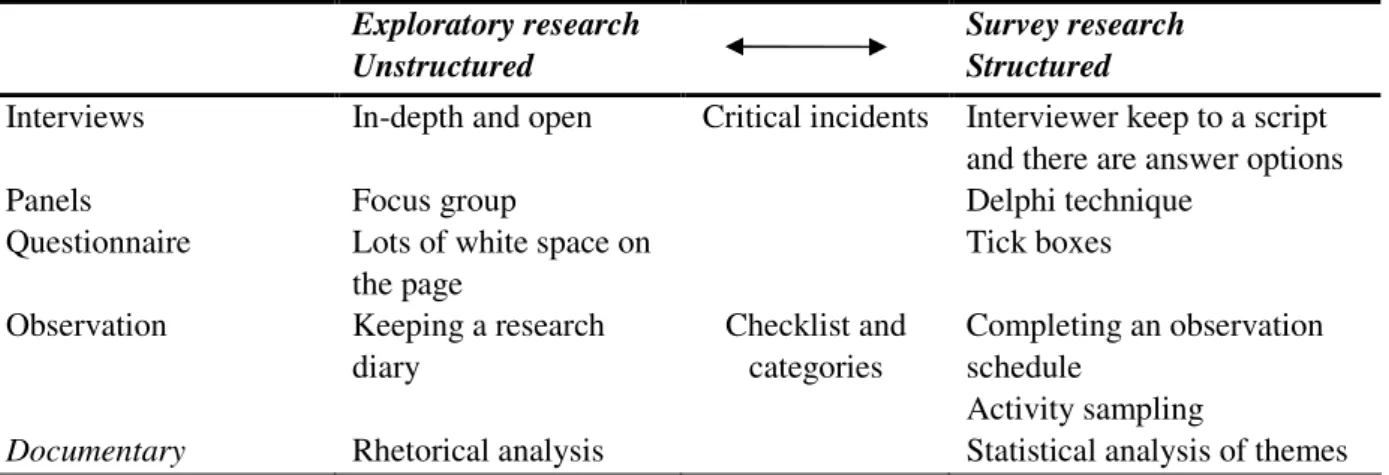
The collection of data is an important and vital to a research to analyze a phenomenon and reach a conclusion. Fisher et al. (2004, p.126-131) suggest that there are several methods of data collection; interviews, panel, questionnaire, observation, and documentary. However, the selection of data collection method is based upon the research manner whether it is qualitative or quantitative. Following table gives a summary of the methods of data collection:
Exploratory research Unstructured
Survey research Structured
Interviews In-depth and open Critical incidents Interviewer keep to a script and there are answer options
Panels Focus group Delphi technique
Questionnaire Lots of white space on the page
Tick boxes Observation Keeping a research
diary Checklist and categories Completing an observation schedule Activity sampling
Documentary Rhetorical analysis Statistical analysis of themes
Table 1 : Unstructured and structured approach to the main research models Source: Fisher et al (2004, p.133)
Any research study consists of a systematic collection of different kinds of data where quality and quantity are important issues concerning to the success of investigation. The data in qualitative method is usually based on words rather than numbers, and words may be represented or obtained by observations, interviews and documents (Miles & Huberman, 1994, p. 56). The authors explain the data collection method by dividing the data into two categories, theoretical data and empirical data, in order to describe that how they manage to collect theoretical and field data for this study.
Literature Review
Fisher et al. (2004, p.126-131) suggest that, after deciding the research topic, next stage is to review the literature to create an initial understanding of the research area as well as build a theoretical framework. The theoretical data consists of literature including books, journals, articles, magazines and Internet research. Books provide a wide and reliable source of information while journals and articles provide more specific and recent information on the subject. In order to achieve a broader overview of the research topic several relevant secondary sources were approached so that a firm understanding of IT and organizational leaning can be built. There are many books available on both topics of Information technology and Organizational learning which are used to conduct this study. However, authors also include articles and research papers to get the recent opinions and developments related to the subject that were retrieved from the electronic databases, such as Elin@Malardalen (an online journal database available from Malardalen University), Emerald, JSTOR and Google Scholar. In addition, Internet was also used to search for most recent developments and for general information about the selected companies. The literature on information technology and organizational learning provide an overview of earlier research in both areas that helps the authors to build a basic understanding of IT and OL theories and their relationship that is necessary to conduct this study. Using these theories, the authors develop their research model to guide this study.
Empirical Data
Empirical data is described as the data collected from the contributing organizations by the researcher(s) through questionnaires and interviews. There are several ways of collecting empirical data but in this case it is collected by conducting face-to-face semi-structured interviews which allow the authors to be more open as there are no strict rules in the semi-structured interview method.
According to Fisher et al. (2004, p.132), semi-structured interviews are in between the two extremes of structured and unstructured approaches and more focused in comparison to the aforementioned interview approaches. In a semi-structured interview the interviewer has a schedule to remind the main issues and topics that need to be addressed by the interviewees. The interviewees, however, have much freedom to answer the questions in the way that makes the most sense to them. Since the authors pursue an explorative research method, the semi-structured interviews are found as appropriate data collection method to conduct the study ensuring the relevance of issues the authors are interested in finding out yet remain enough spaces for interviewees to put interesting relevance issues to the discussions.
The two companies selected to collect the primary data are Accenture, a global management consulting firm and ABB, a global company in automation and power technology. Although both companies are present in the world market, the authors only conduct their study in Sweden as they believe and further confirm with the company’s representatives that both companies employ similar OL concept at all of their business locations throughout the world.
2.3 GAINING ACCESS TO INFORMATION
To obtain necessary information to conduct the study, the authors began with a list of potential companies currently employ the OL concept. The authors dictated the need to study companies employing different knowledge management strategies which can be roughly differentiated whether the companies are in services or production sectors. The logic to select companies in both the services and production sectors is adopted from the article by Hansen et al. (1999) on Knowledge Management strategy. The authors approached several companies through the help of our supervisor, Peter Ekman whose current research is associated with the engineering firms within the Automation Region (see www.automationregion.com), and finally got response from Accenture in Stockholm and ABB in Vasteras. Accenture is the representative of companies in the service sector while ABB is the representative of companies in production sectors. Authors conducted the semi structured interviews with both companies employing the OL concept in two phases.
In the first phase, Accenture was approached in early April, 2008 for the purpose of arranging an interview and the authors instantly received a reply from the company showing an interest in this study. At Accenture, the authors had an opportunity to conduct an interview with Lena Mindus, Senior Manager at Accenture office in Stockholm, Sweden on 23 April 2008. Lena Mindus has been working with Accenture for 11 years as Sweden & Nordic Human Resource Leader. She possesses a strong understanding of company’s background, overall business structure and particularly the human resource and knowledge management practices. Lena Mindus, in this extensive interview, provided detailed information about the company’s business, individual and organizational learning and how Accenture uses IT in learning processes at both levels. The interview session lasted approximately four hours.
In the second phase, the authors also approached ABB in the approximate time as did with Accenture. ABB replied in the late April opening an opportunity for an interview session with Marie Bello Yngveson, Training and Development Manager on 14 May 2008 at ABB HR Center in Vasteras, Sweden. Marie Bello has been working in the company for the last 11 years and is now managing the ABB’s HR Center and directly associated with the learning practices. Empirical data from ABB was collected by two consecutive interviews. In the first interview, lasted for one and half hour, questions concerned the individual learning and the IT role on it, while, the second interview focused on the
learning at organizational level and how IT supports it. The follow up interview session was conducted on 27 May 2008 and lasted for the same time as the first interview.
2.4 RESEARCH MODEL
Research structure model begins with problem formulation which in this case is the IT role on OL. Thus the authors conduct a critical literature review to create a theoretical framework and a conceptual model that will be useful in analyzing the empirical data obtained from two selected companies employing OL concept. Empirical data will be obtained through semi-structure interviews conducted with companies’ representatives from related departments. The authors will then analyze information and data obtained through interviews and prepare a summary chapter of the study.
Figure 1: The Study Structure
2.5 VALIDITY AND RELIABILITY
Validity determines whether the research measures what it is supposed to measure or how truthful the results of the research are. Validity can be increased by arranging interviews at the interviewee’s premises as it gives the opportunity to interviewee to express information in the most adequate manner. On the other hand, reliability, according to Yin (2003, p.37-39), means that a result from a study should be consistent over time if similar research is conducted using same procedure by other researcher. It focuses on the authenticity and reuse of the data collection techniques as well as the analysis procedures to produce the same result if the research is conducted all over again. A research is considered having a high reliability if it gives the same result repeatedly, while low reliability gives the different result each time the study is conducted. Yin (2003, p.39) further advices that a good rule for carrying out case studies is to conduct the research in such a way that allows researchers to repeat the same procedures so that same results can be achieved. The goal of reliability is to minimize errors. In this research all primary data has been collected from the Accenture Sweden and ABB Sweden. Therefore the authors believe that data is highly valid and trustworthy. However, we did not get chance to interview the employee(s) of both companies which might lower the validity of this study. The interview questions are based on the author’s conceptual model which is derived from the theories presented in this study. The questions are thoroughly developed to ensure that the respondents understand them and give faultless answers as they will lead to the conclusion of the study. This increases the level of validity and reliability by eliminating the possibility of misinterpretation. All interviews, in this study, were arranged at the respondents’ premises which allowed them to freely express their opinions in response to the authors’ open-ended questions. Therefore, the authors believe that it strengthen the validity of this study. Since the interviews were recorded in audio format, all audio information was converted into texts so that relevant information can be included into the study as well as any misunderstanding, misinterpretation and partiality can be avoided.
3 THEORETICAL FRAMEWORK
In this chapter the authors describe the theoretical frame of references used to guide this thesis. It begins with an overview of knowledge, organizational learning, information technology and the relationship between IT and OL. At the end, the authors’ conceptual model is presented to lead the research for further empirical analysis and conclusion which will give a better understanding of the whole research process to the readers.
3.1 DATA, INFORMATION AND KNOWLEDGE
Turban et al. (2002, p.388) define that knowledge is information which is contextual, relevance and actionable. Having knowledge implies that it can be used to solve problems at hand, while having information is not always helpful in solving problems. Organizations possess data, information and knowledge which are seen as assets. Knowledge is the highest form of all since it conveys meaning in itself. Data can directly transfers to knowledge provide that such data is relevant and lead to action. Relationship between data, information and knowledge is shown in the figure below.
Figure 2: Data, Information and Knowledge Source: Turban et al (2002, p.389)
Nonaka (1994) depicts the differences between information and knowledge that information is created from messages while knowledge originates from information together with personal beliefs and commitments. Nonaka (1994) tries to relate knowledge to human actions which lies in commitments and beliefs of those who hold the knowledge. Davenport and Prusak (1998 in Marsick and Watkins, 1999, p.82) give definition of knowledge as “a fluid mix of framed experience, values, contextual information, and expert insight that provides a framework for evaluating and incorporating new
experiences and information”. It originates and is applied in the mind of knower. In organizations, it
often becomes embedded only in documents or repositories but also in organization routines, processes, practices and norms.
The authors thus view knowledge according to the definition proposed by Davenport and Prusak (1998) which takes experience, values and contextual information to considerations. However, the strong emphasis is given on knowledge creation which is an interaction between data and/or information and individual base upon personal beliefs and commencements. As explained above, data can be described as the raw material which is processed to produce information. Knowledge is a more broad term which describes the use of information to perform analysis and actions.
Data Knowledge
Information
Processed Relevance & Actionable
Relevance & Actionable
3.1.1 TACIT AND EXPLICIT KNOWLEDGE
Polanyi (1958) is the first to draw the line between tacit and explicit knowledge. Tacit knowledge is usually deep in action, commitment, and involvement in specific context. Tacit knowledge is highly personalized and hard to formalize. For example, painting is one kind of tacit knowledge, though there are numerous numbers of literatures about how to pain professionally, few are able to paint from studying through books. Painting is a skill that needs to be taught personally. Explicit knowledge deals with more objective, rational knowledge which is transmittable through formal, systematic language. Data, policies, software and documents are examples of explicit knowledge which can be easily written and codified as a mean to transfer knowledge.
3.2 ORGANIZATIONAL LEARNING
This part begins with exploring the definitions of OL purposed by many scholars and select the definition that best reflects the purpose of this study, different OL perspectives are then discussed and an OL perspective is chosen as the basic to conduct the study, learning processes in organizations is discussed at both the individual level and the organizational level and lastly, the strategic knowledge management technique is examined.
3.2.1 DEFINING ORGANIZATIONAL LEARNING (OL)
In 1990s, several scholars and researchers have researched on how organizations can sustain their competitive position in the industry. They developed and modernized different theories; OL was one of them which received attention from the industry. OL can be seen as an organization development theme consisting of various factors including organization culture, human resources, cognitive factors, organizational structure and organization strategy.
Fiol & Lyles (1985) hold that organizational learning is a process of improving actions through better knowledge and understanding. Dodgson (1993) describes that organizational learning enables firms to create, supplement, and organize knowledge and routines around their activities and within their cultures and adapt and develop overall organizational efficiency by improving the use of the broad range of skills of their workforces. The different views to OL both stress the importance of learning and knowledge on achieving proprietary advantage by being better at what organizations are doing. Since organization is the collection of individuals, Argyris and Schon (1978) emphasize on the individual learning and explain that OL is the process which allows organizational members to detect and correct errors using organization theory-in-use. Schneider & Angelmar (1993 in Janson et al., 2007), also perceive learning as an individual attribute and argue that organizational learning can be seen as an aggregate of individual learning. While, Glynn et al. (1992) discuss learning at the organizational level and express that OL is the process whereby organizations understand and manage their experiences. Daft & Weick (1984), on the contrary, see OL as the knowledge about the interrelationships between organization’s action and environment. Glen et al. (1992) and Daft & Weick (1984) view OL differently as Glen et al (1992) put the emphasis within the organization context only while Daft & Weick (1984)’s view incorporate the external context to OL. Kim (1993) discusses that “OL is defined as increasing an organization capacity to take effective action”. However, Schwandt & Marquardt (2000) present a social approach to organizational learning and state that OL is an interdependent among people, action, symbols and processes. Lave & Wenger
(1991) also consider OL as a social affair and argue that it can be seen as an indivisible part of the society.
On the other hand, Argyris & Schon (1978) expose the nature of organizational learning and explain that as organizations are not merely collections of individuals, however, no organization can be formed without such collections. They further argue that organizational learning is not only dependent on individual learning and can not be the sum of learning of its members, but they also accept that organizations learn only through the experiences and actions of individuals. Crossan et al.(1999 in Janson et al., 2007) try to address this dilemma by combining both views and describe OL as “a process encompassing intuiting and interpreting at the individual level, integrating at the group level
and institutionalizing at the organizational level”.
In view of the above definitions of OL, the authors agree with Crossan et al. (1999) and define organizational learning as a social affair of individual’s knowledge, experiences, relationships, routines and organizational rules to increase organizational capacity to take effective actions to change the range of organizational behavior.
3.2.2 ORGANIZATIONAL LEARNING PERSPECTIVES
Easterby-Smith et al. (1999, p.3-8) divides the literature on OL into two significant distinctions between OL school of thoughts. One follows the social view while the other follows the technical view:
Social Perspective
Chiva-Gomez (2003) describe that social perspective of OL focuses on the group, community and organizations. In addition, Easterby-Smith et al. (1999, p.3-8) explain that social perspective emphasizes on how people make senses of experiences at work obtained either through explicit sources or tacit sources. In this view, learning can be seen as a process of social interactions. Three dominating schools of thoughts contributed largely to the social perspective of organizational learning are to see it as a socially contracted, a political process and a cultural artifact. The socially constructed thought recognizes that data has no value unless people interpret what it means. To put it in another way, community as whole plays an important role in coaching new entrances to the society about unwritten anecdotes and stories of how to perform tasks effectively. The political process demonstrates that political often acts in constrain to individual learning since people need to protect themselves against political threat. However, it is virtually impossible to eliminate the organizational politics from the social perspective since politics are the nature of social processes. If learning is form through individuals and groups, politics are always inevitable. A concept of organizational learning that embraces political process is indeed needed to promote learning, rather than elimination of politics. The last process in social perspective is learning as a cultural artifact. In this view, learning is seen as an organization culture. Learning takes place through socialization and interactions to individuals within organizations.
Technical Perspective
The technical view assumes that organizational learning is about the effective processing, interpretation of, and response to information both inside and outside the organization. Such information can be in both qualitative and quantitative term but it is explicit in public domains.
double-loop learning. Single-loop learning (SLL) is an incremental and low-level learning which occurs when errors in processes are detected and corrected encouraging the firms to continue with their current policies and goals. Where as, Double-loop learning (DLL) is a radical and high-level learning which occurs when error is detected and corrected in the way that forces the firm to modify its norms, procedures, policies and goals. Further, Levinthal & March (1993)’s research lies in this perspective and discuss that OL copes with the problem of balancing the competing goals of developing new knowledge (exploration) and exploiting current competencies (exploitation) in the face of dynamic tendencies to emphasize one or another.
The authors, referring to perspectives on OL, develop interest in the social perspective of OL since this view allows the authors to examine further the IT role on OL.
3.2.3 LEARNING IN ORGANIZATIONS
Organizations learn through their individual members and it can be said that organizational learning is the process through which individual learning becomes embedded in the organization’s memory and structure (Kim, 1993).
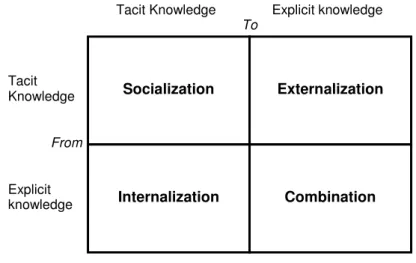
Nonaka and Takeuchi (1995) develop a four stage model of organizational learning which assumes that knowledge is created through conversion between tacit and explicit knowledge. Their model presents four different modes of knowledge conversions including; 1) from tacit knowledge to tacit knowledge, 2) from explicit knowledge to explicit knowledge, 3) from tacit knowledge to explicit knowledge and 4) from explicit knowledge to tacit knowledge. Four different modes of knowledge conversion namely Socialization, Externalization, Combination and Internalization (SECI) can be represented in the following figure.
Figure 3: The SECI Model
Source: Nonaka and Takeuchi (1995)
First, socialization enables organization to convert tacit knowledge to tacit knowledge through interactions between individuals. Languages are not the barrier for transferal of tacit knowledge among individuals since observations, imitation and practice are more dominant in creating new tacit knowledge. It is noted that on-the-job training shares the same principle of socialization. The key to
Socialization Externalization
Internalization Combination
Tacit Knowledge Explicit knowledge To Tacit Knowledge From Explicit knowledge
socialization is experiences among members. Experiences facilitate sharing of thinking processes which are at the heart of tacit knowledge transfers. Second, combination domain allows new knowledge to be created though sorting, adding, re-categorizing, and re-contextualizing of existing explicit knowledge. Modern computer system facilitates the creation of new knowledge based upon the combination definition. Third, externalization involves the conversion of tacit knowledge into explicit knowledge. Metaphor is important in externalization process. Lastly, internalization refers to the conversion of explicit knowledge into tacit knowledge which complies with the notion of learning. Action is required to the internalization process. (Nonaka and Takeuchi, 1995)
In view of Weick (1995 in Gasson and Shelfer, 2007) Nonaka and Takeuchi (1995)’s SECI model provides an environment to the organizations to create a management control system that reflects organizational norms and values. In this way socialization, combination and internalization can be linked with other theories. Socialization can be connected with the theory of organization culture, combination links to information processing and internalization derives the thoughts from organizational learning. Note that the concept of externalization is not well developed in other theory even in the organizational learning theory itself.
Huber (1991) states that an organization learns “if through processing of information the range of its
potential behaviours is changed” and presents four learning processes consisting of; Knowledge
acquisition which is the stage when an organization acquires new knowledge from its internal and external environment that causes learning, Information distribution where organization shares information among all organizational units and members which in turn creates new knowledge and promote learning, Information interpretation involves the sense-making or the establishing one or more meaning of the distributed information. Huber (1991) further states that individual and groups have some prior belief structures which dominate when formulating meanings of the distributed information and Organizational memory which involves the process of storing knowledge in a repository for future use. This contains both the explicit (facts, figures, rules) and tacit (expertise, experiences, stories) knowledge.
Figure 4: Huber’s Learning Process Source: Huber (1991)
The authors perceive that the SECI Model from Nonaka and Takeuchi (1995) represent learning at individual level related to sub-question number two while Huber (1991)’s Learning Process represents learning at organizational level that address the sub-question number three mentioned in section 1.4. These two concepts will be used throughout the study to represent the OL concept.
3.2.4 MANAGING KNOWLEDGE IN ORGANIZATIONS
Easterby-Smith and Lyles (2003) claim that management of knowledge in the organizations rests on the heads of a giant concept of OL. Hansen et al. (1999) introduce two strategic approaches to knowledge management; the codification strategy and the personalization strategy.
The codification strategy is best used when problems are uniform, non-customized and non-creative. Firms pursing this kind of strategy can use IT in codifying knowledge through “people-to-document” approach which captures and extracts knowledge from the person who developed it, makes irrelevance specific information, documents and stores it on electronic databases that allow members in firms to access, retrieve and use such knowledge without contacting the person who developed it. The economic benefit arises from this kind of knowledge management strategy comes from the reuse characteristic of knowledge stored in electronic databases. Although investment in IT infrastructure to host such knowledge sharing databases is costly, the unit cost per usage is low since knowledge stored can be easily retrieved and reused over and over again. (Hansen et al., 1999)
The personalization strategy emphasizes on individuals interactions and dialogues as a mean to share knowledge. In personalization knowledge is not codified and stored on databases but rather is transferred and created though mentoring with experienced members within companies. This suggests that communications, between members of the organizations who follow personalization strategy, are highly encouraged through various means such as meetings, telephone calls, e-mails and video conference. Although knowledge is not stored on electronic databases in this strategy, IT plays a supportive role in connecting members within organization to share knowledge. Database containing contact information of members enables members in need of particular knowledge to connect with other members who possess such knowledge. Building network of people is at the heart of personalization strategy. The personalization strategy is best use to support innovative, unique solutions to problems. In the personalization process of knowledge management strong analytical and creative skills are highly required to create knowledge from the person-to-person knowledge sharing. The economics benefit arises from using the personalization strategy lie on the ability of firms to charge high fees and/or prices to services or products due to their unique characteristics. Achieving a high profit margin is a key for firms employing the personalization strategy. (Hansen et al., 1999) Putting an equal emphasis on both knowledge management strategies is not recommended. The management should focus dominantly on either one of the approaches based on firms’ competitive advantages. It is crucial that the management correctly employs the right knowledge management approach that will enhance firm’s competitive advantages. However, a total emphasis on either one is not recommended either. Firms should always remain a balance between the two approaches as suggested by Hansen et al (1999) as an 80:20 mix between the chosen strategy and the supportive strategy. For example, firm using codification knowledge can not entirely depend on electronic databases as communications between members at meetings are also important in ensuring the effectiveness that suitable written instructions are applied to the suitable situations. On the other hand, firms pursing the personalization strategy have to maintain a modest electronic document system that support members by providing background materials on topics and by pointing them to the experts who can provide further advice
According to Cross and Baird (2000), employees learn the most by interacting with other employees; when seeking information, they are more likely to turn to trusted colleagues than to databases. However, technology can be a tool for building relationships. Ruiz-Mercader et al. (2006) argue that relationship between IT and OL exist as organizations use IT to collect, process, store and exchange knowledge. Authors see that the view purposed by Cross and Baird (2000) is similar to the personalization strategy from Hansen et al (1999). While the view of Ruiz-Mercader et al. (2006) is similar to the codification strategy from Hansen et al. (1999).
In this study, the authors use Hansen et al. (1999)’s strategic approach to knowledge management to study how companies use IT to support knowledge. Thus personalization and codification strategies
can be related to sub-question 1 – How do companies use IT to manage knowledge – raised in the section 1.4.
3.3 INFORMATION TECHNOLOGY
The term “Information technology” has received an enormous attention in the management studies. When people talk about information technology they usually consider server, PCs, routers, network, etc. However, Broendsted and Elkjaer (2001) claim that IT has become an increasingly integrated part of organizational life which enables organization to search for, collect, acquire and distribute knowledge as well as to create an electronic organizational memory. Ward and Peppard (2002) state that IT facilitates the acquisition, storing, processing, sharing and delivery of knowledge and other digital contents.
According to Turban et al. (2002) IT can be viewed as a technological side of an information system which includes hardware, database, software, network and other devices. Subsequently, in the broader way, Turban et al. (2002) describe IT as “collection of several information systems, users and
management for an entire organization”. Van der Zee (2002) also emphasize on the user of IT and
argue that IT is a converging term for computer hardware, software, communication networks, databases and specialized personnel which collectively provide information through the computers, PDAs and other smart devices connected through Local Area Networks (LANs,) Wide Area Networks (WANs) and Personal Area Networks (PANs). Similar view can be seen in Chalmeta and Grangel (2008)’s definition of IT as they state that IT supports the smart integration of all enterprise computer components and individuals who analyze and access data and information in order to make decisions and/or carry out activities assigned. Consequently, Ruiz-Mercader et al. (2006) extend the role of IT including the OL aspect and state that IT can be regarded as an infrastructure to information systems having a role as an enabler of organizational learning by extending the human capacity of creating knowledge through the speed, memory extension and communication facilities of technology.
In the view of the authors, IT is best viewed per definition purposed by Ruiz-Mercader et al. (2006) as an infrastructure to IS in promoting OL.
3.4 RELATIONSHIP BETWEEN IT AND OL
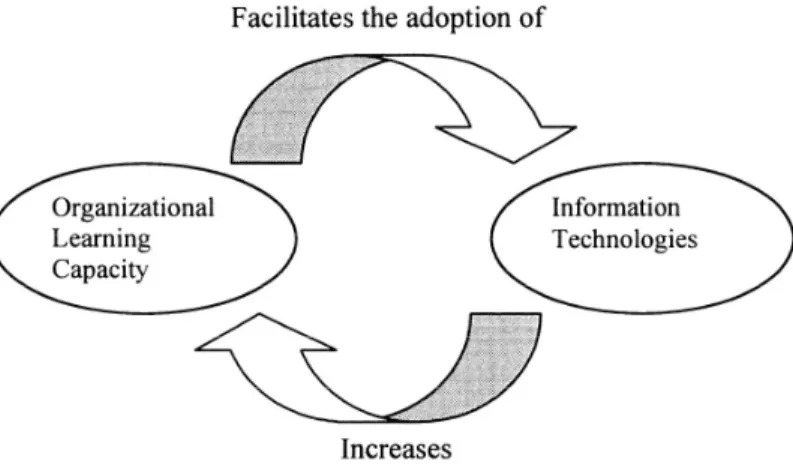
Robey et al. (2000) describe the twofold nature of the relationship between IT and OL that utilization of IT, at one side, supports the learning processes and increases the OL capacity, while on the other hand OL facilitates the adoption and implementation of new technological change (new IT) in the organization. Figure 5 demonstrates the relationship between IT and OL.
Figure 5: Relationship between IT and OL Source: Robey et al. (2000)
3.5 CONCEPTUAL MODEL
After reviewing different literatures on OL and IT, the authors develop a conceptual model to describe the relationship between OL and IT based on how companies use IT to support learning processes in order to create, increase and improve organizational performance and capabilities. Following figure represents the authors’ conceptual model.
Socialization Combination Externalization Internalization
L
e
a
rn
in
g
a
t
in
d
iv
id
u
a
l
le
v
e
l
Knowledge Acquisition Knowledge Interpretation Knowledge Distribution Organization MemoryL
e
a
rn
in
g
a
t
o
rg
a
n
iz
a
ti
o
n
a
l
le
v
e
l
Information
Technology
P
e
rs
o
n
a
liz
a
ti
o
n
C
o
d
if
ic
a
ti
o
n
Socialization Combination Externalization InternalizationL
e
a
rn
in
g
a
t
in
d
iv
id
u
a
l
le
v
e
l
Knowledge Acquisition Knowledge Interpretation Knowledge Distribution Organization MemoryL
e
a
rn
in
g
a
t
o
rg
a
n
iz
a
ti
o
n
a
l
le
v
e
l
Information
Technology
P
e
rs
o
n
a
liz
a
ti
o
n
C
o
d
if
ic
a
ti
o
n
Increase Increase Facilitate FacilitateFigure 6: Authors’ Conceptual Model
The authors hold that it is important to understand the user of IT systems in order to understand the role of IT on OL. Nonaka & Takeuchi (1995)’s SECI model is perceived here as a descriptive model describing learning at individual level through the conversion of tacit and explicit knowledge. Individuals learn new knowledge through four ways namely; socialization, externalization, combination and internalization. While Huber (1991)’s learning processes describe how an organization learns. The interconnection between learning at individual level and at organizational
level is that individuals must learn to create and enhance organizational knowledge. The accumulated organizational knowledge will then in turn promote individual learning process. Please note to distinguish the difference between “learning at organizational level” and “OL”. Learning at organizational level is the term intended to represent the way an organization acquires, distributes, interprets and creates an organizational memory. OL, in contrast, is a broader term which represents the process of learning at both the individual and organizational levels. The relationship between learning at individual level and learning at organizational level is depicted by Crossan et al. (1999) that OL is the interaction between learning at the two levels.
Knowing that OL is the interconnection between learning at the two levels, the relationship of IT and OL derives from the concept proposed by Robey et al. (2000) that utilization of information technology supports the learning processes and increases the organization’s learning capacity. On the other hand, OL facilitates the adoption and implementation of new technological change.
Since the authors view IT as an infrastructure utilized in promoting OL, IT is placed in between the learning at individual level and learning at organizational level. Hansen et al (1999)’s knowledge management strategy, namely codification and personalization strategy, is seen as a mechanism companies apply to cope with the use of IT in promoting OL according to company’s specific strategic goals. The conceptual model is intended to help the authors to find out how organizations use IT to support different knowledge management strategy described by Hansen et al (1999) and, correspondingly , how IT enables or facilitates the individuals to create and share knowledge as well as how IT enhance the organizational capabilities and performances by affecting the learning processes.
4 EMPIRICAL DATA
This chapter explains the empirical information collected from Accenture and ABB in Sweden. The authors present Accenture first followed by ABB for the ease of understanding. In this chapter the authors begin with the introduction of both companies, then proceed to define how these companies manage their learning and finally describe the IT based knowledge management tools utilized by the companies.
4.1 ACCENTURE
4.1.1 ACCENTURE - COMPANY BACKGROUND
Accenture, a large global consulting firm, was established in 1989 as a technology consultant and systems integrator which later extended its offerings with business integrations solutions serving in three service lines; management consulting, technology services and outsourcing. The company generated net revenue of US$19.70 billion for the fiscal year 2007. Accenture collaborates with its client to help them become competitive and make change in their competitive landscape by entering new markets, increasing revenues in existing markets, improving operational performance and delivering their products and services more effectively and efficiently. Lena Mindus describes Accenture business as:
“We are helping our clients to make change. We are not delivering reports to clients; we actually work with clients so that they can feel that something is delivered not just suggested”. (Lena Mindus, Interview, 23 April 2008)
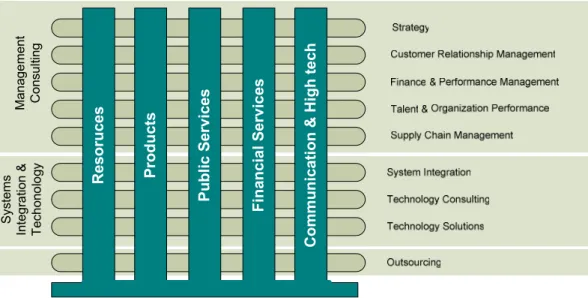
Accenture operates in 150 cities of 49 countries with the strength of 178,000 employees who grasp deep knowledge in different industries, business processes and technologies and provides solutions to Accenture’s clients maintaining strong value chain from analysis and strategy to development, implementation, maintenance and operations. Its business structure is composed of five main operating groups and industry segments within three service lines. The operating groups are further categorized as Communication & High-tech, Financial services, Products, Resources and Public service provides services and solutions in seventeen focused industry groups. A matrix relationship between the three service lines and the five operating groups is depicted as follow:
R e s o ru c e s P u b li c S e rv ic e s P ro d u c ts F in a n c ia l S e rv ic e s C o m m u n ic a ti o n & H ig h t e c h M a n a g e m e n t C o n s u lt in g S y s te m s In te g ra ti o n & T e c h o n o lo g y
Figure 7: A matrix relationship between Service Lines and Operating Group Source: Lena Mindus, Interview, 23 April 2008
The matrix relationship enables Accenture to deliver its expertise and services with the right competency. In addition, Accenture sustains the competitive advantage over its competitors through its vast industry expertise, incomparable experience, comprehensive capabilities across all industries, extensive research on world’s most successful companies and broad and evolving service offerings to its clients. Accenture works with organizations of all sizes in which 94 organizations are recognized as the Fortune Global 100 while more than two-thirds of the Fortune Global 500 are clients of Accenture.
4.1.2 LEARNING AT ACCENTURE
Accenture Institute of Strategic Change claims that “To create value, companies must focus on how
knowledge is used to build critical capabilities” (Donoghue et al. 1999). Since Accenture was
established as an IT consulting company, IT is considered as a very fundamental part of the business. On the other hand, learning is also assumed as a continuous process to move the business forward through their employees. IT is utilized in every process at Accenture to ensure similar processes throughout the world. The importance of IT and knowledge at Accenture is pointed by Lena Mindus as follow:
It is a knowledge company and we are selling knowledge. We don’t have any other asset than what people have in their heads. We don’t do anything without IT, and no manual processes work here, we are an IT-based company and trying to make sure that our clients are doing better and getting more competitive than their competitors. (Lena Mindus, Interview, 23 April 2008)
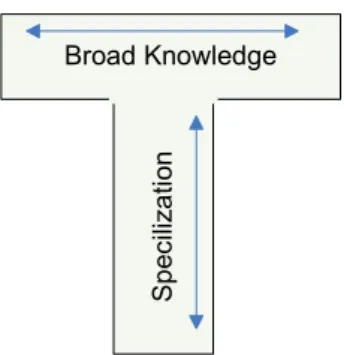
Accenture regards and values knowledge and learning because it strictly conducts business based on knowledge. Each employee is required to have a general knowledge in broad areas with a specialization skill in any specific areas which can be either in industry or a special area such as SAP, Customer Relationship Management (CRM), Supply Chain Management (SCM), administration, human resource management, finance etc. The model is known as the T-profile to Knowledge
Broad Knowledge S p e c ili z a ti o n
Figure 8: The T-Profile to Knowledge Management Source: Lena Mindus, Interview, 23 April 2008
In order to move along the Accenture’s career path, for example in the management consulting service line where one moves along the company’s career path from analyst to consultant, consultant to manager, manager to senior manager and from senior manager to senior executive, employee’s knowledge and expertise in specific areas are the most fundamental promotion criteria applied. The average time spent on certain level varies from 2-4 years depending on the individual’s learning capacity, current work performance and employee’s potential to perform well on the next level. Accenture expects its employees to move along the career path within the specific time frame. Most of the projects undertake are carried out in the form of project execution teams consisting of employees from different levels depending on the project requirements. An example is when a new individual is employed in the analyst position in the management consulting service line, he/ she is expected to stay in the analyst position for 2 years on average, during these years he/ she will be assigned to work on different projects with other analysts, consultants, managers, senior managers, senior executives in order to gain the broad knowledge in all areas and build the specialization in certain industry in compliance with his/ her individual career objective set with the career counselor. Upon project completion, project leader is responsible for documenting all relevance information of the project including the problems faced, the techniques utilized, the solutions and the results. Project documentations are stored on Accenture intranet which can be retrieved by all employees. Project documentation is a large part of how Accenture creates and stores its knowledge. A promotion policy helps enforcing the importance of project documentation process. Accenture strictly employs the same procedures around the globe. Documentation procedure is highly standardized. A description is provided along with the document template. Sometimes, document templates can be in a form of check list to ensure that the team complies with all the necessary procedures.
Training is conducted through both class room and online, however, approximately 90% of training sessions are online as they are more cost effective. Accenture has designed different training modules in all three different service lines for the personal and professional development of its employees. Training sessions are tailored to meet the knowledge requirements at certain job level and are given on a need basis. Employees are notified via intranet about the up and coming training sessions which they are required to attend.
Accenture relies on both internal and external sources to obtain knowledge. Accenture Research Center and information from clients are the main sources of knowledge.