The State and Potential
of Civic Learning in
Canada
Charting the Course for Youth
Civic and Political Participation
Kristina R. Llewellyn
Sharon Cook
Joel Westheimer
Luz Alison Molina Girón
Karen Suurtamm
CPRN Research Report
June 2007
Canadian Policy Research Networks 214 – 151 Slater Street, Ottawa, Ontario K1P 5H3
The State and Potential of Civic Learning
in Canada
Charting the Course for Youth Civic and Political Participation
Kristina R. Llewellyn, Sharon Cook, Joel Westheimer,
Luz Alison Molina Girón and Karen Suurtamm
This research paper is one of the six papers prepared for CPRN’s Democratic Renewal Series, Charting the Course for Youth Civic and Political Participation. All research papers and CPRN’s synthesis report for this project are available on the CPRN website at www.cprn.org. The six papers are listed below.
1. A Group Apart: Young Party Members in Canada – Lisa Young and William Cross 2. Indifferent or Just Different? The Political and Civic Engagement of Young People in
Canada – Brenda O’Neill
3. The Meaning of Political Participation for Indigenous Youth – Taiaiake Alfred, Jackie Price and Brock Pitawanakwat
4. Rendre compte et soutenir l’action bénévole des jeunes – André Thibault, Patrice Albertus and Julie Fortier
5. The State and Potential of Civic Learning in Canada – Kristina R. Llewellyn, Sharon Cook, Joel Westheimer, Luz Alison Molina Girón and Karen Suurtamm
6. “What Do You Mean I Can’t Have a Say?” Young Canadians and Their Government – André Turcotte
Joel Westheimer, PhD Sharon Cook, PhD Professor, Social Foundations of Education Professor of Education University Research Chair in Democracy and Education Cross-appointed, Dept of History Co-Director, Democratic Dialogue Co-Director, Democratic Dialogue (613) 562-5800 x 4161 (613) 562-5800 x 4486
[email protected] [email protected]
The observations and conclusions are those of the author(s).
Contents
Abstract ...iii
Acknowledgements ...iv
Introduction ...1
Methodology ...3
What Kind of Citizen? ...5
A Brief History of Citizenship in Canada ...6
The Canadian Citizen, 1867-1918 ...7
The Canadian Citizen, 1919-1990 ...8
Trends in Youth Civic Participation ...9
Explaining Levels of Engagement and Redefining Civic Literacy ... 14
Political Knowledge and Young Canadians ... 19
Does It Matter?...22
Capacities and Skills for Youth Civic Participation ... 24
What Skills Should School Teach? ...25
Civic Literacy and Schools ... 27
Provincial/Territorial Curriculum Guidelines ...28
Provincial “Behavioural” Codes of Conduct ...30
Opportunities for Civic Learning ... 31
Future Research ...34
References ... 36
Provincial/Territorial Educational Curriculum and Behavioural Documents ...44
Appendix A: Student Questionnaire ... 47
Appendix B: Student Interview Guide ... 48
Appendix C: Teacher Interview Guide ... 50
Abstract
This report focuses on the role of education in improving civic learning for youth. We ask two questions: What knowledge and skills serve as a basis for models of civic learning for young Canadians? What changes to learning processes are needed to encourage youth participation in democratic processes? To answer these questions, the report examines the various perspectives represented in the literature on youth and civic literacy. It also offers the various perspectives of Ottawa students and teachers in relation to government curriculum to provide a snapshot of the state and potential of civic learning within secondary schools. We synthesize this research to identify youth trends in civic participation, possible reasons for political disengagement, and the kind of citizenship knowledge and skills provided for students historically and currently. In so doing, we argue that civic learning is primarily characterized by procedural knowledge and compliant codes of behaviour that do not envelope students in collective action for systemic understandings of political issues. We contend that schools need support for renewing efforts that put social justice citizenship at the heart of student learning and the school environment. Educational programs for civic literacy should teach students to make informed, active choices about policies that affect their lives and to engage with their community in efforts for social change.1
Acknowledgements
The authors of this report wish to thank Amanda Pyykonen and Ranilce Guimaraes for their assistance with this research project. We also extend our appreciation to those schools, teachers and students who welcomed us into their classrooms and to those youths who participated in the CPRN Youth Workshop in March 2007.
We at CPRN would like to express our appreciation to the following financial and in-kind contributors:
Laidlaw Foundation Elections Canada
Human Resources and Social Development Canada
Government of Saskatchewan, Department of Culture, Youth and Recreation Canadian Council on Learning
Government of Nova Scotia, Nova Scotia Youth Secretariat Fireweed Democracy
Laboratoire en loisir et vie communautaire (LLVC), Université du Québec à Trois-Rivières, in collaboration with la Table de concertation des Forums jeunesse régionaux du Québec
The project also benefited from the collective insights and advice of our Project Advisory Group (PAG). We also wish to thank them for attending (as observers) the March 7th Youth Workshop and for their participation at the May 16th Roundtable. The PAG members are:
Rick Anderson, Fireweed Democracy Uttara Chauhan, Elections Canada Jennifer Corriero, TakingITGlobal
Nevin Danielson and Spencer Roberton, Government of Saskatchewan, Department of Culture, Youth and Recreation
Violetta Ilkiw, Laidlaw Foundation Peter MacLeod, The Planning Desk Andrew Medd, Canada 25
Melinda Morin, Aboriginal Youth (Saskatchewan)
Deborah Pellerin, Government of Nova Scotia, Department of Education Daryl Rock and Deborah Monette, Canadian Council on Learning Tom McIntosh, University of Regina
Thanks as well to the anonymous reviewers of the papers, the youth participants of the March 7th Youth Workshop and the May 16th Roundtable attendees for their helpful comments and suggestions. Special thanks to Larry Booi, Canadian Council on Learning (Board Member), for his additional insights and advice.
The State and Potential of Civic Learning in Canada
Introduction
In recent years, Canadians have wrestled with a host of policy concerns that call for the kind of rigorous public debates that are the hallmark of democracy. Following the 2006 general election, for example, concern for the health of the planet figured as the highest priority issue for 26% of Canadians surveyed.2 Not surprisingly, politicians, policy-makers and media pundits have given environmental issues widespread attention. Prime Minister Stephen Harper presented a new Clean Air Act to cut 20% of greenhouse emissions by 2050. Opposition parties and government officials from numerous industrialized countries criticized Harper for setting weak targets that undermined Canada’s commitment to the Kyoto protocol. The public became witness to and participant in explosive debates relating to climate change. Other issues have figured highly in the public psyche as well. Concern over wars in the Middle East, trust in our government and political leaders, and calls for democratic reform of the political process itself have vied for public attention.
In many ways, these debates mark the health of one of the world’s more respected democracies. Politicians express varying positions on issues of public concern. The media carries a variety of views and perspectives. Through election campaigns, a free press and community discourse, politicians and the broader public debate those policies most prominent in the minds of the people these policies will likely affect. Ideally, as Aristotle envisioned, democratic citizens thus move themselves and each other “from individual ignorance to collective wisdom.”
However, as Michael Delli Carpini and Scott Keeter point out in their study of US citizens’ political knowledge, the “quality of the public debate [on such issues] and thus ultimately the quality of the reforms that emerge, depend on two things: the nature of the information brought to the public marketplace and the ability of citizens to use that information to discern their interests and to articulate them effectively.”3 Unfortunately, recent studies indicate cause for concern on both counts. Knowing the names of major political leaders and contenders, how Parliament functions, how social policies have been implemented in the past and basic historical facts about Canada and global affairs are all forms of civic literacy that elude a large number of Canadians.4 If, as Rousseau asserted, the right to vote should be accompanied by an obligation to be knowledgeable in public affairs,5 strengthening democracy will require attention to the level of civic literacy and the ability to use civic knowledge in the democratic process of governance.
While civic literacy needs to be addressed for Canadians of all ages from the workplace to the home, schools and their students are a central place for reform. Our future public policy depends on the commitments of young Canadians and thus deserves the attention of educators and policy-makers. Although most researchers would agree that the school and the community must give priority to harnessing the vision and energy of youth for civic affairs, there is much less agreement on where or how to seek improvement. Indeed, definitions of civic literacy, how to strengthen it, and its importance in democratic reform are all contested in the research literature. A full picture of civic
2
Decima Research, 2006.
3
Delli Carpini and Keeter, 1996: ix.
4
Gidengil et al., 2004: 57-67.
5
learning would have to seriously consider the role of family, media, law, religion, community clubs and many other institutions. The scope of this report allows only for a focus on school. We recognize that the school and its teachers, shaped by a complex web of societal relations, are neither “the problem” with civic learning nor the only solution. The school, however, as one of the primary locations for student learning, has a responsibility to improve civic literacy: the ability of youth to make informed political choices for collective action toward equitable societal improvement.
This report deals with two central questions: What knowledge and skills serve as a basis for models of civic learning for young Canadians? What changes to learning processes are needed to encourage youth participation in democratic processes? The report is based on a dialogical examination of secondary literature on youth and civic literacy, government policy that shapes school civics and a case study in Ottawa schools, specifically about the perspectives of teachers and students on the potential of civic learning in secondary schools. From this research, we argue that civic learning is characterized by procedural knowledge and compliant codes of behaviour that do not envelope students in collective action for systemic understandings of political issues. Civic learning in our schools, stemming from our culture, has contributed to a value-neutral approach to politics. Large-scale possibilities for change-making are thus lost in the eyes of students. We argue for renewed efforts to put social justice citizenship at the heart of student learning and the school environment. Models for social justice can range from curriculum that encourages student dialogue on controversial topics to the role-modelling of effective democratic participation within the school and community.6 Educational programs for civic literacy would teach students to make informed, active choices about policies that affect their lives and to engage with their community in efforts for social change.7
The first two sections of the report demonstrate that apolitical citizenship has historical roots in the purpose of Canadian education. Following that, we turn to current youth trends in civic participation. Specifically, research shows that youth have turned away from formal activities, such as voting and membership in political parties, and have moved toward informal politics, such as volunteerism.8 The next section explores the possible reasons for youth disengagement from the formal civic arena. Students feel disconnected from democratic institutions, and they are finding new ways to talk about community participation, often through Internet chats, which are under-represented by researchers. The following two sections identify the knowledge and skills, or lack thereof, that our education system provides for students to have robust civic literacy. Young Canadians lack both sufficient knowledge of how government works and the capacity to apply democratic skills beyond their school walls. The next section outlines how curriculum guidelines and codes of conduct have contributed to a depoliticized citizenship for youth.9 The final section speaks to opportunities for increased civic learning: revitalizing broad-based debate about social justice in schools, supporting teachers with resources that enable ideological diversity in the classroom and calling upon Canadian researchers to conduct empirical studies on the politicization of schools. The primary objective of this report is to survey the state of school-based civics and spark discussion about potential ways to improve civic literacy for youth and thus strengthen Canadian democracy.
6
Westheimer and Kahne, 2003.
7
Canada, 1993.
8
Barnard, Campbell and Smith, 2003; Bishop and Low, 2004.
9
Methodology
This study builds from a previous report, Strengthening Canadian Democracy: Civic Literacy in Perspective, produced by Joel Westheimer, Sharon Cook, Alison Molina and Karen Suurtamm with the Democratic Dialogue Research Unit at the University of Ottawa. That report was commissioned by the Democratic Reform Secretariat, Privy Council Office of the Government of Canada, to review literature on civic literacy to demonstrate what we already know and what we still need to discover about the knowledge and skills Canadians possess for political participation. We review those results with a greater focus on the position of youth through empirical research in Ottawa schools. Alan Sears contends from his reviews of the field of citizenship education that scholars have debated approaches to fixing what is wrong with civic learning without the benefit of empirical research that provides a deeper analysis and public conversation.10 We thus have used a mixed-methods approach to present quantitative data, primarily national statistics of political participation, in relation to qualitative data, specifically case-study interviews that give a richer picture of youth experience with civic affairs.
A team of researchers, with one primary investigator conducting all interviews, engaged in conversations with students and teachers in four Ottawa schools from November 2006 to February 2007. Ottawa, as the political capital of the country, seemed like the optimal setting for observing and discussing civic learning with those people charged with instructing and learning its lessons. We experienced great difficulty, however, in securing participating schools, as well as teachers and students within schools that welcomed the research. Our difficulty reflects the results of research literature; disengagement is often a part of school culture. Informal conversations with administrators and teachers who chose not to participate revealed that discussion of politics was controversial itself and not a common or comfortable part of the school routine. Some teachers even admitted that they were afraid to speak, with perceived consequences to their job security or status in the school. Students argued that a study on civic learning, similar to the democratic process, seemed disconnected from their lives. The learning experience of the most disaffected youth and empirical research on a national scale still require study.
This study targeted youth who were engaged in formal education and interested at some level in discussing civic issues. As the voices of these participants emerge and the absence of other voices are recognized, we are reminded that young Canadians are not a homogeneous group, and thus our approach to civic literacy must be multi-faceted and include political dialogue based on the conflicts of difference. Our case sample of the nation’s learning institutions attempts to represent the multiplicity of youth experience. The participating four schools were selected based on a desire to include public, alternative (within the public system), private and independent models of education. These schools also represent diverse ethnic, class, gender, age and religious demographics. Schools were chosen from the secondary system, where citizenship education has an explicit objective in the school curriculum. During the course of the study, each school had to be offering, and teachers had to be willing to open their classroom doors to, mandatory Grade 10 Civics and/or upper-year electives in History, World Issues, Economics and Law. While a teacher interview was a prerequisite to selecting each class, student participation was completely voluntary. Student interviewees were randomly selected from those who consented.
To enable more open discussion with participants in our study, each institution and individual has been provided with a pseudonym. The first school, Crestview Academy, is a private day school for
10
girls in an affluent area of the city. The second school is Fellowship High School (HS), an independent school for boys and girls whose families want them to have a Christian-based education. The last two schools are part of the public school board. Ottawa-East HS is one of the most multicultural schools in the city and has a large program for English as a Second Language. Ottawa Alternative HS provides curriculum and social services to mature students, mostly between the ages of 18 and 35, who previously left school without completion. We attended Civics classes at all schools except for Fellowship HS, where, due to scheduling, we met only with a World Issues class. At Ottawa-East HS, we attended only the Civics course, whereas we met with upper-year classes in World Issues at Crestview Academy and in Canadian History at Ottawa Alternative HS. We were also invited to a Literacy class at Ottawa Alternative HS. The students in that course shared their recent experience visiting Parliament and witnessing Question Period.
We visited each school for a total of one week. During that time, with the exception of the Literacy course, we observed each class for one or two sessions and attended school assemblies and special events that were taking place. Students who consented were given a two-page questionnaire that asked a range of questions about their knowledge of political leaders, skills to address political issues they deemed important and understandings of the relevancy of civic lessons (see Appendix A). Interviews were then conducted with two to three randomly selected students for approximately one half-hour. The interview questions corresponded with the themes on the questionnaire, but they also enabled us to get a clearer picture of students’ impressions of political and social issues and the role of the school for increasing civic engagement (see Appendix B). The teacher for each course participated in an interview lasting approximately one hour that touched upon his/her perspectives on democracy, students’ ideas of civic affairs, the content and methods of citizenship lessons, and school policies relating to democratic modelling (see Appendix C). In total, six teachers (four male and two female) and 16 students (12 female and four male) offered their views on civic learning in an interview.
The number of participants obviously represents a small sample and cannot necessarily be statistically generalized for youth across the country. Furthermore, we do not provide conclusive quantitative data from study questionnaires because of completion inconsistencies, language barriers and a lack of identifying information. Specifically, due to ethical concerns from the university council, we were unable to request social identifiers from participants, such as class and ethnicity, on our questionnaires. Questionnaires are evaluated to provide a general picture of these students’ political knowledge, skills to address civic issues and awareness of citizenship lessons in school. Social differences as they relate to youth civic engagement need far greater study. We draw upon issues of difference evident from the school populations and student interviewees. For example, we note in the report that Crestview Academy teachers believed that their students were more civically minded due to their privileged families, which did not seem to come to fruition in comparison with other youth in the study. Two Somali girls in our study were among the most politically active regarding the community issues of immigration and government support of single mothers. Across the student participants, however, the message they conveyed was that politics was not a school priority and thus not a youth issue. This study was conducted in such a manner as to begin to bring students into a discussion with teachers, academics and policy-makers about prioritizing social justice-oriented civic literacy in schools.
What Kind of Citizen?
11The notion of “civic literacy” does not signify purely factual knowledge about the workings of government. Civic literacy concerns an individual’s competence and willingness to engage in civic affairs in multiple arenas. A civically literate citizen, then, possesses necessary knowledge but also knows how to employ that knowledge for effective civic participation. As The Centre for Literacy in Montreal observes, new literacies (such as civic literacy) focus on individuals’ “capacity to use and make critical judgments about the information they encounter on a daily basis.”12 Indeed, the evolving conception of civic literacy signifies an evolving definition of citizenship itself. Citizenship in a modern democratic society requires more than knowing how a parliament is composed, following laws and paying taxes. Rather, modern democracies require citizens to participate in governance at multiple levels, to make informed choices about different political perspectives and policies, and to engage with other members of the community in efforts at societal improvement.13 This robust conception of civic literacy drives our examination of the current state of civic learning for youth in Canada.
Historians, philosophers and political scientists have long debated which conceptions of citizenship would best advance democracy.14 Indeed, as William Connolly15 has argued, conceptions of democracy and citizenship have been and will likely always be debated – no single formulation will triumph. The work of John Dewey, for example, which has probably done the most to shape dialogues on education and democracy, has not led to resolution. Rather, scholars and practitioners have interpreted his ideas in multiple ways. In large part, this diversity of perspectives occurs because the stakes are so high. Conceptions of “good citizenship” imply conceptions of the good society. Ideas about civic literacy represent a similar variety of interpretations.
The diverse perspectives on citizenship and civic literacy also have significantly different implications for school curriculum. For example, Walter Parker16 describes three very different conceptions of citizen education for a democratic society: “traditional,” “progressive,” and “advanced.” He explains that traditionalists emphasize an understanding of how government works (how a bill becomes a law, for example) and traditional subject area content as well as commitments to core democratic values – such as freedom of speech or liberty in general.17 Progressives share a similar commitment to this knowledge, but they embrace visions like “strong democracy”18 and place a greater emphasis on civic participation in its numerous forms.19 Finally, “advanced” citizenship, according to Parker, is one that builds on the progressive perspective but adds careful attention to inherent tensions between pluralism and assimilation or to, what Charles Taylor labels, the “politics of recognition.”20
11
This section (“What Kind of Citizen?”) is partly adapted from Westheimer and Kahne, 2004.
12
The Centre for Literacy, n.d. See also Dubin and Kuhlman, 1992.
13
Canada, 1993.
14
See, for example, Kaestle, 2000; Smith, 1997; Schudson, 1998.
15
Connolly, 1983.
16
Parker, 1996.
17
See, for example, Butts, 1988.
18
Barber, 1984.
19
See, for example, Newmann, 1975; Hanna, 1936.
20
Joel Westheimer and Joseph Kahne21 posit three visions of good citizens that educators and policy-makers can use to consider a variety of goals related to civic literacy and engagement. The
personally responsible citizen acts responsibly in his/her community by, for example, picking up litter, giving blood, recycling, obeying laws and staying out of debt. The participatory citizen
actively participates in the civic affairs and the social life of the community at local, provincial and national levels. The social justice-oriented citizen emphasizes social change and seeks to prepare students to improve society by critically analyzing and addressing social issues and injustices. Advocates of social justice-oriented programs argue that effective democratic citizens need opportunities to analyze and understand the interplay of social, economic and political forces.
These perspectives can help policy-makers understand the various competing notions of civic literacy at work in school programs. For example, as we will detail later in this report, it seems that all provinces consider citizenship as grounded in the individual student’s understandings and knowledge, rather than in collective efforts to solve systemic causes of political problems. It is due in part to this foundation of curriculum and schooling structures that students and teachers within Ottawa schools expressed frustration that they could not “walk the walk,” “put feet to the ideas” or “make a change.” Regardless of the particular perspective of citizenship one adopts, most scholars, policy-makers and study participants agree that the knowledge, skills and dispositions that constitute civic literacy are all important for effective citizen involvement.
A Brief History of Citizenship in Canada
Since the evolving concept of civic literacy in the school curriculum is rooted in changing ideas of the democratic citizen in the culture more broadly, it is worthwhile briefly exploring the history of Canadian citizenship and its impact on Canadian civic education.
It is often observed that Canadian citizenship did not formally exist before the 1947 proclamation of the National Citizenship Act.22 However, invocations of the ideas of citizenship appear much earlier: during and after the 1837 rebellions in Upper and Lower Canada;23 in the founding of the Canadian nation-state through Confederation in 1867;24 in the first Canadian Franchise Act in 1885;25 in the extent of Canadian involvement in the First World War, in which Canada was implicated through its colonial status in the British Empire; and in campaigns for women’s suffrage at the federal and provincial levels.
At first, Canadian civic virtues were closely identified with British imperialism. Throughout the 20th century, however, conceptions of citizenship were influenced by the notion of “Canadianization,” and civic reference points became increasingly North American. With the announcement of the Multiculturalism Policy in 1971 (within a bilingual framework from the Bilingualism and Biculturalism Commission report), the model for Canadian citizenship became officially grounded in multiculturalism.
Questions of citizenship have also entered Canadian public discourse through a wide variety of fundamental concerns: “the character and destiny of Canadian nationhood, the identity of its
21
Westheimer and Kahne, 2004.
22
For one commentary on this issue, see Troper, 2002.
23
Hébert, 2002: 6-7.
24
Adamoski, Chunn and Menzies, 2002: 12.
25
populace, the existing and aspired-to ambits of state power, the scope of civilian duties and entitlements, the experience of belonging, the relations between public and private, the hallmarks of social progress, and the constitution of civil and cultural communities.”26
The Canadian Citizen, 1867-1918
Throughout Canada’s history, social citizenship has always been bounded, inclusive in theory but exclusionary in practice. Canadians have not shared equally in the advantages conferred through citizenship. Historians observe broad patterns of inequity based on race, ethnicity, wealth, gender and, in more recent analysis, sexual orientation. As Eric Gorham suggests, citizenship “divides people as it unites them ... States designate citizens by excluding outsiders”27 and many within their own borders as well. So it has been with the history of Canadian citizenship ideas and practices: inclusion for some, exclusion for many.
Accordingly, from the founding of Canadian society until at least World War I, the ideal Canadian citizen was British (at best, English), male, white, rational and loyal. Early Canadian historical writing all contributed to Canadians’ knowledge and sense of themselves as social citizens in a system characterized by British parliamentary government, fair play, order and duty to self and Empire.28 Procedures and rituals enshrined in virtually every institution of the young country reinforced early Canadian citizenship qualities based on this imperial model: reports of royal commissions such as the BC Commission on Mental Hygiene;29 legal codes related to conduct including those proscribing sexual offences;30 even sanity was determined in relation to the ideal of the “good” citizen.31 The major exception to respect for British hegemony is Quebec, where the models for citizenship, as defined in this period by L’Abbé Groulx, were homegrown and rooted in Quebec rural culture.32 Hence, none of the categories typically used to discuss citizenship or civic literacy in English Canada fit at all easily into Quebec’s history.33
Not surprisingly, the definitions of “good” and “bad” citizens found their way into Canadian school textbooks. Indeed, much of the task of reinforcing positive civic qualities fell to the formal educational system. With the introduction of compulsory schooling in late 19th century Canada, more children were exposed to these prescriptive codes than ever before. Even prior to compulsory attendance laws, local forms of schooling in Central Canada and British Columbia were central in constructing the habits and understandings of the “citizen.”34 This period’s goals of civic literacy included deference to authority, limitations to the freedom of individual and family norms, devolution of their authority to the demands of the state, and the development of an orderly and compliant public culture in the public space of the school.35
26
Adamoski, Chunn and Menzies, 2002: 14.
27
Gorham, 1995.
28
Berger, 1970; Creighton, 1970; McKillop, 1980.
29
Adamoski, Chunn and Menzies, 2002: 385-413.
30
Backhouse, 1991; Chunn, 2002; Dubinsky, 1992; Strange, 1992.
31
Moran, Wright and Savelli, 2004; Kelm, M. E., 1992.
32
Groulx, 1919.
33
Some would argue that the same difficulty arises in applying notions of Canadian citizenship to First Nations peoples, women and Canadians marginalized through poverty. See, for example, Strong-Boag, 1992.
34
Curtis, 1988.
35
In all settings, subjects like Geography, Literature and History provided ideal vehicles for the inculcation of this knowledge.36 Aside from formal curriculum, civic literacy has always been taught through a broad range of “habits of mind” through classroom process and pedagogy, including the discipline of choral speaking and individual elocution, the practice of standard penmanship, punctuality in school attendance and work assignments, orderly queuing and the acceptance of educational authority trumping familial or even community standards of behaviour.37 (Contemporary reflections of these educational goals can be seen in the behavioural “codes of conduct” detailed later in this report.)
The inculcation of standards for good behaviour became a priority in educational programming around the turn of the century. From the 1890s, Canada experienced dramatic growth through immigration and industrialization, and many felt the need to socialize this large group of young, male, semi-skilled workers, many of whom lacked a working knowledge of English or British societal norms.38
The Canadian Citizen, 1919-1990
Post-war Canadians experienced the gradual, if uneven, extension of civic entitlement. White women, for example, were especially successful in obtaining the federal franchise.39 The declaration of women as “persons” under the British North America Act in 192940 and the establishment of the Royal Commission on the Status of Women in 1967 (reporting in 1970)41 provided important legal entitlements for women’s civic integration.42
One major objective of the inter-war period was to “Canadianize” a population that had either been coarsened by the brutality of war or, as new Canadians, had never been exposed to British norms of democracy and justice. Despite the increasing importance of American cultural and economic standards for Canadians, school curricula continued to provide British reference points for most invocations of citizenship, including such celebrations as Empire Day.43 The Second World War provided another rallying point for civic patriotic fervour; young people engaged in home-front support,44 learning the ways of patriotism through labour in defence of a just cause.
Interestingly, the 1947 National Citizenship Act draws little attention from historians interested in the development of civic identity in Canada. Similarly, the passage of Trudeau’s Bill of Rights in 1968, while widely cited in school textbooks for its foundation of citizen rights, came to be overshadowed by the profoundly significant “B and B Commission” in 1963 that first recognized French Canada “as a cultural instead of a geographic concept.”45 The 1971 policy of Multiculturalism within a Bilingual Framework, supported by generous federal funding, most directly influenced and shaped Canadian
36 Bruno-Jofre, 2002. 37 Gaffield, 1987; Cook, 1994. 38 McLean, 2002; Stanley, 1996. 39 Cleverdon, 1970. 40
For example, see Lester, 1985.
41
Begin, 1992.
42
Much historical debate continues around the broader significance of such legislation for women in concert with, and often as opposed to, social movements like the right to abortion (Dubinsky, 1985), equal pay for equal work (Marsden, 1980) and protection from violence for urban and rural women.
43 Stamp, 1982. 44 Johnson, 1988. 45 Newman, 1968.
civic values, especially as these were taught in the schools, in the last third of the 20th century. It was reaffirmed and given the force of law under the Conservative Government of Brian Mulroney with the passage of the Canadian Multicultural Act in 1988.
The new Multicultural Framework caused some to worry about the undermining of Quebec’s special status through the elevation of other ethnic and linguistic groups’ status.46 Despite positive assessments by such historians as Cornelius Jaenen, who judged the policy to be a “sensible cultural ideal, an enlightened policy and an evident social reality,”47 and Howard Palmer, who viewed it as a means to foster national unity by giving ethnic groups a sense of belonging to Canada,48 there continued to be uneasiness. The Canadian sociologist, John Porter, for example, expressed concern that, with the policy, “we may well be turning back on the [democratic]principles which have been evolving in our histories and which the revival of ethnicity contradicts.”49
Nevertheless, by the 1980s, multiculturalism as an essential component of citizenship education had entered mainstream discourse, becoming enshrined in formal curriculum guidelines, as with Ontario’s Grade 9 optional history course Many Cultures, Many Heritages, along with a variety of supportive textbooks. Throughout the 20th century, educational literature remained deeply imprinted by the multicultural context, from the work of influential educational scholars such as Ken Osborne50 – who has called for Canadian citizenship education that is inclusive of varied ethnicities and regions, but also activist – to those practitioners who deplored the loss of traditional History teaching to the multicultural melange.51 Whatever their perspective on multiculturalism, most educators and policy-makers agreed that, if a wide mix of citizens were to effectively participate in the civic and political life of the community, they would require the knowledge, skills and dispositions of participation that democracy demands. The work of preparing citizens for participation in democratic society would, of course, include more than the schools, but schools were most often recognized as the public institution best positioned to reach the majority of young Canadian citizens. Moreover, although the best means for accomplishing this complex goal remains highly contested and somewhat elusive, the conviction continues today among many policy-makers and educators that the goal is a desirable one.
Trends in Youth Civic Participation
Trends in civic participation reveal that youth are increasingly disengaged from formal political activities. Whether they are simply turning to other forms of informal political action is under debate by researchers. The concern is that the benefit of these activities, like Internet chats or volunteering, may be accompanied by depoliticizing citizenship and ostracizing youth from the power of political voice. This section explores nationwide patterns of engagement in relation to the Ottawa youth in our study.
André Turcotte began his recent Elections Canada report on youth voter participation by musing that, if the “Do Not Vote Party” had fielded candidates in the 2004 Canadian general election, our new
46
Mazurek and Kach, 1990.
47
Cited in Kach and DeFaveri, 1987.
48
Palmer, 1975.
49
Porter, 1975: 304. See also McAndrew, 1987.
50
Osborne, 1999.
51
government would be overwhelmingly composed of its members.52 Only 60.9% of Canadian voters participated in that election, leaving almost 40% of the nation not voting.53 More alarmingly, this rate of participation reflects a longstanding downward trend. As shown in Figure 1, between 1988 and 2000 alone, federal electoral turnout dropped substantially from 75% to 64%.54
Figure 1: Turnout in Federal Elections, 1984-2004
75 75 71 67 64 61 50 55 60 65 70 75 80 1984 1988 1993 1997 2000 2004 Year Tur nout ( % )
Source: Elections Canada, 2004.
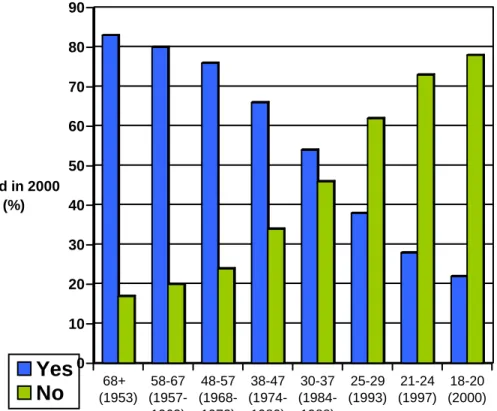
Many analysts observe that the decline in voter participation rates is largely attributable to those under 30 years of age. André Blais echoes the conclusions of many researchers: “If we want to understand why turnout is declining in Canada, we need to focus on the generation that was born after 1970.”55 Figure 2 illustrates that only 22.4% of first-time electors voted in 2000.56 This number rose to 38.7% in the 2004 elections,57 but the turnout was still 15 points lower among those aged 19 to 29 than it was for those over 30.58
52 Turcotte, 2005. 53 Gidengil et al., 2005. 54
Pammett and LeDuc, 2003: 4; Elections Canada, 2003.
55
Blais et al., 2002: 1.
56
Pammett and LeDuc, 2003: 20.
57
Milner, 2005: 3.
58
0 10 20 30 40 50 60 70 80 90 Voted in 2000 (%) 68+ (1953) 58-67 (1957-1963) 48-57 (1968-1972) 38-47 (1974-1980) 30-37 (1984-1988) 25-29 (1993) 21-24 (1997) 18-20 (2000)
Age in 2000 (first eligibility)
Figure 2: Voting and Not Voting in 2000, by Age Cohorts
Yes
No
Source: O’Neill, 2003.
Studies that examine other forms of youth political participation seem to reinforce the belief that voting rates may serve as a proxy for declines in other forms of participation. After studying data collected by the Institute for Research on Public Policy (IRPP), Brenda O’Neill concludes that younger Canadians are “less likely to follow politics closely; are less politically knowledgeable; are significantly less likely to have voted in the 1997 federal election; are less likely to see voting as an ‘essential’ democratic act; are less likely to be or have been a member of a political party or interest group; and are more likely to believe interest groups are more effective than political parties for bringing about change.59 The political disengagement of young Canadians from political parties is glaring considering that the average membership age is 59.60 Only 2% of young Canadians reported being a party member in 2000,61 a decline from 10% in 1990.62 Few disagree with the low-level assessment of Canadian youth’s knowledge, interest and participation in politics.
59
O’Neill, 2001: 15.
60
Young and Cross, 2004: 9.
61
O’Neill, 2001.
62
Little disagreement came from those people who participated in our Ottawa study. While the issue of political knowledge will be discussed later in the report, we note here that students generally claimed to have minimal understanding of government procedures and national issues under current debate. All 16 of the students interviewed described themselves as inactive within formal politics, uninspired to serve as political leaders and unaffiliated (with no expectation of affiliation) with political parties. Lee-Ann, a Grade 12 student at Crestview Academy, voiced the position of most youth participants: “I’m not that intrigued or interested about politics … If I looked at our grade as a whole [other students are] not really.” Only two students, Jamie from Ottawa Alternative HS and Samantha from Crestview Academy, expressed enjoyment from political discussion. As a result of finding politics “fun,” they both identified themselves as “nerds” or atypical in their peer groups. Student reflections stood in contradiction to those of most teachers, who, despite asserting students did not know enough about government, believed and hoped that they were interested. In particular, teachers from Ottawa Alternative HS, Fellowship HS and Crestview Academy asserted that their students were more engrossed in politics because of their respective adult experiences, faith community and privileged families. Little difference among the youth, however, was evident regarding formal political participation. Teachers’ comments from these specific schools may speak to the relevant expectations we place upon youth based on age or socio-economic status or presumed disengagement level of the most disaffected groups in society. We do not know without longitudinal study whether such a pattern will emerge among these youth participants when they reach voting age.
Interestingly, each student who was not yet eligible to vote argued that he/she would vote when of age or upon becoming a Canadian citizen. Given the data in the research literature, we can assume that over half of these students will not follow their intentions. Claims of future voting may have resulted from the context of a personal interview in which characteristics of “good” citizenship were being explored and within a school setting where the expectation for youth to be dutiful citizens was clear. In fact, citizens who would choose not to vote were always referred to by students in the third person. Sahra from the Civics course at the Ottawa Alternative HS said: “I’ll get my citizenship. I’m going to go vote, of course. I find a lot of teenagers complain a lot and they don’t do anything. They can go vote … but they’re not interested in it.” For those student participants who were eligible to vote, a mirror of the data on youth voting patterns emerges. Of the four eligible voters in our sample, only two had voted or would vote.
Reliable information on Canadian youth membership in interest groups is considerably harder to find than similar information about membership in political parties.63 Most data come from the 2000 Canadian Election Study, which asked respondents whether they had ever been a “member of an interest group that worked for change on a particular social or political issue.”64 Generally, Canadian youth are more likely to be a member of a public interest group than a political party. For every Canadian aged 18 to 27 who has been a member of a political party, 4.5 such Canadians have been a member of an interest group.65 Meanwhile, the numbers are nearly reversed for those over 57 years of age.66 Few researchers have asked these kinds of questions of students under the age of 18; thus, analyses of national trends are not possible. Patterns from our Ottawa sample, however, are evident. Samantha, a Grade 12 World Issues student from Crestview Academy, stands as atypical for her involvement outside of school with Greenpeace and organizations to end violence against women, as well as her desire to work with Doctors without Borders.
63
See Young and Everitt, 2004.
64 Gidengil et al., 2004: 131. 65 O’Neill, 2003. 66 O’Neill, 2003.
Nationwide data on youth participation in informal political and community projects are more encouraging. Canadian youth membership and participation in groups and organizations increased slightly from 44% in 1997 to 47% in 2000.67 Similarly, volunteer rates among all Canadians have declined slightly, but Canadians aged 15 to 24 “volunteered at a rate second only to those aged 35 to 54 (30% of this age group volunteered in 2000). Within the 15 to 24 age group, teenagers (those aged 15 to 19) volunteered at a much higher rate than those aged 20 to 24 (37% vs. 22%) and gave more time on average (136 hours vs. 121 hours). Youth aged 15 to 19 were much more likely than older Canadians to volunteer (37% vs. 26% for those aged 25 and older).”68 Stolle and Cruz, in their study of youth participation, conclude that “volunteering generally is on the rise for young citizens, as more young Canadians are engaged in such activities mostly because of required programs … but it seems [to happen] in a more and more sporadic and episodic manner.”69
When Ottawa teachers in our study spoke of high levels of student engagement, they may have been referring to such programs. In 1999, the Ontario government established 40 hours of mandatory “community involvement” to obtain a high school diploma. The stated purpose was to “encourage students to develop awareness and understanding of civic responsibility and of the role they play in supporting and strengthening their communities.”70 When study participants were asked if they volunteered, most of them referred to the regulation as their impetus for action. Bethany was representative of the group when she stated this: “I usually try to volunteer wherever because I want all those hours.” Students at the Ottawa Alternative HS who began their secondary program before the 1999 regulation were not required to complete such hours. None of these students in our study volunteered. In large part, this speaks to their adult commitments to paid work and family. Approximately 75% of our student participants described involvement in some form of volunteer work on their questionnaires, including community clean-ups, assisting at old-age homes, providing child care and working at a community centre.
Most student interviewees did not characterize their volunteer hours as a long-term commitment to organizations or social issues that were of particular interest to them. Most students commented on the episodic character of mandatory volunteerism. Gabrielle, a Grade 10 student from Ottawa-East HS, initially commented that she had not volunteered. After recalling the mandatory program, she stated: “I babysat some kids at an after-school program, but I don’t know, I never got them counted and it was a long time ago. I was thinking of volunteering at retirement homes helping people. I heard that they are accepting volunteer students.” Gabrielle’s experience was echoed by her teacher Helena, who called the program “an artificial way of making [students] do 40 hours” with guidance and not students’ taking the initiative to find placements. Helena believed that the “majority [of students] really resent” the program.
Here we find a significant difference between public and private schools. The students at Fellowship HS spoke of volunteerism as having a higher purpose than a school diploma. Jillian said, “We would call it a Christian duty whereas you, some people would call it a good citizen.” The school has established its own diploma, in addition to the Ontario High School diploma, which is based on extra courses and 60 hours of community service. Larry, a teacher at the school, explained that “some students have two to three hundred hours” because “that was asked of Jesus…We have a
67
Stolle and Cruz, forthcoming.
68
Barnard, 2003: 26.
69
Stolle and Cruz, forthcoming. See, also, Tossutti, 2004.
70
responsibility over and above the government to be caring, merciful and compassionate to people.” The result is school-wide service days that have students sometimes working with secular organizations like Habitat for Humanity, but primarily participating in Christian mission trips within the city and to other countries like Peru. As Trevor put it, “The church doesn’t run without the volunteer work.”
Crestview Academy, although a secular private school, similarly instructs students to be pilgrims, as illustrated by the opening hymn of their assembly. Christine, a Grade 12 World Issues student, explained the school’s merit and reward program for service. Students earn points and a bronze, silver or gold pin, depending on their academic average and membership in school clubs. Christine proudly wore many pins on her uniform for participation with the student newspaper, Amnesty International, a debate club and various other groups. When asked more specifics about Amnesty International, she explained that she was involved in so many organizations that she often just signed the attendance sheet and left the meeting. One of the teachers expressed concern over the common scenario Christine described. The teacher informally stated that the school had a “culture of ‘try everything’” because the school marketed itself as creating future leaders for the country. The teacher expressed “concern for the quality” of the various “civically minded” programs and questioned whether they provided “genuine opportunities to be leaders.”
Research studies often conflate involvement in charitable direct-service volunteering, community organizations and even sports with involvement in political interest groups. As such, clear data on young Canadians’ involvement in civic affairs beyond voting are not easy to find. Our study shows that involvement in charitable and co-curricular activities is high. There is little evidence that these activities, which are episodic of character and/or focused on the internal community of church or school, translate into increased participation in civic affairs. We do not yet know the affects of mandatory volunteerism for long-term commitment among youth and, equally important, the affects of these programs for the wider public arena. Youth attending a 2007 forum organized by the Canadian Policy Research Networks (CPRN) were themselves skeptical of the long-term value of mandatory volunteerism. These young men and women suggested that involving youth in community action around issues of concern to younger Canadians had a much greater chance of re-engaging youth in civic culture than would artificial, mandated volunteer programs.
Explaining Levels of Engagement and Redefining Civic Literacy
There is little consensus around the causes of diminished electoral activity among Canadian youth. This section posits various explanations from researchers and our study participants. These explanations range from disillusionment with politics to the need for a redefinition of what counts as civic engagement.
A primary cause, according to researchers, is a serious disconnect between youth and politicians concerning values and interests.71 While student participants in our study claimed that they would vote in future, studies show that youth generally have a much weaker sense of duty than older cohorts when it comes to voting and other forms of political participation.72 Jon H. Pammet and Lawrence LeDuc are doubtful that these trends will reverse, due to the “widespread perception that politicians are untrustworthy, selfish, unaccountable, lack credibility, and are not true to their word, etc.” Too many citizens, they argue, assume that the government “betrays the people’s trust, and
71
Wyman, Shulman and Ham, 2000: v.
72
accomplishes little.”73 In a study conducted by D-Code, a Toronto youth-focused social research firm, interviewees (aged 18 to 35) suggest that their own disengagement with formal politics is due to the irrelevance of political issues in their daily lives, a lack of strong leadership, the poor level of decorum in the House of Commons, and the perception that politicians and politics are dishonest.74 Lying, brainwashing and being unreliable were common characterizations of politicians made by the Ottawa students in this study. John from Fellowship HS described the political process as “kind of like a soap opera” with boyfriend/girlfriend dramas and different people switching parties. Omar from Ottawa Alternative HS was more critical when he portrayed the government as a crime family distracting citizens with insignificant issues “while other people on the other side of the world [were] dying… like the Iraq war.” “Politician” was used as a “bad” word by most students. By virtue of that fact, politics and political discussions were deemed potentially offensive. When Sahra was asked if she had political discussions in class, she replied: “Some people might get offended … I’m not a person who speaks my mind.” Most students conveyed negative impressions without admittedly having met politicians, been part of election campaigns or visited Parliament Hill.
A particular exception to the lack of exposure to Parliament was in the Literacy class at Ottawa Alternative HS. Luke, who taught Literacy and Civics at the school, believed that, because Canada was a new home and English was a second language for most students there, they should be exposed not only to literacy as reading and writing but as governmental knowledge. The class toured the Parliament Buildings and attended Question Period. The following week, we had a lively discussion with the class members about their visit. Their initial descriptions centred on the high security that resulted in one Afghan student’s being closely searched, the grandiose decor with large pictures of past prime ministers and the lack of racial diversity among the primarily older, male parliamentarians. The students reported hearing discussions on taxation, passports, immigration, Aboriginal education and child care. With agreement from the class, one student commented: “So much discussing and arguing and not much got done.” Another student added that the yelling was both “disrespectful and exciting.” Although most were disapproving of politicians’ behaviour, they asserted that seeing the critical issues being discussed made them want to be sure and vote for the correct person next time. Some commented that because of the visit they watched CPAC, discussed politics more and could envision themselves in Parliament one day.
While many studies, including our own, demonstrate high levels of political cynicism among youth, other research notes that youth are no more cynical about politics than older generations. 75 Canadian youth do not appear to be more jaded than adults in the ways that many suspect. Howe, Johnston and Blais note that people aged 18 to 29 are the least likely to think that all federal political parties are basically the same and that there isn't really a choice (33%). They are also the least likely to believe that the government does not care much what people like them think (53%), and they are actually the most likely to say that they are at least fairly satisfied with the way democracy works in Canada (63%).76
The students in our study seemed to sustain their faith in Canada’s political process by separating good leadership from good people. Samantha described her view of politicians as pessimistic while pointing out the following: “If you look through history, a lot of people who were good leaders were
73
Pammett and LeDuc, 2003: 7.
74
Smith et al., 2001: 20-21. See also O’Neill, 2003; Gauthier, 2002.
75
Blais et al, 2002: 7.
76
not necessarily good people … As long as you can lead the country well, we shouldn’t care about whether or not you’re cheating or something.” Similarly, after Leyla, a Civics student from Ottawa-East HS, argued that lying was “just what politicians do,” she explained that Canadian democracy is “a good thing… Everyone gets their chance to vote, they can vote for whomever they want and the majority can rule.” She concluded her point by saying that “everyone is involved in politics,” not just politicians. From these interactions and statistics, it seems that cynicism perhaps is not the most significant reason for the decline in youth participation.
A more considerable factor may be the perception that politics are irrelevant to the lives of young Canadians. Despite young Canadians’ overwhelming attitude that Canadian democracy works,77 many findings indicate that youth do not believe that the government belongs to them. Rachael, a student in World Issues at Crestview Academy, explained that politics in school is “mainly presented as more of an adult issue … It’s taught, know the political parties of Canada, but it sounds like just that stuffy old political stuff, right.” Civic engagement as something that happens with age was a common theme in the interviews. The top two elements of being a good citizen were, according to most students, paying taxes and voting – actions that did not apply to them until the age of 18. Those students over age 18 similarly described politics as a concern for when they got older, had a family and had a full-time career. When asked why youth were not more attracted to politics, Rachael explained: “There are probably many different reasons … There’s not really any point pushing them into getting attracted when it doesn’t really seem to affect them.”
There were some political issues that Ottawa youth did deem personally important and worthy of their immediate attention. Students from Fellowship HS were passionate against same-sex marriage and abortion. In particular, they mentioned participating in the March for Life on Parliament Hill. Leyla from Ottawa-East HS and Yasmin from Ottawa Alternative HS, both Somali, were adamant in protecting the interests of the Somali community in the city. Leyla protested the Children’s Aid Society’s removing children from Somali mothers, and Sahra informally recruited community members to vote against the Conservatives in the last election because of their stance on immigration. From the student questionnaires, the issues of greatest concern generally were the environment, war and poverty. During interviews, however, few students could envision how a greater youth voice or representation of youth issues in government could make a difference.
Students’ inability to see a place for youth in politics is explained by researcher André Turcotte. He argues that youth disengagement from electoral politics results from their assessment that leaders and candidates do not take interest in their priorities. Specifically, in the 2004 federal election, young voters were more concerned with economic issues and education than the common concerns of the older cohorts – health care and the sponsorship scandal.78 Mauricio Martine, in his examination of the New Democratic Party’s (NDP’s) struggle to attract more youth members, argues that young people are drawn to the direct action of political movements, rather than the electoral system.79 This attitude seems to be a result of both a lack of political knowledge and a general disillusionment about their political efficacy.
Disillusionment was expressed by many of the youth in our study because of their social and economic circumstances. The students interviewed from Ottawa Alternative HS shared particularly important and personal insights in this regard. Jamie, who came from a lower socio-economic
77 Pammett, 2001. 78 Turcotte, 2005. 79
family, spoke about being bullied and ostracized in his previous school and finding home depressing. While Jamie voted in the previous election, he cited poverty as a systemic cause for the decrease in voting patterns. He questioned: “Isn’t it poverty? Isn’t it like the poor people are so downtrodden and they’re depressed, they feel like they don’t have the time and they work more hours?” Unlike Jamie, Teika explained that it was too hard to vote even if she wanted because “life is a little unstable I guess for our generation.” Life has certainly been unstable for Teika. Over the course of the interview, she described leaving her parents’ home at a young age due to family problems, spending two months in a shelter, dealing with anorexia and attending five different schools in the last few years. Teika commented that government was far removed from her needs. She said: “My little world it’s completely different logic, so even if I had the chance to talk I don’t think that’s what government is really talking about, like social services and all that other stuff. I don’t know where it fits in.” Jamie and Teika represent students who spoke about the disaffection of young people from Canadian politics as a result of inequalities. Other students, in particular Fatima from Ottawa-East HS, a recent immigrant from Iraq whose family is struggling to learn English and find employment, felt silenced by the civics questions in our study. Her teacher, Helena, explained, “There’s no continuity in a lot of the kids’ lives, I take my hat off to them because if I had to exist in the situation they’re found in, I don’t know if I would have made it.”
While many students in our study considered political voice an impossibility, Gina Bishop and Rebecca Low remind us from their research interviews of youth “that many expressed passion in things that could be considered political, like the environment, community based action, and community support for neighbours, family and friends.” They do not necessarily identify their actions as political because “most view ‘politics’ as separate from them, something that is boring and to be avoided when possible; ‘politics’ happens some place far away, an activity of ‘older men and women’ and had little to do with their lives, interests, and the things that they value.” Some in their research saw politics as an exclusive group for those with more money and power. As one of their interviewees stated, “Politics is a club, and I’m not a member.” 80
The “club” for youth in our study was student life, a culture that does not easily enable political participation. A busy schedule was the dominant cultural characterization provided by both Ottawa teachers and students. Trevor explained: “Teenagers are busy people, and they’re trying different things … Politics, and being politically active, it kind of takes a back seat to some of the other activities they are involved in.” John made a similar comment when describing the busy in-school schedule of the students he teaches. Outside of schools, he said, “They are either doing homework or [having] down time [because] in the end they’re still Grade 12 girls.” John concluded that “the timeline or their scheduling inhibits their passion or inhibits their action.” Many other participants described the stresses of adolescent relationships, getting high marks or needing to work part-time as adding to a hectic agenda.
Perhaps more definitive of student life than a full timetable, however, were cultural stereotypes of youth made by authority figures. Samantha argued that adults were as jaded about adolescents as adolescents were jaded about politics. She reflected on what adults think about youth: “They [youth] really don’t care. I’m not going to lie, a lot of the adolescent experience is stuff that’s meaningless … but at the same time, adolescence is a lot more because it is when you form most of your ideas.” When Jillian was asked why her peer group did not discuss politics, she responded in a similar manner to Samantha. She said, “This is what I’ve heard, that teenagers generally don’t talk about anything that isn’t going to happen in the next 45 minutes.” Jillian, like most youths in our
80
study, gave examples of living up to their reputations. She said that outside of school she talked about politics more, “but when I’m inside of school … you just talk about oh I have a test, oh this teacher said this, oh I have sport, you know, its just you talk about your environment, and whatever they are doing in politics won’t affect you here now.”
It is possible that the ways we have come to describe youth have further isolated them from perceived “adult” politics. It is also possible that many of the ways traditionally used to describe political engagement have become either calcified or obsolete in describing contemporary youth’s attitudes, skills and knowledge for democratic engagement. There is, indeed, some limited research in this area. There are some students, to be sure, who feel comfortable developing their own civic identities and their own political outlooks with reference to the kinds of questions we asked and using a kind of discourse familiar and comfortable to many traditional researchers on youth civic engagement and political participation. But there are others, perhaps a large number of other youth and young adults, who use a different kind of discourse to describe their forms (and those of their peers) of political learning, identity, engagement and action.
Our understanding of the ways youth describe political action is complicated by the fact that researchers and educators continue to debate what counts and does not count. A student from the Ottawa Alternative HS Literacy class was the only student to seek a definition of being a political person. His teacher and the researchers struggled to provide a satisfactory answer. Is it a personally responsible young adult who does not litter? Is it a social justice-oriented adolescent who protests against security certificates? While most students in our study identified themselves as apolitical, their list of political activities on the questionnaire was extremely broad. The activities ranged from voting and donating to working election events and sitting on municipal government committees. Students at Fellowship HS noted that attending school was a political act for a Christian student. Students at Crestview Academy reported student council, in-school clubs and sports. Sandra summarized the position of most youth interviewed when she argued that “you can make a political statement with where you choose to spend your time.”
There is some indication of under-reporting of certain kinds of civic involvement among youth due to discursive variation. Other researchers have shown that youth may not identify their community work as civic engagement, perhaps because their participation is not inspired by a sense of civic duty. Instead, they volunteered for “the chance to help in a cause they believed in, to connect with friends, or to gain job skills.”81 While our study did not find such results to be typical, some scholars found that youth would deny any involvement in volunteerism and then would continue to discuss their involvement in Big Brothers, day camps and coaching sports.82 Youth in other studies did not identify their activities with the term “volunteerism”’ because they found it to be an “intimidating concept, something that required a major commitment that most could not, or were not, willing to make.”83 The semantic and discursive barriers between generations can often make us fail to notice the ways in which youth are, in fact, actively engaged in political and community work.84 In short,
81
Barnard, Campbell and Smith, 2003: 31.
82
Canadian Centre for Social Entrepreneurship, 2001.
83
Bishop and Low, 2004.
84
Similarly, researchers assume that when young Canadians identify the major election issues, they are also naming their most important concerns. It is possible, however, that youth have other serious political concerns, but would never identify them as “election issues” because they simply do not believe the Canadian government can (or will) address these problems sufficiently. Such issues include corporate globalization and irresponsibility, the growing global divide between the “haves” and the “have nots,” and the production of genetically modified organisms. These are all areas around which young people are mobilizing outside of Parliament.