Submission to the ACCC
Submission to:
Australian Competition and Consumer Commission
21 September 2012
For further information contact:
Maria Brett
Chief Executive Officer
PACFA
03 9486 3077
1
INTRODUCTION
Counsellors and psychotherapists provide the same or similar services as psychologists: psychological therapies that support clients with their mental health. Despite the fact that the services provided are essentially the same, most private health funds recognise psychologists but do not recognise counsellors and psychotherapists.
In this submission, the Psychotherapy and Counselling Federation of Australia (PACFA) argues that failure by private health funds to recognise counsellors and psychotherapists has placed counsellors and psychotherapists at a significant competitive disadvantage compared with psychologists. There are no valid regulatory, medical or other reasons for excluding counsellors and psychotherapists from private health insurance rebates and this exclusion has resulted in reduced health cover and increased out-of-pocket expenses for consumers.
BACKGROUND TO PACFA
Who is PACFA?
PACFA represents the self-regulating profession of counselling and psychotherapy. PACFA is a federation of thirty Member Associations which cover a range of counselling and psychotherapy modalities including family therapy, experiential therapies, hypnotherapy, expressive arts therapies, general counselling, psychodynamic psychotherapy and psychoanalysis.
PACFA advocates for appropriate, accessible health services to meet the bio-psychosocial needs of consumers. Counselling and psychotherapy focus on the prevention of mental illness and the provision of psychotherapeutic interventions for psychological difficulties, while actively promoting the development, mental health and wellbeing of consumers.
PACFA Register
PACFA operates a National Register of suitably qualified and experienced counsellors and
psychotherapists. PACFA Registrants are subject to the PACFA Code of Ethics as well as the Codes of Ethics of the Member Associations to which they belong.
PACFA’s 1,500 Registrants have completed training in counselling and psychotherapy to at least Bachelor degree level or equivalent, and many are trained to post-graduate level. They have attained the required level of supervised practice experience and demonstrate that they meet ongoing professional development requirements. All PACFA Registrants are suitably qualified and experienced to provide psychological therapies.
The PACFA Register has a specialist practitioner category of Mental Health Practitioner. Registrants must demonstrate specialist training and practice competencies in the area of mental health to an accrediting panel to be recognised as Mental Health Practitioners. Mental Health Practitioners are able to provide psychological therapies for clients with more serious mental disorders.
Many PACFA Registrants are also qualified in related disciplines such as psychology, social work, occupational therapy, nursing, naturopathy, medicine and psychiatry. Our Registrants are widely distributed and accessible throughout Australia in urban, regional, rural and remote areas.
2
Australian Register of Counsellors and Psychotherapists (ARCAP)
PACFA has worked in collaboration with the Australian Counsellors’ Association (ACA), the other peak body for the profession, to establish the Australian Register of Counsellors and Psychotherapists (ARCAP), www.arcapregister.com.au. Practitioners who are listed on the PACFA and ACA Registers are also listed on the ARCAP, making it a single register for the counselling and psychotherapy profession and the means of regulating counsellors and psychotherapists throughout Australia.
REPONSE TO ACCC CONSULTATION
Examples where allied health providers offer the same or similar services as other
providers and are not recognised by health funds
Background
Counselling and psychotherapy are interdisciplinary activities that are provided by a range of professionals including psychologists, social workers, occupational therapists, nurses, doctors and psychiatrists, as well as counsellors and psychotherapists. Counselling and psychotherapy are not ‘owned’ by any one of these professional groups.
The most effective and safe counselling and psychotherapy services are provided by health professionals who have undergone a comprehensive training in counselling and psychotherapy. All PACFA Registrants have undergone this comprehensive training and, in order to maintain their registration, are required to comply with high ethical standards and to complete professional development and supervision requirements annually.
Many other health professional such as psychologists, social workers, occupational therapists and psychiatrists have also undertaken a comprehensive training in counselling and/or psychotherapy. This takes place after their foundation professional training (in psychology, social work, occupational therapy or psychiatry) in order to be better equip them to provide counselling and psychotherapy services. This counselling and psychotherapy training is identical to the training undertaken by counsellors and psychotherapist who are registered with PACFA.
Sometimes health professionals provide counselling and psychotherapy services without undergoing specific and comprehensive training in counselling or psychotherapy, relying instead on their initial professional training for example in psychology, social work, occupational therapy or psychiatry, combined with short courses or professional development in counselling. Some of these practitioners may not have had sufficient training to meet the diverse needs of clients who seek counselling and psychotherapy, and indeed some would not be sufficiently trained in counselling and psychotherapy to provide safe and effective therapy services.
Psychologists receive particular attention in this submission as they can offer private health insurance rebates for providing counselling/psychotherapy services whereas counsellors and psychotherapists can offer these rebates in very limited situations only (details on page 3 below).
While it is not PACFA’s role to comment on the training undertaken by psychologists or the suitability of psychologists to provide counselling/psychotherapy services, we are in a position to confirm that PACFA-registered counsellors and psychotherapists are suitably qualified and experienced to provide these servicesusing a wide range of therapy modalities.
3
Current level of recognition of counsellors and psychotherapists
Soon after PACFA was established in 1998, it began seeking recognition of counsellors and psychotherapists by private health funds. Our requests for recognition have been largely rejected and access to rebates for services provided by counsellors and psychotherapists remains very limited. In 2011, PACFA Registrants were recognised for the first time by Medibank Private, following accreditation by Medibank under the Private Health Insurance (Accreditation) Rules 2008. However, the insurance coverage offered by Medibank Private is very limited and rebates are only available for counselling (not psychotherapy) provided by PACFA Registrants to customers with ‘package bonuses’. Also, the insurance products offering these bonuses were discontinued from January 2011 which means that only consumers with these particular old policies, whose numbers are shrinking, can access rebates for counselling from Medibank Private.
Only one other small private health fund, CBHS, recognises psychotherapists (not counsellors). CBHS is a not-for-profit, private health insurer, exclusively for current and former employees of the Commonwealth Bank Group and their families.
In 2012, PACFA launched a campaign to gain recognition by private health funds, targeting eight of the major health funds. A copy of PACFA’s formal submission to these eight funds is available for download PACFA’s website (PACFA, 2012). Our campaign is being supported our partner, the ACA.
To date, we have only had 2 responses to our submission: HCF have indicated they will not support our request because we are not regulated by AHPRA; and BUPA have enquired whether we are intending to join the AHPRA regulatory system (which we are not) and have indicated that the majority of services for which BUPA pays benefits are provided by health professions that are regulated by AHPRA.
Comparison with psychologists
Most private health funds provide some level of cover for psychologists but not for counsellors and psychotherapists. Some funds limit rebates to clinical psychologists. The majority of psychology consultations for which rebates are paid are consultations for counselling/psychotherapy provided by psychologists. It is PACFA’s submission that counsellors and psychotherapists are equally competent and qualified to provide these services.
The following summary shows that most health funds recognise psychologists but do not recognise counsellors and psychotherapists or provide only limited cover for counsellors and psychotherapists.
Table 1: Private Health Fund recognition of psychologists vs. counsellors and psychotherapists
Fund name Psychologists* Counsellors Psychotherapists
AHM Yes No No
Australian Unity No No No
ACA Health Benefits Fund Yes No No
BUPA Yes No No
Central West Health Cover Yes No No
Cessnock District Health Benefits Fund Yes No No
CBHS Yes No Recognised but
rebates not offered in advertised products
Credicare Health Fund Yes No No
4
Fund name Psychologists* Counsellors Psychotherapists
Doctors' Health Fund Yes No No
Grand United Corporate Health Yes No No
GMF Health Yes No No
GMHBA Yes No No
HBF Health Funds Yes No No
Healthcare Assist Yes No No
Health Care Insurance Limited Yes No No
HCF Yes but only after
using Medicare entitlements**
No No
Health Insurance Fund of WA Yes No No
Health Partners Yes No No
Peoplecare Yes No No
Latrobe Health Services Yes No No
Manchester Unity Australia No No No
Mildura District Hospital Fund Yes No No
Medibank Private Yes Recognised but
rebates offered in old products only - not in advertised products
No
National Health Benefits Australia Yes No No
Navy Health Yes No No
NIB Health Funds Yes No No
Phoenix Health Fund Yes No No
Police Health Yes No No
Queensland Country Health Yes No No
Railway & Transport Employees Friendly Society Health Fund
Yes No No
Reserve Bank Health Society Yes No No
St Lukes Health Yes No No
Teachers' Health Fund Yes No No
Transport Health Yes No No
Westfund Yes No No
* Some Private Health Funds only offer cover for clinical psychology, further reducing consumer choice, reducing their health cover, and increasing their out-of-pocket medical expenses.
** It is not clear how HCF would enforce this requirement and whether it is even appropriate for them to make access to a rebate conditional upon use of Medicare rebates first. In order to access Medicare rebates for counselling, the consumer must get a Mental Health Plan from their GP and can only access “focussed psychological strategies”. Research shows that these forms of treatment are not effective for all presenting issues and client groups. Evidence also shows that not all consumers wish to talk about their mental health with their GP or to be labelled with a mental health diagnosis. However, they may feel comfortable talking to a counsellor about their psychological difficulties.
5
In each instance referred to, whether this lack of recognition is warranted. In particular, are there any regulatory, medical or others reason of this lack of recognition?
PACFA submits that the lack of recognition of counsellors and psychotherapists by private health funds is not warranted on any basis. There is certainly no is clinical basis for restricting private health insurance rebates for psychological services exclusively to psychologists or clinical psychologists as effectiveness evidence shows that counsellors and psychotherapists achieve positive treatment outcomes with clients in the same way that psychologists do.
Counselling and psychotherapy have always been interdisciplinary activities in that no one professional group or academic discipline ‘owns’ them. In the Australian context, this is an important issue since it has often been assumed by governments and other institutions that counselling and psychotherapy are the exclusive province of the discipline of psychology and consequently of the psychology profession. However, an examination of the literature for counselling and psychotherapy, along with an examination of who actually provides services to clients, shows this assumption to be untenable.
For example, the outcome data for the Better Access initiative indicates that similar outcomes were achieved regardless of whether treatment was provided by psychologists or by other professionals offering the therapy service. The level of psychological distress decreased from high or very high at the start of treatment to much more moderate at the end of treatment (Pirkis et al., 2011), regardless of the type of therapist delivering the service.
Consumer choice
When it comes to choosing a therapist, choosing the right type of treatment, or deciding on the length of treatment required, a client’s choice will vary greatly depending on their presenting issues, age, temperament, cultural background and geographic location. All of these factors may lead a client to choose a counsellor or psychotherapist instead of a psychologist.
This may be particularly important where Medicare-funded services are not appropriate or accessible. For example, in the Better Access scheme a limited number of counselling sessions can be accessed and the interventions must be Focussed Psychological Strategies, which are not adequate to meet the wide range of needs of consumers. Researchers have found limitations in the effectiveness of some of these strategies, in particular Cognitive Behavioural Therapy (CBT), Interpersonal Therapy (IPT) and Narrative Therapy. Other interventions with a strong evidence base are not accessible, for example some interventions that are known to be effective for substance misuse, the third most common mental disorder after depression and anxiety.
Many psychologists who can offer private health insurance rebates principally provide CBT. This may further limit consumer choice to this form of therapy, which is not always effective or appropriate for the consumer. For example, for some age groups, CBT does not have demonstrated efficacy. A Cochrane review of psychological therapies for Generalised Anxiety Disorder found that older people were more likely to drop out of CBT than other age groups (Hunot et al., 2007). Information on CBT available to consumers from a good quality consumer website, Patient.co.uk, which makes reference to this and other research, includes a statement on the limitations of CBT:
CBT does not suit everyone and it is not helpful for all conditions. You need to be committed and persistent in tackling and improving your health problem with the help of the therapist. It can be hard work. The homework may be difficult and challenging. You may be taken 'out of your comfort zone' when tackling situations which cause anxiety or distress. However, many people have greatly benefited from a course of CBT. (EMIS, 2011).
6 It is also interesting to note that research has found that counsellors are rated by clients as having higher acceptability than either psychologists or psychiatrists (Jorm et. al., 1997; Sharpley 1986) and are seen as more approachable and empathic (Sharpley, 1986). Counsellors are considered by the public to be the most helpful of all the professional groups (Jorm et. al., 1997) and general practitioners also rated counsellors fairly highly for help with depression (Rodgers & Pilgrim, 1997).
Medical diagnosis of mental disorders
There is only one circumstance in which a private health fund would be justified in limiting rebates to psychologists and this is where the psychologist provides a service that a counsellor or psychotherapist would not be able to provide. For example, if the psychologist in undertaking a psychological assessment, this is a specialist psychological service that would not be undertaken by a counsellor or psychotherapist. Counsellors and psychotherapists do undertake counselling/psychotherapy assessments but these are not the same as the formal assessments undertaken by psychologists which are aimed at making a medical diagnosis of a mental disorder. Psychological assessments should therefore be appropriately offered by psychologists only.
Alleged regulatory reasons for non-recognition
PACFA has been advised by HCF that counsellors and psychotherapists will not be considered for recognition by them because we are not regulated by the Australian Health Practitioner Regulation Agency (AHPRA).
Counselling and psychotherapy, like other health professions outside the AHPRA framework, is a self-regulated profession. PACFA and our partner, the ACA, both run registers of appropriately qualified counsellors and psychotherapists, all of whom are now listed on the Australian Register of Counsellors and Psychotherapists, www.arcapregister.com.au.
The profession’s self-regulatory mechanisms are robust: we set standards for the training of counsellors and psychotherapists; we have annual requirements for supervision and professional development; we set ethical standards for practitioners; and we have complaints and disciplinary processes.
The government has not sought to regulate our profession through AHPRA because counsellors and psychotherapists are not considered to pose sufficient risk to the public to warrant regulation by government. For the same reason, counselling and psychotherapy as a profession has not sought regulation by government. Data is provided in Appendix 1 on the low risks associated with counselling and psychotherapy.
It is important to note that any private health funds which claim that they will not recognise counsellors and psychotherapists because we are not regulated by AHPRA are contradicting the provisions of the
Private Health Insurance (Accreditation) Rules 2008. Under these regulations, private health funds clearly have the capacity to recognise health care providers that are not registered by government.
10. Treatments provided by other health care providers
If the treatment is provided by a health care provider who is not referred to in sub-rule 7 (1) or rule 8 or 9, the standard for that treatment is that the health care provider providing the treatment must be a member of a professional organisation which covers health care providers who provide the type of treatment (the profession) and which:
(a) is a national entity which has membership requirements for the profession; and
(b) Provides assessment of the health provider in terms of the appropriate level of training and education required to practice in that profession; and
7
(c) Administers a continuing professional development scheme in which the health care provider is required, as a condition of membership, to participate; and
(d) maintains a code of conduct which the health care provider must uphold in order to continue to be a member; and
(e) maintains a formal disciplinary procedure, which includes a process to suspend or expel members, and an appropriate complaints resolution procedure.
Counsellors and psychotherapists who are registered with PACFA and are listed on ARCAP meet all of these requirements and should therefore be considered appropriate practitioners to be recognised by private heath funds.
Whether this lack of recognition places allied health care provides at a competitive
disadvantage. If so, how are allied health care providers disadvantaged by the practices of
health funds?
It is clear that the failure of private health funds to recognise counsellors and psychotherapists puts counsellors and psychotherapists at a significant disadvantage compared with psychologists.
The following report was received from an experienced psychotherapist practising in WA who is registered with PACFA:
“There are times when clients don’t ask and just assume that they will receive private health fund rebates. In these instances therapists have reported that it not uncommon that a client either does not return after a first session, or declines further sessions when the client either realises, or is made aware, that they do not receive a rebate. In this case it would be fair to say that both the therapist and the consumer are disadvantaged – the therapist in that they lose business, and the client, who has already commenced to work with the therapist, and is in the position to make a decision not on an “appropriate care” basis but on a financial basis. Often the loss of business is at the point of call when the client makes the initial phone enquiry with regard to counselling or psychotherapy services and private health fund rebates for these services. Often it is at this point that the consumer decides not to book an appointment with a counsellor or psychotherapist because they do not get Private Health Fund rebates.”
Counsellors and psychotherapists have to rely principally on word of mouth to find new clients as their services do not compare well when being advertised. Our therapist report continues:
“It would be fair and reasonable to say that only about 20%, if that, of telephone enquiries end up booking an appointment and many of those are direct results of referrals by friends of people who are either currently, or have previously, worked with the counsellor or psychotherapist. There are also instances where a person books an appointment only to call back later cancelling that appointment advising that they have booked with someone else who is able to offer private health fund rebates.
Counsellors and psychotherapists are further disadvantaged compared with psychologists and other professionals who are able to advertise “Private Health Fund Rebates Available” in their advertisements in the Yellow Pages. Through my discussions with other therapists, I am aware that the experiences I have described are shared by many of my colleagues.”
8
Whether this lack of recognition results in a reduction in the extent of health cover or an
increase in the out-of-pocket medical expenses of consumers. If so, what is the detriment
or loss suffered by consumers?
Background
Counselling and psychotherapy have implications for health in a number of ways. The contribution they make is both remedial and preventative.
Mental health
There is widespread evidence for the contribution of counselling and psychotherapy - of various orientations - to the treatment of mental illness. A pertinent example is counselling services for high prevalence disorders such as depression and anxiety. Where aspects of personality functioning are a factor in mental health, psychotherapy has a particular role to play. There is strong evidence for the contribution of counselling and psychotherapy to the prevention and treatment of mental illness, including depression, anxiety and trauma (Cuijpers, van Straten, Smit, Mihalopoulos & Beekman, 2008). Once mental illness develops and becomes severe, specialised clinical services, hospitalisation and a higher level of case management are required. There is evidence from an Australian clinical trial with a 5 year follow up (n = 150) that regular participation in psychotherapy for people with personality disorders reduced the rate of hospitalisation, incidents of self-harm and violence, reduced drug use and improved work history (Stevenson, Meares and D’Angelo, 2005).
Non-clinical services can and should be provided by counsellors and psychotherapists rather than psychologists. Counselling and psychotherapy, as adjuncts to psychiatric and psychological services, can be successful in symptom reduction and increasing the social functioning of clients. There is a shorter and more effective journey towards wellness for those who are able to access counselling and psychotherapy.
Relationship difficulties
The nexus between fulfilling and rewarding personal relationships and both physical and mental health is well documented by research. For example, adult males who experience breakdown of a marriage or committed de facto relationship and have not been able to come to terms with this loss (30% are in this category 2 years after the relationship breakdown) are at significantly greater risk of being diagnosed with depression. Counselling and psychotherapy are the indicated treatment for relationship difficulties.
Physical health and disease
It is recognised that the response of patients to interventions aimed at ameliorating or healing various physical conditions will be influenced by emotional and psychological factors. Examples include treatments for cancer, chronic conditions involving a degree of impaired functioning, and immune disorders including HIV/AIDS. Counselling and psychotherapy have a growing role as an adjunct to medical interventions in these situations.
There is also evidence that many physical ailments have a psychological component and vice versa. For example, recent research from the Australian Institute of Health and Welfare (Sky News, 2012) found that the 1.8 million people who had back problems in 2007-08 were 2.5 times more likely to experience mood disorders such as depression, 1.8 times more likely to suffer from anxiety and 1.3 times more likely to report a substance use disorder, compared with people without back problems.
Offering private health insurance rebates for counselling and psychotherapy would support a more holistic and evidence-based approach to treatment of physical ailments, resulting in a decrease in the length of time for treatment and achieving better health outcomes for members.
9
Reduction in the extent of health cover for consumers
Currently, the fact that consumers cannot access private health rebates for counselling and psychotherapy means they may be missing out of the important health benefits that counselling and psychotherapy offer, as outlined above.
Also, private health insurance rebates for psychology are usually available only through premium health insurance products. This limits access to rebates for psychological treatments to those with the means to purchase these premium products. With the cost of psychologist consultations being relatively high, this further reduces the extent of cover for these services for consumers.
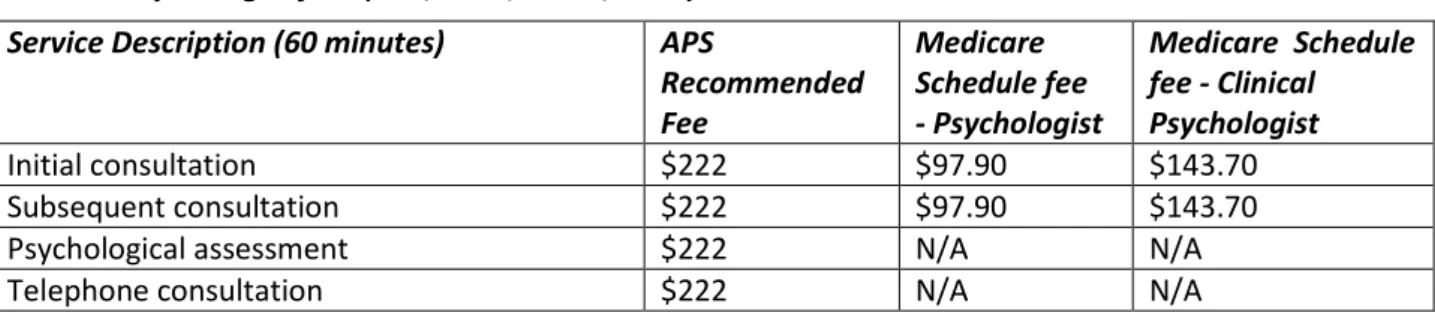
The recommended schedule fee for a psychologist consultation published by the Australian Psychological Society is $222 for a 50 minute session (APS, 2012), making the rebate quite high from the Private Health Fund’s perspective. Even if the psychologist charges a lower than schedule fee of say $150, a rebate of $45 would be payable for a 30% rebate, $75 for a 50% rebate, or $105 for a 70% rebate. With such high schedule fees, customers may use the whole of their available cover in a few sessions with a psychologist, or may not access the service at all if the consumer’s share is prohibitively high.
In light of this, it seems likely that uptake of private health insurance rebates for psychology services is at present low. This is in stark contrast to actual needs for counselling and psychotherapy in the community and the potential consequences for health and mental health when these services cannot be accessed. Counsellors and psychotherapists vary greatly in the professional fees they charge but fees generally range from $70 to $130 per session, with $90 to $100 per session being fairly standard. The affordability of counselling and psychotherapy compared with psychology means there is the potential to improve the extent of cover for psychological services if private health insurance rebates are made available for services provided by counsellors and psychotherapists.
Extending cover may also improve geographic access to services as counsellors and psychotherapists are widely distributed and accessible throughout Australia in urban, regional, rural and remote areas. Access will also be improved for clients from culturally and linguistically diverse backgrounds and for Indigenous clients, who often find it difficult to access culturally sensitive treatment services. Counsellors and psychotherapists come from diverse backgrounds, live in all parts of Australia and have experience providing a wide range of evidence-based treatments for a diverse client population.
Counsellors and psychotherapists already at a competitive disadvantage
Counsellors and psychotherapists are already significantly disadvantaged compared with psychologists by virtue of not being recognised by Medicare and not being able to offer their clients Medicare rebates. In addition, counsellors and psychotherapists are not GST exempt so those who reach the GST registration threshold also have to charge GST on their services.
This results in a reduction in access to appropriate services for consumers and this was also confirmed by the report PACFA received from the experienced WA psychotherapist:
“There are times where clients have been referred by a GP on a Mental Health Plan. This can further disadvantage clients as they can only access certain types of interventions through this plan. However in some instances GPs have referred clients to counsellors or psychotherapists not realising that their clients are not eligible to receive either Medicare or Private Health Fund rebates for these services. This has, at times, caused distress in the client when they are advised that they cannot receive rebates, and they can be caught in the conflict as to whether they can afford to continue with the counsellor or psychotherapist or whether to seek out the services of a psychologist for which they can receive rebates.
10
Often it is very clear to the counsellor or psychotherapist that the interventions offered under the Mental Health Plan by psychologists are not the appropriate type of therapy for a particular client, and that psychotherapy or counselling would be more suitable and of much greater benefit the client. In these cases the consumer is disadvantaged because they cannot get the preferred treatment.”
Out-of-pocket medical expenses
PACFA has undertaken an analysis of the out-of-pocket expenses incurred by clients of counsellors and psychotherapists compared with psychologists. While fees charged by practitioners vary considerably, it is reasonable to state that the fees charges by psychologists are in general higher per session than those charged by counsellors and psychotherapists. Counsellors and Psychotherapists generally charge between $70 and $130 per session plus GST.
Psychologist consultations vary greatly as detailed in table 2 below but it is quite common for
psychologists to charge between $120 and $160 per session. It should be noted that some psychologists bulk bill when providing Medicare-funded services for which the fee would be lower at $83.25 or
$122.15 for a clinical psychologists. Psychologist fees do not attract GST.
Table 2: Psychologist fees (APS, 2011; DoHA, 2012) Service Description (60 minutes) APS
Recommended Fee Medicare Schedule fee - Psychologist Medicare Schedule fee - Clinical Psychologist Initial consultation $222 $97.90 $143.70 Subsequent consultation $222 $97.90 $143.70
Psychological assessment $222 N/A N/A
Telephone consultation $222 N/A N/A
For illustration purposes, we have analysed how much the consumer will be out-of-pocket seeking a counselling service from different professionals. The out-of-pocket amount is impacted by 3 factors: the practitioner’s fee, whether GST is payable, and the availability (and amount) of the private health rebate:
Provider Base Fee* GST Medicare Rebate Private health rebate** Consumer out of pocket Psychologist $120 $70 $50 Psychologist $120 $65 $55
Psychologist with Medicare rebate
$120 $83.25 $36.75
Clinical psychologist $150 $70 $80
Clinical psychologist $150 $65 $85
Clinical psychologist with Medicare rebate
$150 $122.15 $27.85
Counsellor/psychotherapist not registered for GST
$120 $120
Counsellor/psychotherapist registered for GST
$120 $12 $132
Counsellor/psychotherapist not registered for GST
$90 $90
Counsellor/psychotherapist registered for GST
11 * These indicative fees are similar to fees currently charged by practitioners.
** Private health insurance rebate amounts vary for different health funds and different policies. This example is based on BUPA cover for psychology under their Silver Extras Policy for initial and subsequent consultations. This policy offers a maximum of $400 cover.
Even where the counsellor charges a much lower fee of $90 per session, the consumer is still more out-of-pocket that in all the other scenarios in this example where a psychologist is consulted. If private health insurance rebates were offered for counsellors and psychotherapists, the gap payments would be reduced considerably, improving the extent of cover for consumers and reducing their out-of-pocket costs.
Counsellors are already disadvantaged by not being able to offer Medicare rebates and not being able to access GST exemption. Giving consumers access to private health insurance rebates for counselling and psychotherapy is the only way to make these health services more accessible to consumers, given the other competitive disadvantages that counsellors and psychotherapists already face.
REFERENCES
Australian Psychological Society (2012). APS 2012-2013 Schedule of recommended fees and item numbers for psychological service. Retrieved 9 July 2012 from
http://www.psychology.org.au/community/fees_rebates/.
Cuijpers, P., van Straten, A., Smit, F., Mihalopoulos, C. and Beekman, A. (2008). Preventing the onset of depressive disorders: A meta-analytic review of psychological interventions. American Journal of Psychiatry, 165(10), 1272-1280.
Department of Health and Ageing, MBS Online. Retrieved 26 July 2012 from
http://www.mbsonline.gov.au/internet/mbsonline/publishing.nsf/Content/Downloads-201201
EMIS (2011).Cognitive Behavioural Therapy. Retrieved 28 July 2011 from
http://www.patient.co.uk/health/Cognitive-Behaviour-Therapy-(CBT).htm
Hunot, V., Churchill, R., Teixeira, V. & Silva de Lima, M. (2007). Psychological therapies for generalised anxiety disorder. Cochrane Database of Systematic Reviews, 1. Retrieved 24 July 2011 from
http://summaries.cochrane.org/CD001848/psychological-therapies-for-people-with-generalised-anxiety-disorder
Jorm, A., Korten, A.E., Jacomb, P.A., Rodgers, B., Pollitt, P., Christiansen, H., & Henderson, S. (1997). Helpfulness of interventions for mental disorders: beliefs of health professional compared with general public. British Journal of Psychiatry, 171, 233-237.
Psychotherapy and Counselling Federation of Australia, Submission to Private Health Funds, 1 August 2012. Published at http://www.pacfa.org.au/news/id/253.
Pirkis, J., Harris, M., Hall, W. & Ftanou, M. (2011). Evaluation of the Better Access to Psychiatrists, Psychologists and General Practitioners through the Medicare Benefits Schedule initiative:
Summative evaluation. Melbourne: Centre for Health Policy, Programs and Economics. Retrieved 20 July 2011 from
12 Rodgers, A. & Pilgrim, D. (1997). The contribution of lay knowledge to the understanding and promotion
of mental health. Journal of Mental Health, 6(1), 23-35.
Sharpley, C.F. (1986). Public perceptions of four mental health professions: a survey of knowledge and attitudes to psychologists, psychiatrists, social workers and counsellors. Australian Psychologist, 21, 57-67.
Sky News (2012). Dodgy backs linked to psych problems. Retrieved 1 August 2012 from
http://www.skynews.com.au/health/article.aspx?id=777663
Stevenson, J., Meares, R. and D’Angelo, R. (2005). Five-year outcome of outpatient psychotherapy with borderline patients. Psychological Medicine, 35, 79–87.
13
APPENDIX 1
Risks associated with the provision of counselling and psychotherapy by unregistered
Counsellors and Psychotherapists
The prevalence of risk has been reported to be the same for counselling and psychotherapy delivered by registered and unregistered health practitioners. Procci (2007) in the US estimates the risk of serious ethical breaches in psychotherapy is between 0.9 to 12%,with a mean of about 6%. An Australian survey of psychiatrists found that 7.6%, mostly male, reported erotic contact with patients during or after treatment ended (Leggatt, 1994).
While the types of risks for registered and unregistered practitioners are broadly similar, the reported incidence of complaints against unregistered practitioners in Australia is considerably lower. In NSW, 96.5% of complaints (n = 2,170) made to the NSW Health Care Complaints Commission for the period 2009-2010 were for Registered Health Practitioners. 0.4% (n = 8) were in relation to Counsellors and Psychotherapists, similar to the rate for Social Workers which was 0.4% (n = 8). Social Work is accepted as appropriately self-regulating based on the low risks associated with the profession and arguably, the counselling and psychotherapy profession is comparable to Social Work in this regard.
The largest category of risk PACFA has identified from ethical complaints arises where practitioners are in multiple roles, for example psychotherapist, trainer and supervisor. Incidents relating to the more serious ethical breaches such as sexual misconduct or practicing under the influence of alcohol or drugs were not common according to PACFA complaints data.
To what extent have the risks associated with these activities been realised in
practice? What evidence is available on the nature, frequency and severity of risks?
The risks associated with counselling and psychotherapy are generally not realised in practice with a low incidence of complaints. Most complaints are not of a serious nature and the most common outcome from complaints is the recommendation to strengthen professional supervision of the practitioner concerned.
PACFA has collated complaints data for the five years between 2006 and 2011, including complaints against individual practitioners and against Member Associations. Data for 4 of the PACFA Member Associations was not available.
State No of complaints To PACFA No of complaints To MAs Total
Australian Capital Territory 0 0 0
New South Wales 10 12 22
Northern Territory 0 0 0 Queensland 0 6 6 South Australia 0 0 0 Tasmania 0 0 0 Victoria 5 2 7 Western Australia 1 8 9 Unspecified 0 17 17 Total 16 45 61
14 Issue category No of complaints To PACFA No of complaints To MAs Total Breach of confidentiality 1 6 7 Sexual misconduct 0 5 5
Dual and multiple roles 4 7 11
Discrimination 1 2 3
Practicing under influence of Alcohol / Drugs 0 0 0
Other professional misconduct / breach of ethics 5 19 24
Unsatisfactory service or service outcome 1 2 3
Complaint processes 1 0 1 Fees/costs 0 2 2 MA functions/activities 3 2 5 Total 16 45 61 Complaint Outcomes No of complaints To PACFA No of complaints To MAs Total No case to answer 4 8 12 Withdrawn 1 11 12
Referred to another body 3 2 5
Resolution - Professional supervision required 1 7 8
Resolution – Membership & registration revoked 0 5 5
Resolution - MA suspended 3 0 2
Resolution - MA action required 4 3 7
Other 1 9 10
Total 16 45 61
References
Procci, W.R. (2007). Patient-therapist boundary issues: An integrative review of theory and research.
Focus,5, 407-411.
Leggett, A. (1994). A survey of Australian psychiatrists' attitudes and practices regarding physical contact with patients. Australian & New Zealand Journal of Psychiatry, 28 (3), 488-497.