Optimizing the Use of Random Access Channels in GSM-GPRS
JAHANGIR H. SARKER and SEPPO J. HALME
Communications Laboratory, Helsinki University of Technology, P.O. Box 2300, FIN-02015 HUT, Finland E-mail: {jahangir.sarker}{seppo.halme}@hut.fi
Abstract. The random access channels and traffic channels are utilized, respectively, for call establishment and information transmission in the uplink direction (from mobile to base station) of the Global System for Mobile communications (GSM) networks. A call is either rejected or blocked depending on its inability to succeed either in the random access channels or in the traffic channels. The optimum number of random access slots is directly proportional to the average call arrival rate, being independent of the average channel holding time and the number of traffic channels. The number of slots occupied by a given call can be changed dynamically in the newly developed General Packet Radio Service (GPRS) systems. A complete analysis is executed for the traffic channel utilization and call blocking probability with the exact number of random access slots that provide almost zero call rejection probability. The overall call success probability is derived considering call rejection and call blocking probabilities.
Keywords:call blocking, call rejection, GPRS, GSM, random access, traffic channel, overall call success.
1. Introduction
The core network of the Universal Mobile Communication Systems (UMTS) will be at least partly based on Global System for Mobile (GSM) [1]. The initial implementation of GSM was for voice communications. Like several other technologies the second-generation system GSM is evolving via General Packet Radio Services (GPRS), High Speed Circuit Switched Data (HSCSD) and Enhanced Data Rates for GSM Evolution (EDGE) towards UMTS [2]. Currently, the EDGE radio interface is being standardized by European Telecommunications Standard Institute (ETSI) and by TIA TR45.3 as a GSM Phase 2+ work item. The new EDGE radio interface deploys 8-PSK modulation instead of GMSK, thus enabling a higher data throughput per slot [3].
In GSM, a fixed number of radio carriers are allocated in each base station. Precisely, the central frequencies of the carriers are positioned every 200 kHz within the system frequency band (FDMA aspect). Each carrier is divided into time frames of duration 60/13 ms and again each time frame is divided into 8 parts along the time axis calledslots (TDMA aspect). A traffic channel has a single slot in every time frame (or 60/13 ms). In a given base station the number of traffic channels is limited. In the existing GSM system, free traffic channels are given to a circuit-mode voice call on a reserved basis for the whole conversation period on a “one traffic channel for one voice call” basis. A voice call isblockedwhen all traffic channels in a base station are occupied.
A talker of a voice call does not talk continuously. The slots of a traffic channel are oc-cupied when the talker is active and unococ-cupied (gaps) when the talker is silent. The circuit mode voice calls (with a given blocking probability in a base station) keep some unused traffic channel(s) and the dynamic silence gap(s) and thus waste some radio resources. The
packet-mode data transmission technology, GPRS is an effective solution, because it can transmit over the unused traffic channels and silence gaps of existing voice calls in that base station without increasing the voice call blocking probability. A GPRS call can occupy a maximum of 8 slots in a time frame and the number of occupied slots in the next time frames can be changed dynamically [4–8]. Unfortunately, a GPRS call may suffer from a high delay when the network is congested. Some services like video streaming need to transmit data using multiple traffic channels almost with a constant delay. A HSCSD call occupies a multiple number of traffic channels at a time up to completing its whole data transmission time [9]. Thus, HSCSD provides the solution for services like video streaming [10].
If a multiple number of traffic channels are occupied by each HSCSD call from a limited number of traffic channels in a base station then the number of traffic channels for voice calls is reduced, thus increasing the existing voice call blocking probability. Fortunately, for the same voice call blocking probability, the overall channel utilization with continuous multichannel occupied HSCSD calls is higher than the case without HSCSD calls. The overall channel utilization increases with increasing number of HSCSD calls pertaining to the same voice call blocking probability [11]. Such a result encourages the operators to provide different kinds of services using HSCSD with the existing voice services and thus, to increase the different types of calls from mobile terminals. The effective call arrival to the traffic channels depends on the output of the random access channels.
The random access scheme of the GSM network is slotted ALOHA based, which is an efficient algorithm for the distributed bursty traffic. Since the call arrival of a GSM base station is bursty in nature, the choice is appropriate. Slotted ALOHA is used mainly for two kinds of purposes: (1) mobile data transmission and, (2) the request for a dedicated mobile channel. In the first kind of purpose, each packet should be received successfully. So, the retransmissions take place up to the successful reception of each data packet. On the other hand, for the request of a dedicated mobile channel, the successful reception of each data packet is not needed. Therefore, the retransmission cut-off occurs after a certain number of retransmissions involved. Slotted ALOHA with retransmission cut-off is discussed in [12– 16]. A call is rejected if its requested packet(s) fails to transmit through random access slot(s). Traditionally, excess random access slots are mapped in physical channels of a base station, and a maximum possible number of retransmissions is allowed to reduce the call rejection probability [5, 6, 19].
Most of the earlier papers either analyze the random access channels [12–16] or the traffic channels [7, 8, 10, 11] of a TDMA based cellular system. This paper fills this gap by combining those two types of channels together. Our results will help wireless cellular network operators to properly dimension their wireless access systems. The rest of the paper is organized as follows. Section 2 describes the system model. The efficiency of random access channel is described in Section 3. The average number of channels occupied by a single slot occupied voice and multislot occupied GPRS calls together with the optimization of number of random access slots are presented in Section 4 and Section 5 respectively. The overall call success probability depends on two types of channels: random access channels and the traffic channels and both are considered in Section 6. Finally, Section 7 provides the conclusions.
2. System Model
The ETSI GSM specifications define three classes of mobile stations depending on the simultaneous support of attachment, monitoring activation, invocation and traffic flow on circuit-switched voice and packet-switched data services [17]. (1) Class A mobile stations support simultaneous attachment, monitoring, activation, invocation and traffic flow on both voice and data services [18]. (2) Class B mobile stations support simultaneous attachment, monitoring and activation but invocation and traffic flow are mutually exclusive. (3) Class C mobile stations support only non-simultaneous attachment, monitoring activation, invocation and traffic flow on both circuit-switched voice and packet-switched data services. In this paper a special class C type scenario is considered, where all calls are either circuit-switched voice calls or packet-switched data calls.
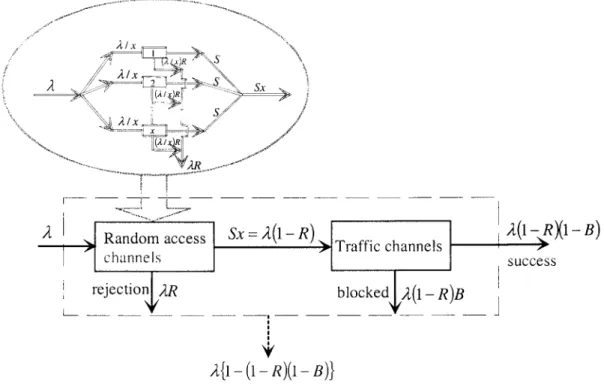
Consider first the circuit-switched voice calls. The system model is shown in Figure 1. In the case of a normal GSM transmission system, one mobile terminal initiates the call using Random Access CHannel (RACH) [19]. The random access channel scheme is based on slotted ALOHA. Each random access channel consists of a number of slots. A given access packet is first transmitted into a random access slot. If the access packet is unsuccessful then the same packet is transmitted into another random access slot. After a successful reception of an access packet through the random access slot(s), the mobile network realizes that one terminal requires radio resources in a base station. A given base station is considered where a maximum ofMvoice calls are allowed to transmit voice bursts at a given time. The arrival of voice calls is assumed to have a Poisson distribution with a mean of λ. The number of random access slots in random access channels isxfor voice calls. The selection of a random access slot is random in nature. Therefore, the Poisson arrival traffic is distributed uniformly over the random access slots that are also Poisson distributed. The output process of different contention packet broadcasting systems is studied in [20]. We assume that the output ofeach
random access slot is Poisson with a mean ofS as shown in Figure 1 (same as the slotted ALOHA throughput or output). Since the addition of Poisson arrivals is also Poisson, the overall output of the random access channels (also the input of the traffic channels) is Poisson where the mean is the addition of multiple output means corresponding to each random access slot.
After a successful reception of a voice call (access packet) through the random access channels (slots), the base station allocates a Traffic CHannel (TCH) for that mobile call to transmit its voice bursts if the network has that TCH available. A voice call does not occupy each slot of a traffic channel. A fractional part of the slots is occupied by each voice call and is considered in the next section.
Consider now a base station serving only GPRS calls. A GPRS call transmits its “bursty” packets occupying 0 to 8 slots from a single time frame if needed and the base station has the free slots available to provide them. If the slots are not available during that time, the packets are buffered and transmitted in the next available slots. A particular case is considered in this paper where the radio resource is provided immediately if needed (real-time transmission system). Therefore, queueing is not allowed and as a consequence the number of allowed calls Din a given base station is limited.
Figure 1. System model.
3. Efficiency of Random Access Channels
3.1. THENUMBER OFRANDOMACCESSSLOTS
Let the call arrival from all GSM calls be exponentially distributed with a mean rateλ. The number of random access (Slotted ALOHA based) slots is x. In the GSM network, a mo-bile terminal generates call access packets and transmits those into the random access slots (RACH). Let us assume that the call (packet) arrival is uniformly distributed over thexrandom access slots. Thus, the call arrival rate per slot isλ/x(packet).
The pessimistic assumption made in studies of standard ALOHA networks is that any collision invariably leads to a mutual destruction of all interfering packets presented in that slot. The throughput of Slotted ALOHA can be increased in a system incorporating the so-called capture effect. Capture is defined as the situation when two or more packets collide in a time slot and one of these packets is recovered. Consider a realistic receiver where a test packet is successfully captured if its power is sufficiently higher than that of the interfering packet(s) in the same slot for a certain fraction of time of the total slot duration locking the receiver onto that packet. Consider that the probability of success of a test packet withnother interfering packets isPC(Su/n). The capture effect is defined as follows. In the case of packet collision, a test packet is captured if its powerPt is larger thanztimes the combined power of nother interfering packets’ powerPn, i.e.,PC(Su/n)=Pr(Pt > zPn), wherez(z≥1)is the capture ratio. This capture phenomenon is defined and analyzed in [21]. For the incoherent
power addition of interfering packets, in which alln+1 packets are received with equal mean power, the probability of success of a test packet is given by
PC(Su/n)= 1 1+z n . (1)
It is further assumed that the call (access packet) arrival rate from any mobile terminal is equal. If the first attempt is unsuccessful, the mobile terminal retransmits its access packet after a random delay. Therefore, the aggregate traffic (1st attempt and the retransmitted traffic) generation rate from any terminal is greater than or equal to the call (access packet) arrival rate. Since the selection of a random access slot is random, the aggregate traffic generation rate from any mobile terminal transmitted to any slot can also be considered as equivalent. The system is assumed to bememoryless, where the probability of transmitting a packet in a given slot is independent of the state of the previous slot(s). In the case of an infinite number of users, the distribution of the interfering packets is Poisson and can be written as
I (n)= G n
n! exp(−G) , (2)
where G is the average aggregate traffic (1st time call arrival and a certain number of retransmissions arrival) generation rate from all active calls per access slot.
Therefore, the unconditional probability of successful capture of an access test packet is PC(Su)=
∞
n=0
I (n)PC(Su/n) (3)
which after rearranging yields PC(Su)=exp −G z 1+z . (4)
According to specifications, a maximum ofr retransmissions is allowed for each mobile call during the access period. The parameterr can be set to four different possible values 1, 2, 4 or 7 [19, 22, 23]. A higher retransmission numberrreduces the access rejection probability, and hence r = 7 is a widely used setting parameter [5, 6, 19]. Considering this particular case and including the first transmission, the maximum allowed transmission number is 8. The retransmission cut-off scheme is studied in [16] and accordingly, the throughput per slot is redefined as S= λ x[1− {1−PC(Su)} 8] = λ x 1− 1−exp −G z 1+z 8 , (5)
where the relation between the new packet arrival rate per random access slot λ/x and the aggregate arrival rate ineachaccess slotGis
λ/x= Gexp −G z 1+z 1− 1−exp −G z 1+z 8. (6)
The throughput or the successful call access rate per random access slot isSper time slot. The overall successful arrival rate into the traffic channels from all active calls isSx. Note that the value ofS should always be less than one packet per time slot, but the value of Sx
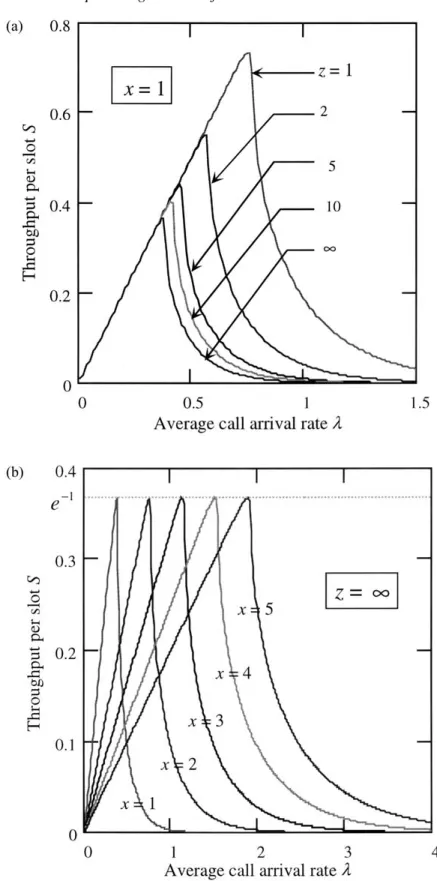
might be larger than one, of course its value should be less than or equal toλ. The random access throughput per slotSfor different values of capture ratiozand the number of slots,x, is shown in Figure 2.
Figure 2(a) indicates that below a certain limit of the call arrival rate, the output of the random access per slotSincreases linearly for a given value of capture ratio,z. Beyond that limit, the throughput decreases abruptly. Similarly, Figure 2(b) demonstrates that for a certain number of slotsx, the access throughput per slot increases linearly up to a certain value of the average access arrival rate. After that the throughput decreases sharply.
We are more interested in this access state to give full availability for all kinds of GSM calls. In the second stage, if all traffic channels are full and the network is unable to provide any service, the network informs the mobile terminal of itsblockedcall. On the other hand, if the call isrejectedin the access stage, a mobile terminal cannot receive any message from the base station. Physically, it is unknown to the network that a terminal tries to access to transmit its information. In this case, the mobile terminal may receive an automatic “access rejection” signal, which may request the mobile user to try again. The mobile user may think that the network is full and attempt to call later. This is true for the case of call blocking but not for call rejection. Thus, the operators have to stimulate more random access slots to avoid the call rejection.
There are five different structures of the RACH [24, 25] with approximately 400,000 and n∗780,000 RACH slots per hour(n=1,2,3,4). It is interesting to know the exact choice of these five different possibilities. It is well known that the Slotted ALOHA with capture shows its maximum throughput when the aggregate traffic generation rate from all active GSM calls per each random access slot isG=(1+z)/z. Using this value in Equation (6), the optimum relation between the call arrival rate and the number of slots becomes
x=
λz1−(1−e
−1)8
(1+z)e−1 , (7)
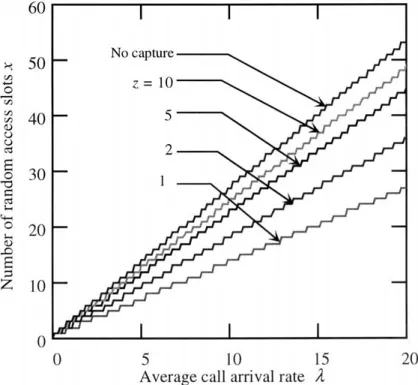
where w is the smallest integer ≥ w. The numerical representation of Equation (7) is depicted in Figure 3.
In principle, the capture has not been practically used in GSM network. The estimation of the optimum number of random access slots for a given time is the main concern in a new cellular environment. Thus, per slot throughputwithoutcapture can be written from Equation (5) as
S= λ
x[1− {1−exp(−G)}
8], (8)
whereλ/xis the call (new packet) arrival rate per random access slot and the aggregate packet arrival rate per slotGis related to
λ/x= Gexp(−G)
1− {1−exp(−G)}8. (9)
As a matter of fact, Equation (9) is the fundamental relationship between the aggregate packet generation rateGand the average call arrival rate/slotλ/x.
Figure 2. Random access throughput per slotSvs. average call arrival rateλfor different values of capture ratio zand number of slotsx: (a) Number of slotsxequal to one. (b) System without capture.
Figure 3. The optimum number of random access slotsxfor different capture ratios. 3.2. THEAVERAGENUMBER OFTRANSMISSIONS
The average number of transmissions defines the average number of slots needed for a suc-cessful access packet transmission. A GSM user tries to access the base station immediately, if it has any information to transmit. If the first access transmission is unsuccessful, it retransmits its access packet. In GSM maximum 8 time transmissions are allowed.
The probability that the packet is successfully transmitted after thekth transmission is Qk = {1−P (Su)}k−1P (Su) 1≤k≤8. (10) Obviously, Equation (10) is not the absolute geometric distribution for the access attempt k(1≤k≤8). Therefore, the modified distribution is
Qk =Qk ∞ k=1 Qk 8 k=1 Qk
which yields the modified geometric distribution
Qk = {1−P (Su)}
k−1P (Su)
Finally, the access delay or expected number of slots needed for a successful transmission of an access packet is D= 8 k=1 kQk = P (Su) 1− {1−P (Su)}8 8 k=1 k{1−P (Su)}k−1 which after simplification is
D = P (Su) 1− {1−P (Su)}8 1−9{1−P (Su)}8+8{1−P (Su)}9 [1− {1−P (Su)}]2 = = 1−9 1−exp −G z 1+z 8 +8 1−exp −G z 1+z 9 1− 1−exp −G z 1+z 8 exp −G z 1+z , (12)
where the relationship between aggregate packet arrival rateGper time slot and average call arrival rateλ/xper time slot can be obtained from Equation (6).
The average number of transmissions without capture is obtained from Equation (12) using z→ ∞
Dno capture=
1−9{1−exp(−G)}8+8{1−exp(−G)}9
[1− {1−exp(−G)}8]exp(−G) , (13)
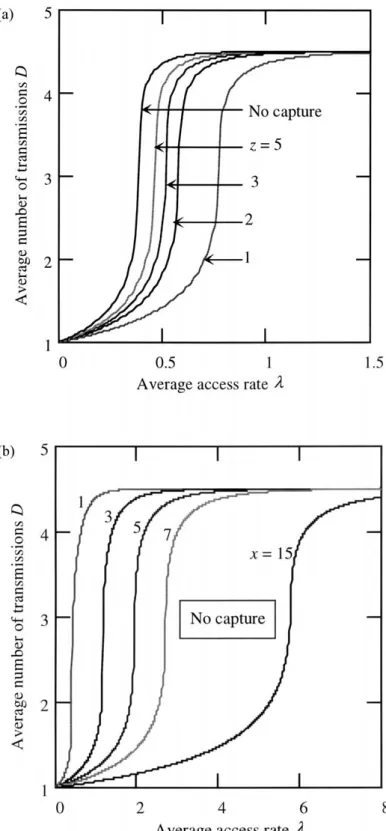
where the relation between λ/x and G is shown in Equation (9). The average number of transmissions of an access packet for a successful call arrival is depicted in Figure 4. Note that the formula includes only the successful call arrival (packets), but not those packets that are finally rejected.
3.3. CALLREJECTION PROBABILITY
Another interesting parameter in the random access channels is the call rejection probability. It defines the probability that an access packet is rejected. If an access packet is rejected, a mobile terminal cannot inform the network of its desire for service. For this reason, the network or base station cannot inform the mobile terminal of its access failure. This parameter can be calculated in the following way. The probability that an access packet is successfully transmitted after the first transmission is P (Su). The probability of failure after the first transmission is {1−P (Su)}. The failure probability in each transmission time is assumed to be independent in nature. Since the transmission takes place 8 times (maximum limit), the call rejection probability is
R= 1−exp −G z 1+z 8 . (14)
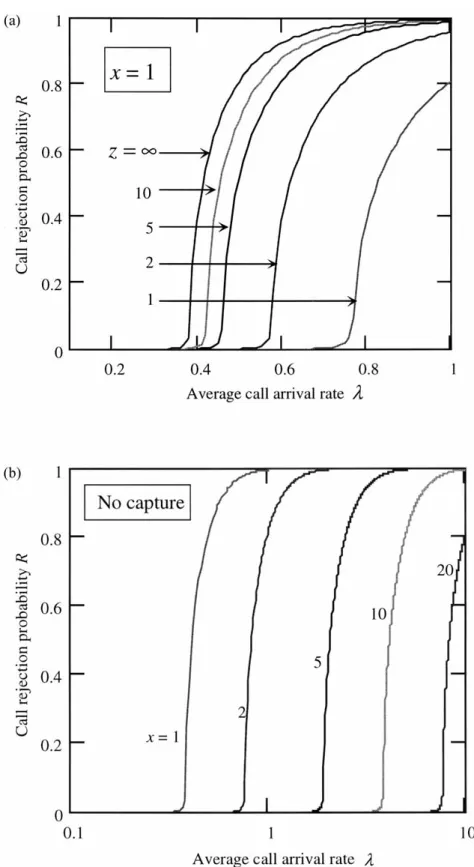
The numerical representation of the call rejection probability is shown in Figure 5. 4. Fractional Channel Occupied Voice Transmission System
Consider only voice calls in a base station, where a voice call uses the random access chan-nels to inform the network that it needs a traffic channel for speech burst transmission. The
Figure 4. Average number of transmissions needed for a successful call arrival: (a) Number of access slotsx=1. (b) System without capture.
output traffic of the random access channels directly works as the input traffic of the traffic channels as shown in Figure 1. The call arrival of voice sources is Poisson with a meanλv. An assumption is made that the random access slot rate isxslots per unit time and those slots are exclusively used for voice calls. If the output of each random access slot isSv, then the average successful call arrival rate to the traffic channels isSvx. If a voice call is successful (neither rejected nor blocked), it holds a traffic channel for the entire conversation period of its user. Let us further assume that the traffic channel (call) holding time of each mobile call is independent and exponentially distributed with a mean 1/µv. If a maximum ofMvoice calls are allowed to transmit voice bursts at a time, the probability that voice calls occupymtraffic channels is p(m)= (Svx/µv) m/m! M i=0 (Svx/µv)i/ i! . (15)
Therefore, there aremtalkers in that network. It is well known that a talker does not talk continuously. Talker activity can be modeled with a two state Markov model. Let the slot duration beτ sec. The talk spurts are assumed to be exponentially distributed with mean 1/σ and the distribution isα =exp(−τ σ). The transition probability from a talk spurt to the next silence period isµ2 = 1−α = 1−exp(−τ σ ). The silence periods are also assumed to be exponentially distributed with mean 1/γ and the distribution isβ =exp(−τ γ ). The transition from a silence period to the next talk spurt isλ2=1−β =1−exp(−τ γ )[26]. It can be shown that a multiple number of exponential voice calls can be modeled as a binomial distribution [27].
Assume that the speech active states and silence states of each voice call are uncorrelated over the GSM slot periods. Defining the states as the situation, wheremtraffic channels are used for speech transmission,i of these in the speech active state and(m−i)in the silence state, whereby the probability of that can be expressed as [27]
p(i|m) = m i (λ2/µ2)i m j=0 m j (λ2/µ2)j = m i ai(1−a)m−i, (16)
whereais the voice traffic activity factor and given by a= λ2
λ2+µ2
. (17)
Considering the voice activity factor, the probability thatitraffic channels are occupied by allMvoice calls can be written as
p(i)= M
m=i
Therefore, the traffic channel utilization defines the ratio of average number of channels occupied by all voice calls to the maximum number of channels allocated for all voice calls and referring to Appendix A:
U = 1 M M i=0 ip(i)= (Svx/µv) M a[1−p(M)], (19)
wherep(M)is the probability that a voice call is blocked because of traffic channel saturation and is given by:
p(M)= (Svx/µv) M/M! M i=0 (Svx/µv)i/ i! . (20)
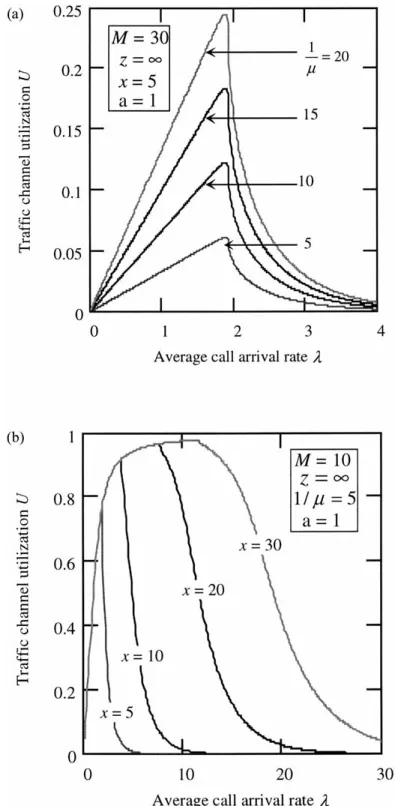
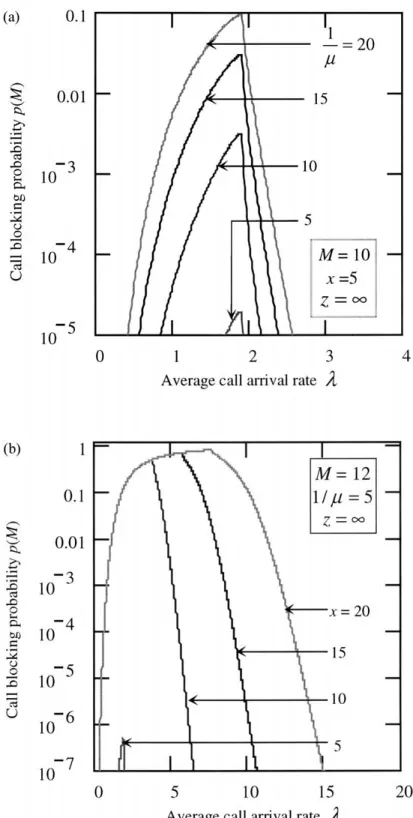
The traffic channel utilization with the variation of average call arrival rate is shown in Figure 6. Figure 6(a) shows that the channel utilization increases linearly up to a certain limit of the call arrival rate and later on decreases drastically. The steepness of the linearly increas-ing curve is proportional to the average channel holdincreas-ing time 1/µv. Figure 6(b) illustrates that by increasing the number of random access slotsx, one can augment the transition point of the average call arrival rate (where channel utilization decreases abruptly). On one hand, the increased number of random access slots decreases the call rejection probability and the channel utilization can achieve its saturation level (Figure 6(b)). On the other hand, the call blocking probability also increases as shown in Figure 7(b).
5. Multislot GPRS Transmission System
Consider a base station where only the GPRS data calls are present. The call arrival at that base station has a negative exponential distribution with meanλD. The base station allocates yrandom access slots for GPRS calls. If the output of each random access slot isSd, then the average GPRS call arrival rate to the traffic channels isSdy. Assume that the data transmission time of each GPRS call is independent and exponentially distributed with a mean 1/µD. If a maximum ofDGPRS calls are allowed to transmit multislot GPRS calls then the probability thatnGPRS calls are in that base station is
p(n)= (Sdy/µd) n/n! D i=0 (Sdy/µd)i/ i! . (21)
A GPRS call can occupy a maximum of 8 slots in a time frame and the number of slots occupied in the next time frames can be changed dynamically. Consider the general analytical case where one GPRS call can occupy a maximum ofq (practically 8) slots. Therefore, n data calls occupy a maximum ofnq slots within a “time frame” duration. Assume that the occupation of each slot is independent of each other and the probability of occupying a slot is b. Consequently, the probability thatnGPRS calls occupykslots is given by
p(k|n)= nq k bk(1−b)nq−k. (22)
Figure 6. Traffic channel utilization vs. average call arrival rate. (a) For different call holding times 1/µ. (b) For different numbers of random access slotsx.
Figure 7. Call blocking probability versus average call arrival rate: (a) For different call holding times 1/µ. (b) For different numbers of random access slotsx.
The probability that allDdata calls occupykslots is given by p(k)= D n=k/q p(k|n)p(n) sincep(k)=0 forn <k/q, (23) where the value ofwdefines the smallest integer≥w.
Finally, the average number of channels occupied by all theD GPRS data calls can be obtained from Appendix B as
UD = D
k=0
kp(k)=(Sdy/µd)bq[1−p(D)], (24) wherep(D)defines the probability that the maximum number of data calls are in the network and can be written from Equation (21) as
p(D)= (Sdy/µd) D/D! D i=0 (Sdy/µd)i/ i! . (25)
The discontinuous multislot occupied GPRS calls show the similar result to that of discon-tinuous single slot occupied voice calls. The average channel occupied by the multislot GPRS calls as in Equation (24) isq times larger than that of single slot occupied voice calls (i.e., Equation (19)). The channel occupation probabilities for discontinuous voice and GPRS calls are already defined asaandb, respectively. Therefore, the numerical results of discontinuous multislot occupied GPRS calls resemble the discontinuous single slot occupied voice calls. 6. Call Success Probability
The following derivation is based on call rejection probability, which is important in the random access channel analysis and on blocking probability which is important when analyz-ing the traffic channel performance. Consideranalyz-ing that a call is rejected in the random access channels with a probabilityR, the input probability of the traffic channels is(1−R). A call is blocked in the traffic channels with a probabilityB. Therefore, the probability that a call is successfully transferred (neither rejected nor blocked) is given by
T =(1−R)(1−B) . (26)
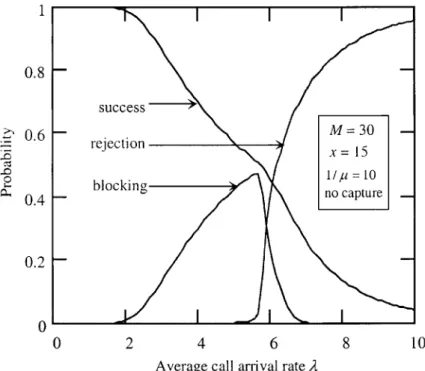
A numerical representation of Equation (26) is depicted in Figure 8 for a few sets of specific values of different parameters that constitute two separate regions:
1. Ifλ < x(1+1/z)e−1{1−(1−e−1)8}−1: (a) The call rejection probability is almost zero.
(b) The call blocking probability increases linearly and thus the call success probability decreases linearly. The steepness of these two curves is proportional to the average traffic channel holding time 1/µ, and inversely proportional to the number of traffic channelM.
Figure 8. Rejection, blocking and success probabilities.
(a) The call rejection probability increases abruptly. Thus, most of the calls are rejected in the random access channels.
(b) The arrivals to the traffic channels decreases and thus the call blocking probability also decreases.
(c) The overall call success probabilityT, declines abruptly because of a sharp increase in call rejection probabilityR.
Finally, it must be emphasized that the overall call success probability can definitely be calculated using the traditional Erlang formula if and only if the number of random access slots is more thanλe{1−(1−e−1)8}(1+1/z)−1.
7. Conclusions
We have derived a closed form expression to compute the optimum number of random access slots. The transfer probability (inverse of rejection probability) of the random access channels depends on the number of random access slots. A capture effect is inserted in the random access scheme. The required number of random access slots is directly proportional to the average call arrival rate. This can be reduced by an increase of the capture effect (capture effect increases with the decrease of capture ratiozand a receiver works without capture if the value ofztends to infinity). The number of random access slots is proportional to(1+1/z)−1. The anticipated number of random access slotsx is obtained by adjusting the optimum aggregate traffic generation rate per time slot G(Equation (7)). The reasons are as follows. The retransmission cut-off is strongly recommended for the stable operation of random access if the average call arrival rate per time slotλ/x, is more than(1+1/z)e−1, otherwise through-put decreases abruptly [16]. This transition point is obtained from the optimum aggregate
traffic generation rate. The maximum number of transmission is 8, equivalent to the case without retransmission cut-off [16]. Thus the required number of random access slots (or the optimum number of random access slots) can be calculated from the optimum aggregate traffic generation rate that maximizes the random access throughput.
The traffic channel utilization for different numbers of random access slots is derived. If a lesser number of random access slots is involved then the traffic channel utilization deteriorates significantly. The reasoning is that more calls are rejected in the access chan-nels. A greater number of random access slots can reduce the call rejection probability and hence increase the traffic channel utilization. However, this leads to a higher call blocking probability.
The overall call success probability experiences a detrimental effect if the number of ran-dom access slots is less thanλe{1−(1−e−1)8}(1+1/z)−1, where wis the smallest integer ≥ w and λ has the same unit (Figure 8). Obviously, the number of random access slots in random access channels depends exclusively on the average call arrival rateλ, and the capture ratioz.
Acknowledgements
The authors would like to thank the reviewers for their constructive comments and sugges-tions.
References
1. P. Chaudhury, W. Mohr and S. Onoe, “The 3GPP Proposal for IMT-2000”,IEEE Communications Magazine, Vol. 37, No. 12, pp. 72–81, 1999.
2. W. Mohr, “Development of Mobile Communications Systems Beyond Third Generation”,Wireless Personal Communications, Vol. 17, Nos. 2–3, pp. 191–207, 2001.
3. S. Nanda, K. Balachandran and S. Kumar, “Adaptation Techniques in Wireless Packet Data Services”,IEEE Communications Magazine, Vol. 38, No. 1, pp. 54–64, 2000.
4. S. Faccin, Hsu. Liangchi, R. Koodli, Le. Khiem and R. Purnadi, “GPRS and IS-136 Integration for Flexible Network and Services Evolution”,IEEE Personal Communications, Vol. 6, No. 3, pp. 48–54, 1999. 5. C. Jain and D.J. Goodman, “General Packet Radio Service in GSM”,IEEE Communications Magazine,
Vol. 35, No. 10, pp. 122–131, 1997.
6. G. Brasche and B. Walke, “Concepts, Services, and Protocols of the New GSM Phase 2+ General Packet Radio Service”,IEEE Communications Magazine, Vol. 35, No. 8, pp. 94–104, 1997.
7. J.H. Sarker and S.J. Halme, “Efficiency of the GSM-GPRS Air Interface for Real-Time IP Traffic Flows With and Without Packet Dropping”,Wireless Personal Communications, Vol. 21, No. 1, pp. 125–140, 2002. 8. C.-C. Lee and R. Steele, “Signal-to-Interference Calculations for Modern TDMA Cellular Communication
Systems”,IEE Proceedings- Communications, Vol. 142, No. 1, pp. 21–30, 1995.
9. GSM 02.34, V5.1.0, “Digital Cellular Telecommunication System (Phase 2+); High Speed Circuit Switched Data (HSCSD)-Stage 1”, March 1997.
10. J. Dunlop, “Potential for Compressed Video Transmission over the GSM HSCSD Service”, Electronics Letters, Vol. 33, No. 2, pp. 121–122, 1997.
11. J.H. Sarker, S.H. Halme and M. Rinne, “Performance Analysis of GSM Traffic Channel Capacity With(out) High Speed Circuit Switched Data”, inIEEE VTC2000 Fall, Boston, U.S.A., Sept. 24–28, 2000, pp. 1603– 1609.
12. S.W. Kim, “Frequency-Hopped Speed-Spectrum Random Access with Retransmission Cutoff and Code Rate Adjustment”,IEEE Journal of Selected Areas in Communications, Vol. 10, No. 2, pp. 344–349, 1992. 13. K. Sakakibara, H. Muta and Y. Yuba, “The Effect of Limiting the Number of Retransmission Trials on
the Stability of Slotted ALOHA Systems”,IEEE Transactions on Vehicular Technology, Vol. 47, No. 4, pp. 1449–1453, 2000.
14. C. Luders and R. Haferbeck, “The Performance of the GSM Random Access Procedure”, inIEEE 44th Veh. Tech. Conf. 94 (VTC’ 94), Stockholm, Sweden, June 8–10, 1994, pp. 1165–1169.
15. J.H. Sarker and S.J. Halme, “The Prudence Transmission Method I (PTM I): A Retransmission Cut-Off Method for Contention Based Multiple-Access Communication Systems”, inIEEE 47th Veh. Tech. Conf. 97 (VTC’ 97), Phoenix, AZ, U.S.A., May 4–7, 1997, pp. 397–401.
16. J.H. Sarker and S.J. Halme, “An Optimum Retransmission Cut-Off Scheme for Slotted ALOHA”,Wireless Personal Communications, Vol. 13, Nos. 1–2, pp. 185–202, 2000.
17. GSM 02.60, “Digital Cellular Telecommunications System (Phase 2+); General Packet Radio Service (GPRS); Service Description; Stage 1”, ETSI.
18. M. Pecen and A. Howell, “Simultaneous Voice and Data Operation for GPRS/EDGE: Class A Dual Transfer Mode”,IEEE Personal Communications, Vol. 8, No. 2, pp. 14–29, 2001.
19. M. Mouly and M.-B. Pautet,The GSM System for Mobile Communications, published by authors, 1992. 20. H. Takagi and L. Kleinrock, “Output Process in Contention Packet Broadcasting Systems”,IEEE
Transac-tions on CommunicaTransac-tions, Vol. COM-33, No. 11, pp. 1191–1199, 1985.
21. J.C. Arnbak and van Blitterswijk, “Capacity of Slotted ALOHA in Rayleigh-Fading Channels”, IEEE Journal of Selected Area on Communications, pp. 261–269, 1987.
22. ETSI-GSM Technical Specification, GSM 04.08, Version 4.4.0, “Mobile Radio Interface-Layer 3 Specifica-tion”, April 1993.
23. ETSI EN 300 940, GSM 04.08 Version 7.1.2, “Digital Cellular Telecommunications System (Phase 2+); Mobile Radio Interface Layer 3 Specification”, 1998.
24. ETSI-GSM Technical Specification, GSM 05.02, Version 4.2.0, “Physical Layer on the Radio Path, Multiplexing and Multiple Access on the Radio Path”, April 1993.
25. EN 300 908, GSM 05.02 Version 6.4.1, “Digital Cellular Telecommunications System (Phase 2+); Multiplexing and Multiple Access on the Radio Path”, 1997.
26. S. Nanda, “Stability Evaluation and Design of the PRMA Joint Voice Data System”,IEEE Transactions on Communications, Vol. 42, No. 5, pp. 2092–2104, 1994.
27. J.H. Sarker, “Voice and Data Transmission over the TDMA Based Networks”, Master’s thesis, Helsinki University of Technology, Finland, 1996.
Appendix A: Derivation of Equation (19)
The channel utilization/efficiency for the discontinuous voice traffic over a circuit-switched based network with voice activity is
U = M i=0 ip(i) M = 1 M M i=1 i M m=i p(i/m)p(m) = 1 M M i=1 i M m=i (Svx/µv)m/m! M m=0 (Svx/µv)m/m! m i ai(1−a)m−i = (Svx/µv)a M M i=1 M m=i (Svx/µv)m−1 (m−1)! M m=0 (Svx/µv)m/m! (m−1)! (m−i)!(i−1)! 1 a i−1 (1−a)m−i.
Letm =m−1 ⇒ (Svx/µv)a M M−1 i=0 M−1 m=i (Svx/µv)m m! M m=0 (Svx/µv)m/m! m! (m−i)!i! 1 a i(1−a)m−i = (Svx/µv)a M M i=0 M m=i (Svx/µv)m m! M m=0 (Svx/µv)m/m! m! (m−i)!i! 1 a i(1−a)m−i− (Svx/µv)M M! M k=0 (Svx/µv)k k! .
The first term inside the third bracket is equal to 1 and the second term is call blocking probabilityas in Equation (20). Thus,
U = (Svx/µv)a
M [1−p(M)].
Appendix B: Derivation of Equation (24)
The average number of channel occupied by allDnumbers of GPRS data calls is
UD = Dq k=0 kp(k) = Dq k=1 k D n=k/q p(k|n)p(n) = Dq k=1 k D n=k/q (Sdy/µd)n/n! D n=0 (Sdy/µd)n/n! nq k bk(1−b)nq−k = Dq k=1 D n=k/q (Sdy/µd)n (n−1)! D n=0 (Sdy/µd)n/n! q(nq−1)! (nq−k)!(k−1)! 1 b k (1−b)nq−q.
Letn=n−1 ⇒ (Sdy/µd)bq (D−1)q k=0 D−1 n=k/q (Sdy/µd)n n! D n=0 (Sdy/µd)n/n! (nq)! (nq−k)!k! 1 b k( 1−b)nq−k = (Sdy/µd)bq Dq k=0 D n=k/q (Sdy/µd)n n! D n=0 (Sdy/µd)n/n! (nq)! (nq−k)!k! 1 b k( 1−b)nq−k− (Sdy/µd)D D! D n=0 (Sdy/µd)n n!
The first term inside the third bracket is equal to 1 and the second term is the GPRS call blocking probability given in Equation (25). Therefore,
Jahangir H. Sarker received B.Sc. degree in electrical and electronics engineering from Bangladesh University of Engineering and Technology, Dhaka, Bangladesh, in 1991, and M.Tech. and Licentiate Tech. degrees in electrical and communication engineering from Helsinki University of Technology, Finland in 1996 and 2000 respectively.
From July 1994 to September 1996, he was a research assistant in communication labo-ratory of Helsinki University of Technology. Since October 1996, he is serving as a research scientist in communication laboratory of Helsinki University of Technology. Mr. Sarker re-ceived Qualcomm Inc., research award in 1997, for his contribution to the IEEE International Conference on Personal Wireless Communications (ICPWC’97). His research interests in-clude packet access, radio resource allocation, and queueing theory. He is a member of IEEE.
Seppo J. Halmewas born in Ruokolahti, Finland, on May 17, 1938. He received the degree of Diploma Engineer (Honors) in 1962, and the degree of Licentiate in Engineering in 1966, both in electrical engineering, from the Helsinki University of Technology, Helsinki, Finland, and the Ph.D. degree in communications from the Massachusetts Institute of Technology, Cambridge, in 1970.
He was nominated assistant professor in 1970 and professor of communication engineer-ing in 1972. He has also served as dean of Electrical Engineerengineer-ing Department in Helsinki University of Technology. Dr. Halme has published over 500 scientific articles, reports, and books.