GAME BASED LEARNING FOR MOBILE USERS
Ioannis Antonellis, Christos Bouras and Vassilis Poulopoulos Research Academic Computer Technology Institute N. Kazantzaki, University Campus, GR-26500 Patras, Greece
and
Computer Engineering and Informatics Department University of Patras,
GR-26500 Patras, Greece
E-mail: {antonell, bouras, poulop}@ceid.upatras.gr
KEYWORDS
Game based learning, web community, mobile devices, small screen device, mobile games.
ABSTRACT
Game based learning has been studied as an important alternative or supplement to traditional teaching. Existing web based platforms that utilize the power of the Internet in order to provide efficient access to information regarding computer learning games aim to create online communities. However, such attempts target only on traditional Internet users, excluding an ongoing population of people that access World Wide Web using mobile devices. In this paper, the restrictions of web browsing using personal digital assistants (PDAs) or smart mobile phones are considered and a methodology for the expansion of a preexisting community for game based learning in universities and lifelong is described in order to also attract mobile users. New, device-specific services are deployed so as to take advantage of game based learning opportunities that mobile phones offer and structural as well as design changes are described in order to fulfill requirements of web browsing using small screen devices.
INTRODUCTION
Game-Based Learning is an issue that concerns game developers, educators and trainees. The teaching methods based on educational games are expected to be extremely attractive to either University students or people who are concerned about Lifelong Learning. In addition, the social and educational aspect of this type of communities (Bouras et al 2003] is becoming increasingly interesting both from a technological and social perspective. However, in order to promote better educational techniques and standards for game developers, an online community must meet communication needs of all existing developers.
Developers, game providers and pedagogues have tried in the past to collaborate aiming at the creation of either communities or games that can be used for educational aspects. TopSIM1 provides different business games that have been used in business education and advanced training.
1 TOPSIM, Business games, Planspiele (by TERTIA Edusoft) http://www.topsim.com
(Myzel, 2002) is another online community game. The players have to select a role and try to survive in the virtual world of Myzel with its various planets and complex social and political life. The Environmental Detectives was developed by MIT and Microsoft within the Games-to-Teach project. It is a handheld PC game where players role play as scientists investigating a rash of health problems in their city stemming from point-source pollution problems. Finally, Unigame2 is a project that introduces the concept of game-based learning with a focus on higher education sector and lifelong learning.
All the above, introduce some attempts that have been made in order to use games in a way that brings Internet users together. But, actually these attempts, except Unigame, do not include the collaboration of developers, game providers and pedagogues altogether. Moreover, existing web communities concerning game based learning target only on standard Internet users, ignoring an ongoing population of game developers that exploit GPRS and UMTS networks to access World Wide Web through personal digital assistants (PDAs) or smart phone devices. It is not coincidental that all new mobile phones are equipped with a browser (Wap, xHTML or HTML compatible) or that network operators of mobile networks give so much attention to traffic optimization techniques so as to deliver content faster to the end user.
The creation of a web community that aims to bring together both developers and users of educational games has already been studied thoroughly (Antonellis et al. 2005a, Antonellis et al. 2005b). However, presented methodology for the creation of communication and collaboration tools to support such a special group can only be applied to provide services to standard Internet users. As game designers’ population will include many mobile users it is also desirable to follow technology trends and enhance the community with mobile specific content and services (Antonellis et al. 2005b). The rest of the paper is structured as follows. In the next section, the main objectives of the game based community are presented and its basic services are described as derived from user’s requirements. In section three, the special needs that arise from mobile users are introduced and existing techniques for content transformation for mobile devices are presented. Consequently, the mobile edition of the platform
2 Unigame: Game-based Learning in Universities and Lifelong Learning / MINERVA. http://www.unigame.net
to support the game based learning community is analyzed and its services are presented. Finally, some concluding remarks and proposals for future work are provided.
GAME BASED LEARNING COMMUNITY
SIG-GLUE3 aims at creating a community (Special Interest Group) for exchange of ideas and knowledge in the research field of Game-Based Learning in Universities and Lifelong Learning. This community will try to bring together both developers and users of educational games. The mission of this community will be multi-dimensional: The ultimate mission of SIG-GLUE is to enhance the quality of education in universities and lifelong learning by further promoting the idea of learning through games. The SIG-GLUE partners, as well as various GBL researchers, aim to disseminate the idea that using games in education (or training) enhances the motivation to learn and improves the process of understanding and learning. Through the development of this community and the use of the communication and collaboration web-based platform that we analyze later, we believe that we will help developers to create better educational games. This will be achieved by promoting the exchange of ideas, knowledge and experience in designing and implementing educational games. The SIG-GLUE community will try to bring together as many developers, educators and users as possible. It will try to convince people about the value of game-based learning and explain how they can benefit from it. It will support educators to select the games that suit their needs or participate in the design of a game that will be adapted to their specific needs. Finally, it will support developers and encourage them to create better educational games. Creating a detailed specification of educational and gaming element and establishing a ‘quality stamp’ for educational games would further promote the above goals. Besides, game developers will be able to use the aforementioned community in order to promote their games and contribute to the standarization of ‘quality stamps’.
The tools of the community will promote communication between developers, educators and simple users, which is difficult to be contacted with other means of communication tools. What is to be noticed is that the discussions between them should not be limited into only technological or only pedagogic issues but to expand in order to meet the demands of the simple users.
Community services
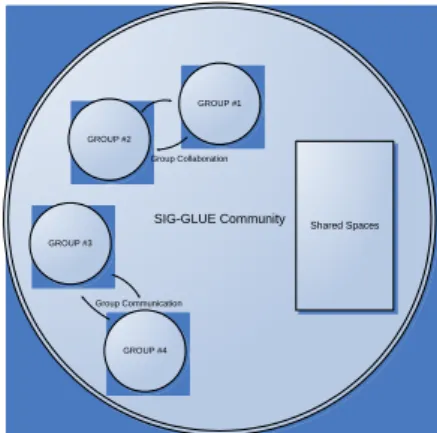
The basic needs for communication and collaboration of the community are organised as shown in Figure 1. These requirements include:
• needs for communication with each other or in
groups
• needs for collaborating in groups on
3
SIG-GLUE: Special Interest Group for Game-based Learning in Universities and Lifelong Learning / Elearning Iniative, http://www.sig-glue.net
• needs for shared spaces to store and archive
information and finally
• needs for making available or disseminating
information to the public
SIG-GLUE Community GROUP #3 GROUP #1 GROUP #2 GROUP #4 Shared Spaces Group Communication Group Collaboration
Figure 1: Web community requirements
Communication tools
SIG-GLUE members need to communicate among themselves in order to exchange opinions, ask questions, offer advises etc. Communication should be both direct and indirect, and both private and public.
Direct: Direct communication requires that all participants participate at the same time and that communication is exchanged almost instantly (i.e. with no or little perceived delay).
Indirect: Indirect communication does not require that all participants participate at the same time, and communication may not be exchanged with a (possibly large) delay.
Person to Person and Group Communication: Although SIG-GLUE is a community where group communication is of great importance, the environment should allow for person-to-person communication as well.
Private, Public and Semi-public: Communication is private when it is not revealed to others than the intended (and know to the originator) recipients. Private communication is needed for exchanges that are of private nature, or do not concern others and might overload them with useless information.
However, taking into consideration that the main purpose of SIG-GLUE is to allow a large number of people interested in Game-based Learning to communicate and exchange results, it comes that the very most need is for public communication. All related members need to easily access all communications and information exchanges within the community and gain the most from this. In addition to its public nature, this type of communication needs to be archived and offer for future reference.
Members of the SIG-GLUE community will need tools to support their co-operative work. This is especially true for the SIG-GLUE Working Groups where in each group its members will have a task to execute co-operatively. As this community will expand with people all over Europe (and the world) this environment will form a shared working environment of the members of SIG-GLUE. The environment should cover the following requirements.
Document sharing: A very common task that all the members will face is the need to compose documents for their work. But when many people compose documents, this work becomes more practical when the environment supports document sharing, where all members of a specific workgroup can access the documents. Access control is also necessary, as there will be situations where only some members of the group could alter the documents while the rest will just read them.
Calendar: A calendar will be useful to keep the members informed about scheduled conferences, online meetings, and other events or milestones. For the Working Groups a calendar can be used for scheduling tasks and monitoring work progress. In addition each member might benefit from a personal calendar. All these various levels of calendars (personal, WG-wide, community-wide) should be merge-able so that one may see in one's calendar the entries one is interested in and/or pertains to one's work within SIG-GLUE.
Support for workgroups: Members of the community must be organized into workgroups. The existence of the workgroups will result in better co-operation, more efficient work and better results. The environment must group members of the same group, support super-members and moderators of each workgroup and provide services that apply to the members of the whole workgroup.
Shared Spaces
As the number of SIG-GLUE members increases the use of attachments to exchange information becomes infeasible. In addition, forums do not usually support attachments to keep the space requirements down. An alternative is to have one (or more) shared spaces where files can be put (uploaded) and made available to SIG-GLUE members. Specific workgroups of SIG-GLUE will also need to share their results with the community or exchange their documents in private. Depending on the scope of members having access to shared spaces can be public, or private.
Public folders: Public folders will be virtual on-line folders that will contain documents, deliverables and all other information that intend to be available for the public. Availability of these folders may be a specific service of SIG-GLUE or it can be provided as part of each workgroup area (one public folder per workgroup). Access to the data of these folders will be provided without any constraint.
Private folders: Private folders will contain information and documents that will be provided to specific users. These
users may be all registered users or specific members of a workgroup. Access to these folders is controlled by access rights management system. A special case of these private shared folders is each WG's shared folder.
Databases: Databases contain structured information of various kinds. E.g. an educational games database, a provider’s database, a member’s database, a links database etc. In these shared databases, each member of the community (subject to having rights to do so) can submit, edit, delete and view information.
News database: A special kind of such a database is a news database. As the main purpose of a community is the easy access to news, articles, results and the exchange of knowledge, a well-organized news database where every member of the community can submit links, articles of public interest is necessary.
TRANSFORMING THE COMMUNITY
Trying to investigate how all these needs of traditional Internet users can be transformed into requirements of mobile users, we meet two main types of obstacles. Firstly, the interface of the communication tools should be changed so as to take into account small screen restrictions. Moreover, services of the community that is communication and collaboration tools, as well as shared spaces must be revised in order to permit easy access through mobile networks, utilizing techniques that are more efficient in order to meet low bandwidth restrictions.
As SIG-GLUE’s main aim is to inform its members about current trends in game design, we can easily apply transformation techniques that come from mechanisms to push news into mobile devices. Such mechanisms take into consideration both restrictions and extra capabilities of the mobile interface and the mobile network resulting in an optimum use of the community tools. Moreover, these techniques have also designed in order to exploit mobility behavior of mobile users (Albert and Kim 2000, Sharples 2000).
Characteristics of mobile device’s interface
Mobile devices introduce a very different interface for their user. Small screen size, slow text input facilities, small storage capacity, limited battery life, low bandwidth network capabilities and slow CPU speed are main characteristics of such modern devices. In particular, screen size limitations directly affect the user’s behavior. Recent studies (Kawachiya and Ishikawa 1999, Buyukkoten et al. 2000) on the effect of screen size on completing task related with browsing, show that mobile users tend to follow links less frequently than traditional Internet users. This behavior comes from the more conservative link exploration trend of small screen users. This implies that we must provide user with information within the first two or three links he visits in order not to lose him.
In addition, as many different small devices exist equipped with web browsers that support different content types (HTML, xHTML, wml, multipart.mixed), it is lasso important to be able to identify the user agent that a mobile device users and serve it with the corresponding edition of the community pages.
Content Transformation Techniques and Mobile Services
Mobile edition of the aforementioned communication tools should take into account special requirements of mobile devices as well as the expected change of mobile users’ behavior while browsing through community services. It is clear that both structural design of the community and community’s services must be transformed in order to meet very different needs.
The major challenge of displaying community pages into small screen devices such as PDAs or smart mobile phones is the content transformation into an appropriate layout that will enable users to access it easily. Standard transformation techniques have been widely studied (Alberts 2000a, Alberts 2000b, Bickmore 1997, Buyukkokten et al. 2000, Buyukkokten et al. 2001a, Buyukkokten et al. 2001b, Danielson 2002, Dyson and Haselgrove 2001, Jones and Marsden 1997, Jones et al. 1999, Feiner 1998) and include direct migration methods, data modification techniques as well as data suppression migration methods.
Direct migration does not require human or system intervention, as there are no transformations made to the original web page. It does require more effort to navigate the pages by users, as only a small part of the page is visible at one time (Alberts and Kim 2000a, Dyson and Haselgrove 2001, Jameson et al.1998)
Data modification techniques involve the creation at source of duplicate Web pages that are intended for use on the small screen by reducing image’s size or summarizing text. Data suppression methods remove data to make small-screen versions that display only skeleton information of the source data resulting in simplifying navigation and reducing disorientation.
The selected transformation technique is very similar to the Gateway methodology (MacKay 2003). According to this method, whenever users visit a web page, they construct a mental model about the structure and the content of it. What is critical while transforming the content is to minimize the adaptation of the existing mental model when migrating between devices so as to reduce volatility. Characteristic factors that form this mental model include page layout, scrolling attributes, distance to information (path of links that must be followed), graphical interface and information density (Danielson 2002, Spence 2001).
What Gateway tries to do is display the page designed for a large screen on the small screen by reducing the web page in scale to fit the screen. The same ‘look and feel’ is replicated using same layout and design. However, blocks of
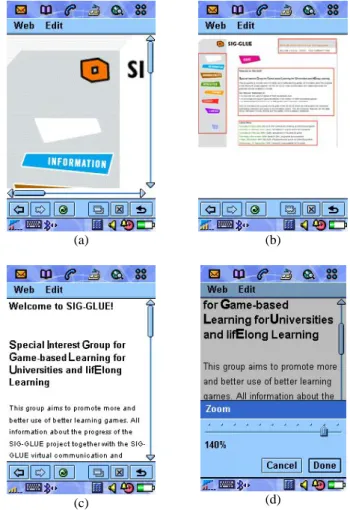
information are identified so as to allow users navigate included information as they would on the large screen (Figure 2).
(a) (b)
(c) (d)
Figure 2: SIG-GLUE community seen from the Symbian Opera browser of the smart phone Sony Ericsson P800. (a) without any transformation, (b) after transformation according to the Visual Gateway schema. Figures (c) and (d) show the corresponding content of a visual block of the main page with and without zoom
The transformation mechanism of SIG-GLUE’s community interface can be summarized as shown on Figure 3.
• Specific interface blocks are decided (e.g. left menu, top menu, advertisments block, main content block)
• HTML pages are transformed ‘on-the fly’ into enchanced images that include visualization of different blocks
• Mobile User Agent is identified using HTTP Header information of the browser request
• If agent implies a mobile browser the response includes the corresponding image to fit the mobile screen (using a database of known mobile devices)
• Visualized blocks link to ‘text -only’ pages that contain only text (so as zoom is allowed)
Figure 3: Content transformation mechanism
CONCLUSIONS AND FUTURE WORK
This paper presented technological functionality and architectural issues concerning game based learning for mobile users. The mobile specific edition of a web community with communication and collaboration tools as well as shared spaces presented and mobile specific services
analyzed. Web content transformation techniques for mobile devices although useful need to be altered in order to adapt to mobile specific services. Enabling mobile game designers to access such a community will contribute in easier access to the services. In the future, we will focus on the needs that will come up using these services. It will be given more emphasis on content personalizing techniques that will save bandwidth by providing mobile users only with content close to their interests. Construction of the user profile will exploit implicit information about the mobile device as well as user-defined interests.
ACKNOWLEDGEMENTS
Work was supported by SIG-GLUE / Elearning Iniative, http://www.sig-glue.net
Ioannis Antonellis’s work was partially supported by a Zosima Foundation Scholarship under grant 1039944/ 891/ B0011 /21-04-2003 (joint decision of Ministry of Education and Ministry of Economics)
REFERENCES
Alberts, M. and L. Kim 2000a, User Web Characteristics Using Palm Handhelds for Information Retrieval. In Proc. of
IPCC/SIGDOC Technology and Teamwork. Cambridge, MA
(2000), 125-135
Alberts, M.J. and L. Kim 2000b. "User Web Browsing Characteristics Using Palm Handhelds for Information Retrieval." In Proceedings of IPCC/SIGDOC Technology &
Teamwork. Cambridge, MA, Sept. 2000. IEEE: N.Y., p.p.
125-135
Antonellis, I.; C.Bouras; V.Kapoulas and V.Poulopoulos. 2005a. "Design and Implementation of a Game Based Learning related Community." In Proceedings of IADIS International Conference Web Based Communities 2005 (Algavre, Portugal, Feb 23-25). pp. 215-222
Antonellis, I.; C.Bouras; V.Kapoulas and V.Poulopoulos. 2005b. "Enhancing a Web Based Community: the case of SIG-GLUE." Int. J. of Web Based Communities, Vol. 3, No 1 (to appear)
Bickmore T.W., and B.N. Schilit, “Digestor: Device
independent Access to the World-Wide Web.”, In Proc. of
6th Int. World-Wide Web Conf., 1997.
Bouras, C., V. Igglesis, V. Kapoulas, T. Tsiatsos, “A Web Based Virtual Community: Funcionality and Architecture
Issues.”, IADIS International Conference - Web Based
Communities 2004, Lisbon, Portugal, March 23 - 26 2004,
pp. 59 – 66
Buyukkokten, O., H. Garcia-Molina, A. Paepcke, and T. Winograd, “Power Browser: Efficient Web Browsing for
PDAs.”, In Proc. of the Conf. on Human Factors in
Computing Systems, CHI’00, 2000, pp. 430-437.
Buyukkokten, O. H. Garcia-Molina, A. Paepcke, 2001a “Accordion Summarization for End-Game Browsing on
PDAs and Cellular Phones.”, In Proc. of the Conf. on
Human Factors in Computing Systems, CHI’01, 2001.
Buyukkokten O., H. Garcia-Molina, and A. Paepcke. 2001b “Seeing the Whole in Parts: Text Summarization for Web
Browsing on Handheld Devices.”, In Proc. WWW10, pages
652--662, 2001.
Danielson, D.R. Transitional, "Volatility in Web Navigation: Usability Metrics and User Behavior.", M.S. Thesis, Stanford University, 2002.
Dyson, M. and M. Haselgrove, The Influence of Reading Speed and Line Length on the Effectiveness of Reading
from Screen. International Journal Human-Computer
Studies, (2001), 54 (4): 585-612
Feiner, S., “Seeing the Forest for the Trees: Hierarchical
Display of Hypertext Structure.”, Conf. on Office
Information Systems, New York: ACM, 1988, pp. 205-212.
Jones, M., G. Marsden, N. Mohd-Nasir, K. Boone and G. Buchanan, “Improving Web Interaction on Small Displays.”, In Proc. of 8th Int. World-Wide Web Conf., 1999, pp. 51-59.
Jones, M. and G. Marsden, 1997. "From the Large Screen to the Small Screen – Retaining the Designer’s Design for Effective User Interaction.", IEEE Colloquium on Issues for
Networked Interpersonal Communicators. 139( 3): 1-4.
Kawachiya, K. and Ishikawa, H. “Improving Web interaction on Small Displays.”, In Proceedings of 8th
International WWW Conference, 51-59, 1999.
MacKay, B. and C.Watters. "The Impact of Migration of Data to Small Screens on Navigation.", IT & Society. 2003. 1(3). pp 90-101
MacKay B., Carolyn R. Watters, Jack Duffy: “Web Page
Transformation When Switching Devices.” In Proceedings
of Mobile HCI, 2004: 228-239
Myzel. 2002. Myzel: Online community game (by Institut für
Gestaltungs und Wirkungsforschung Technische Univeristät Wien), http://www.myzel.org
Sharples, M. (2000). "The Design of Personal Mobile
Technologies for Lifelong Learning." Computers and
Education 34: 177-193.
Spence, R.. Information Visualization. 2001. ACM Press: N.Y.