CHAPTER 33-33-04
FOOD CODE
Section33-33-04-01 Definitions 33-33-04-01.1 Intent - Scope
33-33-04-02 General Care of Food Supplies 33-33-04-02.1 Additional Safeguards
33-33-04-03 Special Requirements
33-33-04-03.1 Shucked Shellfish - Packaging and Identification 33-33-04-03.2 Shellstock Identification
33-33-04-03.3 Shellstock - Condition
33-33-04-03.4 Molluscan Shellfish - Original Container 33-33-04-03.5 Shellstock - Maintaining Identification 33-33-04-04 General Food Protection
33-33-04-04.1 Packaged and Unpackaged Food - Separation, Packaging, and Segregation 33-33-04-04.2 Discarding or Reconditioning Unsafe, Adulterated, or Contaminated Food 33-33-04-04.3 Food Labels
33-33-04-05 Emergency Occurrences 33-33-04-06 General Food Storage
33-33-04-07 Potentially Hazardous Foods - Hot and Cold Holding 33-33-04-07.1 Ready-to-Eat, Potentially Hazardous Food - Date Marking 33-33-04-07.2 Ready-to-Eat, Potentially Hazardous Food - Disposition 33-33-04-07.3 Time as a Public Health Control
33-33-04-07.4 Consumption of Animal Foods That Are Raw, Undercooked, or Not Otherwise Processed to Eliminate Pathogens
33-33-04-07.5 Cooling
33-33-04-07.6 Cooling Methods 33-33-04-08 Hot and Cold Storage 33-33-04-09 General Food Preparation
33-33-04-09.1 Preventing Contamination When Tasting 33-33-04-10 Washing Raw Fruits and Vegetables 33-33-04-11 Cooking Raw Animal Foods
33-33-04-11.1 Minimum Food Temperature and Holding Time [Repealed]
33-33-04-11.2 Oven Parameters Required for Destruction of Pathogens [Repealed] 33-33-04-11.3 Minimum Holding Times Required at Specified Temperatures [Repealed] 33-33-04-11.4 Microwave Cooking
33-33-04-11.5 Parasite Destruction
33-33-04-11.6 Plant Food Cooking for Hot Holding 33-33-04-11.7 Records - Creation and Retention
33-33-04-11.8 Re-Serving Cooked and Refrigerated Food 33-33-04-11.9 Noncontinuous Cooking of Raw Animal Foods 33-33-04-12 Milk Products - Pasteurized
33-33-04-13 Egg Products - Pasteurized 33-33-04-14 Reheating for Hot Holding 33-33-04-15 Nondairy Products
33-33-04-16 Product Thermometers [Repealed] 33-33-04-17 Thawing Potentially Hazardous Foods
33-33-04-18 Food Display and Service of Potentially Hazardous Foods 33-33-04-18.1 Variance Requirement
33-33-04-18.2 Reduced Oxygen Packaging Without a Variance - Criteria 33-33-04-19 Milk and Cream Dispensing
33-33-04-19.1 Dispensing Equipment, Protection of Equipment, and Food 33-33-04-19.2 Molluscan Shellfish Tanks
33-33-04-20 Nondairy Product Dispensing 33-33-04-21 Condiment Dispensing 33-33-04-21.1 Vending Machine Dispensing
33-33-04-21.2 Vending Machine - Automatic Shutoff 33-33-04-22 Ice Dispensing
33-33-04-23 Dispensing Utensils 33-33-04-24 Re-Serving
33-33-04-25 Food Display
33-33-04-25.1 Consumer Self-Service Operations 33-33-04-26 Reuse of Tableware
33-33-04-27 General Food Transportation
33-33-04-27.1 Management and Personnel - Person in Charge 33-33-04-27.2 Demonstration of Knowledge
33-33-04-28 Employee Health [Repealed]
33-33-04-28.1 Employee Exclusions and Restrictions [Repealed] 33-33-04-28.2 Removal of Exclusions and Restrictions [Repealed]
33-33-04-28.3 Responsibility of a Food Employee or an Applicant to Report to the Person in Charge [Repealed]
33-33-04-28.4 Reporting by the Person in Charge [Repealed]
33-33-04-28.5 Obtaining Information - Personal History of Illness, Medical Examination, and Specimen Analysis [Repealed]
33-33-04-28.6 Restriction or Exclusion of Food Employee or Summary Suspension of License [Repealed]
33-33-04-28.7 Restriction or Exclusion Order - Warning or Hearing Not Required - Information Required in Order [Repealed]
33-33-04-28.8 Release of Employee From Restriction or Exclusion [Repealed]
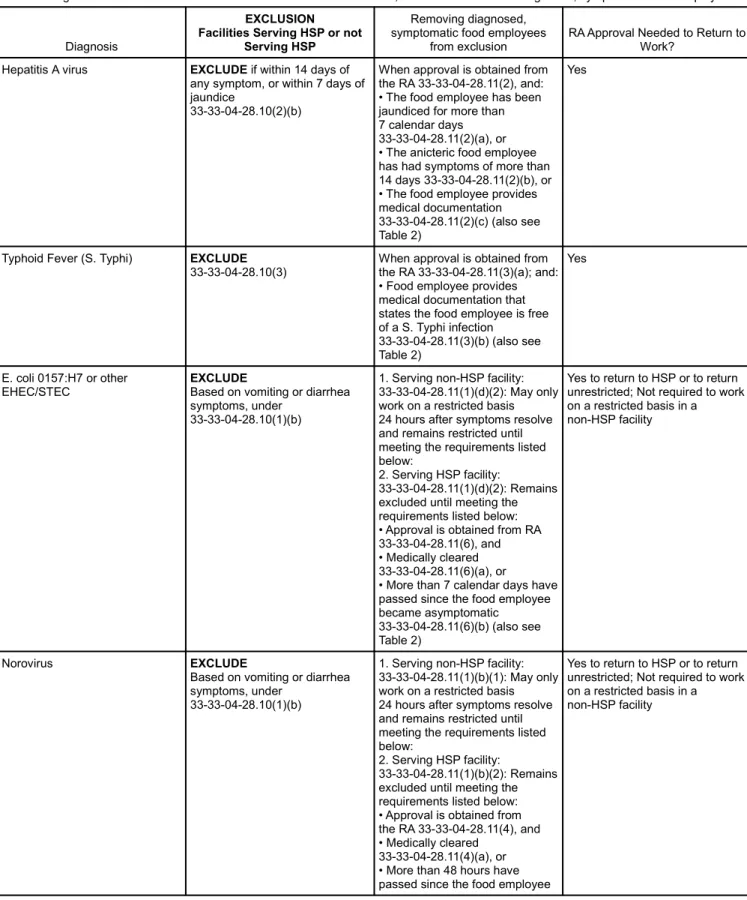
33-33-04-28.9 Responsibility of Permitholder, Person in Charge, and Conditional Employees 33-33-04-28.10 Exclusions and Restrictions
33-33-04-28.11 Removal, Adjustment, or Retention of Exclusions and Restrictions 33-33-04-29 General Personal Cleanliness
33-33-04-29.1 Preventing Contamination From Hands 33-33-04-29.2 Hand Antiseptic
33-33-04-29.3 Where to Wash
33-33-04-29.4 Fingernail Maintenance 33-33-04-30 General Clothing and Jewelry 33-33-04-31 General Employee Practices 33-33-04-31.1 Hair Restraints
33-33-04-32 General Equipment and Utensils Materials and Use 33-33-04-33 Solder and Pewter Alloys
33-33-04-34 Wood
33-33-04-34.1 Cutting Surfaces 33-33-04-35 Plastics
33-33-04-35.1 Sponges
33-33-04-35.2 Nonstick Coatings
33-33-04-36 Mollusk and Crustacea Shells 33-33-04-36.1 Gloves - Use Limitation
33-33-04-37 Single-Service Article - Reuse Prohibited - Composition 33-33-04-38 General Design and Fabrication
33-33-04-39 Accessibility 33-33-04-40 In-Place Cleaning
33-33-04-41 Pressure Spray Cleaning 33-33-04-42 Thermometers - Food
33-33-04-44 Ventilation Hoods 33-33-04-45 Existing Equipment
33-33-04-46 General Equipment Installation and Location 33-33-04-47 Table-Mounted Equipment
33-33-04-48 Floor-Mounted Equipment 33-33-04-49 Aisles and Working Spaces
33-33-04-50 Cleaning Frequency of Equipment and Utensils Cleaning and Sanitizing 33-33-04-50.1 Returnables - Cleaning and Refilling
33-33-04-51 Wiping Cloths and Working Containers - Use Limitation 33-33-04-52 Manual Warewashing - Sink Compartment Requirements 33-33-04-52.1 Warewashing Equipment - Cleaning Frequency
33-33-04-52.2 Warewashing Machines - Manufacturers' Operating Instructions 33-33-04-52.3 Warewashing Sinks - Use Limitations
33-33-04-52.4 Warewashing Equipment - Cleaning Agents 33-33-04-52.5 Warewashing Equipment - Clean Solutions
33-33-04-52.6 Manual Warewashing Equipment - Wash Solution Temperature 33-33-04-53 Mechanical Warewashing Equipment - Wash Solution Temperature 33-33-04-53.1 Manual Warewashing Equipment - Hot Water Sanitization Temperatures 33-33-04-53.2 Mechanical Warewashing Equipment - Hot Water Sanitization Temperatures 33-33-04-53.3 Mechanical Warewashing Equipment - Sanitization Pressure
33-33-04-53.4 Manual and Mechanical Warewashing Equipment - Chemical Sanitization - Temperature, pH, Concentration, and Hardness
33-33-04-53.5 Warewashing Equipment - Determining Chemical Sanitizer Concentration 33-33-04-53.6 Hot Water and Chemical
33-33-04-53.7 Rinsing Equipment and Utensils After Cleaning and Sanitizing 33-33-04-54 Drying
33-33-04-55 Handling of Equipment and Utensil Storage 33-33-04-56 Storage
33-33-04-56.1 Preset Tableware 33-33-04-57 Single-Service Articles 33-33-04-58 Prohibited Storage Areas 33-33-04-59 General Water Supplies
33-33-04-59.1 System Flushing and Disinfection 33-33-04-60 Transportation
33-33-04-61 Bottled Water
33-33-04-62 Water Under Pressure
33-33-04-62.1 Water Reservoir of Fogging Devices 33-33-04-63 Steam
33-33-04-64 General Sewage 33-33-04-65 General Plumbing
33-33-04-66 Nonpotable Water System [Repealed] 33-33-04-67 Backflow
33-33-04-67.1 Backflow Prevention Device - Carbonator 33-33-04-68 Grease Traps
33-33-04-69 Garbage Grinders 33-33-04-70 Drains
33-33-04-71 Toilet Facility Installation 33-33-04-72 Toilet Design
33-33-04-73 Toilet Rooms 33-33-04-74 Toilet Fixtures
33-33-04-75 Handsink Facility Installation 33-33-04-76 Handsink Faucets
33-33-04-77 Handsink Supplies 33-33-04-78 Handsink Maintenance
33-33-04-79 Garbage and Refuse Containers 33-33-04-80 Storage
33-33-04-81 Disposal
33-33-04-82 General Insect and Rodent Control 33-33-04-83 Openings
33-33-04-84 Construction and Maintenance of Floor Construction 33-33-04-85 Floor Carpeting
33-33-04-86 Prohibited Floor Covering 33-33-04-87 Floor Drains
33-33-04-88 Mats and Duckboards 33-33-04-89 Floor Junctures 33-33-04-90 Utility Line Installation
33-33-04-91 Wall and Ceiling Maintenance 33-33-04-92 Construction
33-33-04-93 Exposed Construction 33-33-04-94 Utility Line Installation 33-33-04-95 Attachments
33-33-04-96 Covering Material Installation 33-33-04-97 General Cleaning Physical Facilities 33-33-04-98 Utility Sinks
33-33-04-99 General Lighting 33-33-04-100 Protective Shielding 33-33-04-101 General Ventilation 33-33-04-102 Special Ventilation
33-33-04-103 Dressing Rooms or Areas 33-33-04-104 Locker Area
33-33-04-105 Poisonous or Toxic Materials Permitted 33-33-04-106 Labeling of Materials 33-33-04-107 Storage of Materials 33-33-04-108 Use of Materials 33-33-04-109 Personal Medications 33-33-04-110 First-Aid Supplies 33-33-04-111 General Premises 33-33-04-112 Living Areas 33-33-04-113 Laundry Facilities
33-33-04-114 Linen and Clothes Storage 33-33-04-115 Cleaning Equipment Storage 33-33-04-116 Prohibiting Animals
33-33-04-117 General Mobile Food Service
33-33-04-118 General Mobile Food Service - Restricted Operations 33-33-04-119 Single-Service Articles
33-33-04-120 Water System 33-33-04-121 Waste Retention
33-33-04-122 Base of Commissary Operations 33-33-04-123 Serving Area and Operations 33-33-04-124 Servicing Operations
33-33-04-125 Temporary Food Establishment
33-33-04-126 Temporary Food Establishment - Restricted Operations 33-33-04-127 Ice
33-33-04-128 Equipment
33-33-04-129 Single-Service Articles 33-33-04-130 Water
33-33-04-133 Handwashing 33-33-04-134 Floors
33-33-04-135 Walls and Ceilings of Food Preparation Areas 33-33-04-136 Inspection Report Form FD 2420 [Repealed] 33-33-04-137 Submission of Plans
33-33-04-138 Preoperational Inspection 33-33-04-138.1 Routine Inspections 33-33-04-139 Modifications and Waivers
33-33-04-140 Documentation of Proposed Variance and Justification 33-33-04-141 Conformance With Approved Procedures
33-33-04-142 When an HACCP Plan Is Required 33-33-04-143 Contents of an HACCP Plan 33-33-04-144 Sanitation and Safety
33-33-04-01. Definitions.
For the purpose of this chapter:
1. "Additive" has the meaning stated in the federal Food, Drug, and Cosmetic Act, subsection 201(s) and 21 CFR 170 and "color additive" has the meaning stated in the federal Food, Drug, and Cosmetic Act, subsection 201(t) and 21 CFR 70.
2. "Approved" means acceptable to the department based on a determination of conformity with principles, practices, and generally recognized standards that protect public health.
3. "Asymptomatic" means without obvious symptoms; not showing or producing indications of a disease or other medical condition, such as an individual infected with a pathogen but not exhibiting or producing any signs or symptoms of vomiting, diarrhea, or jaundice. Asymptomatic includes not showing symptoms because symptoms have been resolved or subsided, or because symptoms never manifested.
4. "aw" means water activity which is a measure of the free moisture in a food, is the quotient of
the water vapor pressure of the substance divided by the vapor pressure of pure water at the same temperature, and is indicated by the symbol aw.
5. "Balut" means an embryo inside a fertile egg that has been incubated for a period sufficient for the embryo to reach a specific stage of development after which it is removed from incubation before hatching. A balut is a potentially hazardous food subject to time/temperature management.
6. "Certification number" means a unique combination of letters and numbers assigned by a shellfish control authority to a molluscan shellfish dealer according to the provisions of the national shellfish sanitation program.
7. "CFR" or "Code of Federal Regulations" means the compilation of the general and permanent rules published in the federal register by the executive departments and agencies of the federal government which is published annually by the United States government printing office; and contains food and drug administration rules in 21 CFR, United States department of agriculture rules in 7 CFR and 9 CFR, and EPA rules in 40 CFR.
8. "Commingle" means:
a. To combine shellstock harvested on different days or from different growing areas as identified on the tag or label; or
b. To combine shucked shellfish from containers with different container codes or different shucking dates.
9. "Comminuted" means reduced in size by methods including chopping, flaking, grinding, or mincing and includes fish or meat products that are reduced in size and restructured or reformulated such as gefilte fish, formed roast beef, gyros, ground beef, and sausage; and a mixture of two or more types of meat that have been reduced in size and combined, such as sausages made from two or more meats.
10. "Commissary" means a catering establishment, restaurant, or any other place in which food, containers, or supplies are kept, handled, prepared, packaged, or stored.
11. "Common dining area" means a central location in a group residence where people gather to eat at mealtime. Common dining area does not apply to a kitchenette or dining area located within a resident's private living quarters.
12. "Conditional employee" means a potential food employee to whom a job offer is made, conditional on responses to subsequent medical questions or examinations designed to identify potential food employees who may be suffering from a disease that can be transmitted through food and done in compliance with title 1 of the Americans with Disabilities Act of 1990. 13. "Confirmed disease outbreak" means a foodborne disease outbreak in which laboratory
analysis or appropriate specimens identifies a causative organism and epidemiological analysis implicates the food as the source of the illness.
14. "Consumer" means a person who is a member of the public, takes possession of food, is not functioning in the capacity of an operator of a food establishment or food processing plant, and does not offer the food for resale.
15. "Core item" means a provision in this chapter that is not designated as a critical item. Core item includes an item that usually relates to general sanitation, operation controls, sanitation standard operating procedures, facilities or structures, equipment design, or general maintenance.
16. "Corrosion-resistant materials" means those materials that maintain acceptable surface cleanability characteristics under prolonged influence of the food to be contacted, normal use of cleaning compounds and sanitizing solutions, and other conditions-of-use environment. 17. "Critical control point" means a point or procedure in a specific food system where loss of
control may result in an unacceptable health risk.
18. "Critical item" means a provision of this code whose application contributes directly to or supports the elimination, prevention, or reduction to an acceptable level, hazards associated with foodborne illness or injury. Critical item includes items with a quantifiable measure to show control of hazards such as cooking, reheating, cooling, and handwashing. Critical item also includes items that require the purposeful incorporation of a specific actions, equipment, or procedures by management to attain control of risk factors such as personnel training, infrastructure or necessary equipment, HACCP plans, documentation or recordkeeping, and labeling.
19. "Critical limit" means the maximum or minimum value to which a physical, biological, or chemical parameter must be controlled at a critical control point to minimize the risk that the identified food safety hazard may occur.
20. "Cut leafy greens" means fresh leafy greens whose leaves have been cut, shredded, sliced, chopped, or torn. The term "leafy greens" includes iceberg lettuce, romaine lettuce, leaf lettuce, butter lettuce, baby leaf lettuce (i.e., immature lettuce or leafy greens), escarole, endive, spring mix, spinach, cabbage, kale, arugula, and chard. The term "leafy greens" does not include herbs such as cilantro or parsley.
21. "Department" means the state department of health or its designated agent.
22. "Easily cleanable" means that surfaces are readily accessible and made of such materials and finish and so fabricated that residue may be removed effectively by normal cleaning methods. 23. "Easily movable" means weighing thirty pounds [14 kilograms] or less; mounted on casters,
gliders, or rollers; or provided with a mechanical means requiring no more than thirty pounds [14 kilograms] of force to safely tilt a unit of equipment for cleaning; and having no utility connection, a utility connection that disconnects quickly, or a flexible utility connection line of sufficient length to allow the equipment to be moved for cleaning of the equipment and adjacent area.
24. "Egg" means the shell egg of avian species such as chicken, duck, goose, guinea, quail, ratites, or turkey.
a. Egg does not include: (1) A balut;
(2) The egg of reptile species such as alligator; or (3) An egg product.
b. Egg product.
(1) Egg product means all, or a portion of, the contents found inside eggs separated from the shell and pasteurized in a food processing plant, with or without added ingredients, intended for human consumption, such as dried, frozen, or liquid eggs. (2) Egg product does not include food which contains eggs only in a relatively small
proportion such as cake mixes.
25. "Employee" means the licenseholder, person in charge, person having supervisory or management duties, person on the payroll, family member, volunteer, person performing work under contractual agreement, or other person working in a food establishment.
26. "Enterohemorrhagic Escherichia coli" (EHEC) means E. coli which cause hemorrhagic colitis, meaning bleeding enterically or bleeding from the intestine. The term is typically used in association with E. coli that have the capacity to produce Shiga toxins and to cause attaching and effacing lesions in the intestine. EHEC is a subset of STEC, whose members produce additional virulence factors. Infections with EHEC may be asymptomatic but are classically associated with bloody diarrhea (hemorrhagic colitis) and hemolytic uremic syndrome (HUS) or thrombotic thrombocytopenic purpura (TTP). Examples of serotypes of EHEC include: E. coli O157:H7; E. coli O157:NM; E. coli O26:H11; E. coli O145:NM; E. coli O103:H2; or E. coli O111:NM.
27. "EPA" means the United States environmental protection agency.
28. "Equipment" means stoves, ovens, ranges, hoods, slicers, mixers, meatblocks, tables, counters, refrigerators, sinks, dishwashing machines, steamtables, and similar items other than utensils, used in the operation of a food establishment.
29. "Exclude" means to prevent a person from working as an employee or entering a food establishment except for those areas open to the general public.
30. "Fish" means fresh or saltwater finfish, molluscan shellfish, crustaceans, and other forms of aquatic life (including alligator, frog, aquatic turtle, jellyfish, sea cucumber, and sea urchin and the roe of such animals) other than birds or mammals and includes any edible human food
product derived in whole or in part from fish, including fish that has been processed in any manner.
31. "Food" means any raw, cooked, or processed edible substance, ice, beverage, or ingredient used or intended for use or for sale, in whole or in part, for human consumption, or chewing gum.
32. "Foodborne disease outbreak" means an incident in which two or more persons experience a similar illness after ingestion of a common food and epidemiological analysis implicates the food as the source of the illness. Foodborne disease outbreak includes a single case of illness such as one person ill from botulism or chemical poisoning.
33. "Food-contact surface" means those surfaces of equipment and utensils with which food normally comes in contact, and those surfaces from which food may drain, drip, or splash back onto surfaces normally in contact with food.
34. "Food employee" means an individual working with unpackaged food, food equipment or utensils, or food-contact surfaces.
35. "Food establishment":
a. "Food establishment" means an operation that stores, prepares, packages, serves, vends, or otherwise provides food for human consumption:
(1) Such as a restaurant, satellite or catered feeding location, catering operation if the operation provides food directly to a consumer or to a conveyance used to transport people, market, vending location, conveyance used to transport people, institution, or food bank; and
(2) That relinquishes possession of food to a consumer directly, or indirectly through a delivery service such as home delivery of grocery orders or restaurant takeout orders, or delivery service that is provided by common carriers.
b. "Food establishment" includes:
(1) An element of the operation such as a transportation vehicle or a central preparation facility that supplies a vending location or satellite feeding location unless the vending or feeding location is permitted by the department; and
(2) An operation that is conducted in a mobile, stationary, temporary, or permanent facility or location; where consumption is on or off the premises; and regardless of whether there is a charge for the food.
c. "Food establishment" does not include:
(1) An establishment that offers only prepackaged foods that are not potentially hazardous;
(2) A produce stand that only offers whole, uncut fresh fruits and vegetables; (3) A food processing plant;
(4) A kitchen in a private home if the food is prepared for sale or service at a function such as a religious or charitable organization's bake sale;
36. "Food processing plant" means a commercial establishment in which food is manufactured or packaged for human consumption. The term does not include a food establishment, retail food store, or commissary operation.
37. "Game animal" means an animal, the products of which are food, that is not classified as cattle, sheep, swine, or goat in 9 CFR subchapter A - mandatory meat inspection, part 301, as poultry in 9 CFR subchapter 9C - mandatory poultry products inspection, part 381, or as fish as defined in subparagraph 1-201.10(B)(26). Game animal includes animals such as reindeer, elk, deer, antelope, water buffalo, bison, rabbit, squirrel, bear, and muskrat; aquatic and nonaquatic birds such as wild ducks and geese, quail, and pheasant; nonaquatic reptiles such as rattlesnakes; aquatic mammals; exotic animals as defined in 9 CFR subchapter A - animal welfare, part 1, such as lion, tiger, leopard, elephant, camel, antelope, anteater, kangaroo, and water buffalo; and species of foreign domestic cattle, such as ankole, gayal, and yak.
38. "Group residence" means a private or public housing corporation or institutional facility that provides living quarters and meals. Group residence includes a domicile for unrelated persons such as a retirement home or long-term health care facility.
39. "HACCP plan" means a written document that delineates the formal procedures for following the hazard analysis critical control point principles developed by the national advisory committee on microbiological criteria for foods.
40. "Handsink" means a lavatory, a basin or vessel for washing, a wash basin, or a plumbing fixture especially placed for use in personal hygiene and designed for the washing of hands. Handsink includes an automatic handwashing facility.
41. "Hazard" means a biological, chemical, or physical property that may cause an unacceptable consumer health risk.
42. "Health practitioner" means a physician licensed to practice medicine, or if allowed by law, a nurse practitioner, physician assistant, or similar medical professional.
43. "Hermetically sealed container" means a container designed and intended to be secure against the entry of micro-organisms and in the case of low acid canned foods, to maintain the commercial sterility of its contents after processing.
44. "Highly susceptible population" means a group of persons who are more likely than other populations to experience foodborne disease because they are immunocompromised or older adults and in a facility that provides health care or assisted living services, such as a hospital or nursing home; or preschool age children in a facility that provides custodial care, such as a day care center.
45. "Injected" means manipulating meat to which a solution has been introduced into its interior by processes that are referred to as "injecting", "pinning", or "stitch pumping".
46. "Juice" means the aqueous liquid expressed or extracted from one or more fruits or vegetables, purees of the edible portions of one or more fruits or vegetables, or any concentrates of such liquid or puree. Juice does not include, for purposes of HACCP, liquids, purees, or concentrates that are not used as beverages or ingredients of beverages.
47. "Kitchenware" means food preparation and storage utensils.
48. "Law" includes applicable federal, state, and local statutes, ordinances, and regulations. 49. "License" means the document issued by the department that authorizes a person to operate
50. "Licenseholder" means the entity that is legally responsible for the operation of the food establishment such as the owner, the owner's agent, or other person; and possesses a valid license to operate a food establishment.
51. "Linens" means fabric items such as cloth hampers, cloth napkins, tablecloths, wiping cloths, and work garments including cloth gloves.
52. "Major food allergen".
a. "Major food allergen" means:
(1) Milk, egg, fish (such as bass, flounder, cod, and including crustacean shellfish such as crab, lobster, or shrimp), tree nuts (such as almonds, pecans, or walnuts), wheat, peanuts, and soybeans; or
(2) A food ingredient that contains protein derived from a food, as specified in paragraph 1.
b. "Major food allergen" does not include:
(1) Any highly refined oil derived from a food specified in paragraph 1 of subdivision a and any ingredient derived from such highly refined oil; or
(2) Any ingredient that is exempt under the petition or notification process specified in the Food Allergen Labeling and Consumer Protection Act of 2004 [Public Law 108-282].
53. "Meat" means the flesh of animals used as food including the dressed flesh of cattle, swine, sheep, or goats and other edible animals, except fish and poultry, that is offered for human consumption.
54. "Mechanically tenderized" means manipulating meat with deep penetration by processes which may be referred to as "blade tenderizing", "jaccarding", "pinning", "needling", or using blades, pins, needles or any mechanical device. Mechanically tenderized does not include processes by which solutions are injected into meat.
55. "Mobile food unit" means a vehicle-mounted food establishment designed to be readily movable.
56. "Molluscan shellfish" means any edible species of fresh or frozen oysters, clams, mussels, and scallops or edible portions thereof, except when the scallop product consists only of the shucked adductor muscle.
57. "Noncontinuous cooking" means the cooking of food in a food establishment using a process in which the initial heating of the food is intentionally halted so that it may be cooled and held for complete cooking at a later time prior to sale or service. Noncontinuous cooking does not include cooking procedures that only involve temporarily interrupting or slowing an otherwise continuous cooking process.
58. "Packaged" means bottled, canned, cartoned, securely bagged, or securely wrapped, whether packaged in a food establishment or a food processing plant. Packaged does not include a wrapper, carryout box, or other nondurable container used to containerize food with the purpose of facilitating food protection during service and receipt of the food by the consumer. 59. "Person" includes any individual, partnership, corporation, association, or other legal entity. 60. "Person in charge" means the individual present in a food establishment who is responsible
61. "Personal care items" means items or substances that may be poisonous, toxic, or a source of contamination and are used to maintain or enhance a person's health, hygiene, or appearance. Personal care items include items such as medications; first-aid supplies; and other items such as cosmetics, and toiletries such as toothpaste and mouthwash.
62. "pH" means the symbol for the negative logarithm of the hydrogen ion concentration, which is a measure of the degree of acidity or alkalinity of a solution. Values between zero and seven indicate acidity and values between seven and fourteen indicate alkalinity. The value for pure distilled water is seven, which is considered neutral.
63. "Physical facilities" means the structure and interior surfaces of a food establishment including accessories such as soap and towel dispensers and attachments such as light fixtures and heating or air-conditioning system vents.
64. "Poisonous or toxic materials" means substances that are not intended for ingestion and are included in four categories:
a. Cleaners and sanitizers, which include cleaning and sanitizing agents and agents such as caustics, acids, drying agents, polishes, and other chemicals;
b. Pesticides, which include substances such as insecticides and rodenticides;
c. Substances necessary for the operation and maintenance of the establishment such as nonfood grade lubricants and personal care items that may be deleterious to health; and d. Substances that are not necessary for the operation and maintenance of the
establishment and are on the premises for retail sale, such as petroleum products and paints.
65. "Potentially hazardous food".
a. "Potentially hazardous food" means a food that is a natural or synthetic and is in a form capable of supporting:
(1) The rapid and progressive growth of infectious or toxigenic micro-organisms; (2) The growth and toxin production of clostridium botulinum; or
(3) In shell eggs, the growth of salmonella enteritidis.
b. "Potentially hazardous food" includes an animal food (a food of animal origin) that is raw or heat-treated; a food of plant origin that is heat-treated or consists of raw seed sprouts; cut melons; cut leafy greens; cut tomatoes or mixtures of cut tomatoes that are not modified in a way so that they are unable to support pathogenic micro-organism growth or toxin formation; and garlic and oil mixtures that are not modified in a way so that they are unable to support pathogenic micro-organism growth or toxin formation.
c. "Potentially hazardous food" does not include:
(1) A food with a water activity (Aw (aw)) value of 0.85 or less;
(2) A food with a hydrogen ion concentration (PH(pH)) level of 4.6 or below when measured at seventy-five degrees Fahrenheit [24 degrees Celsius];
(3) A food, in an unopened hermetically sealed container, that is commercially processed to achieve and maintain commercial sterility under conditions of nonrefrigerated storage and distribution; and
(4) A food for which a variance granted by the department is based upon laboratory evidence demonstrating that rapid and progressive growth of infectious and toxigenic micro-organisms or the slower growth of C. botulinum cannot occur.
(5) An egg with shell intact that is not hard-boiled but has been pasteurized to destroy all viable salmonellae.
66. "Poultry" means any domesticated bird including chickens, turkeys, ducks, geese, or guineas, whether live or dead.
67. "Premises" means the physical facility, its contents, and the contiguous land or property under the control of the licenseholder; or the physical facility, its contents, and the contiguous land or property and its facilities and contents that are under the control of the licenseholder that may impact food establishment personnel, facilities, or operations, if a food establishment is only one component of a larger organization such as a health care facility, motel, school, recreational camp, or prison.
68. "Pushcart" means a non-self-propelled vehicle limited to serving only those regulatory authority-approved potentially hazardous foods or commissary-wrapped food maintained at proper temperatures, or limited to the preparation and service of frankfurters.
69. "Ratite" means a flightless bird such as an emu, ostrich, or rhea. 70. "Ready-to-eat food".
a. "Ready-to-eat food" means food that:
(1) Is in a form that is edible without additional preparation to achieve food safety, as specified under one of the following: subsections 1, 2, and 3 of section 33-33-04-11, section 33-33-04-11.4, section 33-33-04-11.5; or
(2) Is a raw or partially cooked animal food and the consumer is advised as specified in subdivision c of subsection 4 of section 33-33-04-11; or
(3) Is prepared in accordance with a variance that is granted as specified in subdivision d of subsection 4 of section 33-33-04-11; and
(4) May receive additional preparation for palatability or aesthetic, epicurean, gastronomic, or culinary purposes.
b. "Ready-to-eat food" includes:
(1) Raw animal food that is cooked as specified under section 33-33-04-11 or 33-33-04-11.4, or frozen as specified under section 33-33-04-11.5.
(2) Raw fruits and vegetables that are washed as specified under section 33-33-04-10. (3) Fruits and vegetables that are cooked for hot holding, as specified under section
33-33-04-11.6.
(4) All potentially hazardous food that is cooked to the temperature and time required for the specific food and cooled as specified under section 33-33-04-07.5.
(5) Plant food for which further washing, cooking, or other processing is not required for food safety, and from which rinds, peels, husks, or shells, if naturally present, are removed.
(7) A bakery item such as bread, cakes, pies, fillings, or icing for which further cooking is not required for food safety.
(8) The following products that are produced in accordance with United States department of agriculture guidelines and that have received a lethality treatment for pathogens: dry, fermented sausages, such as dry salami or pepperoni; salt-cured meat and poultry products, such as prosciutto ham, country-cured ham, and Parma ham; and dried meat and poultry products, such as jerky or beef sticks; and
(9) Foods manufactured as specified in 21 CFR part 113, thermally processed low-acid foods packaged in hermetically sealed containers.
71. "Reconstituted" means dehydrated food products recombined with water or other liquids. 72. "Reduced oxygen packaging".
a. "Reduced oxygen packaging" means:
(1) The reduction of the amount of oxygen in a package by removing oxygen; displacing oxygen and replacing it with another gas or combination of gases; or otherwise controlling the oxygen content to a level below that normally found in the atmosphere (approximately 21 percent at sea level); and
(2) A process as specified in paragraph 1 that involves a food for which the hazards clostridium botulinum or Listeria monocytogenes require control in the final packaged form.
b. "Reduced oxygen packaging" includes:
(1) Vacuum packaging, in which air is removed from a package of food and the package is hermetically sealed so that a vacuum remains inside the package; (2) Modified atmosphere packaging in which the atmosphere of a package of food is
modified so that its composition is different from air but the atmosphere may change over time due to the permeability of the packaging material or the respiration of the food. Modified atmosphere packaging includes reduction in the proportion of oxygen, total replacement of oxygen, or an increase in the proportion of other gases such as carbon dioxide or nitrogen;
(3) Controlled atmosphere packaging, in which the atmosphere of a package of food is modified so that until the package is opened, its composition is different from air, and continuous control of that atmosphere is maintained, such as by using oxygen scavengers or a combination of total replacement of oxygen, nonrespiring food, and impermeable packaging material;
(4) Cook chill packaging, in which cooked food is hot filled into impermeable bags which have the air expelled and are then sealed or crimped closed. The bagged food is rapidly chilled and refrigerated at temperatures that inhibit the growth of psychotrophic pathogens; or
(5) Sous vide packaging, in which raw or partially cooked food is placed in a hermetically sealed, impermeable bag, cooked in the bag, rapidly chilled, and refrigerated at temperatures that inhibit the growth of psychotrophic pathogens. 73. "Regulatory authority" means the state and local enforcement authority or authorities having
74. "Re-service" means the transfer of food, that is unused and returned by a consumer after being served or sold and in the possession of the consumer, to another person.
75. "Restrict" means to limit the activities of a food employee so that there is no risk of transmitting a disease that is transmissible through food and the food employee does not work with exposed food, clean equipment, utensils, linens, and unwrapped single-service or single-use articles.
76. "Safe material" means an article manufactured from or composed of materials that may not reasonably be expected to result, directly or indirectly, in their becoming a component or otherwise affecting the characteristics of food; an additive that is used as specified in subsection 409 or 706 of the federal Food, Drug, and Cosmetic Act; or other materials that are not additives and that are used in conformity with applicable regulations of the food and drug administration.
77. "Sanitization" means the application of cumulative heat or chemicals on cleaned food-contact surfaces that, when evaluated for efficacy, yield a reduction of five logs, which is equal to 99.999 percent reduction, of representative disease micro-organisms of public health importance.
78. "Sealed" means free of cracks or other openings that permit the entry or passage of moisture. 79. "Servicing area" means an operating base location to which a mobile establishment or
transportation vehicle returns regularly for such things as discharging liquid or solid wastes, refilling water tanks and ice bins, and boarding food.
80. "Shellstock" or "shucked shellfish" means raw, in-shell molluscan shellfish or molluscan shellfish that have one or both shells removed.
81. "Shiga toxin-producing Escherichia coli" (STEC) means any E. coli capable of producing Shiga toxins (also called verocytotoxins or "Shiga-like" toxins). Examples of serotypes of STEC include both O157 and non-O157 E. coli.
82. "Single-service articles" means tableware, carryout utensils, and other items such as bags, containers, placemats, stirrers, straws, toothpicks, and wrappers that are designed and constructed for one-time, one-person use.
83. "Single-use articles" means utensils and bulk food containers designed and constructed to be used once and discarded. Single-use articles includes items such as wax paper, butcher paper, plastic wrap, formed aluminum food containers, jars, plastic tubs or buckets, bread wrappers, pickle barrels, ketchup bottles, and number ten cans which do not meet the materials, durability, strength, and cleanability specifications contained in sections 33-33-04-32 and 33-33-04-38 for multiuse utensils.
84. "Smooth" means:
a. A food-contact surface having a surface free of pits and inclusions with a cleanability equal to or exceeding that of one hundred grit (number 3) stainless steel;
b. A nonfood-contact surface of equipment having a surface equal to that of commercial grade hot-rolled steel free of visible scale; and
c. A floor, wall, or ceiling having an even or level surface with no roughness or projections that render it difficult to clean.
85. "Support animal" means a trained animal such as a seeing eye dog that accompanies a person with a disability to assist in managing the disability and enables the person to perform functions that the person would otherwise be unable to perform.
86. "Tableware" means eating, drinking, and serving utensils for table use such as flatware including forks, knives, and spoons and hollowware including bowls, cups, serving dishes, tumblers, and plates.
87. "Temporary food establishment" means a food establishment that operates at a fixed location for a period of time of not more than fourteen consecutive days in conjunction with a single event or celebration.
88. "Thermometer" means a thermocouple, thermistor, or other device that indicates the temperature of food, air, or water.
89. "Utensil" means a food-contact implement or container used in the storage, preparation, transportation, dispensing, sale, or service of food, such as kitchenware or tableware that is multiuse, single-service, or single-use; gloves used in contact with food; and thermometers and probe-type price or identification tags used in contact with food.
90. "Warewashing" means the cleaning and sanitizing of food-contact surfaces of equipment and utensils.
91. "Water activity" means a measure of the free moisture in a food, is the quotient of the water vapor pressure of the substance divided by the vapor pressure of pure water at the same temperature, and is indicated by the symbol AW(aw).
92. "Whole-muscle, intact beef" means whole muscle beef that is not injected, mechanically tenderized, reconstructed, or scored and marinated, from which beef steaks may be cut.
History: Effective August 1, 1988; amended effective June 1, 1991; July 1, 1997; August 1, 2003; January 1, 2008; April 1, 2012.
General Authority: NDCC 19-02.1-20, 23-01-03(3)
Law Implemented: NDCC 19-02.1-09
33-33-04-01.1. Intent - Scope.
The purpose of this chapter is to safeguard public health and to provide consumers with food that is safe, unadulterated, and honestly presented. This chapter establishes definitions; sets standards for management and personnel, food operations, and equipment and facilities; and provides for food establishment plan review, license issuance, inspection, and employee restrictions. If necessary to protect against public health hazards or nuisances, the regulatory authority may impose specific requirements in addition to the requirements contained in this code that are authorized by law. The regulatory authority shall document the conditions that necessitate the imposition of additional requirements and the underlying public health rationale. The documentation shall be provided to the license applicant or licenseholder and a copy shall be maintained in the regulatory authority's file for the food establishment.
History: Effective July 1, 1997; amended effective August 1, 2003.
General Authority: NDCC 19-02.1-20, 23-01-03(3)
Law Implemented: NDCC 19-02.1-09
33-33-04-02. General care of food supplies.
2. Food shall be in sound condition, free from spoilage, filth, or other contamination and shall be safe for human consumption.
3. Food shall be safe, unadulterated, and honestly presented.
a. Food shall be offered for human consumption in a way that does not mislead or misinform the consumer.
b. Food or color additives, colored overwraps, or lights may not be used to misrepresent the true appearance, color, or quality of a food.
c. Food may not contain unapproved food additives or additives that exceed amounts specified in 21 CFR 170-180 relating to food additives, generally recognized as safe or prior sanctioned substances that exceed amounts specified in 21 CFR 181-186, substances that exceed amounts specified in 9 CFR subpart C section 424.21(b) - food ingredients and sources of radiation, or pesticide residues that exceed provisions specified in 40 CFR 185 - tolerances for pesticides in food.
4. Food prepared in a private home may not be used or offered for human consumption in a food establishment.
5. Food in a hermetically sealed container shall be obtained from a food processing plant that is regulated by the food regulatory agency that has jurisdiction over the plant.
History: Effective August 1, 1988; amended effective July 1, 1997; August 1, 2003.
General Authority: NDCC 19-02.1-20, 23-01-03(3)
Law Implemented: NDCC 19-02.1-09
33-33-04-02.1. Additional safeguards.
In a food establishment that serves a highly susceptible population: 1. The following criteria apply to juice:
a. For the purposes of this paragraph only, children who are age nine or less and receive food in a school, day care setting, or similar facility that provides custodial care are included as highly susceptible populations;
b. Prepackaged juice or a prepackaged beverage containing juice, that bears a warning label as specified in 21 CFR section 101.17(g) food labeling, or packaged juice or beverage containing juice, that bears a warning label as specified under subdivision b of subsection 17 of section 33-33-04-03 may not be served or offered for sale; and
c. Unpackaged juice that is prepared on the premises for service or sale in a ready-to-eat form shall be processed under an HACCP plan that contains the information specified in sections 33-33-04-142 and 33-33-04-143 and as specified under 21 CFR part 120 - hazard analysis and critical control point (HACCP) systems, section 120.24 process controls.
2. Pasteurized eggs or pasteurized liquid, frozen, or dry eggs or egg products shall be substituted for raw shell eggs in the preparation of:
a. Foods such as Caesar salad, hollandaise or Bearnaise sauce, mayonnaise, meringue, eggnog, ice cream, and egg-fortified beverages; and
b. Except as specified in subsection 5, recipes in which more than one egg is broken and the eggs are combined.
3. Food in an unopened original package may not be re-served.
4. The following foods may not be served or offered for sale in a ready-to-eat form:
a. Raw animal foods such as raw fish, raw-marinated fish, raw molluscan shellfish, and steak tartare;
b. A partially cooked animal food such as lightly cooked fish, rare meat, soft-cooked eggs that are made from raw eggs, and meringue; and
c. Raw seed sprouts.
5. Subdivision b of subsection 2 does not apply if:
a. The raw eggs are combined immediately before cooking for one consumer's serving at a single meal, cooked as specified under subdivision a of subsection 1 of section 33-33-04-11, and served immediately, such as an omelet, souffle, or scrambled eggs; b. The raw eggs are combined as an ingredient immediately before baking and the eggs
are thoroughly cooked to a ready-to-eat form, such as a cake, muffin, or bread; or c. The preparation of the food is conducted under an HACCP plan that:
(1) Identifies the food to be prepared;
(2) Prohibits contacting ready-to-eat food with bare hands; (3) Includes specifications and practices that ensure:
(a) Salmonella enteritidis growth is controlled before and after cooking; and
(b) Salmonella enteritidis is destroyed by cooking the eggs according to the temperature and time specified in subdivision b of subsection 1 of section 33-33-04-11;
(4) Contains the information specified in subsection 3 of section 33-33-04-143 including procedures that:
(a) Control cross-contamination of ready-to-eat food with raw eggs; and
(b) Delineate cleaning and sanitization procedures for food-contact surfaces; and (5) Describes the training program that ensures that the food employee responsible for
the preparation of the food understands the procedures to be used.
History: Effective August 1, 2003; amended effective January 1, 2008.
General Authority: NDCC 19-02.1-20, 23-01-03(3)
Law Implemented: NDCC 19-02.1-09
33-33-04-03. Special requirements.
1. Fluid milk, dry milk, and milk products shall be obtained pasteurized and comply with grade A standards as specified by law. Frozen milk products, such as ice cream, shall be obtained pasteurized as specified in 21 CFR 135 - frozen desserts. Cheese shall be obtained pasteurized unless alternative procedures to pasteurization are specified in the CFR, such as 21 CFR 133 - cheeses and related cheese products, for curing certain cheese varieties.
2. Packaged food shall be labeled as specified in law, including 21 CFR 101 food labeling, 9 CFR 317 labeling, marking devices, and containers, and 9 CFR 381 subpart N labeling and containers, and as specified in sections 33-33-04-03.1 and 33-33-04-03.2.
3. Fish, other than molluscan shellfish, that are intended for consumption in their raw form and allowed as specified under subsection 4 of section 33-33-04-11 must be obtained from a supplier that freezes the fish or shall be frozen on the premises as specified in section 33-33-04-11.5.
4. Whole-muscle, intact beef steaks that are intended for consumption in an undercooked form without a consumer advisory as specified in section 33-33-04-07.4 shall be:
a. Obtained from a food processing plant that, upon request by the purchaser, packages the steaks and labels them, to indicate that the steaks meet the definition of whole-muscle, intact beef; or
b. Deemed acceptable by the regulatory authority based on other evidence, such as written buyer specifications or invoices, that indicates that the steaks meet the definition of whole-muscle, intact beef; and
c. If individually cut in a food establishment:
(1) Cut from whole-muscle intact beef that is labeled by a food processing plant as specified in subdivision a or identified as specified in subdivision b;
(2) Prepared so they remain intact; and
(3) If packaged for undercooking in a food establishment, labeled as specified in subdivision a or identified as specified in subdivision b.
5. Meat or meat products, poultry or poultry products intended for human consumption shall not be sold or offered for sale or service unless slaughtered and processed in federal or state inspected packing plant or slaughterhouse or by the agency that has animal health jurisdiction. All such meat and meat products and poultry and poultry products must be plainly stamped with a state or federal mark of inspection unless otherwise exempted under 9 CFR 303.1(d), exemptions - retail (FSIS/USDA).
6. Meat and poultry that is not a ready-to-eat food and is in a packaged form when it is offered for sale or otherwise offered for consumption shall be labeled to include safe handling instructions as specified in law, including 9 CFR 317.2(l) and 9 CFR 381.125(b).
7. Eggs that have not been specifically treated to destroy all viable salmonellae shall be labeled to include safe handling instructions as specified in law, including 21 CFR 101.17(h). Raw eggs shall be received in refrigerated equipment that maintains an ambient air temperature of seven degrees Celsius [45 degrees Fahrenheit] or less.
8. Only clean whole eggs, with shell intact and without cracks or checks, or pasteurized liquids, frozen, or dry eggs or pasteurized dry egg products shall be used, except that hard-boiled, peeled eggs, commercially prepared and packaged, may be used. Eggs shall be received clean and sound and may not exceed the restricted egg tolerances for United States consumer grade B as specified in 7 CFR part 56 "Voluntary Grading of Eggs and United States Standards, Grades, and Weight Classes for Eggs", and 9 CFR part 590 inspection of eggs and egg products.
9. Raw eggs may not be used as an ingredient in the preparation of uncooked, ready-to-eat menu items. Pasteurized eggs or egg products shall be substituted for raw eggs in the
meringue, eggnog, ice cream, and egg-fortified beverages. Commercially pasteurized eggs and egg products may be substituted for shell eggs in such items. Pasteurized eggs are also potentially hazardous and must also be protected against contamination and time or temperature abuses, except an egg with shell intact that is not hard-boiled, but has been pasterized to destroy all viable salmonella as specified under paragraph 5 of subdivision c of subsection 65 of section 33-33-04-01.
10. Pasteurized liquid, frozen, or dry eggs or egg products must be substituted for shell eggs in the preparation of eggs for a highly susceptible population if the eggs are broken, combined in a container, and not cooked immediately or if the eggs are held before service following cooking.
11. Individually prepared eggs and pooled eggs shall be cooked to heat all parts to one hundred forty-five degrees Fahrenheit [63 degrees Celsius] or above for fifteen seconds.
12. Cooked eggs requiring holding before service shall be held at an internal temperature of one hundred thirty-five degrees Fahrenheit [57.2 degrees Celsius] or above.
13. Fish may not be received for sale or service unless they are commercially and legally caught and harvested. Molluscan shellfish that are recreationally caught may not be received for sale or service.
14. Except as specified in this subsection, mushroom species picked in the wild shall be obtained from sources where each mushroom is individually inspected and found to be safe by an approved mushroom identification expert. This subsection does not apply to:
a. Cultivated wild mushroom species that are grown, harvested, and processed in an operation that is regulated by the food regulatory agency that has jurisdiction over the operation; or
b. Wild mushroom species if they are in packaged form and are the product of a food processing plant that is regulated by the food regulatory agency that has jurisdiction over the plant.
15. If game animals are received for sale or service, they shall be: a. Commercially raised for food and:
(1) Raised, slaughtered, and processed under a voluntary inspection program that is conducted by the agency that has animal health jurisdiction; or
(2) Under a routine inspection program conducted by a regulatory agency other than the agency that has animal health jurisdiction; and
(3) Raised, slaughtered, and processed according to:
(a) Laws governing meat and poultry as determined by the agency that has animal health jurisdiction and the agency that conducts the inspection program; and (b) Requirements which are developed by the agency that has animal health
jurisdiction and the agency that conducts the inspection program with consideration of factors such as the need for antemortem and postmortem examination by an approved veterinarian or veterinarian's designee;
b. Under a voluntary inspection program administered by the United States department of agriculture for game animals such as exotic animals (reindeer, elk, deer, antelope, water buffalo, or bison) that are "inspected and approved" in accordance with 9 CFR 352
voluntary exotic animal program or rabbits that are "inspected and certified" in accordance with 9 CFR 354 rabbit inspection program;
c. As allowed by law, for wild game animals that are live-caught:
(1) Under a routine inspection program conducted by a regulatory agency such as the agency that has animal health jurisdiction; and
(2) Slaughtered and processed according to:
(a) Laws governing meat and poultry as determined by the agency that has animal health jurisdiction and the agency that conducts the inspection program; and (b) Requirements which are developed by the agency that has animal health
jurisdiction and the agency that conducts the inspection program with consideration of factors such as the need for antemortem and postmortem examination by an approved veterinarian or veterinarian's designee; or
d. As allowed by law, for field-dressed wild game animals under a routine inspection program that ensures the animals:
(1) Receive a postmortem examination by an approved veterinarian or veterinarian's designee; or
(2) Are field-dressed and transported according to requirements specified by the agency that has animal health jurisdiction and the agency that conducts the inspection program; and
(3) Are processed according to laws governing meat and poultry as determined by the agency that has animal health jurisdiction and the agency that conducts the inspection program.
e. A game animal may not be received for sale or service if it is a species of wildlife that is listed in 50 CFR 17 endangered and threatened wildlife and plants.
16. Ice for use as a food or a cooling medium must be made from drinking water. After use as a cooling medium, ice may not be used as food.
17. Prepackaged juice shall:
a. Be obtained from a processor with an HACCP system as specified in 21 CFR part 120; b. Be obtained, pasteurized or otherwise treated to attain a 5-log reduction of the most
resistant micro-organism of public health significance as specified in 21 CFR part 120.24; or
c. Bear a warning label as specified in 21 CFR 101.17(g). 18. Juice packaged in a food establishment shall be:
a. Treated under an HACCP plan as specified in section 33-33-04-143 to attain a 5-log reduction, which is equal to a 99.999 percent reduction, of the most resistant micro-organism of public health significance; or
b. Labeled, if not treated to yield a 5-log reduction of the most resistant micro-organism of public health significance:
(2) As specified in 21 CFR 101.17(g) with the phrase, "WARNING: This product has not been pasteurized and, therefore, may contain harmful bacteria that can cause serious illness in children, the elderly, and persons with weakened immune systems."
History: Effective August 1, 1988; amended effective June 1, 1991; July 1, 1997; August 1, 2003; January 1, 2008; April 1, 2012.
General Authority: NDCC 19-02.1-20, 23-01-03(3)
Law Implemented: NDCC 19-02.1-09
33-33-04-03.1. Shucked shellfish - Packaging and identification.
1. Raw shucked shellfish shall be obtained in nonreturnable packages which bear a legible label that identifies the:
a. Name, address, and certification number of the shucker-packer or repacker of the molluscan shellfish; and
b. The sell by date for packages with a capacity of less than 1.87 L (one-half gallon) or the date shucked for packages with a capacity of 1.87 L (one-half gallon) or more.
2. A package of raw shucked shellfish that does not bear a label or which bears a label which does not contain all the information as specified under subsection 1 shall be subject to a hold order, as allowed by law, or seizure and destruction in accordance with 21 CFR subpart D - specific administrative decisions regarding interstate shipments, section 1240.60(d).
History: Effective August 1, 2003.
General Authority: NDCC 19-02.1-20, 23-01-03(3)
Law Implemented: NDCC 19-02.1-09
33-33-04-03.2. Shellstock identification.
1. Shellstock shall be obtained in containers bearing legible source identification tags or labels that are affixed by the harvester and each dealer that depurates, ships, or reships the shellstock, as specified in the national shellfish sanitation program guide for the control of molluscan shellfish, and that list:
a. Except as specified under subsection 3, on the harvester's tag or label, the following information in the following order:
(1) The harvester's identification number that is assigned by the shellfish control authority;
(2) The date of harvesting;
(3) The most precise identification of the harvest location or aquaculture site that is practicable based on the system of harvest area designations that is in use by the shellfish control authority and including the abbreviation of the name of the state or country in which the shellfish are harvested;
(4) The type and quantity of shellfish; and
(5) The following statement in bold, capitalized type: "This tag is required to be attached until container is empty or retagged and shall be maintained by retaining shellstock tags or labels for ninety calendar days from the date of harvest"; and
b. Except as specified in subsection 4, on each dealer's tag or label, the following information in the following order:
(1) The dealer's name and address and the certification number assigned by the shellfish control authority;
(2) The original shipper's certification number, including the abbreviation of the name of the state or country in which the shellfish are harvested;
(3) The same information as specified for a harvester's tag under paragraphs 2 through 4 of subdivision a of subsection 1; and
(4) The following statement in bold, capitalized type: "This tag is required to be attached until container is empty and shall be maintained by retaining shellstock tags or labels for ninety calendar days from the date of harvest."
2. A container of shellstock that does not bear a tag or label or that bears a tag or label that does not contain all the information as specified under subsection 1 shall be subject to a hold order, as allowed by law, or seizure and destruction in accordance with 21 CFR subpart D - specified administrative decisions regarding interstate shipments, section 1240.60(2).
3. If a place is provided on the harvester's tag or label for a dealer's name, address, and certification number, the dealer's information shall be listed first.
4. If the harvester's tag or label is designed to accommodate each dealer's identification as specified under paragraphs 1 and 2 of subdivision b of subsection 1, individual dealer tags or labels need not be provided.
History: Effective August 1, 2003; amended effective January 1, 2008.
General Authority: NDCC 19-02.1-20, 23-01-03(3)
Law Implemented: NDCC 19-02.1-09
33-33-04-03.3. Shellstock - Condition.
When received by a food establishment, shellstock shall be reasonably free of mud, dead shellfish, and shellfish with broken shells. Dead shellfish or shellstock with badly broken shells shall be discarded.
History: Effective August 1, 2003.
General Authority: NDCC 19-02.1-20, 23-01-03(3)
Law Implemented: NDCC 19-02.1-09
33-33-04-03.4. Molluscan shellfish - Original container.
1. Except as specified in subsections 2 and 3, molluscan shellfish may not be removed from the container in which they are received other than immediately before sale or preparation for service.
2. For display purposes, shellstock may be removed from the container in which they are received, displayed on drained ice, or held in a display container, and a quantity specified by a consumer may be removed from the display or display container and provided to the consumer if:
a. The source of the shellstock on display is identified as specified in section 33-33-04-03.2 and recorded as specified in section 33-33-04-03.5; and
3. Shucked shellfish may be removed from the container in which they were received and held in a display container from which individual servings are dispensed upon a consumer's request if:
a. The labeling information for the shellfish on display as specified in section 33-33-04-03.1 is retained and correlated to the date when, or dates during which, the shellfish are sold or served; and
b. The shellfish are protected from contamination.
4. Shucked shellfish may be removed from the container in which they were received and repacked in consumer self-service containers where allowed by law if:
a. The labeling information for the shellfish is on each consumer self-service container as specified under section 33-33-04-03.1 and subsection 1 of section 33-33-04-04.3 and subdivisions a through e of subsection 2 of section 33-33-04-04.3.
b. The labeling information as specified under section 33-33-04-03.1 is retained and correlated with the date when, or dates during which, the shellfish are sold or served. c. The labeling information and dates specified under subdivision b are maintained for
ninety days; and
d. The shellfish are protected from contamination.
History: Effective August 1, 2003; amended effective January 1, 2008.
General Authority: NDCC 19-02.1-20, 23-01-03(3)
Law Implemented: NDCC 19-02.1-09
33-33-04-03.5. Shellstock - Maintaining identification.
1. Except as specified in subdivision b of subsection 2, shellstock tags shall remain attached to the container in which the shellstock are received until the container is empty.
2. The identity of the source of shellstock that are sold or served shall be maintained by retaining shellstock tags or labels for ninety calendar days from the date the container is emptied by: a. Using an approved recordkeeping system that keeps the tags or labels in chronological
order correlated to the date when, or dates during which, the shellstock are sold or served; and
b. If shellstock are removed from their tagged or labeled container:
(1) Preserving source identification by using a recordkeeping system as specified in subdivision a; and
(2) Ensuring that shellstock from one tagged or labeled container are not commingled with the shellstock from another container with different certification numbers; different harvest dates; or different growing areas as identified on the tag or label before being ordered by the consumer.
History: Effective August 1, 2003; amended effective January 1, 2008.
General Authority: NDCC 19-02.1-20, 23-01-03(3)
33-33-04-04. General food protection.
At all times, including while being stored, prepared, displayed, served, or transported, food shall be protected from potential contamination, including dust, insects, rodents, unclean equipment and utensils, unnecessary handling, coughs and sneezes, flooding, drainage, overhead leakage, or overhead drippage from condensation. Food packages shall be in good condition and protect the integrity of the contents so that the food is not exposed to adulteration or potential contaminants.
1. Except as specified in subsection 2, refrigerated, potentially hazardous food shall be at a temperature of forty-one degrees Fahrenheit [5 degrees Celsius] or below when received. 2. If a temperature other than forty-one degrees Fahrenheit [5 degrees Celsius] for a potentially
hazardous food is specified in law governing its distribution, such as laws governing milk and molluscan shellfish, the food may be received at the specified temperature.
3. Raw shell eggs shall be received in refrigerated equipment that maintains an ambient air temperature of forty-five degrees Fahrenheit [7 degrees Celsius] or less.
4. Potentially hazardous food that is cooked to a temperature and for a time specified in sections 33-33-04-11 and received hot shall be at a temperature of one hundred thirty-five degrees Fahrenheit [57.2 degrees Celsius] or above.
5. A food that is labeled frozen and shipped frozen by a food processing plant shall be received frozen.
6. Upon receipt, potentially hazardous food shall be free of evidence of previous temperature abuse.
7. The temperature of potentially hazardous food shall be forty-one degrees Fahrenheit [5 degrees Celsius] or below or one hundred thirty-five degrees Fahrenheit [57.2 degrees Celsius] or above at all times, except as otherwise provided in this chapter.
History: Effective August 1, 1988; amended effective July 1, 1997; August 1, 2003; January 1, 2008.
General Authority: NDCC 19-02.1-20, 23-01-03(3)
Law Implemented: NDCC 19-02.1-09
33-33-04-04.1. Packaged and unpackaged food - Separation, packaging, and segregation.
1. Food shall be protected from cross-contamination by:
a. Except as specified in subsection 3, separating raw animal foods during storage, preparation, holding, and display from:
(1) Raw ready-to-eat food, including other raw animal food such as fish for sushi or molluscan shellfish, or other raw ready-to-eat food such as vegetables;
(2) Cooked ready-to-eat food; and
(3) Frozen, commercially processed and packaged raw animal food may be stored or displayed with or above frozen, commercially processed and packaged, ready-to-eat food;
b. Except when combined as ingredients, separating types of raw animal foods from each other such as beef, fish, lamb, pork, and poultry during storage, preparation, holding, and display by: