CONTENTS
Chapter 4. Product Selection and Standardization
4-1ChAPTER AT A GLANCE 4-3
4.1 uNDERSTANDiNG PRODuCT SELECTiON AND STANDARDizATiON 4-4 What is product selection and standardization? 4-4
Who performs product selection? 4-4
Collaborative decision making 4-5
What is value analysis? 4-5
What are the benefits of product standardization? 4-7
4.2 PLANNiNG YOuR PROJECT 4-9
Forming your project team 4-9
identifying your project stakeholders 4-10
Key activities for developing and optimizing product selection 4-11
4.3 ASSESSiNG YOuR CuRRENT STATE 4-12
Ask questions 4-12
Collect, classify and summarize data 4-12
Map decision-making processes 4-13
Know your procurement policies and procedures 4-14
vendor relations and management 4-14
4.4 DESiGNiNG YOuR SOLuTiON 4-15
understanding your requirements and conducting research 4-15
Clinical requirements 4-15
Business process requirements 4-15
understanding vendor relationships 4-16
identifying opportunities for savings 4-17
4.5 iMPLEMENTiNG PRODuCT SELECTiON OPTiMizATiON 4-18
Forming product selection committees 4-18
Setting terms of reference 4-20
What makes a successful product selection process? 4-21
4.6 MEASuRiNG AND SuSTAiNiNG iMPROvEMENTS 4-22
Measuring the project impact 4-22
Sustaining your change 4-22
Additional resources 4-23
4.7 APPENDiCES 4-25
Appendix A: Excerpt from ORNAC’s Standards, Guidelines, and Positions
Statements for Perioperative Registered Nursing Practice 4-25
Appendix B: Sample Product Standardization Committee
Terms of Reference from OR Supply Chain Program Participants 4-31
Appendix C: A Guide to vendor Management based on the
Typically the responsibility of a hospital’s purchasing department, product selection is done using structured criteria to facilitate fair and transparent processes in business practices and relationships with suppliers. While an OR may have different product requirements than the hospital at large, it is best to follow your organization’s policies and procedures when it comes to selecting a product. In most cases, any specific product requirements you may have will be addressed by your organization’s additional or unique product selection processes. If your organization does not have an existing structure for product evaluation and standardization, you should make every attempt to put one in place. Hospitals that belong to a shared service organization usually follow collaboratively developed sourcing, contract management and procurement policy.
This chapter begins with an examination of product selection and
standardization including how various decision making structures, such as value analysis, product evaluation, and standardization committees, are created. It also looks at how these structures allow clinicians to assess new products and provide feedback on them before they are brought into the OR.
If you work as part of a large organization, product selection policies will already be in place. In this case, this chapter can serve to give you a better understanding of how product selection is typically conducted, and to show you the framework that will be used to assess the unique requirements of your OR.
If you work as part of a smaller organization, where a perioperative environment may have a more direct role in purchasing, this chapter will serve to improve your understanding of how to create a product selection process.
4.1 uNDERSTANDiNG PRODuCT
SELECTiON AND STANDARDizATiON
What is product selection and standardization?
Product selection refers to the process by which perioperative departments, surgical service areas, and hospitals as a whole select, evaluate and ultimately procure the products they use and consume. These products can be stock, non-stock or consignment items. One of the key elements of product selection is standardization, which has several benefits including increased patient safety and lower costs.
Ontario’s hospitals consume vast amounts of products, require a great deal of related services and rely on thousands of suppliers. The perioperative service (the term department is not inclusive enough in this context) is one of the heaviest users of products and supplies in the hospital’s continuum of care. This entails the constant intake and replenishment of products from external parties such as distributors, vendors and manufacturers.
Given the number of parties involved in reviewing, selecting, evaluating, trialing, and procuring products and services for the perioperative environment, forming a product evaluation and standardization committee to manage product
selection decisions is considered a leading practice.
Who performs product selection?
Product selection centres on collaborative decision making within an accepted and understood organizational structure. Most often, this will consist of
interdisciplinary committees with set terms of reference, governance structures, and policies and procedures for reviewing, procuring and assessing new medical surgical products for the hospital. Product evaluation and standardization committees and value analysis committees are two common examples of interdisciplinary committees.
Collaborative decision making
Getting interdisciplinary participation in product evaluation is a critical success factor to surgical departments and the hospital as a whole. In addition to clinicians, physicians and materials management representatives, it is important to include a wide range of representatives from all relevant areas of the
organization. An effective product evaluation process must include participation from hospital administrators, patient safety and infection control representatives, finance and risk managers, as well as purchasing and procurement professionals from your hospital or shared service organization.
Interdisciplinary and collaborative evaluation teams allow various stakeholders to voice their concerns and opinions, consider patient safety and also help ensure that personal preference is not the sole factor in product selection. What is more, interdisciplinary teams not only strengthen product selection and procurement processes, they can facilitate adherence to processes and procedures, making sure these are sustained and improved over time.
What is value analysis?
Value analysis is the organized, systematic application of recognized techniques that identify the functions of a product or service. It seeks ways to enhance value by providing the performance you need at the lowest overall cost. Product selection and evaluation can be seen as an integral part of a value analysis
process, but product selection and evaluation in and of itself is not value analysis. Value analysis is far more comprehensive, as is illustrated in Figure 1, on the next page.
An effective product evaluation process needs more than just the input of clinicians, physicians and materials management. involve hospital administrators, patient safety and infection control representatives, finance and risk managers, as well as purchasing and procurement.
Figure 1: value analysis holds a central position in relation to the key areas of Product users, Purchasing and Procurement, and Finance.1
Specific to a hospital’s clinical services, the value analysis process can also include the evaluation of the need for and suitability of OR specific procedures, medical supplies and equipment2. These decisions generally occur either at a perioperative executive level or at a senior organizational level.
Generally, the goal of a hospital’s value analysis program is to improve performance and manage costs. It does so through the review of efficacy, standardization and the effective use of products, services and processes. And it does this all the while maintaining or improving the quality of care it provides. Your hospital’s value analysis program may have a number of value analysis teams or committees, of which one may be the perioperative or surgical value analysis team.
1 Source: “What is Value Analysis in Healthcare? WellStarr Health System Georgia, USA. http://www.iienet2.org/uploadedfiles/Webcasts/SHS_VA_Presentation.pdf
2 Cornwall Community Hospital, Surgical Services Value Analysis Committee Terms of Reference, 2010 PRODUCT
USERS
(Clinical Product Knowledge & Evaluation)
FINANCE (Cost-benefit Knowledge) PURCHASING (vendor Management & Contracting Knowledge) Value Analysis
It is important to note that value analysis is not generally the responsibility of perioperative supply chain professionals. Representatives from the perioperative and medical device reprocessing (MDR) departments should be involved in the value analysis process and committees, but the responsibility for the initiation and implementation of value analysis and its processes belongs to the hospital’s purchasing or procurement group.
It is also important to consider that while a value analysis is meant to review products, services, and processes, conducting a value analysis in a surgical setting may also lead to an evaluation of the type of surgical or clinical services provided, or an evaluation of the volume of those services provided. Such evaluations are beyond the scope of this guide, as are any specific recommendations pertaining to particular product decisions or vendor decisions.
The team should also consider the total cost of ownership of the products and equipment before determining the value. Items that may provide efficiency in the OR can actually add to the work of other departments within the hospital. This may be justified if it supports clinical practice, but should be taken into account from a costing perspective. An example of this is the adoption of minimally invasive procedures using endoscopes. While these provide obvious benefits to the patient, reprocessing endoscopes can be labour intensive and this equipment has, in some cases, driven up costs within MDR departments. Although the overall benefit outweighs this additional cost, it is often not considered as part of the cost analysis.
What are the benefits of product standardization?
Product selection efforts can and should lead to some degree of product standardization. This enables the efficient use of resources, promotes common approaches and processes, reduces the opportunity for error, and increases patient-centred outcomes. There may continue to be a need for several different sets of products and instruments from a clinical and patient safety perspective, however, reduction in variety here should be seen as a positive and achievable goal on both a departmental and organizational level.
TIP: Consider sterilization
costs of new product
Be sure to involve representatives
from the MDR department in
the value analysis process and
committees. hospitals must
be certain they can clean and
sterilize the product being
considered, and if so, at what cost.
Product standardization can assist in a number of other ways, including:
• Helping to introduce product to staff and surgeons and easing adoption through appropriate change management and communication;
• Reducing duplication of effort in areas such as training, knowledge transfer, product handling, and replenishment processes;
• Increasing transferability of knowledge and skills; • Increasing safety for patients, surgeons and staff; • Assisting with determining clinical case costing; and,
• Promoting overall cost savings through economies of scale purchasing and
streamlined adoption processes.
Additionally, a structured approach to product selection, including a committee-based product introduction framework, can assist the hospital and specific departments within the hospital in limiting the introduction of ‘exceptional’ or unauthorized products.
Once an approved product is selected, appropriate downstream systems, including materials management systems and clinical information systems, can be updated with applicable and accurate product information. This can benefit the following:
• Product data optimization within the item master files • Procedure card accuracy
• Product inventory replenishment • MDR activities
• Vendor and contract management. Once an approved product is selected,
appropriate downstream systems, including materials management systems and clinical information systems, can be updated with applicable and accurate product information.
Most hospitals already have a formal product evaluation structure in place. Product evaluation and potential standardization decisions should involve all key decision makers from the clinical and non-clinical professions.
There is no single perfect solution or organizational structure for product evaluation and standardization. Product selection and potential standardization efforts centre on collaborative decision making, value analysis, and adherence to decisions through effective policies and procedures. Ultimately, “the ability to consolidate purchases, to use few suppliers and fewer products, generates substantial financial benefits related to inventory investment, product pricing, and total delivered cost… as well as cost associated with clinician use, education, and potential product usage errors.”3
Forming your project team
Most hospitals have some form of committee structure for product selection, if they do not already have committees for value analysis and product selection and standardization. If a product evaluation and selection structure and process exists within the hospital, then optimization projects or improvement suggestions should be taken to the chairs of the appropriate committees.
If your organization does not have a product evaluation and selection structure specific to the medical surgical products for the perioperative or surgical environment, consider forming one as part of the larger product evaluation and selection structure. In this case, the perioperative area may undertake a ‘project’ to form a perioperative product evaluation and selection committee that would report through the perioperative committee.
Steering committee
A steering committee should be formed at the beginning of the project and a clear and concise project charter should be developed that articulates your objectives and ensures these are aligned with the organization’s goals. The steering committee will ultimately be responsible for project progress and participate in conflict resolution, if required. See Chapter 5: Project Management for more details on forming your project team.
3 Anderson et al. Healthcare Supply Chain Management: Resource & Logistics Processes (Chicago, IL:
Association for Healthcare Resource & Materials Management of the American Hospital Association, 2010) p. 316.
Project team
As with any other improvement project, two key elements should be stressed:
• The importance of dedicated project management; and,
• The importance of establishing a collaborative, interdisciplinary
project team.
Typically, from the perioperative environment, the following people must participate in your product evaluation improvement project:
• Service group coordinator (resource nurse, team leaders) • OR manager
• Surgeon sponsor by service • Perioperative materials manager • Supply chain coordinator
• Inventory systems/transactions coordinator/data base managers • MDR representative
• Shared service organizations representative • Infection control practitioner.
identifying your project stakeholders
Beyond having a comprehensive and collaborative composition, your product selection or value analysis committee should include other stakeholders whose involvement is key to bringing about your project’s success.
Senior management.
This group can provide support, approval and conflict resolution but will want to know the benefits of the improvements for the organization.Surgeons.
They will be more likely to participate if it is clear that the changes will support their ability to perform their procedures without supply issues. They should also see that their input has been sought, their positions listened to, and that the products selected continue to meet their surgical needs.Clinicians/professional practice educators.
As champions for change, clinicians will directly benefit from product selection improvements and will drive the project tasks.Surgeons should see that their input has been sought, their positions listened to, and that the products selected continue to meet their surgical needs.
iT department.
It can provide historical purchasing data and support automation of the evaluation process.Materials Management, Purchasing, Shared Service Providers and Finance.
These groups include procurement professionals who will carry out the decisions of your evaluations and product selection.
MDR department.
It will be directly affected and will benefit fromimprovements, product streamlining and standardization, with cost and effort reductions.
Organizational development teams.
They can assist with change management, communication, and relationship-building strategies.Key activities for developing and optimizing
product selection
As with other improvement initiatives, you should start with a clear
understanding of your project’s key components and its business requirements. Additionally, you should design a model of the future state.
Key components of your project then should include the following:
1.
Assessing your current state.
Once you have assembled your team and identified the stakeholders, you should work to form your baseline metrics by collecting data, mapping processes and assessing existing policies and procedures.2.
Developing your future state.
This includes the assessment of what products and supplies are required to successfully complete the clinical procedure and an assessment of the options available.3.
implementing product selection optimization.
Having used the current state analysis and measured it against your future state, you will haveidentified areas of opportunity on which to focus implementation measures. In practical terms, much of the implementation will focus on the formation and functioning of a product selection committee and process.
Once you have identified project team members and stakeholders, you should devote time to understanding your current product selection processes so that you can form your baseline metrics. To do this, perform the following tasks:
Ask questions
Some key questions used to drive your assessment of the current state of product selection in your perioperative environment include the following:
• Do we have or need a perioperative-specific product evaluation
selection process as part of our hospital’s larger product evaluation and selection process?
• Who is selecting/trialing the products and how often? • How long does a product selection process take? • What does our current process do well?
• Where are the opportunities for improvement?
• What is the role of the shared service organization and/or group
purchasing organizations in this process?
Collect, classify and summarize data
A data collection task can include tracking the number of new products by surgical service line, procedure, unit, or department that are reviewed, trialed, selected and procured in a given time frame.
It is important that information on products currently being used for the same purposes in similarly classified procedures, including comparative pricing, is available and presented to all stakeholders, including, most importantly, to the surgeons. This should be done in a manner that allows for clear evidenced-based decision making.
The importance of accurate and current product information and pricing in product evaluation selection and standardization serves to underscore the prominence of data optimization in improving all aspects of the clinical supply chain.
Map decision-making processes
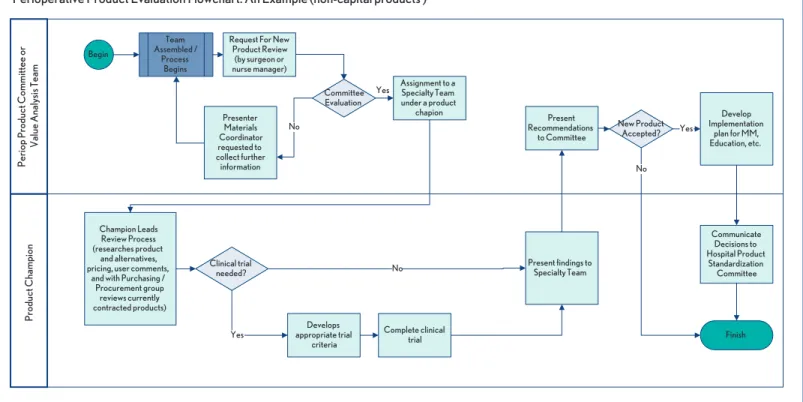
Successful product selection efforts can benefit from project management elements such as templates and flow charts.
Figure 2, below, is an example of a decision-making flow chart that allows for all parties, including vendors and the hospital, to understand how decisions are made and who is responsible at various stages of the process.
Figure 2: Decision-making flowchart for product selection and evaluation.4
4 Source: Adapted from Healthcare Supply Chain Management, Association Healthcare Resource and Materials Management, 2010, p.303.
Perioperative Product Evaluation Flowchart: An Example (non-capital products )
Product Champion
Periop Product Committee or
Value Analysis Team
Begin
Team Assembled /
Process Begins
Request For New Product Review (by surgeon or nurse manager) Present Recommendations to Committee Develop Implementation plan for MM, Education, etc. New Product Accepted? Champion Leads Review Process (researches product and alternatives, pricing, user comments,
and with Purchasing / Procurement group reviews currently contracted products) Assignment to a Specialty Team under a product chapion Clinical trial needed? Develops appropriate trial criteria Complete clinical trial Present findings to Specialty Team Finish Yes No Yes Yes No Committee Evaluation Presenter Materials Coordinator requested to collect further information No Communicate Decisions to Hospital Product Standardization Committee
The flowchart in Figure 2 illustrates a simplified process for the selection of non-capital products or supplies intended for use in the perioperative environment. A similar flowchart could inform a capital product decision making process within a hospital. However, any capital decision-making process should include a link to the operational decision-making process within the hospital or affected area. Capital decision making for products and equipment must advise, inform, and solicit feedback from operational groups that will be affected.
Know your procurement policies and procedures
Procurement Policies and Procedures (PPP) provide a framework and mandatory requirements to govern how organizations conduct sourcing, contracting and purchasing activities, including approval segregation and limits, competitive and non-competitive procurement, conflict of interest and contract awarding.5
The mandatory requirements for procurement for Ontario hospitals can be found in Ontario’s Broader Public Sector Procurement Directive 6.
It must be stressed that the process of determining clinical requirements should be led by surgical practitioners and clinicians. But procurement processes, from assessment through to trials and actual procurement, must be collaborative and involve non-clinical professionals from various parts of the hospital and from the shared service organization. Indeed, while having the surgical practitioners’ input into this process is very important, they are not the sole decision makers for the procurement of goods and services in your perioperative environment.
vendor relations and management
Assess the state of your vendor relations including policies and procedures for the perioperative department. This assessment should also consider how your perioperative department’s vendor relations and management policies and procedures relate to those of the hospital’s as a whole. Please refer to this chapter’s Appendix C: Vendor Management.
5 http://www.fin.gov.on.ca/en/bpssupplychain/documents/bps_procurement_directive.html 6 http://www.fin.gov.on.ca/en/bpssupplychain/documents/bps_procurement_directive.html The process of determining clinical
requirements should be led by surgical practitioners and clinicians.
understanding your requirements and
conducting research
Product evaluation has requirements that are both clinical and non-clinical. Ultimately the goals of product evaluation are to select products and devices that:
• Meet specific performance criteria, including clinical and financial criteria; • Are safe for patients and health care workers;
• Contribute to positive patient outcomes, such as fewer infections and injuries; and,
• Are cost-effective for both the facility and the patient.
A wide range of literature on the benefits of product standardization exists, in Canada and internationally. Conduct research as part of determining your requirements.
Clinical requirements
Once an organization has decided on the clinical services to be offered by the perioperative department, clinical and surgical practitioners can determine the products, supplies, instruments, and equipment that will be required.
Within Ontario, clinical requirements for hospitals are determined by the hospital’s boards and management working with Ontario’s Ministry of Health and Long-Term Care and a hospital’s Local Health Integration Network.
A detailed discussion of how clinical requirements are determined is beyond the scope of this guide, but more information can be found on the Ontario Ministry of Health and Long-Term Care’s website at www.health.gov.on.ca.
Business process requirements
The development of process requirements for product selection will ultimately define a future state model that considers the most efficient process for the introduction, evaluation and selection of product and supplies for the perioperative area or the hospital as a whole.
4.4 DESiGNiNG YOuR SOLuTiON
TIP: Know your regulations
and standards.
As part of determining your
future state, ensure that research
is conducted to determine what
regulations or standards exist
that may apply to this project. This
may include specific clinical and/
or infection control standards, or
Ministry of health and Long-Term
Care reporting standards.
An effective product selection committee structure, with clear terms of reference, senior leadership support, and that is free of individual participant biases (enforced by the terms of reference, a strong governance structure, and a conflict resolution mechanism) should be considered a key business requirement for successful product evaluation and selection.
Working group sessions, facilitated by the project manager, should encourage participants to be open and interactive, discussing all ideas for the future. This process should not be influenced by current limitations, e.g., system limitations, lack of resources, or behavioural barriers that may have inhibited a truly effective product selection process in the past.
An ideal model should be clearly articulated. And before implementation, decisions about priorities, ability, capacity and cost will need to be made. This will allow you to determine short-term implementation goals as well as decide what will need to be moved to another longer-term project phase.
understanding vendor relationships
In health care, there is a symbiotic relationship between vendors, hospitals and physicians. As with any relationship, success is based on trust, open
communication and the recognition that all parties have something to offer and gain. Traditional procurement focuses on evaluation and purchase, while vendor management drives the entire vendor relationship life cycle.
Hospitals have acknowledged that vendors also bring value in expertise and technical clinical skill development. Collaborative relationships allow hospitals to leverage the technology and specialized knowledge of a vendor. The ideal relationship is characterized by clearly-defined and properly communicated expectations for all parties, who operate with accountability and mutual respect. Refer to this chapter’s Appendix C: Vendor Management, for further information. Traditional procurement focuses on
evaluation and purchase, while vendor management drives the entire vendor relationship life cycle.
identifying opportunities for savings
Value analysis and product selection initiatives can be enhanced by examining purchasing patterns across departments. Consider categorizing items and products not just by cost centre or product category but also by additional factors such as the degree of clinical preference associated with the product and the cost saving opportunities. See Figure 3, below, which examines the relationship between clinical preferences and cost savings opportunities. These types of categorizations will require research and should be objective-driven, using an organization’s historical data on usage, purchasing, and pricing.
Figure 3: The relationship between clinical preferences and cost savings. 7
7 Source: Healthcare Supply Chain Management: Resources & Logistics Processes, (AHRMM), p.305.
value Analysis & Standardization Opportunities high Clinical Preference
(Low Potential Savings)
Low Clinical Preference (Low Potential Savings)
Low Clinical Preference (high Potential Savings) high Clinical Preference (high Potential Savings) X-Ray Film
intraocular Lenses
Sutures
Cath Lab Supplies Endoscopic
Products
Cardiovascular Products / Stents Orthopedic implants Cardiac Catheters & Guides
Pacemakers
Food Custom Sterile Kits
Surgical Packs & Gowns
Anesthesia Products Business Forms Linen Office Supplies Sharps Collection i.v. Solutions Dressings Enteral Nutritional Products
Forming product selection committees
As mentioned earlier in this chapter, most hospitals have some form of committee structure for product selection, if they do not already have proper committees for value analysis and product selection and standardization. (Refer to this chapter’s Appendix B for sample documents that outline the formation of an executive supply standardization committee, a clinical services value analysis committee, and a product evaluation and standardization committee.) In most circumstances these are ongoing or standing committees.
The Operating Room Nurses Association of Canada, in its most recent edition of Standards, Guidelines, and Position Statements (see Appendix A for this chapter), offers the following list of participants to be considered in a perioperative product selection committee:
• OR manager/leader • OR educator • Perioperative nurses • Infection control personnel • Finance representative • Biomedical representative • Anesthesiologist
• Surgeon
• Allied health professionals • Materials management • MDR representatives.
While these committees are generally formed in the same manner as most decision making bodies in a hospital, when it comes to value analysis and product selection and standardization, some key points should be considered:
• All participants must be aware of the objectives and desired outcomes of the
value analysis or product selection process.
• All participants should have an interest in supply management and expense
management and overall cost containment and reduction.
4.5 iMPLEMENTiNG PRODuCT
SELECTiON OPTiMizATiON
• Surgeon involvement is critical. But they must understand that there are
a number of contributing factors to the decision-making process, including business requirements that they may not have considered.
• Organizational culture may play a significant part in influencing the overall
product selection process.
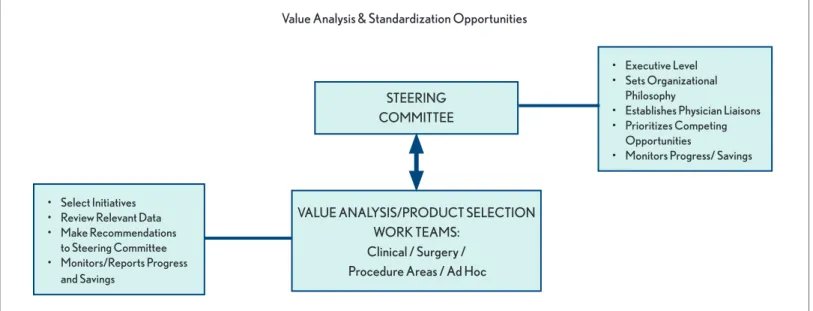
Figure 4, below, illustrates the structure of a value analysis and product selection committee and its governance, as well as its relationship to other bodies within the organization.
Figure 4: A value analysis committee’s structure and relationships. 8
8 Source: Health Care Supply Chain Management, AHRMM, p299
value Analysis & Standardization Opportunities
• Select initiatives • Review Relevant Data • Make Recommendations to Steering Committee • Monitors/Reports Progress and Savings • Executive Level • Sets Organizational Philosophy
• Establishes Physician Liaisons • Prioritizes Competing Opportunities
• Monitors Progress/ Savings STEERiNG
COMMiTTEE
vALuE ANALYSiS/PRODuCT SELECTiON WORK TEAMS:
Clinical / Surgery / Procedure Areas / Ad hoc
Setting terms of reference
There are a number of common elements in the terms of reference for product selection committees. These may include:
Purpose/objectives
• May include the scope of the products, services, or departments to
be included.
Function
• Can include operational, clinical, and financial objectives;
• Design performance criteria for product selection according to needs
for patient care, health care worker safety, and clinical efficacy weighed
against governmental and organization policies and desired outcomes; • Frameworks for planning and implementing an evaluation of products in
clinical settings; and,
• Frameworks for analyzing product performance and cost-effectiveness.
Authorities
• Individuals responsible for the committee.
Membership
• Set out in the product selection committee list above.
Frequency of meetings
• Periodic (monthly meetings are common) or may be called on an • ad hoc basis.
Additional elements within the terms of reference may include:
Conflict of interest policies
• Declarations by members for the committee for any existing or potential
conflicts of interest with any agenda item at any meeting.
information and decisions
• The method by which the committee shall receive information and publish
Targets and goals
• Financial and operational targets or goals can and should be considered.
vendor input and information
• How vendors interact with and present information to practitioners and
committees should be considered in alignment with the organization’s vendor management policies and Doing Business With the Broader Public Sector: A guide for small and medium enterprises) 9.
Review
• The framework and frequency by which the terms of reference will be
reviewed. Organizations often do this annually.
See this chapter’s Appendix B for examples of product selection committee and executive selection committee terms of references.
What makes a successful product
selection process?
Implementing product selection and value analysis processes requires collaborative planning and an effective decision making system. Factors contributing to the success of product selection and value analysis processes include the following:
• Having organizational and executive support;
• Having policies and procedures for evaluating and selecting products; • Assessing current product being used on a value analysis basis;
• Having equal and open access to information for informed decision making; • Having decision makers who are clear on the needs of all stakeholders and
other decision makers;
• Having early clinical involvement in the decision making process; • Being accountable (clinical and non-clinical) for execution of the
process; and,
• Having effective decision-making and committee structures.
having decision makers who are clear on the needs of all stakeholders, and other decision makers, will contribute to successful product selection and value analysis processes.
Measuring the project impact
Measuring the impact of your project can be done in two ways. The first involves examining how well product selection committees are established and maintained. This could be done by measuring how often these committees meet, who regularly attends, and by gauging the overall meeting participation. The second and more complex measure of success should be left to individual committees. It centres on tracking, using appropriate baseline data, the financial and operational measures that the committee, and the organization as a whole, has chosen to improve upon. These measures could include financial elements, overall product costs (e.g., by category, by service), departmental budgets, staff and patient safety metrics, satisfaction with product and satisfaction with the evaluation process.
Sustaining your change
Finding success in value analysis and product selection depends on several key factors. First, executives must make a commitment, supported by the
organization as a whole, to allow managers and staff to take time away from their day-to-day duties to participate in the value analysis and product
selection process.
Next, senior leadership must commit to implement the decisions that come out of the processes and act on recommendations. It is not enough to simply convene committees without heeding their recommendations.
Third, ensure open, fair, and equitable discussions and processes are maintained. There are many ways to manage this. You can rotate the chairpersons of specific
work teams or committees; maintain an established terms of reference, and
establish a dispute resolution process.
Participation, however, is perhaps one of the most important aspects and committee members should be allowed the time to be properly engaged. They should feel comfortable within the process and see that their participation is valued and that the collective decisions and recommendations they design are being implemented. An annual review of the value analysis and product selection processes is also recommended.
4.6 MEASuRiNG AND SuSTAiNiNG
iMPROvEMENTS
Product selection and value analysis should be viewed as an organizational undertaking. Given the complexity of ever-evolving products within the perioperative environment, it is important that staff, clinicians, and surgical practitioners all be involved in product selection and overall value analysis. The perioperative department may not necessarily lead these activities. For many organizations product selection and value analysis are led by purchasing or procurement groups. Nonetheless, the perioperative department has a vital role to play.
Product selection and value analysis frameworks are not short-term or ad hoc solutions. Their success is measured over a longer period, in line with organizational goals. However, establishing the right decision making and committee structure is an important first step.
Additional resources
Product selection and value analysis are activities that cross several disciplines. Clinicians and surgical practitioners receive formal training on product
evaluation, and procurement specialists receive specific training on procurement policies, procedures, and best practices. However, there are many sources of information on procurement, product evaluation as well as how to structure committees, including specialized training courses.
TIP: Beyond asking your
peers in other hospitals, look
to these organizations for
additional information:
The Association for healthcare
Resource and Materials
Management (AhRMM) of the
American hospital Association,
http://www.ahrmm.org/
The Association of
Operating Room Nurses,
http://www.aorn.org/
healthcare Supply Chain
Network, http://www.hscn.org/
The Operating Room Nurses
Association of Canada, http://
www.ornac.ca/ .
Standards, Guidelines, and Position Statements for Perioperative Registered Nursing Practice Operating Room Nurses Association of Canada (ORNAC), 9th Edition, 2009
Included with permission from ORNAC
Equipment Selection/Trialing
Surgical equipment and supply acquisitions need to be managed by having appropriate processes in place to ensure that the right product is available for the right application. Patient safety and staff safety should be considered.
PRACTICE RATIONALE
4.2.1 Health care facilities should establish a multidisciplinary committee to review equipment/supply requests. This committee should include but not be limited to the following:
- OR Manager/Leader; - OR Educator; - Perioperative nurses; - Infection Control personnel; - Finance representative; - Biomedical representative; - Maintenance representative; - Anaesthesiologist;
- Surgeon;
- Allied Health Professionals: - Materials management; and
- Sterile Processing personnel (CSAZ318.8-08)
Surgical suite equipment is expensive and technology is rapidly changing. Input from a variety of users is required to make the best purchase decision. The amount of dollars available for technology purchases is usually far less than the dollar value of requests made, so decisions must be sound.
4.2.2 A systemized process for equipment
A systemized process for equipment requests should be in place and the process should include a feedback mechanism to inform the requester of the status of the request.
Most health care facilities have specific timelines for capital budget item requests. Non-capital items may be purchased within
operating budgets.
4.2.3 Standardization, appropriate utilization and price reduction are the best way to reduce supply expenses.
Standardization benefits both physicians and perioperative staff by creating uniformity in practice that results in reduced learning curves with reduced changes. (Cunningham, 2000, p. 19)
Appendix A: Excerpt from ORNAC’s Standards, Guidelines, and Positions
Statements for Perioperative Registered Nursing Practice
continued
PRACTICE RATIONALE
4.2.4 The following criteria should be considered by the committee to narrow the choice of product/equipment to select/trial: - size, weight and specifications fit into the physical environment;
- the cost of the item falls into budgeted dollars; - the item has the functionality to meet the clinical end use;
- the equipment is approved for use in your jurisdiction (HPB/CSA approval);
- the company or manufacturer shall provide validated cleaning/reprocessing instructions for the equipment; and
- the necessary infrastructure is in place to support the use of the equipment. (CSA, Z314.22-04)
Reviewing the equipment in this context will assist in creating a "short list" of
products/equipment to evaluate. To decrease problems related to inappropriate equipment size, selection etc. , avoid costly mistakes and waste of valuable time.
4.2.5 On site equipment evaluation should be completed prior to purchase.
Contact and/or visit other sites to gather information such as:
- does the equipment meet the needs specified;
- what is the cost and is it acceptable; - are educational sessions offered through the vendor;
- how is the equipment reprocessed; - are staff satisfied with the product; - is the equipment reliable;
- does the vendor provide service/maintenance vendor;
- what is the cost of upkeep; - was this the preferred choice; and - would they purchase the same item if they had that choice
Document and save all information.
To ensure equipment is functioning and suitable to patient, staff and departmental needs.
Input from other centres and staff provide valuable information related to equipment function, use and reliability. To be used for future reference and decision making.
4.2.6 The decision to trial new equipment/ technology should consider but not be limited to the following:
- do physicians and staff require training prior to the use of the equipment;
- is the presence of the sales representative
To plan the necessary arrangements for training. The presence of a sales
representative to lend technical assistance related to the device should not substitute for orientation and training of nursing staff members in the use of the equipment; neither should such presence substitute for formal
PRACTICE RATIONALE
necessary to support the use of the technology; and should the patient be informed that new technology is being used.
instruction of the surgeon before using new equipment in the OR. (Murphy, 2001, p. 824) The sales rep should be readily available if needed and to assist in appropriate equipment selection/use. Sales representatives should not be regarded as an extra set of hands for tying gowns or opening supplies, even if the representative has the skills to do so safely. The representative‘s legitimate role is to provide technical assistance related to the device for the safe care of the patient. (Murphy, 2001, p. 824) To acknowledge the patient‘s input and provide the necessary information required for consent. The patient‘s decision to consent to (or refuse) treatment must be informed; that is, the patient must receive information about the nature of the proposed treatment, its expected benefits, the material risks, special risks or material side effects associated with it, alternative courses of action and the likely consequences of not having the treatment. (CPSO, 2001, p.3)
4.2.7 Health care facilities should develop policies and procedures related to equipment trials involving but not limited to:
- Risk manager; - Bioethicist; - Physicians; - OR Manager;
- Perioperative Registered Nurses; - Allied Health Professionals; and - Infection Control Practitioners.
4.2.8 Develop a user friendly evaluation tool to provide objective criteria to help with the assessment of different technologies.
The decision to purchase a piece of equipment should include but not be limited to the
following considerations: - does it meet the clinical need;
- does it pose a safety concern for the patient or team; for the patient
- ergonomics
- what are the ongoing costs of consumable items;
- is physician, staff and biomedical education
To help with decision making. A user friendly tool will increase compliance.
All information is necessary to make an informed final decision. Sound business principles combined with knowledge of clinical practice should drive the acquisition decision. (Berhardy, 2001, p. 26)
Appendix A: Excerpt from ORNAC’s Standards, Guidelines, and Positions
Statements for Perioperative Registered Nursing Practice
continued
PRACTICE RATIONALE
included;
- are operating/reprocessing instructions resources included (videos, CDs, manuals); - are maintenance instructions available for biomed/maintenance department;
- are preventative maintenance contracts available with the vendor;
- what is the warranty on the item; and - are there opportunities to lease or lease-to-own.
Executive Supply Standardization Committee1 TERMS OF REFERENCE
PURPOSE
• The purpose of the Executive Supply Standardization Committee is to provide direction and support for the purchasing strategies of the hospital.
FUNCTIONS
• Develop formal objectives and financial targets for Supply Chain Management subcommittees.
• Provide quarterly financial progress reports to subcommittees based on annual supply cost reduction targets.
• Provide direction and support to the subcommittees.
AUTHORITIES
• Established by and is responsible to the Senior Administration Team.
MEMBERSHIP
• Chief Financial Officer (Chair)
• Chief Planning and Resource Officer
• Chief Clinical Officer
• Chief of Staff
• Director Logistics and Equipment Planning
• Director of Material Management Services
• Director of Financial Services
FREQUENCY OF MEETING
• Monthly (or as determined by committee)
1
Examples of Committee Terms of Reference and Membership have been drawn from ORSC hospitals with particular acknowledgement to Cornwall Community Hospital, The Hospital for Sick Children, and Trillium Health Centre
Appendix B: Sample Product Standardization Committee
Terms of Reference from OR Supply Chain Program Participants
continued
Surgical Services Value Analysis Committee TERMS OF REFERENCE
PURPOSE
• To evaluate the need for and suitability of OR-specific procedures, medical supplies and equipment.
• To assist the leadership and physician users of the program in determining the best product at the best price utilizing a value analysis approach.
• To serve as a liaison and a resource, in regards to operative medical/ surgical products, for the physicians, the perioperative staff and when necessary the clinical program leaders.
• To formalize a process for the management of special requests.
FUNCTIONS
• To critically review and consider for trial or for use, speciality medical surgical supplies or devices required for interventions in the OR. The committee will also define criteria for specific trials as well as determine duration and identify an evaluation process. The selection of products to be included in the OR speciality/pre-approved purchase processes is based upon objective evaluation of therapeutic merit, safety and budget impact. Duplication of products is minimized.
• To review and recommend the standardization of product use, which will result in financial savings, minimize the breadth of product lines and lead to improvement strategies.
• To serve in an advisory capacity to physicians, perioperative leadership/staff and the
administration in issues related to the purchase and/or use of surgical and anaesthesia supplies including investigational and Special Access Program products.
• To ensure that all new products, equipment, and services meet all safety standards, and codes of the hospital.
AUTHORITIES
• The Surgical Services Value Analysis Committee (SSVAC) is a subcommittee of the OR Committee and Executive Supply Standardization Committee.
• Procedural and product decisions made by the SSVAC are subject to final approval by the Executive Supply Standardization Committee.
MEMBERSHIP
• Director of Material Management
• Director of Surgical Services
• Chief of Surgery
• Chief of Anaesthesiology
• Supervisor Operating Room
FREQUENCY OF MEETING
Product Evaluation and Standardization Committee TERMS OF REFERENCE
PURPOSE
The primary purpose of the Product Evaluation Committee is to provide support to the purchasing strategies of the hospital by:
• Advising the Executive Supply Standardization Committee on issues dealing with product standardization / utilization in the hospital;
• Establishing and monitoring a process for the timely and cost efficient acquisition of products using value analysis techniques;
• Focusing on consolidation of products which leads to obtaining best possible quality products at best prices;
• Pursuing the consolidation of vendors, wherever and whenever possible, if this results in realizable benefits to the hospital.
FUNCTIONS
• The purchase and maintenance of standardization of all stock and non-stock supplies within the hospital. Exception applies to pharmaceutical, reusable stainless steel instruments, nutritional, specific reagents, research, biomedical and engineering products.
• The evaluation of products.
• The standardization/utilization of products.
• To evaluate the impact of the purchase of new equipment on operating supplies and make appropriate recommendations to the relevant decision-making authority for capital acquisitions.
• To authorize the introduction of new products by analyzing, evaluating, and monitoring all trials with the objective of selecting the most clinically and cost-effective products, using predefined criteria and establishing subcommittees to lead the clinical evaluation process.
• To investigate, and where feasible, standardize when two or more products are used to perform the same function.
• To review new or proposed product usage so its economic impact can be identified, studied, and evaluated except for items that fall under the responsibility of other committees, i.e., Pharmacy
• To monitor and evaluate the use of disposable and reusable products.
• To educate all users on current product and product-related and newly adopted policies and procedures.
AUTHORITIES
• The Production Evaluation and Standardization Committee reports to the Executive Supply Standardization Committee.
MEMBERSHIP
• Director, Material Management Services/ Purchasing
• Infection Prevention and Control Professional
• Director, Surgical Services
• Director, Medicine
• Team Leader, Emergency
• Occupational Health & Safety Practitioner
• Clinical Resource Nurse
• Representative, Operating Room
• Director, OB/GYN/Peds
• Diagnostic Services Representative
• Physician
• Sterile processing (senior representative)2
• Secretary
ADDITIONAL INFORMATION
• Members are responsible for relaying products to be addressed at the next meeting to the Chairman.
• When the Committee determines that a product should be evaluated, the key users will be identified and invited to participate. Sample distribution and evaluation results will be coordinated by the Director of Purchasing and appropriate Committee member(s).
• Medical and surgical items that are difficult to assess in terms of relevant impact on patient care, quality and relevant cost will be reviewed by the P.E.S.C. and referred to the appropriate administrative committee.
FREQUENCY OF MEETINGS
• Monthly or as determined by committee
2
Sterile processing representation is important particularly if a reusable product is being evaluated or trialed.
Appendix B: Sample Product Standardization Committee
Guide to Vendor Management
WHAT IS VENDOR MANAGEMENT?
Vendor management is an all-inclusive approach to managing your interactions with the companies and individuals that supply your hospital. For the clinical supply chain, it is about the relationships with vendors that ensure a flow of products, supplies and services to the perioperative environment. Vendor management includes the management of communications, business practices, negotiations, procedures, and services such as training and support, as well as the day-to-day interactions used to establish and maintain a relationship with a vendor.
Vendor management entails the development and implementation of a framework that addresses the following:
• Accountability for vendors, hospital / shared services staff, clinicians, and surgical practitioners;
• Inter-personal relationships;
• Conduct and practice;
• Patient safety and confidentiality;
• Security, and;
• Adherence to all applicable legislation, regulations, professional guidelines and codes of conduct.
WHAT ARE THE BENEFITS OF EFFECTIVE VENDOR MANAGEMENT?
Effective vendor management, which uses policies and procedures, will mitigate potential risks for practitioners, clinicians, the perioperative department, the procurement department and the hospital as a whole. These risks can include:
• Reputational risks
• Operational and technical risks
• Transactional risks
• Credit and financial risks
• Compliance risks
• Security risks
• Access risks
• Contractual risks.
Vendor management is not a matter of simply negotiating the lowest price. Rather, it is about constantly working with your vendors to come to agreements that will mutually benefit both sides.1
It is important to understand this process as relationship building for the long term. Communicating and strategizing with your vendors will help in the development of effective vendor management policies.
1
Bucki, James. In Vendor Management: Making It A Win-Win. Retrieved May 5, 2010 from
Appendix C: A Guide to vendor Management based on the OR Supply Chain Program
continued
Vendors can also be important learning resources. Indeed, vendors of specialized products being introduced into the perioperative environment have an important role to play in explaining and demonstrating their products. They also educate (or assist in the education) of hospital professionals who will use the product in patient care, reprocess it or maintain it, as well as replenish and store the product.
WHO ARE YOUR VENDORS?
There are a number of different types of vendors selling goods, services and supplies into hospitals. These include the following:
• Manufacturers
• Distributors
• Sales representatives
• Service and repair companies
• Consulting companies (management consulting and or subject matter consultants)
• Engineers
• Technical/clinical specialists.
There are also variations and combinations of these basic vendor types and it can often be confusing for purchasers to understand the specific role of their vendor in the manufacturing, selling, and servicing process. An effective vendor management system will help to clarify these roles. In Ontario, there are many classifications and terms used for the variety of people employed by, working in, or visiting hospitals. Vendors may be classified as ‘visitors’, however, each hospital may have its own classification system.
Organizations may consider categorizing vendors based on the areas within the organization or hospital with which they interact. Examples of vendor categories include:
• Vendors that call on materials management, facilities management, administrative areas, and other non-patient care areas;
• Vendors that call on patient care areas;
• Vendors that are required to interact with clinical staff and/ or surgeons; and,
• Vendors that call on and are required within the perioperative environment.
WORKING WITH VENDORS IN THE PERIOPERATIVE ENVIRONMENT
It is increasingly common to find vendors in the perioperative environment. For this reason, vendor management and any formalized vendor agreements should outline matters such as the adherence to aseptic technique, adherence to protocols surrounding blood borne pathogens and sharps, and compliance with and adherence to patient safety and confidentiality regulations and protocols. (For a sample of vendor
guidelines, please see Example A at the end of this section.)
In many cases, different hospital departments have different vendor management policies. For perioperative departments, the responsibility of vendor management tends to fall to departmental directors and the daily enforcement of these policies to departmental managers. Collaboration between vendors and perioperative management teams in setting parameters for innovation and access would help to ensure that hospitals get the most benefit from new techniques and technologies.
The value and insights that vendors may provide to the perioperative environment should not be
underestimated. Given the nature of their jobs and the positioning of their organizations, vendors and their representatives have access to multiple organizations, clinicians, and practitioners. Additionally, many of
these vendor organizations are aligned with academic medicine’s research and development agenda, have access to clinical trials and resources, and they may have the talent to improve and to expand the development and use of their products.
At a minimum, vendors to your organization’s perioperative environment should be bound by a written agreement or contractual obligation to adhere to your vendor policies and procedures. (See the examples at the end of this section for reference materials and position statements that may inform your organization’s development of perioperative vendor policies.)
DEVELOPING VENDOR MANAGEMENT POLICIES
Vendor management policies, procedures and responsibilities can serve as a universal guide. While these are developed collaboratively by various stakeholders to fulfill a number of requirements, among them is the need to ensure effective and efficient patient care.
The Ontario Broader Public Sector Supply Chain Code of Ethics, shown below, sets out basic overarching principles of conduct for broader public sector organizations and must be easily accessible to suppliers, advisors and other stakeholders.
Ontario Broader Public Sector (BPS) Supply Chain Code of Ethics Goal:To ensure an ethical, professional and accountable BPS supply chain.
I. Personal Integrity and Professionalism
Individuals involved with Supply Chain Activities must act, and be seen to act, with integrity and professionalism. Honesty, care and due diligence must be integral to all Supply Chain Activities within and between BPS
organizations, suppliers and other stakeholders. Respect must be demonstrated for each other and for the environment. Confidential information must be safeguarded. Participants must not engage in any activity that may create, or appear to create, a conflict of interest, such as accepting gifts or favours, providing preferential treatment, or publicly endorsing suppliers or products.
II. Accountability and Transparency
Supply Chain Activities must be open and accountable. In particular, contracting and purchasing activities must be fair, transparent and conducted with a view to obtaining the best value for public money. All participants must ensure that public sector resources are used in a responsible, efficient and effective manner.
III. Compliance and Continuous Improvement
Individuals involved with purchasing or other Supply Chain Activities must comply with this Code of Ethics and the laws of Canada and Ontario. Individuals should continuously work to improve supply chain policies and procedures, to improve their supply chain knowledge and skill levels, and to share leading practices.
DEVELOPING VENDOR CONDUCT POLICIES, CHECKLISTS AND CREDENTIALS
Vendor Conduct Policies:
All hospitals should have vendor conduct policies or protocols. Policies should delineate guidelines for visitation to the hospital and address appropriate activities and interactions between the hospital’s medical facility personnel, allied health professionals and other vendors. These may be enhanced by specific departmental policies.
It is recommended that hospitals establish general operating procedures for all vendor representative visits, as well as the receipt and delivery of products.
Vendor Management Checklist:
A checklist will ensure transparent communication, which can in turn help to manage issues over vendor access. The consistent application of the checklist will reduce redundancy, improve risk management and ensure compliance by the vendor community.
Items typically found in a vendor management checklist include:
• Personal Health Information Protection Act (PHIPA) regulations, Freedom of Information regulations, and Bill 122, Broader Public Sector Accountability Act, 2010.
• General Conduct Expectation Introduction within the hospital and the perioperative environment. These include an overall understanding of roles and responsibilities of vendors, practitioners, hospital staff, and various intermediaries including procurement professionals and shared services organization representatives. They can also include:
o Patient privacy guidelines
o Institutional / organizational privacy and confidentiality policies
o Purchasing protocols, including new technology introduction.
• Specific guidelines addressing vendor relations concerning:
o Gifts
o Preferential treatment or benefits to staff, surgeons
o Entertainment
o Samples of goods and services
o Consulting and research activities
o Vendor sponsorship
o Confidentiality of business matters.
• Infection control rules within the hospital should also outline issues of hygiene and attire for vendors. These can include details about the wearing of hair coverings, masks, personal valuables as well as matters such as hand washing protocols, policies on vaccinations and awareness of infectious conditions such as colds, and influenza.
• Information outlining the visible identification vendors must wear. (Vendor credentialing according to their particular access to hospital patients and assets.)
• Information outlining check-in and check-out protocols.
• Information on surgical procedure protocols, which should include:
o Awareness of and adherence to the sterile field.
o Awareness of where to stand while in the surgical suite as well as how to conduct themselves within the surgical suite.
o Protocols on the documentation of vendor presence (on the perioperative or other intra-procedure documentation).
o Appreciation for appropriate behaviour and conversation in the operating room.
Appendix C: A Guide to vendor Management based on the OR Supply Chain Program
o Acknowledgement of emergency protocols.
o Protocols on the appropriate time for a vendor to enter the surgical suite (the vendor is not to enter until the patient is draped).
o Protocols and procedures regarding the prohibition of vendor representatives from opening or handling any sterile items within the sterile field.
o Policies prohibiting vendors from providing any patient care (the vendor will act as support agent for products only).
o Observational Experience Agreement Forms (to be completed for each representative present in a procedure. Forms can be kept on file in the department and updated on an annual basis).
o Patient consent form (which can include check box for vendor representatives).
• Hospital expectations on the delivery and removal of supplies, products, and instruments.
• Policy on interactions with surgical practitioners, staff, clinicians, fellows, residents’ requirements. This includes designated meeting areas for discussions, appointments and a listing of key contacts for specific areas or departments within the hospital.
• Protocols surrounding compliance, accountability, and conflict resolution processes.
• Hospital health and safety rules and regulations.
Additionally hospitals and their leadership teams should consider how vendor conduct and vendor management policies impact on or may be affected by regulations that govern the operation of a hospital. They should also consider safety, patient confidentiality and environmental issues.
Vendor Credentialing:
A vendor credentialing program can help ensure the hospital meets its obligation to provide a safe, secure, and infection-free environment. Credentialing can provide confidence that vendors and their representatives are indeed who they claim to be. These programs are often carried out in partnership with a third party or private company that can be very effective assisting the hospital in establishing, and/or maintaining the credentialing program.
These programs may be attractive as hospitals become more operationally complex entities with multiple entry points that are largely unsecured. Purchasing departments are sometimes located off site, so it can be difficult for hospital staff and surgeons to know all of their vendors.Vendors should be
classified according to the level of access they have within a hospital. This is particularly important in the perioperative area.
General vendor credentialing can include the following:
• Background checks such as criminal record checks on individual representatives, proof of
insurance, professional credentials, national / international lists of excluded persons or companies, etc.
• General financial and business information on the vendor company, including Workplace Safety and Insurance Board compliance, tax compliance, etc.
• Immunization record checks for TB, Influenza, Hepatitis B, Mumps, Measles, Rubella, Chicken pox, etc.
• Behaviour guidelines and compliance: these are general expectations and hospital safety rules, regulations (and may include training for vendors through various educational media).