Payroll Journal Guide
Handbook F-18 January 2014
Transmittal Letter
A. Explanation. The payroll journal shows the details of payments, deductions, and adjustments applicable to Postal Service™ employees each pay period. Use Handbook F-18, Payroll Journal Guide, when reviewing the payroll journal for information about employees’ pay and leave status. This issue of Handbook F-18 includes updates made since this directive was last issued April 2011.
B. Availability. Handbook F-18 is available on the Postal Service corporate intranet at
http://blue.usps.gov/cpim/hbkid.htm.
C. How to Use this Document:
“Rural” refers to those employees paid under the provisions of the rural carrier schedules. “City” refers to those employees paid under the provisions of any schedule other than those applicable to rural carriers.
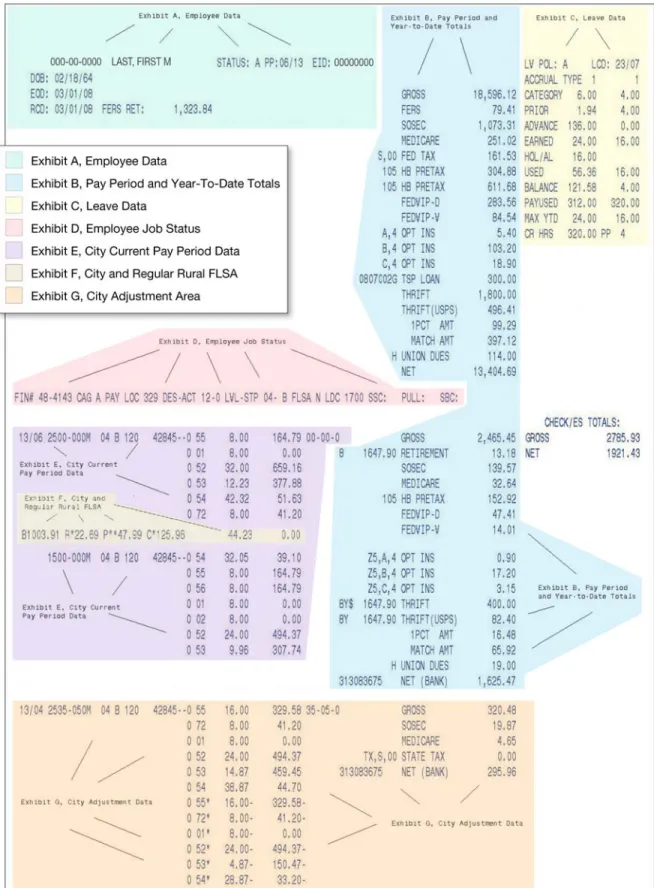
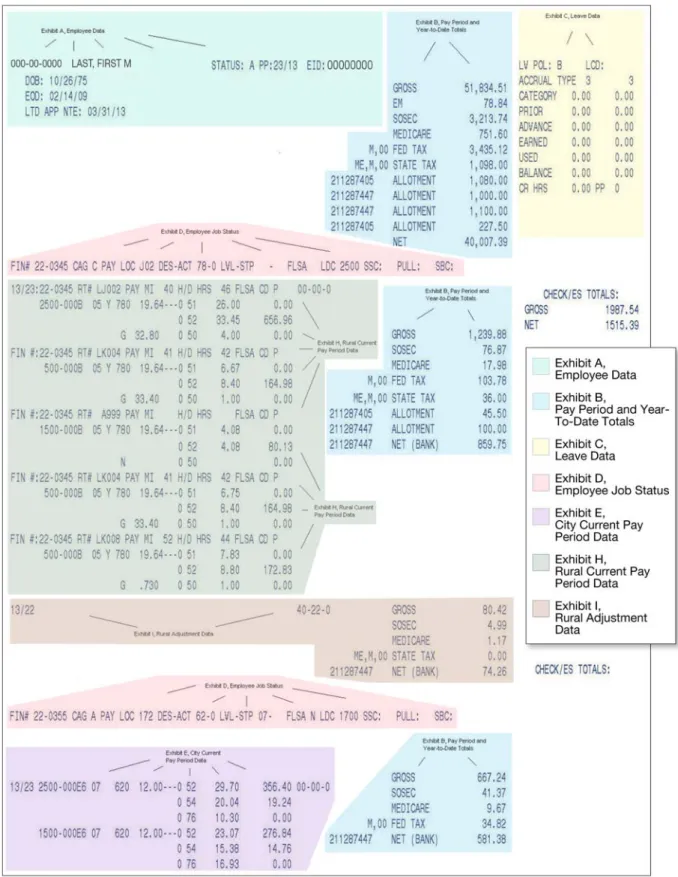
Figure 1 shows a City employee journal record segmented into seven sections (A–G), each of which is labeled and more fully explained in a following exhibit. Figure 2 is a Rural/City Dual employee journal record similarly segmented. The segments labeled Exhibits A through D are laid out the same for both city and rural records. The Rural/City Dual employee journal records shows two additional specific segments (H and I) that are explained in Exhibits H and I. Where possible, the examples in the exhibits are drawn from the records in Figures 1 and 2. Appendices A and B provide more detailed information that more clearly illustrate the possible variables, and they are referenced in the text where relevant.
The exhibits show the most variables that could occur on a payroll record, including variables that may not appear on Figures 1 and 2 or in an actual employee’s payroll record; “Xs” indicate the location and format of such a variable.
Multiple occurrences of year-to-date line items such as union dues or health insurance reflect activation and deactivation of segments on the Employee Master File.
If you have questions about an actual payroll journal with which you are working:
First determine if it is for a city or a rural employee.
Turn to the segmented city journal exhibit (Figure 1) or the segmented rural/city dual exhibit (Figure 2). Identify the segment for which you need information and note the letter and title of the exhibit that contains that segment.
Turn to the exhibit. Each exhibit consists of two parts — “Information” and “Sample.”
– “Information” lists the numbered items and, where applicable, gives a brief description or lists possible variables for that item.
– “Sample” shows a sample journal segment with individual parts numbered and labeled.
D. Rescissions. This revision obsoletes all previous editions of Handbook F-18.
E. Comments and Questions. Address all comments and questions regarding the content of this handbook through management channels to:
MANAGER, PAYROLL U.S. POSTAL SERVICE 2825 LONE OAK PKWY EAGAN MN 55121-9500
January 2014 iii
Summary of Changes
This January 2014 edition of Handbook F-18 replaces the April 2011 edition. The following table is a list of revisions incorporated into the January 2014 version.
Title Type of Change
Payroll Journal Guide Content Change:
Revised date of last issue from April 2011 to January 2014. Figure 1, City Journal Page Segmented
for Exhibit Purposes
Content Change: Updated copy. Figure 2, Rural/City Dual Journal Page
Segmented for Exhibit Purposes
Content Change: Updated copy. Exhibit A, Employee Data (Information) Content Change:
Revised labeling of items. Addition:
11. NTFT TOUR HOURS = Non-Traditional Full-Time employee tour hours.
Exhibit A, Employee Data (Sample) Content Change:
Revised labeling of items. Addition:
11. NTFT TOUR HOURS = Non-Traditional Full-Time employee tour hours.
Exhibit B, Pay Period and Year-to-Date Totals (Information)
Content Changes:
Revised labeling and sequencing of items.
2. RETIREMENT: Revised explanation to include FERS.
2. SALARY ADVPD: Revised explanation to exclude “or invoiced,” and added an asterisk to refer to the footnote.
2. BANKRUPTCY: Revised explanation to include Chapter 13 Plan. 2. HSA PRE-TAX: Revised explanation to include “with routing
transit number.”
2. TSP ROTH: Revised explanation to remove “For future use.” 2. TSP ROTH CATCH UP: Revised explanation to remove “For
future use.”
2. TAX LEVY: Revised explanation to include “Federal.” Addition:
2. SALARY ADV = Salary advance invoiced (not a deduction), and added an asterisk to refer to the footnote.
Deletion:
2. MH AUTO INS = Mailhandlers. Exhibit B, Pay Period and Year-to-Date
Totals (Sample)
Content Change: Revised example.
Payroll Journal Guide
Exhibit C, Leave Data (Information) Content Changes:
Revised labeling and sequencing of items.
4. LV CAT = Leave Category: Revised to “CATEGORY.”
6. ADVANCE = Balance of advanced sick leave available: Revised to “Balance of advanced sick leave.”
Additions:
1. LV POL = Leave Policy.
3. ACCRUAL TYPE = Accrual Type. PAYUSED = Internal ASC use only. MAX YTD = Internal ASC use only. Exhibit C, Leave Data (Sample) Content Change:
Updated copy. Exhibit D, Employee Job Status (Sample) Content Change: Updated copy. Exhibit E, City Current Pay Period Data
(Information)
Content Changes:
Revised labeling of items.
12. N = Postal Data Center craft employees: Revised to “Information Technology/Accounting Service Center craft employees.”
Exhibit E, City Current Pay Period Data (Sample)
Content Change: Updated copy. Exhibit F, City and Regular Rural FLSA
(Sample)
Content Change: Updated copy. Exhibit G, City Adjustment Data
(Information)
Content Changes:
Revised labeling of items.
13. N = Postal Data Center craft employees: Revised to “Information Technology/Accounting Service Center craft employees.”
Exhibit G, City Adjustment Data (Sample) Content Change: Updated copy. Exhibit H, Rural Current Pay Period Data
(Sample)
Content Change: Updated copy. Exhibit I, Rural Adjustment Data
(Information)
Addition:
24. Leave Data = Annual Leave (AL) / Sick Leave (SL). Exhibit I, Rural Adjustment Data
(Sample)
Content Change: Updated copy. Appendix B (page 2), City FLSA
Calculation Formula
Content Change: Updated copy. Deletion:
Removed “Code 38 = Extra 50% (adjustments only)” from the calculation and legend.
Appendix B (page 5), Dual Employee (7X-X and 6X-X) FLSA Calculation Example
Content Change: Updated copy.
January 2014 v
Contents
Figure 1 — City Journal Page Segmented for Exhibit Purposes. . . .
1
Figure 2 — Rural/City Dual Journal Page Segmented for
Exhibit Purposes. . . .
3
Exhibit A — Employee Data . . . .
5
Exhibit B — Pay Period and Year-to-Date Totals . . . .
7
Exhibit C — Leave Data. . . .
11
Exhibit D — Employee Job Status . . . .
15
Exhibit E — City Current Pay Period Data . . . .
17
Exhibit F — City and Regular Rural FLSA . . . .
21
Exhibit G — City Adjustment Data . . . .
23
Exhibit H — Rural Current Pay Period Data . . . .
27
Exhibit I — Rural Adjustment Data. . . .
31
Appendix A — Hours Code . . . .
35
Payroll Journal Guide
January 2014 vii
Contents
Figure 1
City Journal Page Segmented For Exhibit Purposes . . . 2 Figure 2
Rural/City Dual Journal Page Segmented For Exhibit Purposes . . . 4 Exhibit A
Employee Data (Sample) . . . 6 Exhibit B
Pay Period and Year-to Date Totals (Sample). . . 10 Exhibit C
Leave Data (Sample) . . . 13 Exhibit D
Employee Job Status (Sample) . . . 16 Exhibit E
City Current Pay Period Data (Sample) . . . 19 Exhibit F
City and Regular Rural FLSA (Sample) . . . 22 Exhibit G
City Adjustment Data (Sample) . . . 25 Exhibit H
Rural Current Pay Period Data (Sample) . . . 29 Exhibit I
Rural Adjustment Data (Sample) . . . 33 Appendix A
Hours Codes . . . 36 Appendix B (page 1)
Dual FLSA Calculation Formula for Designation 3X-4X/7X Employees . . . 38 Appendix B (page 2)
City FLSA Calculation Formula . . . 39 Appendix B (page 3)
City FLSA Calculation Example. . . 40 Appendix B (page 4)
Dual Employee (7X-X and 6X-X) FLSA Calculation Formula . . . 41 Appendix B (page 5)
Payroll Journal Guide
January 2014 1
Figure 1
City Journal Page Segmented for Exhibit
Purposes
Figure 1 Payroll Journal Guide Figure 1
January 2014 3
Figure 2
Rural/City Dual Journal Page Segmented for
Exhibit Purposes
Figure 2 Payroll Journal Guide Figure 2
January 2014 5
Exhibit A
Exhibit A Payroll Journal Guide Exhibit A
Employee Data (Information)
1. Employee Social Security Number.
2. Employee last name, first name, middle initial. 3. SEP = Separation Date.
4. STATUS = Employee status: A = Active
T = Terminated
P = Pending Termination 5. Relevant Pay Period/Year.
6. EID = Employee Identification Number
7. C/Y LWOP = Total leave without pay charged in the current calendar year. 8. DOB = Date of birth.
9. EOD = Entered on duty date. 10. RCD = Retirement computation date.
11. NTFT = Non-Traditional Full-Time employee tour hours. For others, it is blank. 12. CSRS RET = Civil Service Retirement System
FERS RET = Federal Employee’s Retirement System
Total retirement deduction from the beginning date of employee’s current appointment through the last pay period of the prior year. If the employee separates and is rehired, prior totals are not reflected on the payroll journal.
13. LTD APP NTE = Limited appointment not to exceed date. The month, day, and year when limited appointment expires, if applicable.
Exhibit A
January 2014 7
Exhibit B
Exhibit B Payroll Journal Guide Exhibit B
Pay Period and Year-to-Date Totals (Information) 1. Compensation:
GROSS
EI = Earned income credit. (Discontinued 2011). EM = Equipment maintenance allowance. RC LOCK = Rural carrier lock pouch.
LD/RT = Payment for liquidated damages and USPS rental quarters. TCOLA = Territorial cost of living allowance.
LEAP = Law enforcement premium. LOCP = Locality pay.
AUO = Administratively uncontrollable overtime. INS INCOME = Insurance income.
CDOA = Carrier drive-out payment.
DO-SW = Drive-out subject to withholding. DO-NSW = Drive-out not subject to withholding. SRVU = Supervisor reimbursement for vehicle usage.
SV-SW = Supervisor reimbursement subject to withholding. SV-NSW = Supervisor reimbursement not subject to withholding. VEH H = Vehicle hire payment.
VH-SW = Vehicle hire subject to withholding. VH-NSW = Vehicle hire not subject to withholding.
2. Deductions from Gross: Multiple occurrences of year-to-date line items such as union dues or health insurance reflect activation and deactivation of segments on the Employee Master File.
RETIREMENT = Civil Service Retirement System (CSRS) or Federal Employee’s Retirement System (FERS). SOSEC = Social Security. (Replaces FICA.)
MEDICARE
FED TAX = Federal income tax, with marital status and number of exemptions. HB PRETAX = Health insurance pretax deduction, with plan code.
HB POSTTAX = Health insurance post-tax deduction, with plan code.
STATE TAX = State tax, with state code, marital status, and number of exemptions. LOCAL TAX = Local tax, with local tax code, marital status and number of exemptions. SALARY ADV = Salary advance invoiced (not a deduction).*
SALARY ADVPD = Salary advance collected.*
PODB POSTTAX = Post-tax deduction for Post Office indebtedness, with control number.
OTHER INDEBT = Other government agency indebtedness, with control number. May be collected through Treasury Offset Program.
CS/SS = Child support/spousal support, with control number. BANKRUPTCY = Bankruptcy (Chapter 13 Plan), with control number. GARN FEE AMT = Amount charged to establish garnishment. GARNISHMENT = Garnishment, with control number. FSAHC = Flexible Spending Account, Health Care. FEDVIP-D = Federal Employee Dental Insurance Program. FEDVIP-V = Federal Employee Vision Insurance Program.
HSA PRE-TAX = Health Savings Account, with routing transit number. OPT INS = Optional life insurance, with insurance codes.
LTC POSTTAX = Post-tax Long Term Care Premium. FSADC = Flexible Spending Account, Dependent Care.
TSP LOAN = Thrift Savings Plan loan payment, with loan account number.
THRIFT = Thrift Savings Plan employee contribution, with retirement code, amount eligible for TSP Withholdings, and percentage contribution.
TSP ROTH = Employee TSP Roth contributions combined with regular TSP contributions to determine IRS Limits.
TSP CATCH UP = Thrift Savings Plan catch-up contribution. TSP ROTH CU = Thrift Savings Plan Roth catch-up contribution.
* The amount displayed as “SALARY ADV” in the year-to-date (YTD) area of the payroll journal includes invoiced amount (SALARY ADV) and/or collected amount (SALARY ADVPD).
Pay Period and Year-to-Date Totals Exhibit B
January 2014 9
2. Deductions from Gross (Continued):
THRIFT (USPS) = Total USPS Thrift contribution on behalf of employee. 1PCT AMT = USPS automatic 1% contribution for FERS employees. MATCH AMT = USPS matching amount (2%–5% on FERS employees). CPP = Pre-tax Commuter Program.
CPT = Post-tax Commuter Program. MIL BUY BACK = Military buy back.
UNION DUES = Union dues, with union identification code. CHARITY = Charity, with charity code.
XXX AUTO INS = Automobile insurance, with carrier identification number. MBA AUTO INS = NALC.
VBP AUTO INS = Voluntary Benefit Plan (APWU).
EXTRA FED TAX = Additional federal taxes and exemptions deducted at employee’s request. EXTRA STATE TAX = Additional state taxes deducted at employee’s request.
EXTRA LOCAL TAX = Additional local taxes deducted at employee’s request. ALLOTMENT = Allotment, with routing transit number.
TAX LEVY = Federal tax levy, with control number.
3. NET
NET = Paper check.
Exhibit B Payroll Journal Guide Exhibit B
January 2014 11
Exhibit C
Exhibit C Payroll Journal Guide Exhibit C
Leave Data (Information)
1. LV POL = Leave Policy: A = Leave eligible. B = Leave ineligible
C = Leave eligible modified. (Policy effective 10/6/2012 for new hire/conversion Postmasters and supervisory/managerial employees with no prior USPS or Federal service creditable toward the leave computation date.)
2. LCD = Leave Change Date. Year and pay period of next leave category change.
3. ACCRUAL TYPE: Annual Leave:
1 = Advance annual leave. 2 = Earn as you go. 3 = Not eligible. Sick Leave:
1 = Earn by pay period. 2 = Earn by credit hours. 3 = Not Eligible.
4. CATEGORY:
Annual Leave — the number stated is the maximum possible number of hours of annual leave that the employee can earn in a pay period:
0.00 = Not eligible.
3.07 = 3.07 hours annual leave credit each pay period.
4.00 = 4.00 hours annual leave credit each pay period.
4.61 = 4.61 hours annual leave credit each pay period.
6.00 = 6.00 hours annual leave credit each pay period.
6.15 = 6.15 hours annual leave credit each pay period.
8.00 = 8.00 hours annual leave credit each pay period.
Sick Leave — the number stated is the maximum possible number of hours of sick leave that the employee can earn in a pay period:
0.00 = Not eligible.
3.00 = 3.00 hours sick leave credit each pay period.
4.00 = 4.00 hours sick leave credit each pay period.
5. Annual Leave Hours:
PRIOR = Prior year ending balance. ADVANCE = Annual leave hours advanced for
remainder of leave year. Applies to full-time and part-time regular employees.
EARNED = Hours earned, year-to-date. HOL/AL = Holiday leave not used, exchanged
for annual, year-to date. USED = Hours used, year-to-date. BALANCE = Balance available. PAYUSED = Internal ASC use only. MAX YTD = Internal ASC use only. 6. Sick Leave Hours:
PRIOR = Prior leave year ending balance. ADVANCE = Balance of advanced sick leave. EARNED = Hours earned, leave year-to-date. USED = Hours used, leave year-to-date. BALANCE = Balance available.
PAYUSED = Internal ASC use only. MAX YTD = Internal ASC use only. 7. LWOP = Leave Without Pay.
LWOP hours accumulated this leave year (from beginning of leave year to date). Counter resets each time 80 hours of LWOP are reached. Each increment of 80 hours of LWOP will result in a reduction of 4, 6, or 8 hours, or 3.07, 4.61, or 6.15 hours (depending on leave category) of earned annual leave and 3 or 4 hours of earned sick leave during the leave year. (Annual and sick leave are not earned while in an LWOP or non-scheduled status.)
8. CR HRS = Leave Credit Hours.
Year-to-date hours for crediting leave to employees who earn leave.
9. PP = Leave Periods Credit.
Number of pay periods credited to leave earning for the employee in the current leave year. 10. DL HRS RECEIVED = Donated Leave Hours
Received.
11. DL HRS USED = Donated Leave Hours Used. 12. DL HRS BALANCE = Donated Leave Hours
Balance.
Leave Data Exhibit C
January 2014 13
Exhibit C
Payroll Journal Guide
January 2014 15
Exhibit D
Exhibit D Payroll Journal Guide Exhibit D
Employee Job Status (Information)
Exhibit D
Employee Job Status (Sample)
1. FIN # = Finance number.
2. CAG = Cost ascertainment group. 3. PAY LOC = Pay location number.
4. DES/ACT = Designation and activity code. 5. LVL/STP = Level and step.
6. FLSA = FLSA status code. N = Nonexempt.
E = Exempt. S = Special exempt.
7. LDC = Labor distribution code. 8. SSC = Special salary code.
A = Saved grade.
D = Inserted by Pay Calc to identify dual employees.
E = Protected base — rural carriers on limited duty. Shows in Saved Protected Field. (Implemented 12/1996.)
G = Rural carrier guarantee salary.
H = Saved Grade — Preference Eligible NTE RIF.
P = Protected Rate — NTE 104 weeks. Shows in Saved Protected Field.
(Implemented 12/1996.)
S = Saved Rate. Employees protected in an RSC other than the one to which they are assigned will have the protected salary augmented by the increase applicable to the RSC to which they are assigned. V = PCES employee assigned to EAS position.
Saves the PCES grade and all associated benefits for an indefinite period.
X = Saved grade across RSC.
8. SSC = Special salary code (Continued). Obsolete special salary codes:
B = Frozen base salary (with COLA). C = Saved grade/frozen base.
F = Frozen basic salary (without COLA). I = Salary Retention Preference Eligible RIF. L = Below Minimum (non-bargaining). M = Carrier with no schedule.
N = PCES II health benefits and life insurance option extended to PCES I.
R = Reemployed annuitant.
W = Worker’s compensation (terminated employee due additional continuation of pay).
Z = Rural carrier protected at 125% of basic salary (104 weeks).
9. PULL = Pull check code. P = Employee’s check pulled. 10. SBC = Special benefits code.
A = PCES I Life & Health benefits extended to non-PCES.
B = Non-career employees with career benefits. C = Free Option A Life Insurance (PRC). When
RSC = E and Finance Number = 10-9909, PCES I rules for health benefits and life insurance apply.
M = Military LWOP: Health benefit premium billing deferred.
P = When RSC = S, PCES II rules for health benefits and life insurance apply to PCES I. U = Military LWOP: Employee billed for health
benefit premium.
Obsolete special benefit codes: S = Deferred Compensation Package.
January 2014 17
Exhibit E
Exhibit E Payroll Journal Guide Exhibit E
City Current Pay Period Data (Information)
1. Year and Pay Period. 2. Week of Pay Period. 3. Work Week Code:
4 = 10/4 program employees. 5 = All other employees.
4. Adjustment and Reason Code. Current pay period identified by 00-00.
5. Level.
6. Card Type Code:
0 or 1 = Hours paid at employee’s base rate of pay.
2 = Hours paid for higher-level service. 7. Hours Codes. See Appendix A.
8. Time Credits. Listed in hours and hundredths of hours.
9. Adjustment and Reason Code. Current pay period identified by 00-00.
10. Pay Period Gross, Deductions and Net. See Exhibit B.
11. Payroll Adjustment Type Code:
0 = Adjustment included in current pay. C = Cancelled check.
R = Accounts receivable. T = Typewriter check payment. U = Updated by ASC.
12. Rate Schedule Code:
B = Auxiliary rural carrier, rural carrier relief, and rural carrier associates.
C = Mail equipment shop and supply centers. D = Postal Regulatory Commission.
12. Rate Schedule Code (Continued):
E = Executive and Administrative Schedule (EAS).
F = Part-time postmasters in levels 51 to 55. G = Nurses.
K = Operating Services Division and Headquarters Support Services Division. L = Postmaster relief/replacement.
M = Mail handlers.
N = Information Technology/Accounting Service Center craft employees.
P = Postal Service schedule for craft employees covered by the APWU agreement.
Q = Craft employees covered by the NALC agreement.
R = Rural carriers.
S = Postal Career Executive Schedule (PCES). T = Tool and die shops.
U = USPS attorneys.
V = Technical and management pay bands. W = Inspection Service. (For future use.) Y = Federation of Postal Police Officers. Z = Office of the Inspector General. 13. COLA Roll-in Indicator.
14. Step.
15. Designation Activity Code. 16. Salary Rate.
Annual or hourly base rate, COLA included. 17. Saved/Protected Code (S or P).
18. Calculated Gross Dollar Amount. 19. Check or Earnings Statement Totals.
Totals of compensation paid and net received in current pay period, including adjustments.
City Current Pay Period Data Exhibit E
January 2014 19
Exhibit E
Payroll Journal Guide
January 2014 21
Exhibit F
Exhibit F Payroll Journal Guide Exhibit F
City and Regular Rural FLSA (Information)
1. B = Total remuneration for the paid week.
Amount used to determine FLSA base hourly rate. 2. R = FLSA hourly rate for the paid week.
Hourly rate for the paid week used to calculate FLSA premium amount. 3. P = FLSA Premium Amount.
Minimum amount due according to FLSA regulations. 4. C = FLSA Offset Premium Credit.
Amount calculated by contract or Postal Service policy rules used as offset to FLSA premium amount. 5. FLSA Hours Worked.
Total hours used for FLSA calculations. 6. FLSA Premium Net.
FLSA amount due (item 3 minus item 4 equals item 6). (If negative amount, item 6 equals = 0.00.) See Appendix B for FLSA formula.
Exhibit F
January 2014 23
Exhibit G
Exhibit G Payroll Journal Guide Exhibit G
City Adjustment Data (Information)
1. Year and Pay Period of Adjustment. 2. Designation and Activity Code. 3. Salary Rate.
Annual or hourly base rate, COLA included. 4. Card Type Code:
0 or 1 = Hours paid at employee’s base rate of pay.
2 = Hours paid for higher-level service. 5. Hours Codes. See Appendix A. 6. Time Credits.
Listed in hours and hundredths of hours. 7. Calculated Dollar Amounts Applicable to
Adjustment.
Negative amounts indicated with a trailing minus sign.
8. Adjustment and Reason Code. Current pay period indicated by 00-00.
9. Adjustment Gross, Deductions, and Net. 10. Adjustment and Reason Code. Current pay
period indicated by 00-00. 11. Week of Adjustment. 12. Work Week Code:
4 = 10/4 Program employee. 5 = All other employees 13. Rate Schedule Code:
B = Auxiliary rural carrier, rural carrier relief, and rural carrier associates.
C = Mail equipment shop and supply centers.
13. Rate Schedule Code (Continued): D = Postal Regulatory Commission. E = Executive and Administrative Schedule
(EAS).
F = Part-time postmasters in levels 51 to 55. G = Nurses.
K = Operating Services Division and Headquarters Support Services Division. L = Postmaster relief/replacement.
M = Mail handlers.
N = Information Technology/Accounting Service Center craft employees.
P = Postal Service schedule for craft employees covered by the APWU Agreement.
Q = Craft employees covered by the NALC Agreement.
R = Rural carriers.
S = Postal Career Executive Service (PCES). T = Tool and die shops.
U = USPS attorneys.
V = Technical and Managerial Pay Bands. W = Inspection Service. (For future use.) Y = Federation of Postal Police Officers. Z = Office of the Inspector General. 14. Level and Step.
15. Hours History Flag. * = Hours previously paid. 16. Payroll Adjustment Type Code.
0 = Adjustment included in current pay. C = Cancelled check.
R = Accounts receivable. T = Typewriter check payment. U = Updated by ASC.
City Adjustment Data Exhibit G
January 2014 25
Exhibit G
Payroll Journal Guide
January 2014 27
Exhibit H
Exhibit H Payroll Journal Guide Exhibit H
Rural Current Pay Period Data (Information)
1. Year and Pay Period. 2. Finance Number. 3. Route Number. 4. Pay Miles.
5. Saved/Protected Code. 6. Designation and Activity Code. 7. Evaluated Hours.
8. Rural FLSA Code.
9. Adjustment and Reason Code. Current pay period identified by 00-00.
10. Pay Period Gross and Deductions. 11. Week of Pay Period.
12. Work Week Code.
4 = 10/4 Program Employee. 5 = All other employees.
13. Adjustment and Reason Code. Current pay period identified by 00-00.
14. Rate Schedule Code:
B = Auxiliary rural carrier, rural replacement carrier, rural carrier associate.
R = Full-time rural carriers, rural PTF. 15. Level and Step.
16. Route Deviation. Any deviation in length of carrier’s regularly scheduled route. DEV = Additional miles traveled. MI OMTD = Miles omitted. 17. Route Deviation Length.
18. EMA (Equipment Maintenance Allowance) Pay Calc Code: T = Trips. H = Hours. M = Miles. N = No EMA. G = Government vehicle.
19. Amount per mile. Amount of EMA paid per mile for deviation in carrier’s route.
20. EMA (Equipment Maintenance Allowance) Trip Rate:
If EMA pay calc code = T, EMA rate is per trip. If EMA pay calc code = M, EMA rate is per mile. If EMA pay calc code = H, EMA rate is by the
hour.
If EMA pay calc code = N, EMA is not paid. If EMA pay calc code = G, EMA is not paid. 21. Salary Rate.
Annual or hourly rate, COLA included. 22. Card Type Code.
0 = Hours on PS Forms 1314 and 1314-A paid at employee’s base rate of pay.
23. Hours Codes. See Appendix A.
24. Hours worked, evaluated hours, equipment maintenance allowance. Listed in hours and hundredths.
25. Calculated Gross Dollar Amount.
26. Check or Earnings Statement Totals. Totals of compensation paid, and net received in current pay period, including adjustments.
Rural Current Pay Period Data Exhibit H
January 2014 29
Exhibit H
Payroll Journal Guide
January 2014 31
Exhibit I
Exhibit I Payroll Journal Guide Exhibit I
Rural Adjustment Data (Information)
1. Year and Pay Period of Adjustment. 2. Finance Number.
3. Route Number. 4. Pay Miles.
5. Saved/Protected Code 6. Evaluated Hours. 7. Rural FLSA Code.
8. Adjustment and Reason Code. Current pay period identified by 00-00.
9. Adjustment Gross, Equipment Maintenance Allowance, Deductions, and Net.
10. Week of Adjustment. 11. Work Week Code.
4 = 10/4 Program Employee. 5 = All other employees.
12. Adjustment and Reason Code. Current pay period identified by 00-00.
13. Rate Schedule Code:
B = Auxiliary rural carrier, rural carrier relief, rural carrier associate.
R = Full-time rural carriers, rural PTF. 14. Level and Step.
15. Designation and Activity Code.
16. Salary Rate. Annual or hourly base rate, COLA included.
17. EMA (Equipment Maintenance Allowance) Pay Calc Code (for rural carriers only):
T = Trips. H = Hours. M = Miles. N = No EMA.
G = Government vehicle.
18. EMA (Equipment Maintenance Allowance) Rate: If EMA pay calc code = T, EMA rate is per trip. If EMA pay calc code = M, EMA rate is per mile. If EMA pay calc code = H, EMA rate is by the hour.
If EMA pay calc code = N, EMA is not paid. If EMA pay calc code = G, EMA is not paid. 19. Card Type Code.
0 = Hours on PS Forms 1314 and 1314-A paid at employee’s base rate of pay.
20. Hours Codes. See Appendix A. 21. Hours History Flag.
* = Hours previously paid. 22. Time Credits. Number of Hours.
23. Calculated Dollar Amounts Applicable to Adjustment.
Rural Adjustment Data Exhibit I
January 2014 33
Exhibit I
Payroll Journal Guide
January 2014 35
Appendix A
Appendix A Payroll Journal Guide Appendix A
Hours Codes
01 = FMLA — Annual leave 02 = FMLA — Sick leave 03 = FMLA — COP 04 = FMLA — IOD/OWCP 05 = FMLA — LWOP part day 06 = FMLA — LWOP full day
07 = FMLA — Sick leave dependent care 08 = Sick leave dependent care
09 = FMLA — Rural carriers 23 = Back pay hours paid 24 = Absent without leave 28 = Holiday/annual leave
30 = Full-day LWOP (system generated) 31 = Partial-day LWOP (system generated) 32 = Teletime
33 = Guarantee teletime 34 = Beeper time 35 = Extra straight time 36 = Guarantee tele overtime 38 = Extra 50% (adjustments only) 39 = Extra straight time (adjustments only) 40 = Rural second trip hours
43 = Penalty overtime 44 = Military LWOP
45 = Non-FMLA donated leave 46 = FMLA donated leave
47 = Free Saturday leave (rural carriers only) 48 = Holiday scheduling premium
49 = IOD/OWCP — Leave without pay 50 = Rural trips
51 = Rural actual work hours 52 = City: work hours
Rural: evaluated hours 53 = Overtime 54 = Night work 55 = Annual leave 56 = Sick leave 57 = Holiday work 58 = Holiday leave 59 = Part-day LWOP 60 = Full-day LWOP 61 = Court leave 62 = Guarantee time 63 = Negative cross-foot
64 = Rural relief day earned (rural carrier only) 65 = Meeting time
66 = Convention leave 67 = Military leave 68 = Guarantee overtime 69 = Blood donor leave 70 = Steward’s duty time 71 = Continuation of pay leave 72 = Sunday premium
73 = Out-of-schedule premium 74 = Christmas work
75 = Loaned to Hours
76 = Nonscheduled cross-foot hours 77 = Civil defense leave
78 = Act of God (Nature) leave
79 = Headquarters authorized administrative leave 80 = Relocation leave
81 = Civil disorder leave
82 = Travel within scheduled hours 83 = Travel outside scheduled hours 84 = Union official leave
85 = Voting leave 86 = Other paid leave
87 = Relief day taken (rural carrier only) 88 = Non-bargaining rescheduling premium
January 2014 37
Appendix B
FLSA Calculations
Appendix B contains the following pages:
Page 1, Dual FLSA Calculation Formula for Designation 3X-4X/7X Employees.
Page 2, City FLSA Calculation Formula. Page 3, City FLSA Calculation Example.
Page 4, Dual Employee (7X-X and 6X-X) FLSA Calculation Formula. Page 5, Dual Employee (7X-X and 6X-X) FLSA Calculation Example.
Appendix B Payroll Journal Guide Appendix B (page 1)
FLSA Calculations Appendix B
January 2014 39
Appendix B (page 2)
Appendix B Payroll Journal Guide Appendix B (page 3)
FLSA Calculations Appendix B
January 2014 41
Appendix B (page 4)
Appendix B Payroll Journal Guide Appendix B (page 5)