Homeland Security Exercise and Evaluation Program (HSEEP)
After Action Report/Improvement Plan Black Diamond
(AAR/IP) - FINAL
Black Diamond
Tabletop Exercise
January 13, 2011
A
FTER
A
CTION
R
EPORT
/I
MPROVEMENT
P
LAN
PREPARED BY
J.DAVIDWEIDNER
DIRECTOR, EMERGENCYPREPAREDNESS
January 31, 2011
Homeland Security Exercise and Evaluation Program (HSEEP)
After Action Report/Improvement Plan Black Diamond
(AAR/IP) - FINAL
Homeland Security Exercise and Evaluation Program (HSEEP)
After Action Report/Improvement Plan Black Diamond
(AAR/IP) - FINAL
Handling Instructions 1 Health Care Association of New Jersey
A
DMINISTRATIVE
H
ANDLING
I
NSTRUCTIONS
1. The title of this document is the Black Diamond AAR/IP.
2. The information gathered in this AAR/IP is classified as For Official Use Only (FOUO) and should be handled as sensitive information not to be disclosed. This document should be safeguarded, handled, transmitted, and stored in accordance with appropriate security directives. Reproduction of this document, in whole or in part, without prior approval from Health Care Association of New Jersey is prohibited.
3. At a minimum, the attached materials will be disseminated only on a need-to-know basis and when unattended, will be stored in a locked container or area offering sufficient protection against theft, compromise, inadvertent access, and unauthorized disclosure.
4. Point of Contact (POC):
J. David Weidner
Director, Emergency Preparedness Health Care Association of New Jersey 4 AAA Drive – Suite 203
Hamilton Square, New Jersey 08691 609-890-8700
Homeland Security Exercise and Evaluation Program (HSEEP)
After Action Report/Improvement Plan Black Diamond
(AAR/IP) - FINAL
Handling Instructions 2 Health Care Association of New Jersey
Contents 3 Health Care Association of New Jersey
C
ONTENTS
Administrative Handling Instructions ...1
Contents ...3
Executive Summary ...5
Section 1: Exercise Overview ...8
Exercise Planning Team Leadership ...9
Participating Organizations...9
Section 2: Exercise Design Summary...10
Exercise Purpose and Design ...10
Capabilities and Activities Identified for Demonstration ...10
Scenario Summary...11
Section 3: Analysis of Capabilites...13
Section 4: Conclusion...19
Contents 4 Health Care Association of New Jersey
Executive Summary 5 Health Care Association of New Jersey
FOUO
E
XECUTIVE
S
UMMARY
Long term care facilities must embrace and expand upon their knowledge of emergency management methodologies (National Incident Management System (NIMS) / Incident Command System (ICS) that are congruent with their external healthcare, public health, homeland security and emergency management partners with whom they may be required to work in conjunction with, during a regional catastrophic weather-related event or other disaster. Unfortunately, as demonstrated during recent large scale disasters within the United States, the functional needs of long term care facilities have not always been incorporated as part of local, state and regional disaster response systems.
The Black Diamond tabletop exercise is tangible evidence of the Health Care Association of New Jersey’s (HCANJ) commitment to ensure the safety of our membership, their facilities, staff, and visitors through education, Homeland Security Exercise and Evaluation Program (HSEEP) compliant exercising and the development of collaborative partnerships that will help prepare them to respond to any emergency, whether natural or man-made.
The Black Diamond tabletop exercise was developed to test the capabilities of long term care operations, including skilled nursing and assisted living facilities, to shelter-in-place for an extended period of time. Given the severe weather events of the recent winter seasons, the exercise planning team emphasized the importance of creating a challenging, realistic scenario that might easily become problematic to normal business operations. Since many of the players participating in this exercise have had no prior experience in discussion-based exercises and due to the short time period allowed for the exercise, it was important that the design of this exercise draw out and identify facility weaknesses in a positive manner, as well as, encourage our
member facilities to become more active in the HSEEP exercise process.
Based on the exercise planning team’s deliberations, the following objectives were developed for Black Diamond:
Objective 1: Examine the ability to implement an internal emergency management system (Incident Command System) in order to effectively manage a long term care facility during a regional catastrophic weather-related event.
Objective 2: Evaluate the emergency management plans of long term care facilities and the ability to shelter-in-place for a period of three days (72 hours) or longer.
Objective 3: Identify the scope and complexity of internal and external redundant communications systems utilized within long term care facilities.
The purpose of this report is to analyze exercise results, identify strengths to be maintained and built upon, identify potential areas for further improvement, and support the development of corrective actions that will guide HCANJ’s future emergency preparedness grant initiatives to advance overall emergency preparedness within each of our member facilities. As such, this AAR/IP will be made readily available to all HCANJ members via our website and will be distributed to all players for their review and comment.
Executive Summary 6 Health Care Association of New Jersey
FOUO
Major Strengths
The major strengths identified during this exercise are as follows:
All participating facilities have an emergency management plan and many had a basic understanding of the Incident Command System/National Incident Management System.
Many long term care facilities have previously identified key staff members as “essential employees” and have provided them with the necessary credentials indicating this fact for travel purposes.
Many long term care facilities are familiar with their local Office of Emergency Management partners and have established pre-event relationships.
Long term care facilities were excited about their participation in the exercise process and the use of this and future exercises, as a learning opportunity to improve their emergency management planning efforts.
Primary Areas for Improvement
Throughout the exercise, several opportunities for improvement in the response to the scenario were identified. The primary areas for improvement are as follows:
Incident Command System (ICS) training for administrators and support staff is inconsistent and the specific tasks, roles and responsibilities of healthcare workers who may be involved in an emergency event need to be more clearly defined.
Although many long term care facilities have pre-identified their essential employees; plans, policies, and procedures for sheltering-in-place should strongly encourage employees to stage on location, prior to impending storms. Long term care facilities should plan to shelter their employees and garner appropriate supplies (cots, sleeping bags, etc…) to support employee sheltering prior to an event. Employee “call down” lists should be updated and validated on a more frequent basis.
Emergency communications need to be addressed by augmenting internal and external redundant communications capabilities via equipment such as amateur radios.
Long term care facilities should augment their current business relationships with Offices of Emergency Management/Medical Coordination Centers (OEM/MCCs) and should include Memorandums of Understanding (MOU’s) and Memorandums of Agreement (MOA’s) with multiple supply vendors.
This exercise met all pre-established objectives related to the identification of internal plans, policies and procedures essential to address a regional catastrophic weather-related event
requiring a prolonged sheltering-in-place was a logical “next step” scenario in HCANJ’s exercise program. HCANJ member participants indicated that the exercise was a positive learning
experience, that they had the opportunity to network with their colleagues, and expressed an increased interest in HCANJ’s emergency preparedness program.
Executive Summary 7 Health Care Association of New Jersey
Section 1: Exercise Overview 8 Health Care Association of New Jersey
S
ECTION
1: E
XERCISE
O
VERVIEW
Exercise Details
Exercise Name
Black Diamond
Type of Exercise
Discussion Based – Tabletop Exercise – (TTX)
Exercise Start Date
January 13, 2011 – 9:00am
Exercise End Date
January 13, 2010 – 12:30pm
Duration
3.5 hours
Location
Robert Wood Johnson Center for Health and Wellness
Sponsor
Health Care Association of New Jersey (HCANJ)
Grant funding provided under the auspices of the New Jersey Department of Health and Senior Services (NJDHSS), United States Department of Health and Human Services (HHS), Assistant Secretary for Preparedness and Response (ASPR), Office of
Preparedness and Emergency Operations (OPEO), Division of National Healthcare Preparedness Programs (DNHPP) Hospital Preparedness Program (HPP)
Program
Healthcare Association Emergency Preparedness Program
Mission
Response
Capabilities
Citizen (Resident) Evacuation and Shelter-In-Place, Planning, Communications, and Onsite Incident Management
Scenario Type
Section 1: Exercise Overview 9 Health Care Association of New Jersey
Exercise Planning Team Leadership
J. David Weidner – Exercise Director Director, Emergency Preparedness Health Care Association of New Jersey 4 AAA Drive – Suite 203
Hamilton, New Jersey 08691
Participating Organizations
Bergen Regional Medical Center, Bey Lea Village, Cherry Hill Senior Living, Christian Healthcare Center, Emeritus Gardens at Wayne, Hamilton Continuing Care Center, Manchester Manor, Medicenter of Neptune, Oceanview Center, Park Place – Genesis, Seacrest Village, Spring Oak of Forked River, Summerville at Stafford, Voorhees Center, Washington Township Senior Living, Water’s Edge Healthcare, The Worthington, New Jersey Department of Health and Senior Services, Home Care Association of New Jersey, New Jersey Primary Care Association, Somerset Medical Center – Medical Coordination Center
Number of Participants
Players - 31 Evaluators - 5 Facilitators - 4 Observers - 2Section 2: Exercise Design Summary 10 Health Care Association of New Jersey
S
ECTION
2: E
XERCISE
D
ESIGN
S
UMMARY
Exercise Purpose and Design
The state of New Jersey was adversely affected by several severe weather events in the year just prior to the Black Diamond exercise. Moreover, only weeks prior to this exercise, parts of New Jersey were hit with a large winter storm with snow fall totaling over two feet in depth. These storms placed an enormous stress on the entire healthcare emergency management system and identified several shortcomings that long term care representatives need to be prepared to address in the future. These real life events and the associated challenges identified by HCANJ facilities that were impacted during the storms, were the precursor for the creation of the Black Diamond tabletop exercise.
One of the primary purposes of Black Diamond was to further introduce HCANJ member facilities to the HSEEP exercise process, especially since many of our members indicated that they have never participated in the process before. However, the exercise was also developed to build upon previous grant year educational workshop opportunities presented at HCANJ,
including: Incident Command System 100, Incident Command System 200, National Incident Management System 700, as well as, build upon the After Action Report and Improvement Plan developed for the Ready Set GetOut tabletop conducted in May 2010. Additionally, the specific areas of improvement that were identified during these exercises will be utilized to build upon future emergency preparedness grant program initiatives through the continuous improvement process.
The Exercise Director solicited the assistance of subject matter experts including healthcare partners with expertise in long term care, healthcare emergency management, and exercise design. This exercise provided participants with an opportunity to evaluate their facility’s current shelter-in-place capabilities in response to a severe weather event. This exercise also focused on the implementation and coordination of internal emergency management plans, polices and procedures, critical decision making, communications capabilities and the ability of our member facilities to manage a disaster situation. The exercise design team helped to ensure that the scenario, the event timeline, and expected observable actions were clearly defined, technically accurate and achievable, given the established time parameters of the exercise.
Exercise Objectives, Capabilities, and Activities
Capabilities-based planning allows for exercise planning teams to develop exercise objectives and observe exercise outcomes through a framework of specific action items that are derived from the Target Capabilities List (TCL). Each capability is linked to several corresponding activities and tasks to provide additional detail. The capabilities listed below form the foundation for the organization of all objectives and observations in this exercise.
As this was the second tabletop exercise that many facilities had opportunity to participate in, the three broad objectives of Black Diamond were directly linked with four specific target
capabilities from the Target Capabilities List includingCitizen (Resident) Evacuation and Shelter-In-Place, Planning, Communications, and Onsite Incident Management. The three
Section 2: Exercise Design Summary 11 Health Care Association of New Jersey
objectives of the Black Diamond shelter-in-place that were met include:
Objective 1: Examine the ability to implement an internal emergency management system (Incident Command System) in order to effectively manage a long term care facility during a regional catastrophic weather-related event.
Objective 2: Evaluate the emergency management plans of long term care facilities and the ability to shelter-in-place for a period of three days (72 hours) or longer.
Objective 3: Identify the scope and complexity of internal and external redundant communications systems utilized within long term care facilities.
Scenario Summary
The Black Diamond tabletop exercise was organized into three separate modules; each designed to introduce and elicit a specific response from players who consisted of long term care facility administrators, nursing and support staff. Thirty one (31) players, representing 16 different skilled nursing and assisted living facilities engaged in this discussion-based exercise. Players were encouraged to respond to each section of the scenario as specified within their facility specific emergency management plan. Interactive discussion and evaluation was ensured by pairing several groups of facilities from different public health regions of the state (players) with a facilitator and an evaluator.
Module 1: “The Big Dog Barks”
After exiting one of the hottest summers on record, the entire Northeast is gripped by
unseasonably frigid temperatures. New Jersey braces for an extremely busy holiday season. Daytime high temperatures struggle to make it out of the low 20’s and night time temperatures plummet into the single digits as a large area of arctic air continues to engulf the entire tri-state area. A severe weather system has the potential to deliver the first official accumulating snow – just in time for the holidays. Storm tracking is critical, but the National Weather Service has issued a “Winter Storm Watch”. Key issues for players to consider during this part of the scenario include: uncertain storm tracking, timing of the storm during major holiday, winter weather supply status, and communications.
Module 2: “Why Doesn’t It Just Snow?”
The National Weather Service issues a “Winter Storm Warning” for all of New Jersey. Just as predicted, precipitation starts as snow and highways quickly become hazardous. Surface temperatures are well below freezing and snow in the upper atmosphere encounters warm air aloft and quickly turns into freezing rain. Ice instantly forms on road surfaces, phone lines, power lines, and tree branches. New Jersey Department of Transportation crews struggle to deal with the mounting ice accumulations on roadways. PSE&G now reports numerous power outages. The Governor now declares a “State of Emergency” and institutes travel restrictions across all 21 counties. At approximately 12 noon, during lunch meal service, the lights flicker
Section 2: Exercise Design Summary 12 Health Care Association of New Jersey
once, then twice, then all power fails and line phone service does not function. Key issues for players to consider during this part of the scenario include: declared “State of Emergency” and travel bans, complete loss of power and land line phone service, use of emergency generator, shelter-in-place decision, and regional power outages.
Module 3: “The Deep Freeze?”
Although the “Ice Storm of the Century” is now well past, the road conditions throughout the state are still poor. The state’s transportation system is crippled; roads, airports and railways are paralyzed. Downed power lines, tree limbs and ice continue to hinder emergency management operations. Local/State OEM is overwhelmed with resource requests. Utility crews from across the Northeast converge on the state in an effort to restore power. The Governor’s State of Emergency remains in effect and power throughout much of the state still has not been restored as facilities now enter the critical 72 hour shelter-in-place benchmark. Key issues for players to consider during this part of the scenario include: regional power outages, fatigue with internal staff, facilities are now at the “72 hour” mark for dwindling supplies, and external communications.
Section 3: Analysis of Capabilities 13 Health Care Association of New Jersey
S
ECTION
3: A
NALYSIS OF
C
APABILITIES
This section of the report reviews the performance of the exercised capabilities, activities, and tasks. In this section, observations are organized by capability and associated activities. The capabilities linked to the exercise objectives of Black Diamond are listed below, followed by the corresponding activities. Each activity is followed by related observations, which include references, analysis, and recommendations. Prior to addressing aspects of each activity within each capability, cross cutting or specific observations that do not specifically fall under an activity or task will be addressed. Activity/task assessments will follow.
Capability 1: Citizen (Resident) Evacuation and Shelter-in-Place
Capability Summary: Citizen evacuation and shelter-in-place is the capability to prepare for, ensure communication of, and immediately execute the safe and effective sheltering-in-place of an at-risk population, and/or the organized and managed evacuation of the at-risk population to areas of safe refuge in response to a potentially or actually dangerous
environment. In addition, this capability involves the safe reentry of the population where feasible.
Activity 1.1: Shelter-in-place tactical operations
In response to a hazardous condition at a long term care facility; direct, manage, and coordinate in-place sheltering procedures for the facility population including residents, staff, and visitors throughout incident.
Observation 1.1: Healthcare employees are the most valued and critical resource to ensure continuity of patient care during a regional weather related emergency. As such, their
transportation needs must be addressed and mitigated. Internal human resource policy issues regarding reimbursement of healthcare workers for time at their place of employment during storm events, as well as, allowances for care of family members have not been consistently addressed.
Analysis:The players identified staffing/personnel as a priority in determining their decision and ability to shelter-in-place. One long term care facility described how they mapped the locations of their employees’ residences in relation to the location of their facilities to help assist with identifying staffing resources for emergency transportation. In another facility, players stated that they identified pre-event employee pick-up routes. There was discussion regarding the issue of personal liability for employees who elect, or are directed, to pick-up other employees in their personnel vehicle. Players stated that this may cause some staff members to remain home or not elect to pick-up fellow employees.
Recommendations: Long term care facilities should investigate the possibility of paying for insurance riders on employees personal insurance policies (such as those for real-estate agents) for employees who are participants in the employee pick-up program.
Section 3: Analysis of Capabilities 14 Health Care Association of New Jersey
sheltering process to include specific internal policies for employee reimbursement and back-up that is needed for shift changes when activated to respond during an emergency.
Activity 1.2: Implement demobilization of shelter-in-place protection procedures
Observation 1.2: Long term care healthcare workers do not all have adequate access to stress prevention, crisis counseling, and psychological first aid in response to an emergency event.
Analysis: Many players expressed that they did not have plans for in-house crisis
counseling during or subsequent to a shelter-in-place event. An emergency event may stress employees who are not used to working in an emergency type environment and a
regionalized emergency may impact employee families complicating matters even further.
Recommendations: Individual facilities should augment their emergency management plans to clearly define where employees may access crisis counseling. Additional mental health services may be accessed at the website of the NJ Department of Human Services – Division of Mental Health Services Disaster & Terrorism Branch (http://www.state.nj.us/humanservices/dmhs/disaster/).
Capability 2: Planning
Capability Summary:Planning is essential to successful execution of capabilities. It helps ensure adequate capacity in terms of staffing, equipment required, training needs, and optimal ways to organize the personnel and equipment to prevent, protect and mitigate against, respond to, and recover from catastrophic events.
Activity 2.1: The staffing needs of a long term care facility dictate that their healthcare workers must be designated as “essential personnel”.
Observation 2.1: Some long term care facilities have not adequately provided proper documentation or credentials designating their healthcare workers as “essential” and who by the very nature of their employment responsibilities; require travel authorization during a declared Governor’s State of Emergency.
Analysis:The state of New Jersey currently is in the initial phases of implementing a private sector essential employee credentialing program that is recognized across all local and county jurisdictions.
Recommendations:At the very least, all long term care facilities should provide their employees with credentials identifying them as “essential” and this should be clearly denoted on their employee identification and maintained at all times during travel to and from their place of employment. Facility administrators should also provide all essential employees (on corporate letterhead) with a letter indicating the same. HCANJ should provide all member facilities with information about registering their essential employees in the New Jersey Resource Directory Data Base (RDDB) with is managed under the
Section 3: Analysis of Capabilities 15 Health Care Association of New Jersey
auspices of the New Jersey Office of Emergency Management and the Office of Homeland Security and Preparedness. This credentialing program should be adopted universally adopted across the healthcare continuum including skilled nursing and assisted living facilities.
Capability 3: Onsite Incident Management
Capability Summary: Onsite incident management is the capability to effectively direct and control incident management activities by using the Incident Command System (ICS) consistent with the National Incident Management System (NIMS).
Activity 3.1: In response to a hazardous condition within a long term care facility; initiate and implement a clear command and control structure and establish first emergency event priority as resident “life safety”. Develop all necessary Incident Action Plans.
Observation 3.1: Although all players recognized “life safety” as a first priority in any emergency, many players stated that they did not have NIMS complaint Incident Response Plans which incorporate the use of the Incident Command System or had only a vague understanding of the Incident Command System.
Analysis: It is important that long term care facilities become more familiar with the Incident Command System and the National Incident Management System, as these systems have proven effective in the management of small and large scale disasters and are
recognized by our emergency management partners.
Recommendations:Long term care facilities should develop pre-event Incident Action Plans (IAP) for a facility evacuation and a shelter-in-place event and become familiar with Job Action Sheets that have been specifically developed for nursing homes and assisted living facilities. Job action sheets may be incorporated as part of each facility emergency management plan and the IAP will serve as a “playbook” for the event that can be readily modified as required for event response. In addition, administrators and key emergency management personnel within skilled nursing and assisted living facilities should be trained to ICS level 200, with command and general staff to ICS level 300 and 400 respectively. HCANJ should continue to provide basic instruction in ICS 100/NIMS 700 and further promote ICS/NIMS independent study via Federal Emergency Management Agency (FEMA) website (http://training.fema.gov/IS/crslist.asp) and other ICS classroom instruction as appropriate.
Activity 3.2: Continuity of Operations Planning (COOP)
Observation 3.2:Players did not appear to have a universal grasp of the essential
functions, minimum personnel, required systems and equipment, records and databases that are required to continue operations during a shelter-in-place event.
Section 3: Analysis of Capabilities 16 Health Care Association of New Jersey
Analysis:Lack of COOP planning and a basic understanding of the tenants of Continuity of Operations planning.
Recommendations: Recommend that all the facilities participate in COOP
development to identify and develop more robust facility mandates, essential personnel definitions, and lines of succession, required data, records, and systems. Facilities could develop response teams and supply caches based on the facilities essential functions and should also investigate the development of Business Continuity Plans.
Activity 3.3: Resource management
Observation 3.3: Facilities have pre-established systems to order, track, manage and deploy resources required for effective incident management. Although long term care facilities are required by regulation to maintain adequate stock of food, water and other critical supplies, these systems become quickly stressed after a period of 72 hours.
Replenishment of pharmaceutical supplies was identified as a great concern. Players stated that they usually work with their local pharmacy in times of need, however, during a regional event; these systems may also become heavily stressed.
Analysis:Alternative means of procuring critical resources (non-medical and medical supplies, staffing and transportation) to sustain a long term care facility should be examined prior to the approach of a major weather event.
Recommendations: In a large-scale disaster event, supplies may not be available at the local retail stores in sufficient quantities to sustain nursing facility operations. Recommend extending the on-hand supplies from 72 hours to 96 hours, with the
inclusion of maintenance and fuel supplies. All facilities should clearly establish exactly what internal infrastructure is impacted when on emergency generator power and how long they are capable of functioning on generator power before refueling. Recommend the identification of a regional plan for locating and filling medical and pharmaceutical supply needs as many players stated that they did not have a reliable action plan for the restocking of medical and pharmaceutical supplies. As a precautionary measure, facilities should review medication supply pars levels and resident MAR’s to identify critical medications that should be available prior to an oncoming event, verify that sufficient medications exist, and determine if pre-event delivery is warranted.
Capability 4: Communications
Capability Summary: Communications is the fundamental capability within disciplines and jurisdictions that practitioners need to perform the most routine and basic elements of their job functions. Agencies must be operable, meaning they possess sufficient wireless communications capabilities to meet their daily internal and emergency communication requirements before they focus on interoperability.
Section 3: Analysis of Capabilities 17 Health Care Association of New Jersey
Activity 4.1: Upon shelter-in-place activation, ensure access to redundant emergency
communications that are capable of reaching out to local, county, State and Federal emergency management partners. Communications plan includes the provision for back up if a primary mode of communications overloads or fails and verify that all critical communication networks are functioning.
Observation 4.1: There is a wide range of communications capabilities throughout the various long term care facilities who participated as players, but it was readily obvious that one of the most commonly recognized means of emergency communications (amateur radio) has not been universally adopted. Additionally, although all facilities indicated that they had an employee “call down” phone list; updating and maintenance of this database was difficult and was not always completed on a routine basis.
Analysis: Although it is highly unlikely that all means of phone communications including both land line and cell phone capabilities would be rendered completely inoperable during a single disaster event, redundant means of communications must be investigated and
incorporated into long term care facility planning efforts, especially since with limited access during a disaster, phone communications systems could quickly become overwhelmed.
Recommendations: Amateur radios and the equipment required to operate them in a safe manner are relatively inexpensive, however amateur radios require a license issued by the Federal Communications Commission (FCC). The technology, education, and training required to operate amateur radios can be intimidating to the layperson. HCANJ should continue to promote the use of amateur radio via the New Jersey Pubic Health Amateur Radio Consortium (NJPHARC), an organization that provides cost effective training, education, and licensing examinations for members of the healthcare continuum. HCANJ should also promote the use of Government Emergency Telecommunications Service (GETS) and the NJDHSS Hippocrates situational awareness system within long term care facilities. Individual facilities should ensure that their employee “call down” lists are updated and validated on routine basis.
Activity 4.2: In response to the notification of an incident, provide and receive communications to local, county, State and Federal emergency management partners.
Observation 4.2: Many long term care facilities have pre-established relationships with their local or county Office of Emergency Management (OEM) partners, however, this fact did not appear consistent across all public health regions of the state.
Analysis: Any means by which additional emergency management partnerships can be strengthened and developed prior to an emergency event, will surely prove positive during an emergency. Local and county OEM points of contact can be augmented by introducing long term care facilities to the function, role, and mission of New Jersey’s Medical Coordination Centers (MCCs).
Section 3: Analysis of Capabilities 18 Health Care Association of New Jersey
current points of contact for local and county Offices of Emergency Management. Additionally, contact information related to New Jersey’s MCCs across each of the five public health regions of the state should also be disseminated, validated and updated.
Section 4: Conclusion 19 Health Care Association of New Jersey]
S
ECTION
4: C
ONCLUSION
The Black Diamond tabletop exercise was conducted in an effort to examine how a regional severe weather event would impact the businesses of HCANJ’s membership, but most importantly, how such a weather event would affect the elderly and frail functional needs population that we have been entrusted the responsibly to care for on a daily basis. This discussion based exercise proved successful as a means of educating participants about the importance of exercising their internal plans, procedures and protocols in response to a regional catastrophic weather-related event requiring shelter-in-place operations.
The Improvement Plan enclosed herein focuses on three primary capability elements including:
Training/Education– program development to educate and train members on ICS/NIMS principles
Communications– improved promotion of emergency communications systems and OEM/MCC partnerships
Planning– Refinement of existing emergency plans to address identified gaps The success of HCANJ’s emergency preparedness program hinges on active participation and input from our membership, so that our organization can assist our members in preparing for, responding to, and recovering from emergencies that impact their residents, staff, and family. It is the responsibility of each participating organization to reflect on the analyses and
recommendations contained herein and to further develop improvements to their own emergency management plans.
HCANJ recognizes that the in order to be further successful with our preparedness efforts, we must “harvest” the collective ideas of our membership. This After Action Report and the completion of our subsequent Improvement Plan are contingent upon joint partnerships which we will seek to expand upon both internally within our respective organizations, but also externally with our healthcare, public health, homeland security and emergency management partners.
Appendix A: Improvement Plan 20 Health Care Association of New Jersey
A
PPENDIX
A: I
MPROVEMENT
P
LAN
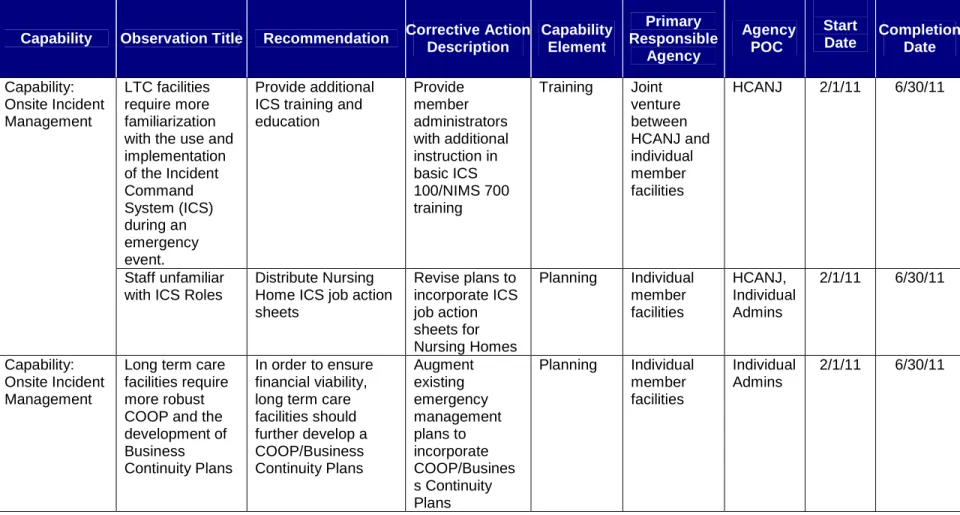
This Improvement Plan has been developed specifically for HCANJ membership as a result of the Black Diamond tabletop exercise conducted on January 13, 2011. These recommendations draw on both the After Action Report and the After Action Conference.
Table A.1Improvement Plan Matrix
Capability Observation Title Recommendation Corrective Action Description Capability Element Primary Responsible Agency Agency POC Start
Date CompletionDate LTC facilities
require more familiarization with the use and implementation of the Incident Command System (ICS) during an emergency event. Provide additional ICS training and education Provide member administrators with additional instruction in basic ICS 100/NIMS 700 training Training Joint venture between HCANJ and individual member facilities HCANJ 2/1/11 6/30/11 Capability: Onsite Incident Management Staff unfamiliar with ICS Roles
Distribute Nursing Home ICS job action sheets Revise plans to incorporate ICS job action sheets for Nursing Homes Planning Individual member facilities HCANJ, Individual Admins 2/1/11 6/30/11 Capability: Onsite Incident Management
Long term care facilities require more robust COOP and the development of Business Continuity Plans
In order to ensure financial viability, long term care facilities should further develop a COOP/Business Continuity Plans Augment existing emergency management plans to incorporate COOP/Busines s Continuity Plans Planning Individual member facilities Individual Admins 2/1/11 6/30/11
Appendix A: Improvement Plan 21 Health Care Association of New Jersey
Capability Observation Title Recommendation Corrective Action Description Capability Element Primary Responsible Agency Agency
POC Start Date
Completion Date Pre-stage healthcare workers on-site to reduce necessity for travel during hazardous weather conditions.
Review internal human resource policies as related to reimbursement of healthcare employees during emergency activations. Augment internal human resources policies Planning Individual member facilities Individual Admins 2/1/11 6/30/11 Capability: Citizen (Resident) Evacuation/ Shelter-in-Place
Long term care healthcare workers do not have adequate access to stress prevention, crisis counseling, and psychological first aid.
Provide long term care healthcare workers with adequate access to stress prevention, crisis counseling, and psychological first aid.
Implement psychological first aid training
Training Joint venture between HCANJ and individual member facilities HCANJ, Individual Admins 2/1/11 6/30/11
Appendix A: Improvement Plan 22 Health Care Association of New Jersey
Capability Observation Title Recommendation
Corrective Action Description Capability Element Primary Responsible Agency Agency POC Start
Date CompletionDate Capability: Planning Provide for emergency transportation of employees prior to storm events Encourage all HCANJ member facilities to properly identify all essential employees, provide all necessary identification and participate in the New Jersey Resource Directory Data Base (RDDB) registration program Provide additional essential healthcare worker credentialing and identification Planning Individual member facilities Individual Admins 2/1/11 6/30/11 Redundant means of emergency communications have not been universally adopted.
Continue the promotion of the New Jersey Public Health Amateur Radio Consortium, Government Emergency
Telecommunications Service (GETS) and the NJDHSS Hippocrates Provide educational opportunities and technical assistance on the use of amateur radio, GETS and Hippocrates Training Communications HCANJ and individual member facilities HCANJ 2/1/11 6/30/11 Capability: Communications Pre-event relationships with OEM/MCCs are inconsistent Promote increased pre-event relationships with OEM/MCCs via email and web based modalities. Distribute and maintain webpage listing of local/county OEM contacts and regional MCC contacts
Planning HCANJ and
individual member facilities