Journal of Criminal Law and Criminology
Volume 58 | Issue 3
Article 4
1968
Proof of Guilt in Capital Cases--An Unscience
Willard J. Lassers
Follow this and additional works at:
https://scholarlycommons.law.northwestern.edu/jclc
Part of the
Criminal Law Commons
,
Criminology Commons
, and the
Criminology and Criminal
Justice Commons
This Article is brought to you for free and open access by Northwestern University School of Law Scholarly Commons. It has been accepted for inclusion in Journal of Criminal Law and Criminology by an authorized editor of Northwestern University School of Law Scholarly Commons.
Recommended Citation
PROOF OF GUILT IN CAPITAL CASES-AN UNSCIENCE
WILLARD J. LASSERS
The author is a member of the Chicago Bar. He is on the Board of Directors of the Illinois Division of the American Civil Liberties Union. Mr Lassers' article is based upon a research project of a special committee of the Illinois Division of the ACLU.*
To what extent do the police and prosecution, in cases where death is the sentence for murder, avail themselves at the trial of the techniques of modern science in establishing guilt? So far as we are aware, no prior investigation of this matter has been conducted.
The question is important, its ramifications ex-tending far beyond the small number of individuals sentenced to death in any one year (60 to 80) and the still smaller number executed (7 in 1965 and 1 in 1966). If it appears that the police and prose-cution do not make full use of current technology in death cases, then it seems a fair assumption that still less use is made of such methods in murder cases where the death penalty is not sought and in other non-capital criminal prosecutions. Presuma-bly the prosecution makes the most thorough in-vestigation and has the most positive proof of guilt in those cases where the extreme penalty is sought. If the resources of science are employed at all, one would expect them to be utilized the most where the heaviest penalty is sought.
There is another related reason for investigating the use of science in murder prosecutions. In 1964, in the Escobedo decision, and again in 1966 in the
Miranda decision, the Supreme Court of the United
States placed radical restrictions on the prosecution in obtaining admissible confessions from persons in custody. Few issues in law enforcement are more emotion-laden. Civil libertarians (and we include ourselves) believe that conviction by confession, among its other evils, kills inducement to good police work. Others view confessions as essential to law enforcement, claiming that in many instances there is no other way to solve crimes. We do not presume to resolve this dispute. Surely, however, data on the utilization of scientific techniques is *The committee members were: Martin Baron, Mary Thale, Richard Whitney, Robert Spitzer, James B. Osgood, Beverly Williams, Paula Gorney, and Chris Mfay. The committee expresses its indebtedness for the assistance of Carol Blomgren, Winifred Meeks, Audrey Dulaney, Richard Fried, Judith Siegel, and Diane Reichenberger.
relevant to the controversy. A showing of failure to make full use of modern methods tends to support the view that reliance on confessions has retarded growth of scientific methods of crime fighting.
There is a third reason for interest in the topic: it throws some light upon a related, but different question, that is, the extent to which the police and prosecution avail themselves of scientific tech-niques in ascertaining the identity of the criminal, apart from the use of such evidence in the courts. The state of the art as used to convict ma, reflect the state of the art as used to catch the accused. We are concerned here, however, solely with scientific evidence in court.
Let us stress an important point. Our attention is directed solely at the use of scientific evidence to
determine the identity of the individual responsible physically for the death of the victim. We were not concerned with scientific testimony as to the nu-merous "state of mind" issues that arise in a murder trial, such as mental capacity, ability to form an intent to kill, the "voluntary" character of a confession, etc. These issues are bcyond the scope of this paper.
We think our study shows an incredible lag in. the employment of modern methods. The prosecu-tion does use scientific evidence in upwards of 25% of all cases, but it relies almost exclusively on three forms of such evidence, the newest of which is 40 years old: firearms identification (so-called "bal-listics"), blood typing, and fingerprint comparison. We deem this fact highly disturbing, not because of the percentage (since there is no standard for judging whether it is high or low), but because it indicates stagnation. And it indicates something more and worse: that the scientific process stands at the periphery of the judicial fact finding inquiry, not integrated as it ought to be in everystep of the investigative and prosecution process.
GUILT IN CAPITAL CASES
on cross-examination from prosecution experts. We shall comment below on tie reason for this situa-tion.
These conclusions are based on a review of sub-stantially all Illinois capital cases decided by the Supreme Court of Illinois since 1950, and all cap-ital cases in the United States for 1963, 1964, and 1965 which have been reviewed by state or federal appellate tribunals. Sentences imposed in 1966 have not yet been reviewed by higher tribunals.
We chose, for several reasons, to study capital
cases-cases tailor-made to appraise the use of technology by the prosecution:
I. As previously stated, scientific evidence is
more apt to be used in capital cases than in other
cases;-2. The liniited number of such cases per year
permits examination of every case. Hence we need not rely on a sample.
3. Because of the penalty, almost every capital case is appealed, usually to the highest court of the state. Hence, there are prepared a verbatim record of the testimony, or a full summary; briefs by the prosecution and de-fense; and a written opinion by the court. The latter is hearly always published; it usu-ally contains a detailed recital of the facts, ,nd is readily avitilable in law libraries.
W6 became interested in our topic during the
.ourse of another study. During 1964-1965, for other purposes, the Illinois Division of the Amer-ican Civ il Liberties Union conducted a survey of all cases in Illinois since 1950 where the defendant was sentenced to death. Upon reading the couft opinions, it seemed to us that there was heavy reliance in these cases on confessions, witness testi-mony, and other traditional modes of proof. Science seemed to play a subordinate role. Our interest piqued, we decided to restudy the cases, addiiig the cases decided subsequently. Our pro-cedure was as follows: we read all of the court
opinions (in some cases there were both state and
federal court opinions or more than one state court opinion), and, in addition, we examined the "ab-stract of record" which contains substantially all of the trial testimony in narrative form.
-During the period 1950-1966, there were 42 capital cases that came before the Supreme Court of Illinois. The decision on the initial appeal to that court, and the subsequent disposition, are shown in Table I. Three cases of the 42 had to be excluded because there was no published opinion by the Supreme Court of Illinois or by any other court.
TABLE I
CAPITAL CASES IN ILLINOIS 1950-1966
Judgment affirmed by Illinois Supreme Court
Executed 11*
Sentence commuted 2
Died of natural causes 1
Suicide 1
Further legal proceedings or
com-mutation pending 7
Discharged by federal courts 1
Total
Judgment reversed and new trial granted No capital sentences subsequently
imposed -Not yet retried
Total 19 19
42**
* Includes two cases where Illinois Supreme Court
refused review. See text.
* Excluded .are 10 cases where the trial court has
imposed the death sentence but the case has not been
reviewed. Among the 10 is one woman.
One detendant died while his case was pending on review, and two individuals were executed without any appellate review of their decisions because Illinois law at the time granted review in the Illinois Supreme Court to those convicted of non-capital felonies, but made review in non-capital cases discretionary. In these two cases, review was denied by the court. Further, in these two cases, no abstract was available.
Now to the meat of the matter: Of the 39 cases, some form of scientific evidence was introduced in 15 cases (38%). In these such cases, firearms iden-tification (ballistics) testimony was introduced on 11 occasions. In two cases there was testimony from an expert that because of the condition of a bullet, no such examination was possible. Blood type evidence was introduced on two occasions, and fingerprint evidence on two occasions. (We have considered one palm print as fingerprint evidence.) No other form of scientific evidence was introduced in any case by the prosecution.1
intro-There was but a single case where scientific evidence was introduced by the defense. Seven years after the initial state court trial, the defend-ant was grdefend-anted a federal court hearing. In these proceedings, for the first time, the defendant had an opportunity to have a defense expert examine a pair of shorts which the prosecution contended were stained with the blood of the victim. The victim, aged 8, had been sexually attacked and murdered. At the hearing, this expert testified that the stains were paint and not blood as the prosecution had claimed in the ,original trial. Further, in this proceeding it was shown that the prosecution had not revealed to the defendant, at the original trial, a crime lab report that a hair found in the vagina of the child was not defend-ant's. The conviction was set aside by the Supreme Court of the United States because of the suppres-sion of evidence regarding the paint.
We were taken aback by our findings. Illinois is a leading urban, industrial state and yet the foundation of all methods of scientific evidence employed by the prosecution in these cases was established 40-60 years ago. Fingerprinting dates from the development of a workable system of classifying the prints in the 1890's and firearms identification in the middle 1920's. Blood groups were discovered in the 1900's.
These methods are not only old, but all three suffer defects. Firearms identification, of course, is of value only where the weapon is a gun and both bullets (or shells) and the alleged murder weapon are found by the prosecution. But firearms iden-tification does not enlighten us on the crucial question, namely, "Who fired the gun?". True, in the context of a specific trial, it may be a link in a chain leading to the defendant.
Fingerprints where found can be almost conclu-sive, but in some situations they are valueless. Thus, if the defendant is accused of murdering his wife with his own gun, his fingerprints in the house are meaningless. His fingerprints on his own gun are scarcely more important.
Blood grouping evidence, as presented, suffers its own defect. In the usual case, the prosecution's evidence is that the victim had blood of a specific type (A, AB, B or o), that blood of that same type was found, say, on the defendant's garments, and that defendant has blood of another type.
The weakness of this evidence is that among
duced that the barrel and the stock had been sawed off the gun. Since the murder case is not yet decided by the Illinois Supreme Court, the case is not included.
white Europeans about -15% have Type A, 10% Type il, 5% Type AB and 40% Type o. In the usual case, victim and defendant have either Type A or o. Hence, if the defendant has any blood on his garment, there is nearly a 50% chance that it is of the same type as the victim.
After analyzing the Illinois data, we asked our-selves next whelher the Illinois cases represented an isolated phenomenon. Perhaps if we reviewed the national picture for recent years the results would be different. We regret to say that the pattern is essentially the same. An initil problem was to determine the cases for study.
There is essentially no coordination betwedn the records of the police, the prison, and the court, nor is there uniformity among the states regarding the stage in the trial process at which a death sentence is impose(], and, thus, becomes reportable as such. We decided to employ the federal records as the reliable starting point. We obtained from the Bureau of Prisons copies of the work sheets for the years 1963, 1964, and 1965 which were used in the preparation of its publication National Prisoner
Stalislics-Executions. These work sheets gave us
the name of every individual sentenced to death during each of these years, the date of sentencing, offense, sex, race, and (late of birth. We disregarded all cases where death sentences were imposed for crimes other than murder but included cases where an individual was sentenced to death for rape and murder.
The next step was to examine the decisions in all cases which have been taken to a higher court and decided by that court. Cases not appealed, or pending an appeal, were not included in our analy-sis.
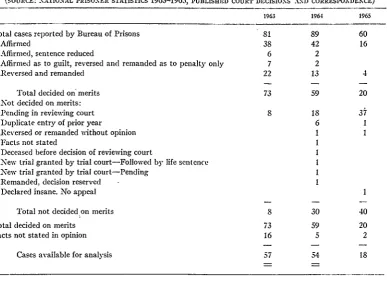
There were, altogether, 230 individuals listed on the government work sheets for the years 1963, 1964, and 1965: 81 cases in 1963; 89 cases in 1964; and 60 cases in 1965. (See Table II for disposition on those cases on review.)
partir-GUILT IN CAPITAL CASES
ularly when we know that the -defense presents a written brief to the court containing a statement of facts. This statement is subject to comment by the prosecution in its brief. There is oral argument before the higher court and then a study of the case by the court. Because it is a capital case, we assume a thorough study of the matter by the court. In this light, our approach to the opinions was as follows: If the court decided a case on an issue which did not require a full statement of facts, or if the court did not attempt to state the facts fully, we did not include the case for analysis. We in-cluded only those cases where the court purported to give a complete statement of the facts. To us it seems unlikely that there were many cases where evidence seriously pressed upon the court by pros-ecution or defense, scientific or otherwise, would escape mention by the court. Further, to the extent that such evidence did go unmentioned, there is no reason to believe it differs as to .type from such
evidence which was mentioned.
Let us look first at the 1963 data which is the most complete. Of 81 cases, 8 are still undecided. We eliminated from our study 16 cases, because the reported decision failed to include a complete state-ment of facts. Thus, we were left with 57 cases subject to analysis. Of the 57 cases, the prosecution relied on confessions in 31 cases (54%).
We found that scientific evidence of one form or another was introduced in 15 of these 57 cases (26%) and that there were 22 instances in all where scientific evidence was presented.2
The breakdown as to type of evidence is as follows:
Blood Typing- 5 cases Firearms identification (Bal- '
listics)- 5 cases Fingerprint identification- 3 cases
Other- 9 cases
22 cases
There were 19 California cases included among the 57. Of the 15 cases throughout the entire country in which scientific evidence was introduced, 10 were from California. Thus there were only 5 cases from other parts of the country. These.included 2 cases (companion cases) from the District of Columbia,
I from Georgia, 1 from Massachusetts, and 1 from
Texas.
2 In two Arizona cases (companion cases) there was testimony that bloodstains and hair were found on a rock, but it is not clear that the blood and hair were identified as such by expert testimony. These cases are not included.
Let us consider these 5 cases first: In the District of Columbia cases, the scientific evidence employed consisted of blood type testimony, plus testimony that a bloodstained heel mark found on the de-ceased had been made by the heel of the boot of one of the defendants. In the Georgia case, the scientific evidence was a firearms identification test of a shotgun shell. In the Massachusetts case, the prosecution, in addition to the introduction of firearms identification testimony, introduced the testimony of a medical examiner as to the course of a bullet. In the Texas case, the scientific evidence was that a gas line had been cut by defendant's pipe cutters.
Based upon these cases, our conclusion is that the scientific evidence introduced by the prosecu-tion in the 1963 cases, while more varied than in the Illinois cases, was nevertheless limited in scope ahd imaginativeness.
In the California cases there was a more sophis-ticated approach. In addition to blood typing, firearms, and fingerprint testimony, other forms of scientific evidence were introduced in 6 cases These decisions give an indication of what might be done generally.
In one case, defendants were convicted of mur-dering a bartender. in their car. In addition to blood group evidence respecting the blood of de-ceased and blood stains in the car, there was evidence that numerous fibers taken from the vic-tim's shoes matched those found in the defendants' automobild, that hairs found in the automobile matched those of the victim; and that red paint found on the floor mat of the defendants' automo-bile came from the shoes of the victim.
The other five cases involved a typewriter com-parison, 2 forensic medicine cases (presence of se-men), one soil matching case, and one matching of bloody footprints.
For 1964, there were 89 cases, of which 54 were subject to analysis (See Table II). Six cases were eliminated as duplications of names previously entered by the Bureau of Prisons for 1963.3
Confessions were relied on in 31 cases (57%). Scientific evidence was employed in 18 cases (33%) representing, in all, 10 states. California contrib-uted scientific evidence in 3 of these cases.
TABLE I
INDIVIDUALS SENTENCED TO DEATH FOR 'MURDER 1963-1965 DISPOSITION OF CASES
(SOURCE: NATIONAL PRISONER STATISTICS 1963-1965, PUBLISHED COURT DECISIONS AND CORRESPONDENCE)
1963 1964 1965
Total cases reported by Bureau of Prisons Affirmed
Affirmed, sentence reduced
Affirmed as to guilt, reversed and remanded as to penalty only Reversed and remanded
Total decided on merits Not decided on merits: Pending in reviewing court Duplicate entry of prior year
Reversed or remanded without opinion Facts not stated
Deceased before decision of reviewing court
New trial granted by trial court-Followed by life sentence New trial granted by trial court-Pending
Remanded, decision reserved Declared insane. No appeal
Total not decided on merits Total decided on merits
Facts not stated in opinion Cases available for analysis
81 89 38 42 6 2 7 2 22 13 73 59
8 18
6 1 1 I 1 1
8 30 40
Again nearly half of the cases fell within the traditional pattern:
Blood Typing- 2 Firearms identification
(Bal-listics)- 5
Fingerprint identification- 3
Other- 10
20
The -other" cases, as for 1963, reveal what evidence can be found when the police are prepared to approach an investigation scientifically. Texas identified the hat of a defendant by hair com-parison. Pennsylvania presented evidence that the pants of a defendant, accused of murder of a boy, were splattered with brain tissue. Pennsylvania also, in a murder and possible rape case, presented evidence the victim had had intercourse within 10 days of death and that there were semen stains on the defendant's shorts. No semen was found in the vagina of the victim, however. California brought
in a handwriting expert to testify that a defendant had made a sketch of a savings and loan
associa-tion. The defendant was charged with murder
committed during a robbery of the association.
California also produced expert testimony as to the course of a bullet in a grocery robbery-murder. Arkansas produced the cast of a foot print at a murder scene which matched the defendant's. In another case it identified liquid found in a car as kerosene. The defendant was charged with the
murder of several members of his family and set-ting the home on fire with kerosene. Alabama
charged a defendant with the rape of a girl and the
murder of a conservation officer who came to her
aid. There was testimony that there was blood and
fatty material of human origin on a knife and that
the tail light assembly of the defendant's car had paint on it which matched the paint of the car of deceased. This evidence was significant because of other evidence that the defendant's car had col-lided with the car of the deceased.
[image:6.431.22.410.85.367.2]GUILT IN CAPITAL CASES
semen in the vagina of the deceased, but the most dramatic evidence, even though not "scientific" in character, was a burn mark on defendant arrested shortly after the crime. The victim had put up a struggle and the outline of the burn matched ex-actly the impression of her iro .
Unquestionably the most bizarre and fascinating case arose from Ohio. Defendant and one Riddle checked into a motel in Stark county. Subse-quently, Riddle's body was found in a burned auto, some distance from the motel in Wayne county. At the defendant's trial for murder in Stark county, he testified that, upon returning to the motel room after a brief absence, he found Riddle dead. He placed the body in his car and drove around- for two days. Defendant chose County Line Road, which divides Stark and Wayne counties, for the final scene. At the top of a hill he soaked the body and car interior in gasoline, ignited it and started the car, in flames, down the hill. The State claimed Riddle was alive when incinerated. This certainly cast grave doubt on the reliability of defendant's tale and his unusual behavior, and it counted heavily against him. Scientific evidence in two crucial areas supported his strange version. Both the State and the defense established by expert testimony -that Riddle had severe heart disease--his life .xpectancy, according to disease--his doctor, could only be foretold from day to day. Further, there was expert testimony by the defense, largely con-curred in by the State, that carbon monoxide is present in bodies of victims burned while alive and that the blood of Riddle contained no carbon mon-oxide. The Ohio Court of Appeals reversed the conviction and granted a new trial in part on the ground guilt was not proved beyond a reasonable doubt, and in part on the ground -(intriguing to lawyers) that venue did not lie in Stark County. In this case, but for scientific evidence, an in-nocent man might well have been convicted, be-cause of grossly incriminating circumstances and his own odd behavior.
For 1965, the data is still fragmentary. Of 60 cases, 37 cases remain undecided and 5 had to be rejected for many of the same reasons that com-pelled rejection of cases in 1964. Included among the 5 was one duplicate from a prior year. Thus, only 18 cases could be analyzed. Of these 18 cases, confessions were presented in 7 cases (39%). Scientific evidence was introduced in 6 cases (33%). In three instances (two in Georgia and one in South Carolinat) firearms identification testi-mony was introduced. In one California case,
de-fendant's palm print was fognd in the cab of a taxi driver .he was accused pf murdering. In a Texas case, defendant was accused of murdering a woman in her home at night.
A
hair, found on de-fendant's pistol, matched the victim's; dede-fendant's shoes had mud on them like that in the victim's yard, and plaster casts of foot prints in the yard matched defendant's shoes. In one New Jersey case, the prosecution charged robbery and murder, followed by burning the corpse. To prove the robbery, there. was scientific testimony that no gold was found among the remains, whereas there was testimony that deceased customarily wore a gold ringAll in all, we think the record is dismal. True,. there are occasional cases where evidence out of the ordinary is presented, but on the whole, it seems clear that scientific evidence is presented in a minority of the cases. And, when it is presented, almost without exception it consists of one of the. three standbys used for decades.
Thus, during a 3-year span, we could study 129 cases (57 + 54 + 18). In all, there were 50 occa-sions (22 + 20 + 8) where scientific evidence was introduced in 39 cases (15 + 18 + 6). Of the 50, the old standbys accounted for 26 instances (13 +
10 + 3) or about 50%. Most of the 24 remaining
instances employed unsophisticated or even ele-mentary techniques. The only instances we con-sider as exceptions are these 7 cases: Texas pipe cutter case, the impressive array of facts in the California bartender case, and the California soil matching case, the Texas hat case, the Pennsyl-vania boy murder case, the Alabama conservation officer murder, and the Texas array of facts in the cab driver case.
The "array" cases such as the two mentioned above illustrate that once scientific evidence is sought more than one item of evidence may be found.
Perhaps murder masked as natural death is rare. Or perhaps when discovered, capital sentences are not imposed. But we suspect that given the lack of sophisticated techniques in convicting the mur-derer where murder is obvious many murmur-derers successfully conceal their crimes.
We have shown that the defense almost never utilizes scientific evidence. For the indigent defend-ant, the reasons are Qbvious. Even if he is given competent counsel, he is not provided an investi-gative staff and funds. Even the defendant who has funds has problems. By the time counsel is retained, the trail is usually cold. The key evidence frequently is in the hands of the prosecution, it may be impossible for the defense to obtain access to it. Finally, a truly scientific study of a criminal case requires a broad spectrum of experts and a coor-dinator who knows what can be done and who can do it. Such individuals and galaxies of specialists exist only in the largest cities.
The Ohio motel case is the oustanding illus-tration of the use of scientific evidence by the de-fense. There, it was a significant fact in the reversal of a capital sentence. It was achieved by bringing in Dr. Milton Halpern, Chief Medical Examiner of New York City to testify. The prosecution sought to counter the defense, but its presentation was flawed by an omission of a key fact from the report of one of its experts.
We do not suggest for a moment that scientific evidence can or should replace traditional modes of proof. Thus, for example, the California motel keepers' case demonstrates the value of careful, patient police work in assembling a massive case. Only a small part of the evidence was "scientific" as such, but in a broad sense, the presentation was truly scientific.
Nevertheless, factual determinations can be exceptionally complex. Consider for example, the storm of controversy on the issue whether the bullet which hit President Kennedy also struck Governor Connally. We should bring to bear every resource, including traditional techniques, to re-solve these issues.
Modern technology ought to play a much greater role than it does now. We have the capacity to in-vestigate the most distant reaches of the universe, and to tear apart the atom, yet, when we put men on trial for their lives we bring to bear almost none of this vast scientific capacity.
If we are to make full use of science and be
truly scientific-and fair to the accused, the task
will be hard for several reasons. We cannot simply
establish a super laboratory in Washington to which police throughout the country can send material for analysis. A national laboratory, far beyond the scope of the BI laboratory would be a forward step, but to be truly effective, it must draw upon a national spectrum of experts. Beyond this we must have well trained local investigators of technical knowledge and imagination. The national laboratory can scarcely rise above the material sent to it and this in turn will depend upon the skill of the local investigators.
There is another dimension to the problem. Science must be used not merely to convict the guilty, but to free the innocent. It is inevitable that the police, being first on the scene, will mar-shal the evidence. Road blocks which bar examina-tion of the physical evidence by the defense must fall. And, even today, the prosecution-how often no one knows-engages in the scandalous practice of concealing exonerating evidence, permitting its expert to tell half truths and engaging in similar disreputable practices. We do not make this charge lightly. It is based upon case after case documented
in the courts. Despite repeated denunciation of such practices by the courts, they have continued, and we fear they will continue.