Journal of Criminal Law and Criminology
Volume 92
Issue 1Fall Article 1
Fall 2001
Fourth Amendment Privacy Interests
William C. Heffernan
Follow this and additional works at:https://scholarlycommons.law.northwestern.edu/jclc
Part of theCriminal Law Commons,Criminology Commons, and theCriminology and Criminal Justice Commons
This Criminal Law is brought to you for free and open access by Northwestern University School of Law Scholarly Commons. It has been accepted for inclusion in Journal of Criminal Law and Criminology by an authorized editor of Northwestern University School of Law Scholarly Commons.
Recommended Citation
0091-4169/01/9201-0001
THE JOURNAL OF CRIMINAL LAW & CRIMINOLOGY Vol. 92, No. I Copyright C 2001 by Northwestern University, School of Law Printed in US.A,
CRIMINAL LAW
FOURTH AMENDMENT PRIVACY
INTERESTS
WILLIAM C. HEFFERNAN*
I. INTRODU CTION ... 2
II. PRIVACYAND PERSONAL SECURITY: ENTICKTO OLMSTEADTO KATZ.. 7
A. The Fourth Amendment's Guarantee of Personal Security ... 9
B. The Eighteenth Century Sources ... 12
C. Trespass and the Eighteenth Century Heritage: ChiefJustice Taft's Opinion for the Court in Olmstead v. United States ... 15
D. The Court's Repudiation of the Trespass Standard in Katz v. United States ... 17
1. Katz and the Court's Recognition of Privacy as an Independent Fourth Amendment Variable ... 18
2. Vindicating the Court's Conclusions in Katz ... 19
E. Fourth Amendment Pluralism ... 24
III. DEVELOPING THE FORBEARANCE MODEL ... 31
A. Post-Katz Privacy Jurisprudence: An Unreasonable Expectation of Eternal Vigilance ... 32
1. The Anxious Quest for Privacy ... 38
2. The Problem of Exposure to Third Party Facilitators ... 39
3. Calculating What a Member of the Public Might D iscover ... 39
B. The Harlan Test I: From Social Expectations to Legally Enforceable Privacy Interests ... 40
C. The Harlan Test II: Methods of Identifying Privacy In terests ... 45
D. The Features of a Valid Privacy Claim ... 48
1. The Different Types of Privacy: Privacy of the Person and Inform ational Privacy ... 52
2. Interpersonal Privacy: Symmetrical and Asymmetrical R elationships ... 53
WILLIAM C. HEFFERNAN
4. The "What" and "How" of Privacy Analysis: Conventional and Idiosyncratic Sources of Personal
V uln erability ... 57
5. Recapitulation ... 60
E. A Reasonable Expectation of Forbearance on the Part of O th ers ... . . 6 1 F. The Possibility of a Role Discount for the Police: Rejecting an Across-the-Board Discount While Accommodating the Government During Emergencies ... 67
IV. APPLYING THE FORBEARANCE MODEL ... 72
A. Settings Where Privacy Cannot Be at Stake ... 72
B. Observational Surveillance ... 80
1. Private Objects and Information ... 81
2. Privacy C ues ... 87
3. Surveillance of Behavior in Public Places ... 94
4. A Note on Technology and Privacy ... 101
C. Interactive Surveillance ... 106
1. N onproblem atic Settings ... 110
2. H arder C ases ... 118
C O N CLU SIO N ... 126
I. INTRODUCTION
Is it possible to incorporate a serious concern for privacy
into Fourth Amendment jurisprudence? Even before the terrorist attacks on America, the question was a pertinent one; in the aftermath, it has become even more so. Fourth Amendment case law is of course grounded in an explicit concern for reasonable expectations of privacy.2 But given a long line of decisions rendered prior to the attacks, one could
* Professor of Law, John Jay College of Criminal Justice and the Graduate Center,
City University of New York. Marc Bernstein, Janice Dunham, and Steve Wasserman provided helpful suggestions concerning an earlier draft of this article.
The Fourth Amendment provides:
The right of the people to be secure in their persons, houses, papers, and effects, against unreasonable searches and seizures, shall not be violated, and no Warrants shall issue, but upon probable cause, supported by Oath or affirmation, and particularly describing the place to be searched, and the persons or things to be seized.
U.S. CONST. amend. IV.
Justice Harlan developed the expectation-of-privacy test in his concurring opinion in Katz v. United States, 389 U.S. 347, 361 (1967). Numerous opinions of the Court have since adopted Harlan's test for purposes of Fourth Amendment analysis.
See, e.g., Minnesota v. Olson, 495 U.S. 91, 95-96 (1990); California v. Ciraolo, 476 U.S.
207, 211 (1986).
FOURTH AMENDMENT PRIVACY INTERESTS
hardly say that the Supreme Court has shown a serious concern for privacy. The Court, for example, has held that individuals do not have any Fourth Amendment privacy interests in their bank records,3 in the phone numbers they dial,4 or in freedom from low-flying surveillance of their backyards.5 Moreover, by the Court's analysis, even our garbage places us at risk. If someone wraps her garbage carefully in an opaque bag and places the bag on the street, that person, the Court has held, cannot expect the police to refrain from inspecting it to find
out what's going on in her home.6
Clearly, the Court has parsed the concept of privacy as thinly as possible. It has expressed concern for residential privacy'-but has allowed police helicopters to conduct surveillance of backyards.' It has expressed concern for the privacy of phone conversations9 but has said people have no privacy interest in the numbers they dial.'° Whether-or how much-terrorism's arrival in America will influence future privacy jurisprudence is hard to say, but it does at least seem clear that even before its advent the Court did not take privacy seriously as a Fourth Amendment value. My question at the outset, though, was not directly concerned with Supreme Court rulings. Rather, I asked whether it is possible to incorporate a serious concern for privacy into Fourth Amendment jurisprudence. In this Article, I argue that it is. But a cogent argument can be advanced to the contrary, an argument that requires special attention given the challenge that police work poses for privacy interests.
SeeUnited States v. Miller, 425 U.S. 435, 443 (1976).
See Smith v. Maryland, 442 U.S. 735, 744 (1979).
See Florida v. Riley, 488 U.S. 445, 449-51 (1988); see also Ciraolo, 476 U.S. at 212-14.
See California v. Greenwood, 486 U.S. 35 (1988).
7 See Payton v. New York, 445 U.S. 573, 589 (1980) ("The Fourth Amendment protects the individual's privacy in a variety of settings. In none is the zone of privacy more clearly defined than when bounded by the unambiguous physical dimensions of the home."); see also United States v. Karo, 468 U.S. 705, 714-15 (1984) ("At the risk of belaboring the obvious, private residences are places in which the individual normally expects privacy free of government intrusion not authorized by a warrant, and that expectation is plainly one that society is prepared to recognize as justifiable.")
8 See Riley, 488 U.S. at 449-51; see also Ciraolo, 476 U.S. at 212-14.
' See Katz v. United States, 389 U.S. 347, 352 (1967) (A person using a telephone "is surely entitled to assume that the words he utters into the mouthpiece will not be broadcast to the world.")
WILLIAM C. HEFFERNAN
The core features of this counterargument are easy to grasp. Privacy norms require people to exercise forbearance in everyday life: they require people not to act on their curiosity about their neighbors and officemates, not to encourage third-party confidences, not to snoop through incoming mail, and so on. But the police, it could be contended, must be exempted from these norms. This exemption is essential for the investigation of what the Court has called "ordinary criminal wrongdoing."" It is wholly indispensable, one could continue, for police work on what the Court has called "special governmental needs"2 (the investigation of terrorism quite
clearly comes under this heading). Police officers, it could be conceded, must avoid egregious violations of privacy norms. Nothing more than this should be expected of them if they are to perform their function effectively.
Indeed, one could further argue that the Supreme Court's privacy jurisprudence is admirable precisely because it draws the line here. The central principle of Fourth Amendment case law, it could be maintained, is that the police cannot engage in egregious privacy violations-for example, they must respect the privacy of the home" and personal belongings carried outside the home. On the other hand, the corollary principle implicit in the case law is that the police are otherwise free to gather information about people-and so they can use helicopters to156
hover over backyards, can sift through people's garbage,6 and
so on. If undertaken by a layperson, the Court's defender would say, these activities would be called "snooping." When undertaken by the police, the defender might continue, the same activities should be endorsed as sound law enforcement practices.
Because it is too early to tell what effect, if any, the investigation of terrorism will have on privacy jurisprudence,7 I
E.g., City of Indianapolis v. Edmond, 531 U.S. 32, 38 (2000). 2E.g., Treasury Employees v. Von Raab, 489 U.S. 656, 665-66 (1989).
"See supra note 7 and accompanying text.
'4See United States v. Chadwick, 433 U.S. 1, 7-11 (1977).
Florida v. Riley, 488 U.S. 445, 449-51 (1988); California v. Ciraolo, 476 U.S. 207, 212-14 (1986).
" California v. Greenwood, 486 U.S. 35, 39-40 (1988).
17 In a speech delivered at New York University Law School on September
28, 2001, Justice O'Connor stated that the attack on New York and Washington "has already
2001] FOURTH AMENDMENT PRIVA CY INTERESTS
devote the bulk of this Article not to the special problems that will arise in the aftermath of the attacks on New York and Washington, but to an examination of the argument, outlined above, as applied to police investigation of ordinary criminal wrongdoing. In particular, I respond in two ways to the claim that police are entitled to a discount from lay privacy expectations. First, I agree that the argument provides a descriptively accurate account of the Court's position on Fourth Amendment privacy protection. The Court, I suggest, has relied on a critical ambiguity in its privacy decisions. When speaking in general terms, it has made privacy protection appear to hinge on lay people's understandings of how they should treat each other-thus the significance of the often invoked reference to the expectations of privacy "that society is prepared to recognize as reasonable."8 When resolving specific cases, though, the Court has reasoned in terms of a narrow, occupationally-grounded conception of privacy. 9 The police, the Court has implied, perform a legitimate role as front-line
information gatherers about the public.2 0 They are thus
entitled, it has further implied, to a special dispensation from
In a New Climate of Unity, Justices Face Divisive Issues, N.Y. TIMES, Oct. 1, 2001 A16. (Full
copy of speech on file with author). It is not clear whetherJustice O'Connor, in her use of the word "us" was referring to the American people through their representatives, the nine justices of the Supreme Court, or both. I argue, in any event, that the Court already has the doctrinal tools needed for responding to the threats posed by terrorism.
" The original source for this is Justice Harlan's concurrence in Katz v. United
States, 389 U.S. 347, 361 (1967). The phrase appears, in slightly different form, in
Bond v. United States, 529 U.S. 334, 338 (2000); Minnesota v. Olson, 495 U.S. 91, 95-96
(1990); Greenwood, 486 U.S. at 39; Ciraolo, 476 U.S. at 211 (1986); Oliver v. United
States, 466 U.S. 170, 179 (1984); Marshall v. Barlow's Inc., 436 U.S. 306, 313 (1978).
" The contrast between lay and occupationally-grounded expectations is readily
apparent in Greenwood, which was concerned with the warrantless inspection of garbage. See Greenwood, 486 U.S. at 37-38. When outlining its general standard for assessing the case, the Court appealed to lay expectations, stating that the Fourth Amendment would be implicated if it could be shown that the defendants whose garbage was inspected "manifested a subjective expectation of privacy in [it] that society accepts as objectively reasonable." Id. at 39. A page later, however, the Court justified warrantless police inspection of the defendants' garbage on the ground that
scavengers and snoops have been known to sift through people's garbage. Id. at 40.
" The most telling example of this is to be found in the Court's invocation of
WILLIAM C. HEFFERNAN
everyday privacy norms, one that doesn't extend to egregious 21
violations but that does encompass minor ones.
On the other hand, I argue that as a normative matter the distinction between occupationally-grounded and lay conceptions of privacy is constitutionally unacceptable. The Court, I suggest, has reasoned in terms of a vigilance model of privacy, one that requires people to be constantly alert to the way in which others can intrude on their lives.22 The vigilance
model, I maintain, is inappropriate even when the investigation of terrorism is concerned; the proper approach there is to recalibrate the Fourth Amendment balancing test by taking into account the special urgency of public security while continuing to accord full weight to lay expectations of privacy. And when we move beyond the special problems occasioned by terrorism, we can see how wholly inappropriate the model is for the investigation of ordinary criminal activity. Vigilance is particularly troubling as an informing principle once one takes into account law enforcement's appetite for information and its capacity to feed it.
The Court, I suggest, has been blind to the points just made; indeed, it has fundamentally misconceived the nature of privacy norms. These norms are grounded not in vigilance but in an expectation of forbearance on the part of others-that is, in an expectation that others will restrain their curiosity with respect to those aspects of life that are essential to defining and maintaining individual identity. The notion of forbearance explains why privacy matters to us: we cherish it because it holds out the prospect of an unanxious shelter from the larger world. When the Court has spoken about reasonable expectations of privacy, it has appeared to be concerned with the substantial degree of forbearance that underlies everyday privacy norms though in fact it has reasoned in terms of the norms followed by
" See id. The Court's favorable reference to snoops in Greenwood and its use of a snoop-baseline for determining the legitimacy of police behavior indicate that it is prepared to tolerate minor deviations by the police from everyday privacy norms. By contrast, its comments on the importance of privacy of the home underscore its unwillingness to tolerate egregious privacy violations. See infra note 7 for its
comments on residential privacy.
22For discussion of the vigilance model, see infra notes 119-27 and accompanying
FOURTH AMENDMENT PRIVA CY INTERESTS
those whose job is to penetrate privacy.3 I argue that the Court should honor the premise implicit in its standard.
This Article is divided into three sections. The first examines the development of Fourth Amendment privacy doctrine; the final two provide a framework for improving contemporary doctrine. My aim in the first section is to trace the evolution of Fourth Amendment privacy jurisprudence-to show why eighteenth century courts linked privacy protection to the law of trespass and explain why it was proper for the twentieth century Supreme Court to sever this connection. In the second section, I outline a forbearance approach to privacy protection and contrast it with the Court's vigilance model. Even in settings where terrorism is under investigation, I maintain, privacy expectations, understood in terms of the forbearance model, are entitled to full respect. What distinguishes the policing of terrorism, I contend, is not the weight to be accorded privacy interests, but the extra emphasis entitled government interests in preserving public safety. In the final section, I apply the forbearance approach to specific Court decisions concerning ordinary criminal activity. In the course of this section, I consider not only those settings where police conduct surveillance of suspects but also those in which the police penetrate private life, either by encouraging individuals to betray intimate acquaintances or by seeking a foothold of false intimacy themselves.
II. PRIVACY AND PERSONAL SECURITY:
ENTICK TO OLMSTEAD TO KATZ
Two issues-one conceptual, one interpretive-must be considered when thinking about Fourth Amendment privacy interests. The conceptual one has to do with the meaning of the term "privacy," the interpretive with the Fourth Amendment's bearing on privacy. Clearly, the conceptual issue has priority: we need to understand what people mean when they talk about privacy before we can understand how the Fourth Amendment protects it. I thus begin this section with some provisional comments about the concept of privacy, comments I then use to examine changing interpretations of the Amendment. In the next section, I expand on these
See infra note 181 for discussion of the analogy between journalists' and police
use of helicopters to conduct surveillance of the curtilage of the home.
WILLIAM C. HEFFERNAN
provisional remarks as I advance an alternative to the Court's account of Fourth Amendment privacy protection.
As a provisional matter, we can say that privacy has two strands. The first has to do with access to one's person, the other with information about key aspects of one's life. These strands can converge: when someone wishes not to reveal something about her person (a scar on her abdomen, a glandular disease, etc.), then limiting access to her person becomes essential to controlling the dissemination of information about herself. But they don't have to converge. Think first about access to one's person. If someone rushes home from a car trip announcing that her bladder is full and that she really needs to go to the bathroom, there is no information she's trying to withhold from others; nonetheless, once she reaches the bathroom, she'll want to be sure no one has access to her person while she's there. Now think about informational privacy. In the modern world, a person is often not in the place where information about her life is located. Indeed, one of the important features of informational privacy is that it allows people to circulate in the larger world while repositories of information about them remain closed to others. If this is what we mean by "privacy," what justification can be advanced for respecting privacy interests? The general answer to this, which I refine later, is that people feel vulnerable about revealing information bearing on their personal lives and also about allowing unrestricted access to their persons. One can imagine a society in which people have no informational privacy. One can also imagine a society in which there is no privacy of the person; a society in which people dress, copulate, and excrete, among other things, without the benefit of seclusion. The mere mention of these possibilities suggests what it is that legitimates privacy claims: once we agree that people tend to feel vulnerable about granting access to their bodies or revealing facts concerning their intimate lives, we must also agree that they are entitled to avail themselves of the conventions of privacy and so reduce this sense of vulnerability to others.
FOURTH AMEADMENT PRIVA CY INTERESTS
A. THE FOURTH AMENDMENT'S GUARANTEE OF PERSONAL SECURITY
To provide even a rudimentary analysis of privacy is to establish a conceptual framework that goes beyond eighteenth century reflections on the subject. Although the Oxford English Dictionary records instances of the use of the word "privacy" in pre-eighteenth and eighteenth century literature, these occasional sightings of the word must be considered in light of its absence from key eighteenth century documents dealing with political life. Perhaps the most important of these documents is the Constitution itself, which contains numerous references to other terms that matter in twentieth century life ("property,2 5 "religion,26 and "speech, ' 7 for example), but none to privacy. Equally significant is the failure of the authors of The Federalist Papers to discuss the concept of privacy: Madison, for example, was deeply concerned about the protection of property rights but had nothing to say about privacy.28 Historians warn us about
the risk of interrogating the past in light of a conceptual
2' Two of the sightings from pre-eighteenth century literature are two William Shakespeare plays: TROILUS AND CRESSIDA, act III, sc. iii, 190 (Achilles: "Of this my
priuacie, I haue strong reasons." Ulysses: "But 'gainst your priucie The reasons are
more potent and heroycall.") and THE MERRY WIVES OF WINDSOR, act IV, sc. v, 24 (Host: "Let her descend: my Chambers are honourable; Fie, priuacy?"). It will be noted that the term "privacy" is not accorded positive value in either of these passages: it prevents the world from appreciating Achilles's heroic stature; in THE MERRY WIVES, it is a condition associated with secret goings-on. The sightings reported for the eighteenth century are more positive, but they are hardly abundant.
8 OXFORD ENGLISH DICTIONARY 1388 (1933)..
" "No person shall ... be deprived of life, liberty, or property, without due process of law . . .nor shall any private property be taken for public use, without just compensation." U.S. CONST. amend. V.
26 "Congress shall make no law respecting an establishment of religion, or prohibiting the free exercise thereof ..." U.S. CONST. amend. I.
" "Congress shall make no law... abridging the freedom of speech . U.S.
CONST. amend. I.
28 "This term [property], in its particular application, means 'that dominion which one
man claims and exercises over the external things of the world, in exclusion of every other
individual.' [quoting Blackstone] In its larger and juster meaning, it embraces everything to which may attach a value and have a right, and which leaves to eveyone else the like
advantage."
THE MIND OF THE FOUNDER: SOURCES OF THE POLITICAL THOUGHT OF JAMES MADISON
243 (Marvin Meyers ed., 1976) (quoting James Madison, Property, NATIONAL GAzETTE,
March 29, 1972); see also JENNIFER NEDELSKY, PRIVATE PROPERTY AND THE LIMITS OF
AMERICAN CONSTITUTIONALISM: THE MADISONIAN FRAMEWORK AND ITS LEGACY (1990).
WILLIAM C. HEFfERNAN
framework derived from the present.29 This risk must be borne
in mind when thinking about the Fourth Amendment. Privacy is an abiding concern of the present age. As far as the Fourth Amendment is concerned, we must begin by reasoning in terms of one of the abiding concerns of the eighteenth century--that is, we must begin by reasoning in terms of its profound respect for property rights.
"There is nothing," Blackstone remarks in his Commentaries, "which so generally strikes the imagination, and engages the affections of mankind, as the right of property."3 Important as
it was for many branches of the common law, property law and, in particular, the bundle of rules collected under the heading of "trespass" were especially significant in determining the search and seizure liability of government agents. According to eighteenth century common law cases, a necessary condition for establishing such liability was proof that one of the government's agents had trespassed on someone's property.3
Clearly, this trespass approach to searches and seizures provides substantial protection for privacy interests. Trespass on someone's person-an arrest can be defined as a trespass in this sense 32-interferes with privacy of the person. Similarly, a
trespassory incursion into someone's home interferes with informational privacy, and, if the owner is home, interferes with privacy of the person as well. On this analysis, however, privacy of person and informational privacy are only incidentally protected by the law of search and seizure. Put differently, we can say that if trespass is to function as a necessary condition for search and seizure liability, then certain matters that clearly come under the heading of "privacy" cannot be actionable in
21 "[W]hen we organize our general history by reference to the present we are
producing what is really a gigantic optical illusion... HERBERT BUTTERFIELD, THE WHIG INTERPRETATION OF HISTORY 29 (1968) "The total result of this method [the method of Whig history] is to impose a certain form upon the whole historical story, and to produce a scheme of general history which is bound to converge beautifully upon the present .. " Id. at 12.
3 2 WILuAM BLACKSTONE COMMENTARIES *2-3.
31 The most prominent case is Entick v. Carrington, 19 Howell's St. Trials 1029
(1765).
12 The term "trespass" is normally employed to refer to possessory interests in real
estate. However, the term is relevant to possession of one's person. As Professor Dobbs has remarked, "The gist of the tort [of trespass] is intentional interference with rights of exclusive possession; no other harm is required." DAN B. DOBBS, THE LAW OF TORTS 95-96 (2001). "Exclusive possession" can of course refer to rights over
one's person as well as rights over real estate.
FOURTH AMENDMENT PRIVA CY IATERESTS
terms of search and seizure-nontrespassory eavesdropping on conversations, for example, and nontrespassory "peeping" on people in their bedrooms.
Do the Fourth Amendment's protections hinge on this trespass limitation? The Amendment's text doesn't definitively answer this question; indeed, it contains no reference to trespass at all. Rather, the Amendment's organizing idea is the concept of personal security. The Amendment's first, and most important, clause states: "The right of the people to be secure in their persons, houses, papers, and effects, against unreasonable
searches and seizures, shall not be violated . . . . "s In
interpreting this clause, one might reason in terms of a narrow version of personal security, one that treats the trespass
standard as implicit in the Amendment and that therefore identifies security with control over physical objects, in particular the objects essential to personal life (persons, houses, papers, and effects). Alternatively, one might argue that because the Amendment contains no reference to trespass, it is grounded in a broader version of personal security. On this account, the Amendment offers protection for the physical environment essential to personal life, but, one could continue, it is also concerned with background factors that can make someone feel vulnerable to others-that is, with nontrespassory surveillance such as constant scrutiny of one's person or the interception of oral communications with friends. According to the narrow version of personal security, the Amendment offers only incidental privacy protection. According to the broad version, it treats privacy as an independent value, one that matters even when officials do not carry out a physical incursion on someone's immediate possessions.
In the twentieth century, the Supreme Court has moved from an interpretation of the Amendment based on the narrow version to an interpretation based on the broader one.34 As noted, the Amendment's text provides no conclusive reason for
" U.S. CONST. amend. IV. For a comment on the importance of the concept of personal security in Fourth Amendment jurisprudence, see United States v. White, 401 U.S. 745, 786 (1971) (Harlan, J., dissenting) ("For those more extensive intrusions that significantly jeopardize the sense of security which is the paramount concern of Fourth Amendment liberties, I am of the view that more than self-restraint by law enforcement officials is required and at the least warrants should be necessary.")
34 The contrast is developed through an analysis of Olmstead v. United States, 277
U.S. 438 (1928), discussed infra in Part I.B, and Katz v. United States, 389 U.S. 347 (1967), discussed infra in Part I.C.
WILLIAM C. HEFFERNAN
preferring one to the other. However, it's clear that the Amendment's common law sources are grounded in the narrow version 35-and clear as well that the early twentieth century Court, relying on this common law background, read the Amendment as if it constitutionalized the common law.36 Thus anyone who argues, as I do, that the Amendment can properly be interpreted as a provision that protects the broad version of personal security must deal directly with both the Amendment's common law background and with the early twentieth century Court's reliance on that background. I turn to these issues next; then I advance an argument for reading the Amendment in light of the broad version of personal security.
B. THE EIGHTEENTH CENTURY SOURCES
Eighteenth century commentators on search and seizure appear never to have used the word "privacy" when writing about their subject. Their conceptual framework was grounded in a concern for property generally and the law of trespass in particular.3' Thus, if we are to find a concern for privacy in eighteenth century commentaries on search and seizure, we must superimpose the categories mentioned earlier-informational privacy and privacy of the person-on judicial opinions and political oratory informed by a conceptual scheme grounded in property law. As I have already noted, such an undertaking is fraught with danger: the act of translating the past's conceptual scheme into one congenial to the present carries with it many opportunities for intellectual dishonesty. In this case, though, the danger can be avoided, for a strong argument can be advanced for saying that eighteenth century commentators were indeed deeply concerned with each type of privacy I have mentioned even though they did not use the rhetoric of privacy in formulating their claims. Two examples
" For a discussion of the Amendment's common law sources, see NELSON B.
LASSON, HISTORY AND DEVELOPMENT OF THE FOURTH AMENDMENT TO THE CONSTITUTION OF THE UNITED STATES 13-50 (1937).
3' See Olmstead v. United States, 277 U.S. 438 (1928); see also Carroll v. United States, 267 U.S. 132, 149 (1925).
" See text and note 30 supra for an example of the high regard in which the concept of property was held by eighteenth century commentators. For an example of how eighteenth century common law judges analyzed search and seizure in terms of trespass, see infra notes 38-43 and accompanying text.
FOURTH AMENDMENT PRIVA CY INTERESTS
can be cited in support of this argument, one related to informational privacy, .the other to privacy of the person.
Consider first a leading eighteenth century case, Entick v. Carrington,18 that deals with what I have called informational
privacy. Entick is one of the many cases that arose out of the Crown's efforts to suppress the anti-government pamphlets John Wilkes and his followers distributed during the early 1760s.. At issue in it was the lawfulness of government officials' seizure
of Entick's personal papers.'9 At the beginning of their investigation, Lord Halifax's agents conducted a dragnet search, arresting more than twenty people on suspicion." By the time they turned to Entick, they were able to identify him as a likely participant in Wilkes's efforts but were unable to specify which papers of his should be seized.41 In bringing an action for trespass, Entick alleged that the officials searching his home "broke open the boxes, chests, drawers, &c. of [all his] private papers," thereby discovering and making public his "secret affairs."42 Lord Camden drew on each of these points in finding for Entick, emphasizing in particular the private nature of the papers seized.
Camden grounded his approach in a Lockean premise about the ends of government, contending that "[t]he great end, for which men entered society was to secure their property."'44 The law of trespass, Camden continued, serves to
protect property interests:
By the laws of England, every invasion of private property, be it ever so remote, is a trespass. No man can set his foot upon my ground without my license, but he is liable to an action [in trespass].... If he admits to the [trespass], he is bound to shew by way of justification that some positive law has empowered or excused him.
19 Howell's State Trials 1029 (1765).
See LASSON, supra note 35, at 43 (describing the investigation of Wilkes and its
implication for the development of the law of search and seizure); see also GEORGE RUDE, WILKES AND LIBERTY 17-37 (1962).
40
TELFORD TAYLOR, Two STUDIES IN CONSTITUTIONAL INTERPRETATION 30 (1969).
41 See LASsON, supra note 35, at 47.
42 Entick, 19 Howell's State Trials at 1066.
41 See note 47 infra and accompanying text.
4' Entick, 19 Howell's State Trials at 1066.
45 id.
WILLIAM C. HEFFERNAN
Because Camden concluded no such justification was available to the officials who searched Entick's home, he held that they were liable in trespass.46 Moreover, he also concluded
that because the papers seized were personal ones, extra damages should be assessed against them. Camden remarked:
Papers are the owner's goods and chattels: they are his dearest property; and are so far from enduring a seizure, that they will hardly bear an inspection; and though the eye cannot by the laws of England be guilty of a trespass, yet where private papers are removed and carried away, the secret nature of those goods will be an aggravation of the trespass, and demand more considerable damages in that respect.47
To the modern reader, the concept of privacy may seem to be the dominant one here. In fact, though, as close inspection of the passage makes clear, Camden carves out a special domain within property law for the seizure and inspection of those articles that contain a person's intimate thoughts. Although property damages are normally assessed in market 'terms, the market doesn't provide the baseline for Camden's reasoning as far as private papers are concerned. These are a person's dearest property, he remarks: their seizure and illegal inspection call for aggravated damages. With his use of the adjective "dearest," Camden unmistakably focused on the emotional rather than the market value of private papers. What matters, Camden maintained, isn't the price such papers will fetch on an open market but the role such papers play in sustaining personal life. One does no violence to Camden's Entick remarks, then, by saying that he evinced a profound respect for informational privacy when writing his opinion for the case. His categories of analysis were those of property law, but property provided an awkward proxy for the values he was actually championing.
Now consider remarks relevant to privacy of the person. A year after Entick, as repercussions of the government's investigation of Wilkes continued to be felt, William Pitt outlined his home-as-castle principle to the House of Commons:
The poorest man may, in his cottage, bid defiance to all the forces of the Crown. It may be frail; its roof may shake; the wind may blow through it; the storm may enter; the rain may enter; but the King of England may
46 Id. at 1044.
47 Id.
FOURTH AMENDMENT PRIVA CY INTERESTS
not enter; all his force dares not cross the threshold of the ruined tenement."
Security in the home, the principle Pitt champions in these remarks, promotes a number of different interests, not only privacy of the person but also informational privacy and control over property. Pitt's eloquent comments thus underscore the fact that eighteenth century commentators didn't view privacy as a separate consideration but instead reasoned in terms of a general interest that, in retrospect, can be said to include a number of specific ones, including privacy of the person. That Pitt expected this general interest to be protected by the law of trespass is made clear by his reference to "cross[ing] the threshold." But we fail to come to terms with the eighteenth century's ambiguous heritage if we focus simply on property rights. Pitt, like Camden, viewed personal property as having a special significance. His remarks, like Camden's in Entick, make it clear he was concerned not with the exchange value of property but with the way in which a certain type of property-the property essential to personal life-sustains independent existence. Indeed, Pitt went out of his way to emphasize this concern by focusing attention on the lowest common denominator of seclusion: the "ruined tenement" of the destitute man. This kind of home is significant not because of its commercial value but because it, just as much as a great mansion, offers the possibility of seclusion from the world. The point made about Camden thus also applies to Pitt, for here too property is a somewhat awkward proxy for the values really at stake in Pitt's remark. As the reference to the ruined tenement makes clear, what matters in Pitt's comments is not property's usual function-its exchange value. Instead, what matters is the way in which it offers security against the larger world.
C. TRESPASS AND THE EIGHTEENTH CENTURY HERITAGE: CHIEF JUSTICE TAFT'S OPINION FOR THE COURT IN OLMSTEAD V. UNITED
STATES
Early twentieth century Supreme Court opinions interpreting the Fourth Amendment focused not on these general considerations but on the stubborn fact that Entick and its companion cases used the trespass standard in assessing
" LASSON, supra note 35, at 49-50.
WILLIAM C. HEFERNAN
search and seizure liability. To the early twentieth century Court, the Fourth Amendment was to be read as containing an
implicit trespass condition.49 The Court employed the following
originalist chain of reasoning: (1) Government officials cannot violate the Fourth Amendment if they engage in neither a search nor a seizure; (2) Given eighteenth century case law, a search can be said to occur only if government officials commit trespass; (3) Therefore, trespass by a government official (or an agent of one) must occur if the Fourth Amendment is to come into play.5"
Here, then, is a formula that upholds the narrow version of personal security. Under the formula, the Amendment offers protection against the classic method of investigating crime-that is, it offers protection in settings where officials engage in physical incursions on a defendant's person or property. But the formula, of course, offers no protection against modern, nontrespassory methods of investigation. The first case in which the Supreme Court considered nontrespassory surveillance was
Olmstead v. United States,51 decided in 1928. At issue in Olmstead
was the admissibility of evidence secured through wiretaps of the defendants' phone conversations.5
' During the course of
their investigation of the Olmstead defendants, who were suspected of running a bootleg liquor ring, government officials placed taps on phone lines going into the defendants' homes and offices, thus avoiding any physical incursion on their property.53 Writing for the Court, Chief Justice Taft treated this point as the critical fact of the case. The Fourth Amendment,
' See note 60 infra and accompanying text.
The first-uncontroversial-premise follows from the text of the Fourth Amendment. The second-controversial and critical-premise is central to Chief Justice Taft's Fourth Amendment originalism. It follows from his remark, quoted
infra in text at note 57, that the Fourth Amendment is to be interpreted "in light of
what was deemed an unreasonable search and seizure at the time it was adopted" and also from the deep respect late nineteenth and early twentieth century members of the Court accorded Entick v. Carrington. See, e.g., the comments ofJustice Bradley for the Court in Boyd v. United States, 116 U.S. 616, 626 (1886) (characterizing Lord Camden's opinion as a "monument of English freedom" and "the true and ultimate expression of constitutional law" on the subject of search and seizure). The third premise, which follows from the first two, is the central doctrine of Olmstead v. United States, 277 U.S. 438 (1928), discussed infra at notes 51-56 and accompanying text.
SI 277 U.S. 438 (1928).
2 Id at 456-57.
5' Id. at 457.
FOURTH AMENDMENT PRIVACY INTERESTS
he had stated in an earlier case, "is to be construed in the light of what was deemed an unreasonable search and seizure when it was adopted.,54 Given this originalist premise, Taft had no difficulty resolving the case. "There was no searching," he concluded.55 "There was no seizure," he continued, for "[t]he evidence was secured by the use of the sense of hearing and that only.5 6
No search? Taft's no-search claim may seem wildly implausible in light of the fact that officials had installed wiretaps as part of their effort to find out about the defendants' activities. But Taft of course viewed the language of the Fourth Amendment through the prism of trespass law. The Amendment's text, he pointed out, mentions only material objects: it offers protection, he argued, not for conversations but for tangible objects that can be subject to physical incursion-for an individual's home, her person, papers, and effects.5 7 The wrong it condemns, he maintained, is arbitrary government interference with an individual's control over certain material objects.8 Because no physical incursion on one of the protected objects had occurred in Olmstead, Taft concluded that the Fourth Amendment wasn't implicated in the case.59
D. THE COURT'S REPUDIATION OF THE TRESPASS STANDARD IN KATZ V. UNITED STATES
What rationale has the contemporary Court advanced for rejecting Taft's conclusions in Olmstead? The answer to this is "none." In overruling Olmstead, Katz v. United States,60 decided in
1967, unmistakably established privacy as an independent variable in Fourth Amendment analysis. But neither Justice Stewart's majority opinion for the Court nor any of the other concurring opinions in the case offered a sustained argument as
to why Taft was mistaken-as to why, in other words, it is not
5' Carroll v. United States, 267 U.S. 132, 149 (1925).
277 U.S. at 464.
'6 Olmstead, 277 U.S. at 464.
17 Id. ("The Amendment itself shows that the search is to be of material
things-the person, things-the house, his papers or his effects. The description of things-the warrant necessary to make the proceeding lawful is that it must specify the place to be searched and the persons or things to be seized.").
58 Id.
59 Id.
WILLIAM C. HEFFERNAN
necessary to interpret the Fourth Amendment as containing an implicit trespass requirement. This is just what I propose to do in the remainder of this section. I first summarize the Court's conclusions in Katz. Then I advance a justification, based on the broad conception of personal security, for its rejection of Taft's position.
1. Katz and the Court's Recognition of Privacy as an Independent Fourth Amendment Variable
At issue in Katz was the legality of an unusual, nontrespassory method of recording telephone conversations. Government agents hung a listening device on top of a phone booth they knew the defendant to use, and in doing so they made sure the device didn't touch the booth's ceiling.' Their actions thus satisfied the trespass standard, but the Katz Court was not impressed by this point. The "'premise that property interests control the right of the Government to search and seize has been discredited,"' Justice Stewart declared.6' The
government's electronic surveillance, he stated, "violated the
privacy upon which [Katz] justifiably relied.,6' As for the
trespass standard, Stewart dismissed it in a single sentence: "The
fact that the electronic device ... employed to achieve that end
... did not happen to penetrate the wall of the [phone] booth," he remarked, "can have no constitutional significance.''6'
Stewart thus held that the Fourth Amendment protects privacy independently of its protection of interests in tangible objects. This is Katz's core conclusion, a conclusion that can be squared only with the broader version of personal security. This holding did not resolve the case, however, for the government further contended that even if its agents did interfere with a protected Fourth Amendment interest they didn't violate the Amendment. At the time its agents installed their listening device, the government maintained, they had probable cause to
61 Id. at 348.
62 Id. at 353 (quoting Warden v. Hayden, 387 U.S. 294, 304 (1967)). In speaking of property interests in Katz, Justice Stewart was concerned solely with the question of trespass. The material objects limitation for the Fourth Amendment established in
Olmstead was not at issue in Katz because the Court had already rejected this limitation in Silverman v. United States, 365 U.S. 505 (1961). See infra note 124 and
accompanying text.
63 Katz, 389 U.S. at 353. 64 Id.
FOURTH AMENDMENT PRIVA CY INTERESTS
believe that Katz was breaking the law, thus making their conduct reasonable (the government asserted) despite the absence of a warrant to overhear his conversations.65 Stewart emphatically rejected this argument. Stressing that "searches conducted outside the judicial process . . . are per se
unreasonable under the Fourth Amendment-subject only to a few specifically established and well-delineated exceptions," he held that no further exception to the warrant requirement could be carved out for an electronic surveillance case such as the one at issue in Katz.6
6 Stewart thus dealt with the two key
issues relevant to Fourth Amendment privacy interests. First, and most importantly, he held that the Fourth Amendment independently protects these interests. And second, he held that when government officials interfere with privacy interests in circumstances such as those at stake in Katz, their conduct will be classified as unreasonable unless they have obtained a warrant beforehand.
2. Vindicating the Court's Conclusions in Katz
If Justice Stewart can be said to have advanced any justification at all for the Katz Court's interpretation of the Fourth Amendment, it is to be found in his remark that a narrower reading of the Constitution would "ignore the vital role that the public telephone has come to play in private communication."6 7 This statement, however, is at most a first step toward justification. Two options are worth considering in building on it. First, one might justify Katz by resorting to an analogy. Telephone conversations are functionally similar to letters, one could maintain, so it is appropriate to expand the Amendment's reach (think of the reference to papers in the Amendment's catalog of protected objects) from written to oral communication. Alternatively, one could contend that there is a general principle implicit in the Fourth Amendment-a principle that enjoins government respect for the environment
of personal life-and then argue that Katz properly applied this principle to telephone conversations. As will become clear, this latter approach is more promising. The former, however, merits careful attention, in particular because it has informed
See id. at 354. Id. at 357.
WILLIAM C. HEFFERNAN
Justice Scalia's recent opinions on Fourth Amendment privacy issues.
In resorting to analogy, Justice Scalia has cited the Amendment's catalog of protected objects and asked how far courts can go when applying the catalog to specific fact patterns.8 The question is significant for its negative implication-for its implication that anything outside the scope of a reasonable analogy is not protected under the Amendment. For example, in construing the term "secure in their . houses," Justice Scalia has remarked that the Court was right to hold that a tenant who rents his home is protected.69 The Court
was also correct when it held that a grandson who lived in his grandmother's home is protected'0 And it was even right to
protect an overnight guest staying in a host's apartment. But protection of such guests, he has insisted, is the "absolute limit of what text and tradition permit."72 In particular, he has
argued that the Court would go too far were it to extend the Amendment to a guest who is not staying overnight in a home.73
Justification by analogy, it should be clear, requires fine and hardly convincing hair-splitting (overnight guest protected, shorter-term guest unprotected). But this is not its primary flaw. Rather, the major difficulty with this approach is that it casts doubt on the legitimacy of Katz. If reasoning by analogy is to be employed, then Taft's point about the material nature of the objects in the Amendment's catalog must be taken into account.4
There are, of course, degrees of analogy, but analogy's appeal lies in the discipline it is supposed to impose on courts. Justice Scalia has made just this point in criticizing the Court's later use of Katz. In castigating these opinions as "subjective and "self-indulgent,"76 he has implied that his
68 For exampleJustice Scalia has remarked that "[w]e [i.e., the Court] went to the
absolute limit of what text and tradition permit in Minnesota v. Olson when we protected a mere overnight guest against an unreasonable search of his hosts' apartment." Minnesota v. Carter, 525 U.S. 83, 96-97 (1998) (Scalia, J., concurring).
69 Id. at 97 (Scalia, J., concurring) (citing Chapman v. United States, 365 U.S. 610 (1961)).
70 See id. (citing Bumper v. North Carolina, 391 U.S. 543 (1968)).
71 See id. at 96-97 (citing Minnesota v. Olsen, 495 U.S. 91 (1990)).
72 Id.
71
See id. at 97. This was the issue at hand in Carter, 525 U.S. 83. 74 See Olmstead v. United States, 277 U.S. 438, 464 (1928).
7 Kyllo v. United States, 533 U.S. 27, 34 (2001). In this instance,Justice
Scalia was speaking for the Court.
FOURTH AMENDMENT PRIVACY INTERESTS
analogy-based approach places limits on the judiciary." But if it is discipline Scalia wants, then surely the material-objects point circumscribes the reach of the Amendment-and surely, Katz must then be said to have been wrongly decided given the protection it offers oral communication when the Amendment's catalog is limited to material objects.
One could attempt to salvage Scalia's approach by relying on Taft's purer version of it.7 But Taft's originalism is also incompatible with Katz, and it compounds difficulties by requiring hair-splitting inquiry into when a trespass occurs. The sounder analysis breaks entirely with this approach while still taking the text seriously. On this account, there is a principle implicit in the Fourth Amendment that ensures individuals a secure environment in which to conduct their personal lives. The catalog makes this clear. In speaking of "persons, houses, papers, and effects,"79 the Amendment identifies the physical foundations of personhood, the objects an individual must control (including her person) to feel secure in everyday life. But the items are significant not simply as physical objects. The contents of the home and personal papers are, as Camden put it, their owner's dearest property.0 They matter not because they are material objects but rather as props of personhood and as containers of information about an individual's life. Given this intangible value, it is wholly appropriate for courts to think not only about the physical environment of personhood but about its intangible attributes-and thus appropriate for courts to protect conversations as well as material objects.
This appeal to principle is consistent with the Fourth Amendment's. But is it consistent as well with its common law background-in particular with the common law's insistence on trespass as a prerequisite to search and seizure liability? This
" Minnesota v. Carter, 525 U.S. 83, 97 (1998) (Scalia, J., concurring). In this
instance,Justice Scalia was speaking only for himself andJustice Thomas.
77 One of the central themes ofJustice Scalia's jurisprudence has been that judges
must place limits on themselves in construing statutes and the Constitution. See generally Antonin Scalia, The Rule of Law as a Law of Rules, 56 U. CHI. L. REv. 1175
(1989).
7' Chief Justice Taft's interpretation of the Amendment limited its scope to material objects and also treated trespass as a prerequisite to liability. See Olmstead, 277 U.S. at 464. According to Taft, these limitations are required by an originalist account of the Amendment. Id. at 465.
79U.S. CONST. amend. IV.
WILLIAM C. HEMFERNAN
question is significant in light of Chief Justice Taft's unbending originalism. Justice Scalia, while also claiming to rely on "the original meaning of the Fourth Amendment,"'" has in fact diluted originalism by not insisting on either the material-objects limitation or the trespass rule.82 Taft's Olmstead opinion,
on the other hand, relies on both. On Taft's account, the Fourth Amendment gives constitutional standing to Entick, thus making trespass and a material-objects limitation essential to
Fourth Amendment analysis. 83
The best way to answer this Olmstead-inspired challenge is to note what is not contained in the Fourth Amendment's text. There is no reference in it to trespass, nor does the text contain a reference to the common law. The significance of this omission is underscored by an examination of the text of the Seventh Amendment.84 That provision contains an explicit
reference to the common law, preserving the right to a civil jury trial in common law suits where the value in controversy exceeds twenty dollars. Given this unequivocal, and detailed, reference, one can discern the different strategies at stake in the drafting of each Amendment. The authors of the Fourth Amendment appealed to a broad principle of personal security, a principle informed by the common law but that also transcends it through use of a term ("unreasonable searches and seizures") not typically employed by common law judges.
"S Kyllo, 553 U.S. at 39.
82
Justice Scalia's failure to insist on this is consistent with his general conception of originalism. Although he advocates an originalist interpretation of the Constitution, he has maintained that his approach must be qualified by respect for stare decisis. See
Antonin Scalia, Originalism: The Lesser Evil, 57 U. CIN. L. REV. 849, 861 (1989). Justice Scalia can be understood to say, then, that he must follow Katz given its repudiation of Olmstead. But the question to ask of Justice Scalia in this context is what is left of Fourth Amendment originalism, other than a desire to limit the Amendment's protection, once a concession has been made about the material-objects and trespass limitations ChiefJustice Taft established in Olmstead.
" See Olmstead, 277 U.S. at 464; see also Carroll v. United States, 267 U.S. 132, 149
(1925) (Chief Justice Taft remarked that the Fourth Amendment "is to be interpreted in light of what was deemed to be an unreasonable search and seizure when it was adopted.").
84 The Seventh Amendment provides:
In suits at common law, where the value in controversy shall exceed twenty dollars, the right of trial by jury shall be preserved, and no fact tried by a jury, shall be otherwise reexamined in any Court of the United States, than according to the rules of the common law.
U.S. CONST. amend. VII.
FOURTH AMENDMENT PRIVACY INTERESTS
The authors of the Seventh Amendment, on the other hand, referred to the common law and set an exact dollar amount for preserving the common law right to jury trial in civil cases. The Fourth Amendment is thus best read as a provision containing a principle of broad application. Taft's error was to read it as if it were analogous to the Seventh Amendment's mandate to fix forever the dollar amount of the civil trial jury right.
This focus on constitutional principle rather than a narrowly circumscribed common law rule has two advantages as far as interpretation of the Fourth Amendment is concerned. First, it captures the significance of Camden's and Pitt's remarks about the importance of security within personal life. On the account proposed here, the Amendment's catalog is suggestive rather than exhaustive. The catalog underscores the importance of the environment of personal life but doesn't purport to list all items essential to that environment. Although their positions differ in important respects, the Scalia and Taft accounts are similar in treating the catalog as exhaustive-as a list of discrete entities that defines the outer limits of Fourth Amendment privacy protection. Scalia's approach is marred by inconsistency: it casts doubt on Katz's legitimacy but avoids the originalist reading of the Amendment that distinguishes Taft's analysis. Taft's framework is internally consistent, but it rests on the problematic assertion that the purpose of the Fourth Amendment is to freeze the common law in its tracks.
Second, the interpretation proposed here makes it possible to consider the continuity between property and privacy interests. It is true of course that these are distinct categories, but it is also true they have some points in common. In particular, both are interests individuals assert for the purpose of excluding others-interests that set us off from others, emphasize our individuality, and weaken our ties to larger communities.s5 Moreover, there is an important sense in which the rhetoric of privacy is derived from that of property-thus the significance of references to invasions of privacy and
intrusions on it, expressions that appeal to boundaries and the
"5 See, e.g., Bond v. United States, 529 U.S. 334, 341 (2000) (Breyer, J., dissenting) ("Privacy itself implies the exclusion of uninvited strangers, not just strangers who work for the Government."); see also Rakas v. Illinois, 439 U.S. 128, 144 n.12 (1978) ("One of the main rights attaching to property is the right to exclude others .... and one who owns or lawfully possesses or controls property will in all likelihood have a legitimate expectation of privacy by virtue of this right to exclude.")
WILLIAM C. HERFERNAN
language of trespass even though only metaphorical boundaries are at stake. As these points make clear, privacy rights have much in common with property rights because they originated in them and only gradually became distinct from them.86 In the
less mobile eighteenth century, property rights offered nearly complete protection for privacy interests." In the twentieth century, as mobility of the person became increasingly important, privacy came to matter on its own-above all, people came to value it as a device for protecting information about themselves while circulating in society.8 Had the Fourth
Amendment been written in the narrow terms used for the Seventh, courts could not have properly invoked it to offer personal protection for this new, more mobile way of life. Given the Amendment's appeal to principle, though, it was entirely appropriate for the Katz Court to apply it to the changing circumstances of life.
E. FOURTH AMENDMENT PLURALISM
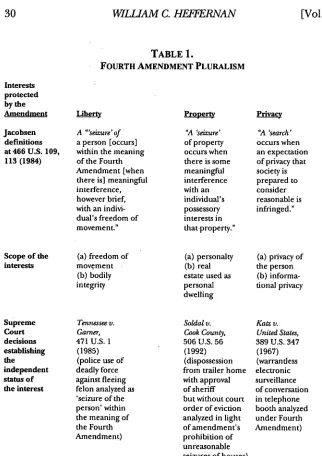
Implicit in the justification I have advanced for Katz is the claim that there are different ways in which officials can destabilize the environment of personal life-and so different interests protected by the Fourth Amendment. One is to interfere with someone's freedom of movement, to seize her person. Another is to interfere with her control over her personal property, to seize her home, papers, and effects. Yet another is to subject her to surveillance, to search her person,
86 Indeed, the property framework continues to be employed when talking about
informational privacy. For example, in My Data, Mine to Keep Private, N.Y. TIMES, Oct. 23, 2000, at A25, Linda Monk denounces efforts by members of Congress to discover information obtained by census workers on the basis of promises of confidentiality. Clearly, information provided to the census is the property of the United States government, not the property of the person -who provided it. But when the information is provided on the basis of a pledge of confidentiality, one feels a strong sense of empathy with those who resort even to property-based arguments for limiting dissemination of their disclosures.
87 As Justice Black noted, even in the eighteenth century the trespass doctrine did
not provide complete privacy protection, because eavesdropping-that is, listening or observing without trespassing-remained possible. See Katz v. United States, 389 U.S. 347, 366 (1967) (BlackJ., dissenting).
Seminal cases such as Olmstead and Katz can be understood in light of this remark. Each raises questions about the Fourth Amendment's protection of informational privacy. The same value was of course at stake in Entick and in Fourth Amendment cases decided in the late nineteenth and early twentieth centuries, but it was not until Olmstead that the value of informational privacy was considered independently of other considerations.
FOURTH AMEDMENT PRIVACY INTERESTS
home, papers, and effects. Each of the intrusions just mentioned interferes with a different interest in personal security-with a
liberty interest (in freedom of movement), with a property interest (in exercising control over personal property), or with a privacy interest (in avoiding surveillance of one's person and of the sources of information about one's personal life). These three interests are of course complementary. But they are also analytically distinct-that is, each can be infringed without the others being affected. It is because this is so that one can speak of "Fourth Amendment pluralism."
Standing in contrast with this is Fourth Amendment monism, a doctrine that views the Amendment as protecting directly only one interest. Taft, it is clear, was a proponent of Fourth Amendment monism. When he argued in Olmstead that the Fourth Amendment is triggered only by trespass, he maintained that the Amendment is concerned exclusively with the control people exercise over physical objects, whether those objects are their person or personal property.9 Another kind of monism is possible, however. One can read Katz as having turned Olmstead on its head, as having interpreted the Fourth Amendment as a provision that offers direct protection only for privacy. This is surely as mistaken an approach to the Amendment as the one Taft employed in Olmstead, yet the post-Katz Court appeared at one time to be prepared to endorse it.9° To understand the significance of privacy in Fourth Amendment jurisprudence, it is essential to see how the Court came close to endorsing privacy as the only value directly protected by the Fourth Amendment-and how it turned away from this, as it should have from the outset, by adopting a pluralistic interpretation of the Amendment.
The case that comes closest to Olmstead inversion is Oliver v. United States.9' At stake in Oliver was a claim that government agents violated a defendant's Fourth Amendment rights when they trespassed on his open fields, located far from his home, to seize marijuana he was growing.9' Writing for the Court, Justice Powell offered two rationales for holding that the Fourth Amendment wasn't implicated in the case. One was drawn from
" See 277 U.S. at 464.
" See Oliver v. United States, 466 U.S. 170 (1984).
91 I 92 Id. at 173.