Thesis by
Robert James Glaser
In Partial Fulfillment of the Requirements For the Degree of
Aeronautical Engineer
California Institute of Technology Pasadena, California
1972
ii
ACKNOWLEDGMENT
The author first came in contact with the gravity gradiometer through the efforts of Dr. E. J. Sherry who arranged for the author to define gravity gradiometer satellite constraints as a summer job at the Jet Propulsion Laboratory (JPL). This proved nearly impossible without some idea of what could be done to reduce the gradiometer data, a project outside the scope of the JPL study. Thus the author was lead to pursue gradiometer data reduction as a thesis topic.
Dr .. H. J. Stewart was kind enough to be persuaded to direct the work at Caltech. As the author's committee chairman, Dr. Stewart proved to be an interested and authoritative advisor, especially as regards the myriad equations surrounding associated Legendre polynomialso
Throughout the effort surrounding a work of this type, the author has received superb support from a large number of people both at JPL and Caltech. At JPL~ Dr. Sherry and Dr .. A. A .. Loomis
stand out in particular.. Dr. Loomis, a Geologist specializing in gravity and the programv s Project Scientist~ played a valuable role in keeping the author from pursuing the wilder schemes the author
ABSTRACT
Two existing gravity gradiometers are discussed and a single signal equation is developed for both instruments. Equations are derived for calculating the gradiometer signal from known spherical harmonic coefficients. The result is a signal equation in the same form as the harmonic expansion but with a" gradiometer" polynomial. Next, an integral curvefit procedure is developed for calculating the harmonic coefficients of the gravitational field from known gradiome-ter data. The procedure only requires calculation of a theoretical observation matrix, thus the orbit determination part of the algorithm is the rate determining step. This increases in cost as the fourth power of the maximum harmonic degree considered. Calculations using parts of the algorithm are discussed and procedures for dealing with error sources are described. Finally, a brief description of a
iv
TABLE OF CONTENTS
PART TITLE PAGE
ACK.NOW LEDGMENT ii
ABSTRACT iii
TABLE OF CONTENTS iv
LIST OF SYMBOLS vi
NOTATION AND COORDINATE SYSTEMS x
I INTRODUCTION I
II THE GRADIOMETER SIGNAL EQUATION 8
II. l Gradiometers Constructed from 9 Accele romete:r s
II. 2 Mechanical Gradiometers 12
II. 3 Observations about the Signal Equation 14
II. 4 Error Sources in the Signal Equation
16
III THE SIGNAL IN SPHERICAL HARMONICS 20III. l Derivatives with Respect to Local 21
Satellite Coordinates
III. 2 Evaluation of the Polynomials 25
TABLE OF CONTENTS (cont'd)
PART TITLE PAGE
IV
AN INTEGRAL CURVEFIT TECHNIQUE 32IV. l Linearization of the Signal Amplitude 33 IV. 2 Derivation of Integral Curvefit Technique 37 !Vo 3 Expansion of Polynomials in Fourier Series 42
IV. 4 Weighting Functions 45
IV. 5 Other Possibilities 47
v
RESULTS AND EVALUATION OF ERROR SOURCES 49v.
l Data on a Sphere 49v. 2
. Cost of G:radiometer Data Reduction 56v. 3
Drifts in the Proportionality Constant 58v.
4 Satellite Orientation Errors 60v. 5
Orbit Determination Errors 61v.
6 Spin Rate Effects 63v. 7
The Signal to Noise Ratio 65VI AN ALGORlTHM FOR GRAVITY GRADIOMETER 66 DATA REDUCTION
VI. l Input Data 66
Vla 2 The Trajectory Calculation 68
VI. 3 Data Purification 70
VI. 4 Integral Curvefit Calculations 72
VII CONCLUSIONS 74 .
A
a
B
b
b. c. cnm
EU
G nm
vi
LIST OF SYMBOLS
The transformation matrix relating local coordinates to global coordinates defined by III. 2.
A constant defined in Table IV. 2.
The transformation matrix relating global coordinates
to
satellite coordinates defined by III. 13.A constant defined in Table IV. 2. Block center.
The degree, n, order, m, harmonic coefficient defined by III. 1.
The cosine coefficient for the cos i8 term in the Fourier expansion of P from Table IV. 2.
nm .
Eotvos unit, l EU
=
lo-
9
/sec2.Gradiometer polynomial, G = nm
GM The product of the earth's mass and the gravitational constant, a fundamental constant.
GW A gradiometer polynomial times its appropriate weighting nm I c I..
lJ
s I..lJ
Is i i ifunction, defined by IV. 16.
The arm inertia for the Hughes gradiometer (figure II. 2) .. An integral used to determine the degree, i, and order, j, cosine harmonic coefficient. Either IV. 10 or IV. 15 (after IV. 1 5) define this quantity.
Same as I:. except for sine coefficient.
lJ
Rotational inertia of the satellite (figure II. 2). Orbit inclination (figure III. 2).
An index in section IV for degree.
A unit vector in the local x direction in section II. The C
j j K k m
m
n 0 0 ..nJl pnm Q R r r
s.
1snm
An index in section IV for order.
A unit vector in the local y direction in section II. The spring constant of the center spring on the Hughes gradiometer (figure II. 2).
The spring constant of the two exterior springs on the Hughes gradiometer (figure II. 2).
A unit vector in the local y direction in section II.
The mass of one of the four arm masses for the Hughes ,gradiometer in section II (figure II. 2).
An index for order ..
An index for degree.
The observation matrix defined by IV. l O.
An element of the observation matrix. See the paragraph that follows IV. l 0 for an explanation of the indices.
Inverse of O.
The associated Legendre polynomial of degree, n, and order, m» defined by III. 7.
A notation, see note following this section.
The quality factor for the Hughes gradiometer introduced in II. 5. This quantity is experimentally determined by the instrument manufacturer.
The equatorial radius of the earthj a fundamental constant.
A characteristic radial dimension for a gradiometer in section II, see figures II .. l and II. 2.
The radial position of the satellite in spherical coordinates (figure III. l ).
The signal from the i-th accelerometer (figure II. 1 ).
The degree, n, order, m, harmonic coefficient defined by III. 1.
The sine coefficient for the sin i8 term in the Fourier expansion of P from Table IV. 2.
viii t Time in section II.
t The argument of a polynomial in section III, t
=
cos=
sin •v
v
xy
x
x y y
z
z
Ax
Ay
v
The gravitational potential defined by III. 1. A notation, see note following this section. Global coordinate defined in figure III. l. Local coordinate defined in figure III. 1. Global coordinate defined in figure III. l. Local coordinate defined in figure III. 1. Global coordinate defined in figure III. 1. Local coordinate defined in figure III. 1. The change in x from figure II. I.
The change in y from figure II. lo The change in z from figure II. lo
The difference in arm deflections for the Hughes gradiometer (figure II. 2). The quantity measured by the Hughes instru-ment.
e
= () -
e •
o e
The colatitude from section IV, ()
=
11' - <P, from figure III. I.Deflection of the odd numbered arm from figure II. 2 .. Deflection of the even numbered a:rm from figure II. 2. Rotation of the satellite from figure II. 2.,
Total deflection, () t
= ()
+ () ,
from figure II. 2. e oThe longitude of the satellite from figure III. I. The true anomaly from figure III. 2.
w The argument of perigee from figure III. 2 in section III.
w The spin rate of the satellite in section IL
w The resonance frequency of the Hughes gradiometer, w
=
2w.·X
NOTATION AND COORDINATE SYSTEMS
P is the associated Legendre polynomial defined by III. 7. It nm
differs from Pm by (-l)m. n
( m
n ) is the binomial coefficient in IV. 13,(mn)
=
(n-m)! m!
n! ~V xy' etc. stands for
pxy etc .. stands for nm'
Quantity
I
superscript means the quantity is to be evaluated at the subscriptlocation of the subscript and, or identifies the meaning (source) of the quantity in the superscript .
.Examples:
J
<iv
V xz
I
2 means the term fromax
oz
with a J 2 coefficient.Ampl
I
meas means the amplitude of the gradiometer data actually measured in a satelliteoI
meas measAmpl orbit means th~ same as Ampl
I
but specifies the data is taken along the satellite orbit.Four coordinate systems are being used:
1. local coordinates (x, y, z) from figure Ill. 1.
2. spherical coordinates (r, i\, ) or (r, i\, ) from figure III. 1. 3. global coordinates (X, Y, Z) from figure III. 1.
I. INTRODUCTION
Observation of the earth is one of the most relevant applications of satellite technology. In this era of skepticism about the space
program, weather satellites, communications satellites, and military satellites are unique in that the information they gather has obvious and direct application to the re st of the world. Earth physics satellites are in a similar class. These are satellites that measure properties of the earth itself. Some of the properties of the earth that might be measured using satellites are the variations in the earth's gravitational field, the altitude of the earth's surface, and the ocean's tidal varia-tions. While the relevance of this type of science, known as Geodesy,
is not as obvious as that from weather satellites, the applications of Geodesy include areas in Geology, Oceanography and Cartography, as well as satellite orbit determination.
This thesis deals with one of the fundamental quantities in
Geodesy: local variations in the earth's gravitational field. Gravita-tional perturbations are of interest for several reasons. The most obvious application of gravitational data is in the area of orbit deter-mination. Improved representation of the gravitational field is
2
National Aeronautics and Space Administration is currently studying the applications of satellite technology in Geodesy. Th~ current program plan identifies the need for gravitational data in Oceanography and Geology.. Gravitational data coupled with satellite altimetry data would facilitate modeling ocean tides. Gravitational data would help to determine the altimeter satellite trajectory to the
required accuracy and also would independently determine the geoid. The difference between geoid height and ocean surface height repre-sents the dynamic head associated with tides, ocean currents, and storm surges. In Geology, measurement of gravitational perturbations is a way of obtaining information about the subsurface structure of the earth. A more detailed gravitational model coupled with existing data might lead to a causal model for the density distribution of the earth with possible applications in mining and earthquake modeling. For a more complete picture of what might be accomplished the reader could refer to the Williamstown report (l) or to the current National
Aeronautics and Space Administration plan (2).
This thesis discusses data· reduction from a prospective satellite experiment for determination of the earth's gravitational field - a gravity gradiometer experimento The gravity gradiometer measures a combination of second spatial derivatives of the gravita-tional potential; i.e., the spatial change in acceleration. The
There are several reasons why a satellite experiment would be advantageous. The most important advantage of a satellite experiment is that it allows complete, uniform coverage of the earth in a relatively short time span. Ground based geological surveys have already
covered most of the land areas of the earth. It is in coverage of the oceans» polar regionsp and inaccessible land masses that a satellite study offers an attractive contribution. Another advantage of a
satellite experiment is that the local terrain need not be corrected for. In a satellite the nearest topography is several hundred kilometers away. This eliminates the need for terrain corrections. A further advantage of the same sort is that the ambiguity of needing a geoid to determine a geoid is reduced. From a satellite, the measurement is
referenced to the local equipotential surface. At satellite altitudes this is a considerably smoother surface than at sea level.
4
techniques is that it extends the range of wave lengths attainable at , satellite altitudes.
There are a number of other techniques that have been
proposed for obtaining gravitational data~ Direct observation of long term satellite motions from the earth has been applied to calculate the gravitational field (3). The data reduction technique used involves expressing the orbital elements as Fourier series whose coefficients are expressed as linear functions of the spherical harmonic coef-ficients. This is known as frequency decomposition. The accuracy of this technique is expected to improve dramatically in the next few years with the development of laser position determination.
Doppler radar or laser measurement of the range between two satellites has been proposed as a possible experiment for
deter-mining the earth's gravitational field (4,S)o The range rate between an earth syncronous satellite and a low test satellite could be measuredo Alternately, two low test satellites might be used, one continuously
ranging the other. A recent proposal for data reduction involves parameter fitting to an assumed mass distribution on the ground (5).
A radar altimeter has been ·suggested for determination of the earthw s gravitational field. Altimetry data alone contains considerable information about the gravitational field in the ocean regions where the mean surface height closely follows the geoid. This information
coupled with existing surface data could be used to improve existing representations of the gravitational field (6).
precise measurement of the period of a pendulum. This data is con-verted to an acceleration and mapped as anomolies over the area
surveyed.. Characteristically this is done for geological surveys in an attempt to find oil or mineral deposits. Unfortunately, accurate meas-urements are difficult over water~ Use of gradiometers is currently being investigated as a technique applicable to ship or aircraft carried experim.ents (7) and a data reduction technique has been proposed for
reducing horizontal gradients to geoid height (8).
It is within this framework of existing proposals that yet another proposal, the gravity gradiometer satellite, should be con-sidered as a potential satellite experiinent.. The gradiometer technique offers a number of advantages when compared to more conventional satellite techniques. First, the gradiometer measures a combination of spatial derivatives of acceleration. Differentiation accentuates high frequencies, thus the gradfometer tends to selectively measure the unknown high frequency components of the gravitational fieldo The other satellite techniques measure lower order deriva-tiv.es of the field, thus their signals are composed of a larger proportion of low frequencies (9) ..
Another advantage of the gradiometer technique is that it is relatively insensitive to drag. Atmospheric drag causes changes in a satellite's velocity and position which are an error source for other satellite techniques. However, to the extent that the drag acts
6
difference in acceleration between points in the satellite is zero regardless of the time history of the measurement.
A final advantage of the gradiometer technique when compared to other satellite techniques is that it makes a direct measurement. The most important consequence of this is that the time history of the measurement is insignificant. Ignoring imperfections in the instru-ment the gradiometer will read the same irrespective of how it
arrived at its current location. Thus a number of different satellites in different trajectories would not significantly improve the accuracy of the measurement except by increasing the amount of datao For this reason the gradiometer lends itself to data reduction techniques more often associated with surface measurements than satellite techniques. At the same time, the gradiometer preserves the satellite advantage of working with a convergent field.
In the material that follows, the general properties of
gradio-meters will be discussed. Next an integral formulation of the data
reduction problem will be developed. This requires a new set of
polynomials based on the derivatives of Legendre polynomials. These
polynomials can be orthogonalized with respect to a set of weighting
functions. A theoretical procedure will be developed for doing this,
thus allowing calculation of the spherical harmonic coefficients
8
II. THE GRADIOMETER SIGNAL EQUATION
In this section two existing gravity gradiometers will be dis-cussed and a single signal equation will be developed for both
in st rum ent so
At least two manufacturers are engaged in developing gradio-meters suitable for satellite Geodesy applicationso They are
Bell Aerospace of Buffalo, New York, and Hughes Research of Malibu, California. The Bell Aerospace design calls for four directional
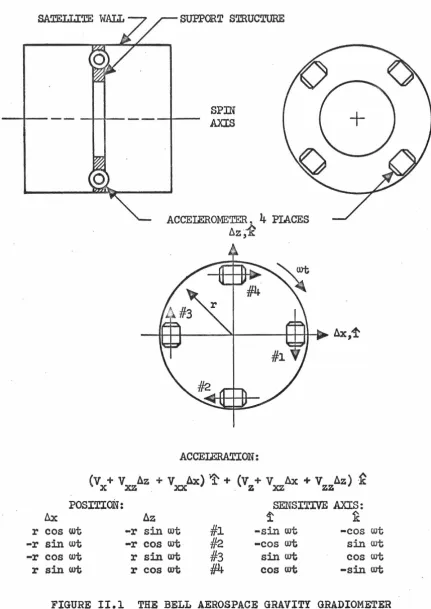
accelerometers rigidly attached to the walls of a cylindrical, spin stabilized satellite. The sensitive axis of each accelerometer would be directed tangentially, i.e. the proof masses inside the accelero-meters would be constrained radially. The signal from diagonally opposing accelerometers would be added and the pair of resulting
signals would be subtracted~ The Bell Aerospace accelerometers have been flight qualified and used in several satellite programs in other configurations.
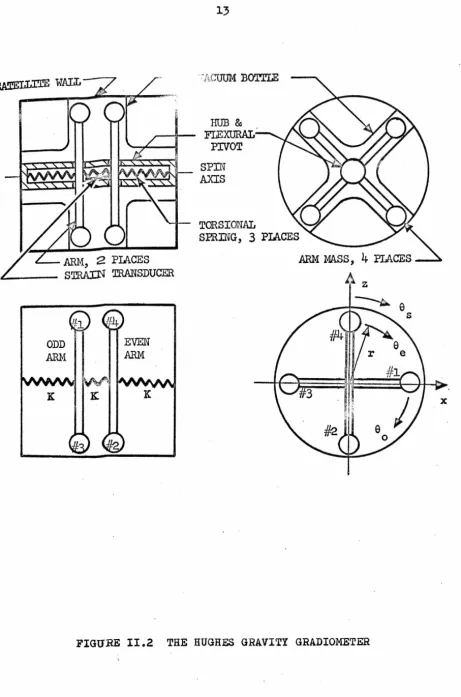
The Hughes design calls for a pair of torsional spring-mass oscillators, composed of two arms in the shape of a cross, with
torsional springs cross connecting the arms and connecting the arms to the walls of a spin stabilized satellite. Heavy proof masses would be located on the ends of the arms and the "difference" mode of the
II. 1 Gradiometers Constructed .from Accelerometers
Taking the proposals one at a time, consider the Bell Aerospace
instrument operating at a fixed point in a gravitational field which
varies slowly with position. The situation is indicated in Figure II. 1.
Think of an accelerometer as a proof mass sliding on a frictionless
wire. The proof mass is centered electronically so that a signal is
produced which is proportional to the force required to maintain the
proof mass at the center of the wire. Thus the signal is proportional
to. the acceleration relative to the accelerometer housing that the proof
mass would experience if free to travel along the sensitive axis. The
entire system rotates about the y axiso The acceleration due to this
rotation is radial and the sensitive axes are tangential; thus no signal
is produced by the satellite rotation.
The situation due to the gravitational field is different,
how-ever. Since the field is slowly varying, one is justified in writing a
Taylor's series expansion for the gravitational potential. This must
be carried to at least second ordero By differentiating the Taylor's
series expansion with respect to each of the coordinate axes one
obtains the vector acceleration of the proof masses as a function of
position (x, y, z)o Substituting expressions for sinusoidal motion in
the x, z-plane as a function of time, and dotting these expressions with
a time variant unit vector in the direction of each accelerometer's
sensitive axis (i.e., taking the vector component of acceleration in
the direction of the sensitive axis), one obtains the four equations
10
SUPPORT STRUCTURE
SPJN
AXIS
ACCEIEROMETER A.
4
.
PIACES 6z)-.itACCEIERATION:
(V
+
V flz+
VAx)
1-
+
(V+
V flx+
V /lz) ·~ x xz . xx . z xz· zzPOSITioN: SENSITIVE AXIS:
~ ~
t
~r
cos
wt
-r
sin wt
-rcos
wt
r sin wt
-r sin wt
-rcos
wt
rsin wt
r
cos
wt
#1
#2
#3
#4
-sin wt
-cos
.
wt
sin
wt
cos
wt
-cos
wt
sin
wt
cos
wt
-sin
wt
[image:20.615.110.541.83.692.2]s
1oc -sin wt V - cos x wt V z+
r sin wt cos wt(V . zz -V )- r(cosxx 2 wt-sin2wt)V xzs
2oc-cos wtV +sin wtV- r sin wt cos wt(V -V )+ r(cos2 wt-sin2wt)Vx z zz xx xz
s
3 oc sin wt V+ cos
wt
V + r sin wt cos wt(V -V )- r(cos2wt-
sin2 wt)Vx z zz xx xz
s
4 oc coswt
V - sin wt V - r sinwt
cos wt(V -V )+ r(cos2 wt-sin2wt)Vx z zz xx xz
(II. 1)
The satellite response is just enough to cancel the first order
derivatives in equation II. l except for satellite drag terms. This is
the reason that the signals can not be combined to measure
acceler-ation. However, by adding the signals from diagonally opposing
accelerometers and subtracting the resulting pair of signals, one
obtains the signal equation for the Bell Aerospace gradiometer.
Signal oc sin 2
wt (
V - V ) - 2 cos 2 wt Vzz xx ' xz (II. 2)
Satellite drag can be measured using the same four
acceler-ometers in this configuration. This is done by subtracting opposing
pairs of signals and adding the resulting pair of signals. The
resulting signal has an amplitude proportional to the in-plane drag
12
II. 2 Mechanical Gradiometers
Next consider the Hughes instrument operating at a fixed point
in the same gravitational field. By balancing the moments of the
gradiometer arms1 one can show that the ideal equations of motion
for the simple three degree of freedom system shown in figure II. 2
are:
I
0
+
K ( 8 - 8 )+
K ( 8 - 8 )=
m r 2 { ( V - V ) sin 2 8 -2 V cos 2 80 }
o o e o o s . zz xx o xz
,,
- 8 )
=
-mr2{(V - V ) sin 28 -2V cos 28 ls zz xx e xz ef
I 8
+
K( 8 - 8 )+
K ( 8e e o o e
"
I (J
+
K (2 8 - fJ - 8 )=
Drag Torques s o s o e (II. 3)
Taking the sum and difference of the first two equations one
can very nearly separate the difference equation from the other two.
Define 8
=
B - 8 and 2 Ot=
e
+
8 where (j is proportional to theo e o e
strain measured by the Hughes instrument.,
,, 2
IO+ (2K - K )6
=
2mr{CV -
V ) sin 28t - 2V cos 28tl cos8o zz xx . xz
r
zret'
+
2K (8t - 8 ) = 2mr2{(v -
V ) cos 28t+
2V sin 2 (Jt } sin 80 s zz xx xz
II
I 8
+ 2K (
(J - 8t)=
Drag Torques s 0 s (II. 4)
Since the difference between the arm deflections, 8, is very ·
small, the last two equations approach the solution: 8 s
=
.8t=
wt.'
SATELLITE
WALL
ARM,
2 PIACES
£----
STRA:cN TRANSDUCERTORSI
ON
AL
SPRING,
3
PIACES
[image:23.623.106.568.58.755.2]l'+
quantity w
=
(2K - K )/I, the resonance frequency of the sensor; andg 0
after observing that I
=
2mr2; one obtains equation II. 5.8"
+
- - £ WQfY 9'+
W 2 8 -- ( V - V ) sin 2 wt ~ 2 V. g zz xx xz cos 2wt (II. 5)
This is the classical harmonic oscillator with a periodic
forcing function. Hughes proposes to increase the amplitude of
0
by picking the stiffness of the torsional springs such that w
=
2w. gUnder this condition, the forcing function on the right is forcing the
system at resonance, thus the steady state solution to equation II. 5
is as shown belowe
Q
(J
= -
2 (2.w)j (V - V ) cos 2wt
+ 2V
sin 2wt}l zz
xx
xz (II. 6)The output of the Hughes strain transducer is proportional to this
quantity, thus the Hughes output equation is the same as the
Bell Aerospace output equation except for a 90° phase shift.
II. 3 Observations about the Signal Equation
There are several points it is important to realize about the
gradiometer signal. Firsti one should realize that the instrument
measures a combination of second derivatives of the gravitational
potential. It is hoped in this way to extend the range of frequencies
that the instru.rnent can measure, and also it is possible to measure
this quantity directly in free-fall.
Second, the signal comes at twice spin frequency. This
allows separation of the actual signal from a number of noise
the derivation it should be clear that the instrument must be rotated to
produce a signal, thus a spin stabilized satellite is called for.
Third, the equation is an approximation based on the Taylor's
series expansion for the gravitational potential. This is a very good
approximation. There are two length scales for the potential: the
altitude of the satellite above the surface and the radial distance to the
center of the earth. The dimensions of the gradiometer are small
compared to either scale.
Fourth, as a consequence of the derivation, the expression
involves second derivatives with respect to a spacecraft defined local
Cartesian coordinate system. This is unfortunate as an earth centered
spherical coordinate system is more natural for gravitational work.
Finally, it is important to realize that both amplitude and
phase data are associated with the signal. The amplitude is given by
equation II. 7:
Amplitude oc ,./(V - V )2
+
4 V 2" zz xx xz (II. 7)
and the phase angle is within an additive constant of equation II. 8.
Phase
=
tan -12V xz
v
- v
zz xx
(II. 8)
Both Hughes and Bell Aerospace derive this equation in different ways.
By way of comparison the reader could refer to the appropriate
16
II. 4 Error Sources in the Signal Equation
The signal equation is not exact. A number of hardware effects must be considered before one is justified in talking about the signal in this waye Some of the larger errors that must be considered are: 1) long term drifts of the instrument proportionality constant, 2) errors in the orientation of the satellite spin vector~ 3) orbital responses to the higher degree terms in the gravitational field, 4) finite spin rate effects, and 5) the instrument signal to noise ratio. These error sources will be discussed in detail in a subsequent chapter (Chapter V) and will only be described herea Another class of at least equally important error sources arises from misalignments of the instrument. These are not within the scope of this thesis ..
The signal equation, IL 2~ expresses a proportionality between the output signal and the gravitational fielde The accuracy of this relationship is limited by the accuracy to which the proportionality constant can be made to hold constant. A number of factors act to change the proportionality constant in orbit. The most important factor will probably be changes in temperature in the satellite. This problem is easily understood in the case of the Hughes instrument. The
strain transducer Hughes uses to obtain a readout is functionally dependent on the temperature.
The signal equation is dependent on the orientation of the satellite's spin vector (i.e., the orientation of the x, z-plane with
orientation of the spin vector needs to be accounted for in the data reduction. If changes in orientation smaller than the smallest angular position that can be determined caused output signals larger than the instrument significance level, the data could not be corrected. This happens in the case of the angular position with respect to the in-plane
rotation, thus the phase angle from equation II. 8 can not be measured as accurately as the amplitude can be measured.
The satellite responds to the higher harmonics in the earth's gravitational field. One of the reasons for measuring gravity in the first place is to facilitate prediction of this response, i.e., orbit determination. Obviously this effect must be taken into account in the data reduction procedureo If the error in predicting the response of the satellite were large enough to cause signals of the order of the instrument sensitivity, a simultaneous solution for the satellite
response and the gravitational field would be necessary to remove this effect.
The cause of finite spin rate errors can be seen most clearly by considering the differential equation for the Hughes instrument expressing the way the signal is transmitted thru the proof masses (equation II. 5 copied below).
fl 2w I 8
+-fJ
Q
2
+
4 w (}= (
V - V ) sin 2 wt - 2 V cos 2 wtxx xx xz
(II. 9)
Since the satellite translates, V - V and 2V can be expressed
zz xx xz
18
frequency of the forcing on the right. The product of the spin rate
term and any of the frequencies from the terms V - V and V
zz xx xz
is equal to a sum of sine waves at the sum and difference of the
frequencies. If the satellite spin rate, w, is essentially infinite with
respect to the highest frequency of interest there is no problemo For
a finite spin frequency the attenuation can be rather large.
The instrument signal to noise level is one of the limiting
factors in the design of a gravity gradiometer. Essentially, this
problem arises because of Brownian motion of the test masses. This
random vibration creates a signal which can not be distinguished from
the gradiometer signaL Electrical noise is also a factoro Hughes
develops an equation for the signal to noise ratio which can be found in
reference I 0.
Finally, the reader should be aware of the nature of the
mis-alignment problems mentioned earlier as being outside the scope of
this thesis. These occur because of assumptions made in the
deriva-tion of the signal equaderiva-tion that can not be met preciselyo For example,
it was stated in deriving the signal equation for the Bell Aerospace
gradiometer that the sensitive axes of the accelerometers were
oriented tangentially. This is not possible to arbitrary accuracy ..
Similarly, the geometric center of the two instruments were both
assumed to lie on the spin axis. Again this can not be done to arbitrary
accuracy.
Most of these error sources are intimately coupled to the
20
III. THE SIGNAL IN SPHERICAL HARMONICS
Equations will be developed for calculation of the gradiometer
signal from known spherical harmonic coefficients.
The spherical harmonic expansion for the earth's gravitational
field is derived by recognizing that the gravitational field satisfies
Laplace's equation in spherical coordinates. By applying separation of
variables and requiring continuity at the coordinate boundaries and a
zero potential at infinity, one arrives at equation III. 1 for the
gravi-tational field exterior to a sphere of radius R.
n GM
~
(Rr)n V(r,X,cl>)= -
Lr
L
Pnm(sin cl>)[Cnm cosmX +Snmsin mX] n=o m=o(III. 1)
The problem with using this representation of the earth's field to
rep-resent the output of a gravity gradiometer is that the expressions for
the second derivatives with respect to a Cartesian coordinate system
are extremely complicated. This is obvious when one considers the
chain rule expansion for the second derivative of a function 6£ three
variables.
2 \ 2 2
V
=
V r+
V'\ A+
V"" cJ> + V r + V'\ '\I\ + V,,,.,,,. cJ>xx r xx " xx
'*'
xx rr x "" x'*''*'
x+
2(V \r A+
V ""r <I>+
V'\"'-X cl>)r"' x·x r'*' x x "'*' x . x
III. 1 Derivatives with Respect to Local Satellite Coordinates
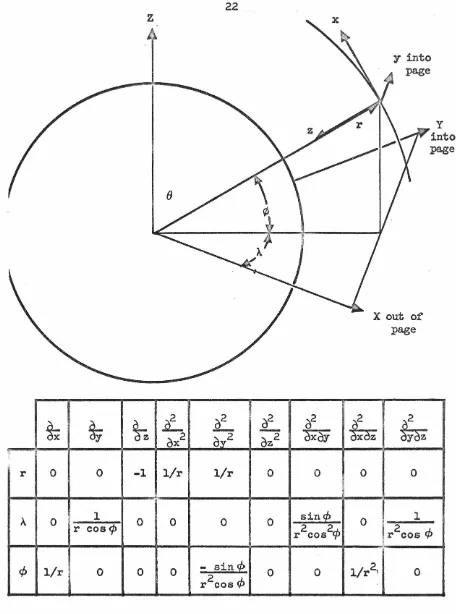
By working at an arbitrary point in space and defining the local
x-axis in the direction of
¢,
the latitude; the local y-axis in thedirection of ,\, the longitude; and the local z-axis in the opposite
direction of r, the radius; all but two of the terms in equation III. 2
are identically zero. Figure III. l defines this coordinate system. It
is necessary to take first and second derivatives of the spherical
coordinates with respect to the local coordinates. This requires the
transformation between the two coordinate systems. The
transforma-tion between global coordinates and the local coordinate system is
indicated in equation III. 3.
X
=
cos A. sin<P x - sin X y +cos A cos <P(r z)Y - - sin X sin cl> x
+
cos I\ y+
sin ~ cos cf>( r z)Z
=
cos cf> x+
sin c;J>(r - z) (III. 3)Working with equation !IL 3 and the transformation between
global and spherical coordinates, it can be shown that the derivatives
of the local coordinates with respect to the spherical coordinates are
as shown in Figure .III. L Substituting these expressions into the chain
rule expansions for the second derivates of equation III. 1 with respect
z
0
~
~ ~
L
ox
2
~
A
r 0 0 -1 l/r
'.
A
0 1 0 0 r coscp
¢
l/r
0 0 022
x
02
?P
02
-
dxoy
o:v2
oz
2l/r
0 00 0 sin <.2,
2
2
r cos
cp
- sin
cf>
0 0r 2 cos
¢
~
y into
page
y into
page
X
out of
page
2
fxaz
fuz
2
0 0
0 ~ < 2 1
I
r
cos¢l/r
21 0 [image:32.618.93.549.58.672.2]00
I
n=o
. GM
V
(r,X,<P)=-3
yy r
00
I
n=o
GM 00
vzz(r,A,<P) = - 3
I
r n=o
GM 00
V (r,A,cj>)
=
-3
L
xy r n.=o
GM 00
vxz(r,A,<I>) =-3
I
r n=o
GM 00
V (r,A,cP)
=
-3
L
yz r n=o
n
~ pxx (sin 4')
re
cos mA+
S sin m,\lL... nm L nm nm ~
m=o
n
"' pYY (sin <P)
[c
cos mA+
S sin m,\]~nm nm nm
m=o
n n
(
~) ~
Pzz (sin <t>)[c
cos m.A+ S sin mA]r L.. nm nm nm
m=o
(R)n n
-r "' pxy (sin <P)[s
cos mA- C sin mA]L.. nm nm nm
m=o
n n
(
~) ~
pxz (sincp)[c
cos mX+
S sin m,\]r L... nm nm nm
m=o
(Rr)n
Ln
pYZ (sin<t>)[S cos mA - C sin mi\)nm nm nm
m=o ·
(III. 4)
Pxx (sin cl>)
=
nmpYY (sin <J>)
=
nm
Pzz (sin ct>)
=
nmPxy (sin cl>)
=
nmpxz (sin ct>)
=
nmpYZ (sin <i>)
=
nm
24
d 2 P ( s in cl>) nm
- (n
+
1) P (sin <J>)nm
~
+ (
n+
1) p (sin <J>) - sin <J> nm (2 ) d P (sin <J>)
cos2ct> nm cos<J> dct>
( n
+ 1 )( n
+ 2} P
( sin cl>) nmm (sin
2"'
p nm (sin <J>)+
1d P (sin <J>)j
nm cos"' d(/) cos
q,
d P (sin <J>)
(n
+ 2)
nm d<J>(III. 5)
m (n
+
2) Pnm (sin</>) cos"'The equations have been written in this way to emphasize that
the form of the spherical harmonic expansion has been preserved.
There is a term containing the units, GM/ r ; a term expressing 3 . altitude variations, (R/r)n; a polynomial in latitude, P!!m(sin<P); and
sinusoidal variations in longitude, cos mX and sin mA. . From a dimensional argument one can see that the altitude variations must
take this form regardless of the orientation of the local coordinate
system. Since the local x direction is perpendicular to _the unit vector in the direction of A and the local y direction is
perpendic-ular to the unit vector in the direction of cb, it is obvious that the
III. 2 Evaluation of the Polynomials
By applying the chain rule expansion, one can show that the
polynomials from equation III. 5 may be written as shown in III. 6
below"
pxx (t)
nm
pYY (t)
nm
pXY (t) nm
pxz (t)
nm
2 d2Pnm(t)
=
(1 - t ) 2dt
d p (t)
t nm
dt
(n
+
1) P (t)nm
2 ) d p
(t)]
m 2
+
(n+
1) p (t)+
t nm- t ) nm dt
=
m t p (t)+
nm(
d p
(t))
(1 - t2) nm dt
d p (t)
nm dt
pYZ (t)
=
m(n+
2)(1 - t2)
-
i
P (t)nm nm
(III. 6)
The polynomials in equation III. 6 are always finite. This is
not obvious from the form in which they are written, but it follows
from substitution of Rodriques' formula for the associate Legendre
polynomial, equation III. 7.
p (t)
nm
=
dn+m (t2 _ l)n
26
Equation III. 4 satisfies Laplace's equation. The sum
pxx
+
pYY+
pzz is zero since it is equal to the governing equationnm nm nm
for the associated Legendre polynomialg equation III. 80
d ( 2 d p
(t)) (
dt ( 1 - t )
~~
+
.
n(n+
I) - m2 ) p (t)=
0( 1 - t2) nm
(III. 8)
From this much information it is possible to calculate the
value of the second derivatives at any point using the recursion
formulas for the associated Legendre polynomial and the equations
just developed for the second derivatives. For example, using
Rodriques' formula it can be shown that the first derivative of the
associated Legendre polynomial with respect to t is given by
equation III.
9.
d p (t)
nm
dt
= -
n t P nm (t) .,_ (n+
m) P n- ,m 1 (t)(III. 9)
Substituting this expression into the governing equation one obtains a
three-term recursion relation for the associated Legendre polynomial.
(n - m
+
1) P+
1 (t) = (Zn
+
1) t P (t) - (n+
m) P 1 (t)n , m n, m n- , m
This allows simple calculation of Legendre polynomials and
their fir st derivative. In order to start the procedure, one uses
Rodriques' formula to obtain an expression for the terms of equal
order and degree, i.e., m
=
n:(2m)!
2m I
m.
(III. 11).
and the special cases PO,
0(t)
=
1 and P11 0(t)=
t. Also fromRodriques 1 formula it is clear that P (t)
=
0 for m greater than n.nm
The reader should be warned that equation III. 10 is known as
an unstable recursion relation since the coefficient multiplying the
terms on the right is larger than unity. The argument here is that any
error in P nm will be larger in P n
+
1 ,m due to being multiplied by anumber larger than one. If the reader is concerned about this, a
variety of other recursion relations are available ( 15).
III. 3 Relating the Second Derivatives to the Signal Equation
At this point it becomes necessary to relate the signal equation
(II. 2) to the expressions for the second derivatives (III. 4). This is
not as straightforward as it might appear since the orientation of the
coordinate system for the signal equation was fixed by the plane of the
gradiometer while the coordinate system for the second derivatives
was fixed by the location of the gradiometer. In general one of the
two coordinate systems must be rotated to the other.
The situation is further complicated by the requirement that
the satellite be spin stabilized to provide the necessary rotation for
28
space not in earth centered space. For normal usage of the
gradio-meter in a satellite, there is no problem. If the orbit is polar to
obtain complete coverage of the earth, and if the spin vector of the
satellite is perpendicular to the plane of the orbit, the derivatives of
Section IIL 2 can be substituted directly into the signal equation. If
either of these conditions are not met, the derivatives of Section III. 2
must be rotated to the coordinate system in which the gradiometer is
operating.,
In general an Euler angle transformation is required to
per-form the necessary rotation. First the rotation to inertial space is
required. This was already given as equation III. 3 repeated as a
matrix equation below.
(III. 12)
Where
[A
1
is:- sin <f> cos )\ - sin X. - cos</> cosX. cos
x.
- sinX. 0 - sine/> 0 - cos </>- sin<:fa sin A. cos
x.
- coscp sinX.=
sinX. cosx.
0 0 1 0cos¢ 0 -sin¢ 0 0 I cos<f' 0 - sin</'·
This may be viewed as a rotation of </>
+
90° about the local y-axisfollowed by a rotation of -X. about the global z-axis. The
transfor-mation from global to local coordinates is the transpose of this.
Having rotated to global coordinates, the next step is to orient
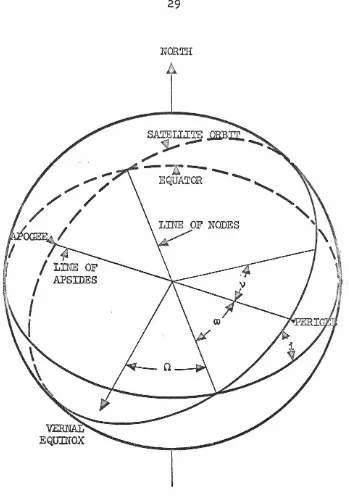
the satellite in the plane of its orbit. To do this the more general
I
LINE OF
I
APSIDESI
f
NORTH
SATELLITE
.OB.BU,.
j.__.
---
--....;
/
-- -
A
w--...,.
EQUATOR ~,
'
'
'
[image:39.620.153.502.57.555.2]30
right ascension of the node; i, the orbit inclination; w, the argument
of perigee; and v, the. true anomaly. This coordinate system ·is
defined in Figure III.2. In general, to orient the y-axis (spin axis)
perpendicular to the plane of the orbit, the x-axis in the direction of
travel, and the z-axis downward in the radial direction, the
transfer-mation defined by equation III. 13 is required.
l
xsatellitel =[BJ
l
xgloball
(III. 13) Where[Bl
is:- sin(w + v) 0 cos(w+v) I 0 0 cos
n
sinu
00 1 0 0 sin i cos i -sin
n
cosn 0-cos(Ci>+v) 0 - sin(w +ii) 0 -cos i sin i 0 0 1
Thus this transformation may be viewed as a rotation of
n
about theglobal z-axis, followed by a rotation of (90° - i) about the new x-axis,
followed by a rotation of - ( (w
+
v)+
9o
0) about the new y-axis. This isnot a standard Euler angle transformation. Normally one rotates
about the z-axis, then the x-axis, and then the z-axis again(l6). This
series of rotations was used to allow the y-axis to be the spin axis
instead of the z-axis. Thus the total rotation for the second
deriva-tives is given by equation III. 14 ..
[
v.~atellite
J
Substituting 0 for w, </> for v, 90° for i, and ~ for
n,
onediscovers the transformation is unityo Thus, if a circular polar orbit
is used no transformation is required. This of course is what prompted
the selection of the coordinate system shown in Figure III. I in the first
place~
In the preceding transformations it was assumed that the spin
vector would be perpendicular to the plane of the orbit. This is not an
arbitrary choice. Another alignment would cause the large mean
signal to be modulated with the period of the satellite rotation about
the earth. This would create several problems. First, the character
of the signal would change during different parts of the orbiL At
worst the signal would change from small amplitude rather random
variations to large amplitude sinusoidal oscillations. The data
sub-system would need to be able to handle both cases. Further, phase
references would present difficulties. If the spin vector were in the
plane of the orbit, the satellite would have to shift between an inertial
and an earth centered phase reference to obtain orientation
informa-tion·. Finally, the signal would not be as nearly linear in terms of
the harmonic coefficients in any other orientation. Thus there ar~
hardware limitations and data reduction advantages that dictate this
32:
IV. AN INTEGRAL CURVEFIT TECHNIQUE
In this section an integral procedure will be developed for curvefitting the spherical harmonic coefficients of the earth's gravitational field. The procedure under consideration essentially involves a free air reduction of the gradient signal onto the surface of a sphere.. This corrected data can be integrated using theoretically derived weighting functions to orthogonalize the data. In order to evaluate the necessary integrals, the signal equation polynomials from equation III. 5 will be expanded in Fourier series. This raises the possibility of performing most of the calculations using a fast Fourier transform, thus reducing computer run time.
In proceeding in this way, the data reduction procedure is more like surface data reduction techniques than satellite data reduction techniques. This is made possible because the gradiometer signal amplitude is only a function of position and does not involve initial conditions. The gradiometer satellite is the only gravimetry
satellite proposed to date that has this characteristic. The prospects for actually making an integral procedure work are greatly enhanced by the effect of the satellite altitude. Since the satellite is flying well above the surface of the earth, the spherical harmonic expansion is highly convergent at wave lengths shorter than the satellite altitude. Further, global data will be available with the gradiometer satellite. Both of these advantages are not shared by existing surface techniques.
the higher harmonics is very much like the error in ground based data reduction introduced by not knowing the geoid height. At
satellite altitudes this error is considerably reduced for the higher harmonics by the attenuation of the response with altitude. Since the gradiometer measures a higher derivative than the satellite displace-ment responds to, it is reasonable that a data reduction procedure of this sort will converge at least as fast as surface data reduction procedures based on measuring acceleration.
IV. 1 Linearization of the Signal Amplitude
Since the phase angle of the gradiometer signal can not be measured to the accuracy that the amplitude can be measured, one is
constrained to fit data knowing only the signal amplitudeo The equa-tion for the signal amplitude is not linear (eq .. II. 7 repeated below). This difficulty can be overcome by
Amplitude oc
'1
(V - V )2+
4 V 2zz xx xz (IV. I)
recognizing that the signal from the mean earth (C ) very much 0, 0
dominates the signal. Expanding the signal amplitude equation according to the binomial theorem, one obtains equation IV. 2.
2
v
2zv
4 Amplitude ~ (V - V )+
xzzz xx V -V zz xx
xz
+
(V - V
)j.
zz xxTABLE IV.1 COMPONENTS OF THE GRADIOMETER SIGNAL
COMPONENT
TERM
EXPRESSION
C )
v
3
co,o
=
1v
zz
xx
3
GM/r CO,O
2
v
0xz
J2
=
0.001083
v - v
zz
xx
GM (R)
2(57
15)
r3
r
4
cos
2(J +4
J2
2
v
:~
m212 sin
2(}J2
xz
n
~3v
-
GM
~
((Rt
r (n+l)(n+2)(10-5)
7
)2
(2n+l)•
zz
r3
see ref.
9
AMPLITUDE AT
100 KM
4400 EU
0 EU
28
EU18.5
EU0.73 EU RMS
[image:44.793.127.682.187.428.2]+-5000
4000
3000
2000
40
30
20
10
51
o.
5o.
1.id
MEA
~ SIGN~L
"""---.
...
----
____...
----
-
~---ft - - - i - - . . . _r,
r,
-.
~
vzz
.. v
xx
"'2
.
J2 /
/
-~
~
vxz
-\
\
\
·' ""
'
~
..
I"
'
"
[
~
}'
~
RMS
RAD I Al
SECOND~
~
DER!\
ATIVE
~
...__0
1 0
0200
300
400
500
600
700
800
9l
0 lUOCSATELLITE ALTITUDE (KM)
[image:45.618.122.550.80.671.2]36
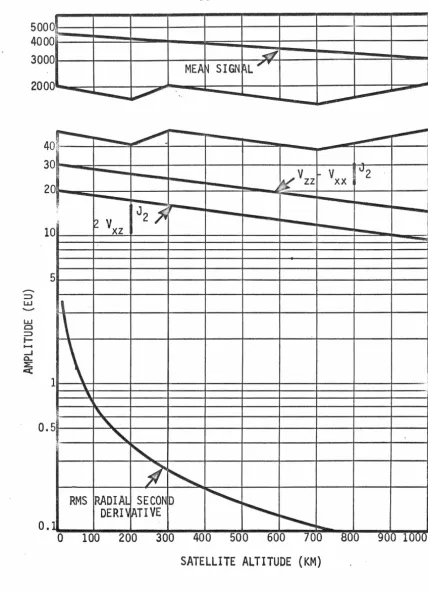
Figure IV. I is a plot of these results as a function of altitude. Using
these results one can further simplify equation IV. 2. Taking a
nominal altitude of 100 km one expects V - V to have a mean zz xx
signal larger than 4000 EU ( l EU
=
10-9 / sec2). The ellipsoidal bulge will contribute less than 30 EU to V - V i and there will be azz xx
perturbation signal of about 2 EU RMS. On the other hand, there is
no mean contribution to V so the ellipsoidal bulge dominates that XZ
term with a signal of the order of 20 EU. Again, the perturbation
signal to V will be relatively small, of the order of 1 to 2 EU RMS. xz
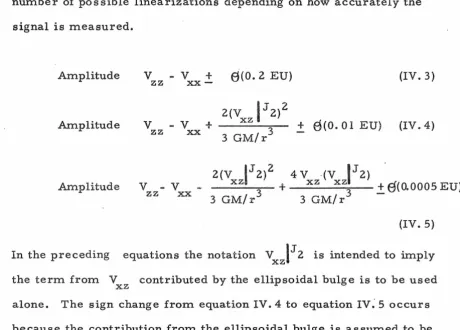
Substituting these results into equation IV. 2, there are a
number of possible linearizations depending on how accurately the
signal is measured.
Amplitude V zz - V xx-
+
0(0. 2 EU) (IV. 3)Amplitude
2(V
I
J 2)2V - V
+
xz+
8(0. 0 I EU) (IV. 4) zz xx 3 GM/r3Amplitude
v - v
zz xx2(V IJ2)2 4V ·(V
IJ2)
xz .
+
xz XZ+
EJ(0.0005 EU) 3 GM/r3 3 GM/r3(IV. 5)
In the preceding equations the notation V
IJ
2 is intended to imply xzthe term from V contributed by the ellipsoidal bulge is to be used xz
alone. The sign change from equation IV. 4 to equation IV~ 5 occurs because the contribution from the ellipsoidal bulge is assumed to be
[image:46.615.95.556.344.674.2]Another linearization procedure is perhaps easier if one
considers using the data from a gravity gradiometer to improve the
values of an existing reference field. Under this condition one would
be able to form an estimate of the amplitude from the reference field
using the actual signal amplitude equation (IV. .. 1) o If one subtracted
the value of V - V calculated from the reference field from the
zz xx
amplitude calculated from the reference field, the result would be the
correction to the actual signal to linearize it so that equation IV. 3
held. This has the advantage that the correction is expressed totally
in terms of the reference field. Algebraically equation !Vo 6
illus-trates this procedure~
(IV. 6)
This procedure will have an error of about four times the error in
predicting V in the reference field times the value of V
xz xz
contributed by the ellipsoidal bulge divided by the mean signal
amplitude. In any event$ this procedure is more accurate than the
one implied by equation IV. 4 as long as the reference field is at least
as complicated as the reference ellipsoid. This linearization
procedure was the one used in subsequent calculations.
IV. 2 Derivation of Integral Curvefit Technique
One starts to develop the integral curvefit equations by writing
down the signal equation and identifying the signal as the actual
38
V V = Signal
zz xx
GM
3 " R
~
G (<f>)(C cosmA+S mA)=Signal(r,Alt>)oo
(~n
nL.J r nm nm
nm
r n=o m=o
G (cp) = pzz _ pxx
nm nm nm (IV. 7)
Multiplying on both sides by G .. (<I>) cos j,\, requiring r to be constant11
lJ
and integrating over a sphere of radiusp r, one obtains equation IV. 8.
1
f
211" 2ir oo n ooGM3
f
L
~~)
L
G (<l>\G .. (cp)(C cosmA
+S sin m,\)r nm<1J nm nm
r n=o m=o
1 0
-zrr
2ir
Signal G .. (<;i>) cos jA co
scp
r2cL\
dcplJ
(IV. 8)
Next one formally interchanges the order of integration and .summation.
Since sines and cosines are orthogonal one can drop the summation
over m~ replace m by j, and integrate with respect to ,\.
C .
J
trr
G {</>)G •. (</>) cos</> d</>nJ nm lJ
. 1
-zrr
(IV. 9)
J
-}IT!
Zir= Signal G .. (sf>) cos
j~
coscp r2dA dcplJ
1
Realizing that the integral remaining on the left side is just a
number, what is left is an equation relating the coefficients of the
theoretical expansion to the actual signal. This is the C .. -th
lJ
equation. Replacing the cos jA by a sin jA and repeating the process,
one can obtain a similar S .. -th equation. Conceptually, repeating the
lJ
process over all i and j one has an equation for each coefficient.
and where:
c ..
JJ
s ..
JJ
0 .. nJl
s
I..
lJ
0 ...
JJl
0 ...
JJl
+ ....
+
s .
nJ0 ..
llJl
0 ..
IlJl
+ •••
+
0 • 0c
=I..
lJ
s
=
I..lJ
=
rr r2
~ (~)nf
-}rr
G
.(</J)G
..
(</') cos</J:J r nJ lJ
r i
dcp
- 211"
f
-}rrf
2rr
=
1
Signal (r~,\ ,'f>)Gij(</') cos jA
-211" 0 .
2
cos</' r dA d</'
2
coscpr_
dA
dcp(IV.IO)
A word on notation is in order here. The use of three indices
instead of four in the previous equation is confusing. The notation
0 . . is intended to imply the coefficient relating the C . harmonic
~1 ~
to the C.. harmonic is being worked with. The coefficients relating
lJ
the C harmonic to the C.. harmonic for m =/:. j are all zero.
nm lJ
40
found to be zero due to orthogonality in equation IV.
9.
The resultingmatrix of coefficients is indicated in Figure IV. 2 for a system
truncated at n = 5. It will be shown in the next section that only
coefficients of the same parity in n and i (i. eo, n even and i even
or n odd and i odd) are non zerov This accounts for the arrangement
of the variables.
At this point one is dealing with a matrix composed only of
theoretical quantities on the left and a fairly complicated column
vector of integrals of the real signal (mapped on a sphere) on the right.
The system looks as follows:
f
o ..
J
{c . }
L
nJi nJ=
{I~.
lJ}
ro ..
J
{s . }
l
nJl nJ=
h~.}
lJ(IV. 11)
If the system is non-singular, it can be solved for the coefficients by
inverting the observation matrix and multiplying on the right.
Ex:peri-mentally the author has shown the system is non singular, i.e., each
non-zero partition has a finite determinant which can be made as large
as desired by scaling. Further, the size of matrix that needs to be
inverted is small~ Inverting by partitions» the largest matrix that needs to be inverted has a dimension of about n/2. Since the system
converges, i.e., the integrals on the right become negligibly small,
the infinite system of equations developed here can be truncated at
wave lengths about equal to the altitude the satellite flies at. This is
n
n
m0 0
2
·
04
0 1 0 J ·O 5 0 1 1 3 15 1
2
14
1 22
4 2
3 2 5 23 3 5 3 4 3
4 4
5
4
5
5
0 2 4
1 3 5 1 3 52 4
2 43 5
3 5 4 4 !=) 50 .. 0 0 0 0 0 1 1 1 1 1
2 2 2 2
3 3 34 4
5x x x
x x x
x x x
x x x
x x x
x x x
x x x
x x x
x x x
x x
x x
x x
x x
x x
x x
x x
x x
x
x
x
x
x signifies a non-zero number
FIGURE IV.
-
2
FORM OF THE OBSERVATION
MATRIX
[image:51.620.139.423.97.387.2]42
IV. 3 Expansion of Polynomials in Fourier Series
The construction of the observation matrix requires expansion
of the theoretical integrals from eq':lation IV. 10. This is readily
. accomplished if one observes that the polynomials have a simple
expansion in terms of a Fourier series. Returning to equation III. 5
one discovers that the polynomials may be represented as shown in
equation IV. 120
d2P (sin¢ )
G ( ¢) = P z z - Pxx = ( n + 1)(n+3) P (sin
cp ) -
nmnm nm mn nm d¢2
(IV. 12)
The associated Legendre polynomials have a Fourier series
I
which terminates with the term ncpc Further» if one converts to
colatitude, (}, instead of latitude,
<P,
(where 8=
'TT - ¢) the Fourierseries expansions have the properties shown in .Table IV .. 2.
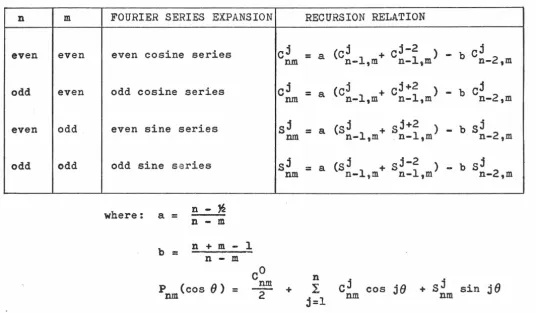
The coefficients of the Fourier series expansion are readily
calculated from the recursion relations discussed in Section III. 2
by calculating a new recursion relation for the coefficients of the
Fourier series expansion. This is done by substituting the Fourier
series expansion into the recursion relation and equating amplitudes
of frequencies.. The results of this operation are shown in Table IV. 2
for the recursion relation indicated in equation III. 10.
The procedure may be started by the use of the formula
n
m
even even
odd even
even odd
odd odd
FOURIER SERIES EXPANSION
even cosine series
odd cosine series
even sine series
odd sine series
where: a
=
n - ~ n - mb =
n
+m -
ln - m
co
P (cos8)
=
nm 2nm
RECURSION RELATION
cj
=
a (cj + cj-2 ) - b cj nm n-1,m n-1,m n-2,mcj
=
a (cj + cj+2 ) - b cj run n-1,m n-1,m n-2,msj = a (sj + sj+2 ) - b sj nm n-1,m .n-1,m n-2,m
sj = a (sj + sj-2 ) - b sj nm n-1,m n-1,m n-2,m
n
cj cos j8 + sj sin j8
I
+
j=l
nm nm+-"
[image:53.799.148.685.161.474.2]