A Novel method of Stabilization of Anthocyanins using
Beetroot peel and Red cabbage
Monica.J1, Dr.VyjayanthiNeelakantan2 and, Dr.Seenappa.D3
1
M.Sc Biotechnology, Maharani Lakshmi Ammani College for Women ,Bangalore(India)
2Associate Professor, Department of Biotechnology, Maharani Lakshmi Ammani college for Women, Bangalore(India) 3Ex-Chief Scientific Officer, Inland fisheries, University of Agricultural sciences, Bangalore(India)
DOI: 10.29322/IJSRP.8.5.2018.p7771 http://dx.doi.org/10.29322/IJSRP.8.5.2018.p7771
Abstract:
Anthocyanins are phytochemicals belonging to class of flavonoids and polyphenolic molecules. In the current investigation, extraction of Anthocyanin pigments from beetroot peel and red cabbage leaves by cold maceration method was more effective expressing 4.2% yield when compared to Soxhlet method of 2% yield. Various methods of fractionation were implied namely column chromatography, analytical thin layered chromatography and preparative thin layered chromatography. The separated compounds in analytical TLC showing fluoroscence with reference to flavanoid property were isolated through purification. Stabilization was achieved through self-association with co-pigmentation technique. Co-pigment yielded high anthocyanin (0.878mg/l), flavanoid (10.4mcg/ml) and antioxidant content (706mcg/ml) when compared to red cabbage and beetroot peel extracts. Co-stabilized anthocyanin pigment was analysed further with pH indicator method for authentication.
Key words : Phytochemicals,Anthocyanins, cold-maceration, co-pigmentation, pH indicator
1. Introduction:
Phytochemicals are naturally occurring plant chemicals that provide odour, colour and flavour. Some of the commonly identified phytochemicals are carotenoids,flavanoids (anthocyanins, quercetin), indoles and glucosinolates etc., Anthocyanins are defined as floral secondary metabolite pigment ranging from blue to red intensity depending on pH and exists as glycosides in combination with glucose or cellulose molecules.[1] Anthocyanins are stored in vacuoles which are slightly acidic in nature.[2]They counter check the imbalance of oxidative and antioxidative factors, thus protecting health against higher risk of several cancer forms. They help in lowering blood glucose by improving insulin resistance, protecting beta cells and also reduces obesity[3].they are helpful in treating chronic inflammation, which is related to cardiovascular illness, arthritis, joint diseases, type 2 diabetic issues, Alzheimer’s disease, dementia and many other illnesses. Anthocyanins are found to have 150 types of flavanoids having anti-oxidant property, hormone supplementation property (reduces menopausal symptoms and osteoporosis), stimulating property for few enzymes and interference with DNA replications [4].Flavanoid metabolism and anthocyanin synthesis takes place in the cytosol of plant cell and finally accumulates in cell vacuole.
Stabilty of anthocyanins are widely studied with reference to minimizing processing difficulty and economic viablility. As Anthocynins are water soluble, they are unstable and easily susceptible to degradation through factors such as light, oxygen, temperature and pH.[4] Various methods have been theoretically explained for the stabilization of anthocyanin pigment. Among them, association and encapsulation methods are strongly considered. Association is the combination of two or more pigments bound chemically to increase stability and coloration ; which is further sub divided into self association, metal complexation, inter and intra association co-pigmentation.
Beetroots have a class of red and yellow indole derived pigments found in Caryophyllales plants where they replace anthocyanin pigments. Red cabbage is a rich source of anthocyanin and contains 36 different types of anthocyanins. Hence it is used for purpose of co-pigmentation. Beetroot peel is selected as one of the pigment source as it is non-edible and proved to contain many functional properties such as antioxidant, phenolic, and flavanoid content which can be utilized for economic purpose in industries.
The aim of the study is to develop the most effective and efficient method of stabilization of anthocyanins pigments from a non -edible beetroot peel and whole red cabbage. Also Different functional properties were compared to optimize a novel method of co-pigmentation for industrial production
Plant materials such as red cabbage and beetroot were procured from a local supermarket and surface sterilized with mild detergent (0.1% tween-20)
2.1.Extraction methods: Two methods of extraction were used such as cold maceration and Soxhlet method.
2.1.1.Soxhlet method: 25g of 72 hours shade dried source were placed in soxhlet apparatus for 14 hours under 450C . 2.1.2 Cold maceration method: 25g of fresh chopped source were incubated at 40C for 14 hours with frequent stirring.
The filterates from both methods were filtered through Whatman’s filter paper No1 Further evaporated through Rotary evaparator and yield in terms of percentage was compared.
% yield= weight of extract(g) / weight of dry powder(g)*100
2.2. Purification of anthocyanins: Fractionization was done by Column and Thin layered chromatography.
2.2.1.ColumnChromatography: A wisp of cotton followed by silica hexane slurry was filled to 3/4th of the column without any air gap. The extracts were passed through the column and fractions was collected .
2.2.2. Analytical TLC was performed to check for fluroscene under UV light. Mobile phase included butanol: glacial acetic acid: water (3:2:1/v/v/v). The fluroscene induced analyte was scarred, diffused in HPLC grade methanol further the filterate was rotary evaporated (Preparative TLC). The Rf value was calculated and compared.[2]
2.3. Stabilization of Anthocyanins: This was done by following the theoretical principles of Cavalcanti(2011).[9] Two equal extracts were self associated in a stabilized condition of 40C air tight dark glass container with 4 hours incubation . The partially purified beetroot peel and red cabbage extracts along with co-stabilized pigment was evaluated in triplicates.
2.4. pH Indicator :The obtained co-pigment were checked for pH indicative property using the protocol of Bondre, 2012[11]
2.5. Estimation of anthocyanin by pH differential method was done by AOAC method followed by Lee and Durst, 2005[5] with slight modification of 1:1 dilution of sample and buffer.1ml of sample was taken in two different aliquots and diluted separated with pH1 and pH4.5 buffer ;absorbance was read at 520 and 700nm.
2.6.Antioxidant property: Quantification of ascorbic acid/vitamin C was done by DNPH method and reducing power assay.
2.6.1. DNPH Method:By using 0.1ml of Brominated sample against a standard graph of ascorbic acid.1ml of 2%DNPH reagent and 2 drops of thiourea was added and incubated, further red osazones crystals were treated with 80% sulphuric acid .Absorbance was read at 450nm
2.6.2.Reducing Power Assay was done with different concentration of samples(0.2-1ml) by the following the protocol of Jayanthi and Lalitha (2011)[4].Reducing power was measured by varying concentration of the extract and contact time.
2.7.FlavanoidProperty was quantified by Aluminium Chloride Method followed by Pallab (2012)[6] ; 0.5ml of sample ,1.5ml of methanol was mixed with 0.1ml of 10% aluminium chloride ,0.1ml of 1M potassium acetate ;Incubated for 30 minutes and absorbance read at 415nm against standard gallic acid curve.
2.8. Phenolic Property: Phenolicacid content was estimated through Folin-Ciocalteu method followed by Ronald (2011)[8].
3. Results and discussion:
3.1. In the present study, Extraction of anthocyanin pigments from beetroot peel, red cabbage leaves by cold maceration method was more effective when compared to Soxhlet method.This indicates that anthocyanin pigments are less stable at high temperature and they get degraded fast (browning) at increased temperature (80-90degree). Cold maceration method being more efficient showed yield of 4.2% while Soxhlet method expressed 2% of yield.
Plate1.:TLC based detection of anthocyanins, visualized under visible light for calculation of refractive index(C=red cabbage extract,B= beetroot peel,Co= co-pigment)[left ]Analytical TLC screening of flavonoid compound under UV transilluminator.[right]
3.3. Total anthocyanin content was found to be more in red cabbage (34.64mg/l)and moderate in co-stabilized pigment(0.878mg/l) and less in beetroot peel (0.638mg/l); and was compared with standard (44.8mg/l).The pH differential method is based on the structure of anthocyanins at different pH . Although nearly all monomeric anthocyanins are in the hemiketal form at pH 4.5, a small proportion are in quinoidal form or the flavylium form, which will contribute to the absorbance. 3.4.Antioxidant property (Vitamin C)was estimated from the regression equation in the standard plot of ascorbic acid (y=0.005x+ 0.028, r²=0.990)(figure:2a) in 3 sources. Beetroot peel contained less antioxidant property and co-pigment contained higher antioxidant.(figure:2b)The absorbance of red colourosazones formed is proportional to the quantity of ascorbic acid present in the solution before oxidation. The anthocyanins are the major of flavanoids in plants. Beetroot peel expressed 336.6±11.5,red cabbage expressed 386.6±5.7and copigment showed 706.6±5.7.
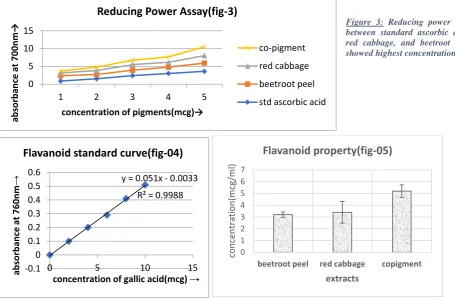
3.5. Reducing capacity of a compound may serve as a significant indicator of its potential antioxidant activity. At the minimum concentration (2mcg/ml) co-pigment ascorbic acid and other sources showed less activity and at the maximum concentration (10mcg/ml) co-pigment has an increased amount of reducing power compared to standard and other sources.(Figure:3)The reducing capabilities of the anthocyanin pigments of beetroot peel and red cabbage was found to be in dose dependent manner to each other. The co-pigmented anthocyanin was in correlation with the Standard Ascorbic acid activity.
3.6.The result of total flavanoid content was calculated from regression equation of the standard plot (y=0.051x-0.003, r²=0.998) (figure:4)Flavanoid content was more in co- pigment and least in red cabbage similar to the phenolic content.. Characterization of Red cabbage showed an concentration of 3.4mcg/ml flavanoid content; 59mcg/ml of vitamin C; and 75mcg/ml of phenolic content. Beetroot peel expressed increased amount of flavanoid (3.5mcg/ml) and phenolic content(170mcg/ml) and decreased amount of antioxidant (37mcg/ml) when compared with red cabbage extractCharacterization of co-stabilized anthocyanin pigments showed an increase amount of flavanoid (4.8mcg/ml)(figure:5), increased antioxidant vitamin C content(75mcg/ml) ,increased amount of reducing power (10mcg/ml)and reduced amount of phenolic content(90mcg/ml) when compared to other sources(figure:5).
Figure1&2 :Standard curve of Ascorbic acid for antioxidant assay (left). Antioxidant property analysis byDNPHmethodcpmpared between beetroot peel ,red cabbage and copigment mean ±S.D was calculated (n=06) .(right).
y = 0.0057x + 0.0286 R² = 0.9904
0 0.2 0.4 0.6 0.8
0 50 100 150
abso
rba
nc
e a
t 450
nm
→
contentration of std ascorbic acid(mcg) →
Standard curve of Ascorbic acid - Antioxidant Property(fig-01)
0 20 40 60 80 100
beetroot
peel red cabbage copigment
co
nce
nt
ra
tio
n(m
cg
/m
l)
extracts
Figure 3: Reducing power assay compared between standard ascorbic acid ,copigment, red cabbage, and beetroot peel .copigment showed highest concentration among all.
Figure 4 & 5 : Gallic acid standard curve for flavonoid analysis.[left] Flavonoid quantification done by aluminium chloride method(.n=06).beetroot peel expressed 6.4mcg±1.08,red cabbage 6.93mcg/ml±0.9 and copigment 10.4±0.5 [right]
Figure 6: Phenolic acid assay by FC method(n=06 beetroot peel expressed 2.5g/ml±0.2 ; red cabbage 1.03g/ml±0.05 and copigment 1.26g/ml±0.2[mean±S.D].
Conclusion:
Outcome of the present study showed that a commonly available plant material which goes as waste in every house hold, like beetroot peel can be a good source of pigmentation. We noticed that the cold maceration extract method was very effective for the optimization of anthocyanin pigment by reporting its functional properties when compared to other methods .Self association means of co-pigmentation was achieved to be most efficient method for the industrial production of stabilized anthocyanins. In future, this method can be extrapolated to commercial purpose in food and pharmaceutical industries to attract consumers with high benefits and aesthetic properties.
Acknowledgement:
We are thankful and acknowledge Late .Dr.Shantha.T.L, ex-Director and Dr.M.B.Nagaveni, Director, Maharani Lakshmi Ammani college (mLac) for providing the necessary facilities.
References
1. Tanaka and Ohmiya, “Biosynthesis of plant pigments: anthocyanins, betalains and carotenoids”, The plant Journal [Wiley online library]2008
y = 0.051x - 0.0033 R² = 0.9988
-0.1 0 0.1 0.2 0.3 0.4 0.5 0.6
0 5 10 15
abso rba nc e a t 760nm →
concentration of gallic acid(mcg) →
Flavanoid standard curve(fig-04)
0 1 2 3 4 5 6 7
beetroot peel red cabbage copigment
co nce nt ra tio n(m cg /m l) extracts
Flavanoid property(fig-05)
0 1 2 3 Beetrootpeel red cabagge copigment
co nce nt ra tio n(g /m l) Extracts
Phenolic content assay(fig-06)
05 10 15
1 2 3 4 5
abso rba nc e at 700nm →
concentration of pigments(mcg)→
Reducing Power Assay(fig-3)
496.2011
5. Jungmin Lee and Robert.W.Durst.“Total anthocyanin pigments of fruit juices, natural colorants”. Journal of AOAC international. vol.88(5).pp165-174.2005.
6. KalithaPallab.”Estimation of total flavanoid and phenolic content of plant extract”. Journal of drug delivery;vol.3(4),pp33-37.2012
7. Majeed Al-Ani and Linus.U.Opara. “Spectrophtometric quantification of ascorbic acid of fruit and vegetables”. Journal of Food,agri and envirnoment . vol.5;pp165-168.2007
8. Ponmozhi.P Ronald and Dr.M.Geetha.”Extraction of anthocyanins and analysing its antioxidant properties from pithecellobium dulce fruit pericarp”.Asian journal of pharmaceuticals research. vol.4,No1,pp81-88.2011
9. Rodrigo.N.Cavalcanti.”Stabilization mechanism of anthocyanin in food system”. food research international,vol44,pp499-509. 2011 10. Snoeynink.VandJenkins.D.“Waterchemistry.johnwiley and sons,newyork.ISBN 0-471-05196-9.1980
11. Sushma Bondre.”Study on isolation and purification of Anythocyanins and its pH indicator”. International journal of advanced biotech.., vol3,issue3,pp698-702. 2012
12. S.Asen1R.N.Stewart1K.H.Norris2, “Co-Pigmentation of anthocyanins in plant tissues and its effect on color”.Elsevier phytochemistry , volume11,issue3
pp1139-1144(1972)
13. Xiao-Ding li,JieLi,Meng Wan, Hong Jiang“Copigmentation effects and thermal degradation kinetics of purple sweet potato anthocyanins with metal ions and sugars”Applied biochemistry springer ,February 2016, Volume 59,Issue 1, pp 15–24
Authors:
First Author: Monica.J, M.Sc Biotechnology, Maharani Lakshmi Ammani College for Women ,Bangalore(India). email:[email protected].
Second Author: Dr.VyjayanthiNeelakantan, Associate Professor, Department of Biotechnology, Maharani Lakshmi Ammani college for Women, Bangalore(India); [email protected]