Computer Science Dissertations Department of Computer Science
8-7-2018
Enhancing Automatic Annotation for Optimal
Image Retrieval
Mohamed Masoud
Follow this and additional works at:https://scholarworks.gsu.edu/cs_diss
This Dissertation is brought to you for free and open access by the Department of Computer Science at ScholarWorks @ Georgia State University. It has been accepted for inclusion in Computer Science Dissertations by an authorized administrator of ScholarWorks @ Georgia State University. For more information, please [email protected].
Recommended Citation
by
MOHAMED MASOUD
Under the Direction of Saeid Belkasim, PhD
ABSTRACT
Image search and retrieval based on content is very cumbersome task particularly when
the image database is large. The accuracy of the retrieval as well as the processing speed are two
important measures used for assessing and comparing the effectiveness of various systems.
Text retrieval is more mature and advanced than image content retrieval. In this
dissertation, the focus is on converting image content into text tags that can be easily searched
using standard search engines where the size and speed issues of the database have been already
dealt with.
Therefore, image tagging becomes an essential tool for image retrieval from large image
databases. Automation of image tagging has received considerable attention by many researchers
from large databases are few of the important domains that can benefit from automatic tagging.
In this work, several state of the art image classification and image tagging techniques are
reviewed. We propose a new self-learning multilayered tagging framework that can address the
limitations of current approaches and provide mutual accuracy improvement between the
recognition layer and the annotation layer. Our results indicate that the proposed framework can
improve the overall accuracy of information retrieval in a variety of image databases.
by
MOHAMED MASOUD
A Dissertation Submitted in Partial Fulfillment of the Requirements for the Degree of
Doctor of Philosophy
in the College of Arts and Sciences
Georgia State University
Copyright by
by
MOHAMED MASOUD
Committee Chair: Saeid Belkasim
Committee: Anu Bourgeois
Iman Chahine
Raj Sunderramen
Electronic Version Approved:
Office of Graduate Studies
College of Arts and Sciences
Georgia State University
DEDICATION
ACKNOWLEDGEMENTS
First of all, I thank Allah (God) for giving me the passion, patience, and ability to finish
my Ph.D.
I would like to express my deepest gratitude to my advisor, Dr. Saeid Belkasim, for his
excellent guidance, support, patience, and suggestions throughout my program. His extraordinary
commitment, expertise and effectiveness as a mentor paved the way for me to success in my
degree. Definitely, I own him my success in completing such a major milestone. Besides my
advisor, I would like also to extend my thanks and appreciation to my committee members
Dr. Anu Bourgeois, Dr. Iman Chahine and Dr. Raj Sunderraman for their support and
constructive comments during my dissertation work.
Also, I would like to thank Dr. Carol Winkler and Dr. Tony Lemieux from the TCV
program for their help and guidance. Many thanks go also to all faculty, staff, and administrators
of our department for their help and professional attitude during my study. Special thanks to my
lab members as well as to the people of the neuroscience department at Emory University for
their collaboration.
Also, words cannot express how grateful I am to my family especially to my mother for
her unconditional love and support. I am truly grateful to my elder brother Mahmoud, my sister
Hanan and my nephews Ahmed and Abdel Rahman for their love, encouragements and stood by
me through the good and hard times.
Finally, my heartfelt thanks go to my wife Noha for her patience, tolerance and for
everything that she has made on my behalf over the years. I would like also to thank her family.
Thank you for everyone who supported me during my study, and also my sincere
TABLE OF CONTENTS
ACKNOWLEDGEMENTS ... V
LIST OF TABLES ... IX
LIST OF FIGURES ... X
1 INTRODUCTION... 1
1.1 Content Based Image Retrieval ... 2
1.2 Image Tagging ... 4
1.3 Dissertation Objectives ... 4
2 IMAGE TAGGING AND ANNOTATION SYSTEMS ... 5
2.1 Image Retrieval ... 5
2.2 Image Classification ... 7
2.2.1 Bag of Visual Words ... 8
2.2.2 Improved Fisher Kernel ... 9
2.2.3 Convolution Neural Network ... 11
2.2.4 Semantic Segmentation... 14
2.3 Performance Evaluation Metrics ... 15
2.4 Image Annotation ... 16
2.5 Image Retrieval and Annotation Datasets ... 20
2.6 Summary ... 20
3.1 Multi-level Annotation Framework ... 22
4 STATISTICAL BASED IMAGE TAGGING ... 25
4.1 Image Retrieval Layer ... 26
4.2 Image Recognition Layer... 27
4.3 Image Tagging Layer ... 28
4.4 Experiment ... 29
4.5 Summary ... 32
5 AUTOMATICALLY GENERATED SEMANTIC TAGS OF TEXTURE IMAGES ... 32
5.1 Introduction ... 32
5.2 Proposed Categorization Model ... 34
5.3 Experimental Results ... 37
5.4 Summary ... 38
6 DEEP LEARNING FUSION ALGORITHM FOR TEXTURE IMAGES CATEGORIZATION ... 39
6.1 Introduction ... 39
6.2 Classification Model ... 40
6.3 Experimental Results ... 45
6.4 Summary ... 47
7.1 Introduction ... 48
7.2 Fusion Algorithm... 55
7.2.1 Fusion Metrics ... 58
7.2.2 Global Threshold and Dependency Metric ... 60
1.3 Rejection Principle ... 66
7.4 Summary ... 73
8 CONCLUSIONS, IMPLICATIONS AND FUTURE WORK ... 73
8.1 Conclusions ... 73
8.2 Practical Implications ... 74
8.3 Future Work ... 75
LIST OF TABLES
LIST OF FIGURES
Figure 1.1 Typical CBIR model... 2
Figure 1.2 CBIR different types and selected methods ... 3
Figure 2.1 SIFT keypoint descriptor ... 7
Figure 2.2 Three-level pyramid with different levels of resolution ... 8
Figure 2.3 Example of CNN architecture ... 11
Figure 2.4 Kernel of 3x3 size convolves the input image ... 12
Figure 2.5 The pooling function ... 13
Figure 2.6 ConvNet architecture ... 13
Figure 2.7 Semantic segmentation examples ... 14
Figure 2.8 Multiclass classifier ... 16
Figure 2.9 Bayesian annotation approach ... 17
Figure 2.10 Parametric approach using GMM modelling ... 18
Figure 3.1 Proposed annotation framework ... 22
Figure 3.2 Framework training and optimizing block diagram ... 23
Figure 3.3 Proposed multi-labeled annotation model ... 23
Figure 4.1 KH schematic diagram ... 27
Figure 4.2 Training and optimizing block diagram ... 28
Figure 4.3 Example of auto tagging framework ... 30
Figure 4.4 Comparison of image tagging accuracy with 10 concepts of Corel-1K ... 31
Figure 5.1 Plot of the categorization accuracy of different methods ... 37
Figure 6.1 The classification accuracy of the fine-tuned CNN and FV-SURF-HOG ... 46
Figure 7.1 Samples of the training dataset ... 49
Figure 7.2 Classifiers performance versus SVM lambda ... 50
Figure 7.3 Recall metric for the proposed classification methods for each class ... 52
Figure 7.4 Precision metric for the proposed classification methods for each class ... 53
Figure 7.5 F-score for the proposed classification methods for each class ... 54
Figure 7.6 Average precision of proposed classification methods for test dataset-1 and 2 ... 55
Figure 7.7 Sample of the co-occurrence matrix of test dataset-1 ... 59
Figure 7.8 Global threshold values of proposed classifiers for test dataset-1 ... 60
Figure 7.9 Performance of fusion algorithm with FC SVM 0.1 ... 62
Figure 7.10 Performance of fusion algorithm with FC SVM 0.01 ... 63
Figure 7.11 Performance of fusion algorithm with FV-HOG... 63
Figure 7.12 Average precision of fusion algorithm ... 64
Figure 7.13 Fusion metrics performance versus proposed classifiers ... 65
Figure 7.14 Fusion algorithm versus SVM, KNN and subjective optimal fusion ... 66
Figure 7.15 Performances of the selected attributes of the rejection model ... 68
Figure 7.16 Performances of several classification techniques with the rejection model ... 69
Figure 7.17 Outputs of the standalone classifiers ... 70
Figure 7.18 Outputs of fusion algorithm and the rejection model ... 71
Figure 7.19 Outputs of classifiers, fusion and rejection model ... 72
1 INTRODUCTION
The explosive growth of digital imaging devices (e.g. smart phones, digital cameras) in
the past two decades along with the presence of convenient mechanisms to share pictures and
videos have led to an overwhelmingly expanding supply of visual data. In 2014, Yahoo reported
that over 800 billion photos had been uploaded to the web. This number is expected to grow
exponentially every year. Retrieval of visual data based on contents is a challenging task [1-2,
9-10]. Tagging images based on their content is a promising mechanism that can objectively find a
proper tag for captured images [22-24]. Automatic image tagging based on image content would
have huge impact on archiving, filtering, and retrieval of visual data. Subjective manual
annotation is impractical due to the huge visual data produced daily. Therefore, automatic image
annotation is a possible solution that aims to bridge the gap between the visual and semantic
concepts [39-40]. Automatic annotation is the process that utilizes machine learning techniques
to identify proper annotation for partially or fully untagged image by mapping its visual content
to semantic predefined concepts. One of the main issues associated with the current image
retrieval on the internet is the need to increase the efficiency of the image search engines that
deploy tags for locating images. Therefore, tags provide an attractive approach for searching
web contents based on text queries. However, to retrieve images with no tags or ambiguous tags,
low level image features can be used to help in assigning a sematic tag to an image. Semantic
tagging is an active research area where tag recommendation techniques have been widely
investigated by many researchers leading to considerable improvement in Tag-Based Image
1.1 Content Based Image Retrieval
In automatic image tagging system, Content Based Image Retrieval (CBIR) represents
the first stage in the system where extracting the low level features of the untagged image is used
to represent the image. The low level features are directly extracted from the image pixel
information. Similar to data mining and text mining, we can use pixel information to identify
useful patterns in images. These patterns can be regions, objects or any correlated features in the
image.
The concept of CBIR first appeared in 1992 [1] when image color and shape features are
used to retrieve similar images from a database. Since then, the technique becomes popular and
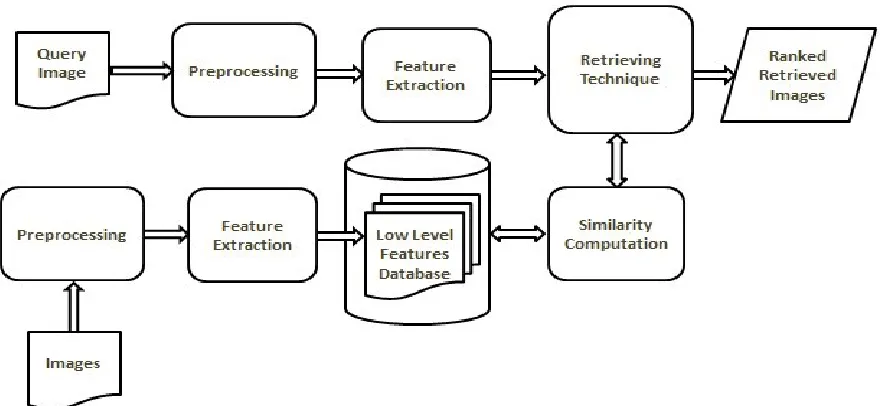
has contributed significantly to the field of computer vision. A basic block diagram of the typical
CBIR is depicted in Figure 1.1, where the query is not by text as the case with most search
engines on the web but by image content as in CIBR model where similar images are retrieved
from the low level features database. In this dissertation we will explore the deployment of CBIR
[image:16.612.89.529.470.673.2]model for building an efficient automatic tagging system.
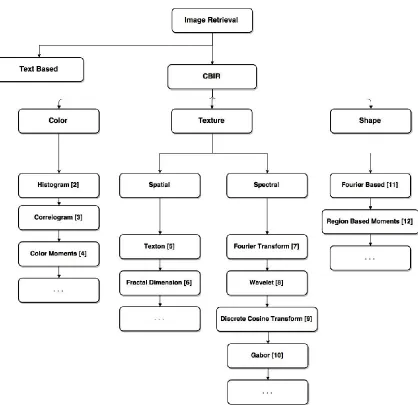
The accuracy of CBIR, in general, depends mainly on the choice of the low level feature
extraction process. Basically there are three different types of features: color, texture and shape
features. Each of these types underline a wide range of methods, and each has its pros and cons.
[image:17.612.98.516.223.628.2]Some of the popular methods are depicted in Fig. 1.2.
In Fig. 1.2, several CBIR techniques are shown. The feature extraction process can be
based on one method, or it can be a combination of several methods. Whatever is the feature
extraction technique in use, both of the low level features in the database library and the query
image must be the same.
1.2 Image Tagging
Image annotation or tagging is used to categorize and indexing images in the form of
keywords or labels. In this dissertation, the tagging process addresses the applicability of
automatically annotating images with set of keywords that semantically describe each image
content. We believe that the improvement in the accuracy of automatic tagging can lead to
advancement in many domains such as web image search, image analysis and recognition.
In automatic image tagging, CBIR provides low level features to represent different
images. Basically, there are two types of annotations: single labeling, and multi labeling
annotation. In multi-labeling annotation, the image is segmented into regions, each region
represents a particular scene (e.g. sky, sea, mountains), and/or a particular object (e.g. airplane,
ship). There is a need to identify these regions and assign a proper keyword that describes each
of them based on a learning model. Although much research has been carried out in automatic
image annotation [19 -25], the problem still open and needs further improvement and
optimization in terms of accuracy and speed. Also, we are introducing new method to identify
semantic relations between generated tags within the same image to predict new tags for other
untagged regions and thus increase the overall retrieval accuracy.
1.3 Dissertation Objectives
The main objectives of this dissertation are:
2. To use the model generated tags for predicting semantically related tags and improve the
overall accuracy of the image retrieval.
3. To build a hierarchical optimization model that can handle multi-learning framework.
This dissertation is organized as follows. Chapter 2 describes Image Tagging and
annotation systems. In Chapter 3, we propose our semantic tagging framework. Chapter 4-6
introduce our approaches for single annotation. Chapter 7 describes our multi-label algorithms
and results; the conclusions, implications and future research are described in chapter 8.
2 IMAGE TAGGING AND ANNOTATION SYSTEMS
In this chapter, we describe existing image tagging and annotation systems as well as
introduce the theoretical background for this dissertation.
2.1 Image Retrieval
Image retrieval techniques are considered to be the foundation of automatic tagging
framework, and their performance is directly affected by the efficiency of the low level feature
extraction. For example, local descriptors are effective in images that contain many objects,
while global descriptors are more effective in natural scene images.
As we mentioned earlier, image retrieval approaches use color, texture, and shape to
extract global or local features. The main focus of content based image retrieval for many
decades has been on global feature extractors [1] while recently local features gained
considerable attention. There is no unified method that can guarantee the best accuracy which
makes feature extraction and tagging assignments a challenging problem. Feature extraction
and orientation. The simplicity of maintaining image invariance makes color histogram based
techniques very attractive for many applications [2].
Texture can be also considered as features for representing certain image characteristics
[26]. Fusion of color and texture features has been used in many descriptors as in the
micro-structure descriptor (MSD) [27]. MSD can extract low level shape features associated with edge
colors, but the retrieval accuracy of this technique showed little improvement.
Shape feature descriptors for binary and gray scale images have been used for image
retrieval in techniques such as Fourier-based descriptors [11], and region-based moment
descriptors [12]. CBIR is still an active research area that needs more improvement.
In addition to previous techniques, local descriptors show also some advantages such as
invariance to image translation, scaling, and rotation. Unlike global descriptors which consider
the global image features such as the color histogram, local descriptors breakdown the image
into very small regions and consider the properties of these regions (e.g. shape corners) when
retrieving similar images. One popular technique widely used is the Scale-Invariant Feature
Transform (SIFT) [13].
In SIFT, a computation of the local gradient orientation can be achieved as shown in Fig.
2.1, after that the gradient orientation histograms or the so called SIFT keypoint descriptor can
Figure 2.1 SIFT keypoint descriptor [13]
2.2 Image Classification
Image classification is the research area that deals with assigning unknown image to the
closest class of a library formed from classified and labeled images. The classification process is
dependent on the feature extraction methods that include local or global features. The ultimate
task is to achieve class assignment with least errors. Object classification is a special case of the
general science of pattern classification and recognition. The pattern can be an object (e.g.
person) or an event (e.g. running). Image classification is very sensitive to choice of the feature
vector that would be used for the classification process. The feature vectors are the main entries
for the learning library which forms the basis for the labeled classes. A distance measure or
metric is used to find the closest match in the learning library to classify an unknown image or
object. Image regions can be classified based on their extracted features. The library features can
be stored as feature vector or optimal set of weights in neural networks. Several techniques are
used to represent local and global features within an image among these techniques Bag of
Visual Words (BoW), Improved Fisher, and deep learning will be considered in our
2.2.1 Bag of Visual Words
BoW is a popular local feature based technique for image classification inspired by Bag
of Words model that is used in text mining. In document retrieval, the frequency of words in
documents are used to classify or retrieve similar documents, the same idea inspired in the image
retrieval and classification by using image features as visual words and classify the image based
on the histogram of the frequency of visual words. The visual word vocabulary can be generated
by clustering the image local features, for example in SIFT descriptors key points are often used
as feature vectors. These vectors as we mentioned before are 128 dimensional gradient based
feature vector. By finding all SIFT key points in an image and using, for example, K-means
clustering, the means of each cluster constitutes a visual word. Therefore, if there are N clusters
generated then the dimension of the bag of visual words is N.
In one of the most cited work in this area, Lazebnik et al [28] extended the BoW
technique by proposing a method that works by partitioning the image into increasingly fine
sub-regions and computing histograms of local features found inside each sub-region as shown in
Fig. 2.2.
In Fig. 2.2, a multi-level pyramid is constructed, and in each level the image subdivided
into different levels of resolution. This subdivision process resulted in a number of channels; the
frequency of features in each channel is counted and represented by spatial histogram.
The pyramid matching mechanism measures the similarity between images in each
pyramid level by comparing their channels histogram or the statistics of these histograms such as
their means. Therefore, two points in two images are said to be matched if they fall into the same
cell of the grid, and the weight of this matching is proportional to the number of levels.
The generated “spatial pyramid” is an efficient extension of the bag-of-features image
representation, and it shows more improved performance in scene classification when evaluated
on the Caltech-101 database [33]. This database contains from 31 to 800 images per category.
Their results show that increasing the number of visual words to 200 along with increasing the
number of pyramids level to 2 resulted in increasing the scene classification accuracy based on
the support vector machine (SVM) classifier trained using the one-versus-all rule. However, their
experimental work shows also there is an optimal number of visual words and pyramid level that
can give best accuracy.
2.2.2 Improved Fisher Kernel
As an alternative approach to the BoW technique, Fisher kernel (FK) [34] is a powerful
framework that shows competitive performance in the field of image classification. The
advantage of this technique is because it combines the strengths of generative and discriminative
models. In generative models (e.g. Naïve Bayes, Gaussian mixture model (GMM)) we are given
some sample data and labels where the model finds the hidden parameters and specifies the joint
probability distribution between the observed and target variables. For discriminative models
sampling of the target variables conditional on the observed quantities. Therefore, discriminative
models focus directly on the classification problem while generative models can handle variable
length data.
The main idea of FK approach in image classification domain is to characterize the input
images with a gradient vector derived from a generative probability model which is a GMM. The
GMM can approximate the distribution of the images low level features such as the visual
vocabulary. Therefore, the gradient representation here is replaced the histogram of occurrences
that we discussed in BoW section. This replacement results in making the discriminative
classifier that received gradient representation can be linear classifier with high accuracy rather
than the costly kernel used with the BoW technique. Using the gradient vector can help in
determining in which direction the model parameter should be modified to best fit the data. In
the context of image classification the FK can actually be understood to extend the popular BoW
by going beyond count statistics. A concise comparison between both techniques shows that:
Both FK and BoW are based on a visual vocabulary; FK based on GMM while BoW uses
K-means clustering, FK properties support the use of linear classifiers while BoW stipulate
nonlinear classifiers to give good classification accuracy.
Because of the original FK framework has not shown enough superiority over the BoW,
several modifications are run over it to boost the accuracy of the FK in what it called improved
FK (IFK) [35]. The improvements added to the IFK are the L2 normalization to the gradient
vector, and the Spatial Pyramid approach employed by Lazebnik et al [28] in BoW approaches.
The main advantage of the L2 normalization is to remove the dependence of the Fisher vector
signature on the image specific information (e.g. image background information). Before this
Fisher vector signatures. Therefore, the normalization comes here to solve this issue. In the
Spatial Pyramid the classification accuracy increases as it has been shown in BoW section, IFK
employs this advantage by replacing the BoW histogram extracted from each grid by the Fisher
vector.
A comparison between these methods is shown in table 2.1 on Pascal VOC dataset [43],
where an increasing in the Average Precision (AP) from 47.9% in the original FK to 58.3% in
IFK is shown.
Table 2.1 Comparison between IFK with state of the arts methods
Method AP (in %)
Standard FK (SIFT) 47.9
Context (SIFT) 59.4
Kernel Codebook 60.5
IFK (SIFT) 58.3
IFK (SIFT+Color) 60.3
2.2.3 Convolution Neural Network
Convolutional Neural Networks (ConvNet) are a special category of artificial neural
networks [14-15]. They process data with a trainable hierarchical architectures composed of
multiple transformation stages as shown in Fig. 2.3.
In a typical ConvNet, there are four types of layers that each stage of the network can be
composed of: Convolution layer (Conv), Pooling layer (Pool), Fully Connect layer (FC), and
Rectifying Linear Unit (ReLU). At the end of the network, there is a classification module to
identify the object or image class.
The Conv layer is the layer that does most of the computations in the network. The layer
parameters consist of a set of small spatial learnable filters or kernels as shown in Fig. 2.4.
Figure 2.4 Kernel of 3x3 size convolves the input image (Source: developer.apple.com)
Each Conv layer is used to transform a set of feature map to another set of feature map.
Therefore the output of each stage represents a particular feature extracted at all locations on the
input.
In the pooling layer, a spatial down-sampling of the input feature maps is performed as
shown in Fig. 2.5. This down-sampling reduces the number of parameters and computation in the
Figure 2.5 The pooling function (Source: cs231n.stanford.edu)
The main advantage of the ReLU layer is to increase the ConvNet training speed by
replacing the standard way of modeling the neuron output of tanh with non-saturating
nonlinearities function f(x)=max(0 , x) which have been referred to as Rectified Linear Units or
ReLU. Using these neuron units the ConvNet can reach 25% training error rate six times faster
than standard tanh neurons.
In the FC layer, the neurons have full connections to all activations in the previous layer
as shown in Fig. 2.6.
Figure 2.6 ConvNet architecture (Source: Mathworks.com)
The output of this layer can be passed to a softmax function which converts the outputs
𝑃(𝐶𝑘 = 1|𝑿) = 𝑠𝑜𝑓𝑡𝑚𝑎𝑥(𝑓𝑜𝑢𝑡) 𝑘 =
𝑒𝑓𝑘𝑜𝑢𝑡
∑ 𝑒𝑓𝑗𝑜𝑢𝑡 𝑗
where softmax represents the probability of class k given input x, and 𝑓𝑘𝑜𝑢𝑡 is the
activation of the k neuron of FC layer.
2.2.4 Semantic Segmentation
Scene parsing, or semantic segmentation, is the process of labeling each pixel in an image
with the category of the object it belongs to. It is a challenging task that involves the
simultaneous detection, segmentation and recognition of all the objects in the image. In an ideal
[image:28.612.81.533.354.610.2]scene parsing, every region and every object is annotated as shown in Fig. 2.7.
Figure 2.7 Semantic segmentation examples [19]
Scene parsing is associated with many challenges. The difficulty of segmenting and
background, scale, rotation and reflection variations are some of these challenges. The traditional
approaches in segmentation are mostly heuristic based. The generated segmentations are encoded
and a trained prediction model is used to produce the segmentations label. However, such
approaches need sophisticated post-processing to ensure the global consistency between the
produced labels.
One technique that recently used successfully in this domain is the ConvNet as in
Farabet et al [20]. In ConvNet the raw image pixels are fed into the ConvNet and trained in
supervised mode with fully labeled scenes to categorize each pixel location. Using a large
contextual window to label pixels reduces the traditional post-processing requirement for
consistent labels.
2.3 Performance Evaluation Metrics
In Image retrieval and classification, the performance evaluation can be measured with
different metrics. The precision and recall are the most used metrics in these domains. In image
retrieval, precision refers to the percentage of true positive (relevant) images in the retrieved
images, while the recall is the percentage of true positive images in all relevant images in the
dataset such that:
𝑃𝑟𝑒𝑐𝑖𝑠𝑖𝑜𝑛 = 𝑡𝑝 𝑡𝑝+ 𝑓𝑝
𝑅𝑒𝑐𝑎𝑙𝑙 = 𝑡𝑝 𝑡𝑝+ 𝑓𝑛
where 𝑡𝑝 is the number of true positive or relevant retrieved images, 𝑓𝑝 is the number of
false positive or irrelevant retrieved images, and 𝑓𝑛 is the number of false negative or relevant
measures the capability to retrieve relevant items from the database. Another metric that can be
used also for the evaluation purpose is the F-score metric which combines precision and recall in
different degree according to the score in use such that:
𝐹𝑠𝑐𝑜𝑟𝑒 = (1 + 𝑠𝑐𝑜𝑟𝑒2)
𝑃𝑟𝑒𝑐𝑖𝑠𝑖𝑜𝑛 . 𝑅𝑒𝑐𝑎𝑙𝑙 𝑠𝑐𝑜𝑟𝑒2 . 𝑃𝑟𝑒𝑐𝑖𝑠𝑖𝑜𝑛 + 𝑅𝑒𝑐𝑎𝑙𝑙
Therefore, the increase in the score results in increasing the weight of the recall metric
than precision and vice versa. In image classification, the precision of a classifier during the
testing phase is the number of true positives compared to the total classified instances.
2.4 Image Annotation
Image annotation techniques can basically be classified into single labelling annotation
and multi-labelling annotation. Even though the last one is more dominating, the single labelling
can be beneficial if we consider the multi-labelling annotation as a collection of single-labelled
regions within the image such that each segmented region can be viewed as an instance and the
image as a bag of instances. In this context, we may extend the use of the single-labelling
annotation framework shown in Fig. 2.8 to the multi-labelling domain also.
Neural Networks (NN) [37] and Support Vector Machine (SVM) [22] as a binary
classifier for linear and nonlinear data are among the common classifiers that have been used
widely in the single labelling annotation. While the drawbacks of NN are the long time it takes
for training and the high probability to fall into local optima, the SVM also has its class
imbalance problem in which it performs poor on imbalanced data such as image data.
The multi-labelling approach annotates the image with multiple concepts which is known
as multi-instance multi-label (MIML) learning which is different from single labelled annotation.
In general, the MIML learning can be based on a probabilistic method (e.g. Bayesian model)
where the posterior probability region is assigned to a certain label based on the given
observations of specific features extracted from the image region. The model is shown in Fig.
[image:31.612.84.530.408.668.2]2.9.
In Fig. 2.9, x can represent an image or a region feature vector. 𝑝(𝑥|𝑐) is the conditional
probability of the region feature vector 𝑥 given the concept 𝑐 . This conditional probability can
be approximated to be 𝑝(𝑥𝑗|𝑐) where 𝑥𝑗 is the closet centroid (cluster center). The annotation
system can use the conditional probability of the closet centroid to calculate the posterior
probability for the region label based on the formula 𝑎𝑟𝑔 𝑚𝑎𝑥𝑐 {𝑝(𝑥𝑗|𝑐)𝑝(𝑐)} .
The previous approach is called non-parametric because it does not stipulate any prior
assumptions about the distribution of the image or region features. In the parametric approaches,
such a distribution is required for computing the conditional probability 𝑝(𝑥|𝑐). Carneiro et al
[39] use the parametric approach by assuming that the image features follow a certain Gaussian
distribution in the feature space, and built a Gaussian Mixture Models (GMM) for each concept
[image:32.612.106.512.394.684.2]by averaging the individual GMMs within each concept as shown in Fig. 2.10.
The drawback of the method in Fig. 2.10 is the complexity in estimating the GMM models.
Many different techniques have been used in annotation systems. Semantic layer tagging
[23] is one of these techniques that utilize word embedding techniques for bridging the semantic
gap between the image content and the related tag text, where each word is associated with a
vector. Vector of pairs, each image and its related text, are used for the model training phase and
for optimizing the mapping function in the semantic space where a text component of an image
is a linear combination of its tag representation vectors. The mapping function is trained to map
the untagged image features to the semantic space to infer its tag. A difference measure is
formulated to ensure the consistency between the mapped image features and the tag
representation in the semantic space. Other learning-based approaches are also used widely by
constructing many discriminative models such as SVM [24-25] to predict image tags from low
level features.
Another feature is added in [40] by incorporating keyword correlations and region
matching, a heuristic greedy iterative algorithm to estimate the probability of a word being a
caption of an image.
However, successful tag assignment requires both efficient retrieval and accurate tagging
approaches, and almost all the approaches connected with the annotation domain consider only
the modification in the tagging layer without any feedback for adjustment in the retrieval layer.
After producing the image tag, a refining process is needed to make the query more
efficient,forexample,ifwearegivenanimagetagof“apple”,adomainis needed to identify the
word sense in this case. In the context of word domain, the word can be apple food or apple
2.5 Image Retrieval and Annotation Datasets
In this section, we introduce the most widely used datasets in image retrieval and
annotation:
- Pascal VOC 2007 [43] used widely in object and image annotation. It contains 10000
images of 20 classes including animals, handmade and natural objects. Pascal VOC images come
with bounding box annotation.
- NUS-WIDE [18] is a popular social image dataset that includes 269,648 images and
5,018 unique tags for images description. The dataset concept taxonomy consists of 81 concepts
and several low level features are provided for the evaluation purpose.
- ImageNet [16] is a dataset of around 15 million labeled images categorized in 22000
different classes. A widely used subset of this dataset is the ImageNet Large Scale Visual
Recognition Challenge (ILSVRC) which consists of 1000 categories each has around 1000
images.
- Corel 5k [44] is a popular image dataset for image retrieval and annotation. Corel 5k
dataset has 5000 images each annotated with1 to 5 words.
2.6 Summary
Most of the current research techniques closely connected to image retrieval,
classification, and annotation have been reviewed. However, each technique has advantages and
some limitations. SIFT is widely used as low level descriptor with many of the research work
done in the annotation area on some large scale databases such as NUS-WIDE, however SIFT is
a local shape descriptor and cannot represent the images that can be best represented by global
In bag of visual words technique the classification relies on the discriminative power of
visual vocabulary, it results in the technique limitation of correlating visual words with tags. The
same also can be said for the IFV.
The main drawback of ConvNet comes from the high computational power it needs in the
training phase which makes this phase impractical without parallel processing. The
computational overhead is due to the huge number of parameters it has. This impracticality
results in many difficulties in implementing this technique in portable devices (e.g. digital
cameras, mobile phones) which are the main sources of captured images on the web.
Almost all current annotation techniques consider the improvement in the tagging phase
only without any additional effort for improving the underlying layers. The architecture of these
layers and the relations between them are studied in this work and additional improvements are
proposed to advance the interaction between the model main components.
3 PROPOSED APPROACH
The number of image retrieval, classification, and annotation techniques has been rapidly
increasing over the last decade; however, each technique in any of these categories has
advantages and limitations. In chapter two we concisely outlined the main pros and cons of the
current popular techniques. The main drawback that is shared with these techniques is that none
of them has treated annotation as integrated part of both the classification and retrieval. Most of
the research work in annotation area did not consider using some important benefits from
classification and retrieval. The classification and retrieval can be used to refine the overall
results and give a semantic definition to the annotated category.
In this dissertation we propose to enhance the process of the automatic annotation by
accuracy and reliability. In this chapter a new multi-layered feedback model is proposed for the
annotation process and a description for the overall system architecture is given.
3.1 Multi-level Annotation Framework
In order to design an automatic image tagging algorithm, we propose multilevel
framework for the tagging process as shown in Fig.3.1. The proposed framework consists of
three main layers: the image retrieval, image recognition, and image tagging.
Figure 3.1 Proposed annotation framework
The retrieval layer is used as an input to the proposed system, the middle layer represents
the image recognition layer, and the top layer is the image tagging layer. In the recognition layer,
the proposed system recognizes the various image regions prior to feeding the output to the
tagging layer which assigns the proper annotation. The training block diagram of the proposed
Figure 3.2 Framework training and optimizing block diagram
In Fig. 3.2, we show the basic idea of how to train the annotation framework and
optimize the main parameters of the retrieval layer and recognition layer. In the retrieval layer,
the optimal parameter depends on the descriptor in use. For example, in the color histogram, the
number of bins is the optimal factor.
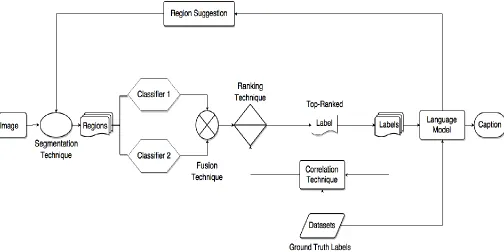
We propose our multi-label automatic annotation model that implements the feedback
between the annotation layers to improve the annotation accuracy as shown in Fig. 3.3.
In Fig. 3.3, we present the annotation model to label images with a subset of vocabulary
keywords. In the first stage, a segmentation technique is used to extract the mean regions in the
image. Each region passes through multiple trained classifiers (e.g. FV-HOG and CNN) to find
the probability distribution of its label. One of the limitations of current approaches in this
domain is that the annotation depends only on the top ranked label of once classifier. Therefore,
we need to consider more than recommendation for each region in our approach, for example,
we may consider the top n suggested labels generated from the classification stage by n classifier
for each region. The probability of these labels per region can be different from one classifier to
another, therefore, a fusion function is used to decide on the final label such that:
Fu (ℒ𝑖𝑗) P(ℒ𝑖𝑗| D1) + .P(ℒ𝑖𝑗| D2) ℒ
where and are two decision variables that are found during the training phase. ℒij is
the jth label suggested based on the classifiers outputs D1 and D2 for region i, and is the
vocabulary which is determined from the words in use by the common datasets.
The classifier fusion process is performed by a ranking technique, in which we may have
at least two approaches. First, we can consider the label of the region that has the top ranking as
the first label to be generated from the annotation system. Second, we may consider the top
ranked labels for all regions, and then consider the one with the highest correlation with others.
The first generated label from the model is used as a seed or first token of the caption
subset As an initial step, As= Ø before the seed is created such that As= As ℒr where ℒr is the
label of region r that has the highest ranking score among all the labels of the other regions in
After generating the first token, a correlation function is used to re-rank the top suggested
labels of the other regions such that the label of the other region that has the highest occurrence
with the first token label will receive more weight as follows:
Fu (ℒ𝑖𝑗) =Fu (ℒ𝑖𝑗−1) arg max Corr(ℒ𝑖𝑗−1, ℒ𝑖𝑗) (3.2)
where Corr is the correlation function that measures the correlation between the next
label; ℒ𝑖𝑗 and the generated one; ℒ𝑖𝑗−1. If there are multiple labels previously generated, we may
consider the generated one that has the best correlation value.
The correlation function can be created based on the ground truth captions which are
subjectively annotated in common datasets. A co-occurrence matrix is created for all the words
of the ground truth captions and used to refine the next suggested label according to the last
formula (3.2).
The labels generated with reasonable consistency is passed to a Language Model (LM).
The model is used to estimate the probability of a new region label conditioned on the preceding
region label generated by the model. This process contributes to the retrieval stage of the
annotation model by finding more relevant unrecognized regions. This step makes the retrieval
and classification stages benefit from the semantic domain which constitutes one of our main
contributions in this dissertation.
The previous approach can be enhanced during the development process by optimizing
its parameters to guarantee best possible reliability and accuracy for the annotation system.
4 STATISTICAL BASED IMAGE TAGGING
In this chapter, a statistical based image tagging prototype is introduced. The statistical
descriptor of low level features of images is an extension of earlier work [45]. The histogram
based concept has been tested using Corel 1K dataset [31] which includes ten categories of
images represented by global features. The k-nearest neighbor rule is used to predict the closest
tags that can be assigned to untagged images. Tag assignment of the untagged images, involves a
statistical prediction method that implements a joint probability distribution to rank the
appropriate tags. Despite the simplicity of this basic model, it outperforms most of the learning
based methods in terms of accuracy and speed. The main reason stems from the fact that such a
simple technique does not require a large number of training examples compared to most of the
ML-based techniques.
4.1 Image Retrieval Layer
The first layer of the framework is the CBIR layer, in which the untagged image features
are extracted and matched with the nearest image features stored in the feature database.
The accuracy of the tagging model depends on the output from the retrieval technique
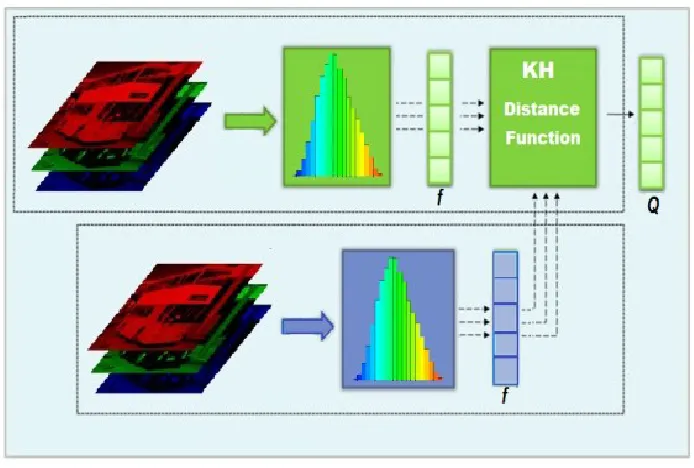
and the optimization of the tagging parameters. In the KNN Histogram (KH) descriptor, RGB
color space is used in computing the feature vector f as shown in Fig. 4.2. The color histogram
descriptor algorithm quantizes the color histograms for each channel of the (R,G,B). The
Euclidean color histogram 𝒇𝐻 vector is computed for each image according to the following
equation:
where 𝑯 is scale invariant histogram for each RGB channel. The dimension of the vector
is controlled by the number of quantization levels which is a critical factor in determining the
phase and verified to be a reasonable value.
The optimal features vector dimension is achieved through an optimization feedback loop
controlled by precision factor as shown in the image tagging section. The vector Q in Fig. 4.1
represents the feature vector of the images in the database. The KNN distance is used to rank the
closest neighbors between the untagged image histogram feature vector and the database image
[image:41.612.132.479.263.497.2]features vectors.
Figure 4.1 KH schematic diagram
4.2 Image Recognition Layer
In this layer, the image database is used as a library to identify the untagged image I
according to a predefined image concept. With 10 different predefined concepts 𝐶𝑖 such that
i ∈ {1, . . ,10}, and 10 retrieved images from the database in the Q vector, the classifier uses all
𝑅(𝐼) = 𝑎𝑟𝑔𝑚𝑎𝑥 ∑𝑚𝑖=1Pr ( 𝑄𝑖|𝑪) (4.2)
where 𝑅(𝐼) is the recognized concept for image I.
4.3 Image Tagging Layer
As a top layer, auto-tagging aims to annotate a group of untagged images, and retags each
image according to the statistical data received from the recognition layer. Because this layer
depends on the recognition layer, a training set from the image database can be used here as a
library of concepts to optimize the model such that both the retrieval layer and the recognition
layer can be optimized to decrease number of the incorrect tags recommended by the top layer.
The proposed training block diagram for the framework is shown in Fig. 4.2.
Figure 4.2 Training and optimizing block diagram
The auto tagging system is probabilistic approach, that is, the more frequent features
received for a certain concept, the higher the probability to use this concept as a recommended
Basically, in the image dataset, each set of image low level features 𝒇𝐻 is associated with
a text representing the concept or simply the tag of that image such that 𝐼𝑥 = {(𝒇𝐻𝑥, 𝐶𝑥)} for each
image, 𝑥 ∈ {1, . . , 𝑛} where 𝑛 is the number of images in the database. Therefore, the image
database is used here as a library of concepts to predict the closest tag. The same tag can also be
used in the training dataset of the tag prediction model.
4.4 Experiment
Corel-1K image dataset [31] is a popular dataset that we have used for evaluating the
automatic tagging. In Corel-1K dataset there are 10 categories each with 100 relevant images.
Each category represents a different semantic concept. The proposed auto-tagging multilayer
model is coded in Matlab, and a snapshot of the results is shown in Fig. 4.3, where a new
untagged image that does not belong to the image dataset and exists on the web is used to
evaluate the tagging system.
The results shown in Fig. 4.3 reflect the performance of the KH descriptor. The results
are based on the Chebyshev distance measure. The results also show the accuracy of the
statistical based approach in tag recommendation. In order to evaluate the efficiency of the
retrieval layer, the precision measurement is used to compute the ratio between the number of
Figure 4.3 Example of auto tagging framework
Table 4.1 Comparison of the Average Retrieval Precision (ARP) rates
Retrieval Method Average Precision
Block Based LBP [30] 0.230
MSD [27] 0.536
Color, texture, shape [29] 0.549
Image Based SIFT-LBP [32] 0.657
Our KH Method 0.672
A comparison between retrieval precision rates of the proposed descriptor and other
techniques is given in Table 4.1, which shows that our proposed technique is more suitable for
Corel-1K images than other existing techniques. The results also indicate that many categories in
Corel 1K dataset are best represented by global descriptors rather than local descriptors (e.g.
SIFT) or texture-based descriptors (e.g. LBP). Our proposed system which is referred to by the
KH method achieves the highest overall precision rate over existing approaches. The accuracy of
the retrieval stage has direct impact on the efficiency of the recognition layer. The higher
A comparison between our statistical approach and other machine learning classifiers has
been performed. To evaluate our statistical approach performance in predicting image tags, three
popular machine learning methods are used: Random Forest (RF), Neural Network (NN), and
Decision Tree (D-Tree). RF classifier is an ensemble learning method that operates by
constructing a multitude of D-trees to obtain better tagging prediction performance, while NN is
a well-known classification technique that is robust for handling noisy data.
The experiment has been setup up for the RF using 500 trees with 2 variables per level. In
the NN, a hidden layer of 100 nodes and 10 nodes in the output layer.
For evaluation purposes, Corel-1k dataset is partitioned into two main sets: a training set
consists of 700 images, and a testing set of 79 images. The accuracy is measured by computing
the ratio between the number of the correctly tagged images and the total number of the tested
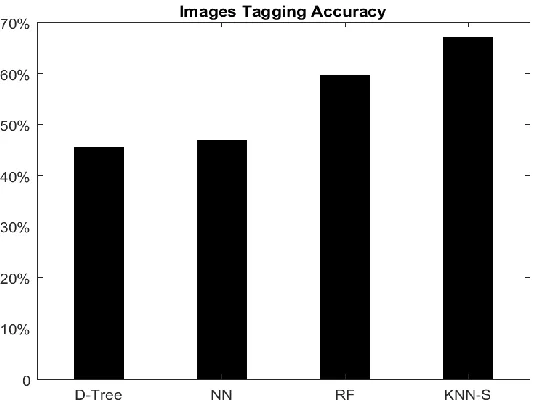
images. The accuracy of these techniques is shown in Fig. 4.4, where the accuracy of the D-tree,
[image:45.612.170.438.454.660.2]NN, RF, and statistical KNN (KNN-S) are: 0.456, 0.468, 0.57, and 0.671 respectively.
4.5 Summary
In this chapter, we proposed a new image tagging framework that consists of multilayer
prediction system. The framework architecture combined with our proposed descriptor (KH) has
shown considerable improvement over other comparable technique when tested with the
Corel-1K image database. These test results indicate that the global descriptor has high robustness in
automatic tagging for these types of images. Our algorithm has been compared to four different
techniques. The overall performance of our proposed technique is the highest in both image
retrieval and automatic tagging accuracies. The results indicate the suitability of our technique
for improving the automatic tagging of images.
5 AUTOMATICALLY GENERATED SEMANTIC TAGS OF TEXTURE IMAGES
Automatic image categorization is the process that classifies an image and categorizes it
into a semantic predefined concept based on the image visual content. Classification based on
visual contents is a very challenging task due to the diverse variations of objects, shapes, textures
and colors that underlying each class. In this chapter, we build a new texture dataset that
represents images of artifacts as shown in our work [46]. The dataset is organized into seven
categories of 100 images each. The classification pipeline is evaluated with several encoders, and
feature extractors. Among the evaluated methods, Integrating Speedup Robust Features (SURF)
algorithm and Histograms of Oriented Gradients (HOG) features. SURF-HOG show the best
classification accuracy when encoded with IFK.
5.1 Introduction
In the area of CBIR, diversifying image features to include color, texture, and shape, or
thecategorizationsystemdoesn’tdependonlyontheextractedfeatures,butalsoontheencoding
technique, the classifier in use and the tuning of the main parameters of the system pipeline [38].
Most of the traditional feature extraction approaches have many limitations and they are
application specific. While color based features are orientation and scale invariant, they do not
provide useful spatial information unless we patch the image in multiple regions for better
retrieval accuracy. Shape feature descriptors for binary and gray scale images have been used in
image retrieval as in the region-based moment descriptors [48], or contour-based (e.g.
Fourier-based descriptors). Despite the advantage of each approach and the enhancements achieved in
the Fourier-based techniques in terms of time complexity or affine invariant, but still both
approaches have multiple restricted requirements and limited number of applications.
In general, the CBIR has many challenges, which makes mid-level features receive more
attention in last decade. In keypoint detection and description, SIFT, and SURF [49] are among
the most widely used algorithms today for their invariance in translation, scaling, and rotation.
However, SURF is considered as a faster version of SIFT and also shows a robust performance
in object detection and image classification. The Maximally Stable Extremal Regions (MSER)
descriptor [50] is another example of the med-level feature methods. HOG descriptor [51] has
shown also good results in face and action recognition. Unlike global descriptors which consider
the global image features such as the color histogram, local descriptors breakdown the image
into very small regions and consider the properties of these regions (e.g. shape corners) as
features for retrieving similar images. In this chapter we are expanding the potential of the
med-level descriptor and extend their application to a new dataset of texture images by integrating
SURF and HOG features and encoding them with the improved fisher kernel technique to raise
5.2 Proposed Categorization Model
The proposed model for the image categorization is based on BoW approach. BoW is a
popular local feature based technique for image classification inspired by Bag of Words model
that is used in text mining. In document retrieval, the frequency of words in documents are used
to classify or retrieve similar documents, the same idea inspired in the image retrieval and
classification by using image features as visual words and classify the image based on the
histogram of the frequency of visual words. The visual word vocabulary can be generated by
clustering the image local features, for example in SURF descriptors of key points are often used
as feature vectors. These vectors can be 64 or 128 dimensional gradient based feature vector. By
finding all SURF key points in an image and using, for example, K-means clustering, the means
of each cluster constitutes a visual word. Therefore, if there are K clusters generated then the
dimension of the bag of visual words is K. This approach is also known as codebook
representation.
In order to find the k-means clustering for the image, suppose the SURF descriptors of a
category is given by n SURF keypoints, and each keypoint is represented by a vector 𝑥 of
dimension 64 such that the features space is 𝑥1, . . , 𝑥𝑛 , and the K-means objective is to find K
centers 𝑐1, . . , 𝑐𝑘 and assignments 𝑞1, . . , 𝑞𝑛 ∈ {1,..,K} of the points to the centers such that:
min 𝐸(𝑐1, . . , 𝑐𝑘, 𝑞1, . . , 𝑞𝑛) = ∑ ||𝑥𝑖 − 𝑐𝑞𝑖||𝑝𝑝 𝑛
𝑖=1
(5.1)
where E is the minimum sum of distances between the point and the centers. Many
algorithms are used to estimate these centers which represent the vocabs of the codebook. After
forming the codebook, each image is represented by a histogram of the vocabs in the codebook.
art categories can be determined. Therefore, this categorization system is a combination between
the unsupervised and supervised techniques.
As an alternative approach to the BoW technique, FK is a powerful framework shows
competitive performance in the field of image classification. The advantage of this technique is
that it combines the strengths of generative and discriminative models. In generative models (e.g.
Naïve Bayes, GMM) we are given some sample data and labels where the model finds the
hidden parameters and specifies the joint probability distribution between the observed and target
variables. For discriminative models (e.g. SVM, Neural Networks) which are also called
conditional models, they allow only sampling of the target variables conditional on the observed
quantities. Therefore, discriminative models focus directly on the classification problem while
generative models can handle variable length data.
The main idea of FK approach in image classification domain is to characterize the input
images with a gradient vector derived from a generative probability model which is a GMM.
Because GMM is a mixture of K multivariate Gaussian distribution, therefore, if we are given a
features space 𝑥1, . . , 𝑥𝑛 extracted from an image, then 𝜃 = (𝜇𝑘, ∑ ,𝑘 𝜋𝑘 ∶ 1, . . , 𝐾) is the
parameters of the GMM that fits the distribution of the features space such that 𝜇𝑘and ∑ ,𝑘 are
the mean and covariance of the distribution, 𝜋𝑘 is the prior probability of the K.
The GMM can approximate the distribution of the images low level features such as the
visual vocabulary. Therefore, the gradient representation here is replaced the histogram of
occurrences in the BoW such that:
𝑝(𝑥|𝜃) = ∑ 𝜋𝑘𝑝(𝑥𝑖| 𝐾
𝑘=1
𝜇𝑘, ∑ )
Learning GMM to fit a dataset distributed in a feature space 𝑥1, . . , 𝑥𝑛 is done by
maximizing the log-likelihood of the data such that:
𝑙(𝜃; 𝑥) = 1
𝑛∑ 𝑙𝑜𝑔
𝑛
𝑖=1
∑ 𝜋𝑘𝑝(𝑥𝑖| 𝐾
𝑘=1
𝜇𝑘, ∑ )
𝑘 (5.3)
Once the generative model is learned, the representation of each x is determined by its
effects on the maximum likelihood parameter estimation such that this effect can be computed
as:
𝜑(𝑥) = ∇𝜃𝑙𝑜𝑔 ∑ 𝜋𝑘𝑝(𝑥𝑖| 𝐾
𝑘=1
𝜇𝑘, ∑ )
𝑘 (5.4)
Using the gradient vector can help in determining in which direction the model parameter
should be modified to best fit the data.
In the context of image classification, the FK can actually be understood to extend the
popular BoW by going beyond count statistics. Therefore, we can concisely state that both FK
and BoW are based on a visual vocabulary, FK based on GMM while BoW uses K-means
clustering, FK properties supports the use of linear classifiers while BoW stipulate nonlinear
classifiers to give good classification accuracy. In this chapter we use a special, approximate and
improved case of FK called Fisher Vector (FV) which is a statistics capturing the distribution of
a set of local image descriptors. We evaluate both of K-means and FV performance with the art
dataset as it is shown in experimental section.
A competitive categorization performance in this chapter could be achieved by
integrating the FVs of SURF and HOG descriptors. HOG descriptor decomposes the image into
the result using a block-wise pattern, and returns a descriptor for each cell. In this chapter, after
extracting SURF keypoints, the histograms of oriented gradient around these keypoints are
extracted. The GMM of both descriptors features space computed each alone before computing
the Principle Component Analysis (PCA) of the FVs. Both of the PCA-FVs are fused for the
learning and testing datasets.
5.3 Experimental Results
Matlab and VLFeat [55] are used as the main environments to construct and evaluate the
proposed categorization model. The texture dataset is collected from the web and categorized in
seven groups as represented in our work [46]. The dataset has 700 images divided into 7
categories each with 100 relevant images and each category is considered as an independent
concept. Another 110 images are used to evaluate the categorization model with different
[image:51.612.144.467.416.677.2]techniques and descriptors as shown in Fig. 5.1.
The testing dataset for the seven different categories is used for the evaluation purpose.
The model trained using Support Vector Machine (SVM) as a classifier, the results in Fig. 5.1,
show that FV-SURF-HOG method outperforms the other methods for almost all vocabulary
sizes.
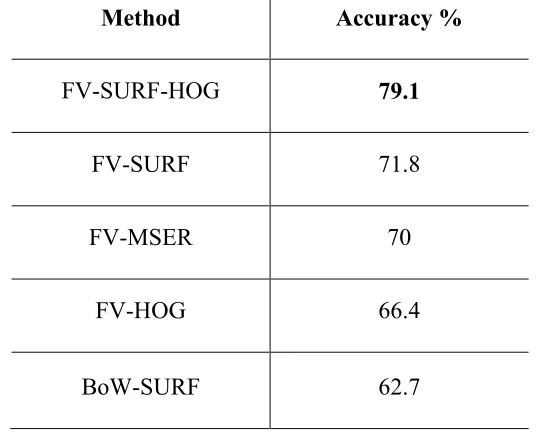
In Table 5.1, a comparison between the proposed methods shows also that FV-SURF
achieves higher accuracy than BoW-SURF by a margin of 9.1% which proves the
competitiveness of the FV over the BoW. The performance of the categorization model
according to the best accuracy achieved can be considered competitive if we take into account
that the dataset has diversity of objects in each category with limited training size of data for
each object.
Table 5.1 Comparison of the best categorization accuracy of the methods.
Method Accuracy %
FV-SURF-HOG 79.1
FV-SURF 71.8
FV-MSER 70
FV-HOG 66.4
BoW-SURF 62.7
5.4 Summary
In this chapter, we introduced a new dataset of texture images. The dataset has been
[image:52.612.171.440.387.603.2]that minimizes the errors of both SURF and HOG descriptors. This method when encoded with
FV outperforms the K-means based Bag of Words’ approach. The results also indicate the
suitability of our method for the arts` image categorization. Integrating the proposed approach
with the Convolution Neural Networks (CNN) is considered and discussed in next chapter.
6 DEEP LEARNING FUSION ALGORITHM FOR TEXTURE IMAGES
CATEGORIZATION
The intent of the image classification process is to objectively categorize image visual
contents into semantic meanings. The classification process is a challenging task due to the
difficulty associated with extracting and identifying relevant shape information. In this chapter,
we introduce a new fusion algorithm that combines the strengths of deep learning and mid-level
image descriptors. Our approach is evaluated using a newly constructed dataset of texture images
as discussed in chapter 5. The dataset is organized into seven categories of 100 images each. The
fusion algorithm shows an improvement in the classification accuracy over other state of the art
methods.
6.1 Introduction
Trying to automatically classify texture images is a challenging task due to the tinny low
level details that can differentiate them from each other. To classify these images we proposed a
new fusion algorithm that integrates mid-level descriptors and deep learning. The evaluations of
the classification pipeline of the mid-level descriptors involved several encoders, and feature
extractors. Among the evaluated methods, Integrating SURF and HOG features for the detected
surf point show best artifacts classification accuracy when encoded with the IFK.
In general, traditional feature extraction approaches such as color and shape have many
![Figure 2.7 Semantic segmentation examples [19]](https://thumb-us.123doks.com/thumbv2/123dok_us/9054038.976938/28.612.81.533.354.610/figure-semantic-segmentation-examples.webp)
![Figure 2.9 Bayesian annotation approach [36]](https://thumb-us.123doks.com/thumbv2/123dok_us/9054038.976938/31.612.84.530.408.668/figure-bayesian-annotation-approach.webp)
![Figure 2.10 Parametric approach using GMM modelling [39]](https://thumb-us.123doks.com/thumbv2/123dok_us/9054038.976938/32.612.106.512.394.684/figure-parametric-approach-using-gmm-modelling.webp)