S T U D Y P R O T O C O L
Open Access
Pit excision with phenolisation of the sinus tract
versus radical excision in sacrococcygeal pilonidal
sinus disease: study protocol for a single centre
randomized controlled trial
Edgar JB Furnée
*, Paul HP Davids, Apollo Pronk and Niels Smakman
Abstract
Background:Excision of the pit of the sinus with phenolisation of the sinus tract and surgical excision are two treatment modalities for patients with sacrococcygeal pilonidal sinus disease. Phenolisation seems to have advantages over local sinus excision as it is performed under local anaesthesia with a relatively small surgical procedure, less postoperative pain, minor risk of surgical site infection (8.7%), and only a few days being unable to perform normal activity (mean of 2.3 days). The disadvantage may be the higher risk of recurrence (13%) and the necessity to perform a second phenolisation in a subgroup of patients. Wide surgical excision of sacrococcygeal pilonidal sinus disease has a recurrence rate of 4 to 11%. The disadvantages, however, are postoperative pain, high risk of surgical site infection, and a longer period being unable to perform normal activity (mean of 10 days). The objective of this study is to show that excision of the pit of the sinus of sacrococcygeal pilonidal sinus disease with phenolisation of the sinus tract is a successful first-time treatment modality for sacrococcygeal pilonidal sinus disease accompanied by a quicker return to normal daily activity compared to local excision of the sinus.
Methods/design:Patients with sacrococcygeal pilonidal sinus disease will be randomly allocated to excision of the pit of the sinus followed by phenol applications of the sinus tract or radical surgical excision of the sinus. Patients are recruited from a single Dutch teaching, non-university hospital. The primary endpoint is loss of days of normal activity/working days. Secondary endpoints are anatomic recurrence rate, symptomatic recurrence rate, quality of life, surgical site infection, time to wound closure, symptoms related to treatment, pain, usage of pain medication and total treatment time. To demonstrate a reduction of return to normal activity from 7.5 days in the excision group to 4 days in the phenolisation group, with 80% power at 5% alpha, a total sample size of 100 is required. Discussion:This study is a randomised controlled trial to provide evidence that phenolisation of the sinus tract compared to radical excision reduces the total number of days unable to perform normal activity.
Trial registration:Dutch trial register NTR4043, registered on 24 June 2013.
Keywords:Sacrococcygeal pilonidal sinus disease, Surgery, Local excision, Pit excision, Phenolisation, Randomised controlled trial
* Correspondence:[email protected]
Diakonessenhuis, Department of Surgery, Bosboomstraat 1, P.O. Box 80250, 3508 TG Utrecht, Netherlands
Background
Sacrococcygeal pilonidal sinus disease (SPSD) is an ac-quired disorder of the natal cleft. In patients with SPSD, there are one or more sinus openings in the natal cleft with a blind-ending subcutaneous sinus. It has a preva-lence of 8.3% [1]. There is a sex preponderance in men presenting with SPSD between the age of 20 and 30 years [2]. Although 3.7% of patients do not have any symp-toms (silent disease), SPSD may cause sympsymp-toms inter-fering with quality of life and social function [1]. Symptoms associated with SPSD are pain, itch and dis-charge from the sinus with soiling of the underwear. Moreover, infection of the sinus with abscess formation may develop. In patients with silent SPSD, watchful waiting should be the treatment of choice [3]. An ab-scess requires simple surgical drainage. For patients with complaints due to chronic SPDS interfering with normal daily life, however, several treatment options have emerged in the past years. Simple excision of the pit of the sinus according to Lord and Miller [4], radical excision of the sinus and unroofing of the sinus are frequently used treatment modalities for SPSD [5].
Radical surgical excision of the sinus with primary wound closure or secondary wound healing is the most frequently used treatment for chronic SPDS [4,6,7]. Surgical site infection (SSI), however, is a frequent complication of radical excision with prevalence up to 24% [2]. SSI leads to secondary wound healing which may take several months to cure [8]. The use of a gentamicin-absorbed collagen sponge on the sacrococ-cygeal fascia reduced the infection rate after primary closure from 20% to 5% in one study [9], although this difference could not be confirmed by another study (26% versus 22%) [10]. The relatively big surgical trauma and the high rate of wound complications after radical excision results in a long wound healing time (mean (standard deviation (SD)) of 15 (4.9) days) and a long mean time to return to normal activity (9.7 (3.6) days) [2,5]. The recurrence rate after excision of SPSD is another problem. Midline wound closure after exci-sion of SPSD has a mean (SD) recurrence rate of 11.1% (0.81%). Off-midline wound closure (Karydakis flap re-construction), however, possibly seems to decrease the recurrence rate to 4% [2,5].
Another minimal invasive treatment modality for SPSD is excision of the pit(s) of the sinus followed by the appli-cations of phenol into the sinus tract. Phenol has sclero-sant properties destroying epithelium and debris in the sinus and is thereby able to promote healing of the sinus [11]. This procedure, first described in 1964, is performed in an ambulatory setting under local anaesthesia [12]. Other advantages of this treatment modality over radical surgical excision of SPSD are a smaller surgical wound with less pain and faster wound healing, and therefore
faster recovery and return to normal activity. A disad-vantage is the higher recurrence rate. A review of the literature in 2009 [13] reported a mean (SD) recurrence rate of 12.6% (0.91%) after follow-up of 2 years, but without results from randomised controlled trials. Therefore, some patients require another phenolisation treatment to cure the SPSD. The surgical site infection rate after phenolisation treatment was reported as 8.7%. The mean (SD) return to work after the procedure was within 2.3 (3.8) days [13]. Some other cohort studies have been performed since then showing a recurrence rate varying between 8.7 and 33.3% after a follow-up of 22 to 26 months. Mean wound closure time varied from 16 to 28 days, SSI from 0% to 8.7% and return to work from 0 to 3 days [11,14-16].
Rationale
Excision of the pit of the sinus of SPSD with phenolisation of the sinus tract seems to have advantages over the most used surgical treatment for SPSD radical sinus excision -as it is performed under local anaesthesia with a relatively small surgical procedure, less postoperative pain, minor risk of SSI (8.7%) and only a few days unable to perform normal activity (mean of 2.3 days). The disadvantage may be the higher risk of recurrence (up to 33%) and phenoli-sation may have to be repeated a second time. However, high-quality randomised controlled trials comparing both treatment modalities are importantly lacking.
Objective
The primary objective of this randomised controlled trial is to show that phenolisation of the sinus tract is a suc-cessful treatment modality for SPSD and reduces the total number of days unable to perform normal activity.
Methods/design
This study protocol was constructed according to the SPIRIT guidelines [17].
Study design
This study is designed as a randomised, non-blinded, single centre, superiority trial with two parallel groups.
Setting
Patients will be enrolled from a Dutch teaching, non-university hospital.
Eligibility criteria Inclusion criteria
Exclusion criteria
A potential subject who meets any of the following criteria will be excluded from participating in this study: 1) No or minimal symptoms related to SPSD; 2) suspicion of exten-sive subcutaneous network of sinus tracts; 3) abscess of SPSD; and 4) previous surgical procedures for SPSD.
Interventions
Intervention: excision of the sinus pit and phenolisation of the sinus tract
Patients are treated in an outpatient setting, under local anaesthesia and aseptic conditions. The patient is posi-tioned in the prone position on the proctology table. The operative area is shaved. No antibiotics are used. The skin is cleaned with an antiseptic solution and cov-ered with a sterile dressing. Circumferential field block infiltration anaesthesia of the sinus is applied, using Lidocaine HCl 2%/epinephrine 1:100,000 (Pharmacist Hospital Haarlem, Haarlem, The Netherlands). Probing via the pit(s) of the sinus is performed to determine the direction of the sinus. Then, a very limited excision of all pits in the midline is made. Additionally, all out-of-midline openings are also excised as little as possible. A small sharp spoon is introduced via all separate orifices to curettage the sinus tract. Attention is paid that all hairs are removed from the sinus tract. After extensive curettage of the sinus tract, accurate haemostasis is reached by external compression. Gauze is used to pro-tect the anus, and the surrounded skin is propro-tected by a coating of vaseline (Pharmachemie BV, Haarlem, The Netherlands). Liquid phenol (85%; Meander Medical Centre, Amersfoort, The Netherlands) is injected by one or more 1 mL syringes (depending on the volume of the sinus tract) with a small catheter via one orifice until phenol is seen at the other orifices. This volume is accepted as the sinus tract volume. The phenol is left in place for 1 minute and aspirated afterwards. This procedure is repeated once. Afterwards, remaining phenol is washed out with ethanol (70%; Fresenius, Schelle, Belgium) to neutralise the phenol. The surrounding skin is cleaned with normal saline. The wound is covered with an absorbing bandage only to prevent soiling of the clothes. The patient is discharged immediately after the procedure.
Comparison: radical surgical excision
Patients are treated in a 1-day surgery setting under spinal or general anaesthesia, depending on the prefer-ence of the patient or anaesthesiologist. The patient is positioned in the prone position on the operating table. The buttocks are separated with plasters optimising the view of the area of the natal cleft. The operative area is shaved. No antibiotics are used. The skin is cleaned with an antiseptic solution and covered with a sterile
dressing. Probing via the pit(s) of the sinus is performed to determine the direction of the sinus. Then, a limited asymmetrical incision of the skin around the sinus is made with the diathermia. An asymmetrical skin inci-sion is preferred to be able to close the wound off-midline. All off- and midline orifices are included in the excision of the sinus. Subsequently, the sinus is radically excised with the diathermia. The subcutaneous tissue is mobilised to be able to close the wound off-midline.
Haemostasis is reached by electrocautery. After
complete haemostasis, the plasters are loosened to re-move the tension on the wound in the natal cleft. A gentamicin-absorbed collagen sponge (Garacol 130 mg sponge; EUSA Pharma (Europe) Ltd, Oxford Science Park, Oxford, UK) is partitioned into numerous small parts and positioned on the sacrococcygeal fascia. Subse-quently, the wound is closed off-midline with several separate hand-tied absorbable sutures. The edges of the wound are infiltrated with Lidocaine HCl 2%/epinephrine 1:100,000 (Pharmacist Hospital Haarlem, Haarlem, The Netherlands) for postoperative pain reduction. The skin is closed with separate non-absorbable vertical mattress sutures. The patient is discharged the same day.
Outcomes Primary endpoint
The primary endpoint is the loss of days of normal activ-ity, measured from the day of operation. Patients do not have any restrictions after the surgical intervention. Complaints due to the intervention are the only factors restricting patients from performing their normal activ-ities. Return to normal activity, such as working or doing housekeeping work, is assessed by filling in a diary dur-ing the first 2 weeks after surgery by all participants. As this study mainly includes young and active patients, this outcome measure is highly relevant.
Secondary endpoints
The secondary endpoints include symptomatic recur-rence rate (assessed by the Visick grading system [18]), symptoms related to treatment (fluid, pain, irritation, itch, burning), usage of pain medication and quality of life. These secondary endpoints are assessed by the pa-tient. Some other secondary endpoints are measured by an assessor with an assessment form including anatomic recurrence of SPSD, time to wound closure (defined as the time from the day of surgery until the day of complete epithelialisation) and surgical site infection.
Participant timeline
sinus pit and phenolisation of the sinus tract. Afterwards, patients enter into the follow-up programme. If there is recurrent anatomic SPSD combined with symptoms interfering with daily life after at least 6 weeks, the phe-nolisation procedure is repeated. The treatment in group A can therefore consist of up to two phenolisa-tion sessions. Patients randomised to group B primarily undergo excision of the sinus. Afterward, patients enter into the follow-up programme.
Data regarding quality of life and complaints related to SPSD are obtained preoperatively by questionnaires. Furthermore, the number and locations of pits of the SPSD in the natal cleft are preoperatively assessed. After the procedure, patients enter the follow-up programme. This consists of a diary during the first 2 weeks after the intervention to score complaints re-lated to the surgical intervention, usage of pain medica-tion and loss of days to perform normal activity and, at 1, 2, 6, 12, 26 and 52 weeks after the surgical interven-tion, quality of life scores, complaints in the natal cleft, satisfaction assessment and wound assessment are measured.
Sample size
The sample size of this study was calculated based on a re-duction of return to normal activity from 7.5 days in the ex-cision group to 4 days in the phenolisation group. A more conservative estimation has been taken into account for both groups as the results shown from the literature are relatively broad (mean (SD), 9.7 (3.6) and 2.3 (3.8) days, re-spectively) [2,5,13]. The sample size calculation was based onα= 0.05 (two-sided) and a power of 80%. This led to a required sample size of 100 (50 per group) computed by using Microsoft Office Excel 2007 (Microsoft Corporation, Redmond, WA, USA).
Recruitment
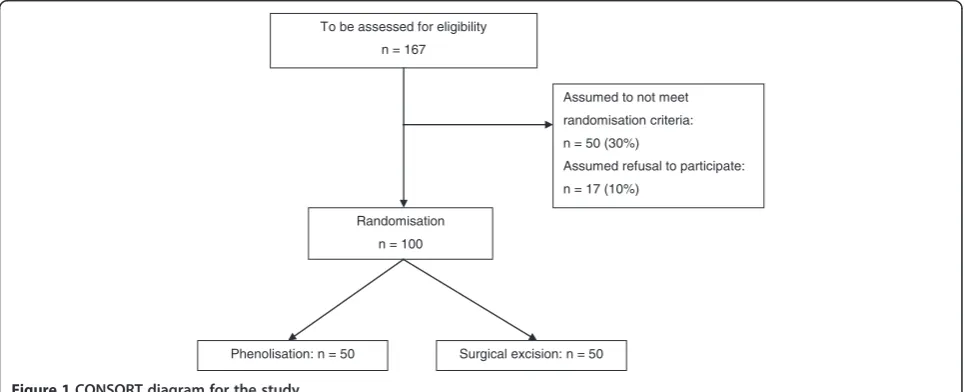
All patients who present to the surgical outpatient clinic of the participating centre with sacrococcygeal pilonidal sinus disease will be considered by the surgeon for par-ticipation in this research protocol. Patients with no or minimal symptoms related to SPSD are encouraged to use conservative treatment. However, if conservative treatment is inadequate or symptoms interfere consider-ably with daily life, there is a reason to proceed to surgi-cal treatment. These patients are assessed if they are eligible for enrolment in this study. With 130 patients presenting with SPSD in the participating centre in 2011 and 2012, an estimation that 30% do not meet the inclu-sion criteria and assuming a refusal rate of 10%, the in-clusion period will be about 2 years (Figure 1).
Randomisation
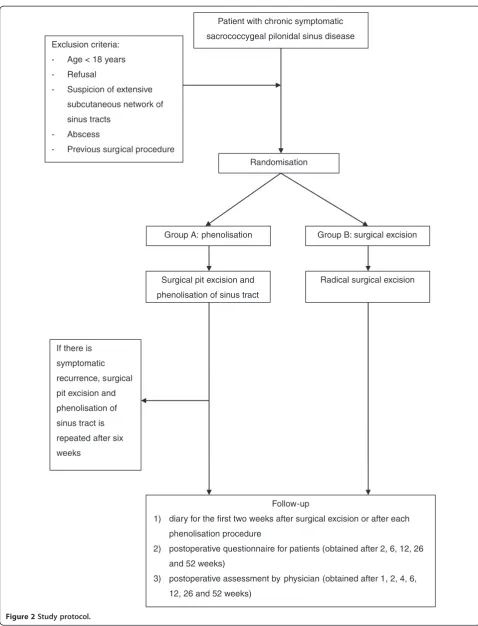
All patients who give consent for participation and who fulfil the other inclusion criteria will be randomised. Pa-tients will be randomly assigned to either group A (pit excision followed by phenolisation) or group B (primary surgical excision) with a 1:1 allocation (Figure 2). The simple randomisation type will be performed by sequen-tially numbered, sealed and opaque envelopes which will be opened one at a time. Each envelope contains a folded paper with “phenolisation” or “excision” accord-ing to the assigned treatment. The content is not visible in any way prior to unsealing and resealing is impossible. These envelopes have been generated by one of the in-vestigator (NS). The assignment schedule is unpredict-able and unknown by the principal investigator (EJBF) who will randomise the participants.
Blinding
Due to the nature of the intervention (that is, because of obvious differences between both interventions) neither
To be assessed for eligibility n = 167
Assumed to not meet randomisation criteria: n = 50 (30%)
Assumed refusal to participate: n = 17 (10%)
Randomisation n = 100
[image:4.595.57.540.529.725.2]Phenolisation: n = 50 Surgical excision: n = 50
Patient with chronic symptomatic
sacrococcygeal pilonidal sinus disease Exclusion criteria:
- Age < 18 years
- Refusal
- Suspicion of extensive
subcutaneous network of
sinus tracts
- Abscess
- Previous surgical procedure
Randomisation
Group B: surgical excision Group A: phenolisation
Surgical pit excision and
phenolisation of sinus tract
Radical surgical excision
Follow-up
1) diary for the first two weeks after surgical excision or after each
phenolisation procedure
2) postoperative questionnaire for patients (obtained after 2, 6, 12, 26
and 52 weeks)
3) postoperative assessment by physician (obtained after 1, 2, 4, 6,
12, 26 and 52 weeks) If there is
symptomatic
recurrence, surgical
pit excision and
phenolisation of
sinus tract is
repeated after six
[image:5.595.57.536.84.711.2]weeks
participants nor staff members can be blinded to alloca-tion. However, the hypothesis and the primary outcome measure are unknown to the participants.
Data collection
Preoperatively, complaints related to SPSD (discharge, pain and itch) are evaluated and each symptom is scored by the participants on a six-point scale from 0 (no com-plaints) to 5 (daily comcom-plaints). Quality of life is also preoperatively measured, both by a visual analogue scale (scored from 0 (worst) to 100 (best)) and the Short Form (SF)-36 [19]. The SF-36 is a questionnaire designed to measure health-related quality of life. This questionnaire consists of 36 questions comprising eight different do-mains of quality of life: physical functioning, physical role limitation, emotional role limitation, bodily pain, vi-tality, mental health, social functioning, and general health. For each domain, a score between 0 and 100 can be obtained; the higher the score, the better the quality of life.
During the phenolisation procedure, the following items are assessed with an assessment form: number of pit excisions in midline and right and left from the mid-line and volume of phenol administrated in the sinus. For the excision procedure, the size and depth of the wound is measured as well as the weight of the excision specimen. For both procedures, duration of operation and possible complications are recorded.
A diary is obtained for the first 2 weeks after the intervention to score complaints related to the treat-ment (fluid, pain, irritation, itch, burning), scored on a six-point scale from 0 (no complaints) to 5 (daily com-plaints). Additionally, pain is evaluated with a visual analogue scale, scored from 0 (no pain) to 100 (extreme painful), usage of pain medication (yes or no) and if the patient is able to perform normal activity such as work-ing or dowork-ing housekeepwork-ing work.
The postoperative questionnaire assesses the following items: patient satisfaction by the Visick satisfaction rate (disease scored by the patient as cured, improved, un-changed or worsened; the last two are considered as symptomatic recurrence) [18], symptoms related to the treatment (fluid, pain, irritation, itch, burning; scored from 0 (no complaints) to 5 (daily complaints), and quality of life as obtained by both a visual analogue scale and the SF-36 (both are assessed as described for the preoperative stage).
The wound is postoperatively assessed by an assessor with an assessment form. This form includes anatomic recurrence of SPSD, wound closure (defined as complete epithelisation of the skin) and surgical site infection scored by the Southampton wound scoring system [20]. This scoring system consists of six grades: normal heal-ing (grade 0), normal healheal-ing with mild bruisheal-ing or
erythema (grade I), erythema plus other signs of inflamma-tion (grade II), clear or haemoserous discharge (grade III), pus (grade IV) and deep or severe wound infection with or without tissue breakdown (grade V).
To encourage patients to complete follow-up, appoint-ments are scheduled for all patients and a reminder is sent to them 2 to 3 days prior to the appointment.
All forms and questionnaires will be kept in locked cabinets and access to the study data will be restricted. All data will be entered electronically in a SPSS database (SPSS Inc., Chicago, IL, USA) and a password system will be utilized to control access and prevent unauthor-ised access.
Statistical methods
The analysis in this study will be performed according to the intention-to-treat principle; that is, all participants, re-gardless of protocol adherence, will be analysed as rando-mised [21]. Continuous variable will be summarised using mean (SD) or medians (interquartile range), and binary and categorical data will be summarised using frequencies and percentages, where appropriate. Data will be analysed using SPSS for Windows version 17.0 (SPSS Inc.). We will calculate relative risk and relative risk reduction with cor-responding 95% confidence intervals to compare dichot-omous variables. The paired-samplesttest will be used for statistical analysis of continuous pre- and postoperative values and thettest for independent samples for statistical analysis of continuous values between both intervention groups. Statistical analysis of categorical values between both groups will be performed using the Pearson Chi-square test, and statistical analysis of categorical pre- and postoperative values by the McNemar test. Differences will be considered statistically significant withP< 0.05. We will report reasons for withdrawal for each randomisation group. The effect that any missing data may have on re-sults will be assessed by sensitivity analysis [21,22].
Harms
Both surgical interventions in this study are generally accepted interventions for SPSD [5,13]. The safety of both procedures has already been established in several previous observational studies and in none of them has a serious adverse event been shown [4,6,7,11,14-16]. During the study any potential side effect or adverse event will be recorded.
Ethics
criteria are both orally and in writing informed about the study by their surgeon as well as by the principal re-searcher. All patients will provide written informed con-sent before inclusion in the study and randomisation may be allowed. Patients have 1 week to consider their decision whether they will participate in this study. All study-related information will be stored securely in locked cabinets with limited access and password protected databases. Partici-pant study information will not be released outside of the study without the written permission of the participant.
Discussion
In the past, radical surgical excision was the treatment of choice for SPSD. Since 2010, however, pit excision and phenolisation of the sinus tract has increasingly been applied as treatment for SPSD. This treatment seems to have some advantages compared to radical ex-cision; it is performed under local anaesthesia with a relatively small surgical wound, less postoperative pain and minor risk of complications of the wound (that is, SSI) and long-lasting wound healing. All these advan-tages potentially lead to a reduction in days unable to perform normal activity. The recurrence rate is, at 13%, somewhat higher for the phenolisation technique. How-ever, as far as we know it seems unlikely that this treat-ment does compromise or negatively influence radical surgical excision if necessary in the future due to recur-rence after phenolisation. Currently, no randomised controlled trials have been performed comparing both treatment modalities. Therefore, the abovementioned advantages of the phenolisation technique over radical excision are not evidence-based. The study described in this research protocol is potentially able to provide evi-dence of the advantages of the phenolisation technique. The primary endpoint in this study is the number of days unable to perform patient’s normal activity. This was chosen as all the advantages of the phenolisation technique (that is, local anaesthesia and less pain and wound complication) contribute to this primary end-point. As stated in the research protocol, a more con-servative estimation of the primary endpoint was considered for sample size calculation, as the results from the previous observational studies showed a rela-tively broad SD [2,5,13]. Moreover, this more conser-vative estimation requires the inclusion of more patients into each study group, leading to the advan-tage of a more powerful randomised trial. The sample size could also be calculated based on the difference in recurrence rate between both interventions. Although the recurrence rate of surgical excision seems to be favourable, the difference with the phenolisation tech-nique is quite small as reported in previous studies [5,13]. Therefore, it would require an inclusion of over 4,000 patients in each group to reach statistical
significance. It is, in our opinion, unattainable to per-form such a randomised controlled trial.
The most important disadvantage of the phenolisation technique is the somewhat higher recurrence rate. An extensive subcutaneous network of sinus tracts may re-sult in treatment failure when phenol does not reach all the tracts [16]. This may contribute to recurrence. Therefore patients with a suspected extensive network of subcutaneous tracts are not considered for inclusion in this study protocol. The traditional treatment consist-ing of surgical excision should be the treatment of choice in these patients. Suspicion of an extensive sub-cutaneous network should especially be raised if more than three off-midline orifices are present. Another fac-tor that may lead to recurrence after phenolisation is in-adequate haemostasis after debridement as this prevents sufficient contact between the walls of the sinus tracts and phenol. Additionally, an essential step of the pheno-lisation technique required to reduce the recurrence rate is removal of all hairs from the sinus tract(s) as these are not destroyed by phenol. All these items may result in recurrence, and therefore repetition of treatment with the phenolisation technique may be required in a sub-group of patients. These three essential steps in the phe-nolisation procedure have been incorporated in the current study protocol to confine the recurrence rate to a minimum. A second treatment with phenolisation, however, will be inevitably necessary in a subgroup of patients. A second procedure is included in the phenoli-sation group (group A) in this study, if required. How-ever, a third phenolisation session is not performed in this study in the case of recurrent SPSD after a second time of phenolisation, as Dag and colleagues reported a failure rate of 98% in patients with three or more pheno-lisation sessions [11].
In conclusion, this study is a randomised controlled trial to provide evidence that sinus pit excision followed by phenolisation of the sinus tract compared to surgical excision reduces the total number of days unable to per-form normal activity.
Trial status
The first patient was randomized on 20 September 2013. To date, 40 patients have been included in the study. The end date of this study is currently expected to be February 2016. This study is registered in the Dutch Trial Register (NTR4043).
Abbreviations
SD:Standard deviation; SF-36: Short-Form-36; SPSD: Sacrococcygeal pilonidal sinus disease; SSI: Surgical site infection.
Competing interests
Authors’contributions
EJBF participated in the design of the study, drafted the statistical analysis plan and drafted the manuscript. PHPD participated in the design of the study and critically revised the manuscript. AP participated in the design of the study and critically revised the manuscript. NS participated in the design of the study and critically revised the manuscript. All authors read and approved the final manuscript.
Acknowledgements
The authors thank Sjoerd G Elias who contributed to the sample size calculation and statistics in the design of this randomised controlled trial. This study has not received any external funding.
Received: 15 June 2014 Accepted: 18 February 2015
References
1. Aysan E, Ilhan M, Bektas H, Kaya EA, Sam B, Buyukpinarbasili N, et al. Prevalence of sacrococcygeal pilonidal sinus as a silent disease. Surg Today. 2013;43:1286–9.
2. Al-Khamis A, McCallum I, King PM, Bruce J. Healing by primary versus secondary intention after surgical treatment for pilonidal sinus. Cochrane Database Syst Rev. 2010;1:CD006213.
3. Doll D, Friederichs J, Boulesteix AL, Düsel W, Fend F, Petersen S. Surgery for asymptomatic pilonidal sinus disease. Int J Colorectal Dis. 2008;23:839–44. 4. Lord PH, Millar DM. Pilonidal sinus: a simple treatment. Br J Surg.
1965;52:298–300.
5. Thompson MR, Senapati A, Kitchen P. Simple day-case surgery for pilonidal sinus disease. Br J Surg. 2011;98:198–209.
6. Soll C, Dindo D, Steinemann D, Hauffe T, Clavien PA, Hahnloser D. Sinusectomy for primary pilonidal sinus: less is more. Surgery. 2011;150:996–1001.
7. Kepenekci I, Demirkan A, Celasin H, Gecim IE. Unroofing and curettage for the treatment of acute and chronic pilonidal disease. World J Surg. 2010;34:153–7.
8. Alptekin H, Yilmaz H, Kayis SA, Sahin M. Volume of the excised specimen and prediction of surgical site infection in pilonidal sinus procedures (surgical site infection after pilonidal sinus surgery). Surg Today. 2013;43:1365–70.
9. Yetim I, Ozkan OV, Dervişoglu A, Erzurumlu K, Canbolant E. Effect of gentamicin-absorbed collagen in wound healing in pilonidal sinus surgery: a prospective randomized study. J Int Med Res. 2010;38:1029–33. 10. Andersson RE, Lukas G, Skullman S, Hugander A. Local administration of
antibiotics by gentamicin-collagen sponge does not improve wound healing or reduce recurrence rate after pilonidal excision with primary suture: a prospective randomized controlled trial. World J Surg. 2010;34:3042–8. 11. Dag A, Colak T, Turkmenoglu O, Sozutek A, Gundogdu R. Phenol procedure
for pilonidal sinus disease and risk factors for treatment failure. Surgery. 2012;151:113–7.
12. Maurice BA, Greenwood RK. A conservative treatment of pilonidal sinus. Br J Surg. 1964;51:510–2.
13. Kayaalp C, Aydin C. Review of phenol treatment in sacrococcygeal pilonidal disease. Tech Coloproctol. 2009;13:189–93.
14. Olmez A, Kayaalp C, Aydin C. Treatment of pilonidal disease by combination of pit excision and phenol application. Tech Coloproctol. 2013;17:201–6. 15. Aksoy HM, Aksoy B, Egemen D. Effectiveness of topical use of natural
polyphenols for the treatment of sacrococcygeal pilonidal sinus disease: a retrospective study including 192 patients. Eur J Dermatol. 2010;20:476–81. 16. Kaymakcioglu N, Yagci G, Simsek A, Unlu A, Tekin OF, Cetiner S, et al.
Treatment of pilonidal sinus by phenol application and factors affecting the recurrence. Tech Coloproctol. 2005;9:21–4.
17. Chan AW, Tetzlaff JM, Gøtzsche PC, Altman DG, Mann H, Berlin JA, et al. SPIRIT 2013 explanation and elaboration: guidance for protocols of clinical trials. BMJ. 2013;346:e7586.
18. Rijnhart-De Jong HG, Draaisma WA, Smout AJ, Broeders IA, Gooszen HG. The Visick score: a good measure for the overall effect of antireflux surgery? Scand J Gastroenterol. 2008;43:787–93.
19. Ertan T, Koc M, Gocmen E, Aslar AK, Keskek M, Kilic M. Does technique alter quality of life after pilonidal sinus surgery? Am J Surg. 2005;190:388–92. 20. Bailey IS, Karran SE, Toyn K, Brough P, Ranaboldo C, Karran SJ. Community
surveillance of complications after hernia surgery. BMJ. 1992;304:469–71.
21. Moher D, Hopewell S, Schulz KF, Montori V, Gøtzsche PC, Devereaux PJ, et al. CONSORT 2010 explanation and elaboration: updated guidelines for reporting parallel group randomised trials. BMJ. 2010;340:c869. 22. Little RJ, D’Agostino R, Cohen ML, Dickersin K, Emerson SS, Farrar JT, et al.
The prevention and treatment of missing data in clinical trials. N Engl J Med. 2012;367:1355–60.
23. WMA Declaration of Helsinki - Ethical Principles for Medical Research Involving Human Subjects. http://www.wma.net/en/30publications/10policies/b3/.
Submit your next manuscript to BioMed Central and take full advantage of:
• Convenient online submission
• Thorough peer review
• No space constraints or color figure charges
• Immediate publication on acceptance
• Inclusion in PubMed, CAS, Scopus and Google Scholar
• Research which is freely available for redistribution