Is There a Need for a Better Basal Insulin?
Richard Guthrie, MD, FAAP, FACE, CDE
D
iabetes is one of the most com-mon noncommunicable dis-eases.1It is a leading cause of death in developed countries and is epi-demic in newly industrialized countries.Complications associated with uncontrolled diabetes include blindness, renal failure, neuropathy, peripheral vas-cular disease, infection, and amputation. These outcomes are not inevitable; they can be prevented or delayed through strict metabolic control of blood
glucose.2,3Attempts to achieve and main-tain good glycemic control are aided by a growing armamentarium of insulin for-mulations.
The routine use of intensive insulin therapy by people with type 1 diabetes and increasing use of insulin by people with type 2 diabetes4has fueled efforts to produce better insulin formulations. To date, most research has been directed toward optimization of short-acting insulins, whereas new developments in long-acting insulins have lagged. Indeed, there have been no innovations in long-and intermediate-acting insulins in near-ly 50 years,5despite multiple attempts to produce insulins without the pharmaco-kinetic shortcomings of existing formu-lations.
Thanks to advances in recombinant DNA technology, however, researchers are attempting to design long-acting insulin analogs that lack the variable absorption and pharmacological limita-tions of currently available depot insulin preparations.6Results of preclinical and clinical studies of these newer insulins have demonstrated varying degrees of success. Results of clinical trials of insulin glargine, a recently approved long-acting insulin analog, and a variety of basal insulins now in clinical
develop-ment suggest that these newer agents may provide benefits compared with the older long-acting insulin formulations.
The Role of Basal Insulin
The goal of diabetes treatment is to mimic the physiological secretion of insulin in healthy people. Insulin is secreted in response to carbohydrate ingestion into the portal circulation from pancreatic -cells in two phases: a rapid initial release followed by a slower, longer-acting phase that begins about 10 min after eating and lasts ~60 min.7 Additionally, a basal amount of insulin is secreted continuously at a rate of about 0.5 U/h to meet between-meal and overnight glucose-regulating require-ments and to suppress excess hepatic glucose production.8
Typically, people with type 1 dia-betes attempt to model physiological insulin secretion by using a basal-bolus insulin regimen that combines a once- or twice-daily injection of an intermediate-or long-acting insulin to meet basal insulin requirements with bolus injec-tions of a short-acting insulin before meals to meet prandial needs.
The short-acting, monomeric insulin lispro is effective for preventing post-prandial glucose excursions and can be more convenient to use than regular insulin. However, clinical study results have not consistently shown insulin lispro to improve overall glycemic con-trol as illustrated by HbA1c
concentra-tions.9This is thought to be because of the observed late postprandial blood glu-cose rise as the effect of insulin lispro wanes in the presence of inadequate sub-stitution of basal insulin.9For example, in a 3-month study of type 1 diabetic patients in which lispro was used with once-daily NPH insulin, HbA1cwas not
improved and fasting blood glucose was significantly increased.10In contrast, a study of insulin lispro used in combina-tion with continuous subcutaneous insulin infusion (CSII) of regular insulin demonstrated statistically significant reductions in HbA1c.11Thus, an effective
long-term intensive regimen with insulin lispro in people with type 1 diabetes must include adequate basal insulin replacement.12,13
The glycemic abnormality in type 2 diabetes appears to be a combination of insulin deficiency caused by -cell dys-function and insulin resistance.14 There-fore, people with type 2 diabetes typical-ly begin pharmacological treatment with oral insulin secretagogues and/or insulin sensitizers.
Type 2 diabetes is a progressive dis-ease, and antidiabetic agents such as sul-fonylureas and metformin are associated with a high rate of secondary failure.15 Although physicians are often reticent to prescribe insulin therapy for these patients, a long-acting basal insulin can effectively treat both insulin deficiency and insulin resistance.13
Basal insulin therapy is an integral part of intensive management of type 1 diabetes and is often used in con-junction with oral agent therapy for type 2 diabetes. Currently available insulins do not always provide ade-quate background coverage. Insulin glargine, a new product that will soon be available for commercial use, addresses this need by providing 24-h coverage wit24-hout peaks or valleys.
glycemia is a well-known shortcoming of NPH therapy.5
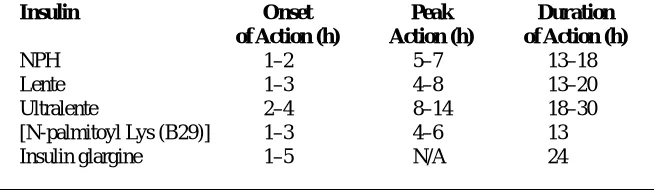
Lente insulins. The intermediate-act-ing human lente insulins are crystalline suspensions of insulin with zinc ions added to prolong duration of action. Human lente insulins have a slightly longer pharmacokinetic profile than NPH (Table 1), although variations in absorption with both insulins can make it difficult to distinguish between their time-action profiles.18Human ultralente insulin is the longest-acting human insulin. It exhibits peak activity between 8 and 14 h after injection, with glucody-namic effects lasting up to 30 h.9
The use of ultralente as a basal insulin is controversial. Several studies suggest that ultralente does not provide true basal insulin coverage. Instead, its pharmacokinetics are similar to those of NPH and lente insulins. Moreover, ultra-lente insulin is associated with high lev-els of severe hypoglycemia.18
The most significant shortcoming of NPH and the lente insulins is their vari-ability of effect. Despite attempts to achieve low, constant concentrations, these basal insulins still produce a peak.11
A related weakness is their large variability of absorption. It is estimated that 80% of the inconsistency of thera-peutic effect of NPH is due to variability in absorption from the subcutaneous site.19At least four features of the avail-able longer-acting insulins contribute to absorption variability. First, these insulins are in hexameric form. Once injected, the hexamers slowly dissociate into dimers and monomers, which are then absorbed into the tissue. The rate of dissociation and subsequent absorption Basal-bolus insulin regimens are
infrequently used in managing type 2 diabetes. Instead, therapy may consist of a once-daily long-acting subcutaneous insulin in combination with oral agents.4 There is concern about undue weight gain. However, at appropriate doses, a basal insulin need not induce marked weight gain.14
The first successful longer-acting exogenous insulins, protimine zinc, glo-bin, and neutral protamine Hagedorn (NPH) and the lente insulins, were pro-duced in the 1930s16and 1950s,17 respec-tively, and continue to be widely used to meet basal insulin requirements. Unfor-tunately, the pharmacokinetic and phar-macodynamic effects of these insulins often contribute to significant hypo- and hyperglycemia.12
Limitations of Available Basal Insulins
NPH insulin. NPH human insulin is a crystalline suspension formed by adding a basic protein (protamine) to insulin, rendering it less soluble at neutral pH and extending its duration of action. A single dose of NPH is inadequate for use with the short-acting insulin lispro.5
The number of injections of NPH per day is not of great concern. However, the action profile of NPH can make evening administration problematic. NPH has an onset of action within 2 h of injection, peaks approximately 6 h after injection, and has a duration of effect ranging from 13 to 20 h (Table 1). Thus, a pre-supper injection is not sustained overnight, and fasting hyperglycemia results.18
Administering NPH at bedtime can also be risky. An injection at 10:00 p.m. provides maximum hypoglycemic action between 3:00 and 5:00 a.m., when insulin requirements are relatively low. This increases the risk of nocturnal hypoglycemia. Attempts to prevent hypoglycemia by decreasing the night-time dose can lead to relative insulin deficiency between 5:00 and 8:00 a.m., a time when insulin sensitivity is
decreased. Morning fasting
hyper-is highly variable within and between subjects. Second, because they are sus-pensions, these insulins must be thor-oughly mixed. If they are not, inhomo-geneities can occur or insulin crystals can remain in the vials. Third, insulin injected as crystals in a suspension can be trapped in the tissue, unable to diffuse toward a capillary vessel, and may degrade over time.5Finally, variations in absorption may result from differences in local blood flow and tissue structure, resulting in a high intrapatient variability of effect when injected at different body sites.20
The excessive variability of absorp-tion of NPH and lente insulins is associ-ated with a high rate of hypoglycemia, the most common and severe complica-tion of insulin therapy.21Nocturnal hypoglycemia is particularly common in patients with well-controlled type 1 dia-betes.22Reducing the incidence of noc-turnal hypoglycemia is of utmost impor-tance given that even mild episodes of hypoglycemia can blunt counterregula-tory hormonal responses and increase the risk of hypoglycemia unawareness.22
Recent attempts to produce better long-acting insulins have focused on insulin analogs. Whereas the extended action of NPH and lente insulins is pro-duced by combining insulin with a retarding agent, insulin analogs are pre-pared by rearranging amino acids in the insulin molecule or attaching the insulin molecule to a side chain to attain desir-able pharmacological attributes.
Long-Acting Insulin Analogs
Insulin analogs are similar in structure and function to regular human insulin, a
Table 1. Approximate Pharmacokinetic Parameters of Basal Human Insulins
Insulin Onset Peak Duration
of Action (h) Action (h) of Action (h)
NPH 1–2 5–7 13–18
Lente 1–3 4–8 13–20
Ultralente 2–4 8–14 18–30
[N-palmitoyl Lys (B29)] 1–3 4–6 13
ing absorption of the insulin into the cir-culation.
The first long-acting insulin analog to use this mechanism was NovoSol Basal, which had a much slower absorp-tion than human ultralente insulin. However, NovoSol Basal was associated with local inflammatory reactions and increasing dosing requirements. There-fore, development was discontinued.12
In addition to diminished potency and local site reactions, development of insulin analogs has been hampered by their potential to induce cell prolifera-tion and carcinogenicity, which may be related to their ability to cross-react with insulin-like growth factor-1 (IGF-1). For this reason, all new insulin analogs are now tested for cross reactiv-ity with IGF-1.
Promising long-acting insulin analogs, such as NN304 (Novo Nordisk, Princeton, NJ), are in the later stages of development. Recently, the Food and Drug Administration approved insulin glargine (Lantus, Aventis Pharmaceut-icals, Bridgewater, NJ) for use in patients with type 1 or type 2 diabetes.
NN304
NN304 (ε-LysB29-myristoyl, des [B30] human insulin) is a long-acting insulin acylated with a 14-C-fatty acid chain, protein hormone comprising two
polypeptide chains. The A and B chains of human insulin are 21 and 30 amino acids in length, respectively. The chemi-cal, physichemi-cal, and biological properties of insulin are determined by the sequence of these amino acids. Changing their sequence or extending the chains can alter the pharmacokinetic and pharmacodynamic profiles of the insulin.
Experience gained with existing long- and intermediate-acting insulins has informed the development of long-acting insulin analogs. Theoretically, an optimum basal insulin is one that could be administered once daily, would have peakless action, would be consistently absorbed, and would be associated with lower rates of hypoglycemia and better glucose control than currently available insulins.
To minimize the absorption prob-lems associated with an insulin suspen-sion, insulin analogs have been formu-lated as homogenous solutions so that they may be more evenly distributed and diffuse more readily at a capillary sur-face. One such soluble insulin is [Ne-palmitoyl Lys (B29)] human insulin.19 Modification through fatty acid acyla-tion of the insulin extends its duraacyla-tion of action by increasing the residence time at the site of injection, in the circulation, and in the interstitial space at target sites. However, preliminary investigation indicates that a four- to fivefold higher dose of [Ne-palmitoyl Lys (B29)] human insulin is needed to achieve a similar effect to NPH insulin. It is uncertain at this time whether differ-ences in dosing are because of lower potency or decreased availability of [Ne-palmitoyl Lys (B29)] compared with NPH.19
Another strategy to prolong insulin absorption involves the substitution and/or addition of basic amino acid residues at locations on the A and B chains to elevate the isoelectric point of the insulin. When an acidic solution enters the neutral pH subcutaneous tis-sue, insulin molecules crystallize,
retard-which allows prolonged action due to reversible binding to albumin.23In healthy subjects (n = 10), bioactivity of NN304 was ~70% lower than that of NPH. However, in a separate study with 16 healthy subjects, NN304 demonstrat-ed an intrapatient variability of effect that was approximately half of that seen with NPH.23Clinical data in diabetic subjects should soon be available to indicate whether this insulin will offer significant benefits to diabetic patients.
Insulin glargine
Insulin glargine (HOE 901, 21A
-Gly-30Ba-L-Arg-30Bb-L-Arg human insulin)
has shown significant benefits in pre-clinical glucose clamp studies and in clinical trials with type 1 and type 2 dia-betic patients. Like NovoSol Basal, insulin glargine relies on shifting the isoelectric point of the insulin to a neu-tral pH (7.0).5
Insulin glargine is a homogenous solution, so it lacks some of the prob-lems associated with insulin suspen-sions. Results of absorption studies in healthy volunteers and subjects with type 1 (Figure 1) and type 2 diabetes show that insulin glargine has a peakless, long-lasting action profile with more repro-ducible pharmacokinetics than NPH.24–27 Additionally, no differences in
absorp-Figure 1. Time-action profile of insulin glargine and NPH human insulin in
long-acting insulin analogs will expand therapeutic options in the near future, improving the health of patients with dia-betes. Physician enthusiasm will be an important factor in acceptance of insulin therapy by type 2 diabetic patients.
REFERENCES
1Amos AF, McCarty DJ, Zimmet P (Eds.):
The rising global burden of diabetes and its com-plications: estimates and projections to the year 2010. Diabetic Med 14 (Suppl. 5):S1–S85, 1997
2The DCCT Research Group: The effect of
intensive treatment of diabetes on the develop-ment and progression of long-term complications in insulin-dependent diabetes mellitus. New Engl J Med 329:977–983, 1993
3Ohkubo Y, Kisikawa H, Araki E, Miyata T,
Isami S, Motoyoshi S, Kojima Y, Furuyoshi N, Shichiri M: Intensive insulin therapy prevents the progression of diabetic microvascular complica-tions in Japanese patients with non-insulin-dependent diabetes mellitus: a randomized, prospective 6-year study. Diabetes Res Clin Pract 28:103–117, 1995
4Riddle MC, Schneider J, the Glimepiride
Combination Group: Beginning insulin treatment of obese patients with 70/30 insulin plus glimepiride versus insulin alone. Diabetes Care 21:1052–1057, 1998
5Rosskamp RH, Park G: Long-acting insulin
analogs. Diabetes Care 22 (Suppl. 2):B109–B113, 1999
6Burge MR, Schade DS: Insulins. Endocrinol
Metab Clin North Am 26:575–596, 1997
7Hoogwerf B-J, Mehta A, Reddy S: Advances
in the treatment of diabetes mellitus in the elder-ly: development of insulin analogues. Drugs Aging 9:438–448, 1996
8White JR, Campbell RK: Diabetes. In
Clini-cal Pharmacy and Therapeutics. 5th ed. Herfind-al ET, Gourley DR, Hart LL, Eds. BHerfind-altimore, Md., Williams and Wilkins, 1992, p. 307–332
9Berger M, Heinemann L: Are presently
avail-able insulin analogues clinically beneficial? Dia-betologia 40:S91–S96, 1997
10Rowe R, Anderson JH, Gale E: A
double-blind comparison of insulin lispro with regular insulin in patients on a multiple injection regimen (Abstract). Diabetes 45 (Suppl. 2):71A, 1996
11Zinman B, Chiasson JL, Tildesly H, Tsui E,
Strack T: Insulin lispro in CSII: results of a dou-ble-blind, cross-over study (Abstract). Diabetes 45 (Suppl. 2):28A, 1996
12Barnett AH, Owens DR: Insulin analogues.
Lancet 349:47–51, 1997
13Janssen MMJ, Popp-Snijders C, Casteleijn
S, Roach P, Deville W, Heine RJ: Nighttime insulin kinetics and glycemic control in type 1 diabetes patients following administration of an intermediate acting lispro preparation. Diabetes Care 20:1870–1873, 1997
14Holman RR, Turner RC: Insulin therapy in
type II diabetes. Diabetes Res Clin Pract 28 (Suppl.):S179–S184, 1995
tion were observed when insulin glargine was injected at different body sites (leg, arm, or abdomen) in a crossover study with healthy volun-teers.28
Short-term (4 weeks)29–32and long-term (28 weeks)33,34clinical safety and efficacy studies have been conducted comparing insulin glargine to NPH human insulin in both type 1 and type 2 diabetes. These studies have demonstrat-ed that once-daily insulin glargine is as effective as or more effective than once-and twice-daily NPH regimens for glycemic control as measured by fasting plasma glucose and HbA1c, in many
cas-es with reduced incidence of nocturnal hypoglycemia.29,32–34
One drawback of insulin glargine compared with NPH and lente insulins is that it cannot be mixed with other insulins (e.g., lispro).35
Safety evaluations of insulin glargine indicate it is at least as safe as NPH; the frequency and types of adverse events in diabetic subjects are similar between treatments. Immunogenicity studies show no increased antibody develop-ment with insulin glargine compared with regular human insulin.36 Further-more, in vitro studies show that the IGF-1 receptor-mediated growth-promoting activity of insulin glargine in muscle cells is not different from that of native human insulin.37
Postmarketing data are needed to confirm the beneficial effects demon-strated by insulin glargine in controlled trials with diabetic subjects. The clinical benefits of insulin glargine must be established by improvement in overall patient outcomes as measured by glycemic control, incidence of hypo-glycemia, and improved quality of life.9
Summary
A constant supply of low-level basal insulin is essential to improving overall glycemic control. Achieving adequate basal insulin substitution requires knowledge of the pharmacology and limitations of available insulins.
Advances in the development of new
15Riddle MC: Combined therapy with a
sul-fonylurea plus evening insulin: safe, reliable, and becoming routine. Horm Metab Res 28:430–433, 1996
16Hagedorn H, Jensen B, Krarup N, Woodstrup
I: Protamine insulinate. JAMA 58:78–92, 1936
17Hallas-Moller K, Jersild M, Petersen K,
Schlichtkrull J: Clinical investigation on new insulin preparations with protracted action: insulin-zinc preparations used in one daily injec-tion. Ugeskr Laeg 113:1767–1771, 1951
18Hirsch IB: Intensive treatment of type 1
dia-betes. Med Clin North Am 82:689–719, 1998
19Radziuk J, Pye S, Bradley B, Braaten J,
Vig-nati L, Roach P, Bowsher R, DiMarchi R, Chance R: Basal activity profiles of NPH and [Ne-palmi-toyl Lys (B29)] human insulins in subjects with IDDM. Diabetologia 41:116–120, 1998
20Home P: Insulin glargine: the first clinically
useful extended-acting insulin in half a century? Exp Opin Invest Drugs 8:307–314, 1999
21Cryer PE: Hypoglycemia: the limiting factor
in the management of IDDM. Diabetes 43:1378–1389, 1994
22Kane K, Janssen MMJ, Keulen ETP, Jacobs
MAJM, Popp-Snijders C, Snoek FJ, Heine RJ: Substitution of nighttime continuous subcuta-neous insulin infusion therapy for bedtime NPH insulin in a multiple injection regimen improves counterregulatory hormonal responses and warn-ing symptoms of hypoglycemia in IDDM. Dia-betologia 41:322–329, 1998
23Bloomgarden ZT: New approaches to
insulin treatment and glucose monitoring. Dia-betes Care 22:2078–2082, 1999
24Coates PA, Muhherjec S, Luzio S,
Srodzins-ki KA, Kurzhals R, Rosskamp R, Owens DR: Pharmacokinetics of a long-acting human insulin analogue (HOE 901) in healthy subjects (Abstract). Diabetes 44 (Suppl. 1):130A, 1995
25Linkeschowa R, Heise T, Rave K,
Hom-pesch B, Sedlack M, Heinemann L: Time action profile of the long-acting insulin analogue HOE901 (Abstract). Diabetes 48 (Suppl. 1):97A, 1999
26Lepore M, Kurzhals R, Pampanelli S,
Fanel-li CG, BolFanel-li GB: Pharmacokinetics and dynamics of s.c. injection of the long-acting insulin glargine (HOE901) in T1DM (Abstract). Dia-betes 48 (Suppl. 1):97A, 1999
27Luzio SD, Owens D, Evans M, Ogunku A,
Beck P, Kurzhals R: Comparison of the sc absorption of HOE 901 and NPH human insulin in type 2 diabetic subjects (Abstract). Diabetes 48 (Suppl. 1):111A, 1999
28Owens D, Luzio S, Beck P, Coates P,
Tin-bergen J, Kurzhals R: The absorption of the insulin analogue HOE 901 from different sites in healthy subjects (Abstract). Diabetes 46 (Suppl. 1):329A, 1997
29Pieber TR, Eugene-Jolchine I, Derobert E:
Efficacy and safety of HOE 901 versus NPH insulin in patients with type 1 diabetes. Diabetes Care 23:157–162, 2000
30Rosenstock J, Park G, Zimmerman J, US
HOE 901 (insulin glargine) in subjects with type 2 DM: a 28-week randomized, NPH insulin-con-trolled trial (Abstract). Diabetes 48 (Suppl. 1):100A, 1999
35Lantus [package insert]. Bridgewater, N.J.,
Aventis Pharmaceuticals, 2000
36Siepke G, Berchthold H, Giesen K,
Hilgen-feld R, Rosskamp R: HOE 901: a new insulin with prolonged action (Abstract). Eur J Endocrinol 132 (Suppl. 1):25, 1995
37Bahr M, Kolter T, Seipke G, Eckel J: Growth
promoting and metabolic activity of the human insulin analogue [GlyA21,ArgB31,ArgB32]insulin (HOE 901) in muscle cells. Eur J Pharmacol 320:259–265, 1997
ACKNOWLEDGMENT
The author thanks Sheila Owens for insulin regimens. Diabetes Care 23:1137–1142,
2000
31Raskin P, Park G, Zimmerman J, US Study
Group of HOE 901 in Type 2 DM: The effect of HOE 901 in glycemic control in type 2 diabetes (Abstract). Diabetes 47 (Suppl. 1):103A, 1998
32Matthews DR, Pfiefer C, Multicentre
HOE901 Research Group: Comparative clinical trial of a new long-acting insulin (HOE901) vs protamine insulin demonstrates less nocturnal hypoglycemia (Abstract). Diabetes 47 (Suppl. 1):101A, 1998
33Ratner RE, Hirsch IB, Neifing JL, Garg SK,
Mecca TE, Wilson CA: Less hypoglycemia with insulin glargine in intensive insulin therapy for type 1 diabetes. Diabetes Care 23:639–643, 2000
34Rosenstock J, Schwartz S, Clark C,
Edwards M, Donley D: Efficacy and safety of
assistance with the development of this manuscript.
Richard Guthrie, MD, FAAP, FACE, CDE, is the medical director of Mid-America Diabetes Associates in Wichita, Kansas.
Note of disclosure: Dr. Guthrie sits on