EFFECT OF BAUXITE RESIDUE LOADING ON HEAT SHIELDING
PERFORMANCE OF AN AMMONIUM POLYPHOSPHATE BASED
EPOXY INTUMESCENT SYSTEM
Arogundade A. I.
1, Megat-Yusoff P. S. M.
1, Ahmad F.
1, Bhat A. H.
2and Gillani Q. F
1 1Department of Mechanical Engineering, Universiti Teknologi, Petronas, Malaysia
2
Department of Applied and Fundamental Science, Universiti Teknologi Petronas, Bandar Seri Iskandar, Malaysia E-Mail: [email protected]
ABSTRACT
Bauxite residue (BR) is the aluminosilicate waste generated by the alumina industry. Its disposal has become a global industrial problem. Preliminary study has recognized its potential as synergistic filler in intumescent system. In this work, the effect of percent weight of the residue on the heat shielding performance of the system was investigated. Different formulations were prepared by varying filler loading from 0 to 5%. Performance characterization of the coatings were done by using Furnace test to determine the char expansion at 500 °C and Bunsen burner test to determine insulative capacity at 900 + 100 °C. Thermogravimetric analysis was used as analytical tool. The presence of hydrated minerals in BR and early dehydroxylation of layered silicates were found to have a marked effect on heat shielding and flame spread. The effect of dehydroxylation appeared optimal at 2% BR influencing the melt rheology, improving insulative efficiency and reducing the flame spread. A steel back temperature of 172 °C was recorded compared to that of the unfilled with 267 °C. Excessive dehydroxylation at 4% BR led to high mass loss and early oxidation of char. The combined endothermic action of the hydrates and calcites and physical thermal barrier of the ceramic metal phosphates resulted in improved heat shielding performance and flame retardation of the BR-filled epoxy intumescent systems.
Keywords: bauxite residue, synergistic filler, intumescent coating, dehydroxylation, heat shielding efficiency.
INTRODUCTION
Bauxite residue (BR) commonly referred to as red mud (RM) is the alumino-silicate waste of the alumina refinery. For every tone of alumina produced, almost twice that amount of red mud is generated. With an annual generation of 120 million tonnes, global accumulation is said to be about 2.7 billion tonnes. Its sheer bulk, slurry nature and high caustic content make the disposal of red mud difficult and expensive. In a bid to create a sustainable disposal outlet for the residue, studies into BR utilization has evolved into a major research field in waste utilization [1, 2].
Due to its pozzolanic property and mineralogy, red mud has witnessed much research interest in the construction industry as cement additives, aggregates substitutes, bricks and sand. Its metal hydroxyl surface gives it high potentials as an adsorbent in the treatment of waste effluents, acid mine drains, soil remediation and gas scrubbing. It has also been studied as filler for anti-wear in plastics, and anti-corrosion in steel coatings [3-6].
The thermal analysis of red mud is well reported and shows three main endotherms at which heat is absorbed with the release of water or carbon dioxide [7, 8]. The release of water of hydration and other diluents gases is a major mechanism driving the performance of fire retardants and intumescent coatings. Fire retardants and intumescent coatings are passive fire safety devices which by their chemical and physical properties act to prevent the propagation of fire and sometimes smoke [9, 10].
Several workers have investigated the use of waste materials as alternative fillers in intumescent coatings. Estevao et al [11] investigated the effect of spent
oil catalyst in an ammonium polyphosphate-pentaerythritol intumescent system and found the zeolitic component of the waste to play a major role in fire retardation of the host material. Yew et al [12] incorporated egg shell into an acrylic based composite and reported high intumescence and good heat shielding property partly contributed by the CaCO3 component of the animal waste. It is interesting to note that BR not only possess endotherms which may act in the gaseous state to provide some level of heat sink, but its heterogeneous composition of metal oxides such as iron oxide, titanium oxide, calcium carbonate and zeolitic aluminosilicate minerals may also act in the condensed state as insulative shield. These aforementioned minerals have been reported in numerous works for their synergistic actions on intumescent fire retardant systems [13-15]. In this work therefore, TGA was employed as analytical tool to study the heat shielding performance of BR at different loading in an ammonium polyphosphate-expandable graphite based epoxy intumescent system.
EXPERIMENTATION
Materials
shows the oxide composition of the BR used in this study as analyzed by a Bruker X-ray Florescence Spectrometer.
Table-1. Oxide Composition of bauxite residue [16].
Components (wt %)
Fe2O3 Al2O3 SiO2 CaO TiO2 Na2O P2O5 Cl
50.8 11.5 11.4 10.1 9.58 2.42 1.11 0.765
Sample preparation and characterization
The BR was used without washing. After light grinding with mortar and pestle, certain quantity was dried in a Carbolite 450 Oven at 105 °C for 24 hours to remove physically bonded water and prevent clogging of holes during sieving. This was passed through a set of sieves to obtain an even size distribution. The material retained in the 63 μm sieve and the pan was used for the coating. The microscopic structure of the mud was studied using a Field emission scanning electron spectrometer. Phase analysis was carried out on a Bruker type Xray Diffractometer. Its thermal properties were analysed on an Exstar TG/DTA 6300, S11 Model at the SIRIM Bhd. Sdn. in the temperature range of 30°C to 1000°C.
Preparation of intumescent coatings (IC)
Several bauxite residue intumescent coatings (BR-IC) were prepared in an epoxy matrix by varying the mass of BR in the base formulation. The base formulation was made up of ammonium polyphosphate-melamine-boric acid-expandable graphite (APP-MEL-BA-EG) in the ratio 3:1:3:1 [17]. Coatings were applied on 100 x 100 x 3 mm steel plates for Bunsen burner test and on 50 x 50 x 3 mm steel plates for char expansion test. Filler percent loadings of 0-5% were used and the coatings were referred to as BR-IC0 to BR-IC5 respectively.
Furnace test
The coated plates were fired in a Carbolite muffle furnace from 30 °C to 500 °C at 45 minutes ramp and 60 minutes dwell time. Film thickness was measured using a PosiTector 6000 Coating thickness gauge. Char thickness was determined by calculating the average of four readings taken at each side of the char with a meter rule. Degree of expansion was calculated as a ratio of char expansion to film thickness. The test was repeated three times and the average of the readings taken.
Fire Test
The Bunsen burner test was conducted to determine the heat shielding efficiency. The heat curve was maintained at 900 + 100 °C following closely the ASTM E 119 Standard Fire Curve for building structures. An impacting hydrocarbon flame from a butane gas was applied to 100 x 100 x 3mm coated steel plates for 60 minutes. Three K-type thermocouples were attached to the uncoated face. Readings were recorded using an Anritsu AM-800K data logger. Average steel back temperature was plotted against time.
Thermogravimetric analysis (TGA)
The residual mass and thermal behaviour of each formulation were determined on a Perkin Elmer Pyris Thermogravimetric Analyzer at 10 °C/min from 30 °C to 800 °C in inert environment with nitrogen.
RESULTS AND DISCUSSION
Fire retarding properties of BR
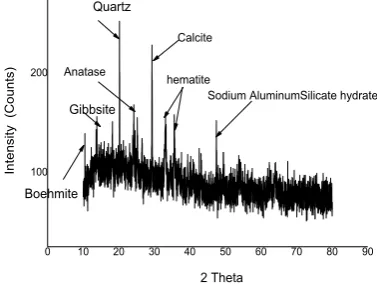
The Xray analysis of BR in Figure 1 revealed a crystalline mixture of several metal oxides and hydroxide minerals. Anatase (TiO2), silica (SiO2) and hematite (Fe2O3) are resident impurities in the parent bauxite ore, while calcite (CaCO3), and sodium aluminium silicate hydrates (Na6(Al6Si6O24)2NaF.xH2O) are precipitation products of the hydrothermal processing of bauxite to alumina. Residual aluminium hydroxides, gibbsite and boehmite were also identified. XRD showed a significant percent of amorphous presence. The presence of semi crystalline layered hydroxides in BR has also been reported [18, 19]. FESEM micrographs of the residue in Figure 2 revealed nano-sized aggregates of platy silicates, cubic calcites, rod-like constituents suspected to be zeolitic sodalite, and a cementing amorphous layer of probably ferrihydrites.
0 10 20 30 40 50 60 70 80 90
100 200
2 Theta
Int
en
sity (
Coun
ts)
Sodium AluminumSilicate hydrate Calcite
Anatase
hematite
Gibbsite
[image:2.595.327.516.505.648.2]Boehmite Quartz
Figure-2. Micrograph of bauxite residue [16].
Thermal analysis of the residue in Figure 3 revealed 3 endotherms. The first endotherm occurred within the first 100 °C due to surface water, the second is located between 270-300 °C from the dehydration of the interlattice water of the layered silicates. The third main endotherm exists between 650-750 °C due to decarbonation of calcite with release of carbon dioxide. These endothermic reactions are responsible for the three major mass losses as depicted in Figure-4. The release of diluent gases such as water and CO2 as represented in equations 2 and 3 is a major mechanism responsible for fire retardation in the gas phase. The mass loss of 18% spread over 1000 °C as shown in Figure 5 indicates the high thermal stability of BR. The barrier action of the resulting oxides and the formation of glassy ceramics around 850-1350 °C [20] would also act in the condensed phase to contribute to the insulative capacity of BR intumescent coatings.
Figure-3. Endothermic peaks of bauxite residue.
Figure-4. DTG showing the 3 major mass losses of
bauxite residue.
2�� �� � � � � + � � � (1)
���� � ��� � + �� � (2)
Where M represents Al or Fe
Figure-5. Mass loss of bauxite residue spread over a
wide temperature range.
Expansion behavior of BR-ICs
The expansion behaviour of BR-IC systems appeared inconsistent, probably due to the heterogeneous nature of the residue and uneven dispersion in the matrix. The average of three runs is presented in Figure-6. At 1% addition, the char expansion was not significantly affected, about 10.6 % reduction in the degree of char expansion occurred at 2% loading. Beyond 2% further addition resulted in increasing expansion. The general expansion with filler addition is attributed to the increased intumescence contributed by the released interlayer water. Reduction of char volume at 2% of BR occurred as a result of early dehydroxylation of the layered silicates at around 300 °C. This conclusion is drawn from the result of the thermogravimetric analysis which is presented later in the paper. Layered silicates are known to undergo structural changes due to dehydration which may lead to collapse of the crystal structure and transition to an amorphous phase [21]. Such changes in the mid-temperature is not uncommon, especially for poorly crystalline alumina silicates [22]. This structural change at 2% BR had an effect on melt rheology leading to a more compact structure.
Figure-6. Graph of char expansion against bauxite
residue loading for BR-IC systems.
Insulative efficiency of BR-IC
Results of Bunsen burner test is presented in Figure-7. The fire behaviour of the different systems are explained using the TGA graph of Figure-8 and the pictures of the fired plates presented in Figure-9. The presence of the hydrated minerals has a marked effect on the fire performance of BR-IC systems. The filled systems had an initial lower rise in temperature compared to the unfilled due to the additional water of hydration and CO2
-100 0 100 200
0 200 400 600 800 1000
R
ate
o
f m
ass
lo
ss
(u
g
/m
in
)
Temperature (°C)
DTG
-20
0
20
0 500 1000
M
ass l
o
ss
(w
t%
)
Temperature (°C)
0 2 4 6
BR-IC0 BR-IC1 BR-IC2 BR-IC3 BR-IC4 BR-IC5
E
xp
an
si
o
n
r
atio
gas. The better performance of BR-IC2 at 172 °C in 60 minutes is due in part to the early temperature plateau caused by the dehydroxylation of the layered silicates and in part to the ceramic metal phosphates. Excessive dehydroxylation in BR-IC4 at 300 °C led to a mass loss of 50% with a drastic drop in insulative efficiency and a steel temperature of 290 °C at 60 minutes. The combined effects of the heat sink created by the endothermic reaction
Figure-7. Temperature-time curves of BR-IC systems.
and insulative barrier by the high residual mass is seen at play in BR-IC5 and BR-IC3. For BR-IC1, the loading appeared insufficient for significant endothermic effect and this could be seen in the fast rise of the heat curve compared to the others. This caused reduced mass loss at around 450 °C resulting in a high residual mass of 46% at 800 °C with increased oxidative performance compared to BR-IC4. For BR-IC0, early oxidation of the carbonaceous char led to a second steep rise. This could not be adequately arrested by residual boron phosphates alone, resulting in a steel temperature of 267 °C at 60 minutes. The insulative action of boron phosphates is augmented in the BR-filled systems by the ceramic metal oxides and silicates.
Figure-8. TGA pattern of BR-IC systems heated to 800
°C.
Figure-9. BR-ICplates at 60 minutes’ butane gas firing.
CONCLUSIONS
The thermal properties of bauxite residue have been analysed vis-à-vis its performance in an epoxy based intumescent system. The effect of percent filler loading on heat shielding performance was investigated using small scale fire test and thermogravimetric analysis. The presence of hydrated minerals is found to be responsible for an initial low rise in temperature. Early dehydroxylation of the layered silicates was found to have a marked effect on insulative performance. Early dehydroxylation gave improved performance while excessive dehydroxylation resulted in low residual mass and quick oxidation of the carbonaceous char. The heterogeneity of the residue and uneven dispersion might have contributed to the non-linear performance of the BR-IC systems. At this stage, no direct correlation could be found between percent filler loading and the dehydroxylation process but the effect appeared optimal at 2% BR and influenced the rheology of the system leading to formation of a more compact char, reduced flame spread and a steel back temperature of 172 °C compared to the unfilled with 267 °C.
ACKNOWLEDGEMENT
The authors wish to acknowledge the Department of Mechanical Engineering, Universiti Teknologi, Petronas for sponsoring this research work.
REFERENCES
[1] C. Klauber, M. Grafe, and G. Power, "Bauxite residue issues: II. Options for residue utilization," Hydrometallurgy, vol. 108, pp. 11-32, Jun 2011.
[2] H. Sutar, S. C. Mishra, S. K. Sahoo, and H. Maharana, "Progress of red mud utilization: An overview," 2014.
[4] V. A. Prabu, V. Manikandan, and M. Uthayakumar, "Friction and dry sliding wear behavior of red mud filled banana fibre reinforced unsaturated polyester composites using taguchi approach," Materials Physics and Mechanics, vol. 15, pp. 34-45, 2012.
[5] A. Bhatnagar, V. J. Vilar, C. M. Botelho, and R. A. Boaventura, "A review of the use of red mud as adsorbent for the removal of toxic pollutants from water and wastewater," Environmental technology, vol. 32, pp. 231-249, 2011.
[6] X. Liu and N. Zhang, "Utilization of red mud in cement production: a review," Waste Management & Research, vol. 29, pp. 1053-1063, 2011.
[7] S. N. Meher, "Thermal Analysis of Nalco Red Mud," International Journal of Chemical Studies, vol. Vol. 1 2014.
[8] M. L. P. Antunes, S. J. Couperthwaite, F. T. da Conceicao, C. P. Costa de Jesus, P. K. Kiyohara, A. C. V. Coelho, et al., "Red mud from brazil: Thermal behavior and physical properties," Industrial & Engineering Chemistry Research, vol. 51, pp. 775-779, 2011.
[9] T. R. Hull, A. Witkowski, and L. Hollingbery, "Fire retardant action of mineral fillers," Polymer degradation and stability, vol. 96, pp. 1462-1469, 2011.
[10]F. Laoutid, M. Lorgouilloux, D. Lesueur, L. Bonnaud, and P. Dubois, "Calcium-based hydrated minerals: Promising halogen-free flame retardant and fire resistant additives for polyethylene and ethylene vinyl acetate copolymers," Polymer Degradation and Stability, vol. 98, pp. 1617-1625, 2013.
[11]L. R. Estevão, M. Le Bras, R. Delobel, and R. S. Nascimento, "Spent refinery catalyst as a synergistic agent in intumescent formulations: influence of the catalyst's particle size and constituents," Polymer degradation and stability, vol. 88, pp. 444-455, 2005.
[12]M. C. Yew and N. H. R. Sulong, "Fire-resistive performance of intumescent flame-retardant coatings for steel," Materials & Design vol. 34, pp. 719-724., 2012.
[13]F. Ahmad and S. Ullah, "Enhancing the Char Resistant of Expandable Graphite Based Intumescent Fire Retardant Coatings by Using Multi-Wall Carbon Nano Tubes for Structural Steel," Solid State Phenomena, vol. 185, pp. 90-93, 2012.
[14]M. Jimenez, S. Duquesne, and S. Bourbigot, "Kinetic analysis of the thermal degradation of an epoxy-based intumescent coating," Polymer Degradation and Stability, vol. 94, pp. 404-409, 2009.
[15]F. Ahmad, S. Ullah and W. F. Mohamad, "Effect of Inorganic Fillers on Thermal Performance and Char
Morphology of Intumescent Fire Retardant Coating," Asian Journal of Scientific Research, vol. 6, pp. 263-271., 2013.
[16]A. I. Arogundade, P. S. M. Megat-Yusoff, A. H. Bhat, and A. Faiz, "Characterization of red mud-epoxy intumescent char using surface imaging and micro analysis," AIP Conference Proceedings, vol. 1669, p. 020063, 2015.
[17]F. Ahmad, P. S. M. B. M. Yusoff, and M. Zia-ul-Mustafa, "Effect of Kaolin Clay and Alumina on Thermal Performance and Char Morphology of Intumescent fire retardant coating," in MATEC Web of Conferences, 2014, p. 04013.
[18]D. McConchie, M. Clark, C. Hanahan, and R. Fawkes, "The use of seawater-neutralised bauxite refinery residues (red mud) in environmental remediation programs," in Proceedings of the 1999 Global Symposium on Recycling, Waste Treatment and Clean Technology, San Sebastian, Spain, 1999.
[19]S. J. Palmer, R. L. Frost, and T. Nguyen, "Hydrotalcites and their role in coordination of anions in Bayer liquors: anion binding in layered double hydroxides," Coordination Chemistry Reviews, vol. 253, pp. 250-267, 2009.
[20]V. M. Sglavo, S. Maurina, A. Conci, A. Salviati, G. Carturan, and G. Cocco, "Bauxite ‘red mud’in the ceramic industry. Part 2: production of clay-based ceramics," Journal of the European Ceramic Society, vol. 20, pp. 245-252, 2000.
[21]M. F. Iozzi, C. Bisio, T. Regi-Macedo, C. Airoldi, M. Cossi, and L. Marchese, "Structural changes induced by dehydration in the crystalline layered silicate Na-RUB-18: a computational/experimental combined study," Journal of Materials Chemistry, vol. 19, pp. 2610-2617, 2009.