Copyright © 2017, Scholarly Research Journal for Interdisciplinary Studies
DEVELOPMENT OF “TEACHING COMPETENCY SCALE [TCS] OF B. Ed TRAINEES”
D. Senthil Murugan1 & T. Sivasakthi Rajammal2 1
Assistant Professor, E. S. College of Education, Villupuram, TamilNadu, India. 2
Assistant Professor, Department of Educational Psychology, TamilNadu Teachers Education
University, Karapakkam, Chennai, TamilNadu, India.
In the present study, teaching competency scale (TCS) has been constructed and standardized for the B. Ed trainees. This scale consists of 59 statements. The simple random sample technique was used for current investigation. The sample consists of 117 B. Ed trainees randomly selected from Villupuram Districts. The “Cronbach’s Alpha” technique was used to regulate the tool and finally out of 59 statements, 42 statements were retained in the final study.
Keywords: Teaching Competency, B. Ed trainees, Professional, statements, dimensions.
Introduction
The quality of education has been significantly important in recent years. This plays a
key tent for the professionals who teach in this modern society with ethnically capable, clever,
pioneering, resourceful problem-solvers, skilled and critical philosopher. Hence, these skills
of the professional teachers help the learners to team up with good decisions, manage their
time effectively, respond to one another and decide the right communication strategy at the
right time (Olga Nessipbayeva, 2012).
Restructuring teaching profession has been a main public discussion by creating a new
change in the educational system. The different reorganization activities which took place on
teacher training system have made it difficult to get standardization in teacher education
which will enhance the basic teaching competencies (Suleyman Sadi Seferoglu, 2005).
Therefore, teachers have a meticulous effort in the classroom and outside as well as
frequent interaction with parents and society. For this reason teachers need to be well trained
and competent to perform their professions. If teachers acquire teaching competencies with
commitment and enabled to perform their multiple tasks in the classroom as well as in the
community in a genuine professional manner, then high quality learning increases as a result
in cognitive, affective and psychomotor areas of human development which will augment the
teaching performance through more effectiveness.
Scholarly Research Journal's is licensed Based on a work at www.srjis.com
Copyright © 2017, Scholarly Research Journal for Interdisciplinary Studies
Thus, teaching competency is an essential factor in solving most educational problems (Shashi
Shukla, 2014).
Thereby, on understanding the needs of new requirements a teaching competency
scale was implemented for the B.Ed trainees.
Definitions of teaching competency of B.Ed trainees
On going to teaching competency, we have to know the competency first. Competency
is defined as a requirement of a “competency-based” teacher education which includes the
knowledge, skills and values of a teacher-trainee to demonstrate for the successful completion
of a teacher education programme (Houstan, 1987).
Teaching competencies include the acquisition and demonstration of the composite
skills required for student teaching like establishing a lesson, fluency in questioning, probing
questions, amplification, rapidity of lesson, strengthening, sympathetic child psychology,
recognizing performances, classroom supervision and generous assignment. Competency
development is a continuous process in the institution. B.K.Passi and M.S.Lalitha defined that
the teaching competency is an effective performance of all observable teachers’ behavior that
brings about desired novice effects. Halls & Jones (1976), definite that the competencies are
the composite skills, manners or acquaintance that can be demonstrated by the learner and
desired from explicit conceptualization of the preferred outcomes of learning competencies
through assessment of student learning through direct observation of learners behavior.
Walker (1992), defines the competency are the attributes which enable an individual or group
to perform a role to an appropriate grade of quality and thus make the individual or group
experienced in that responsibility.
Encyclopedia of teacher training and education (Vol.II, 1998) defines teaching
competency as a suitable skill, knowledge and experience for teaching purpose, which are
appropriately satisfied. S.Venkataiah (2000), describes the teaching Competency as a solitary
knowledge, ability or specialized proficiency which a teacher may say to posses and which
was believed to be relevant to the successful practice of teaching. Therefore, the current
investigation was based on the following literature study.
Review of Related Literature:
R. Sivakumar and Dr. A.Edward William Benjamin (2016) conducted a study deals
with the interrelationship among teaching competency and professional development of
teacher educators in B.Ed. colleges. The investigators have randomly selected a teacher
Copyright © 2017, Scholarly Research Journal for Interdisciplinary Studies
Statistical techniques used by Pearson’s correlation and t-test were employed for analyzing
the data. Results reveal that there is an interrelationship between teaching competency and
professional development of teacher educators in B.Ed. colleges. Hence, the teacher educators
having a positive influence on teaching competency show higher relationship in their
professional development. Also result reveals that there is no significant difference between
teaching competency and professional development of teacher educators in the sub categories
such as gender, teaching of pedagogy subject and also reflect evidence that there is a
significant difference between the experience of below 5 years and above 5 years of teacher
educators in B.Ed. colleges.
A. Antony Sagaya Ruban and Dr. R. Selvaraju (2015) conducted a study reveals that
the relevance of modernity of B.Ed trainees in relation to the background variable and gender.
A self-made tool was used for assessing modernity of 987 B.Ed trainees from three districts
namely, Tirunelveli, Kanyakumari and Tuticorin in Tamil Nadu. The simple random sampling
method was espoused for attaining the data. The results illustrates that the modernity on
teaching competency of B.Ed trainees was correlated with an orientation to gender.
Jagannadh.Y.V and Dr. J. Master Arul Sekar (2012) measured the teaching
competency and attitude towards teaching profession of B.Ed. college students. The sample
consists of 300 student teachers of colleges of education from Amalapuram town, affiliated to
Andhra University. The teaching competency and attitude towards teaching inventory was
developed and standardized by him. The results show that the inter-dimensional relationship
between teaching competency and attitude towards teaching profession is positive. Male and
female teachers do not differ significantly in terms of their teaching competency and attitude
towards the teaching profession. The rural and urban student teachers do not differ
significantly in terms of their teaching competency and attitude towards the teaching
profession. The age below 25years and above 25years of student teachers do not differ
significantly in terms of their teaching competency and attitude towards the teaching
profession.
F. L. Antony Gracious and P. Anna raja (2011) found the relationship between
creativity and teaching competency of prospective B.Ed teachers. Statistics of the study were
composed using self made teaching competency scale and creativity scale. The investigator
used a random sampling technique for selecting the sample. The sample consists of 242 B.Ed
Copyright © 2017, Scholarly Research Journal for Interdisciplinary Studies
statistical techniques used. As a result, there was no significant relationship between creativity
and teaching competency of prospective B.Ed teachers.
Vogt.F, Rogalla.M, (2009) seeks to conceptualise the processes of modification of
teaching to the individual student's learning needs and empirically test, within the field of
science teaching, to an extent adaptive teaching competency can promote through teacher
education. 32 primary and secondary teachers were examined their adaptive teaching
competency based on content-focused coaching while 18 teachers formed the control group.
As a result, teachers receiving the coaching increased to their adaptive teaching competency
with regard to planning and their students showed a higher learning outcome compared to the
control group.
Pilot Study
The teaching competency scale of 59 statements intended for the pilot study was
administrated to the sample of 117 B.Ed trainees studying in the Villupuram Districts. Then,
their responses have been scored carefully and the marks secured by all the B.Ed trainees have
been arranged in the descending order from the highest score to lowest score. Then, they were
subjected to the statement analysis.
Construction of teaching competency scale
The investigator constructed the teaching competency scale for B.Ed trainees. The
scale used for the pilot study, consists of 59 items. All the 59 items were with five point
scales, such as always, often, sometimes, occasionally and never. The statement of the scale
consists of factors related to, interest in the profession, classroom behavior, attitude towards
students and instructional strategy. The tool was validated with the help of 117 B.Ed trainees.
Each statement has been scored as 5 for always, 4 for often, 3 for sometimes, 2 for
occasionally and 1 for never for all the favorable statements. The total scores secured from the
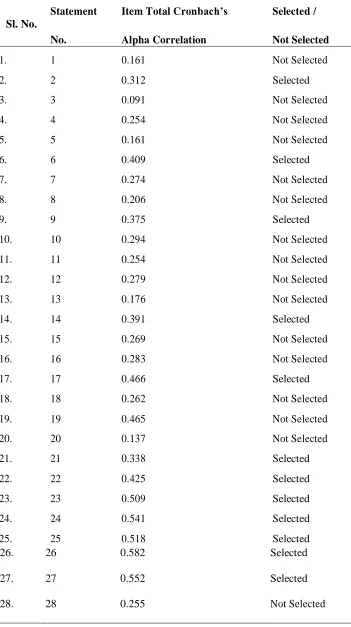
sample were calculated by using Cronbach’s alpha method to identify the reliability of the
tool. The statements which have a value above than 0.3 level was selected for the final study.
Thus, out of 59 statements, 42 statements were selected for the final study. The final
studies of the teaching competency scale of B.Ed trainees of the pilot study show the selected
Copyright © 2017, Scholarly Research Journal for Interdisciplinary Studies
Table 1. Statement Analysis For Teaching Competency Scale Of B. Ed Trainees And Selection Of Statements For Final Study
Sl. No.
Statement Item Total Cronbach’s Selected /
No. Alpha Correlation Not Selected
1. 1 0.161 Not Selected
2. 2 0.312 Selected
3. 3 0.091 Not Selected
4. 4 0.254 Not Selected
5. 5 0.161 Not Selected
6. 6 0.409 Selected
7. 7 0.274 Not Selected
8. 8 0.206 Not Selected
9. 9 0.375 Selected
10. 10 0.294 Not Selected
11. 11 0.254 Not Selected
12. 12 0.279 Not Selected
13. 13 0.176 Not Selected
14. 14 0.391 Selected
15. 15 0.269 Not Selected
16. 16 0.283 Not Selected
17. 17 0.466 Selected
18. 18 0.262 Not Selected
19. 19 0.465 Not Selected
20. 20 0.137 Not Selected
21. 21 0.338 Selected
22. 22 0.425 Selected
23. 23 0.509 Selected
24. 24 0.541 Selected
25. 25 0.518 Selected
26. 26 0.582 Selected
27. 27 0.552 Selected
Copyright © 2017, Scholarly Research Journal for Interdisciplinary Studies
29. 29 0.519 Selected
30. 30 0.264 Not Selected
31. 31 0.451 Selected
32. 32 0.444 Selected
33. 33 0.381 Selected
34. 34 0.239 Not Selected
35. 35 0.418 Selected
36. 36 0.458 Selected
37. 37 0.396 Selected
38. 38 0.401 Selected
39. 39 0.508 Selected
40. 40 0.444 Selected
41. 41 0.377 Selected
42. 42 0.496 Selected
43. 43 0.448 Selected
44. 44 0.459 Selected
45. 45 0.484 Selected
46. 46 0.323 Selected
47. 47 0.418 Selected
48. 48 0.439 Selected
49. 49 0.350 Selected
50. 50 0.457 Selected
51. 51 0.462 Selected
52. 52 0.585 Selected
53. 53 0.491 Selected
Copyright © 2017, Scholarly Research Journal for Interdisciplinary Studies
59. 59 0.409 Selected
Description of the teaching competency scale of B.Ed trainees:
The teaching competency tool was constructed and validated by the investigator. The
investigator constructed this tool on the bases of the literature review with regard to teaching
competencies of the B.Ed trainees and its dimensions are interest in profession, classroom
behavior, attitude towards students and instructional strategy. Totally 42 statements were
finalized on the basis of the dimensions of teaching competency.
Dimensions of teaching competency of B.Ed trainees:
Teaching competency scale for B.Ed trainees consist of four dimensions namely,
interest in profession, classroom behavior, attitude towards students and instructional strategy.
The 59 statements were arranged according to the dimensions such as, interest in profession
has 15 statements, classroom behavior has 14 statements, attitude towards students has 13
statements and instructional strategy has 17 statements (table 2).
Interest in profession:
Interests in profession are helpful to understand the relation to the professional
development. Professional interests are different than ability or cleverness. However, the
statements from 1-15 determines the professionals tend to be attracted towards the activities
that they enjoy and are interested in, which then affords the opportunity to develop skills and
abilities.
Classroom behavior:
Classroom behavior is one of the trickiest issues of B.Ed trainees facing nowadays.
Disruptive behavior results shows lose of time in curriculum and creates a classroom
environment that is not always favorable to learning. Therefore, statements 16-29 are the key
to nipping behavioral problems in the bloom to promote a positive environment before the
problems arise.
Attitude towards students:
Teaching completely changed our mode of teaching and learning in the current years. Use of
computer assisted teaching, audio visual aids; power point presentations, etc., have found their
55. 55 0.316 Selected
56. 56 0.410 Selected
57. 57 0.387 Selected
Copyright © 2017, Scholarly Research Journal for Interdisciplinary Studies
place in every institution in the world. The attitude of teacher trainees towards teaching aids
enhances the teaching -learning context. A questionnaire on attitude towards students was
prepared by the investigators from 30-42 in a sample. It was found that teaching through
visual aids enabled classrooms to be interesting and motivating for both teachers and learners.
Instructional strategy:
Instructional strategies are techniques where the teachers use to help students to be
independent and strategic in learners. These approaches lead from 43-59 statements of
learning strategies when students independently select the appropriate persons and use them
effectively to accomplish responsibilities or congregate to achieve their goals.
Table 2. Dimensions- Wise Distribution Of Selected Items In Teaching Competency Of B.Ed Trainees
S.No. Dimensions Questionnaires Total
1. Interest in profession 1-15 15
2. Classroom behaviour 16-29 14
3. Attitude towards students 30-42 13
4. Instructional strategy 43-59 17
Total 59
Reliability:
A reliability coefficient measures the accuracy of a test or measuring instrument
obtained by measuring the same individuals twice and computing the correlation of the two
sets of measures by the Cronbach’s alpha method. Therefore, the reliability value is 0.915.
Validity:
validity was established by circulating the roughly drafted teaching competency tool
and carrying out all the suggestions specified by the professors in the Department of
Education.
Scoring Procedure:
The tool consists of 59 statements which reflected the teaching competency of the
B.Ed trainees. The respondents were asked to put a tick (√) mark against each statement under
one of the five responses such as always, often, sometimes, occasionally and never. Each item
has scored as 5 for always, 4 for often, 3 for sometimes, 2 for occasionally and 1 for never for
all the favorable statements. The teaching competency scale of B.Ed trainee’s score of the
subject gives the sum total of statement scores of all the 5 sub scales. As a result, the range of
Copyright © 2017, Scholarly Research Journal for Interdisciplinary Studies Conclusion
The investigator is hopeful that this scale would be helpful to measure the level of
teaching competency of B.Ed trainees. Hence, the constructed teaching competency tool will
be very useful for the investigator to measure the extent level of teaching competency of B.Ed
trainees in their future teaching profession.
References
Olga Nessipbayeva, (2012), The competencies of the modern teacher. In the 10th Annual Meeting of the Bulgarian Comparative Education Society, Kyustendil, Bulgaria: 148–154.
Suleyman Sadi Seferoglu, (2005), A study on teaching competencies of teacher candidates, Proceedings of the International Conference on Education. Singapore, 709-716.
Shashi Shukla, (2014), Teaching competency, professional commitment and job satisfaction-A study of primary school teachers, IOSR Journal of Research & Method in Education (IOSR-JRME) Vol. 4(3), Ver. II, 44-64.
R. Sivakumar, Dr. A.Edward William Benjamin, (2016), Interrelationship among teaching competency and professional development of teacher educators in B.Ed. Colleges, International Education and Research Journal, Vol. 2(1).
A. Antony Sagaya Ruban, Dr. R. Selvaraju, (2015), Correlation between modernity and teaching competency of B.Ed trainees - a gender wise analysis, Paripex- Indian Journal of Research, Vol. 4 (9).
Jagannadh Y V, Dr. J. Master Arul Sekar, (2012), Teaching competency of B.Ed. female teacher trainees, An International Indexed, Refereed & Peer Reviewed Bi-Annual Journal in Education, Vol.III (II).
F. L. Antony Gracious, P. Annaraja, (2011), Creativity and teaching competency of prospective B.Ed teachers, Turkish Online Journal of Distance Education-TOJDE, Vol.12 (1).