1
Cite This Paper: Shin Y Ang, SNAM Razali, Sie L Kek.(2019) Optimized Preference of Security Staff Scheduling Using Integer Linear Programming Approach, 8(4), COMPUSOFT, An International Journal of Advanced Computer Technology.
This work is licensed under Creative Commons Attribution 4.0 International License.
OPTIMIZED PREFERENCE OF SECURITY STAFF SCHEDULING USING
INTEGER LINEAR PROGRAMMING APPROACH
Shin Yin Ang1*, Siti Noor Asyikin Mohd Razali2, Sie Long Kek3
1,2,3
Department of Mathematics and Statistics, Faculty of Applied Sciences and Technology, Universiti Tun Hussein Onn Malaysia, Pagoh Education Hub, 84600 Pagoh, Johor, Malaysia
[email protected], [email protected], [email protected]
Abstract: This paper proposes an optimized schedule for security staff using integer linear programming approach. It is important to improve the life quality of the security staff since the negative social life such as family problems, less social support or even stress following from a poor work schedule. Therefore, this study aims to maximize the preference satisfaction of the security staff by allowing them to choose their preferred shift and day off while taking into consideration the restrictions of the university rules. The mathematical model of integer linear programming approach is developed and solved by using LPSolve IDE package. The result shows the overall preference satisfaction of the security staff towards work shift and days off is successfully maximized from 228.33 to 394.33. The comparison of the real schedule and the new proposed optimized schedule is made and all the constraints are successfully satisfied. The proposed schedule able to assist the university management in producing the most flexible and beneficial schedule for their staff to increase the satisfaction towards the working life.
Keywords: scheduling; shift; preference; integer programming; security staff
I. INTRODUCTION
Scheduling is a complex process of assembling work timetables for different number of staff and different type of tasks [1, 2]. Scheduling is indeed important in the area of manufacturing and service. By considering the limited resources, scheduling functions as a plan to optimize the objective of management and achieve the goals of company in a fixed period of time, normally a week or a month [2, 3]. Additionally, the workforce scheduling problems are traditionally classified into three types: shift scheduling, days off scheduling, and tour scheduling. Shift scheduling determines each employee's work and breaks hours per day. Days off scheduling determines each employee's workdays and off days per week or multiple-week work cycle.
Meanwhile, the tour scheduling combines the shift and days off scheduling problems by determining each employee's daily work hours and weekly workdays [4].
Security staff scheduling is the procedure of assigning staff to a certain task in a set of shifts during a fixed period of time [2]. A proper schedule for the security staff is important for an institution or a company as they are responsible to make sure the surrounding is safe and secure. Security staff should be always in a good condition physically, mentally and emotionally since their job need a high attention during all the period to keep the property as well as the people safe. In general, the schedule of security staff, which is performed for 24 hours, is assigned to the shift due to their post.
Available online at: https://ijact.in
Date of Submission Date of Acceptance
25/02/2019 08/04/2019 Date of Publication
Page numbers (9 Pages)
2
Normally, the security staff has different preference for their work shift and day off depending on their lifestyle. This due to the diverse personal lifestyles and different degrees of physical tolerance for continuous working days [5]. The preference satisfaction of security staff enables them to have a proper rest in order to increase the quality of their service. Besides, a security staff who can work at his/her preference work shift and rest at his/her preference day can have a positive social life. On the other hand, a low preference satisfaction schedule will create disturbances in their lives, no time for family and friends as well as having health problems [6, 7]. Thus, this study is aim to produce a schedule that consider the preference and opinion of security staff to ensure their performance of work is always in high level. This win-win situation between the management and the security staff could be achieved.
There is less studies in the literature that consider the preference of workforce especially for security staff. None of them includes both criteria, the preference of work days and days off in developing the optimal schedule for security staff. To fill in the gap, this paper proposes a mathematical model for scheduling the security staff at Universiti Tun Hussein Onn Malaysia (UTHM) which includes the preference of shift and day offs for one-week period. This model includes maximum number of staff for each shift as a hard and preference rank towards each shift as a soft constraint in order to maximize the satisfaction of security staff towards the working life. The optimization approach, integer linear programming approach was applied to find the optimal schedule in thousands of solution space.
There are many types of shift and day off such as four hours shift, six hours shift and eight hours shift. Meanwhile, for days off, there are random two days in a week, two continuous days in a week or one day in a week. In UTHM, the schedule applies eight hours shift and continuous two days off after six days working for eight days’ cycle. The problem exists when their working days is different than normal period which is seven days’ cycle. Hence, this study proposes the seven day’s schedule to overcome the problem.
The next section discusses on previous studies related to scheduling problem, followed by methodology, which discusses the development of the mathematical model and ending with the result and discussion on sensitivity analyses. At the end, the conclusion is made.
II. PREVIOUS RELATED WORKS
The scheduling functions in a company or an organization rely on mathematical techniques and heuristic methods to allocate limited resources for the activities that have to be done. This allocation of resources has to be handled efficiently in order to optimize the objectives and goals of the company or the organization. The resources could be machines in a workshop, runways at an airport, crews at a construction site, or processing units in a computing environment. Activities would be operations in a workshop, take-offs and landings at an airport, stages in a construction project, or computer programs that have to be executed. Each activity has a priority level to be done, where an earliest possible starting time and a due date are taken into consideration. The various objectives of the
scheduling such as minimizing the time to complete all activities, and minimizing the number of activities that are completed after the committed due dates are considered [3]. Nursing scheduling is one type of the workforce scheduling which generate a schedule for each nurse that involves in shift duties and days off within a certain planning period. Multiple sources of uncertainties are considered in the real world application to provide a higher quality schedule, where the minimum demand and other time related constraints are met to maximize the preference of nurse [8]. Staff scheduling considers three varieties of shift work including a stable/permanently, rotating shift and on-call shift with organized in an eight-hour working time [5].
Other than the workforce scheduling, single machine schedule, flow shop scheduling, and job shop scheduling are the three basic types of scheduling in machine schedule [9]. Meanwhile, in academic area, educational scheduling problem is classified into three main classes which are school, course, and examination timetabling [10]. Examination scheduling is a scheduling problem to distribute a number of exams into a potential time period or slots within the examination period [11].
Linear programming is well-performed to produce optimal class schedule [12, 13], nursing schedule [14, 15, 16, 17] and manpower schedule [18, 19, 20, 21, 22, 30]. Class scheduling solves the class schedule to fit into timetables with limited facilities and teachers, while [14] solved the nursing schedule with a right mix of nursing skills for 24 hours’ effectiveness and different shift allocation.
Besides that, integer linear programming approach had been applied to maximize the capacity of bed allocation [16], to build an effective maintenance schedule for manpower in airport service [18] and to minimize the training cost for academic and non-academic staff [20]. These studies showed the integer linear programming approach is successfully obtained a comprehensive schedule in different fields to achieve the objectives of company.
In addition, the study of [23] focuses on the maintenance workforce scheduling at Afam Power Station in Nigeria, with the objective to optimize the schedule in order to satisfy growing maintenance labour requirements with the minimum cost and the highest efficiency by applying the integer linear programming.
Integer programming is also used to maximize the nurse preferences in nurse scheduling problem [15, 24]. The preference of staff becomes the soft constraint due to the humanity when designing the schedule [5, 25], where the nurse staff’s preference satisfaction to the shift is considered [5]. Meanwhile, [25] also solved the schedule with optimizing the employee satisfaction by applying the binary integer programming approach.
3
data trend, the workforce schedule should be run by computer to produce more possible solutions to achieve the objectives effectively.
When the scheduling problem become more complex and involve thousands of variables, heuristic approaches are the best technique to obtain the best or near optimal solution. [26, 27] classified heuristic methods into several categories which are decomposition method, inductive method, reduction method, constructive method and local search method. [28] used tabu search algorithm to resolve the course schedule with the aim to minimize the conflict between lessons in the same section. Meanwhile, [29] applied genetic algorithm to solve the scheduling problem in well-service companies. Both studies show both heuristic techniques were successful producing efficient schedule in less computational time. In addition, genetic algorithm is a flexible method that can provide an acceptance result and easily extended to various resource scheduling areas such as process scheduling and transportation scheduling.
III. METHODOLOGY
In this study, both qualitative data and quantitative data are involved where the data are collected through interview and survey form distribution.
A. Interview
Interview was conducted with the person in charge in developing the schedule of security staff at UTHM in order to understand how the current schedule is built and the constraints that should be fulfilled. UTHM has 55 security staffs under the general section. The male staffs go on duty for six continuous days, which starts with the morning shift for two days, the afternoon shift for two days and the night shift for two days. Meanwhile, the female staffs go on duty for six continuous days, which starts with the morning shift for two days and followed by the afternoon shift for four days. Note that the difference between the male and female staffs is that the female staffs are not assigned to the night shift due to safety purpose.
There are 45 staffs are required to be on duty in each day, which consists of 13 staffs for the morning shift, 17 staffs for the afternoon shift and 15 staffs for the night shift. Besides that, we were informed that the staff should only be assigned one shift in each day and have at least eight hours rest between two shifts in two continuous days. Apart from that, a survey form was constructed and distributed to collect the data of preferred shift and the day off of each security staff. The real schedule of one week, starting on 6 March 2017- 12 March 2017 was collected with the purpose of comparison with the proposed schedule from this study.
B. Integer Programming Approach
The mathematical model consists of three components, which are decision variable, objective function and constraints. The integer programming model is constructed
to maximize the overall preference satisfaction of the security staffs towards the shifts and the days off.
The symbols of subscript in the model are:
i Index of a security staff
j Index of a shift type
k Index of day off
p Index of preference
The symbols of the parameters in the model are:
I Set of the security staff (i.e., i ∈I, I = {1, 2, …, 55})
J Set of shift types (i.e., j∈J; J = {1 (morning shift), 2 (afternoon shift), 3 (night shift)})
K Set of days off (i.e., k∈K, K = {Mon, Tues, Wed, Thurs, Fri, Sat, Sun})
, i j
P
The preference shift of each security staff = {0 (notpreferred), 1 (preferred)}
, i j
A
The availability shift of each security staff = {0 (notpreferred), 1 (preferred)}
, i j
W
The preference weight of each security staff, j k
D
Manpower demand in shift j on day kmin , i j
Minimum number of shift that the staff i assigned inshift j in a week max
, i j
Maximum number of shift that the staff i assigned inshift j in a week
, i j
S
The number of shift for security staff to be assignedin each day
C. Decision Variable
, i j
X
Staff i is scheduled for shift j, ∈ {0 (off shift), 1 (on shift)}., i k
X
Staff i is scheduled on day off k, ∈ {0 (day off), 1 (day on)}D. Objective Function
First, the objective function of the model is explained as follows. The overall preference satisfaction of the security staff towards work shifts and days off [25] is given by
, ,
I J
i j i j
i j
Max
X W
(2.1)where i = 1, 2, 3, …, 55; j = 1, 2, 3
The weight of preference satisfaction [25] for each security staff is calculated by
, ,
, , ,
, ,
0 , 0, 1
1 , 1, 1
1 , 1, 0
i j i j
i j i j i j
i j i j
A P
W A P
4
where α and β in the weight of preference satisfaction [25] in Eq. (2.2) is obtained from
, ,
,
i j i j
i j
A P
A
(2.3),
, ,
( i j )
i j i j
P
A P
(2.4)where i = 1, 2, 3, …, 55
j = 1, 2, 3
E. Constraints
For the first constraint, the manpower demand and the number of security staff in each shift for each day should be met. For the morning shift, there are 13 staffs on duty, that is,
1,k 13
D (2.5)
For the afternoon shift, there are 17 staffs on duty, that is,
2,k 17
D (2.6)
For the night shift, there are 15 staffs on duty, that is,
3,k 15
D (2.7)
The second constraint consists of each security staff is given at least one day off but not more than two days off for each week, that is,
,
1 2
I K i k i k
X
(2.8)The third constraint is each security staff is assigned to at most one work shift for each day, that is,
, 1
i j
S (2.9)
The forth constraint is the interval between two shifts to be assigned for each staff must equal or more than 8 hours if we want to as-signed in two continuous days, that is,
2
, 2
j
i j j
X
(2.10)where i = 1, 2, 3, …, 55; j = 1, 2, 3
The fifth constraint is the maximum total number of security staff are allowed to have day off in each day, that is,
, 10
I K
i k i k
X
(2.11)where i = 1, 2, 3, …, 55; k = 1, 2, 3,4,5,6,7
The sixth constraint is the security staff should work between their minimum and maximum shifts per week.
,
5 6
I J
i j i j
X
(2.12)where i = 1, 2, 3, …, 55; j = 1, 2, 3
The decision variables of work shifts and days off should be either zero or one, given by
, {0,1}, ,
i j i
X I jJ (2.13)
, {0,1}, ,
i k i
X I kK (2.14)
IV. RESULT AND DISCUSSION
In this paper, a schedule is created to maximize the overall preference satisfaction of the security staff towards work shifts and days off, Z which is targeted on 55 security staffs at UTHM which consists of 48 males and 7 females. The female staffs are coded as A11, A12, B11, B12, C12, D11 and D12, while the other codes represent male staffs.
A. Data Analysis
The schedule of security staff for each day is divided into three shifts which consist of morning shift (1), afternoon shift (2) and night shift (3). Each shift has 8 hours. The preference weight of each security staff is calculated using Eq. (2.2).
The availability shift means that the staffs are free at the particular shift while the preference shift means that the staff is willing to work at the specific shift. For example, if staffs prefer to work at the morning shift, the staff will choose every morning shift as preference and not choosing the afternoon or night shift. From the availability and preference shift of a staff, α and β are calculated to get the preference weight of each security staff.
Fig. 1: Availability Shift for Partial UTHM Security Staff
Fig. 2: Preference Shift for Partial UTHM Security Staff
5
while Saturday and Sunday is coded as 0. Staff A2 prefers to work at the afternoon shift, then every afternoon shift is coded as 1, while the other shifts are coded as 0 as shown in Fig. 2. After that, α and β are computed to get the preference weight of each security staff,Wi j, . With Fig. 1
and Fig. 2, the total availability of staff A2, is 15 and the total preference of staff A2, is 7.
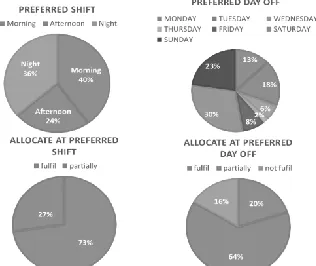
Result from the survey showed that majority of staffs prefer to work on morning shift (40%), followed by night shift (36%) and afternoon shift (24%) (refer Fig. 3(a)). Fig. 3(b) illustrated Saturday, Sunday, Thursday and Monday is the most preferred day off in ascending order which have 33 staffs, 25 staffs, 20 staffs and 14 staffs respectively. Friday and Wednesday is the fifth and sixth preferred day off. There are 9 staffs chose Friday and 7 staffs chose Wednesday as their day off. The less preferred day off is Thursday where there are only 2 staffs preferred that day as their day off.
[image:5.612.97.255.488.621.2]In the proposed schedule, Fig. 3(c) show that 40 staffs (73%) are successfully allocated according to their preference and only 15 staffs (27%) are partially allocated to their preference. Meanwhile, for the day off, the Fig. 3(d) demonstrates 11 staffs (20%) are successfully allocated to their preferred day off, 35 staffs (64%) are partially allocated to their preferred day off and 9 staffs (16%) are not allocated according to their preferred day off. The demand for one day requires 45 staffs to be on duty with 13 staffs for the morning shift, 17 staffs for the afternoon shift and 15 staffs for the night shift. Therefore, a seven day cycle needs 315 staffs to be on duty. By having 55 staffs, and each staff given two days off in a cycle, there will only be 275 shifts (5 working days x 55 staffs) to be fulfilled in a seven days cycle. As a result, there will be less than forty shifts to be assigned to the security staffs to work.
Fig 3: The preferred shift (a), preferred day off (b), allocate at preferred shift (c) and allocate at preferred day off (d).
From the survey, most of the security staffs at UTHM prefers to work overtime and there is only one staff who dislikes overtime work. Thus, the forty shifts need to be covered by overtime worker. 40 staffs will be needed to do overtime and the other 15 staffs will not be needed to do any overtime work. Therefore, the management does not need to choose 3 to 4 staffs during their day off to meet the
demand of every shift. By changing the schedule from the eight days cycle to the seven days cycle, the staffs have more probability to work on fixed shift on a certain day.
B. Comparison of Real Schedule and Proposed Schedule
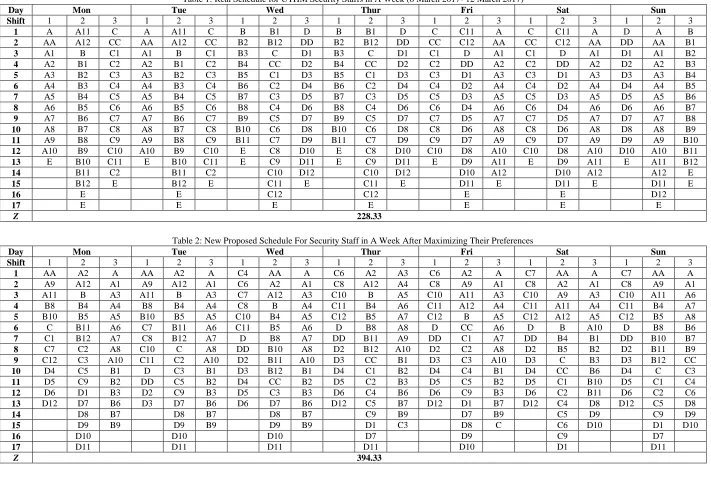
Table 1 shows the real schedule of UTHM security staff for one week. There are several weaknesses found in the real schedule. First, from Table 1, we can see that the female staffs are assigned to the night shift which contradicts the rule of security department. Second, there are lack of staff for every shift demand required by security department where the symbol E represents the staff needed to be chosen by the management to fulfil the requirement of each shift. From Table 1, four staffs are needed to be selected for duty during their day off for each day. As a result, we can conclude that the real schedule of UTHM security staff does not follow the rule appropriately and do not considered the preference of staff for shift and day off where the objective function, Z value for real schedule is only 228.33.
Thus, this study is conducted to improve the performance of security department in term of scheduling problem. The new proposed schedule in Table 2 represents the Z value is maximized up to 394.33. Moreover, in the new proposed schedule, there is no female staffs are assigned to any of the night shifts. This is the hard constraint which the real schedule could not fulfil. The female staffs are not encouraged to work at the night shift because night seems more dangerous for them. As a working mother, they also need to look after their children especially those with small children or babies. With the use of the new proposed schedule, it is a great help to allow working mothers to balance their working life and responsibilities at home both as a wife and a mother.
Besides that, the demand for each shift is fulfilled. There is no issue in lacking of staff for every shift. The security staff would never being call back for duty during their day off. However, each staff will have at least one day off but not more than two days off in a week. So, the staff that works for six days will have only one day off. They are required to work one day extra than those staffs who work five days in a week. So, the extra one day is known as the overtime work.
The objective of this study is to maximize the overall preference satisfaction of the security staff towards work shift and days off. From the result, there are 5 staffs totally fulfil their preferred work shift and day off, which are staff B12, C7, C12, D1 and D11. Staff B12, D1 and D11 prefers the afternoon shift while staff C7 and C12 prefer the morning shift. Staff B2 and D7 prefer to off at Thursday and Friday, staff C12 and D1 prefer to off at Tuesday and Wednesday and staff D11 prefer to off at Friday and Saturday.
6
shift on Monday and Tuesday, but he need to work at the afternoon shift on Wednesday, Saturday and Sunday. Staffs A9, A11, B5, B8, B10, C, CC, C1, C3, C4, C6, D8, D9 and D10 are staffs that partially fulfil the constraint.
There are 46 staffs met the soft constraint of having the preferred day off, while staff A, AA, A1, A9, A10, A11, D8, D9 and D10 do not meet the constraint. This due to 9 of them chose Saturday and Sunday as their preferred day off. These two days are the most preferred day off among the 55 security staffs. There are 33 staffs chose to off on Saturday and 25 staffs chose to off on Sunday. Therefore, those staffs that rest on Saturday and Sunday in Table 2 will rest at the other day and these 9 staffs will off according to their preference day off on the next following week.
The schedule is built based on a week rotation and the rotation of the schedule also follows week by week. A staff can have a fixed day off and the fixed shift in every week. From the analysis, there are 39 staffs (70.9%) who prefer to work on the fixed shift while only 16 staffs (29.1%) vice versa. It seems like they can arrange their lifetime easier if they have to work at a fixed rotation compared to a random shift assigned every week.
C. Sensitivity Analysis
Sensitivity analysis demonstrates how optimal solution and the value of the objective function changes with the given changes in various inputs to the problem. Sensitivity analysis helps to figure out “what if” questions and validate
the flexibility of the mathematical model. The varying number of the objective function represents the sensitivity.
7
Table 1: Real Schedule for UTHM Security Staffs in A Week (6 March 2017- 12 March 2017)
Day Mon Tue Wed Thur Fri Sat Sun
Shift 1 2 3 1 2 3 1 2 3 1 2 3 1 2 3 1 2 3 1 2 3
1 A A11 C A A11 C B B1 D B B1 D C C11 A C C11 A D A B
2 AA A12 CC AA A12 CC B2 B12 DD B2 B12 DD CC C12 AA CC C12 AA DD AA B1
3 A1 B C1 A1 B C1 B3 C D1 B3 C D1 C1 D A1 C1 D A1 D1 A1 B2
4 A2 B1 C2 A2 B1 C2 B4 CC D2 B4 CC D2 C2 DD A2 C2 DD A2 D2 A2 B3
5 A3 B2 C3 A3 B2 C3 B5 C1 D3 B5 C1 D3 C3 D1 A3 C3 D1 A3 D3 A3 B4
6 A4 B3 C4 A4 B3 C4 B6 C2 D4 B6 C2 D4 C4 D2 A4 C4 D2 A4 D4 A4 B5
7 A5 B4 C5 A5 B4 C5 B7 C3 D5 B7 C3 D5 C5 D3 A5 C5 D3 A5 D5 A5 B6
8 A6 B5 C6 A6 B5 C6 B8 C4 D6 B8 C4 D6 C6 D4 A6 C6 D4 A6 D6 A6 B7
9 A7 B6 C7 A7 B6 C7 B9 C5 D7 B9 C5 D7 C7 D5 A7 C7 D5 A7 D7 A7 B8
10 A8 B7 C8 A8 B7 C8 B10 C6 D8 B10 C6 D8 C8 D6 A8 C8 D6 A8 D8 A8 B9
11 A9 B8 C9 A9 B8 C9 B11 C7 D9 B11 C7 D9 C9 D7 A9 C9 D7 A9 D9 A9 B10
12 A10 B9 C10 A10 B9 C10 E C8 D10 E C8 D10 C10 D8 A10 C10 D8 A10 D10 A10 B11
13 E B10 C11 E B10 C11 E C9 D11 E C9 D11 E D9 A11 E D9 A11 E A11 B12
14 B11 C2 B11 C2 C10 D12 C10 D12 D10 A12 D10 A12 A12 E
15 B12 E B12 E C11 E C11 E D11 E D11 E D11 E
16 E E C12 C12 E E D12
17 E E E E E E E
Z 228.33
Table 2: New Proposed Schedule For Security Staff in A Week After Maximizing Their Preferences
Day Mon Tue Wed Thur Fri Sat Sun
Shift 1 2 3 1 2 3 1 2 3 1 2 3 1 2 3 1 2 3 1 2 3
1 AA A2 A AA A2 A C4 AA A C6 A2 A3 C6 A2 A C7 AA A C7 AA A
2 A9 A12 A1 A9 A12 A1 C6 A2 A1 C8 A12 A4 C8 A9 A1 C8 A2 A1 C8 A9 A1
3 A11 B A3 A11 B A3 C7 A12 A3 C10 B A5 C10 A11 A3 C10 A9 A3 C10 A11 A6
4 B8 B4 A4 B8 B4 A4 C8 B A4 C11 B4 A6 C11 A12 A4 C11 A11 A4 C11 B4 A7
5 B10 B5 A5 B10 B5 A5 C10 B4 A5 C12 B5 A7 C12 B A5 C12 A12 A5 C12 B5 A8
6 C B11 A6 C7 B11 A6 C11 B5 A6 D B8 A8 D CC A6 D B A10 D B8 B6
7 C1 B12 A7 C8 B12 A7 D B8 A7 DD B11 A9 DD C1 A7 DD B4 B1 DD B10 B7
8 C7 C2 A8 C10 C A8 DD B10 A8 D2 B12 A10 D2 C2 A8 D2 B5 B2 D2 B11 B9
9 C12 C3 A10 C11 C2 A10 D2 B11 A10 D3 CC B1 D3 C3 A10 D3 C B3 D3 B12 CC
10 D4 C5 B1 D C3 B1 D3 B12 B1 D4 C1 B2 D4 C4 B1 D4 CC B6 D4 C C3
11 D5 C9 B2 DD C5 B2 D4 CC B2 D5 C2 B3 D5 C5 B2 D5 C1 B10 D5 C1 C4
12 D6 D1 B3 D2 C9 B3 D5 C3 B3 D6 C4 B6 D6 C9 B3 D6 C2 B11 D6 C2 C6
13 D12 D7 B6 D3 D7 B6 D6 D7 B6 D12 C5 B7 D12 D1 B7 D12 C4 D8 D12 C5 D8
14 D8 B7 D8 B7 D8 B7 C9 B9 D7 B9 C5 D9 C9 D9
15 D9 B9 D9 B9 D9 B9 D1 C3 D8 C C6 D10 D1 D10
16 D10 D10 D10 D7 D9 C9 D7
17 D11 D11 D11 D11 D10 D1 D11
[image:7.792.43.754.73.551.2]8
Below are the situations that are set to identify the sensitivity of the integer linear programming model of this study. The analysis is focus on Monday output. Both situations are compared with the Monday obtained from the new proposed schedule (refer Table 2).
Situation 1: What happens if the security staffs are assigned according to the ascending order to fulfil the demand and neglects their preferences of work shifts and day off on Monday.
Situation 2: What happens if four security staffs (S1, S2, S3 and S4) were added who prefers to work in the afternoon shift in the Monday schedule.
Day Monday Situation 1 Situation 2 Shift 1 2 3 1 2 3 1 2 3
1 AA A2 A A A12 C2 AA A2 A
2 A9 A12 A1 AA B C3 A9 A12 A1
3 A11 B A3 A1 B1 C4 A11 B A3
4 B8 B4 A4 A2 B2 C5 B8 B4 A4
5 B10 B5 A5 A3 B3 C6 B10 B5 A5
6 C1 B11 A6 A4 B4 C7 C1 B11 A6
7 C7 B12 A7 A5 B5 C8 C7 B12 A7
8 C12 C A8 A6 B6 C9 C12 C2 A8
9 D4 C2 A10 A7 B7 C10 D4 C5 A10
10 D5 C3 B1 A8 B8 C11 D5 C9 B1
11 D6 C5 B2 A9 B9 C12 D6 D1 B2
12 D9 C9 B3 A10 B10 D D9 D7 B3
13 D12 D1 B6 A11 B11 DD D12 D11 B6
14 D7 B7 B12 D1 S1 B7
15 D8 B9 C D2 S2 B9
16 D10 CC S3
17 D11 C1 S4
Z 63.33 34.00 70.01
In Table 3, the preference value, Z from the proposed schedule is 63.33 for Monday. Situation 1 represents the security staffs are being assigned in an ascending order where their preferences are not included when designing the schedule. The Z value obtained is decreased to 34. This clearly shows that the security staffs dislike the schedule. In Situation 2, four staffs that prefer to work in the afternoon shift were added which causes the increasing value of Z up to 70.01. It shows that, when the number of security staffs increases, the value of Z increases as well. This situation able to overcome the problem of under-staff happened in the security department currently. Based on the proposed schedule, there is several staff need to work overtime due to lack of staff.
V. CONCLUSION
Manpower schedule is a plan to assign people to complete their task at a certain time and at a certain place. In this study, the optimal and efficient schedule for the UTHM security staffs is successfully produced in order to meet the demand of each shift and to make sure that each staff is assigned to at most one shift in each day.
The satisfaction of security staff towards UTHM management is increased when they are given opportunity
to choose their preferred shift and day off. This flexibility is definitely benefits the staffs towards time management with their family and social life. This study shows that the integer linear programming approach is able to produce optimal schedule for scheduling problem. However, further study can be done by developing a schedule system using optimization or metaheuristic approach with friendly user interface that allow staff to key in their data easily. This system is able to make the scheduling process to be more efficient and less time consuming.
VI. ACKNOWLEDGEMENT
Authors would like to thank Universiti Tun Hussein Onn Malaysia (UTHM) and Department of Security Staff UTHM for kindly providing us with the internal funding. This work is also supported by the Research Management Centre (RMC), Universiti Tun Hussein Onn (UTHM) under the GPPS grant number UTHM.RMC.600-5/1/39(324).
VII. REFERENCES
[1] Ernst, A.T., Jiang, H., Krishnamoorthy, M., Owens, B., & Sier, D. (2004). An annotated bibliography of personnel scheduling and rostering. Annals of Operations Research, 127(1-4), 21.
[2] Meisels, A. & Schaerf, A. (2003) Modelling and solving employee timetabling problems. Annals of Mathematics and Artificial Intelligence, 39(1-2), 41-59.
[3] Pinedo, M.L. (2005). Planning and Scheduling in Manufacturing and Services. Edition 1. Springer-Verlag New York, NY: Springer Series in operation research & financial engineering.
[4] Nanda, R & Browne, J. (1992). Introduction to Employee Scheduling. New York: Van Nostrand Reinhold.
[5] Lin CC., Kang JR., Liu WY. (2015) A Mathematical Model for Nurse Scheduling with Different Preference Ranks. In: Park J., Pan Y., Kim C., Yang Y. (eds) Future Information Technology - II. Lecture Notes in Electrical Engineering, vol 329. Springer, Dordrecht.
[6] Ahasan, R., Khaleque, A. & Mohiuddin, G. (1999). Human aspects of shift work in developing countries: A case study in Bangladesh. Journal of Human Ergology, 28(1-2), 59-65.
[7] Elizabeth A. Larson & Ruth Zemke (2003) Shaping the Temporal Patterns of our Lives: The Social Coordination of, Journal of Occupational Science, 10:2, 80-89, DOI: 10.1080/14427591.2003.9686514.
[8] Topaloglu, S. & Selim, H. (2010). Nurse scheduling using fuzzy modeling approach. Fuzzy Sets and Systems, 161, 1543-1563.
[9] Ajay, K.A. (2013). Modelistic Solution Approach For Flowshop Scheduling Problems On Makespan Criterion By Heuristics Models. Manav Bharti University, Solan, India.
[10]Schaerf, A. (1999). A survey of automated timetabling (Review of the Artificial Intelligence Review a survey of automated timetabling). Artificial Intelligence Review, 13, 87-127.
9
[12]Nakasuwan, J., Srithip, P., & Komolavanij, S. (1). Class Scheduling Optimization. Science & Technology Asia, 4(2), 88-98. Retrieved from https://www.tci-thaijo.org/index.php/SciTechAsia/article/view/41949.
[13]Mendoza, Adel & Jimenez Rojas, Ana & Hernández Escamilla, Sharon. (2017). Assigning schedules in the industrial engineering program at the Universidad Del Atlántico using linear programming. International Journal of Application or Innovation in Engineering & Management (IJAIEM). 6. 56-60.
[14]Satheeshkumar, B., Nareshkumar, S. & Kumaraghuru, S. (2014). Linear Programming Applied to Nurses Shifting Problems. International Journal of Science and Research (IJSR), 3(3), ISSN: 2319-7064.
[15]Ahmed Ali El Adoly, Mohamed Gheith & M. Nashat Fors. (2018). A new formulation and solution for the nurse scheduling problem: A case study in Egypt. Alexandria Engineering Journal. 57(4), Pages 2289-2298
[16]Suryati Sitepu, Pasukat Sembiring, Herman Mawengkang. (2017). An Optimization Model for Integrated Capacity Management and Bed Allocation Planning of Hospitals. International Journal on Recent and Innovation Trends in Computing and Communication. 5(3), 169-173.
[17]Mobasher Arezou, Lim Gino, Bard Jonathan & Jordan Victoria. (2011). Daily Scheduling of Nurses in Operating Suites. IIE Transactions on Healthcare Systems Engineering. 1(4). 232-246.
[18]Ip W.H., Nick Chung & George Ho. (2010). Using Integer Programming for Airport Service Planning in Staff Scheduling. International Journal of Engineering Business Management. 2(2), 85-92.
[19]Wan Nor Ashikin Wan Ahmad Fatthi, Adibah Shuib, Rosma Mohd Dom. A mixed integer programming model for solving real-time truck-to-door assignment and scheduling problem at cross docking warehouse. Journal of Industrial & Management Optimization, 2016, 12 (2) : 431-447. doi: 10.3934/jimo.2016.12.431.
[20]Akanbi, Olumuyiwa O. (2016). Determination of the Optimal Cost of Training Staff in Tertiary Institution Using Linear Programming
and Integer Linear Programming Model. The International Journal of Business &Management. 4(11), 87-93.
[21]Seyed Hasan Hataminasab, Seyed Mohsen Mirjalili, Mahdieh Yavari & Mohamadreza Pakde. (2016). A Mathematical Model to Schedule Manpower and Solve using Genetic Algorithm. Pacific Business Review International. 1(4), 174-180.
[22]Mahalakshmi E. &Akila S.. (2017). A shift sequence for job scheduling by using Linear programming problem. International Journal of Advanced in Management, Technology and Engineering Sciences. 7(12), 263-268.
[23]Alfares, H.K., Lilly, M.T. & Emovon, I. (2007) Maintenance Staff Scheduling at Afam Power Station. IEMS, 6(1), 22-27.
[24]Jafari H. & Salmasi N. (2015). Maximizing the nurses’ preferences in nurse scheduling problem: Mathematical modeling and a meta-heuristic algorithm. J. Ind. Eng. Int. 11, 439–458.
[25]Thomas, P. I. (2013). Scheduling Algorithm with Optimization of Employee Satisfaction. Senior Design Project Article of Electrical and System Engineering Washington University.
[26]Marti, R. & Reinelt, G. (2011). The Linear Ordering Problem, Exact and Heuristic Methods in Combinatorial Optimization. New York, NY: Springer Berlin Heidelberg
[27]Pinedo, M.L. (2008). Scheduling: Theory, Algorithms, and Systems. New York, NY: Springer Science and Business Media.
[28]Aladag, C.H. & Hocaoglu, G. (2007). A Tabu Search Algorithm To Solve A Course Timetabling Problem. Hacettepe Journal of Mathematics and Statistics, 36(1), 53-64.
[29]Brezulianu, A., Fira, L. & Fira, M. (2012). A genetic algorithm approach for scheduling of resources in well-services companies. International Journal of Advanced Research in Artificial Intelligence (IJARAI), 1(5), 1-5.