Journal of Chemical and Pharmaceutical Research
ISSN No: 0975-7384 CODEN(USA): JCPRC5
J. Chem. Pharm. Res., 2011, 3(4): 809-813
A Highly Selective and sensitive Lu
3+PVC-Membrane Sensor based
on Di-tert-butyl-1-(tert-butyl thio)-1,2-hydrazine dicarboxylate
Hassan Ali Zamani,* Mohammad Reza Abedi
Department of Applied Chemistry, Quchan branch, Islamic Azad University, Quchan, Iran _____________________________________________________________________________
ABSTRACT
Di-tert-butyl-1-(tert-butyl thio)-1,2-hydrazine dicarboxylate (DBHC) was used as a sensing material which plays the role of a suitable ionophore in the creation of a Lu(III) PVC membrane sensor. It shows a Nernstian behavior (with slope of 20.2
±
0.4 mV per decade) over a wide concentration range (1.0 × 10⁻⁶-1.0 × 10⁻² M) with the detection limit of 5.8 × 10⁻⁷ M. The sensor has a very short response time, in the whole concentration range (~5 s), and can be used in the pH range of 2.9-8.8.Keywords: Ion-Selective Electrode, Sensor, PVC Membrane, Potentiometry.
_____________________________________________________________________________
INTRODUCTION
EXPERIMENTAL SECTION
The ionophore Di-tert-butyl-1-(tert-butyl thio)-1,2-hydrazine dicarboxylate was purchased from Fluka. Nitrate and chloride salts of all cations, as well as reagent grade, dibutyl phthalate (DBP), benzyl acetate (BA), acetophenon (AP), nitrobenzene (NB), sodium tetraphenyl borate (NaTPB), tetrahydrofuran (THF) and high relative molecular weight PVC of the highest purity available were procured from Merck and Aldrich, and used without any further treatments, except for the vacuum drying of the salts over P2O5. Doubly distilled deionized water was used in all
experiments.
The membrane solutions were prepared by thoroughly dissolving 30 mg PVC, 66 mg of NB, 2 mg NaTPB and 2 mg of ionophore in 5 mL of fresh THF. The mixture was completely dissolved in 3 mL of THF. The resulting clear mixture was evaporated slowly until an oily concentrated mixture was obtained. A Pyrex tube (3–5 mm i.d.) was dipped into the mixture for about 10 s so that a transparent membrane of about 0.3 mm thickness is formed [25-31]. The tube was then pulled out from the mixture and kept at room temperature for about 24 h. The tube was then filled with internal filling solution (1.0×10⁻³ M of LuCl3). The electrode was finally conditioned
for 36 h by soaking in a 1.0×10⁻³ M lutetium chloride. A silver/silver chloride electrode was used as an internal reference electrode.
The EMF measurements with the polymeric membrane were carried out with the following cell assemblies:
Ag–AgCl| 1.0 × 10⁻³ M LuCl3 | PVC membrane: test solution| Hg–Hg2Cl2, KCl (satd).
The potential measurements were made using a Corning ion analyser 250 pH/mV meter. The measurements were performed at room temperature (25.0 °C) and the activities of the species were calculated according to the Debye–Huckel procedure.
RESULTS AND DISCUSSION
The ionophore was used as a potential neutral ion carrier in the fabrication of the PVC membrane sensors for a number of alkali, alkaline earth, transition and heavy metal ions. The potential responses of all the membrane sensors were studied in a wide range of concentrations. Among different tested metal ions, only the Lu3+ ion displays a stronger and the most sensitive response (with a slope of 20.2 ± 0.4 mV per decade) and seems to be suitably determined by the DBHC-PVC membrane.
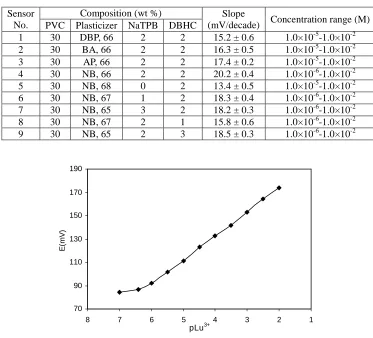
membranes and the mobility of the ionophore and its complex [37]. From Table 1, it is evident that the increase of the DBHC amount in the membranes (No. 4, 8 and 9) up to 2% resulted in greater slopes. A maximum slope of 20.2 ± 0.4 mV per decade of lutetium concentration was observed for the membrane No. 4 with 2% of DBHC. However, the membrane sensor with a composition of 30 % PVC; 66 % NB; 2 % NaTPB and 2 % DBHC exhibits the best performance. The developed sensor (composition no. 4) demonstrated a linear response in the range of 1.0×10
-6
[image:3.595.100.473.240.578.2]-1.0×10⁻² M at varying lutetium ions concentrations (Fig. 1). The slope of the calibration curve was 20.2 ± 0.4 mV per decade of Lu3+ ions activity. The detection limit, defined as the Lu(III) concentration obtained after the extrapolation of the linear region of the standard plot to the baseline potential, was 5.8×10⁻⁷ M.
Table 1: Composition of membrane ingredients
Sensor No.
Composition (wt %) Slope
(mV/decade) Concentration range (M) PVC Plasticizer NaTPB DBHC
1 30 DBP, 66 2 2 15.2 ± 0.6 1.0×10⁻⁵-1.0×10⁻² 2 30 BA, 66 2 2 16.3 ± 0.5 1.0×10⁻⁵-1.0×10⁻² 3 30 AP, 66 2 2 17.4 ± 0.2 1.0×10⁻⁵-1.0×10⁻² 4 30 NB, 66 2 2 20.2 ± 0.4 1.0×10⁻⁶-1.0×10⁻² 5 30 NB, 68 0 2 13.4 ± 0.5 1.0×10⁻⁵-1.0×10⁻² 6 30 NB, 67 1 2 18.3 ± 0.4 1.0×10⁻⁶-1.0×10⁻² 7 30 NB, 65 3 2 18.2 ± 0.3 1.0×10⁻⁶-1.0×10⁻² 8 30 NB, 67 2 1 15.8 ± 0.6 1.0×10⁻⁶-1.0×10⁻² 9 30 NB, 65 2 3 18.5 ± 0.3 1.0×10⁻⁶-1.0×10⁻²
70 90 110 130 150 170 190
1 2 3 4 5 6 7 8
pLu3+
E
(m
V
)
Figure 1. Calibration curve of Lu(III) electrode based on DBHC.
The effect of pH on the potential response behavior of the sensor was studied across a pH range of 1.0_11.0 and usig an Lu3+ solution of a fixed concentrations of 1.0×10⁻³ M throughout the experiment. The results are shown as Fig. 2. As it can be seen, the potential remains fairly constant in the pH range of 2.9–8.8 (the pH adjustment of the solutions was performed either by HNO3 or NaOH).
130 140 150 160 170 180 190
0 1 2 3 4 5 6 7 8 9 10 11 12
pH
E
(m
V
)
[image:4.595.165.406.85.275.2]1.0 × 10⁻³ M Lu3+
Figure 2. pH effect of the test solution (1.0×10⁻³ M of Lu3+) on the potential response.
80 100 120 140 160 180 200 220
0 10 20 30 40 50 60 70 80 90 100 110
t(s)
E
(m
V
)
B
C
D
E
A
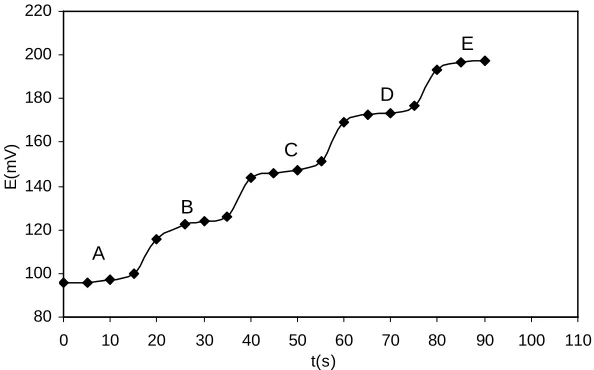
Figure 3. Dynamic response time of the lutetium electrode for step changes in the Lu3+ concentration: A) 1.0 × 10⁻⁶ M, B) 1.0 × 10⁻⁵ M, C) 1.0 × 10⁻⁴ M, D) 1.0 × 10⁻³ M, E) 1.0 × 10⁻² M.
Acknowledgements
The authors acknowledge the financial support kindly offered by the Research Council of Quchan Branch Islamic Azad University for the preparation of this study.
REFERENCES
[1] E Bakker; P Bühlmann; E Pretsch. Chem. Rev., 1997, 97, 3083.
[2] HA Zamani; MS Zabihi; M Rohani; A Zangeneh-Asadabadi; MR Ganjali; F Faridbod; S Meghdadi. Mater. Sci. Eng. C 2011, 31, 409.
[3] HA Zamani; A Arvinfar; F Rahimi; A Imani; MR Ganjali; S Meghdadi. Mater. Sci. Eng. C
2011, 31, 307.
[4] HA Zamani; M Nekoei; M Mohammadhosseini; MR Ganjali. Mater. Sci. Eng. C 2010, 30, 480.
[image:4.595.136.433.311.496.2][7] HA Zamani; G Rajabzadeh; M Masrornia; A Dejbord; MR Ganjali; N Seifi. Desalination
2009, 249, 560.
[8] MR Ganjali; P Norouzi; A Atrian; F Faridbod; S Meghdadi; M. Giahi. Mater. Sci. Eng. C
2009, 29, 205.
[9] HA Zamani; MR Ganjali; P Norouzi; M Adib; M Aceedy. Anal. Sci., 2006, 22, 943. [10] HA Zamani; H Ghahremani; H Behmadi. J. Chem. Pharm. Res. 2010, 2, 328. [11] HA Zamani; G Rajabzadeh; MR Ganjali; Sensor Lett., 2009, 7, 114.
[12] HA Zamani; MR Ganjali; P Norouzi; A Tadjarodi; E Shahsavani. Mater. Sci. Eng. C 2009, 28, 1489.
[13] VK Gupta, RN Goyal; RA Sharma. Anal. Chim. Acta 2009, 647, 66.
[14] H Behmadi; HA Zamani; MR Ganjali; P Norouzi. Electrochim. Acta 2007, 53, 1870. [15] S Chandra; DR Singh; Mater. Sci. Eng. A 2009, 502, 107.
[16] HA Zamani; M Masrournia; M Rostame-Faroge; MR Ganjali; H Behmadi. Sensor Lett.,
2008, 6, 759.
[17] M Masrournia; HA Zamani; HA Mirrashid; MR Ganjali; F Faridbod. Mater. Sci. Eng. C
2011, 31, 574.
[18] HA Zamani; A Imani; A Arvinfar; F Rahimi; MR Ganjali; F Faridbod; S Meghdadi. Mater. Sci. Eng. C 2011, 31, 588.
[19] HA Zamani; MR Ganjali; P Norouzi; M Adib. Sensor Lett., 2007, 5, 522. [20] E Naddaf; HA Zamani. Anal. Lett., 2009, 42, 2838.
[21] HA Zamani; M Mohaddeszadeh. Anal. Lett., 2008, 41, 2710.
[22] HA Zamani; MT Hamed-Mosavian; E Aminzadeh; MR Ganjali; M Ghaemy; H Behmadi; F Faridbod. Desalination 2010, 250, 56.
[23] HA Zamani; MR Ganjali; P Norouzi; M Adib; M Aceedy. Anal. Sci., 2006, 22, 943. [24] MR Abedi; HA Zamani. Anal. Lett., 2008, 41, 2251.
[25] HA Zamani; MR Ganjali; P Norouzi; A Tadjarodi; E Shahsavani. Mater. Sci. Eng. C 2008, 28, 1489.
[26] HA Zamani; MT Hamed-Mosavian; E Hamidfar; MR Ganjali; P Norouzi. Mater. Sci. Eng. C
2008, 28, 1551.
[27] HA Zamani; MR Ganjali; P Norouzi; M Adib. Mater. Sci. Eng. C 2008, 28, 157. [28] MR Abedi; HA Zamani; MR Ganjali; P Norouzi. Sensor Lett., 2007, 5, 516. [29] HA Zamani. Anal. Lett., 2009, 42, 615.
[30] HA Zamani; G Rajabzadeh; MR Ganjali. Talanta 2007, 72, 1093.
[31] HA Zamani, MR Ganjali, M Salavati-Niasari. Transition. Met. Chem., 2008, 33, 995. [32] T Rostazin; E Bakker; K Suzuki; W Simon. Anal. Chim. Acta 1993, 280, 197.
[33] E Ammann; E Pretsch; W Simon; E Lindner; A Bezegh; E Pungor. Anal. Chim. Acta 1985, 171, 119.
[34] J Koryta. Anal. Chim. Acta 1990, 233, 1.