Journal of Chemical and Pharmaceutical Research, 2012, 4(4):1978-1982
Research Article
ISSN : 0975-7384
CODEN(USA) : JCPRC5
Effect of Solvent Properties on Equivalent Conductivity of Electrolytes
P. A Sonkar, P. S Suryavanshi., S. H Sutar. and S.T Shukla
*Department of Chemistry, Yashawantrao Chavan Institute of Science, Satara, India
______________________________________________________________________________
ABSTRACT
Measurement of solution conductance is a classical electroanalytical technique that finds application in a variety of chemical and biochemical studies . Because solvents are used by chemists to carry out chemical reactions or observe chemical and biological phenomena, more specific measures of solvent effects are required. In the present investigation, the equivalent conductivity of acetic acid in methanol-water mixtures has been determined..
Equivalent conductivity of acetic acid is found to decrease with increasing percentage of methanol. The effect of solvent properties like dielectric constant and viscosity on equivalent conductivity of KBr has also been studied using different solvents.
Key words: Equivalent conductivity, dielectric constant, viscosity, electrolytes.
______________________________________________________________________________
INTRODUCTION
Solvents can be broadly classified into two categories: polar and non-polar. Generally, the dielectric constant of the solvent provides a rough measure of a solvent's polarity. The strong polarity of water is indicated, , by a dielectric constant of 80 at 20°C. Solvents with a dielectric constant of less than 15 are generally considered to be non polar. Technically, the dielectric constant measures the solvent's ability to reduce the field strength of the electric field surrounding a charged particle immersed in it. This reduction is then compared to the field strength of the charged particle in vacuum.
It has attracted the researchers to study the effect of physical properties of solvents on dissociation of acids and electrolytes. Studies on the dissociation constants of Benzoic Acid and substituted Benzoic acids in ethanol-water mixtures by conductometric methods have been performed earlier. An effect of solvent polarity on the acid dissociation constants of benzoic acids has also been reported [1, 2]. Literature reveals the measurements of the electrical equivalent conductivity of polyelectrolytes in methanol-water mixtures and investigation of electrical
conductivity of different electrolyte solutions [3-5] . Medium effects in mixed-aqueous solvents have also been
reviewed [6-9]
Conductance measurements can be used to assess solvent purity, determine relative ionic strengths, dissociation constant of acids, solubility product etc[10].
containing water and methanol. It also presents experimental details of conductance measurements of KBr and effect of solvent properties like dielectric constant and viscosity, on equivalent conductance .
EXPERIMENTAL SECTION
Materials and equipments used:
Conductometer- Equiptronics Model No.Eq.660A was used for conductance measurements. Solvents used: Methanol, Ethanol and Acetic acid were from PCL (Pune chemical laboratory) n-propanol, DMSO and DMF were from SRL (SISCO research laboratory,Mumbai)
Effect of mixed solvent on equivalent conductivity of acetic acid: Preparation of Solutions:
Methanol and water were the two solvents chosen to study the effect of mixed solvent on conductivity of acetic acid.
50 ml of 0.1N CH3COOH was prepared in each solvent containing 20%, 40%, 60%, 80% and 100% by weight of
methanol in water (0.3g of acid in 50ml of solution).
Measurement of conductance:
Six different solutions were prepared by taking appropriate quantity of acetic acid in a volumetric flask with the help of a microburette and was diluted to 50 ml with 0%,20%,40%,60%80% and 100% methanol in water to get
0.1N solution. Each solution was poured into a 100 ml beaker , the conductance cell (cell constant 1cm-1) was
immersed into it and the conductance was noted.
Solvent Effect On Equivalent Conductivity of an electrolyte: Preparation of solution:
The electrolyte chosen for these studies was potassium bromide(KBr) and the solvents used were 50%(by volume) of ethanol, methanol, n-propanol, dimethyl sulphoxide and Dimethyl formamide. 0.1N solution of KBr was prepared by dissolving 0.5951g in 50% aq solution of each solvent and diluted up to 50ml.
Conductance measurements:
50ml of each solution was taken in a clean and dry beaker. Conductance cell was dipped into it and its conductance was noted with the help of the conductometer. The procedure was repeated using pure water as solvent.
RESULTS AND DISCUSSION
Effect of mixed solvent on equivalent conductivity of acetic acid:
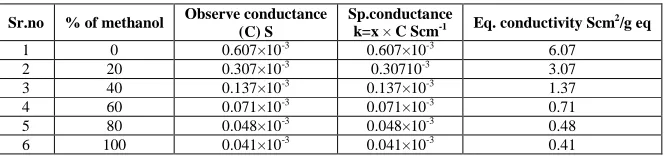
[image:2.595.133.466.563.641.2]From the values obtained , it can be seen that as the % of methanol increases , the equivalent conductivity values show a decrease. These values are given in Table 1.
Table 1.Conductance data for 0.1N CH3COOH in water-methanol
(Cell constant x=1cm-1)
Sr.no % of methanol Observe conductance (C) S
Sp.conductance
k=x × C Scm-1 Eq. conductivity Scm2/g eq
1 0 0.607×10⁻³ 0.607×10⁻³ 6.07
2 20 0.307×10⁻³ 0.30710-3 3.07
3 40 0.137×10⁻³ 0.137×10⁻³ 1.37
4 60 0.071×10⁻³ 0.071×10⁻³ 0.71
5 80 0.048×10⁻³ 0.048×10⁻³ 0.48 6 100 0.041×10⁻³ 0.041×10⁻³ 0.41
.
Fig.1. Plot of Eq. Conductivity of acetic acid vs % of methanol
Careful statistical analysis of the above results shows a better correlation between reciprocal of square root of equivalence conductance and % of methanol. The correlation coefficient has been determined and found to be 0.9926 and a linear relation has been observed .The plot is shown in Fig.2.
.
Fig.2. Effect of % of methanol on /
0 1 2 3 4 5 6 7
0 0.2 0.4 0.6 0.8 1 1.2
eq
u
iv
a
le
n
t
co
n
d
u
ct
iv
it
y
percentage of methanol
Equivalent conductivity against percentage of
methanol
y = 0.012x + 0.381
0 0.2 0.4 0.6 0.8 1 1.2 1.4 1.6 1.8
0 20 40 60 80 100 120
1
/
√
λv
% of methanol
Effect of solvent properties on equivalent conductivity of KBr : Dielectric Constant:
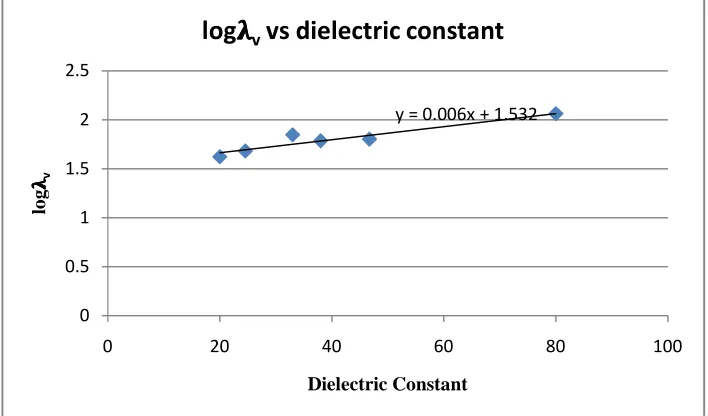
The influence of dielectric constant on the variation of equivalent conductivity with solvent has been studied. 0.1N KBr in50% solvent i.e. (50%water and50% other solvent such as ethanol, methanol, n-propanol, Dimethyl sulphoxide, and dimethylformamide) with dielectric constant varying from 80 to20. The results obtained are shown in Table.2 and depicted graphically in Fig3.
[image:4.595.102.456.185.393.2].
Fig.3. Plot of log v vs. Dielectric Constant of solvents
Table 2.Equivalent Conductivity of 0.1N KBr in different solvents (50%)
Sr.no. Solvent Dielectric constant Equivalent conductivity S cm2/g eq.
1 n-propanol 20 42.2 2 Ethanol 24.55 48.5
3 Methanol 33 70.7
4 Water 80 116.1
5 DMF 38 64.4
[image:4.595.177.422.450.620.2]6 DMSO 46.7 63.8
Table 3. Viscosity data
Solvent Viscosity cp(200C)
Water 1.00 Methanol 0.60 Ethanol 1.20 n-propanol 2.3
Effect of Viscosity:
Earlier studies have also shown that viscosity affects conductivity [11,12] .On comparison of the equivalent
conductivity values of methanol, ethanol and n-propanol it can be seen that the values of v in a particular solvent
increase in the order n-propanol< ethanol <methanol. This may be due to the fact that viscosity of these solvents increases in the order methanol< ethanol < n- propanol .This is because of the fact that with decrease in viscosity, the speed and movement of the ions increases so the conductance of the electrolyte increases from n-propanol to methanol.
y = 0.006x + 1.532
0 0.5 1 1.5 2 2.5
0 20 40 60 80 100
lo
g
v
Dielectric Constant
CONCLUSION
Equivalent conductivity of acetic acid decreases with increasing percentage of methanol. A linear correlation has been obtained between reciprocal of square root of equivalence conductivity and % of methanol. Comparison of equivalent .conductivity of KBr in 50% alcohol in water shows an increase in eq conductivity with dielectric constant. Comparison of equivalent conductivity of KBr in 50% alcohols in water shows an increase in equivalent conductivity with decrease in viscosity.
Acknowledgement
We thank Dr. Arvind Burungale, Secretary, Rayat Shikshan Sanstha and Principal, Y. C. Institute of science Satara for encouragement and for providing facilities for conducting this work. We also thank Dr. D. V. Jagtap, Head ,Dept of Chemistry for providing laboratory facilities .
REFERENCES
[1]Mandal A. K. and Lahiri S. C. Journal of. Prakt. Chemie. Band 319, Heft 3, (1977) pp 377-382
[2] Rubino, J. T. and Berryhill, W. S. Journal of Pharmaceutical Sciences, 75: (1986), pp182–186
[3]Raul G. Barraza, Andres F. Olea, Irma Fuentes, and Francisco Martinez J. Chil. Chem. Soc. v.48 n.1(2003).
[4] H. Golnabi1, M. R. Matloob, M. Bahar, M. Sharifian Iranian Physical Journal, 3-2, (2009) pp24-28
[5]Norman G. Foster and Edward S. Amis. Zeitschrift für Physikalische Chemie: Vol. 3, No. 5, (1955) pp. 365-381
[6]R. F. Cookson Chemical Reviews, Vol.74, No.1 (1974)pp5-28
[7]S. D. Thakur, K. P. Munot, D. T. Mahajan,R. D. Deshmukh and M. S. Tihile. Journal of Chemical and
Pharmaceutical Research, 2012, 4(1):450-455
[8]Sujit K. Dehury, M. Talukdar and Upendra N. Dash Journal of Chemical and Pharmaceutical Research, 2012,
4(3):1619-1624
[9]N. H. El-Hammamy M. M. El-Kholy A.I.Kawana and Ghada. A. Ibrahim J. Chem. Pharm. Res., 2010,
2(4):1112-1134
[10]Samuel Glasstone. Electrochemistry,( 1942), EWP (An east-west edition).
[11] Asif .M. Brazilian Journal of Physics, vol. 39, no. 1, March, (2009) pp 60-61
[12]G.Herlem,P Tran-Van,P Marque,S Fantini, J F Penneau,B Fahys,M Herlem J. Power Sources107(2002)