Evolution Perception with Metaphors
Fatih Yılmaz
Department of Elementary Education, Dicle University, Turkey
Copyright©2016 by authors, all rights reserved. Authors agree that this article remains permanently open access under the terms of the Creative Commons Attribution License 4.0 International License
Abstract
The main objective of this research is to find out how the teacher candidates who graduated from the Faculty of Theology and study in pedagogical formation program perceive the theory of evolution. Having a descriptive characteristic, this research is conducted with 63 Faculty of Theology graduate teacher candidates of which 36 is women and 27 is men who study in pedagogical formation education program in the Ziya Gökalp Faculty of Education in Dicle University. For data collection, teacher candidates were asked to specify which metaphor they identify evolution with and explain why. For the analysis of data, descriptive analysis was used. 37 metaphors and 5 categories related to these metaphors were obtained in the research. In general, the participants do not accept evolution and they also specified that acceptance of evolution is not possible due to their religious beliefs. Besides, some of the participants stated that evolution is not in contradiction with their beliefs and they do believe in evolution.Keywords
Teacher Candidate, Evolution Theory, Metaphor1. Introduction
Considered as one of the fundamental conceptual areas of science [15,16], the theory of evolution is accepted in scientific sense but argued and mostly refused or insufficiently accepted in social sense [5,9].
Presented by Darwin to enable the explanation of similarities and differences between living things by proposing that living systems evolve, with a cause-effect relationship [2,17,27], the theory of evolution is perceived such that humans are evolved from monkeys, embittering the conflict between religion and science and helping the discussion on evolution and origin of life in different societies to concentrate on parallel ideas. For example, in United States of America and Turkey which have different social, cultural, economical and religious structures, the perspective on the theory of evolution is similar [35]. The reason is basically the common perception that the theory of evolution explains the origin of living things. If all the
species that we observe today are a result of evolution, they must have one common ancestor [25]. The question how this common ancestor came into existence is considered as the common ground for the opponents and proponents of evolution. Yet, Darwin’s (1859) theory of evolution does not say anything about the origin of living things or life. Darwin had tried to present how come life turned out to have such rich diversity.
The most fundamental model that explains how the evolutionary process that species undergo takes place is natural selection [27,26]. This model which intends to explain a phenomenal case with a mechanical approach is also considered as an artificial theory [19]. When this case which is normal and can be related to the nature of science is not made sufficiently clear during education, it can lead to misperception. This mechanical model [3] which can be considered by individuals as contrary to and competitor of their beliefs triggers the development of negative attitudes toward evolution. In this context, it can be said that insufficient explanation of the model and discussion of evolution and religious beliefs in relation to each other play an important role in this negative attitude toward evolution:
Knowledge and belief underlie many fundamental research questions in science education, but there is little agreement about whether or not both knowledge and belief are legitimate goals of evolution education or about how to practically and meaningfully differentiate such distinctions in classroom discourse. A burgeoning literature about knowledge and belief has thus far focused on the theoretical, philosophical, and epistemological meanings of these concepts and the justifications for advocating them as learning goals [24].
science, natural selection and earth science. This disables the theory of evolution to be understood due to social pressure and nonscientific approaches [6,7,12,24,28,13].
When studies in literature are viewed, it is found out that there has been studies on the perception of evolution and misconception of teachers [16,17,18,37,33,14,4,36], level of understanding and accepting the theory of evolution in psychology students [1], attitude of university students toward evolutionary theory [3,9,11], relationship between the views of science teacher candidates on evolution and their religious beliefs [29,28].
Teachers have important tasks and great responsibility in raising the future generations. For teachers to perform their role in bringing the ability of unprejudiced, scientific and correct thinking to students, they, themselves, should have this ability. In teaching subjects such as the theory of evolution in which religious judgment and pre-acceptance is high, teaching evolution and view of evolution can be problematic if the teacher is not sufficiently knowledged. Most studies examine the perception and belief of science and biology teachers toward evolution. This study examines evolution theory with the views of teacher candidates who have studied in theology field in university and will be giving religious education in the future. The reason is that the subject of evolution is not only lectured by science and biology teachers but also addressed on a limited level by religious education teachers within the subject of creation and biological laws in the course Religious Culture and Moral Knowledge. In this context, how religious education teacher candidates who will be teachers after receiving pedagogical formation perceive the theory of evolution, what metaphors they identify evolution with and which categories these metaphors are grouped under are discussed as the main objectives of this research.
2. Method
Model of the Research
Since this research aims to present the existing situation as it is, it has descriptive characteristic. For the collection, analysis and interpretation of data obtained in the research, the qualitative research methods were used.
Participants
This research was conducted with the participation of 63 graduate students of the Faculty of Theology with 36 women and 27 men who study in “Pedagogical Formation Education Certificate Program” coordinated by Ziya Gökalp Faculty of Education of Dicle University. For selection of participants, among the purposive sampling methods, criterion sampling method was used. The basic understanding in this sampling method is to study all the cases which meet a series of predetermined criteria [38]. The main criterion for participants in this research is having graduated from the Faculty of Theology and having obtained pedagogical
formation education certificate program, possessing the knowledge, skills, attitude and competence regarding their field. All teacher candidates have received a heavily religious education. They have strong religious beliefs and they all identify themselves as Muslim.
Data Collection
A two-staged questionnaire was used to determine the metaphors of the participants with regards to the theory of evolution. In the first stage, the participants were asked to complete the sentence “The theory of evolution is like ...” in order to identify what metaphor they associate the notion of evolutionary theory with. In the second stage, they were asked to explain in detail the part starting with the word “because ....” in order for them to explain the metaphor that they associate with the theory of evolution. The main objective in using such approach is to regard the questionnaires that participants wrote in with their own handwriting as a document and use them as the main data collection tool in the research. In the process of developing the questionnaire, 4 instructors (from the fields of biology education and pedagogy) who are experts at their field were asked for opinions. The questionnaire which was put in the final form after corrections in line with expert opinions was then applied to the participants.
Analysis of the Data
The data collected from teacher candidates in pedagogical formation education certificate program were analyzed in consideration with the following stages:
Analysis of Qualitative Data
Formation of Metaphors
After determining the metaphors formed by the participants regarding the theory of evolution, a table of metaphors is constructed. The metaphors formed by 63 participants are categorized by the researcher and added to the metaphor table. The metaphors and categories in the metaphor table are the metaphors and categories which are accepted as common and agreed upon by the researcher. Tabulation was used in the visual presentation of the categories and metaphors created.
Formation of Categories
In this stage, mainly, the metaphors formed by the participants are examined in terms of their common characteristics in relation to the theory of evolution. Keeping to the previously prepared metaphor table, 5 main categories were created and it was determined which categories 37 metaphors formed by the participants fall under. The relationship between the metaphors and the categories were presented with direct quotation.
Validity and Reliability Study
Detailed reporting of the data collected and explanation of how the researcher reached to the results is among the important criteria of validity in a qualitative research [38]. Two basic operations were performed to ensure the validity and reliability of this research. Primarily, in order to ensure validity, the data analysis process is explained in detail, all the data obtained are provided in the findings. Afterwards, in order to ensure reliability, the metaphor table and categories created were compared through the opinions of the researcher and an expert and the numbers of agreement and disagreement in the comparison were determined. The reliability of the research is calculated using the formula of Miles and Huberman (1994) (Reliability = agreement / agreement + disagreement). The result of reliability calculation of the research is 93%. According to Miles and Huberman (1994) again, if 70% or higher agreement between the researcher and the expert is achieved in a qualitative research, that research is considered reliable. In this case, this research can be said to be reliable.
Findings and Comments
The findings obtained in the research are provided on the basis of the order set out in the objectives.
Metaphors formed by pedagogical formation teacher candidates regarding the theory of evolution
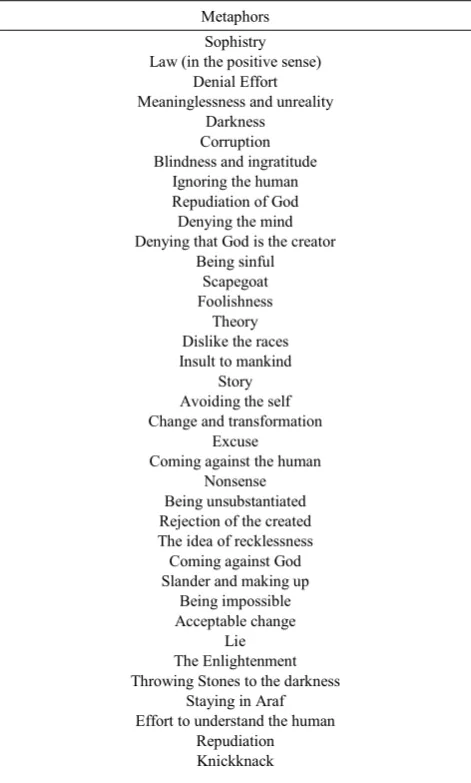
The pedagogical formation teacher candidates have stated 37 valid metaphors regarding the theory of evolution. These metaphors are given in Table 1. Examining Table 1, it is seen that the metaphors formed oppose the theory of evolution. The rejection of the theory of evolution is explained through metaphors such as “Not recognizing God, objecting him, denial of human nature, rejection of humanity, recklessness”. In addition, it can also be said that they exhibited positive approach toward the theory of evolution with metaphors
[image:3.595.314.550.135.527.2]such as “enlightenment, change and transformation, understanding the human being, acceptable change and theory”.
Table 1. Metaphors about the concept of evolution Metaphors
Sophistry Law (in the positive sense)
Denial Effort Meaninglessness and unreality
Darkness Corruption Blindness and ingratitude
Ignoring the human Repudiation of God Denying the mind Denying that God is the creator
Being sinful Scapegoat Foolishness
Theory Dislike the races Insult to mankind
Story Avoiding the self Change and transformation
Excuse
Coming against the human Nonsense Being unsubstantiated Rejection of the created The idea of recklessness Coming against God Slander and making up
Being impossible Acceptable change
Lie The Enlightenment Throwing Stones to the darkness
Staying in Araf Effort to understand the human
Repudiation Knickknack
Categories created by pedagogical formation teacher candidates regarding the theory of evolution
[image:3.595.312.554.624.693.2]The metaphors formed by pedagogical formation teacher candidates are categorized. These categories are given in Table 2.
Table 2. Categories regarding the theory of evolution Categories
Theological approaches Scientific approaches
Mental approaches Creational approaches
Other approaches
said to be expected categories. It can however be also said that the mental and scientific approaches in particular are the unexpected approaches when the educational and belief history of the teacher candidates are considered.
Metaphors for the theory of evolution formed by the pedagogical formation teacher candidates regarding the category “theological approaches”.
[image:4.595.311.551.416.483.2]The metaphors for the “theory of evolution” formed by the pedagogical formation teacher candidates in the category “theological approaches” are given in Table 3.
Table 3. Metaphors regarding the theory of evolution formed by the pedagogical formation teacher candidates in the category of theological approaches
Theological approaches Rejection of the created
Staying in Araf Being sinful Denying that God is the creator
Coming against God Blindness and ingratitude
Repudiation of God
When Table 3 is examined, it is seen that, in the category “theological approaches”, pedagogical formation teacher candidates have expressed the “theory of evolution” as coming against God, repudiation of God, denying that God is the creator, staying in Araf, being sinful, blindness and ingratitude and rejection of the created. The opinions of the pedagogical formation teacher candidates regarding this category are as follows:
“The main objective in suggesting the theory of evolution is to deny the human being which is the most beautiful among the created and hence denying God indeed who is the creator of the human being. A thought system that denies God also denies the creatures and order that God created and regulated. Instead of this order that it ignores, it develops a theory that it has made up” (The metaphor of denying the creations of God).
“God is the only creator and only owner of everything. However, evolutionary understanding is such an understanding that creatures came into existence with transformations of other things in time and God’s power is not sufficient for this, I mean, for creating the human as human” (The metaphor of repudiation of God)..
“Every intellect, when he/she looks around, can deduce that everything he/she sees cannot be created as a result of an evolution. If he/she cannot, either he/she has not achieved the intellectual maturity to notice the difference between looking and seeing or as noticing would not suit him/her, he/she hides behind that excuse. The human is intrinsically capable of apprehending that it is superior to other beings. If they insist on that they evolved from monkeys, so be it, we are distant to them.” (The metaphor of blindness and ingratitude)
“God has the power to create everything one by one. Moreover, it is also denying God’s existence. It emphasized an accidental change without a creator, which is impossible.
As a medicine cannot appear by its own, people make discoveries considering the quantity of one millimeter after years of researches millimeter by millimeter. Is the intellect that leads them to this discovery something that can occur with a spontaneous development or change of a monkey? And why is monkey and not something else? After all, it is nonsense and denial of God and person’s own intellect.” (The metaphors of repudiation of God and denial that he is the creator)
It can be said that the approaches of the pedagogical formation teacher candidates to the theory of evolution is parallel with the education that they have received. Particularly, it was observed that they shared the opinion that the fundamental source of the creation of human is “God” and another form of creation or transformation is not possible. Within the framework of the same approach, it can be said that there was an opinion such that believing in a different form of creation of the human being would make them sinners and it would mean coming against the created. Metaphors for the “theory of evolution” formed by the pedagogical formation teacher candidates regarding the category “scientific approaches”.
The metaphors for the “theory of evolution” formed by the pedagogical formation teacher candidates in the category “scientific approaches” are given in Table 4.
Table 4. Metaphors regarding the theory of evolution formed by the pedagogical formation teacher candidates in the category of scientific approaches
Scientific approaches Theory Effort to persuade
Enlightenment Law Unsubstantiated claims
The metaphors regarding the “theory of evolution” formed by the pedagogical formation teacher candidates in the category “scientific approaches” are given in Table 4. According to this, it is seen that the metaphors formed by pedagogical formation teacher candidates under this category are enlightenment, effort to persuade, unsubstantiated claims, law and theory. Pedagogical formation teacher candidates have stated the following opinions in this subject:
Because Darwin lived in 1800s and it was the age of enlightenment, he transformed God and everything that is abstract to matter. The thought system caused by this age greys the God factor and there might even have been some who says that there is no need for a creator. But, some thinkers act with the thinking that the absence of God/creator fills most gaps. Darwin is one of those who act with this way of thinking. However, this is about materializing concepts and abstract thoughts. For this reason, this theory can be significantly criticized. However, it is a theory after all.” (The metaphor of enlightenment and theory).
water” also supports the theory of evolution. Even in this time we are living in, there are examples that support it, such as the difference in the skin color of people living in Africa and in North Europe. There are differences between the point where living things have arrived today and the forms they had in the past. Even at the present time, the layer of fat around the eyes of people living Middle Asia, giving them slanted eyes, protect them from the arid and cold climate. Or the difference between the bears in the northwest zone and middle zone... I also do not think that the theory of evolution contradicts Koran for there is the verse “We created everything from a drop of water.” (The metaphor of law).
Some of the pedagogical formation teacher candidates can be said to approach the theory of evolution in a positive manner. It was also observed that they stated that the theory of evolution is a scientific phenomenon and a theory that raised with the age of enlightenment and it has not been proven yet, but it can also not be disclaimed.
Metaphors for the “theory of evolution” formed by the pedagogical formation teacher candidates regarding the category “mental approaches”.
The metaphors for the “theory of evolution” formed by the pedagogical formation teacher candidates in the category “mental approaches” are given in Table 5.
[image:5.595.58.297.487.590.2]Examining Table 5, in the category “mental approaches”, the pedagogical formation teacher candidates expressed the theory of evolution as denial of the mind, meaningless and unreal, change and transformation, thoughtlessness, coming against human nature, effort to understand the human, avoiding the self, acceptable change and sophistry. The opinions about this subject are as follows:
Table 5. Metaphors regarding the theory of evolution formed by the pedagogical formation teacher candidates in the category of mental approaches
Mental approaches Avoiding the self Denying the mind
Sophistry
Meaninglessness and unreality Acceptable change Effort to understand the human
Change and transformation The idea of thoughtlessness Coming against human nature
It can be said that the views of the pedagogical formation teacher candidates in the category of mental approaches are both positive and negative. For example, we can consider the metaphors of denying the mind, thoughtlessness, coming against human nature and sophistry as negative approaches. The positive approaches can be regarded as the one about change and transformation and effort to understand the human. The opinions related to this subject are given below:
“It is impossible for a person with intellect to accept the theory of evolution. I believe there is a power which creates out of nothing and I do not accept the theory of evolution. I think the limits of the mind should be pushed to believe this theory.” (The metaphor of denying the mind).
“It is obvious that there is an evolution among the living
creatures. It means that they are exposed to biological change. Even though I accept this much of it, I do not think people have evolved. However people’s perspective, ideas and beliefs change in time” (The metaphor of change and transformation).
“It is not right to neither accept nor deny something in advance. I think extensive research should be done to be able to talk about a subject. There is a wrong attitude in the theological field caused by attributing everything to Islam enmity. Theologists have such a perception that as if anything is licit, including nonsense talk, to refuse Islam. They consider the theory of evolution as one of such nonsense. However, before Darwin’s theory of evolution came out, Islamic scholars had discussed about evolution. It is not absolutely about having descended from monkeys, but it was thought about that humans may have been evolved to their current form from different forms. It is not absolutely about having descended from monkeys, but it does not seem impossible and nonsense to me that humans have taken their final form after evolving and evolving, it should be researched.” (The metaphor of acceptable change).
“It was thrown out in 18th century with a materialist thought. This thought was never mentioned about by previous people. It is the thought system in the west, which aims to separate God and human, God from the universe and eliminate human intervention. Yes, there is a change in the universe but it would be mindless to claim that mindless matters and atoms form an order because just as the motion of a train requires a machinist or for a car to run, a motor power is required, the universe requires the willpower of a creator to exist”. (Denying the mind).
It can be said that, considering in the framework of reason and intelligence, the perception that the theory of evolution is a denial of human’s reality because of its understanding that the mind is not functional is predominant among the pedagogical formation students. Despite the approaches are negative in general, they lean toward the theory of evolution, although partial, with the metaphors of change and transformation as well as acceptable change.
Metaphors for the “theory of evolution” formed by the pedagogical formation teacher candidates regarding the category “creational approaches”.
The metaphors for the “theory of evolution” formed by the pedagogical formation teacher candidates in the category “mental approaches” are given in Table 6.
Table 6. Metaphors regarding the theory of evolution formed by the pedagogical formation teacher candidates in the category of creational approaches
Creational approaches Ignoring the human
Deception Insult to mankind Being impossible
Decay Disliking one’s own race Repudiation of the human
[image:5.595.312.553.650.732.2]expressed the theory of evolution as decay, disliking one’s own race, being impossible, deception, repudiation of the human, ignoring the human and insult to mankind. The opinions of the pedagogical formation teacher candidates are as follows:
“I believe that the theory of evolution is a great insult to mankind. I think the theory of evolution was suggested to overshadow the belief of God and create distraction through making an alternative. Those who do not accept or want to accept that the human has a creator want to perplex people’s mind with the thought that humans evolved developing from a simple being with a successive evolution theory” (The metaphor of insult to mankind).
“A person who thinks he/she descended from monkeys dislikes his/her own race in some way. How absurd? We were humans and we keep going as humans. What is evolution anyway? Let those who accept it believe they come from monkeys. I do not. I have not evolved from monkeys.” (The metaphor of disliking one’s own race).
“What makes the lives of humans and other living things meaningful is that they wake up to each day with a goal and they set out their lives in line with certain rules. The theory of evolution disregards these goals and beliefs and argues that everything should go with the flow. In this respect, it is some sort of wrong definition of freedom. The universe cannot be purposeless. If it was, every creature would act for its own interest and the order of the universe would break down. In terms of the individuals, if humans had come to existence by their own, which is not possible, why their organism run smoothly until the person dies, thinking it does not have a free purpose anyway? No organ fails to perform its duty. One that defends reason is aware that nothing can be without a purpose, meaning or order.” (The metaphor of ignoring the human).
It can be said that acceptance of the theory of evolution is perceived as an approach that is contradictory to the existential philosophy of humans and as humans’ deception and repudiation of themselves. It is observed that accepting the theory of evolution is perceived as disregarding the creational values of the human.
Metaphors for the “theory of evolution” formed by the pedagogical formation teacher candidates regarding the category “other approaches”
[image:6.595.59.298.660.743.2]The metaphors for the “theory of evolution” formed by the pedagogical formation teacher candidates in the category “other approaches” are given in Table 7.
Table 7. Metaphors regarding the theory of evolution formed by the pedagogical formation teacher candidates in the category of other approaches
Other approaches Ignoring the human
Deceit of human Insult to mankind Being impossible
To decay Dislike the races Repudiation of human
Examining Table 7, in the category “other approaches”,
the pedagogical formation teacher candidates expressed the theory of evolution as stupidity, excuse, scapegoat, slander and making up, throwing stones to darkness, darkness, story, knick-knack and lie. The opinions regarding this subject are given below:
“An individual who denies the existence of a creator and has intellect and conscience would not believe in this nonsense. Every passing day, science proves that nothing is accidental. Darwin may have descended from monkeys. But we, Muslims, and everything are created by God.” (The metaphor of nonsense).
“It is a concept and doctrine that is taken as shelter by scientists who want to hold on to reasons in relation to the creation of human beings as to the whole universe because in the whole universe, the laws and reasons made by God keep up with this ordinate process to a certain point. After that point, as Satre puts it, there is no other way to leave it to the existence of a hand” (The metaphor of scapegoat).
“As technology and science is not so advanced, the creation of human beings could not be explained. Denial of creation is in question. Whereas, it is definite how the first human was created. It was not a different creature that evolved afterwards. The chemistry of a person may change with things like radiation but mutation cannot occur. The number of chromosomes of human beings is definite and 46 since the first human being. Monkeys’ is not 46. The theory of evolution is one of the ways for satisfaction for those who do not want to believe. If mutation existed, it would occur in everything, not just in humans or in some certain animals” (The metaphor of slander and making up)
“It is in complete contradiction to the historical development of humans. The first human being is Hz. Adem. He is the father of mankind. That is why he had all the characteristics that people today have. He was taller and stronger. This theory which does not even slightly touch science and reality has no evidence. Indeed, this theory could not received its own share from reality.” (The metaphor of throwing stones to darkness).
“Even if the subjects presented to us by the theory of evolution are accepted, they do not have much value when compared to those presented to us by our faith. The fundamental essentials of a construction are definite. With its aspects that seems reasonable to us, having knowledge about the theory of evolution is worthless as a knick-knack inside the house outside the construction of the house.” (The metaphor of knick-knack).
The pedagogical formation teacher candidates can be said to perceive the theory of evolution as dark and nonsense. It appears that they identify their views on the theory of evolution with metaphors that have emotional characteristics. In this context, it can be said that it is a common perception that beside not believing in the theory of evolution, they also do not believe that those who suggested this theory believes in it.
3. Discussion and Result
Faculty graduate teacher candidates studying in pedagogical formation program on the theory of evolution are studied, 37 main metaphors were identified and these metaphors were grouped under 5 categories. The categories that the teacher candidates have formed regarding the theory of evolution are theological, scientific, mental, creational and other approaches, respectively. In general, the teacher candidates approach the theory of evolution from a theological aspect and do not accept it, justifying this with their beliefs.
It is seen that when the pedagogical formation teacher candidates metaphorize the theory of evolution, their approaches are more affected by their belief. The education that they have receive contributed in this result because the students have graduated from the Faculty of Theology and received theology-weighted education during all their education life. Naturally, they are expected to oppose the theory of evolution, a theory in which the creation of human beings is based on a different context. However, it cannot be explained only by their education background. When similar researches are examined, same approaches are also observed in groups that received a different education [3,1,10,16,18]. In this case, it can be said that the program or education area studied in can have an effect on the opinion about the theory of evolution, but beliefs come before education and strict and invariable value judgments affect the view on the theory of evolution in a significant level.
As the acceptation of the theory of evolution is said to mean “denial of God, denial of the human, ignoring the mind”, these metaphors appeared as strong evidences that religious beliefs are effective in disregarding the theory of evolution. Consequently, those kinds of approaches of the teacher candidates are explained with theological approaches. In their research carried out in USA and Turkey, Miller et al. [20] stated that human is considered as the “most honorable of all the created” and in parallel with this, the belief in evolution is considered as weak and low. Asghar [4] pointed out that Canadian and Pakistani Muslim teachers accept the theory of evolution in terms of the beginning of life, but not in terms of the creation of human beings as it contradicts their beliefs. Similarly, in a research carried out by Irez and Bakanay [14], teacher candidates are found to exhibit negative attitudes toward the nature and statue of the theory of evolution. Again in Kahyaoglu’s research [15], it was observed that teacher candidates have negative attitude toward the lecturing of the theory of evolution. Consequently, these findings in the research are compatible with each other because belief is considered as a powerful tool and its change or transformation is not easy. In this context, whether Christian or Islamic, religious beliefs are influential on the acceptation of the theory of evolution.
Cetinkaya [8] attributes the low levels of acceptation of the theory of evolution in Turkey to that Turkey have never been through a radical enlightenment project, that thought systems based on religion are gradually increasing and that the level of science education in Turkey have greatly weakened recently. Opinions that support this approach have been found out in the research. The pedagogical formation
teacher candidates regard enlightenment as disbelief, perceive it as a reflection of the materialist understanding and believe that it confuses the individuals who were raised with Islamic belief. In addition to this, a very small group of people stated that the theory of evolution is real and religious references accept it. They consider evolution as a mandatory change and express that total acceptation or total rejection do not also comply with Islamic belief. This kind of thought of the individual who received religious education should be considered positive. It can be said that it is an opinion away from stereotyped judgments, which states that the measures of the mind and science would not contradict with religious measures, on the contrary, support them and this should not be avoided.
The researches on the theory of evolution point out that epistemological approaches to the notion cause negative views and perceptions [3,9,31] because the nature of science and the nature of religion are different and their approaches also differ. In general, the theory of evolution is understood through the belief that human beings evolved from monkeys, causing repudiation and denial of the creator and a different perception of the human nature. This causes negative approaches to be exhibited to the theory of evolution. Acceptance of the theory as a change and transformation of the human being in a process would make it easier to scientifically approach it instead of epistemologically. In this context, the teacher candidates in the research approach the theory of evolution within the framework of epistemological approaches because it is seen that they consider certain metaphors such as denying God, ignoring the human, denying the nature of human in an epistemological context.
In general, the pedagogical formation students are observed to object the theory of evolution because of the denial of God and human nature and because of their religion. This perspective of the pedagogical formation students is expected to affect them such that they will explain and tell the subject of evolution at school with prejudice and with belief-based explanations, rather then scientific explanations. Such a real approach, instead of an epistemological one, to the theory of evolution, which involves that religion and science do not contradict with each other and they can be complementary to each other would make it easier to accept and teach evolution.
REFERENCES
[1] Annac, E. & Bahcekapili, H. G. (2012). Understanding anda acceptance of evolutonary theory among Turkish university students. Dogus Universitesi Dergisi, 13(1), 1-11.
[2] Alles, D. (2001). Using evolution as the framework for teaching biology. The American Biology Teacher, 63(1), 20-24.
[4] Asghar, A. (2013). Canadian and Pakistani Muslim teachers’ perceptions of evolutionary science and evolution education. Evolution: Education and Outreach, 6(10).
[5] Bishop, B. A. & Anderson C. W. (1986). Student conceptions of natural selection and its role in evolution. Michigan: College of Education Michigan State University.
[6] Berkman, M. B., & Plutzer, E. (2011). Defeating creationism in the courtroom, but not in the classroom. Science, 331, 404–405.
[7] Brem, S. K., Ranney, M., & Schindel, J. (2003). Perceived consequences of evolution: college students perceive negative personal and social impact in evolutionary theory. Science Education, 87(2), 181–206.
[8] Cetinkaya, H. (2006). Evrim, bilim ve egitim üzerine. Ege
Eğitim Dergisi, 7(1), 1-21.
[9] Dagher, Z. R. and BouJaoude, S. (2005). Students’ perceptions of the nature of evolutionary theory. Science Education, 89, 378-391.
[10] Deniz, H., Cetin, F., Yilmaz, I. (2011). Examining the relationships among acceptance of evolution, religiosity, and rteaching preference for evolution in Turkish preservice biology teachers. National Center for Science Education, 31;4.
[11] Downie, J., R. & Barron, N., J. (2010). Evolution and religion: attitudes of Scottish first year biology and medical students to the teaching of evolutionary biology. Journal of Biological Education, 34(3), 139-146.
[12] Gregory, T. R. (2009). Understanding natural selection: essential concepts and common alternative conceptions. Evolution: Education and Outreach, 2, 156–175.
[13] Ha, M., Haury, D. L., & Nehm, R. H. (2012). Feeling of certainty: Uncovering a missing link between knowledge and acceptance of evolution. Journal of Research in Science Teaching, 49(1), 95–121.
[14] Irez, S. & Bakanay, O., D., Ç. (2011). An assessment into pre-service biyology teachers’ approaches to the theory of evolution and nature of science. Education and Science, 36;162.
[15] Kahyaoglu, M. (2013). The teacher candidates’ attitudes towards teaching of evolution theory. Necatibey Faculty of Education Electronic Journal of Science and Mathematics Education, 7(1), 83-96.
[16] Kilic, S. D. (2012a). Pre-service biology teachers’ intentions to teach evolution. Hacettepe University Journal of Education. 42, 250-261.
[17] Kilic, S. D. (2012b). An examination of biology teachers’ intention to teach evolution based on the theory of planned behaviour. Hacettepe University Journal of Education. 43, 294-305.
[18] Kose, O., E. (2010). Biology students’ and teachers’ religious beliefs and attitudes towarda theory of evolution. Hacettepe Universty Journal of Education, 38, 189-200.
[19] Lewis, W., R. (1980). Evolution: a system of theories. Perspectives in Biology and Medicine, 23:551-572.
[20] Miller, J. D., Scott, E. C., & Okamoto, S. (2006). Public
acceptance of evolution. Science, 313, 765-766.
[21] National Resarch Council, (1998). National science education standarts. Washington DC: National Academies Press.
[22] National Resarch Council, (2011). A framewrok for K-12 science education: practices, crooscutting concepts and core
iıdeas. Washington DC: National Academies Press.
[23] Narguizian, J., P. (2012). Evolution education and the nature of science: strategies for the classroom. International Journal of Humanities and Social Science. 2 (12).
[24] Nehm, R. H., & Schonfeld, I. S. (2007). Does increasing biology teacher knowledge of evolution and the nature of science lead to greater preference for the teaching of evolution in schools? Journal of Science Teacher Education, 18, 699–723.
[25] Ozgokman, F. (2013). Yasamin kokeni, evrim ve tanri. Ankara Universitesi Ilahiyat Fakultesi Dergisi, 54(2), 49-76. [26] Passmore, C. & Stewart, J. (2002). A modeling approach to
teaching evolutionary biology in high schools. Journal of Research in Science Teaching, 39 (3), 185-204.
[27] Rudolph, J.L. & Stewart J. (1998). Evolution and the nature of science: On the historical discord and its implications for education. Journal of Research In Science Teaching, 35 (10), 1069-1089
[28] Sickel, A. J., & Friedrichsen, P. (2013). Examining the evolution education literatüre with a focus on teachers: major findings, goals for teacher preparation, and directions for future research. Evolution: Education and Outreach, 6(1), 23. [29] Smith, M. U. (2010). Current status of research in teaching and learning evolution: II. Pedagogical issues. Science & Education, 19(6), 539–571.
[30] Strauss, A., L. and Corbin, J. (1994). Grounded theory methodology: an overview. In N. K. Denzin & Y. S. Lincon (Eds.), Handbook of Qualitative Research. Thousand Oaks, CA: Sage.
[31] Southerland, S. A., Sinatra, G. M., & Matthews, M. (2001). Belief, knowledge, and science education. Educational Psychology Review , 13; 325-351.
[32] Trani, R. (2004). Iwon’t teach evolution it’s against my religion. The American Biology Teacher, 66 (6).
[33] Toman, U., Karatas, O. F. & Cimer, O. S. (2014). Analysis of the science and technology preservice teachers' opinions on teaching evolution and theory of evolution. Journal Of Educational And Instructional Studies In The World, 4 (1), 43-52.
[34] Pennock,R., T. (2004). On Teaching evolution and the nature of science. (Ed: Joel Cracraft and Rodger W. Bybee) Evolutionary Science and Society: Educating a New Generation. Proceedings of the BSCS, AIBS Symposium November 2004, NABT Convention Chicago, IL. 7-12. [35] Yalcinoglu, P. (2009). Impacts of anti-evolutionist
movements on educational policies and practices in usa and turkey. Elementary Education Online, 8(1), 254-267. [36] Yates, T. B. & Marek, E., A. (2014). Teachers teaching
biology students’ acquisition of biological evolution-related misconceptions. Evolution: Education and Outreach , 7, 7. [37] Yetisir, M., İ. & Kahyaoglu, M. (2010). Pre-service teachers'
attitudes towards teaching of evolution theory. Procedia Social and Behavioral Sciences, 2, 1720-1724.
[38] Yildirim, A. & Simsek, H. (2013). Sosyal bilimlerde nitel arastirma yontemleri. (Genisletilmis 9. Baski). Ankara: Seckin Yayincilik.