42
Unsupervised Aspect-Based Multi-Document Abstractive Summarization
Maximin Coavoux,2∗ Hady Elsahar,1 Matthias Gall´e1 1Naver Labs Europe
2Univ. Grenoble Alpes, CNRS, Grenoble INP, LIG
{maximin.coavoux,hady.elsahar,matthias.galle}@naverlabs.com
Abstract
User-generated reviews of products or services provide valuable information to customers. However, it is often impossible to read each of the potentially thousands of reviews: it would therefore save valuable time to provide short summaries of their contents. We address opin-ion summarizatopin-ion, a multi-document summa-rization task, with an unsupervised abstractive summarization neural system. Our system is based on (i) a language model that is meant to encode reviews to a vector space, and to generate fluent sentences from the same vector space (ii) a clustering step that groups together reviews about the same aspects and allows the system to generate summary sentences fo-cused on these aspects. Our experiments on the Oposum dataset empirically show the im-portance of the clustering step.
1 Introduction
Nobody reads all available user-generated com-ments about products they might buy. Summa-rizing reviews in a short paragraph would save valuable time, as well as provide better insights into the main opinions of previous buyers. In ad-dition to traad-ditional difficulties of summarization, the specific setting of opinion summarization faces the entanglement of multiple facets in reviews: po-larity (including contradictory opinions), aspects, tone (descriptive, evaluative).
Obtaining large parallel corpora for opinion summarization is costly and makes unsupervised methods attractive. Very recently, a neural method for unsupervised multi-document abstractive
sum-marization was proposed byChu and Liu (2019,
Meansum), based on an auto-encoder which is given the average encoding of all documents at in-ference time. Major limitations identified by the authors of this work are factual inaccuracies and
∗
Work done at Naver Labs Europe.
Aspect-aware
Clusters LSTM (dec) LSTM (enc)
Summary
sentence i
sentence j Aggregation
[image:1.595.307.526.219.297.2]Input reviews
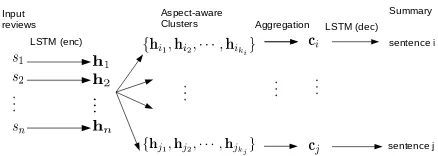
Figure 1: Aspect-aware unsupervised summarization system. The decoder LSTM shares weights with the encoder LSTM.
the inability to deal with contradictory statements. We argue that this can be attributed to feeding the decoder the summation of sentence representa-tions in the embedding space, which is not equiv-alent to the average meaning representation of all the input sentences.
In this paper, we present a work in progress that investigates better ways of aggregating sentence representations in a way that preserves semantics. While available gold summaries might be expen-sive to acquire, we leverage more attainable train-ing signals such as a small amount of sentiment and aspect annotations. We adopt a strategy based on a language model – used both for encoding re-views and for generating summaries – and aspect-aware sentence clustering. This clustering ensures coverage of all relevant aspects and allows the sys-tem to generate independently a sentence for each aspect mentioned in reviews. Our system proceeds by projecting reviews to a vector space, clustering them according to their main aspect, and generat-ing one sentence for each cluster that has been dis-covered. Our experiments, performed on the
Opo-sum dataset (Angelidis and Lapata,2018),
2 Related Work
Since obtaining large parallel corpora for opin-ion summarizatopin-ion is costly, a line of work has focused on unsupervised methods. Proposals in unsupervised opinion summarization include both
extractive and abstractive methods.
Unsuper-vised extractive summarization methods consists in selecting the most salient sentences from a text. Saliency can be quantified with the centroid
method (Radev et al., 2004; Gholipour
Ghalan-dari,2017;Rossiello et al.,2017), which consists in computing vector representations for sentences and selecting which sentences are the closest to their centroid, and thus the most representative of the set. Other proposals make use of the
PageR-ank algorithm (Mihalcea and Tarau, 2004;Erkan
and Radev, 2004) to compute sentence saliency.
The weakly supervised method ofAngelidis and
Lapata(2018) uses a pretrained polarity classifier and an aspect-based autoencoder to compute the saliency of reviews segments.
On the other hand, non-neural abstractive
meth-ods are based on graphs (Ganesan et al., 2010;
Nayeem et al.,2018). They consist in constructing a graph whose nodes are words and extract paths
that correspond to valid sentences.1
This work is inspired by the Meansum
model (Chu and Liu, 2019), which leverages
an encoder-decoder trained using self-supervision with a sentence reconstruction objective to recon-struct each of the input sentences. It performs summarization by averaging the encoded vectors of each input sentence and feeding them to the pre-trained decoder to generate a summary out of them. The main difference with that work is our use of an LSTM instead of a auto-encoder, and in particular experimenting with different ways of aggregating the documents.
3 Proposed Model
Each product p is associated with a set of
re-views represented by a set of sentences S(p) =
{s(1p), . . . s(np)}. The task consists in predicting a
set of sentences (under a word budget) that
con-tains the important information inS(p). Ideally, a
good summary should cover all aspects (e.g. price, quality, ease of use) mentioned in reviews, and ex-press judgements that are consistent with those in
1These methods are semi-extractive: they produce
sen-tences that are not in input reviews, but only use words that occur in them.
the reviews.
Overview of the approach Our approach con-sists in the following general pipeline:
1. Encoding: compute vector representations for sentences;
2. Clustering step: cluster sentence representa-tions into meaningful groups (i.e. cluster to-gether sentences that are about the same as-pect);
3. Aggregation: compute a single vector repre-sentation for each cluster, from the represen-tations of sentences in the cluster;
4. Generation step: generate a sentence for each cluster.
Each of these modules has a wide range of pos-sible instantiations. In the next four paragraphs, we describe the architecture we implemented for each step.
3.1 RNN Language Model
The main module of our model is a standard LSTM trained with a language model objective.
We construct a representation for a sentencesby
running the LSTM on the sentence and retrieving
the last LSTM stateh.
3.2 Sentence clustering
We use a function faspect that associates a
sen-tence vector representation h to an aspect
iden-tifier a ∈ {1, . . . , n}, where n is the total
num-ber of aspects. Many possibilities exist to
in-stantiatefaspect, ranging from unsupervised topic
modelling (Latent Dirichlet Allocation,Blei et al.,
2003), or unsupervised aspect extraction
(Aspect-based Autoencoder, He et al., 2017), to weakly
supervised approaches (Multi-seed Aspect Extrac-tor, Angelidis and Lapata, 2018). In this paper, we use a supervised aspect classifier to instantiate
faspect, trained jointly with the language model.
This choice requires annotated data.
We score possible aspects with a single linear
layer followed by a softmax activation:2
p(A=·|si) =Softmax(W(A)·hi),
faspect= argmax a
p(A=a|si),
2During training, we use a sigmoid activation instead,
whereW(A) is a parameter matrix, and hi is the
LSTM sentence encoding.
For comparison purposes, we also experiment
withk-means clustering, an unsupervised method
whose only hyperparameter is a predefined num-ber of clusters.
3.3 Constructing cluster representations
For each cluster Ca =
{(s1,h1),(s2,h2), . . . ,(ska,hka)}, contain-ing pairs made of a sentence and its vector representation, we need to compute a single
representation h(a) that retain most important
information from the original sentences. To do so, we first select the most salient sentences from the cluster, and then compute the centroid of selected sentences.
FollowingAngelidis and Lapata(2018), we use
the output of a polarity classifier to define saliency.
In particular, we define the saliency scoresalfor
a single sentencesas the prediction confidence of
the classifier:
p(P ol=·|si) =Softmax(W(P ol)·hi),
sal(si) = max
pol p(P ol=pol|si),
whereW(P ol)is a parameter matrix. Finally, we
prune the clusterCto thekmost salient sentences
C0 ⊂C, and compute their centroid:
ca=
1 |C0|
X
(si,hi)∈C0
hi.
This method can be seen as a form of hard atten-tion, where a few items are attended to, whereas the majority does not participate in the final repre-sentation.
3.4 Generating summary sentences
The last step of the summary construction process consists in generating a sentence per cluster. We do so by initializing the language model LSTM
with the cluster representation ca, and
perform-ing decodperform-ing in the same fashion as a translation model (without attention).
Our decoding method is based on top-k
sam-pling decoding (Fan et al.,2018), i.e. at each time
step, we extract thekmost probable next tokens,
renormalize their probabilities and sample from
the resulting distribution. We perform top-k
sam-pling decoding K times. We then rerank theK
generated sentences according to the cosine simi-larity of their representation, as computed by the
LSTM, to the cluster representationca. This
pro-cess makes sure that non-relevant sampled sen-tences are rejected and is meant to improve the se-mantic similarity between the centroid of the clus-ter and the generated sentence.
3.5 Multi-Task Training Objective
We train the model using a multitask learning
(MTL, Caruana, 1997) objective. We jointly
op-timize a language modelling objective, as well as the two supervised classification task (aspect and polarity):
Llm=
n X
i=1
−logP(wi|wi−0 1;θLSTM),
Lpolarity =−logP(yp|wn0;θLSTM, θpolarity),
Laspect=−logP(ya|w0n;θLSTM, θaspect),
LMTL =Llm+Lpolarity+Laspect,
wherewn0 is a sentence,yp is its polarity label,ya
is its aspect labels. In some experiments, we only use the language modelling objective (we optimize
Llminstead ofLMTL). It is important to note here
that while our method uses an MTL objective, it does not require aspect and polarity annotations for the input summaries but rather a small number of annotated examples for training. For the rest of the dataset (not annotated with aspect nor polar-ity) our model shifts training to solely a language modeling objective.
4 Experiments
Dataset We perform experiments on the
Opo-sum dataset (Angelidis and Lapata, 2018). This
dataset contains 3,461,603Amazon reviews for
6 types of products, extracted from the Amazon
Model Bags and cases Bluetooth Boots Keyboards TV Vacuums
TextRank 0.35 0.28 0.31 0.30 0.30 0.30
Mean 0.18±0.03 0.15±0.02 0.16±0.02 0.17±0.02 0.16±0.03 0.15±0.02
Kmeans 0.38±0.02 0.37±0.01 0.37±0.01 0.37±0.01 0.35±0.01 0.38±0.02
Kmeans + MTL 0.38±0.01 0.36±0.01 0.38±0.02 0.35±0.01 0.35±0.02 0.36±0.02
[image:4.595.81.525.64.156.2]Aspect + MTL 0.4±0.02 0.38±0.01 0.38±0.01 0.38±0.01 0.37±0.01 0.39±0.01
Table 1: ROUGE-L evaluation per product type.
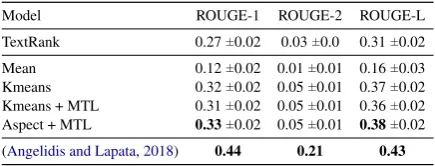
Model ROUGE-1 ROUGE-2 ROUGE-L
TextRank 0.27±0.02 0.03±0.0 0.31±0.02
Mean 0.12±0.02 0.01±0.01 0.16±0.03
Kmeans 0.32±0.02 0.05±0.01 0.37±0.02
Kmeans + MTL 0.31±0.02 0.05±0.01 0.36±0.02
Aspect + MTL 0.33±0.02 0.05±0.01 0.38±0.02
(Angelidis and Lapata,2018) 0.44 0.21 0.43
Table 2: ROUGE-{1, 2, L}metrics on the full dataset.
and development sets.3 We split the polarity
anno-tated sets into a train (90%) and development set (10%).
Protocol and hyperparameters To optimize
the objective function in Section3.5, at each
train-ing step, we sample a batch of sentences and per-form an update on the language modelling loss
(Llm), then sample a batch of sentences (from the
annotated subset) and perform an update on one
of the supervised classification losses (Lpolarityon
even steps, aspectLaspecton odd steps).
For the language model, we use a 2-layer
monodirectional LSTM with state size 1000 and
randomly initialized word embeddings of size200.
Minibatches have size 10 for the language
mod-elling objective and size8for aspect and polarity
classification. For thek-means clustering method
we set the number of clusters to8. For the
aspect-based clustering we do a grid search over different pruning sizes (16, 100). Finally, at inference time
using top-k with re-ranking we set k = 20 and
K = 10(see Section3.4). For each product type
we run the training process with2different seeds
and the inference process with 3 different seeds.
The results5reported are themeanand thestdof
the6train/inference combinations.
External comparisons As a baseline, we use a
publicly available implementation4(Barrios et al.,
3
The provided split does not include a training set, since the authors only used the annotations for evaluation.
4https://github.com/summanlp/textrank
2016) of the TextRank algorithm (Mihalcea and
Tarau,2004). We also compare to the results of the
extractive system ofAngelidis and Lapata(2018).
Model variations We experiment with four variations of the model:
• No clustering, Llm training objective: the
summary is generated from the centroid rep-resentation of all reviews (as in the Meansum model);
• K-means,Llmtraining objective;
• K-means,LMTLobjective, this setting assess
whether k-means clustering provides better
information when the LSTM is trained to in-corporate aspect information in its represen-tations (via MTL training);
• Aspect prediction clustering,LMTL.
5 Results and discussion
We present results in Tables1 and2. We report
ROUGE-1, ROUGE-2 and ROUGE-L F scores
(Lin,2004) as computed by thepy-rouge
pack-age implementation of ROUGE.5
First we observe that clustering reviews and generating a review sentence per cluster (Kmeans) provides a huge benefit over generating a full sum-mary from the centroid of all reviews (Mean), as
also done by the MeanSum model. Using K
-means clustering with a model trained with mul-titask learning (Kmeans+MTL) has no effect over the quality of the summaries. Furthermore, we ob-serve that clustering reviews based on the aspect classifier provides a small improvement (+0 to +4
ROUGE-L overK-means clustering). This model
outperforms the Textrank baseline on all metrics.
We report in Table 2 the results published
by Angelidis and Lapata (2018) on the Oposum dataset. Our system falls short of matching their results. However, the Oposum gold summaries are
[image:4.595.73.291.197.280.2]extractive, and thus are biased towards extractive methods.
Overall, we also observe that our ROUGE-2 metric is quite low in absolute value, with scores ranging around 0.05. However, those re-sults are consistent with other published rere-sults in unsupervised abstractive summarization (on other
datasets), e.g.Chu and Liu(2019). This might be
related to the fact that the language model is good, so it uses on-topic words (Rouge-1) and does so in the correct order (Rouge-L); but the broader sense of what is being said might not necessarily match with reference summaries.
6 Conclusion
We have presented an unsupervised opinion sum-marization method, based on language modelling and aspect-based clustering. Preliminary exper-iments showed the benefits of clustering review sentences into meaningful groups, instead of ag-gregating them into a single vector as done by the MeanSum model, thus addressing an impor-tant limitation of that model. Furthermore, our experiments showed that incorporating aspect in-formation, as predicted by a supervised classifier is beneficial to opinion summarization, and lever-ages only a small amount of annotated data that is easier to acquire than parallel summarization data.
References
Stefanos Angelidis and Mirella Lapata. 2018. Sum-marizing opinions: Aspect extraction meets senti-ment prediction and they are both weakly super-vised. In Proceedings of the 2018 Conference on Empirical Methods in Natural Language Process-ing, pages 3675–3686, Brussels, Belgium. Associ-ation for ComputAssoci-ational Linguistics.
Federico Barrios, Federico L´opez, Luis Argerich, and Rosa Wachenchauzer. 2016. Variations of the simi-larity function of textrank for automated summariza-tion.CoRR, abs/1602.03606.
David M. Blei, Andrew Y. Ng, and Michael I. Jordan. 2003. Latent dirichlet allocation. Journal of Ma-chine Learning Research, 3:993–1022.
Rich Caruana. 1997. Multitask learning. Machine Learning, 28(1):41–75.
Eric Chu and Peter Liu. 2019. MeanSum: a neural model for unsupervised multi-document abstractive summarization. pages 1223–1232.
G¨unes Erkan and Dragomir R. Radev. 2004. LexRank: Graph-based lexical centrality as salience in text
summarization. Journal of Artificial Intelligence Research, 22(1):457–479.
Angela Fan, Mike Lewis, and Yann Dauphin. 2018. Hierarchical neural story generation. In Proceed-ings of the 56th Annual Meeting of the Association for Computational Linguistics (Volume 1: Long Pa-pers), pages 889–898, Melbourne, Australia. Asso-ciation for Computational Linguistics.
Kavita Ganesan, ChengXiang Zhai, and Jiawei Han. 2010.Opinosis: A graph based approach to abstrac-tive summarization of highly redundant opinions. In Proceedings of the 23rd International Conference on Computational Linguistics (Coling 2010), pages 340–348, Beijing, China. Coling 2010 Organizing Committee.
Demian Gholipour Ghalandari. 2017. Revisiting the centroid-based method: A strong baseline for multi-document summarization. InProceedings of the Workshop on New Frontiers in Summarization, pages 85–90, Copenhagen, Denmark. Association for Computational Linguistics.
Ruidan He, Wee Sun Lee, Hwee Tou Ng, and Daniel Dahlmeier. 2017. An unsupervised neural attention model for aspect extraction. InProceedings of the 55th Annual Meeting of the Association for Compu-tational Linguistics (Volume 1: Long Papers), pages 388–397, Vancouver, Canada. Association for Com-putational Linguistics.
Chin-Yew Lin. 2004. ROUGE: A package for auto-matic evaluation of summaries. InText Summariza-tion Branches Out, pages 74–81, Barcelona, Spain. Association for Computational Linguistics.
Julian McAuley, Christopher Targett, Qinfeng Shi, and Anton van den Hengel. 2015. Image-based recom-mendations on styles and substitutes. In Proceed-ings of the 38th International ACM SIGIR Confer-ence on Research and Development in Information Retrieval, SIGIR ’15, pages 43–52, New York, NY, USA. ACM.
Rada Mihalcea and Paul Tarau. 2004. TextRank: Bringing order into text. InProceedings of EMNLP 2004, pages 404–411, Barcelona, Spain. Associa-tion for ComputaAssocia-tional Linguistics.
Mir Tafseer Nayeem, Tanvir Ahmed Fuad, and Yl-lias Chali. 2018. Abstractive unsupervised multi-document summarization using paraphrastic sen-tence fusion. In Proceedings of the 27th Inter-national Conference on Computational Linguistics, pages 1191–1204, Santa Fe, New Mexico, USA. As-sociation for Computational Linguistics.