I Learn What I Need: Needs Analysis of English
Learning in Taiwan
I-Ju Chen
1,*, Yung-Hao Chang
2, Wei-Huan Chang
11Language Center, Ling Tung University, Taiwan
2Department of Applied Foreign Languages, Ling Tung University, Taiwan
Copyright © 2016 by authors, all rights reserved. Authors agree that this article remains permanently open access under the terms of the Creative Commons Attribution License 4.0 International License
Abstract
The purpose of this study was to investigate the needs analysis of English learning from the viewpoints of students and the real needs of employers regarding English usage at the workplace. A questionnaire was administered to 60 participants comprising 30 senior students and 30 employers. After quantitative analysis, the results demonstrated that students and employers had different perspectives of English learning needs, especially regarding listening and speaking skills. In addition, the skills learned in school do not totally match the skills required by employers in the workplace.Keywords
Needs Analysis, English for Specific Purposes, Students’ Needs, Employers’ Needs1. Introduction
The role of English as the language of communication in the world is indisputable. English is regarded as a vehicle that facilitates progress in other subjects (Albakrawi & Almutairi [1], and has become the international language of technology and commerce [14]. English is not merely a school subject but also a skill that requires considerable content knowledge. Therefore, to achieve the goal of successful communication, it is vital that the needs of the target situation be understood.
Because of the necessity of English, there is generally a high standard of everyday English communication skills among students. By taking general-purpose English courses, students learn to communicate more effectively. However, they also need career-oriented English skills to meet employers' requirements. Therefore, English for specific purposes (ESP) is crucial in the field of English learning and is equally vital for students who are about to enter the workplace. Such students must acquire as much knowledge as possible on their target situation; they should then develop their English language skills according to the requirements of target department managers or personnel directors.
ESP can be defined as “an approach to language teaching in which all decisions as to content and method are based on the learner’s reason for learning” [6, p19]. The term was identified based on the learner's specific goals and needs such as business English, news in English, medical English, legal English, tourism English, marketing English, and IT English [15].
Because content knowledge and specific goals are necessary in the field of ESP language teaching and study, needs analysis is a fundamental part and core process of teaching language for specific purposes [6, 13, 19]. According to Dudley-Evans and St. John [3, p126], “needs analysis is the procedure of establishing the what and how of a course.” The aim of needs analysis is not only to perceive learners as language users but also to help them comprehend language use in the contexts of both target situations and learning environments. Most important, needs analysis helps learners maximize language learning and skills in a given target context.
Many researchers have emphasized the vital role of needs analysis in ESP approaches and ESP course design [4-5, 12-13, 18]. Needs analysis can facilitate determining the ESP course that learners require [12]. Needs analysis can help learners determine “what they may know, what they can do, and what they need to learn” [4, p119]. Therefore, needs analysis is of “the utmost importance for ESP courses” [19, p217], and is generally viewed as a crucial part of ESP [13]. In other words, needs analysis involves seeking and clarifying information about learners’ needs for an ESP course, particularly regarding “what learners will be required to do with the foreign language in the target situation, and how learners might best master the target language during the period of training” [17, p1]. Needs analysis can be further categorized between the needs of students and employers.
1.1. Students’ Needs
English for art and design students in Malaysia, finding that 47 students and 10 staff members perceived English speaking skills as the most useful component of their art and design courses and their careers, followed by English listening, reading, and writing skills. In a literature review, Tseng [16] found that learning speaking skills was particularly necessary in Asia [2, 11, 18-19]. In New Zealand, nonnative English speakers from China, Thailand, South Korea, Qatar, and Saudi Arabia learn reading and speaking before writing and listening instruction [11]. Based on the studies reviewed, Tseng [16] sought to determine students’ needs for language courses. A sample of 83 undergraduate students majoring in the arts participated in the study. The results revealed that the two main language skills in need were conversation and writing. In addition to the compulsory courses, students wanted to be trained in speaking and listening skills; they wanted to understand colloquial verbal expressions from native speakers and to acquire speaking and listening skills for daily life. Specifically, it was also revealed that speaking and listening skills are essential for such students when attending exhibitions, contests, and performances. Furthermore, reading skills are also necessary for understanding specific website content.
1.2. Employers’ Needs
Previous research has determined that employers expected their employees to demonstrate substantial English knowledge and advanced English skills. Kaur and Lee [9] conducted semi-structured interviews in which employers stated that effective oral presentation, listening, interviewing, and conversational skills in English were vital for employees. In particular, employers wanted their employees to be able to follow instructions and provide feedback in English. Isarji and Zainab [7] found empirical evidence that suggests the value of oral communication skills such as the ability to welcome visitors, be persuasive, make business arrangements, respond to questions, and inform others. Therefore, it is imperative that English language course providers understand the expectations of employers when designing or reviewing course syllabi.
The purpose of this study was to analyze the needs of English learning based on student perceptions and employer expectations. A questionnaire was administered to employers and students. It focused on the English tasks in the workplace that employers expect their employees to perform and what the students have learned in school. This study then compared the employer and student perceptions of English learning needs. Thus, the following research questions were addressed:
1. What are the differences between student perceptions and employer perceptions toward needs for English skills?
2. What are the differences between student perceptions and employer perceptions toward needs for specific tasks of English skills?
2. Methodology
2.1. Participants
A total of 60 people participated in this study. The participants were divided into two groups: 30 senior students from a technology college in Central Taiwan and 30 employers working in service, tourism, banking, insurance, construction, manufacturing, or media communications.
2.2. Survey Instrument Design and Administration
A questionnaire with a 5-point Likert scale was adopted from Lin [10] to explore the participants’ perspectives and needs. The questionnaire comprised three sections: The first section focused on the participants’ personal information, the second section focused on their English proficiency levels, and the final section focused on their needs of English skills at school or in the workplace. The questionnaire was divided into a student section and an employer section. The data collected from the questionnaire were used to understand the differences between the students’ course learning content and the employers’ expectations for particular job requirements. After designing the survey instrument, the researchers delivered the questionnaire to the students and employers electronically. Finally, the researchers analyzed the data from the questionnaires.
2.3. Data Analysis
Descriptive analysis, such as the mean score and standard deviation, was used to interpret the data on what the students learned at school and what the employers expected from their employees. The t test was used to analyze the quantitative data concerning the differences between the students’ and employers’ assessments of English learning needs.
3. Results and Discussions
years of English reading classes that Taiwanese students received before their transition to the workplace did not seem to prevent reading from being the weakest language skill of Taiwanese students. A similar trend was found with listening; the students wanted to improve their listening skill also. These receptive skills were found to be crucial among the employers. Ironically, although the students received more instruction in receptive skills at school, a wide gap was found when they were at the workplace. One possible reason may be the incompatibility between the school teaching materials and their practicality in the workplace. Another compelling finding was that the overall means of the English skills of both groups of participants were below average. This implies that both the students and employers underestimated the needs of English as a necessary skill. This result may have been due to less emphasis on English language skills among the technology college students and the employers in the local entrepreneurs as the participants in the present study Table 1. Comparison of English skills as perceived by students and identified by employers in the workplace
Task Subjects Mean SD t
Overall Students 2.4667 .93710 -1.008
Employers 2.7273 1.09752
Listening Students 2.1000 .99481 -2.009* Employers 2.6364 1.11294
Speaking Students 2.6333 .85029 -.133
Employers 2.6667 1.10868
Reading Students 1.9667 .92786 -2.585* Employers 2.6667 1.19024
Writing Students 2.2667 1.01483 -.990
Employers 2.5455 1.20133
Note. *p < .05
Table 2 presents the differences of perceptions toward English listening and speaking tasks between the students at school and the employers in the workplace. Among the 12 listening and speaking tasks, the employers’ perceptions toward overseas exhibitions (t = -2.66, p < .05), hosting VIPs (t = -2.37, p < .05), and socializing with clients (t = 2.96, p <.05) were significantly different from those of the students at school. Although the employers identified these tasks as necessary in the workplace, the language of these communication situations were seldom taught to the students at school (the means for these tasks were all below average). As Kaur and Lee [9] claimed, listening skills are one of the fundamental skills that employers look for in employees. Tseng [16] also stated that speaking and listening skills are essential for students attending overseas exhibitions. Although oral communication skills are indispensable in the workplace, there is a disparity between the English learned at school and the needs of the workplace. Oral communication needs are generally neglected in Taiwanese English
education. The backwash effect of the English test in Taiwan high school or college entrance exams may be one possible explanation; entrance exams rarely test oral communication skills. Therefore, these vital job-specific skills are rarely taught and learned at school.
Table 2. Comparison of the English listening and speaking tasks learned by students at school and identified by employers in the workplace
Task Subjects Mean SD t
Meeting Students 2.1667 .91287 -1.398 Employers 2.5455 1.20133
On the telephone/Skype calls
Students 2.4667 1.00801
-1.214 Employers 2.8182 1.26131
Seminar Students 2.2667 .90719 -1.084 Employers 2.5758 1.29977
Job interview Students 2.6333 1.06620 -.827 Employers 2.8788 1.26880
Discussing work with colleagues
Students 2.3667 1.12903 .125 Employers 2.3333 .98953
Presentation Students 2.5333 .97320 .417 Employers 2.4242 1.09059
Video conference Students 1.9667 .96431 -1.153 Employers 2.2727 1.12563
Conference Students 2.1000 .95953 -1.411 Employers 2.5152 1.32574
Socializing with clients
Students 2.1000 .92289
-2.964* Employers 2.9091 1.20840
Appraisal interview Students 1.9333 .90719 -1.901 Employers 2.4545 1.22706
Overseas exhibition Students 2.2000 1.15669 -2.660* Employers 3.0909 1.46551
Hosting V.I.Ps Students Employers
2.3000 3.0909
1.20773 1.42223 -2.367*
Note. *p < .05
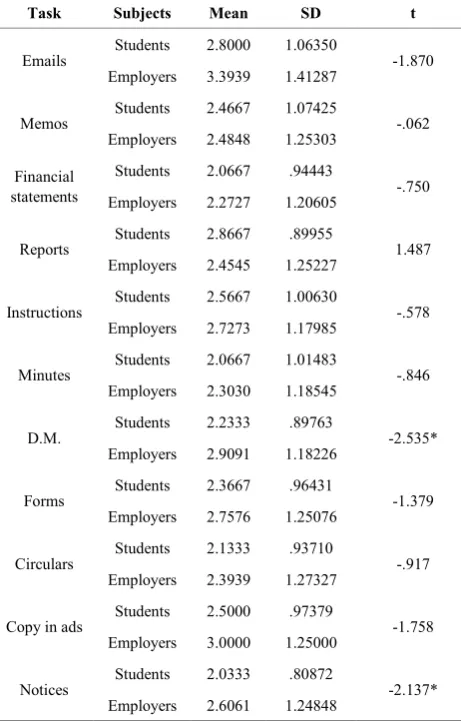
[image:3.595.58.297.323.524.2]asked their employees to perform these two writing tasks, the students’ skills did not meet the expectations. It seems that examinations play an essential role in influencing Taiwanese English learning. Because the technology college students mainly came from vocational high schools and seldom received writing tests, this essential skill was thus neglected. Table 3. Comparison of the English writing tasks learned by students at school and identified by employers in the workplace
Task Subjects Mean SD t
Emails Students 2.8000 1.06350 -1.870 Employers 3.3939 1.41287
Memos Students 2.4667 1.07425 -.062
Employers 2.4848 1.25303
Financial statements
Students 2.0667 .94443
-.750 Employers 2.2727 1.20605
Reports Students 2.8667 .89955 1.487
Employers 2.4545 1.25227
Instructions Students 2.5667 1.00630 -.578 Employers 2.7273 1.17985
Minutes Students 2.0667 1.01483 -.846 Employers 2.3030 1.18545
D.M. Students 2.2333 .89763 -2.535*
Employers 2.9091 1.18226
Forms Students 2.3667 .96431 -1.379
Employers 2.7576 1.25076
Circulars Students 2.1333 .93710 -.917 Employers 2.3939 1.27327
Copy in ads Students 2.5000 .97379 -1.758 Employers 3.0000 1.25000
Notices Students 2.0333 .80872 -2.137* Employers 2.6061 1.24848
Note. *p < .05
Table 4 shows that, compared with the other three skills, there are less significant differences between the students’ and employers’ requirements of reading skills. The employers stated that reading e-mails (M = 3.15, SD = 1.28) is the most frequent reading task in the workplace. The students reported that they learned more reading tasks at school, such as reading web information (M = 3.4, SD = .86), instructions (M = 3.03, SD = 1.03), reports (M = 3.00, SD = .83), and business journals and magazines (M = 3.00, SD = .87). The choice of reading material may be attributed to the teaching goal of English for general purposes (EGP) courses at the technology college level. Because EGP courses aim to provide students with more training in receptive skills for academic use, students acquire more-advanced skills in reading. Meanwhile, students from different departments could also choose ESP courses as an
elective, which provide more English training for specific communication contexts.
Table 4. Comparison of the English reading tasks learned by students at school and identified by employers in the workplace
Task Subjects Mean SD t
Emails Students 2.9000 .80301 -.925
Employers 3.1515 1.27772
Meeting Students 2.4667 .89955 -.067
Employers 2.4848 1.20211
Financial statement
Students 2.2333 1.00630
-.033 Employers 2.2424 1.14647
Reports Students 3.0000 .83045 1.961
Employers 2.4545 1.30122
Instructions Students 3.0333 1.03335 1.369 Employers 2.6364 1.24545
Minutes Students 2.2000 .76112 -.500
Employers 2.3333 1.26656
D.M. Students 2.7333 .90719 -.206
Employers 2.7879 1.16613
Forms Students 2.5333 1.00801 -.751
Employers 2.7576 1.32359
Circulars Students 2.5333 1.10589 1.023 Employers 2.2424 1.14647
Copy in ads Students 2.8000 1.03057 .042 Employers 2.7879 1.24392
Notices Students 2.4333 1.07265 -.477 Employers 2.5758 1.27550
Newsletters Students 2.3000 .98786 -1.256 Employers 2.6667 1.29099
Agenda Students 2.1333 .81931 -1.385
Employers 2.4848 1.14895
Catalogs Students 2.9667 .92786 .200
Employers 2.9091 1.30776 Business
journal & magazines
Students 3.0000 .87099
.530 Employers 2.8485 1.32574
Legal documents
Students 2.0667 .94443
-1.385 Employers 2.4242 1.09059
Records Students 2.1667 .83391 -1.129
Employers 2.4545 1.14812
Manuals Students 2.7000 .79438 .011
Employers 2.6970 1.28659
Web information
Students 3.4000 .85501
[image:4.595.61.292.180.541.2]4. Conclusions
The purpose of this study analyzed the needs of English learning as perceived by students and employers. Our results reveal discrepancies between what is taught at school and the requirements of the workplace and can be used to improve students’ understanding of what English abilities are necessary for their future occupations.
Regarding the two research questions, this study determined that, first, there is a disparity between the students’ and employers’ perceived reading and listening skills requirements. Second, the students’ and employers’ perceptions toward specific tasks needing language skills were mismatched (e.g., employers stated overseas exhibition, hosting VIPs, and socializing with clients, which the students did not). Hence, social communication skills were considered vital for the employers. In addition, the students’ and employers’ perceptions of the required writing skills for specific tasks also differed, such as for writing DM and notices.
In summary, the results indicate that students do not always learn the skills that employers need. Therefore, students and teachers should seek to understand the skills that employers expect for the workplace. In addition, teachers at technology colleges should pay more attention to textbook selection, material compilation, and course design. Textbook designers should also survey what the market needs and provide more realistic and adequate materials for English teachers and learners. The combination of these steps would ensure that educators can improve students’ English abilities and help them transition successfully to their future careers after graduation.
REFERENCES
[1] Albakrawi, H. D. M., & Almutairi, F. M. (2013). The Effect of ESP Program on the Engineering Student’s Proficiency at the University of Tabuk. Journal of Education and Practice, 4(3). 117-124.
[2] Choi, L. S. (2005). Literature Review: Issues Surrounding Education of English-as-a-Second Language (ESL) Nursing Students. Journal of Transcultural Nursing, 263-268. [3] Dudley-Evans, T., & St John, C. (1998). Developments in
English for Specific Purposes: A multi-disciplinary approach. Cambridge: Cambridge University Press.
[4] Graves, K. (1996). Teachers as course developers.
Cambridge: Cambridge University Press. doi: 10.1017/CBO9780511551178
[5] Hamp-Lyons, L. (2001). The Cambridge guide to Teaching English to Speakers of Other Languages (pp.126-130). Cambridge: Cambridge University Press.
[6] Hutchinson, T., & Waters, A. (1987). English for Specific Purposes: A learning-centered Approach. Cambridge: Cambridge University Press.
[7] Isarji, H. S., & Zainab, M. N. (2013). Oral communication skills in the financial services and telecommunication, technology, and media industries. IPEDR, 68 (9), 42-46. [8] Kaur, S., & Khan, A. B. M. A. (2010). Language Needs
Analysis of Art and Design Students. Considerations for ESP Course Design. Universiti Sains Malaysia, Malaysia. [9] Kaur, S., & Lee, S. H. (2006). Analysing Workplace Oral
Communication Needs in English among IT Graduates. English for Specific Purposes World, 5(1), 12.
[10] Lin, C. Y. (2013). A Need Analysis of English for Business Purposes at Universities in Taiwan: From Teachers’ and Professionals’ Perspective. Unpublished doctoral dissertation of National Taiwan Normal University, Taipei, Taiwan. [11] Pawanchik, S., Kamil, A. A., Hilmi, T. M., & Baten, A. Md.
(2011). English Language Needs of non-native foreign students. Sino-US English Teaching, 8(8), 505-510.
[12] Piyanapa, N. (2004). An Analysis of the Levels of Communication English Required by English Program Students. The University of Thai Chamber of Commerce, Bangkok, Thailand.
[13] Robinson, P. (1991). ESP today: A practitioner’s guide. Hemel Hempstead: Prentice Hall International.
[14] Su, H.H. (2010). English for Specific Purposes (ESP) in technological and vocational higher education in Taiwan. Chaoyang University of Technology, Taichung, Taiwan. [15] Strevens, P. (1988). ESP after twenty years: A re-appraisal.
Singapore: SEAMEO Regional Center.
[16] Tseng, M. C. (2014). Language Needs Analysis for Taiwanese Arts Students: What do young artists need to know? International Refereed Research Journal, 5(1), 25-36. [17] Watanabe, Y. (2006). A Needs Analysis for a Japanese High
School EFL General Education Curriculum. Unpublished MA Thesis of University of Hawai‛i, Mānoa.
[18] West, R. (1994). Needs analysis in language teaching. Language Teaching, 27, 1-10.