International Journal of Emerging Technology and Advanced Engineering
Website: www.ijetae.com (ISSN 2250-2459, ISO 9001:2008 Certified Journal, Volume 6, Issue 8, August 2016)
166
Improved Intrusion Detection System using cascading of C4.5
Decision Tree and Support Vector Machine
Snehal S. Somwanshi
1, Daivshala R. Deshmukh
21Post Graduate Student, 2Assistant Professor, Maharashtra Institute of Technology, Aurangabad, Maharashtra, India. Abstract— The Computer network is a heart of the
communication. lots of things individual can do on the internet such as email, credit card transaction, net banking, online shopping. Due to this increasing dependency of internet we have to significantly improve the security of internet. Hence, there is an instant need to recognize and detect the attacks. Intrusion Detection is defined as a process of diagnosing the attack and the sign of malicious activity in a computer network by evaluating the system constantly. The software that does such task can be defined as Intrusion Detection Systems (IDS). System established with the single algorithms like classification, neural networks, clustering etc. gives good detection rate and less false alarm rate. Current studies show that the flowing of multiple algorithm yields much better performance than the system developed with the single algorithm. Intrusion detection systems that uses single algorithm, the accuracy and detection rate were not up to mark. Increase in the false alarm rate was also come across. Flowing of two algorithm is implemented to resolve this problem. This paper suggests flowing of two algorithms for developing the intrusion detection system. C4.5 decision tree and Support Vector Machine (SVM) are pooled to maximize the accuracy, which is the benefit of C4.5 and decrease the wrong alarm rate which is the benefit of SVM. Outcomes illustrate the upturn in the accuracy and detection rate and less false alarm rate.
Keywords—Intrusion Detection System ,Data Mining, Decision Tree, Support Vector Machine, Hybrid Algorithm,kddcup99.
I. INTRODUCTION
Heady et al 1990 defined intrusion as “any set of activities that tries to compromise the reliability, confidentially or accessibility of a resource” [3].Damaging the information or accessing it as an unauthorized user, or maliciously using the information comes under the category of intrusion. Six types of attacks are defined by Mahoney [3] and they are viruses, worms, server attacks, client attacks, network attacks and root attacks.
It is challenging to identify such kinds of attacks in spite of of strong security strategies, anti- virus software, firewalls or other appliance because every system has some fault and bugs. Thats why the IDS are deliberate and can detect the new attacks IDS observer all traffic flow in a network, and classify the doubtful, malicious activities.
It also continuously observers the system health and responds to the supervisor if anything goes wrong. The achievement of IDS is that it must be intellectual to identify all the attacks in the Local Area Network (LAN).IDS must intelligent to distinguish between the normal and attacks and should take the balance among the false negative and alarm rate.In today’s situation network is a heart of the communication. Lot of things individual can do on internet. Internet gives many benefits and but has some drawbacks too. It is used as apparatus for crime. One of the major and famous criminalities is hacking. In this attack, one can increase the information of other system by reading it as a root user and can use this data for profit purpose.In today‟s portico there are lots of computer peripherals available and the internet technology has got a marvellous quantity of growth, moving of data from one address to another is a very critical issue in this present world. Internet plays a primary role in data transmission. But internet is not completely secured. There are many intimidations to internet. So there is a undecorated need to make them secure and safe.
Intrusion detection systems are existence developed as devices to identify attacks and anomalies in thnetwork,IDS are beneficial in detecting effective intrusion, and also in observing the network movement and the attempts to break the security. Intrusion detection is the exercise of discerning and inspecting the actions going on in a system in order to recognize the attacks and vulnerabilities.
II. RELATED WORKS
An In 1980, the notion of intrusion detection initiated with Anderson's [5] He offered a intimidation classification model that develops a security monitoring observation system based on detecting irregularities in user behaviour. There are various methods that have been used in the development of Intrusion Detection System which are categorized as single and hybrid techniques.
International Journal of Emerging Technology and Advanced Engineering
Website: www.ijetae.com (ISSN 2250-2459, ISO 9001:2008 Certified Journal, Volume 6, Issue 8, August 2016)
167
M. Jiang et al (2011)[16] In this paper he concentrated on a collective model for misuse and anomaly intrusion detection. Collective behaviour rule set are developed by using the clustering analysis algorithm to detect the new unknown attacks and association rule mining algorithm was useful to detect the known attack rapidly.
M. Panda et al (2011)[4] In this paper they have suggested a hybrid intellectual intrusion detection system by merging the two classification algorithm for creating the decision more accurate and rapid. First the classification or clustering was applied in the entire dataset and the output is applied to another classification algorithm. They applied 10-fold cross validation method, and the result realized is in the form of normal or intrusion.
Yogita B .Bhavsar et al (2013)[2] In this paper author suggested Intrusion Detection System using data mining method SVM(Support Vector Machine) and in their suggested system SVM is used for classification and verification concerning the effectiveness of the suggested system is done by conducting some experiments using NSL-KDD Cup’99 dataset which is developed version of standard KDD Cup’99 data set. The SVM is one of the most conspicuous classification algorithms in the data mining area, but its drawback is its large training time. For this drawback they suggested system that supported several studies using NSL-KDD Cup’99 data set. The experimental results show that It can reduce widespread time required to Build SVM model by accomplishing appropriate data set pre-processing. Also when they do appropriate selection of SVM kernel function such as Gaussian Radial Basis Function because of this it create results that shows attack detection rate of SVM is enhanced and False Positive Rate (FPR) is decrease.
Jashan Koshal, et al(2012)[3] This paper author signified two hybrid algorithms for emerging the intrusion detection System.C4.5 decision tree algorithm and Support Vector Machine (SVM) algorithm are cascading to maximize the accuracy and for that purpose grouping of algorithm result shows that growth in the accuracy and detection rate. And then they accomplish that the cascading of algorithm gives improving results than single algorithm in detection of Intrusion Cascading the Algorithm increases the accuracy and consistency. Thus Scientists are focused on cascading methods for developing the Intrusion Detection System.
Following figure shows percentage distribution of several data mining techniques used to detect intrusion.
Fig.1(3) The percentage dispersion of number of papers under various Ids approaches
III. DATA MINING METHODS
A. C4.5 Decision Tree
C4.5 is a typical decision tree algorithm. It is basically an extensionof ID3 algorithm. This was developed by Ross Quinlan [15]. C4.5 is also known as statistical or supervised learning classifier. In this algorithm, divide and conquer approach is used to recursively construct a decision tree of database/dataset attributes . Decision tree is built by using two methods i.e top down manner or bottom up manner. A decision tree is constructed with empty root node and then decision tree node corresponding to the algorithm is built [15] [14].
To construct the decision tree following steps is followed recursively. Following are the steps [15]:
1. Information gain (IG) is computed for each and every attribute.
2. A tree like structure gets started constructing from its root node by the selection of attributes which have a maximum value of IG.
International Journal of Emerging Technology and Advanced Engineering
Website: www.ijetae.com (ISSN 2250-2459, ISO 9001:2008 Certified Journal, Volume 6, Issue 8, August 2016)
168
4.After splitting, consider whether or not these new nodes are leaves (their data belongs to the same type); otherwise, new nodes are the root of the sub-trees. 5.Repeating all the above steps, until all new nodes are
leaves.
This partition of the training dataset is performed and a tree like structure is created. Due to selection of highest IG value it is best suited for decision making tree.
Let D is a training set which contains m distinct classes, Ci(i=1,2….m) Ci,D set of tuples in class Ci in D.|Ci,D| and |D| represent the number of tuples in D and Ci,D respectively and Pi is the probability that any tuple present in D belongs to class Ci, which is calculated by |Ci,D| / |D|. When an attribute A is selected, it can be used to split D into v partitions {D1,D2…..Dv}where Dj contains tuples in D that have outcome aj of A.There are some method for selecting best or splitting attributes as follows:
Info(D) = -
im1P
ilog
2Pi
[1]
Gain(a,T)=Entropy(a)-Info(a,T)
Info (a, T) +=
T
a,vEntropy
(
a
v)
T
aGain
(
a
,
T
)
GainRatio(a,T)=
SplitInfo
(
a
,
T
)
SpiltInfo (a, T) +=
|
T
a,v|log
|
T
a,v|
|
T
a||
T
a| [1]
B. SVM (Support vector machine)
SVM are a class of supervised learning algorithms which first introduced by Vapnik . Given a set of labeled training vectors (positive and negative input examples), SVM learn a linear decision boundary to discriminate between the two classes. The outcome is a linear classification rule that can be used to classify new test examples. SVM have demonstrated excellent generalization routine (accuracy on test sets)in practice and have strong theoretical motivation statistical learning theory.The basic idea of SVM can be illustrated in Figure below, two types of two-dimensional linearly separable case, there are many possible linear classifiers can be separated from this set of data, but only a classification of the two intervals the most that figure has.
The so-called optimal separating superficial is the classification of line not only requires appropriate parting of the sample (training errorrate is 0), but also the largest class interval, these are two inconsistent goals
IV. DATASET DESCRIPTION
KDD Cup 1999 Dataset
KDD Cup 1999 dataset is the most popular dataset that is used for evaluating the anomaly type intrusion. In 1998 DARPA conducted an evaluation program for intrusion detection in the MIT Lincoln Labs. The main objective of this program was to evaluate the intrusion [7] [8] . In this a standard dataset was provided which simulated a wide variety of intrusions on the perspective of a military network environment. This dataset was prepared by Stotfo et al[8].DARPA 1998 dataset consist of 4 gigabytes of compressed tcp dump data which was collected over the period of 7 weeks . In this dataset, around 5 million connections and each one connection having 100 bytes were records. KDD Cup 1999 having 4,90,000 single vector connection [9]. This dataset contains 41 features which were labeled as normal or as abnormal[10-12]
In our experiment we used 4178 records.among that 4178 2089 is used for training and 2089 is used for testing.
Fig-Datset Description
V. ATTACK CATEGORISATION
International Journal of Emerging Technology and Advanced Engineering
Website: www.ijetae.com (ISSN 2250-2459, ISO 9001:2008 Certified Journal, Volume 6, Issue 8, August 2016)
169
User to Root Attack (U2R): It is a type of exploit in which attacker has a local normal user account access on the system. But an attacker takes the advantage of present vulnerabilities in the system like sniffing passwords, a dictionary attack or social engineering and gets the super user privilege access.Remote to Local Attack (R2L): is a type of attack in which an attacker machine is able to send a packet remotely but does not have an account on the victim machine. So by taking advantage of any vulnerabilties on the victim machine like clock, guest, xnsnoop, phf, sendmail, the attacker gets access to the victim machine.
Probing Attack: It is a very basic and initial step of exploiting any system.The attacker scans a machine to find out the weakness or vulnerabilities in the network using saint, portsweep, mscan, nmap etc. To exploit the victim machine.
VI. EXPERIMENTAL RESULTS
The proposed system is developed by using cascading of two algorithm C4.5 decision tree and support vector machine.for that purpose experiments done on standard dataset i.e.kdd cup 99 dataset.these dataset containing 4178 records and among that records 2089 is selected for training and 2089 is selected for testing.for training purpose c4.5 and svm algorithm is applied on dataset to train the dataset about normal and abnormal traffic,after training ,testing is done on that dataset to check the efficiency of model.
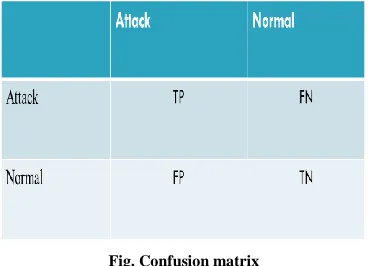
When algorithm is applied on the dataset,dataset gives results in the form of normal and malicious records.these records are obtain from each algorithm such as c4.5,svm and hybrid algorithm which is a combination of c4.5 and svm algorithm.After getting normal and abnormal results of data,from that results confusion matrix is drawn,Confusion matrix has following values
False positive (FP): Or false alarm, Corresponds to the number of detected attacks but it is in fact normal.
False negative (FN): Corresponds to the number of detected normal instances but it is actually attack, in other words these attacks are the target of intrusion detection systems.
True positive (TP): Corresponds to the number of detected attacks and it is in fact attack.
[image:4.612.352.536.136.269.2]True negative (TN): Corresponds to the number of detected normal instances and it is actually normal.s following values that are follows:
Fig. Confusion matrix
After getting confusion matrix values performance of proposed madel is tested by using some performance evaluation parameter.
We checked performance of model by using following parameter
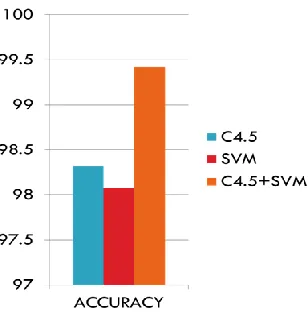
Accuracy: This refers to the ability of the classifiers to correctly measure theintrusions from the training dataset. This is defined as the ratio of correctly classified data to the total classified data.
[image:4.612.322.573.474.598.2]Results of accuracy of c4.5 ,svm and hybrid model shows following table.
Fig. Accuracy results of three algoritm
International Journal of Emerging Technology and Advanced Engineering
Website: www.ijetae.com (ISSN 2250-2459, ISO 9001:2008 Certified Journal, Volume 6, Issue 8, August 2016)
[image:5.612.344.521.139.297.2]170
Fig: shows graphical representation of results of accuracyDetection Ratio: It is defined as the ratio of detecting attacks to total no of attacks. This is the best parameter to measure the performance of the model.
[image:5.612.91.245.148.305.2] [image:5.612.348.537.454.613.2]Following table shows results of detection ratio of three algorithm
Fig : shows results of detection rate of three algorithm
Fig:shows graphical representation of results of detection rate
False Positive Rate:This is one of the main parameters to find out the effectiveness of various models and also the major concern while network setup. A normal data is considered as abnormal or attack type data. It is defined as:
[image:5.612.77.262.471.636.2]Following table shows false positive rate of three algorithm
International Journal of Emerging Technology and Advanced Engineering
Website: www.ijetae.com (ISSN 2250-2459, ISO 9001:2008 Certified Journal, Volume 6, Issue 8, August 2016)
[image:6.612.73.277.136.305.2]171
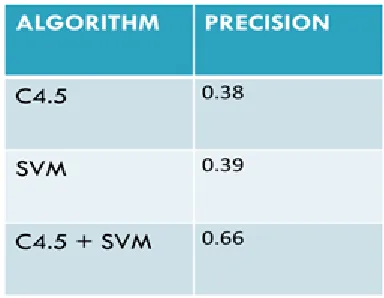
Fig: shows graphical representation of results of false positivePrecision Ratio: It is also known as positive predictive value (PPV). It measures the relevant instance that is retrieved after classification. A classifier that has high precision means that classifiers or algorithm returns more relevant results
[image:6.612.332.552.136.304.2]
Following table shows results of precision value
Fig : shows results of precision of three algorithm
Fig: Shows graphical representation of precision value
[image:6.612.353.534.365.506.2]Time Complexity: time complexity refers that time required to build the model and time complexity of three model are as follows,
Fig: shows time complexity of three models
From the above results time complexity of proposed model is more than single model.
VII. CONCLUSION
As overall study shows that hybrid approaches gives better results than single algorihm.therefore researchers are now focusing on two hybrid algorithm for greater results.
[image:6.612.71.263.480.629.2]International Journal of Emerging Technology and Advanced Engineering
Website: www.ijetae.com (ISSN 2250-2459, ISO 9001:2008 Certified Journal, Volume 6, Issue 8, August 2016)
172
The results of the proposed approach are compared with the results of single data mining techniques such as C4.5 and SVM, then it is shows that the HYBRID approach is effective during detection of attacks, Accuracy and to reduce false positive. The DETECTION RATE of the proposed algorithm is 98.89 which is better than single data mining techniques c4.5 & svm which is having detection rate 98.32,98.08 respectively. The ACCURACY of proposed algorithm is 99.42which is also higher than c4.5 and svm which is having 98.32, 98.08 respectively. The FALSE POSITIVE RATE of Proposed System is 0.53 lower than c4.5 and svm which is having 1.42,1.35 respectively
REFERENCES
[1] Intrusion Detection Using Data Mining Techniques, Mohammadreza Ektefa,Department of IS UPM Serdang Malaysia [email protected]., Sara Memar Department of CS UPM Serdang, Malaysia [email protected]
[2] Intrusion Detection System Using Data Mining Technique: Support Vector Machine Yogita B. Bhavsar1, Kalyani C.Waghmare2 Post Graduate Student, Assistant Professor, Pune Institute of Computer Technology, Pune, Maharashtra, India
[3] Cascading of C4.5 Decision Tree and Support Vector Machine for Rule Based Intrusion Detection System Jashan Koshal, Monark Bag Indian Institute of Information Technology Allahabad, Uttar Pradesh211012,[email protected],[email protected] om
[4] M. Panda, A. Abraham, M.R. Patra, “Discriminative multinomial Naïve Bayes for network intrusion detection”, Proceedings of the 6th International Conference on Information Assurance and Security [5] A Java Based Network Intrusion Detection System (IDS) Allam
Appa Rao, P.Srinivas, B. Chakravarthy, K.Marx, and P. KiranDepartment of Computer Science and Systems Engineering,Andhra University College of Engineering, [email protected].
[6] M.Jiang,“Combining Multiple Techniques for Intrusion Detection”, International Journal of Computer Science and Network Security, 2006.
[7] I. Levin, ―KDD-99 classifier learning contest LLSoft's results overview,‖ ACM SIGKDD Explorations Newsletter, vol. 1, no. 2, p. 67, 2000
[8] S.J. Stolfo, A.L. Prodromidis, S. Tselepis, W. Lee, D.W. Fan, and P.K. Chan,In KDD JAM: Java Agents for Meta-Learning over Distributed Databases,‖ vol.97, pp. 74-81, 1997
[9] I.Levin, ―KDD-99 classifier learning contest: LLSoft's results overview,SIGKDD explorations, vol.1, no. 2, pp. 67-75, 2002. [10] P.G. Jeya, M. Ravichandran, and C. S. Ravichandran, ―Efficient
Classifier for R 2 L and U 2 R Attacks,‖ International Journal of Computer Applications, vol. 45, no. 21, 2011.
[11] S.Paliwal and Ravindra Gupta, ―Denial-of-Service, Probing & Remote to User (R2L) Attack Detection using Genetic Algorithm,‖ International Journal of Computer Applications, vol. 60, no. 19, 2012.
[12] L.Sunitha, M. BalRaju, J. Sasikiran, and E.V. Ramana. "Automatic outlier identification in data mining using IQR in real-time data." International Journal of Advanced Research in Computer and Communication Engineering,vol. 3, no. 6, pp. 7255-7257, 2014. [13] W. Lin, S. Ke and C. Tsai,CANN: An intrusion detection system
based on combining cluster centers and nearest neighbors‖,Knowledge-Based Systems, vol. 78, pp. 13-21, 2015 [14] G. Kim, S. Lee and S. Kim, ―A novel hybrid intrusion detection
method integrating anomaly detection with misuse detection,‖ Expert Systems with Applications, vol. 41, no. 4, pp. 1690-1700, 2014 [15] J. Quinlan, Bagging, Boosting, and C4. 5. 1996
[16] Choosing an Intrusion Detection System that Best Suits yourOrganization Dennis Mathew GSEC Practical v1.4b Option A
Acknowledgements