International Journal of Emerging Technology and Advanced Engineering
Website: www.ijetae.com (ISSN 2250-2459, ISO 9001:2008 Certified Journal, Volume 4, Issue 3, March 2014)
An Analytical Study of Enhancing Energy Efficiency of
Wireless Sensor Network through Relay Nodes Placement
Ankur Pandey
1, M.A. Rizvi
2 1P.G. Scholar, 2Associate Prof., Dept. of Computer Engg. & Application, NITTTR Bhopal
Abstract—Power consumption of a node in the wireless
sensor network increases with the increment of distance between the transmitter and the receiver i.e. the sensor and the base-station. Many published studies have been covered in this paper, which suggests various approaches to minimize power consumption of wireless sensor networks. One of the most effective techniques is to deploy relay nodes in the network, which receives the sensed data from distant nodes and transmit them to the destination i.e. sink node. The strategies for deployment of relay nodes have been discussed in detail, so as to obtain better results in the form of longer network lifetime as well as efficient data gathering.
Keywords—Duty cycling, Energy conservation schemes,
Mobility-based Approaches, Relay nodes, Topology control, Wireless Sensor Networks.
I. INTRODUCTION
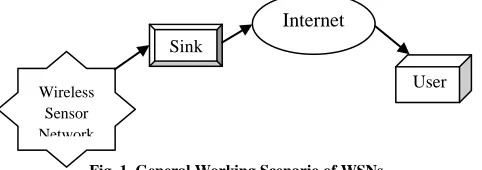
[image:1.612.50.291.641.726.2]A sensor network is a network of tiny, lightweight, battery-operated devices, known as sensor nodes. These nodes are usually equipped with a sensing unit, a processing unit, and an RF communication unit. These nodes are intended to sense some physical phenomena. Each sensor node in a sensor network can sense only its vicinity. The data generated by each sensor is required to be sent to a destination, known as base station or sink, from where the user can access the data, usually through the Internet, to extract some useful information. Similar to the development of many other technologies, research and development in sensor networks was initially driven by the requirement for defense applications [2]. It is the recent technological advances in the field of micro-electro-mechanical systems (MEMS) that have made the development of tiny, low-cost, low-powered and multifunctional sensor nodes technically and economically feasible [1][2]. The general working scenario of WSNs is as shown in Fig. 1.
Fig. 1. General Working Scenario of WSNs
MANETS (Mobile Ad-hoc Networks) and WSNs are two classes of the wireless Ad-hoc networks with resource constraints [3]. MANETS usually consists of devices that are mobile and have high processing capabilities with sufficient energy budget. Whereas, in sensor network there are various resource constraints such as energy, computation and memory, etc.
Some of the key features of wireless sensor networks are as follow [1]:
Self-organizing capabilities
Short-range broadcast communication and multihop routing
Dense deployment and cooperative effort of sensor nodes
Frequently changing topology due to fading and node failures
Limitations in energy, transmit power, memory, and computing power
These features (especially the last three) differentiate sensor network from other Adhoc networks.
For Sensor networks have a wide range of applications. They can be deployed in many areas such as structural health monitoring, military surveillance, civil engineering and environmental monitoring etc. Sensor networks also find their way into factory applications (e.g. inventory managements) and home applications (e.g. home automation) [1]. These networks have proved to be of tremendous benefit for a number of industries.
II. CHALLENGES OF WSNS
Factors such as the small size of sensor nodes, use of wireless technology, limited non-renewable energy sources, dense deployment of large number of sensor nodes and remote location of deployment, led to a number of challenges in the design, operation and maintenance of the networks. Some of the challenges included are discussed in [1]. The design of sensor network are determined by various factors, like fault tolerance, scalability, small size, robust operations, production costs, operating environment, security, compatibility, flexibility, data aggregation, sensor network topology, hardware constraints, transmission media, quality of service (QoS),data latency and overhead and power consumption etc [1].
Wireless Sensor Network
Sink
Internet
International Journal of Emerging Technology and Advanced Engineering
Website: www.ijetae.com (ISSN 2250-2459, ISO 9001:2008 Certified Journal, Volume 4, Issue 3, March 2014)
770 A. Area Coverage
Sensor nodes can sense a physical phenomenon only in its vicinity. Thus, in order to monitor an entire area, it needs to be completely covered by the sensor nodes.
B. Connectivity
In order to obtain complete results, it needs to be ensured that the nodes in a sensor network are highly connected i.e. no node is isolated from the remaining network.
C. Energy Constraint
The nodes need to use their power efficiently as the sensor nodes are operated by lightweight batteries and recharging or replacing batteries may not be physically or economically feasible.
D. Fault Tolerance
Some sensor nodes may fail or be blocked due to lack of power, physical damage, or environmental interference. Therefore, the failure of few sensor nodes should not affect the overall task of the sensor network.
E. Self-Configurability
The network could be deployed in areas where no infrastructure is available. Therefore, the nodes need to self-configure and self-organize themselves to maintain the network in operational mode i.e., if there is any alteration in the networking scenario, the nodes need to reconfigure themselves to adapt to the current environment.
F. Scalability
Since sensor node are densely deployed in large numbers (in the order of hundreds or thousands), the protocols need to be scalable to handle such large number of nodes.
G. Quality of Service
There is always a trade-off between performance of the network and lifetime of the network. Therefore, energy-efficient schemes are required to address the issue of quality of service.
Mostly, sensor networks are deployed in a remote and hostile location. Therefore, it is not feasible to replace the power-source of sensor nodes, which are generally the batteries with limited energy budget. Hence, prolonging the network lifetime becomes the most critical issue of such networks.
III. ENERGY CONSERVATION SCHEMES OF WSNS
There are several approaches to reduce power consumption in wireless sensor networks.
[image:2.612.336.555.186.264.2]However, at a very general level, we can classify them in three major techniques, namely, duty cycling, data-driven approaches, and mobility-based techniques. The above mentioned classification is as shown in the Fig. 2.
Fig. 2. General Classification of Energy Conservation Schemes for Wireless Sensor Networks
A. Duty Cycling
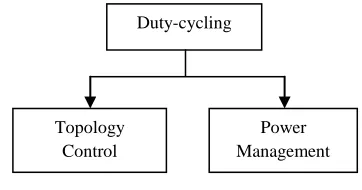
Duty cycle is a fraction of time in which the nodes are active during their lifetime. Duty cycling can be achieved through two mutually exclusive approaches that are topology control and power management as shown in Fig. 3.
Fig. 3. Classification of Duty-cycling Approach
1) Topology Control
The basic idea behind the topology control is to exploit the network redundancy to prolong the network longevity, typically increasing the network lifetime by a factor of 2–3 with respect to a network with all nodes always on [4]. Topology control is an approach of finding optimal subset of nodes that guarantees connectivity among the nodes in a wireless sensor network.
In [6] the authors consider two- tiered WSN consisting of sensor cluster installed around strategic area and base stations whose locations are relatively movable. In a sensor cluster there can be at least one application node to received row data from the sensor nodes and create a comprehensive local view and send in form of composite bit – stream toward a base station. The topology control approach maximize the network lifetime by using Computational Geometry algorithm for arranging base station locations and application nodes relaying optimally.
Energy Conservation Schemes
Duty-cycling Data-driven Mobility-based
Duty-cycling
Topology Control
[image:2.612.352.533.373.468.2]International Journal of Emerging Technology and Advanced Engineering
Website: www.ijetae.com (ISSN 2250-2459, ISO 9001:2008 Certified Journal, Volume 4, Issue 3, March 2014)
2) Power Management
In power management approach of duty cycling, active nodes (nodes that are selected by the topology control scheme) do not need to keep their radio continuously on. Most effective energy-conserving method is to put the radio transceiver in the low-power mode whenever the communication is not required. The low-power radio is continuously in stand-by, and whenever receives a signal it wakes up the data radio [5]. Thus, power management technique is a duty cycling approach applied on active nodes of the network.
B. Data-driven Approach
[image:3.612.347.536.301.396.2]In a sensor network, large number of nodes is closely deployed. Therefore, sensor networks may generate redundant data and a large fraction of the total energy of a node is spending on the transmission of data. So by reducing the amount of data which is to be transmitted, a significant amount of energy can be conserve. Data-driven approaches can be classified according to the problem they address as shown in Fig. 4.
Fig. 4. Classification of Data-driven Approach
Data-reduction schemes address the case of unneeded samples, whereas energy-efficient data acquisition schemes are mainly focused at reducing the energy spent by the sensing subsystem. However, some of them can minimize the energy spent for communication as well.
1) In-network Processing
The most often applied technique is In-network processing also known as network aggregation. In-network aggregation is the global process of gathering and routing information through a multi hop network, processing data at intermediate nodes with the objective of reducing resource consumption (in particular energy), thereby increasing network lifetime [7].
C. Mobility-based Approach
In case some of the sensor nodes are mobile, mobility can finally be used as a tool for reducing energy consumption (beyond duty cycling and data-driven techniques).
[image:3.612.82.258.390.483.2]These mobile nodes (including, possibly, the sink) are responsible for collecting data directly from static nodes. As a result, static nodes can save energy because path length, contention and forwarding overheads are reduced. An initially connected network can turn into a set of disconnected sub-networks due to hardware failures or energy depletion. In these cases, nodes can exploit mobility in order to remove partitions and re-organize the network so that all nodes are connected again [10]. In this case, the network‘s lifetime would be extended as well. Mobility-based energy conservation schemes are applied by deploying either mobile-sink or mobile-relay as shown in Fig. 5.
Fig. 5. Shows the classification of Mobility-based Approach
IV. ENERGY CONSERVATION THROUGH MOBILITY-BASED
SCHEMES
Data coming from sensor nodes traverse the network towards the sink by following a multi-hop path. When the sink is stationary, some paths are more loaded than others depending on the network topology and packet generation rates at sources. Usually, nodes closer to the sink have to relay more data. Thus, they are subjected to higher energy depletion. The traffic flow can be altered if a mobile device takes the responsibility of data collection. Ordinary nodes wait for the mobile device and communicate with mobile data collector in proximity (directly or with a few multi-hop traversals). As a result, ordinary nodes can save energy. Nodes can also exploit this feature of mobility in order to remove partitions and re-organize the network so that all nodes remain connected at all times. In addition, the constraint of connectivity can be relaxed as the mobile nodes can reach to isolated ones in the network. But the need is to define an efficient data transfer protocol specifically targeted to communicate between a node and a mobile device.
Due to the above-mentioned advantages, sensor nodes are equipped with mobilizers for changing their location. However, these mobilizers are quite expensive. Therefore, adding mobility to each node may be not feasible.
Data-driven Approach
Data reduction Energy-efficient Data Acquisition
Mobility-based Schemes
International Journal of Emerging Technology and Advanced Engineering
Website: www.ijetae.com (ISSN 2250-2459, ISO 9001:2008 Certified Journal, Volume 4, Issue 3, March 2014)
772
So, in spite of making each node mobile, mobility can be limited to some special nodes known as relay nodes that are less energy constrained than the ordinary ones. Mobility of sensor nodes is actually feasible, and it can be accomplished in different ways [9]. Mobility-based energy conservation schemes are applied by deploying either mobile-sink or mobile-relay as shown above in Fig. 5.
A. Mobile-Sink (MS)
Sensor networks with mobile sinks (MSs) usually rely on a Linear Programming (LP) formulation, which is exploited in order to optimize certain parameters such as network lifetime, etc. A Linear Programming (LP) formulation is derived in order to obtain the optimal sojourn times at each sink site. The obtained solution optimizes the network lifetime while enforcing balanced energy expenditure, but do not consider the costs due to sink relocation. Nodes that are not in the coverage area of sink can send messages along multi-hop paths ending at these mobile-sinks.
In [11] the author proposed a protocol for energy conserve routing, topology control, clustering and data aggregation. The protocol focused on sensor nodes, but load on sensor nodes are unbalanced. The load on sensor nodes can be balanced by using mobile-sink and changing base station position from time to time and thereby, finding better routing strategy.
A. Mobile-Relay (MR)
The mobile relays (MR) used for data collection in multi-hop ad hoc networks are also termed as message ferries, in context of opportunistic networks. Message ferries are special mobile nodes, which are introduced into a sparse mobile ad hoc network to provide the service of message relaying. Message ferries move around in the network area, gather data from nodes and forward them towards the sink node. Thus, message ferries can be considered as a moving communication infrastructure, which helps data transfer in sparse wireless networks.
In [8] the author investigates the benefits of heterogeneous wireless sensor network architecture composed of mobile nodes and a large number of simple static nodes. These mobile nodes act as a mobile relays or mobile sink. They compute the network lifetime by using different routing algorithm, there are three different algorithm works on three different conditions as like static network, mobile sink and mobile relay.
Mostly, these mobile-relays move along a fixed path. In fact, changing the path of MR is not always feasible because sensors may be deployed in places with obstacles, on rough terrain, or generally at remote locations.
Sensor nodes that are located near to the MR path transmit their data directly to the MR when passing by. Nodes that are far from the path followed by the MR transmit their data over a multi-hop path towards the MR when it passes by or to one of the nodes which are positioned near to the path of the MR. These nodes act as data caches until the MR passes by. In order to manage this kind of data collection, nodes self-organize into clusters. Here cluster heads are the nodes which are nearer to the path of the MR. The other nodes of the cluster send their data to the cluster head for storage until the next visit of the MR. Data from the sensor nodes of the cluster travel towards the cluster heads according to the directed diffusion protocol. Election of the cluster heads is kept after the first traversal of the MR. During this traversal the MR does not collect any data. Transmissions from cluster heads to the MR occur only when the MR is near so as not to waste energy in useless transmissions. Each cluster head is visited before its buffer runs out of space. Better performance can be achieved when the MR alternates between two states: moving at a constant speed and stopping for a while. Therefore, MR moves fast in places with no, or only a few, sensors and stops near the cluster heads where the deployment of sensors is denser. The determination of places where sensor deployment is denser (congested regions) is done at each traversal of the MR.
V. RELAY NODES IN SENSOR NETWORKS
Research on improving energy efficiency of a sensor network is going on two parallel streams. First category of research has focused on the energy conservation, after the network has been deployed, i.e. it considers that the placement of nodes is fixed by deployment, and then aims to reduce the power consumption so that the lifetime of network is maximized. Second category of research has focused on the placement of sensor nodes in a sensor network before its deployment. The aim of this category of research is to address the node-placement problem in sensor networks, which is to determine a set of locations for the sensor nodes within a sensor network such that, if sensor nodes are placed at these locations, the network may remain functional for a longer time with the available energy resources.
International Journal of Emerging Technology and Advanced Engineering
Website: www.ijetae.com (ISSN 2250-2459, ISO 9001:2008 Certified Journal, Volume 4, Issue 3, March 2014) Therefore, energy consumption is much higher in direct
communication between two distant nodes as compared to that of a multi-hop communication between the same pair of nodes. In sensor networks, data flows towards the base station, whose location is generally fixed. So the nodes located closer to the base station need to transfer data at a higher rate than the nodes that are at a distance from the base station. For example, in the minimum-energy transmission model [12], nodes located closer to the base station need to relay data at much higher rate than the nodes located further away from the base station. Hence, there is uneven energy dissipation among the nodes of the network, which may lead to the faster death of the burdened nodes.
The solution to this problem is proposed in [13], which is to use a special node in sensor networks, called relay nodes, whose function is only to relay data generated by other sensor nodes, without sensing any physical phenomena. The relay nodes may also reduce the transmission distance between a pair of nodes by acting as a hop between them.
VI. DEPLOYMENT OF RELAY NODES
Based on deployment, sensor networks can be classified into two categories, namely flat architecture and hierarchical architecture. Relay nodes can be deployed in either of the architectures.
A. Relay Nodes in Flat Architecture
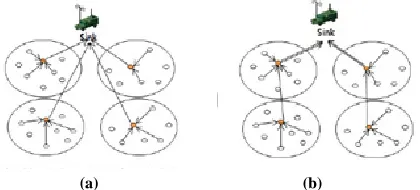
[image:5.612.343.561.144.235.2]In flat architecture, each sensor node shares the burden of routing with other nodes. Each sensor node is responsible for sensing and forwarding the data of its own as well as of any other node of the network, towards the base station, provided the node have been selected to be a hop in the path of data gathering. Cheng et al. in [13] have proposed to use relay nodes for maintaining connectivity, by using minimum-per-node transmission power. They have concentrated on a specific class of sensor network, called the biomedical class of sensor networks, where the location of sensor nodes are predetermined and fixed. They have solved the optimization problem based on a NP-Hard problem. Fig. 6 shows the deployment of nodes with flat architecture using single as well Multihop communication case.
Fig. 6. Flat Architecture of WSN (a) Single Hop Model (b) Multihop Model
In [14], Dasgupta et al. proposed the use of relay nodes to maximize the lifetime of sensor networks, but instead of considering that the nodes‘ positions are fixed (as in [13]), they have allowed node mobility and provided an integer solution to the optimization problem. In [15], Falck et al. (2004) have attempted to achieve balanced data gathering against sufficient coverage, using relay nodes in sensor networks and have solved the optimization problem by Linear Programming (LP). In [16], Coleri and Varaiya (2005) have focused on achieving a desired network lifetime using minimal total energy and have formulated the problem in LP, assuming the placement of sensor nodes and their sampling rate are predetermined and fixed. And for the placement problem, they have proposed an NLP formulation and an approximation algorithm.
B. Relay Nodes in Hierarchical Architecture
In hierarchical architectures, each sensor node belongs to only one cluster. Therefore, each sensor node sends only its own data to the respective head node. The cluster-head, on the other hands, bear much more responsibilities, e.g. data gathering, data aggregation and routing. Cluster-head nodes may form networks among themselves and forward the data that has been collected, from its own cluster as well as from other cluster heads, towards the base station, using multi-hop paths. It is proven that cluster-based architectures are scalable. Fig. 7 shows the hierarchical deployment of nodes in WSN using single as well as Multihop communication case.
Fig. 7. Hierarchical Architecture of WSN (a) Single Hop Model (b) Multihop Model
(a) (b)
[image:5.612.340.550.608.703.2]International Journal of Emerging Technology and Advanced Engineering
Website: www.ijetae.com (ISSN 2250-2459, ISO 9001:2008 Certified Journal, Volume 4, Issue 3, March 2014)
774
The deployment of relay nodes in hierarchical architecture was first proposed in 2003, in two different publications, [17] and [18]. In [17], Gupta and Younis focused on the issue of load-balancing and proposed an algorithm for load-balanced-clustering of hierarchical sensor networks (The performance evaluation of their approach was published in [19]). They have called the relay nodes gateway nodes.
The other paper that has introduced relay nodes in hierarchical sensor networks was by Pan et al. (2003) [18]. In their publication, they have called the relay nodes as aggregation nodes (AN), and have attempted to maximize the topological network lifetime of sensor networks. Their approach has focused on arranging the base stations (BS) and optimizing inter-AN relaying. In the same year (2003), Gupta and Younis published another paper that has included relay nodes in hierarchical sensor networks, but has focused on fault-tolerant issues [20]. Their approach has focused on recovering the underlying sensor nodes from a cluster whose cluster head has died. Subsequently, in 2004, Tang and Xue in [21], focused on optimizing the number of relay nodes that can be used in a sensor network such that the connectivity and fault-tolerance can be ensured.
VII. CONCLUSION
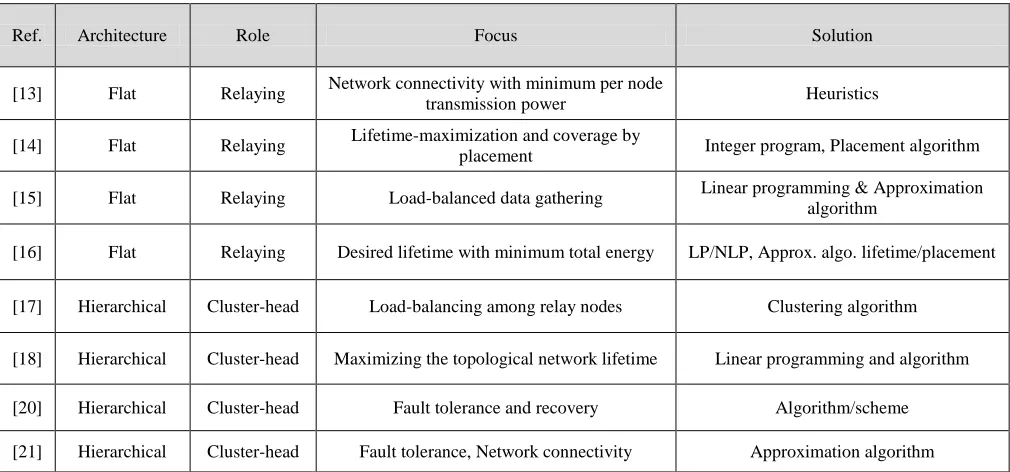
[image:6.612.54.559.445.681.2]Analysis of energy conservation schemes for wireless sensor network has been done. The discussion was not limited to the topics that have received wide interest in the past i.e. duty cycling and data-driven approaches but also the emphasis has been laid upon mobility-based schemes for enhancing energy efficiency of WSNs. It is worth noting that these approaches must not be considered as alternatives rather they should be applied simultaneously. Since, mobility-based energy conservation schemes are relatively less explored in the field of wireless sensor network. Thus, many aspects are needed to be studied with more attention. With the help of published works, this study has been concluded that deployment of relay nodes in the sensor network is an effective technique to maximize the network‘s lifetime. In Table 1, various papers studied have been summarized using architecture, problem focused and their corresponding solution.
Table I
Summary of the Published Studies Covered in this Paper
Ref. Architecture Role Focus Solution
[13] Flat Relaying Network connectivity with minimum per node
transmission power Heuristics
[14] Flat Relaying Lifetime-maximization and coverage by
placement Integer program, Placement algorithm
[15] Flat Relaying Load-balanced data gathering Linear programming & Approximation algorithm
[16] Flat Relaying Desired lifetime with minimum total energy LP/NLP, Approx. algo. lifetime/placement
[17] Hierarchical Cluster-head Load-balancing among relay nodes Clustering algorithm
[18] Hierarchical Cluster-head Maximizing the topological network lifetime Linear programming and algorithm
[20] Hierarchical Cluster-head Fault tolerance and recovery Algorithm/scheme
International Journal of Emerging Technology and Advanced Engineering
Website: www.ijetae.com (ISSN 2250-2459, ISO 9001:2008 Certified Journal, Volume 4, Issue 3, March 2014) REFERENCES
[1] I.F. Akyildiz, W. Su, Y. Sankarasubramaniam, and E. Cayirci. Wireless sensor networks: a survey. Computer Networks, 38:393– 422, 2002.
[2] C.-Y. Chong and S. P. Kumar. Sensor Networks: Evolution, Opportunities, and Challenges. Proc. of the IEEE, 91(8):1247–1256, 2003.
[3] Rajashree.V.Biradar , V.C .Patil , Dr. S. R. Sawant , Dr. R. R. Mudholkar, Classification and Compa Networks, Special Issue on Ubiquitous Computing Security Systems.
[4] D. Ganesan, A. Cerpa, W. Ye, Y. Yu, J. Zhao, D. Estrin, Networking issues in wireless sensor networks, Journal of Parallel and Distributed Computing 64 (2004) 799–814.
[5] L. Guo, J. Rabaey, Low power distributed MAC for ad hoc sensor radio networks, in: Proc. IEEE Globecom, 2001.
[6] J. Pan, Y.T. Hou, L. Cai, Y. Shi, and S.X. Shen, ―Topology Control for Wireless Sensor Networks,‖ Proc. ACM MobiCom, pp. 286-299, 2003.
[7] Fasolo E., Rossi M., Widmer J. and Zorzi M. (2007) IEEE Wireless communication.
[8] W. Wang, V. Srinivasan, and K.-C. Chua, ―Using Mobile Relays to Prolong the Lifetime of Wireless Sensor Networks,‖ Proc. ACM MobiCom, 2005.
[9] I.F. Akyildiz, I.H. Kasimoglu, Wireless sensor and actor networks: research challenges, Ad Hoc Networks Journal 2 (4) (2004) 351– 367.
[10] G. Dini, M. Pelagatti, I.M. Savino, An algorithm for reconnecting wireless sensor network partitions, in: Proc. 5th European Conference on Wireless Sensor Networks (EWSN 2008), Bologna, Italy, January 30–February 1, 2008, pp. 253–267.
[11] J. Luo and J.P. Hubaux, ―Joint Mobility and Routing for Lifetime Elongation in Wireless Sensor Networks,‖ Proc. IEEE INFOCOM, 2005.
[12] W. Heinzelman, A. Chandrakasan, and H. Balakrishnan. Energy efficient communication protocol for wireless micro-sensor networks. In Proc. of the 33rd HICSS, pages 3005–3014, Maui, Hawaii, 2000.
[13] X. Cheng, D-Z. Du, L. Wang, and B. B. Xu. Relay Sensor Placement in Wireless Sensor Networks. IEEE Transactions on Computers, 2001. http://citeseer.ist.psu.edu/cheng01relay.html.
[14] K. Dasgupta, M. Kukreja, and K. Kalpaki. Topology-aware placement and role assignment for energy-efficient information gathering in sensor networks. In Proc. Of Eighth IEEE International Symposium on Computer and Communication, pages 341–348, 2003.
[15] E. Falck, P. Floréen, P. Kaski, J. Kohonen, and P. Orponen. Balanced data gathering in energy-constrained sensor networks, 2004. In S. Nikoletseas and J. D. P. Rolim, editors, Algorithmic Aspects of Wireless Sensor Networks: First International Workshop (ALGOSENSORS 2004, Turku, Finland, July 2004), volume 3121 of Lecture Notes in Computer Science, pages 59–70, Berlin Heidelberg, 2004. Springer Verlag.
[16] S. Coleri and P. Varaiya. Optimal Placement of Relay Nodes in Sensor Networks. Submitted to ICPP, 2005.
[17] G. Gupta and M. Younis. Load-balanced clustering of wireless sensor networks. In IEEE International Conference on Communications, volume 3, pages 1848–1852, 2003.
[18] J. Pan, Y. T. Hou, L. Cai, Y. Shi, and S. X. Shen. Topology Control for Wireless Sensor Networks. In Proc. of Ninth Annual International Conference on Mobile Computing and Networking, pages 286–299, 2003.
[19] G. Gupta and M. Younis. Performance evaluation of load-balanced clustering of wireless sensor networks. In 10th International
Conference on Telecommunications, volume 2, pages 1577–1583, 2003.
[20] G. Gupta and M. Younis. Fault-tolerant clustering of wireless sensor networks. In Proceedings of IEEE WCNC, pages 1579–1584, 2003. [21] B. Hao, J. Tang, and G. Xue. Fault-tolerant relay node placement in