Full Length Research Paper
Effect of OPC and PFA cement on stabilised peat bricks
Sadek Deboucha* and Roslan Hashim
Department of Civil Engineering University of Malaya, Lembah Pantai 50603 Kuala Lumpur, Malaysia.
Accepted 30 April, 2010
The paper presents a study of compressive strength, water absorption and apparent porosity of different types of compressed stabilised peat bricks. Peat soil, sand, PFA cement or OPC cement were steam autoclaved under different conditions to produce brick samples. The percentage of peat soil 20%, PFA and OPC cement was between 20 - 30%, and sand ranged from 50 - 60%. The effect of each component of the mixtures on compressive strength, water absorption and apparent porosity of compressed stabilised peat after 3, 7, 14 and 28 days of conservation at 23 ± was 2°C. The compressive strength increased with increased binder ration. However, strength of mixture with PFA cement was higher than OPC cement. The water absorption decreased with increased ration of binder and period time. The apparent porosity decreased with increased period time. The compressive strength, water absorption and porosity of cemented peat bricks obtained at 28 days for both stabilisers PFA and OPC cement were 6.33 and 5.91 Mpa, 2.6 and 5.4% and 4.75 and 9.7%, respectively. The results demonstrate that the cemented peat bricks can be used as construction building material.
Key words: Peat soil, stabilisers, siliceous sand, pressure.
INTRODUCTION
Masonry is one of the most popular materials in many countries for the construction of houses due to its useful properties such as durability, relatively low cost, wider availability, good sound and heat insulation, acceptable fire resistance, adequate resistance to weathering and attractive appearance (Jayasinghe and Mallawarachchi, 2009).
A literature review on stabilised earth masonry bricks or blocks revealed that there is a growing interest in stabilised earth building materials development with respect to an energy conscious and ecological design, which fulfils all strength and serviceability requirements for thermal transmittance (Oti et al., 2009).
The prevision of good quality housing is recognised as an important responsibility for welfare of people in any country. For this, building materials based on natural resources are often used. Some examples include the use of clay for making bricks, and river sand for making cement sand blocks. The commercial exploitation of these resources often leads to various environmental
*Corresponding author. E-mail: [email protected]. Tel: +60176608219. Fax: +603-79675318.
problems (Jayasinghe and Kamaladsa, 2006).
Modification of the properties of soil-water-air system makes them permanent and compatible with desired applications in construction. Although there are several types of stabilization: Mechanical stabilisation, which involves compacting the soil to increase its density and mechanical strength, while decreasing its permeability and porosity (Ndigui et al., 2008).
The use of a cement replacement material (GGBS) with a lower environmental burden offers opportunities for significant reductions in energy use and carbon dioxide emissions. One of the most effective alternatives to Portland cement is GGBS, which has the potential to typically replace up to 80% of the Portland cement (Oti et al., 2008a).
Cement is commonly used for the construction of low cost houses, especially in the arid region, as it can used to stabilise sandy and clayey soils. In sediment soils, cement has the ability to reduce liquid limit and increase plasticity index and hence, increase the workability of soil. In theory, any soil can be stabilised with cement. However, increase in the silt and clay content requires more cement to be added.
acceleration of flocculation and promotion of chemical bonding. The chemical bonding depends upon the type of stabiliser employed. Strength of silt and clay can improve up to 30 folds (Ahnberg et al., 1995; Janz and Johansoon, 2002).
In the case of tropical peat, little is known about its response to chemical admixtures such as cement and lime (Bujang, 2006).
Clayey soil may also be stabilised with cement. Any type of cement can be used to stabilise soil, but the most commonly used is the ordinary Portland cement (Janz and Johansson, 2002).
Stabilised compressed earth materials are made using graded soils with the addition of hydraulic binder (e.g. Portland cement), and either statically or dynamically, it is compacted into moulds to form compressed earth bricks, or monolithically inside, to create rammed earth walls (Hall and Allinson, 2009).
The conventional type of construction material is burnt clay bricks. But for the purpose of being environmental – friendly and cost effective, there is need for alternative types comparable performance and appearance materials, which in fact can be formed in compressed stabilized peat soils consisting of solid and paving bricks. The objective of this study is to evaluate the possibility of improving the physical and mechanical properties of compressed peat soil and sand by incorporating a binder (PFA cement or OPC cement). The aim of the work reported in this paper is to determine the effect of addition binder and sand ration in peat brick. However, the period time on the compressive strength is water absorption and porosity.
MATERIALS AND METHODS
Characteristics of materials used in this study
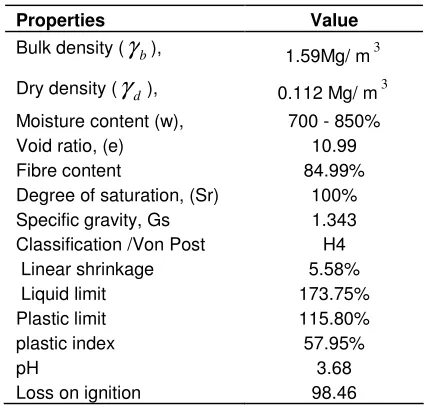
In this study, peat soils commonly found in Selangor State, Malaysia, PFA cement from Malayan Lafarge Company, OPC cement and siliceous sand were used for making bricks. Properties of peat soil are presented in Table 1. The particle size distribution of sand is presented in Table 2. The chemical analysis of peat soil, PFA cement, OPC cement and sand is reported in Table 3.
Compressed stabilised earth bricks were selected as one of the alternative materials for these programmes (Jayasinghe and Kamaladsa, 2006). The compressed earth bricks were manufactured with laterite soil stabilised with at least 5% cement. The CEB brick masonry panels were constructed with cement sand mortar of designation (iii) as specified in BS 5628: Part 1: 1992 (that is, 1:5 cement: sand) (BS 5628: Part 1, 1992).
Mixture proportions
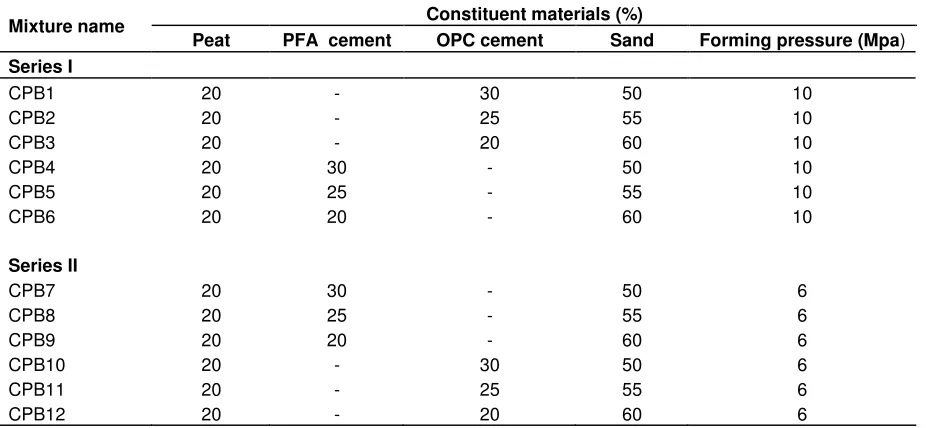
A total of 12 mixtures were prepared in the fabrication of bricks (designated CPB1-CPB12).
The material proportions used in the designs of these mixes are presented in Table 4.
[image:2.612.341.555.92.295.2]These designs were further categorised into two series; Series I and II. Six mixtures in series I (CPB 1-CPB 6) were compacted at 10 Mpa. Series II mixtures (CPB7-CPB12) were compacted at
Table 1. Properties of in-situ peat soil.
Properties Value
Bulk density (
γ
b), 1.59Mg/ m3Dry density (
γ
d), 0.112 Mg/ m3Moisture content (w), 700 - 850%
Void ratio, (e) 10.99
Fibre content 84.99%
Degree of saturation, (Sr) 100%
Specific gravity, Gs 1.343
Classification /Von Post H4
Linear shrinkage 5.58%
Liquid limit 173.75%
Plastic limit 115.80%
plastic index 57.95%
pH 3.68
Loss on ignition 98.46
6 Mpa. Dry peat soil sieved through a 2.00 mm mix with siliceous sand, PFA or OPC cement with 24% content of water.
Fabrications of bricks
The compressed cemented peat brick was fabricated in steel mould with internal dimension of 70 mm × 70 mm × 70 mm typically used in the laboratory test. There are electric hydraulic machine connected with load cell and data-logger to control the pressure. This equipment was used to cast bricks. After 3 min under pressure, the sample was removed from the moulds, and was covered with plastic bags for 1 day, when the specimens had attained sufficient strength for handling; these specimens were then transferred to the water filled tanks at 23 ± 2°C.
Test methods
A series of tests were conducted to determine compressive strength, density, absorption and porosity of the bricks. The compressive strength of the specimens was determined using compression testing machine at ages of 3, 7, 14, and 28 days. The density AND absorption of the specimens determined were weighed and dried in an oven at a temperature of 105°C for 24 h. After removing each specimen from the oven, the dried mass of specimen was taken.
The apparent porosity was tested as following: The samples were dried at 105°C to constant weight, and weighed at dry state (D), then boiled in water for 5 h, cooled and weighed in water (S), and weighed at the saturated wet in air (W) again. The apparent porosity of samples was calculated according to the equation:
W - D Porosity ρ = W - S
RESULTS
Compressive strength
Table 2. Chemical analysis of raw materials.
Concentration (%) Element
Peat Siliceous sand PFA cement OPC cement
MgO 0.830 0.390 0.710 0.89
AL2O3 9.050 19.200 6.430 6.28
SiO2 51.200 70.040 18.60 21.60
P2O5 3.330 0.731 0.474 0.99
SO3 8.920 0.160 3.710 0.01
[image:3.612.194.427.250.353.2]CaO 9.590 2.150 64.240 66.23
Table 3. Sand particle size distribution.
Sieve (mm) Passing (%)
2.00 5
1.18 10
600 15
425 25
300 20
150 15
75 10
Table 4. Mixture proportions of bricks (Series I and II).
Constituent materials (%) Mixture name
Peat PFA cement OPC cement Sand Forming pressure (Mpa)
Series I
CPB1 20 - 30 50 10
CPB2 20 - 25 55 10
CPB3 20 - 20 60 10
CPB4 20 30 - 50 10
CPB5 20 25 - 55 10
CPB6 20 20 - 60 10
Series II
CPB7 20 30 - 50 6
CPB8 20 25 - 55 6
CPB9 20 20 - 60 6
CPB10 20 - 30 50 6
CPB11 20 - 25 55 6
CPB12 20 - 20 60 6
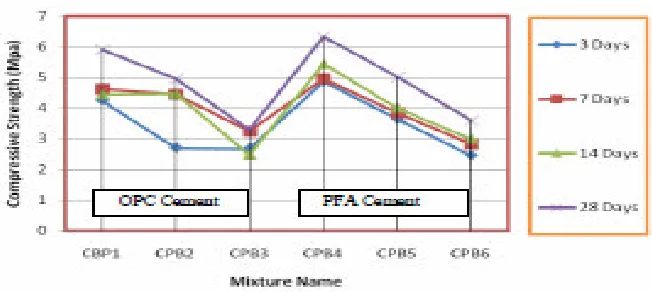
determined at the ages of 3, 7, 14, and 28 days for each mixture for the first series. Three specimens were tested and average of three results was reported as compressive strength. Mixtures of 30% PFA cement and 30% OPC cement achieved the best compressive strength at all ages ranging from 4.26 - 6.33 Mpa. The lowest strength reflected in those mixtures with less
cement was ranged from 2.69 - 3.6 Mpa.
[image:3.612.81.547.406.620.2]Figure 1. Compressive strength series I (10 Mpa pressure).
Figure 2. Compressive strength series II (6 Mpa pressure).
[image:4.612.147.473.73.219.2]
Figure 3. Water absorption series I (10 Mpa pressure).
Water absorption
Figures 3 and 4 shows the water absorption of bricks for various mixtures. The water absorption of bricks ranged from 2.6 - 15.7% with PFA cement mixtures and 5.4 -
Figure 4. Water absorption series II (6 Mpa pressure).
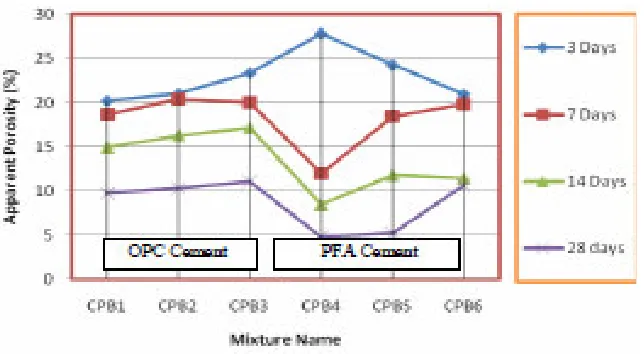
Figure 5. Apparent porosity of bricks series I (10 Mpa pressure).
7.9 - 9.1% with OPC cement mixtures. In this study, at 28 days, for 30% PFA or OPC cement, the water absorption was between 2.6 and 5.4%.
Apparent porosity
Figures 5 and 6 shows the porosity of PFA and OPC peat bricks mixture ranging from 4.75 - 12.68%, and 9.75 - 11.06% at 28 days curing under 10 Mpa pressure for PFA and OPC cement, respectively. However, under 6 Mpa pressure, the porosity for PFA and OPC cement ranged from 12.79 - 15.47% and 14.16 - 16.28% at 28 days, respectively. It is evident from these Figures that the increase in curing period-reduced porosity and increased strength, however, density increased as well. To mitigate the adverse effects, but at the same time retain the advantages associated with porosity, the rate
of water absorption of facing bricks for masonry brickwork should preferably be maintained at approximately 10% (www.claybricks.com).
DISCUSSION
Compressive strength
[image:5.612.152.474.298.475.2]
Figure 6. Apparent porosity of bricks series II (6 Mpa pressure)
than 2.3 Mpa, which is the minimum strength indicated by the standards (EN777-1, 2004, EN 777-1. 2003). Less compacted pressure indicates lower strength.
Water absorption
It is clear from Figures 3 and 4 that the water absorption decreased with increased time period, thus during that time, the binders OPC or PFA cement failed to induce hydration in the dry peat with water to produce the required cementation products that bond the peat and siliceous sand together to form hard cemented peat. Besides, black humic acid, a component of organic mater in peat tends to react with calcium liberated from cement hydrolysis to form insoluble calcium humic acid, which makes it difficult for calcium crystallization, which in turn is responsible for the increase of cemented soil strength (Chen and Wang, 2006).
Higher compression reduces the amount of voids and increases inter-particle contact within a brick. Higher density has always been associated with higher strength (Spence, 1975; Goodung, 1993).
According to British standard, water absorption of brick should be less than 7%. The results obtained at 28 days showed that water absorption was between 2.6 and 5.4% for both binders OPC and PFA cement. The water absorption of ordinary burnt clay bricks was not more than 20% by weight.
Apparent porosity
Porosity is an important characteristic of brick. In contrast to other moulded or pre-cast building materials, the porosity of brick is attributed to its fine capillaries. By virtue of the capillary effect, the rate of moisture transport
in the brick is ten times faster than in other building materials. Moisture is released during day-time and absorbed during night-time. The ability to release and re-absorb moisture (a "breathing" process) by capillary effect is one of the most useful properties of brick that helps to regulate the temperature and humidity of atmosphere in a house.
This distinctive property makes brick an admirable building material, particularly suitable for houses in the tropics. On the other hand, all porous materials are susceptible to chemical attacks and liable to contami-nation from weathering agents like rain, running water and polluted air. Porosity of building material is an important factor to consider with respect to its performance and applications (www.claybricks.com).
Conclusion
Compressed cemented peat bricks (CPB) are earthen bricks made by compacting raw materials, that is, soil and sand mix with stabiliser as cement and lime under pressure with motorised hydraulic machine. The characteristics of compressed cemented peat bricks were investigated in this study under the following conditions.
Brick forming pressure has great positive influence on the mechanical strength of bricks. However, forming pressure between 6 Mpa and 10 Mpa have adverse effects, and added water content of 24% by weight of admixtures. However, test results may provide a means to reduce carbon from the environment, while providing the brick industry with a new, useful, low cost raw material. The following conclusion can be drawn from the present investigation:
[image:6.612.149.472.75.254.2]2. The compressive strength of the bricks prepared was at 28 days of 6.33 and 5.91 Mpa for PFA and OPC cement, respectively.
3. The water absorption of compressed cemented peat pricks ranged from 2.6 - 5.4% at 28 days for PFA and OPC cement, respectively.
4. The porosity of compressed cemented peat pricks ranged from 4.75 - 15%.
The compressed cemented peat bricks produced in this study seem to be suitable for use as construction material.
ACKNOWLEDGEMENTS
Source of finance for this research came from Postgraduate Research Fund PS115-2008C under University of Malaya Research University Grant. This acknowledgement will not be complete without thanking Lafarge Malayan Cement Berhad for providing binders for the purpose of the research.
REFERENCES
Bujang BH (2006). Effect of Cement Admixtures on the Engineering Properties of Tropical Peat Soils. Ele. J. Geot. Eng., 0644.
Chen H, Wang Q (2006). The behaviour of organic matter in the process of soft soil stabilisation using cement. B. Eng. Geo. Environ., 65(4): 445-448. Digital object Identifier (DOI): 10.1007/s 10064-005-0030-1.
EN 777-1. French (2003). Spécification des éléments en maçonnerie. Afnor. BS 5628: Part 1, (1992). Code of Practice for use Masonry. British standard institute. United Kingdom.
EN777-1. French (2004). Spécification des éléments en maçonnerie. Inorpi.
Goodung DEM (1993). Improvement processes for the production of soil cement building blocks. University of Warwick.
Hall MR, Allinson D (2009). Evaporative drying in stabilized compressed earth materials using unsaturated flow theory. B. Envi., 45: 509-518. Janz M, Johansson SE (2002). The function of different binding agents
in deep stabilization. Swedish Deep Stabilization Research Center, Linkoping.
Jayasinghe C, Kamaladsa N (2006). Compressive strength characteristics of cement stabilized rammed earth walls. C and BM, 21: 1971-1976.
Jayasinghe C, Mallawaarachchi RS (2009). Flexural of compressed stabilized earth masonry materials. Mater. Design., 30: 3859-3868. Ndigui Billong UC, Louvet F, Njopwouo D (2008). Properties of
Compressed lateritic soil stabilized with a burnt clay-lime binder: Effect of mixture components. C and BM, 23: 2457-2460.
Oti JE, Kinuthia JM, Bai J (2008a). Developing unfired stabilised building materials in the UK, Proceeding of ICI, J. Constr. Mater., 161(4): 147-155, DOI: 21(1). 1680.
Oti JE, Kinuthia JM, Bai J (2009). Stabilised Earth Masonry Technology Incorporating Industrial By-Product. Proceeding of the 11th
International Conference On Non-conventional Materials and Technology. Bath, UK.