Towards a shared understanding of the
concept of heritage in the European
context
Petti, L, Trillo, C and Ncube Makore, BC
http://dx.doi.org/10.3390/heritage2030155
Title
Towards a shared understanding of the concept of heritage in the European
context
Authors
Petti, L, Trillo, C and Ncube Makore, BC
Type
Article
URL
This version is available at: http://usir.salford.ac.uk/id/eprint/52233/
Published Date
2019
USIR is a digital collection of the research output of the University of Salford. Where copyright
permits, full text material held in the repository is made freely available online and can be read,
downloaded and copied for noncommercial private study or research purposes. Please check the
manuscript for any further copyright restrictions.
Article
Towards a Shared Understanding of the Concept of
Heritage in the European Context
Luigi Petti1, Claudia Trillo2 and Busisiwe Chikomborero Ncube Makore2,* 1 Department of Civil Engineering, University of Salerno, 132, 84084 Fisciano SA, Italy
2 School of the Built Environment, Salford University, Salford M5 4WT, UK
* Correspondence: [email protected]
Received: 1 July 2019; Accepted: 21 August 2019; Published: 30 August 2019
Abstract:The purpose of this paper is to develop an understanding of commonalities and differences in the concept of cultural heritage in Europe. This was achieved through a comprehensive academic and non-academic literature review focused on different definitions and conceptualisations related to cultural heritage internationally and in the European context. This is complemented with a comparative study in three European countries. This paper frames cultural heritage using the foundation set up by the United Nations Educational, Scientific and Cultural Organisation (UNESCO). It further discusses the European actors involved in defining heritage today. Finally, it focuses on three European countries and verifies that they share an understanding of cultural heritage including classifications, categorisation and heritage values. Findings from the overall study show how the definition of cultural heritage across Europe is reasonably homogeneous, and this is confirmed by the analysis of the three chosen test case studies. This finding is relevant to policy makers as it allows the support of potential common frameworks for heritage management at the European level, including risk management and risk reduction common methodologies. Further studies will shed light on the implementation issues which may arise from the creation of a common European framework for cultural heritage management, with emphasis on risk management and risk reduction of cultural heritage.
Keywords: cultural heritage; Europe heritage; classification; risk management
1. Introduction
Conceptualising cultural heritage globally and in Europe has become more multifaceted and sophisticated throughout the years, with the concept of heritage holding multiple meanings, depending on different sets of values [1–10]. Despite the complexity of the concept, it is still possible to identify similarities in the various approaches to heritage protection across Europe. The purpose of this study is to understand whether a common approach to the protection and safeguarding of European heritage can be identified, allowing the creation of shared methodologies to manage risks challenging heritage. Indeed, this study is part of a wider effort to develop a novel methodology for risk management and heritage, financed by the Italian Ministry for Education and Research [11]. The first step is to check if the current European context enables the creation of a common platform based on a shared definition of heritage. Once such a platform is ready, it would then be possible to move on and build a risk management strategy, based on a shared assumption about what assets need to be protected and which level of protection they would require.
This paper explores the progressive evolution of the concept of cultural heritage within Europe aiming to arrive at a more comprehensive understanding of the term within the different European contexts. The elaboration of concepts discussed in this paper use documents and publications at an international and state level. Acknowledging the varied complex definitions of Europe [4,6,9]
and taking into consideration the policy discourse central to this paper, Europe is defined here as membership to the European Union, although this is still acknowledged as a variable criterion for the cases discussed here. This paper is divided into four broad sections. Section1is the introduction followed by Section2, a discussion on the concept of heritage through a main actor of developing a legislative framework, the United Nations Educational, Scientific and Cultural Organisation (UNESCO). Section3brings to attention the changing nature of the concept and definition of heritage within the European context through policy and scholarly discourse. This is followed by Section4, which focuses on three European countries (Italy, England and Spain) to identify commonalities and differences in the respective legislative framework on understanding cultural heritage including classifications, categories and heritage values. Section5is the discussion and concludes in Section6. It is anticipated that it is possible to identify a European common approach to heritage protection, suitable to support the construction of a shared methodology for risk management and heritage.
2. The Conceptualisation of Cultural Heritage: The International Framework
The aim of this section is to discuss the scope and nature of the concept of heritage in Europe, by exploring the official characterisation and construction of “European heritage” through UNESCO as a main vehicle. The preeminent role of UNESCO provides an internationally accepted operational definition of the term “heritage” through its directives, charters and international resolutions introduced over the last few decades. In the aftermath of the Second World War, the mobilisation of international cooperation in heritage conservation was channelled through UNESCO, initially to respect cultural property in the event of armed conflict [7,8,12]. It is within this context that UNESCO began its significant contributions to the adoption of a series of international conventions, recommendations and declarations that have led to the development of general international law. Marked by the first formal introduction of the expression of “cultural property”, a direct reaction to the destruction of heritage in the Second World War was used in the Convention for the Protection of Cultural Property in the Event of Armed Conflict (The Hague, 14 May 1954) [13]. The preservation, collection and valorisation of cultural and natural heritage in view of the magnitude and gravity of the new dangers threatening them is the essence of the Preamble to the 1972 World Heritage Convention. This Convention is considered one of the most forward-looking conventions [12,14,15]. The World Heritage Convention reconciles previous definitions of cultural heritage and presents the definition as three categories: (1) monuments, (2) groups of buildings and (3) sites. After adopting the 1972 Convention, UNESCO drew up the World Heritage List including outstanding heritage in need of protection. Almost half of the sites are situated in Europe, with Italy heading the list followed by France, Germany and Spain, which share second place [16]. The list and Convention have been extensively criticised for proliferating the universal significance of European history and culture [2,3,15,17]. This is discussed further in the following section.
Timbuktu. This milestone in the international law clarifies that the deliberate destruction of heritage has become a weapon of war, part of a broader strategy of cultural cleansing that includes murder and persecution of people in the short term, and the annihilation of identities and destruction of social fabric in the longer term.
[image:4.595.87.508.156.300.2]1
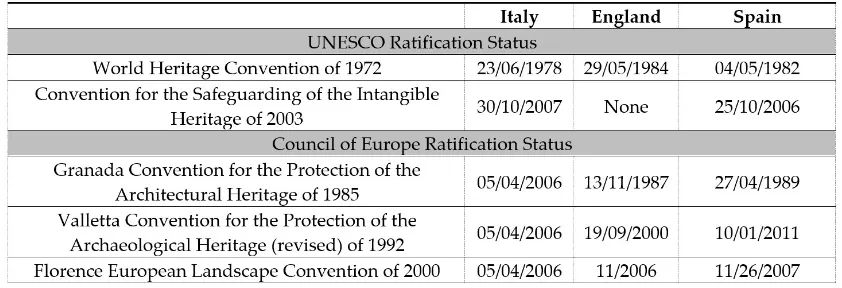
Figure 1.Comparison of international and European ratification status. 3. The Changing Nature of Cultural Heritage in Europe
In the case of Europe, key actors such as the European Union (EU) and the Council of Europe (CoE) have debated the meaning and scope of cultural heritage throughout the 1960s, 1970s and 1980s and into the twenty-first century [10,12,16,19]. European experts have played a leading role in developing international conservation standards and concepts concerning heritage [20]. They have participated at some point in the emergence of an EU discourse connecting European culture, values and identity without necessarily sharing the same goals [6,12,17].
local and community heritage. Delanty [6] argues that there is no underlying European self, but rather, European heritage is an endless reinterpretation of its own past. A recent manual by ICOMOS [21] under the mandate of the European Commission and in the framework of the flagship EU Initiative of the European Year of Cultural Heritage 2018 argues for a revised, modernised and integrated approach to heritage that responds to a changing context and new developments (p. 23) as advocated by the Faro Convention. This is with the aim to raise the threshold of desired quality on planning and implementing interventions on cultural heritage, thereby acknowledging notions of multidimensionality, inclusivity and diversity as key perspectives into defining future actions on EU cultural heritage. Although the discourse and motto of the EU “United in diversity” is championed, achieving this delicate balance between “unity” (common society and union) and “diversity” (pluralism and multiplicity) is still perceived as a significant challenge in reality. Aligned with this view is an increasing emerging policy discourse foregrounding effective dialogue between stakeholders (citizens, the public and private sector, voluntary, politicians and heritage professionals) and multiple interpretations and values. This context gives way to a sharing of heritage that can also be created through what Macdonald (2013) describes as “social memory” and “collective memory” (p. 15).
The following section discusses the nature and related definitions and classification of cultural heritage in four selected countries, with the purpose to verify the consistency between what has emerged from this section and the respective national framework.
4. Establishing the Scope of Cultural Heritage in Different European Contexts
The previous section showed how both in the international and in the European context, the intangible component of cultural heritage has been fully acknowledged as an independent category, thus leading to listing some new categories of assets previously not considered (i.e., oral traditions, festivals, etc.), as well as re-casted as an inseparable component of any of the categories previously classified and listed as cultural tangible heritage. The changing nature of the concept of heritage evolved almost in parallel internationally and in the European contexts, contributed by the international debate nurtured by international networks and institutions, which ensured consistency of approaches. This section builds on and moves forward this initial finding, by testing it against three selected case studies: Italy, England and Spain. The three case studies WERE chosen because all countries have a well-established tradition on cultural heritage conservation and are included in the top ten World Heritage Sites list. The three cases are not a representative sample of the European approach to heritage conservation. However, they are intended to be instrumental in facilitating a discussion and exploration on the complexity of the approaches to heritage conservation in Europe. The methodology for investigating the three case studies has been based on the analysis of international and local documents and literature, while the findings have been corroborated by feedback provided by local experts in the field of heritage conservation. It is anticipated that all the three cases confirm the initial finding, i.e., a reasonably common understanding of the concept of heritage at European level does exist.
4.1. Cultural Heritage in the Context of Italy
instruments, encompassing the notion of protecting the wider historical city context [32]. There was an inclination to classify cultural heritage as a cluster of assets interdependent with one another (territories and environments) and part of a specific context, not just as a solitary building [26,30,31].
The 1999 Law no 490 “Testo unico delle disposizioni legislative in materia di beni culturali e ambientali” (The coordinated law text regulating cultural and environmental assets) was enacted to protect cultural heritage and display progression in the conceptualisation of cultural heritage [33]. Heritage was defined as “things of artistic and historic interest” in the 1939 law; however, the 1999 Law made up for this inadequacy by broadening the range of protected objects (including photographs with their negatives and relating to the history of science and scientific techniques). At the national level, the 2004 “Codice dei beni culturali e del paesaggio” (Code on cultural assets and landscape), also known as the “Urbani Code”, collates all the legislation for cultural and natural heritage. In this legislation, the term “cultural assets” is used. It is defined as immovable and movable property presenting artistic, historical, archaeological, ethno-anthropological, archival and bibliographic interest as well as being rare and valuable [34]. This law does not offer different grades or levels of protection. Instead, there is one level of protection given to eligible objects. The protection of heritage is ensured by the Ministry of Heritage, which is articulated in a network of local offices centrally dependent on the national Minister. This ensures consistency in the protection of the heritage, which originates from the national Constitution. Regional governments are competent authorities for the activities aimed at the enhancement of the tangible heritage assets.
4.2. Cultural Heritage in the Context of England
The scope and definition of heritage in the UK has developed over the last few decades from a focus on monumentalism and prioritised grandeur, to one which normalises areas and buildings which, may be argued, have no aesthetic glory, such as industrial, post-war heritage and heritage landscapes [35–37]. Such wider versions of heritage have become embedded in recent planning policy and practice, becoming part of contemporary heritage discourse [2,35]. The 2018 National Planning Policy Framework (NPPF) defines a heritage asset as “A building, monument, site, place, area or landscape identified as having a degree of significance meriting consideration in planning decisions, because of its heritage interest” [38].
In the 19th Century, there was an increasing public interest in ancient monuments and buildings stimulated by the work of topographers and historians [39]. This rising discourse began initially as monument-centric, with the enactment of the Ancient Monuments Protection Act in 1882, passed to solely protect ancient monuments such as long barrows and stone circles [40]. This legislation was the first step towards the development of statutory classification of heritage known as “Listing” after the Second World War [37,41]. It provided protection of approximately 50 prehistoric areas [42] and appointed a single inspector of ancient monuments. The stage was therefore set for the birth of a modern system of heritage protection and classification [43]. The demolition of houses during the Second World War acted as a catalyst for more robust legislation [40], namely, the Ancient Monuments and Archaeological Areas Act 1979. This Act broadly defines monuments as buildings, structure, site or remains above or below the surface of the land, or any cave, excavation or other movable structure that is a matter of public interest [44].
or historic interest and should be added to the list [46]. The statutory protection on the built heritage in England extends into gardens, parks and landscapes. The Buildings and Ancient Monuments Act 1953 gives authority for the compilation of “a register of gardens and other land situated in England and appearing to them to be of special historic interest” [47]. The register was established in 1983 under the National Heritage Act the Register, which is administered by Historic England. The classification for parks and gardens follows the same convention as for listed buildings in that a landscape can be listed at Grade I, Grade II* or Grade II depending on its relative national significance. Although this extension to the scope of protected heritage is progressive, there is still an emphasis on the physicality, such as structure, design style and materials [48]. Influenced by the growing discourse on the immaterial, heritage conservation in the UK has begun to appreciate the association of tangible forms with elements of immaterial, social and traditional significance and value [48], thus progressing from an exclusive way of seeing defined by the nation, expertise, tangibility and White middle and upper classes [49]. Although the UK has not ratified the 2003 Convention for the Safeguarding of the Intangible Cultural
Heritage (Figure1), comments made by the Department for Culture, Media and Sport suggested
that the Government acknowledges “the contribution that the UK’s oral traditions, social practices and festive events make to the country’s cultural fabric and continues to encourage communities to celebrate these practices” [50].
4.3. Cultural Heritage in the Context of Spain
Spain has a relatively complex administrative structure for the preservation of cultural heritage [29,51], with multiple agents including the state government, regional government, autonomous communities, private and financial institutions and individual owners [52,53]. Heritage policy was brought to a halt during the years of Franco’s power from 1939 to 1975 [54]. Accelerated urbanisation led to the degradation of Spanish cities and their architectural heritage [55,56] with the replacement of historic quarters with new residential dwellings. During this time, Spain emerged as a state-driven heritage industry side-by-side with preservationist practices of monumentalism and the isolation of historical artefacts without considering their environments [54,57]. Therefore, the political change ending the Franco regime prompted increased support and initiative for heritage and its preservation [55]. An example of this is the text in Article 46 of the 1978 Constitution, which goes beyond conservation and promotes the “enrichment of the historical, cultural and artistic heritage” of Spain [58].
the urban and architectural structure as well as the settings of historical sites [52,53,57,60]. Following these advances, from 1990, the Autonomous Communities began using these newly given powers to create their own laws for cultural heritage as well as a regional cultural identity [61].
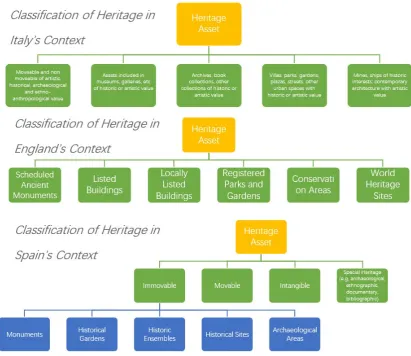
To a certain extent, a common feature in these laws stemming from the 1985 Heritage Act is the classification of cultural assets into three main categories, immovable, movable and intangible as well as an additional category of special heritage (archaeological, ethnographic, documentary, bibliographic and even industrial) [51,60]. Another commonality is the establishment of three levels of protection, the first being the maximum, for Assets of Cultural Interest [51]. Focusing on immovable assets, this protection covers the most prominent cultural assets including monuments, historic gardens, historic ensembles, historic sites and archaeological areas [60], although almost all Autonomous Communities have expanded on these categories by including, for example, areas of ethnographic or ethnological interest, monumental complexes, paleontological areas and archaeological protection areas. The second level of protection is the intermediate (Inventoried or Catalogued), and the third is the minimum level which mainly consists of integrating assets of cultural heritage [51].
Changes in the field of cultural heritage such as the introduction of international conventions and new challenges in the protection of national heritage highlighted the need to modernise the 1985 Historical Heritage Act [57]. Heritage as a concept began increasingly being approached as an assemblage that includes material and immaterial forms: representations and aspirations, mortar and emotions, values and interpretations, symbols and narratives [61,62], therefore leading to work by the Ministry of Culture on a draft Act on Cultural Heritage in 2008. The conceptualisation of Spanish heritage was further broadened with the approval of the Act on Protection of Intangible Cultural Heritage in 2014, as well as new initiatives on integrating cultural assets into landscape development [51,53]. Although this is a step in the right direction, the continuous fragmentation of Spanish laws and the various initiatives make it difficult to integrate the protection of cultural heritage and promoting support for its protection and management.
5. Discussion
Findings from the analysis of the literature show how the policy definition of cultural heritage across Europe can be considered as reasonably homogeneous, and this is confirmed by the in-depth analysis of the three chosen testing case studies. The driver of such homogeneity can be identified in the consistent and continuous action of the international researchers and experts’ community, through international governmental and nongovernmental institutions (e.g., UNESCO, ICOMOS), performed through charters, documents and brought at the local level through a constant advocacy process, which created the conditions for having such a common understanding at local level. Although the foundations of heritage are slightly different in each context [63], the current conceptualisations
of heritage have emerged with a similar redefined narrative. As discussed in Section 2 of this
paper, UNESCO has played a pivotal role in mobilising such a Eurocentric discourse that values the authenticity of original fabric and aesthetic qualities. It places European values as central to human history, engaging in what Smith [2] describes as “heritage making”.
protecting heritage, although Meskell [64] argues that these utopian goals are mired by the promotion of competitive branding through the World Heritage sites and bureaucracy surrounding it [17]. These sociopolitical and economic agendas are reflected in the European pursuit of common identity and unity for all members [65,66], promoting European values and community action in favour of bringing European citizens closer together [12]. At both levels, the hallmark of heritage industry is continuously redefined as the preservation of cultural heritage referring not just to its materiality, but also considering the wider potential allowing for multiple benefits.
The analysis of the three chosen case studies conducted in the previous sections allows the identification of commonalities across the three cases, confirming that the concept of heritage as elaborated and accepted at international and European level reflects the three chosen countries’ framework and underpinned values. Figure2displays a comparative image of the scope of heritage assets in the three country contexts. The three countries have different forms of classifying cultural heritage. In all three county contexts, there is reference to movable and non-movable assets stemming from the UNESCO framework. There is less clarity to the embedded and interdependent nature of the intangible qualities within the conceptualisation of heritage. One can identify three main categories that are present in all contexts: monuments, historic ensembles and sites and landscape heritage, such as gardens and parks. The associated values mentioned in Table1include artistic, aesthetic and archaeological values but also different values that testify to the symbolic and civic qualities of each country.
[image:10.595.92.504.358.714.2]1
Table 1.Comparative analysis of the heritage concept in England, Italy and Spain.
Italy England Spain
Why: Motivation for protection to heritage
(values)
Artistic, historical, archaeological, ethno-anthropological, archival
and bibliographic interest (Article 2, 10) Significance to political, military,
literature and art history, of science, technology, industry and culture in general (article 10)
Collective cultural identity, social and civic, religious and
symbolic value (article 7, 10)
Evidential value: the potential of a place to yield evidence about past
human activity. Historical value: the ways in which past people, events and aspects of life
can be connected through a place to the present—it tends to be illustrative
or associative.
Aesthetic value: the ways in which people draw sensory and intellectual
stimulation from a place. Communal value: the meanings of a place for the people who relate to it, or
for whom it figures in their collective experience or memory
Artistic, historical, paleontological, archaeological, ethnographic,
scientific or technical value (Article 15) Promoting national and regional cultural identity
and sense of belonging
How: Means of ensuring protection
to heritage
Multiple level legislative framework process. Four levels
of government: State, regions, Provinces and Municipalities
Government Policy and Guidance (National Planning Framework) and
Primary Legislation; Listed System Local Plans
Funding
Knowledge Platform and sharing
Constitutional provisions, national legislation and
regional laws Special Plans Regional authorities and
municipal councils 1% of the State Administration budget
How: Means of ensuring protection
to heritage
Overall responsibility with the Ministry for Heritage and Cultural Activities (National) Further articulated in Regional Directions for Cultural Assets
and Landscape and local Soprintendenze (branch offices)
The Department for Culture Media and Sport (DCMS) responsible for policy on the Historic environment. Historic England (Public Body) is the
statutory adviser
Local planning authorities responsible for making management decisions
about designated heritage
Responsibility resides with autonomic regional
governments
With regard to the measures of ensuring protection to heritage, each country has different approaches (Table1). In England, there is a strong focus on national legislation, particularly through planning policies. This is coordinated with local councils to protect heritage through the listing process described in Section4.2. The public body, Historic England is tasked with protecting the historical environment of England by preserving and listing historic buildings, ancient monuments and advising central and local government. In Italy, the coordination of protection is a bit more complex, with balance between the Ministry and regional entities with procedures allowing for database and knowledge sharing through municipal plans. Some efforts are made to support the municipalities with tools to allow them to apply distinct measures and levels of intervention [29]. By contrast, Spain’s autonomous communities have their own process of protection with minimal national coordination, where each region adapts the national law according to the characteristics of their own heritage.
6. Conclusions
were essential to set the basis for creating a potential common platform for classification. Conversely, despite this consistent policy discourse, there are limitations in knowledge about the possibility of integrating and recognising plural views of heritage, perhaps more evident at the community level within a common European framework, and what this means for risk assessment. Additionally, further interrogation is needed into the power relations and how decisions can be made about what should be kept and what not. Future studies will shed light on the implementation issues which may arise from the creation of a common European framework for cultural heritage management, with emphasis on risk management and risk reduction of cultural heritage.
Author Contributions:This article reflects the outcome of a joined discussion among the three authors, whoshare the conceptualisation and the research methodology. L.P. is the project supervisor, manager and he is responsible for the funding. C.T. is the project external adviser, she drafted the concept and reviewed the draft. B.C.N.M. was responsible for writing and editing the article.
Funding:This research is financed by the PRIN program—Research Projects of National Interest, Italian Ministry for University and Research, n. 2015EAM9S5, Project name “Protecting the Cultural Heritage from water-soil interaction related threats”.
Conflicts of Interest: The authors declare no conflict of interest. The funders had no role in the design of the study; in the collection, analyses, or interpretation of data; in the writing of the manuscript, or in the decision to publish the results.
References
1. Graham, B.; Ashworth, G.; Tunbridge, J.A Geography of Heritage: Power, Culture and Economy, 1st ed.; Routledge: New York, NY, USA, 2000. [CrossRef]
2. Smith, L.Uses of Heritage; Routledge: London, UK, 2006; p. 368. [CrossRef]
3. Lowenthal, D.The Heritage Crusade and the Spoils of History; Cambridge University Press: Cambridge, UK, 1998. [CrossRef]
4. Macdonald, S.Memorylands: Heritage and Identity in Europe Today; Routledge: London, UK, 2013. 5. Delanty, G.Europe and Asia Beyond East and West; Routledge: London, UK, 2006. [CrossRef]
6. Delanty, G. The European Heritage from a Critical Cosmopolitan Perspective. LSE ‘Europe in Question’ Discussion Paper Series. 2010. Available online:http://www.lse.ac.uk/european-institute/Assets/Documents/ LEQS-Discussion-Papers/LEQSPaper19b.pdf(accessed on 1 August 2019).
7. Yahaya, A. The Scope and Definitions of Heritage: From Tangible to Intangible.Int. J. Herit. Stud.2006,12, 292–300.
8. Vecco, M. A definition of cultural heritage: From the tangible to the intangible. J. Cult. Herit. 2010,11, 321–324. [CrossRef]
9. Whitehead, C.; Bozo ˘glu, G.Heritage and Memory in Europe: A Review of Key Concepts and Frameworks for
CoHERE; Performing and Representing Identities in Europe Work Package 1 Work in Progress; Critical
Heritages (CoHERE): Newcastle, UK, 2017. Available online:https://eprint.ncl.ac.uk/file_store/production/ 239678/CD7C34A7-DEDC-4BAA-9168-3FC71006C70A.pdf(accessed on 10 August 2019).
10. Whitehead, C.; Eckersley, S.; Zito, A.European Policy Brief: Productions and Omissions of European Heritage; CoHERE, Newcastle University: Newcastle, UK, 2019.
11. PRIN.Protecting the Cultural Heritage from Water-Soil Interaction Related Threats, in Research Projects of National
Interest; Italian Ministry for University and Research: Salerno, Italy, 2015.
12. Calligaro, O.From ‘European Cultural Heritage’ to ‘Cultural Diversity’? The Changing Core Values of European
Cultural Policy; Cairn.info pour L’Harmattan: Paris, France, 2014; pp. 60–85. Available online: https:
//www.cairn.info/revue-politique-europeenne-2014-3-page-60.htm(accessed on 1 January 2019).
13. UNESCO.Convention for the Protection of Cultural Property in the Event of Armed Conflict with Regulations for the
Execution of the Convention; United Nations Educational Scientific and Cultural Organisation: The Hague,
The Netherlands, 1954. Available online:http://www.unesco.org/new/en/culture/themes/ armed-conflict-and-heritage/convention-and-protocols/1954-hague-convention/(accessed on 1 November 2018).
14. UNESCO.Convention Concerning the Protection of the World Cultural and Natural Heritage; United Nations Educational Scientific and Cultural Organization (UNESCO): Paris, France, 1972. Available online:
15. Labadi, S.UNESCO, Cultural Heritage, and Outstanding Universal Value Value-based Analyses of the World
Heritage and Intangible Cultural Heritage Conventions; AltaMiraPress: New York, NY, USA, 2013.
16. Pasikowska-Schnass, M.Cultural Heritage in EU Policies; European Union, European Parliamentary Research Service: Brussels, Belgium, 2018. Available online:http://www.europarl.europa.eu/RegData/etudes/BRIE/ 2018/621876/EPRS_BRI(2018)621876_EN.pdf(accessed on 1 February 2019).
17. Chalcraft, J.; Delanty, G.Can Heritage Be Transnationalised? The Implications of Transnationalism for Memory and
Heritage in Europe and Beyond; AXIS 1. CULTURAL MEMORY TF1. Memory and Heritage; University of
Sussex: Brighton, UK, 2015. Available online:https://culturalbase.eu/documents/1.%20CHALCRAFT%20& %20DELANTY.%20Can%20Heritage%20be%20Transnationalised.pdf(accessed on 10 August 2019). 18. Gfeller, A.L.E. Negotiating the meaning of global heritage: ‘Cultural landscapes’ in the UNESCO World
Heritage Convention, 1972–1992.J. Glob. Hist.2013,8, 483–503. [CrossRef]
19. Zito, A.R.; Eckersley, S.; Turner, S. The Instruments of European heritage. InDimensions of Heritage and
Memory: Multiple Europes and the Politics of Crisis; Whitehead, C., Eckersley, S., Eds.; Routledge: Abingdon,
UK, 2019.
20. Soldano, S.; Borlizzi, P.; Valle, M. Report on Current State-of-Art of Use and Re-Use of Medieval Ruins; European Union Interreg Central Europe: Brussels, Belgium, 2017. Available online:https:// www.interreg-central.eu/Content.Node/D.T2.1.1---Report-on-the-current-state-of-art-on-contempo-1-.pdf(accessed on 1 November 2018).
21. ICOMOS International. European Quality Principles for EU-Funded Interventions with Potential Impact upon
Cultural Heritage; ICOMOS International: Paris, France, 2019. Available online:http://openarchive.icomos.
org/2083/1/European_Quality_Principles_2019_EN.PDF(accessed on 1 August 2019).
22. European Commission, Communication from the Commission to the European Parliament, the Council, the European Economic and Social Committee and the Committee of the regions. Towards an Integrated
Approach to Cultural Heritage for Europe; European Commission: Brussels, Belgium, 2014. Available online:
https://eur-lex.europa.eu/legal-content/EN/TXT/?qid=1412240757164&uri=CELEX:52014DC0477(accessed on 1 March 2019).
23. European Commission. Mapping of Cultural Heritage Actions in European Union Policies, Programmes and
Activities; European Commission: Brussels, Belgium: 2017. Available online:http://ec.europa.eu/assets/eac/
culture/library/reports/2014-heritage-mapping_en.pdf(accessed on 1 March 2019).
24. Jet, A.C. Domestic, supranational and international historic preservation legislation: Does it protect our cultural heritage or restrict development? Exploring its’ impact on ancient roman monuments.Ga. J. Int.
Comp. Law2003,31, 651–678.
25. Micelli, E.; Pellegrini, P. Wasting heritage. The slow abandonment of the Italian Historic Centers.J. Cult. Herit.
2018,31, 180–188. [CrossRef]
26. Piccinato, G.Historic Centres under Pressure. Lights Andshadows from the Italian Experience; AESOP Congress: Vienna, Austria, 2005. Available online: https://www.academia.edu/4482139/HISTORIC_CENTRES_
UNDER_PRESSURE._LIGHTS_AND_SHADOWS_FROM_THE_ITALIAN_EXPERIENCE (accessed on
1 November 2018).
27. Dainotto, R. The Gubbio Papers: Historic Centers in the Age of the Economic Miracle.J. Mod. Ital. Stud.
2003,8, 67–83. [CrossRef]
28. Senato della Repubblica.The Constitution of the Italian Republic; Senato della Repubblica: Rome, Italy, 1947. Available online:https://www.senato.it/documenti/repository/istituzione/costituzione_inglese.pdf(accessed on 1 January 2019).
29. Ornelas, C.; Guedes, J.M.; Breda-Vázquez, I. Cultural built heritage and intervention criteria: A systematic analysis of building codes and legislation of Southern European countries.J. Cult. Herit.2016,20, 725–732. [CrossRef]
30. Bosna, C.The Didactic-Educational Dimension of Our Territory, in International Conference RCIC’17 Redefining
Community in Intercultural Context; The Italian Constitution and the Cultural Heritage: Bari, Italy, 2017.
31. Piccinato, G.Words and History: Controversies on Urban Heritage in Italy, in Culture, Urbanism and Planning; Monclus, J., Guardia, M., Eds.; Routledge: New York, NY, USA, 2006.
33. Gianighian, G.Italy, in Policy and Law in Heritage Conservation; Pickard, R., Ed.; Routledge: New York, NY, USA, 2001.
34. Il Presidente della Repubblica. Decreto Legislativo 22 Gennaio 2004, No. 42, Codice dei beni Culturali edel
Paesaggio, ai Sensi Dell’articolo 10 Della Legge 6 Luglio 2002, No. 137; La Presidenza del Consiglio dei Ministri:
Rome, Italy, 2004.
35. Ludwig, C. From bricks and mortar to social heritage: Planning space for diversities in the AHD.Int. J.
Herit. Stud.2016,22, 811–827. [CrossRef]
36. Pendlebury, J. Conservation values, the authorised heritage discourse and the conservation-planning assemblage.Int. J. Herit. Stud.2013,19, 709–727. [CrossRef]
37. English Heritage Conservation Principles.Policies and Guidance: For the Sustainable Management of the Historic
Environment; Historic England: London, UK, 2008.
38. Ministry of Housing Communities and Local Government.National Planning Policy Framework; Secretary of State for Ministry of Housing, Communities and Local Government by Command of Her Majesty: London, UK, 2018.
39. Harvey, D.C. Heritage Pasts and Heritage Presents: Temporality, meaning and the scope of heritage studies.
Int. J. Herit. Stud.2001,7, 319–338. [CrossRef]
40. Larkham, P. The place of urban conservation in the UK reconstruction plans of 1942–1952.Plan. Perspect.
2003,18, 295–324. [CrossRef]
41. Historic England about the List. 2019. Available online: https://historicengland.org.uk/listing/the-list/
(accessed on 1 March 2019).
42. UK Parliament Preserving Historic Sites and Buildings. 2019. Available online: https://www.parliament. uk/about/living-heritage/transformingsociety/towncountry/landscape/overview/historicsites/(accessed on 1 March 2019).
43. Fry, S.A History of the National Heritage Collection Volume Two: 1900–1913; English Heritage: London, UK, 2014. 44. UK Government.Ancient Monuments and Archaeological Areas Act 1979; UK Government: London, UK, 1979. Available online:http://www.legislation.gov.uk/ukpga/1979/46/pdfs/ukpga_19790046_en.pdf(accessed on 1 November 2018).
45. UK Government.Planning (Listed Buildings and Conservation Areas) Act 1990; UK Government: London, UK, 1990. Available online:https://www.legislation.gov.uk/ukpga/1990/9/pdfs/ukpga_19900009_en.pdf(accessed on 1 November 2018).
46. Department for Digital Culture Media & Sport. Principles of Selection for Listed Buildings; Department for Digital, Culture, Media & Sport, UK Government: London, UK, 2018.
47. UK Government. Historic Buildings and Ancient Monuments Act; UK Government: London, UK, 1953. Available online:https://assets.publishing.service.gov.uk/government/uploads/system/uploads/attachment_ data/file/757054/Revised_Principles_of_Selection_2018.pdf(accessed on 1 March 2019).
48. Turnpenny, M. Cultural Heritage, an Ill-defined Concept? A Call Joined-Up Policy.Int. J. Herit. Stud. 2004, 10, 295–307. [CrossRef]
49. Waterton, E. Sights of sites: Picturing heritage, power and exclusion.J. Herit. Tour.2009,4, 37–56. [CrossRef] 50. UK Parliament.Convention for the Safeguarding of the Intangible Cultural Heritage: Written Question—HL6360;
UK Parliament: London, UK, 2017.
51. Arbol, M.R.D.; Orejas, A. Protection and management of Spanish archaeological-historical landscapes.
InThe Cultural Landscape & Heritage Paradox: Protection and Development of the Dutch Archaeological-Historical
Landscape and its European Dimension; Bloemers, T., Kars, H., Van Der Valk, A., Wijnen, M., Eds.; Amsterdam
University Press: Amsterdam, The Netherlands, 2010; pp. 477–493.
52. Pickard, R. A Comparative Review of Policy for the Protection of the Architectural Heritage of Europe.Int. J.
Herit. Stud.2002,8, 349–363. [CrossRef]
53. Cruz, L.; Caro, C.The National Plan of Cultural Landscape: 100 Cultural Landscapes in Spain; Spanish Cultural Heritage Institute, Ministry of Education, Culture and Spain: Madrid, Spain, 2016.
54. Afinoguenova, E. Unity, stability, continuity’: Heritage and the renovation of Franco’s dictatorship in Spain, 1957–1969.Int. J. Herit. Stud.2010,16, 417–433. [CrossRef]
55. Núñez, G.; Ruiz, L.G. Little New Under the Sun. Heritage and Public Administration: The Spanish Case.
InNational Approaches to the Governance of Historical Heritage over Time. A Comparative Report; Fisch, S., Ed.;
56. Amineddoleh, L. The Protection of Abandoned Cultural Heritage in Spain.J. Arts Law Online2012. [CrossRef] 57. Villarroya, A.; Ateca-Amestoy, V.Spain/1. Historical Perspective: Cultural Policies and Instruments; Compedium
of Cultural Policies and Trends: Madrid, Spain, 2015.
58. Agencia Estatal Boletín Oficial del Estado.The Spanish Constitution; Agencia Estatal Boletín Oficial del Estado: Madrid, Spain, 1978. Available online:https://www.boe.es/legislacion/documentos/ConstitucionINGLES.pdf
(accessed on 1 March 2019).
59. Capote-Pérez, L.-J. Cultural Heritage and Spanish Private Law.Santander Art Cult. Law Rev.2018,2, 237–254. [CrossRef]
60. Del Estado, J.LEY 16/1985, de 25 de junio, del Patrimonio Histórico Español; BOE: Madrid, Spain, 1985. 61. Viejo-Rose, D. Cultural heritage and memory: Untangling the ties that bind. Cult. Hist. Digit. J.2015, 4.
[CrossRef]
62. Viejo-Rose, D. Reconstructing Heritage in the Aftermath of Civil War: Re-Visioning the Nation and the Implications of International Involvement.J. Interv. State Build.2013,7, 125–148. [CrossRef]
63. Swenson, A.The Rise of Heritage: Preserving the Past in France, Germany and England, 1789–1914 (New Studies in
European History); Cambridge University Press: Cambridge, UK, 2013.
64. Meskell, L.A Future in Ruins; OUP: New York, NY, USA, 2018.
65. Council of Europe.European Cultural Convention; Council of Europe: Paris, France, 1954. Available online:
http://conventions.coe.int/Treaty/EN/Treaties/Html/018.htm(accessed on 1 January 2019).
66. Council of Europe. Convention for the Protection of the Architectural Heritage of Europe; Council of Europe: Granada, Spain, 1985. Available online:https://rm.coe.int/CoERMPublicCommonSearchServices/ DisplayDCTMContent?documentId=090000168007a087(accessed on 1 January 2019).