Philosophy Theses Department of Philosophy
Summer 5-18-2012
Against the Linguistic Analogy
Against the Linguistic Analogy
Noel B. Martin
Georgia State University
Follow this and additional works at: https://scholarworks.gsu.edu/philosophy_theses
Recommended Citation Recommended Citation
Martin, Noel B., "Against the Linguistic Analogy." Thesis, Georgia State University, 2012. https://scholarworks.gsu.edu/philosophy_theses/114
AGAINST THE LINGUISTIC ANALOGY
by
NOEL B. MARTIN
Under the Direction of Eddy Nahmias
ABSTRACT
Recently it has been proposed that humans possess an innate, domain-specific moral faculty, and that this faculty might be fruitfully understood by drawing a close analogy with nativist theories in linguistics. This Linguistic Analogy (LA) hypothesizes that humans share a universal moral grammar. In this paper I argue that this conception is deeply flawed. After profiling a recent and appealing account of universal moral grammar, I suggest that recent empirical findings reveal a significant flaw, which takes the form of a dilemma: either there is something wrong with the moral grammar model because we do not actually possess the innate contents (rules, principles, and concepts) it says we have, or the moral grammar model is simply the wrong model of moral cognition. In light of this dilemma, I conclude we ought to be skeptical that the Linguistic Analogy can adequately serve as a general account of moral cognition.
AGAINST THE LINGUISTIC ANALOGY
by
NOEL B. MARTIN
A Thesis Submitted in Partial Fulfillment of Requirements for the Degree of Master of Arts
in the College of Arts and Sciences Georgia State University
Copyright by Noel B. Martin
AGAINST THE LINGUISTIC ANALOGY
by
NOEL B. MARTIN
Committee Chair: Eddy Nahmias
Committee: Daniel Weiskopf
Andrea Scarantino
Electronic Version Approved:
Office of Graduate Studies
College of Arts and Sciences
Georgia State University
To Sally
ACKNOWLEDGEMENTS
Thanks, first, to Eddy Nahmias –I am grateful for his guidance. Since the beginning, he has struck a
fine (and rare) balance between criticism and support. My deep appreciation goes to Dan Weiskopf and
Andrea Scarantino, who graciously agreed to serve on my committee, and for their valuable comments and
discussions during this process. Thanks also to Michael Owren for modeling what a good empiricist looks
like, whether or not his influence shows here. I owe a debt of gratitude to Neil van Leewen, and my
colleagues Toby Amoss, Michael Johnson, Kathryn Joyce, and AnaïsStenson, whose camaraderie and insights
have all helped greatly with the ideas presented here. To my family, for their support throughout this process
TABLE OF CONTENTS
ACKNOWLEDGEMENTS...v
LIST OF TABLES...vii
LIST OF FIGURES... viii
CHAPTER 1: INTRODUCTION... 1
CHAPTER 2: MORAL GRAMMAR: MODEL & CONTENTS...4
2.1. Descriptive Adequacy & the Goals of a Grammar... 4
2.2. The Moral Grammar Model... 6
2.2.1. Competence, Performance, & Considered Judgments... 8
2.3. Our Moral Grammar’s Contents...13
2.3.1. Four Trolley Cases...14
2.4. Summary...17
CHAPTER 3: EVIDENCE AGAINST THE ANALOGY...18
3.1. Modal Minorities... 18
3.2. Gendered Judgments... 20
3.3. Patterns of Preference... 22
3.4. Summary... 24
CHAPTER 4: THE ANALOGY’S DILEMMA... 24
4.1. Explaining Modal Minorities... 25
4.2. Reconsidering Gendered Judgments... 38
4.3. Accounting for Preferential Patterns... 44
4.4. Revisiting the Analogy’s Dilemma... 53
4.5. The Analogy’s Aftermath... 54
CHAPTER 5: CONCLUSION... 55
REFERENCES... 56
LIST OF TABLES
Table 1. Matrix of Permissibility/Impermissibility Judgments in Loop Track and Man-in-Front 35
Table 2. Competent Judgments About Four Trolley Cases 35
LIST OF FIGURES
Figure 1. The LA’s Expanded Perceptual Model of Moral Judgment 11
1. INTRODUCTION
In concluding The Theory of Moral Sentiments, Adam Smith suggests that the goal of moral philosophy
is to answer two questions:
First, wherein does virtue consist? … And, secondly, by what power or faculty in the mind is it, that this character, whatever it be, is recommended to us? Or in other words, how and by what means does it come to pass, that the mind prefers one tenour of conduct to another, denominates the one right and the other wrong; considers the one as the object of approbation, honour, and reward, and the other of blame, censure, and punishment? (VII.i.2)
Smith’s second question constitutes one of the core concerns of moral psychology: how and why do we
humans make the moral judgments that we do? One way to answer such questions is to offer an account of
the faculty or faculties that underlie moral cognition.
Moral anti-nativists argue that moral cognition is not innate. These anti-nativists propose that moral
cognition relies on psychological mechanisms that are not specifically dedicated to making moral evaluations
(e.g., Nichols, 2004; Sterelny, 2010). One might be an anti-nativist, then, by claiming that the ability to make
moral judgments results from our emotional capacities (Prinz, 2007). Views of this kind imply that there are
no moral rules or principles that humans possess merely in virtue of being human. Instead, all distinctively
moral concepts, rules, and principles are learned and employed via cognitive systems that also perform (and
evolved to perform) other functions.
Moral nativists, on the other hand, have suggested that our capacities to make moral judgments are
subserved by innate psychological mechanisms dedicated to, or evolved for, moral cognition, and that the
capacities these mechanisms support cannot be the result of experience alone. Instead, on the nativist view,
there must be some natural, biological basis for moral cognition. One recent formulation of this position is
the Linguistic Analogy (LA) (Dwyer, 2006, 2009; Dwyer et al., 2010; Harman, 2008; Hauser, 2006; Hauser et al.,
2007; Mikhail, 2007, 2011). The LA engages with and extends the traditional rationalist notion that the moral
law is “engraved in the mind” (e.g., Grotius, 1625; Kant, 1788; Leibniz, 1705). Inspired by Chomsky’s (1965)
there is a Universal Moral Grammar subserved by an innate, possibly domain specific, human moral faculty.1
Advocates of the LA propose that the best empirical findings support the case for the existence of this moral
faculty and that it is empirically and explanatorily illuminating to presuppose a strong analogy between the
mechanisms underlying human linguistic and moral capacities. Though there have been several recent
formulations of the LA (Dwyer, 2006; Roedder & Harman, 2010; Hauser et al., 2007), in what follows I will
specifically focus on the account developed by John Mikhail (2011).
In this thesis, I argue that we ought to reject Mikhail’s view on the grounds that it fails to give a
descriptively adequate account of moral judgment, thus failing to satisfy adequately its own explanatory
desideratum. This failure is revealed by considering evidence from recent studies of moral judgment and the
LA’s inability to explain these findings successfully. Since the LA is unable to offer a successful response to
the findings I present, it faces a dilemma: either the LA attributes the wrong contents (moral rules, principles,
and concepts) to our moral grammar, or the moral grammar model is the wrong model of our moral faculty.
There is a straightforward way in which the LA might be wrong about the contents of our moral grammar: by
claiming that we innately possess deontic concepts, rules, or principles that we do not, in fact, possess. So, if
the LA proposes that we each innately possess a deontic rule that forbids acts of type F, but we appear to
have no such innate prohibition against F-ing, then the LA is wrong about the contents of our moral
grammar.
On the other hand, there are a number of ways for Mikhail’s moral grammar model to be the wrong
model of our moral faculty. The most obvious way in which the moral grammar model might be the wrong
model is if moral nativism is false, full stop. However, some brand of nativism might be true, while the moral
grammar model is false. For example, morality might still be innate without being analogous to language. Or
morality might be innate, and in some sense language like, without moral cognition having the central features
that Mikhail’s moral grammar model claims. I argue that, at a minimum, the last of these ways of being wrong
applies to the LA.
1 The notion of innateness is, itself, much disputed (see Griffiths, 2002; Samuels, 2007). I do not wish to take up this issue
Despite my criticism, I consider Mikhail’s account a significant development in contemporary moral
psychology. While the LA, like other modern theories, focuses on the elicitation and constitution of moral
judgments, it also offers a number of virtues many of its rivals lack. First, Mikhail (2007) suggests that his
account offers a fruitful approach to investigating the behavioral features of human morality, as well as the
ontogenic, phylogenetic, and computational features of moral cognition. If the analogy between language and
morality is a good one, then, moral psychologists have a ready framework from which to develop a rich
account of moral learning and development, as well as its evolution. Another asset of Mikhail’s model is that
it offers a level of analysis unexplored by many recent and influential accounts of moral cognition (e.g.,
Greene et al., 2004; Haidt, 2001): computational analysis, which allows the LA to model (and generate
hypotheses regarding) the mental representations and computations involved in the process of making moral
judgments. In offering this level of analysis, Mikhail’s LA provides a distinctively complex and detailed
portrait of moral cognition. The LA possesses another distinct virtue in that, if it is correct, it can provide
moral psychologists with a theoretic framework for understanding the innate limitations or constraints on the
development of moral systems, just as Chomskyan accounts of language propose that there may be
limitations on what types of languages humans can develop. An upshot of this virtue is that the LA can
explain the convergence (and divergence) of moral systems. Thus, the LA, if correct, may also be able to
provide moral philosophers with the tools for illuminating (and potentially resolving) moral disagreement.
These virtues are noteworthy even if the LA is the wrong model of moral cognition. At minimum, I take it
that future models would do well to consider the value of the LA’s novel focus on computational analysis, as
well as its ambitious attempt to detail which, if any, underlying principles are common to human moral
judgments.
In the discussion to follow, I provide a brief portrait of the LA (Chapter 2). I then consider recent
evidence that shows that the LA fails to offer an adequate response to broad patterns in human moral
judgments including gender differences and partiality toward the young, kin, and in-group members (Chapter
we ought to be skeptical of the very idea of an innate moral grammar, and the Linguistic Analogy on which it
relies.
2. MORAL GRAMMAR: MODEL & CONTENTS
Recently, there has been a deepening interest in explaining moral cognition and moral judgment
(Cushman, Young, & Greene, 2010; Doris, 2002; Haidt, 2001; Moll et al., 2005; Nichols, 2004; Prinz, 2007;
Sripada & Stich, 2006). This interest includes the revival of a notion proposed by John Rawls: the Linguistic
Analogy (Dwyer, 2006; Hauser, Cushman, & Young, 2008; Mikhail, 2000). In Section 9 of A Theory of Justice,
Rawls (1971, pp. 46-53) suggests that his own account of the human moral sense is usefully understood as
being akin to linguists’ accounts of linguistic competence.2 Though Rawls provided the inspiration for
contemporary proponents of the LA, Noam Chomsky’s (1965) work furnished its structure.3
As with generative linguistics, the LA’s goal is to depict the mental system or innate knowledge
underlying a distinctive human capacity. In particular, the LA hopes to provide a descriptively adequate account
of the human moral faculty and its operations (e.g., judgments). As with much of the LA’s conceptual
apparatus, this key desideratum is borrowed from linguistics.
2.1. Descriptive Adequacy & the Goals of a Grammar
‘Descriptive adequacy’ is a technical term used to indicate the relative quality or success of a theory as
compared to competing theories operating at similar levels of description (Chomsky, 1965). A theory is
descriptively adequate if it meets the following criteria:
2 In what follows, I use ‘linguistics’ and ‘generative linguistics’ to refer to accounts of the human linguistic faculty inspired by
and in harmony with Chomsky’s (1965) account.
3 While Mikhail references Chomsky’s work, and generative linguistics, broadly, the account developed in Chomsky’s Aspects of
1. It can account for more observed data than other theories.
2. It produces correct predictions.
3. It succeeds in correctly describing its target.4
What would it mean for the LA to satisfy these three criteria? In this case, satisfying the first criterion means
that the LA’s moral grammar model is consistent with, and accurately describes, more moral judgments than
other accounts of moral cognition. Meeting the second criterion is straightforward –here judgments the LA
predicts we will make must match judgments we do make. To satisfy the third criteria, the LA must correctly
describe the mental operations (i.e., the computations) involved in the familiar process of taking in a stimulus
as input and producing a moral judgment as an output.
Mikhail (2007) suggests that the LA is descriptively adequate where other theories of moral cognition
are not largely because it is sensitive to computational theory (Marr, 1982), a level of analysis underemphasized or
unmentioned in other theories of moral cognition. This computational analysis considers the mental
processes, or “conversion rules”, that convert a given stimulus (e.g., a particular moral dilemma) into a
structural description –the mental representation of the stimulus’ acts and omissions– to which moral (or
“deontic”) rules will be applied, and the deontic rules implicated in the rendering of moral judgments
(Mikhail, 2007, p. 145).
For the moment, however, the fine points of Mikhail’s computational analysis are not important.
Instead, it is simply worth keeping in mind that even Mikhail’s critics, such as Greene, acknowledge that
computational theory has been largely ignored in studies of moral cognition (Greene, 2008). Additionally, it is
important to note that for Mikhail’s computational analysis to be counted as a descriptive virtue of the LA it
must accurately analyze the human moral faculty that constitutes its target. If there is no universal moral
grammar, then Mikhail’s computational analysis merely models the properties of a fictional system. If this is
so, then the LA’s computational analysis is plausibly insensitive to the broader data set that should constitute
its target, and will only minimally or accidentally contribute to the first two criteria for descriptive adequacy –
4 The ‘target’ in Mikhail’s case, is the human moral faculty “in its mature or steady state” (Mikhail, 2011, p. 22). This last
accounting for more data and producing correct predictions– and fail altogether with respect to the third (i.e.,
accurate target description).
2.2. The Moral Grammar Model
Two arguments, both “inferences to the best explanation” (Harman, 1965), constitute the
foundations the Linguistic Analogy’s model of moral grammar (Mikhail 2011, p. 17):
1. The Argument for Moral Grammar – the observed properties of our moral judgments are best explained
on the assumption that our minds possess a moral grammar.
2. The Argument from the Poverty of the Moral Stimulus – the speed and ease with which children acquire “a
moral sense” (a moral grammar) is best explained by the existence of an innate genetic program
devoted to this acquisition.
It is worth noting that for Rawls (1971) and Mikhail (2011), the Argument for Moral Grammar is logically
prior to the Argument from the Poverty of the Moral Stimulus, since the latter succeeds in explaining the
acquisition and development of moral grammar only if, in fact, there is a moral grammar that is possessed
universally by normal adults.5
But what are the properties of our moral judgments for which, according to the Argument for Moral
Grammar, a universal moral grammar is the best explanation? This argument follows the structure of the
more familiar arguments for linguistic grammar.6 First and foremost, Rawls (1971) observed that normal
adults are prepared to make a “potentially infinite number and variety of [moral] judgments” (p. 46), despite
limited exposure to human actions and action contexts (e.g., social arrangements and institutions). Similar to
5 In light of the logical priority of the Argument for Moral Grammar, my emphasis (and Mikhail’s) here is with it, rather than
the POS arguments. However, there may be good reason to find this emphasis objectionable, since poverty of stimulus concerns provided much of the initial motivation for developing generative theories in linguistics (Chomsky, 1965).
6A natural worry for the LA is whether or not Chomsky’s account can serve as a viable basis for drawing an analogy in moral
the linguistic case, then, the question is how to explain a normal individual’s ability, and preparedness, to
project (sensu Goodman, 1983, p. 85) from her modest range of experiences to a “potentially infinite” number
of novel cases about which she can render moral verdicts. Further, normal individuals’ moral judgments are
(in many cases) stable and predictable. To Mikhail and Rawls, it seems plausible that this stability and
predictability reflects the existence of a system of deontic rules or principles (i.e., a moral grammar), which
serves as a basis for these judgments. For instance, even if I have never heard of elder abuse (or similar forms
of abuse), once I am presented with an example of it, I am readily able to make the intuitive judgment that
such conduct is immoral. Also, my intuitive judgment that elder abuse is immoral is stable in that it is unlikely
to change if I am presented with other examples of elder abuse. According to the LA, then, the best
explanation for these observed features of human moral judgments (e.g., stability and boundless productivity)
is that each person’s mind “contains a moral grammar” (Mikhail, 2011, p. 88). Therefore, the LA concludes,
normal individuals’ minds do, in fact, contain a moral grammar.
This moral grammar is defined as a cognitive system, comprised of “a complex and largely
unconscious system of moral rules, concepts, and principles” (Mikhail, 2011, p. 16). According to the moral
grammar model, this system generates the observed human capacity to offer a potentially inexhaustible variety
of deontic judgments –those judgments in which the status of ‘morally permissible’, ‘morally obligatory’, or
‘morally forbidden’ is assigned to an action.7 Though these rules can be consciously represented, the LA
claims that in many, if not most cases, these rules are unconsciously or tacitly represented, while playing an
operative, causal role in production of moral judgments. This suggestion highlights a further feature of the
LA: the distinction between express and operative principles. According to the LA, in many instances operative
principles –that is, the principles responsible for one’s moral judgment– may not be available when one
makes a moral judgment. And, similarly, express principles (those one can access and invoke) may not be the
principles causally involved in one’s moral judgments. This distinction has additional explanatory value in that
7 Mikhail does not discuss two remaining traditional deontic categories: “supererogatory” and “indifferent”. While the LA is
it helps to account for commonly observed phenomena surrounding moral judgments, including
confabulation and moral dumbfounding.8
A chief goal of the LA is making these operative rules and principles explicit. Since the LA claims
that human moral grammar is a system of predominantly unconscious principles, concepts, and rules, a
natural concern is how they are to be discovered. To address this concern, the moral grammar model again
borrows from linguistics, invoking the competence-performance distinction (Mikhail, 2011, p. 52). Just as one’s
linguistic competence is the idealized set of unconscious linguistic (e.g., grammatical) knowledge that serves as
the basis for one’s linguistic performance (i.e., real world language use, interpretation, and evaluation), one’s
moral competence is the idealized body or system of implicit moral knowledge that serves as the basis for
one’s moral performance (i.e., real world deontic judgments). Knowledge, here, is not meant to suggest
anything like a set of justified true beliefs; rather, the term refers to a potentially domain-specific, implicit
system in the human mind-brain.9 This implicit system, then, is one’s moral grammar, which is revealed by
one’s moral competence.
2.2.1. Competence, Performance, & Considered Judgments
Borrowing from A Theory of Justice, Mikhail identifies competent judgments with Rawlsian considered
judgments (1971). According to the LA, considered judgments putatively reflect our underlying moral
competence – i.e., these intuitive judgments are most likely to reveal our moral competence without
“distortion” (Mikhail, 2011, p. 53). As Mikhail (2011) suggests, considered judgments are the “categorical data
a descriptively adequate moral grammar must explain” (p. 110).10
According to Mikhail (2011, p. 83) considered judgments are immediate and spontaneous, stable,
stringent, impartial, and certain (Rawls, 1950, p 45). A judgment is spontaneous, just in case it is made directly in
8 For more on these topics, see Cushman et al. (2006) and Haidt et al. (2004) respectively.
9 This knowledge, in a sense, subserves our ‘moral know-how’. And this system is ‘implicit’, in that its operations are often
opaque to us, and appear to happen automatically –i.e., one is exposed to a stimulus, such as news of pervasive government corruption, and one makes a moral evaluation without intending to or without deliberately doing so.
10 These considered judgments, Mikhail notes, are not to be confused with “considered judgments in reflective equilibrium”
light of inspecting or considering a situation or event, rather than being pre-planned, imitative, or the result of
mere chance –‘intuitive’ may be another way to characterize this feature. Stable judgments are those that an
individual retains over time, and are also shared by a class of individuals. Considered judgments are stringent in
the sense that they are largely immune to revision, even in the face of reflection and argument.11 On Rawls’
(1950) view, these judgments are also impartial in that they are not made as the result of a desire for personal
gain or intense “emotional duress” (p. 53). Also, these judgments cannot be the result of inadvertently or
willfully ignoring the interests of those the judgment concerns. So, Rawls implies that for a judgment to be
impartial is for that judgment to give due weight to the interests relevant to that judgment. Certainty, here, is
understood as a psychological alignment toward a judgment – namely, an intuitive sense about the truth of a
judgment, a sense that typically withstands subsequent reflection.
Any judgment possessing these features counts, on Rawls’ (1950) view, as a considered judgment.
Mikhail agrees, and proposes that competent moral judgments have these same features. More important,
then, judgments possessing these features provide insight into human moral grammar, in that these
judgments reflect the (relatively) undistorted workings of human moral competence. Conversely, judgments
that lack these features do not qualify as considered judgments, and will likely reflect performance errors in
moral judgment. Given that the LA is a theory of moral competence, advocates of the LA are not chiefly
concerned with judgments involving performance errors, since such judgments putatively reflect the distorted
workings of the human moral faculty.
Ideal cases for generating a theory of our underlying competence, then, are those cases in which an
individual’s performance will reflect her competence. In developing a model of moral cognition –that is, a
theory of the rules and principles of which human moral grammar is constituted– the LA crucially relies on
deontic judgments that are most likely to reflect normal individuals’ moral competence. For cases of this kind,
it is critical that one’s performance is not affected by irrelevant conditions such as distractions, limitations in
memory, or shifts in attention or interest, since such conditions are likely to lead to judgments that are
11 Interestingly, Rawls (and Mikhail, one suspects) would agree that, through reflective equilibrium, it is possible that one would
inconsistent with one’s competent verdicts (Chomsky, 1965). Similarly, Mikhail proposes that factors such as
emotional duress, self-interest, confusion, and even physical discomfort can all negatively affect one’s moral
performance. For example, if one is asked to make a moral judgment about a scenario, but the scenario is
presented in a way that is extremely complicated, it is likely that one’s judgment will not cohere with one’s
judgment about a simpler case that is morally equivalent (i.e., the context, actions and omissions are identical,
as are the agents, patients, intentions, and outcomes are identical). Similarly, my competent judgment may be
that a particular type of social or political arrangement is patently unjust; however, if it turns out that in a
particular context I stand to gain a great deal from this arrangement, I am less likely to judge that this
arrangement is unjust. Instances in which such factors affect one’s real world judgments, such that these
judgments do not reflect one’s underlying competence, are deemed errors in performance.
On Mikhail’s view, developing a theory of moral competence (i.e., his theory of moral grammar) is
logically prior to an account of moral performance. Hence, for Mikhail, until the moral grammar model under
discussion here is complete, the LA cannot (and need not) offer a theory of moral performance. This
commitment thus compels defenders of the LA to privilege a particular set of moral judgments as reflective
of our moral competence, and to reject others as the byproduct of performance errors.
I have not yet said anything about why Rawlsian considered judgments might plausibly reflect the
operations of our innate moral faculty. Why should we think this? Mikhail again points to the analogy
between morality and linguistics. If competent grammaticality judgments and competent moral judgments are
properly analogous, then the properties possessed by the former (qua competent judgments) will also be
shared by the latter. He observes that competent grammaticality judgments and Rawlsian considered
judgments do, in fact, have multiple, significant properties in common. First, the grammaticality judgments
that constitute the base data set of competent judgments in linguistics share the primary features that Rawls
and Mikhail identify in their considered judgments: spontaneity, immediacy, impartiality, stability, and
stringency. Both judgment types have other notable features in common. For example, competent
grammaticality judgments and considered moral judgments are “highly predictable” (Mikhail, 2011, p. 83),
‘objective’ or certain, rather than being perceived as a the result of subjective preference. Lastly, these
judgments are also intuitive, in the sense that they are not causally produced by consciously applying rules or
principles of morality or grammar (Mikhail, 2011, p. 82). Instead, the moral grammar model hypothesizes that
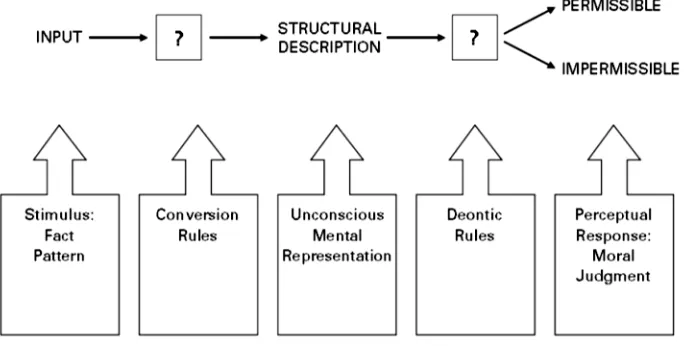
there are three elements behind the human moral faculty’s outputs: conversion rules, structural descriptions,
and deontic rules.
When a person is presented with a “fact pattern stimulus” –a particular case or moral dilemma–
[image:21.612.135.481.294.467.2]innate conversion rules convert the stimulus into a structural description (Figure 1).
Figure 1. The LA’s Expanded Perceptual Model of Moral Judgment12
This structural description reflects the structure of acts and omissions (and causal relations, etc.)
of the stimulus. Once a stimulus has been converted to a structural description, innate deontic rules are
unconsciously applied to that structural description, producing a moral judgment.
Having described these basic elements, the LA is now able to offer a more detailed account of the
sequence of unconscious steps usually involved in producing moral judgments (see Appendix A). On
Mikhail’s view, when one is presented with a moral stimulus (e.g., a moral dilemma) the conversion rules first
produce a representation of the temporal structure of the dilemma. This structure is a simple accounting of
the stimulus’ sequence of events, actions, and omissions. The conversion rules next give rise to the
representation of the stimulus’ causal structure. When one represents this causal structure, one represents the
relations between objects, agents, actions, states of affairs, the effects they produce, and the impact of those
effects on the objects and patients described in the stimulus (Mikhail, 2011, p. 172). Following the conversion
of a stimulus into its temporal and causal structure, the LA claims that the conversion rules produce a moral
structure that represents the good and bad effects involved in the stimulus. Here, harmful effects are
represented as ‘bad’, while positive effects are represented ‘good’ –bad effects that are negated (prevented) are
also deemed ‘good’. After converting a stimulus to into its moral structure, its intentional structure follows.
This structuring concerns the means, ends, and side effects of the actions isolated in the moral structure. As a
last step, the conversion rules culminate with the representation of the deontic structure of the stimulus. This
representation builds on the temporal, causal, moral, and intentional structure of the stimulus, adding in the
relevant innate deontic rules, principles, and concepts.
On the LA, the deontic rules of our moral grammar include prohibitions of intentional homicide and
battery, the Rescue Principle, and the Principle of Double Effect (PDE).13 These partially represent the
contents of our moral grammar. The prohibition of intentional homicide forbids willfully killing another
person. A prohibition of intentional battery “forbids purposefully or knowingly causing harmful or offensive
contact with another or otherwise invading her physical integrity without her consent” (Mikhail, 2011, p. 117).
The PDE is the principle according to which it can be permissible for one to act in a way normally prohibited
if that act produces both good and bad effects under four conditions: 1. the forbidden act is not “directly
intended” as such; 2. the good effects outweigh the bad; 3. one intends the good effects, but not the bad; 4.
one has no “morally preferable” alternatives (Mikhail, 2011, pp. 117-118). For example, one might claim that
the PDE allows for military action that results in collateral damage –i.e., unintended damage to non-military
targets (persons and property). The Rescue Principle prohibits one from not preventing serious harms
(including deaths) that can easily be prevented, provided the harm can be prevented “without violating other
13 Mikhail discusses other innate rules, but, since battery and homicide prohibitions, as well as the Principle of Double Effect
fundamental moral precepts” and without serious risk to one’s safety (Mikhail, 2011, p. 117). This principle is
exemplified by the common response to Peter Singer’s (1972) example of a bystander who comes upon a
child drowning in a shallow pond; the bystander’s clothing will be muddied (and perhaps ruined) if she saves
the child, but there is no further risk to the bystander.14
Minimally, then, these rules constitute the contents of our universal moral grammar – at least as
regards the contents of our innate deontic rules. Mikhail argues for this claim, in part, by considering what
best explains a broad range of ordinary judgments about familiar philosophical thought experiments. I now
turn to this argument, the evidence for it, and its role in Mikhail’s broader account of the innate rules,
principles, and concepts that constitute our moral grammar’s contents. Once the contents of Mikhail’s model
are clear, my plan is to suggest that there is important evidence for which the LA, in its present form, cannot
account. If this suggestion is correct then, I will argue, we have good reason to think that either the LA is
wrong about the contents of our moral competence, or it is the wrong model of our moral endowment.
2.3. Our Moral Grammar’s Contents
Recall that the LA is fundamentally a model of our innate moral competence, and that Mikhail
(borrowing from Rawls) claims that our considered judgments are plausibly competent ones. So, the data for
which the LA must account are our considered judgments. Mikhail cites a recently acquired set of considered
judgments in support of his model of moral competence, its contents, and the conclusion that humans
universally possess a moral grammar (Mikhail, 2000, 2002; Mikhail, Sorrentino, & Spelke, 1998). This
evidence is taken from multiple studies of folk intuitions about a range of “Trolley Problem” thought
experiments (Fischer & Ravizza, 1992; Foot, 1967; Thomson, 1986). Traditionally, these problems involve
scenarios in which a runaway train will kill five people if not stopped or diverted. Subjects are then typically
presented with two non-ideal choices. Mikhail and colleagues (Mikhail, 2000, 2002; Mikhail, Sorrentino, &
Spelke, 1998) employed a total of twelve variations on these traditional trolley problems, in order to gather a
14 Mikhail indicates that other rules are likely a part of our moral grammar, though for the most part he does not discuss these
rules in detail. For example, he suggests that we may possess a catastrophe prevention rule (a “supreme emergency
detailed enough data set from which to begin modeling the computational structure of moral cognition and
its innate contents. In particular, the various trolley variants provide a basis for positing a modest set of
deontic rules, concepts, and principles that partially constitute the contents of the human moral faculty. While
Mikhail presented twelve different scenarios to subjects, I focus on the four that most crucially support his
account of the contents of our moral grammar.15
2.3.1. Four Trolley Cases
In one case (Bystander), subjects were asked whether or not it would be morally permissible for Hank
to throw a switch, diverting the path of the train so that it will kill one person, instead of five. In another case
(Footbridge), subjects were asked about the moral permissibility of Ian’s stopping the train before it kills five
people by pushing a large person off of a footbridge that passes over the train tracks. Though Ian’s pushing
the large person from the footbridge would stop the train, it will also kill the large person.
Mikhail labels another related pair of cases Loop Track and Man-in-Front. In the former, a runaway
train will kill five men if it is not diverted. Ned, a bystander can temporarily divert the train onto a sidetrack
that eventually loops back onto the main track. If Ned diverts the train onto the side track, it will strike a man
who is standing there, killing him, but slowing the train enough to allow the five men on the main track to
escape. The Man-in-Front case also involves five men on the main track, and a side track that eventually loops
back to the main track. A bystander, Oscar, can divert the train onto the side track, where it will strike a heavy
object, slowing the train. There is a man standing in front of the heavy object, and –though it is the heavy
object that will slow the train enough to allow the five men on the main track to escape– Oscar’s throwing
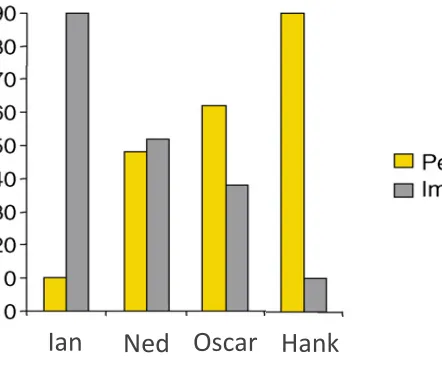
the switch will kill the man on the side track. The majority of subjects (nearly 90%) judged that it is morally
permissible to for Hank to throw the switch in the Bystander case, but nearly 90% of subjects judge that it is
impermissible for Ian to push the stranger in the Footbridge case (Mikhail, 2002; 2007). For Man-in-Front, a
narrow majority (62%) judged it morally permissible for Oscar to throw the switch, while a narrow majority
(52%) judged it impermissible for Ned to throw the switch.
For Mikhail, not only do the responses to these trolley cases reveal the operations of our moral
faculty, they can be used to discover the contents of our moral grammar. Specifically, by considering
structurally similar cases that elicit differing moral responses we might discover the concepts, rules, and
principles that are partly constitutive of our universal moral grammar. Since the outcomes, in terms of lives
saved and lost, in Bystander and Footbridge are identical (if Hank throws the switch and Ian pushes the large
stranger) the LA, like any account of moral judgment, must explain the striking asymmetry between our
judgments about the two cases. The more modest differences between judgments about Oscar and Ned
similarly warrant explanation. If the LA is the correct model of the human moral faculty, then these
asymmetries are best explained by the rules, principles, and concepts that partially constitute our moral
grammar. With this provision in mind, what explains the difference between judgments about the Bystander
and Footbridge cases, and judgments about Loop Track and Man-in-Front, is that we innately possess deontic
rules and principles that apply to one case, but not the other.
As I have mentioned, Mikhail claims that we innately possess a deontic principle against intentional
battery (i.e., performing battery as a means to some other end), and the PDE. By appealing to these
principles, the LA can readily explain the differences in permissibility judgments when comparing Hank and
Ian, and also Ned and Oscar. To save the five people on the main track in Footbridge, Ian intentionally
commits three acts of battery (touching the large person without consent, causing him to strike the ground
after falling from the footbridge, and causing the man to be struck by the train) and knowingly produces the
side effect of killing the large person as a means of intentionally producing the end result of saving five
people.16 Thus, to save the five Ian violates the PDE, as well as our rule against intentional battery. If Ian
does not act by pushing the large person from the footbridge, he does not save the five, but he does not
violate the PDE either. In throwing the switch Hank in Bystander knowingly commits an act of battery
(though his committing battery, as such, is not his intended end) and an act of homicide as a side effect of
preventing five deaths. According to the LA, Hank’s behavior, in contrast to Ian’s, is deemed permissible
16 Mikhail uses this language, even though it may seem unusual to refer to killing the large person a ‘side effect’. Mikhail’s point,
since it conforms to the PDE, the Rescue Principle, and it does not violate our innate rule against intentional
battery.
The asymmetry between Oscar and Ned is explained in a similar way. In throwing the switch, both
intentionally produce the good result of preventing five deaths. However, Ned intentionally commits battery
as a means to slow the train and save the five, since to save the five requires the train slow as a result of
striking the man on the strike track. Also, Ned knowingly commits homicide as a side effect of intending the
train to strike the man on the side track – the point being that Ned doesn’t want the man’s death, but he does
intend for the train to strike the man. Oscar, on the other hand, merely commits battery and homicide as side
effects of slowing the train, since he intends for the train to strike the heavy object on the side track, and it
just so happens that there is no way to achieve this intention without also having the train strike the man on
the side track. So, the LA explains that Oscar’s switch throwing is deemed morally permissible by most
people, since it violates no innate principles or rules, but, since Ned violates the PDE and our innate rule
against intentional battery, his switch throwing is judged impermissible by most people.17
It is important to note that, according to the LA, the deontic judgments provided by the majority in
these cases constitute considered judgments, in the Rawlsian sense. So, since Ned’s throwing the switch and
Ian’s pushing the large person are judged morally impermissible by the majority of respondents, these modal
responses are, on Mikhail’s view, the considered judgments. The majority judgments that Hank and also
Oscar are morally permitted to throw the switch also count as considered judgments.
Mikhail (2011) highlights this commitment by making “the simplifying assumption that these
judgments [the majority modal responses] are considered judgments in Rawls’ sense” (p. 110). Additionally, as
with all considered judgments, these possess the key features (spontaneity, impartiality, stability, stringency,
and certainty) required of such judgments. So, Mikhail proposes that considered judgments are competent
judgments, as are the majority modal responses, and that these judgments reflect the operations and contents
17 It might seem that since these cases (Ned and Oscar’s) are complex, and only subtly different, that the LA can easily explain
of our moral grammar. Conversely, the minority modal responses are rejected as errors in performance and
do not, according to the LA, accurately reflect our innate moral endowment.18 In §3, I go on to discuss how
the LA responds to cases in which the majority response is only slightly larger than the minority response,
and argue that, ultimately, this type of response presents a problem for the LA. Specifically, it reveals that the
LA is unable to satisfy one of its key desiderata: descriptive adequacy.
2.4. Summary
I will now argue that the LA is undermined by recent empirical work on moral judgments, since it
fails to offer a satisfactory response to three lines of evidence that plausibly constitute part of our innate
moral endowment. The failure to deal with this evidence successfully, I suggest, is the result of the LA’s
untenable account of moral competence. Before detailing this evidence, it is worth keeping in mind the
fundamental structure of the LA as I have just described it. The LA concludes that we each possess an innate
system of deontic principles and rules, and that this system is implied by the observed features of moral
judgments.19 This system of principles and rules is characterized by a theory of moral competence, and our
considered judgments, in turn, reveal the undistorted operation of our moral competence. Mikhail (2011)
examines a set of judgments about trolley problem variants, and claims that these judgments qualify as
considered judgments. This data set of considered judgments provides the LA with a starting point for
determining the specific moral rules and principles that are operative in the causal production of normal
individuals’ judgments. Having developed an account of the rules and principles implicated in considered
judgments about trolley cases, the LA can then begin to predict the competent judgments of normal
individuals, at least in those cases sufficiently similar (i.e., cases possessing the same set of value neutral facts)
to the trolley problem data set.
18 ‘Modal response’ is meant to refer to statements concerning how things ought to be. The response that pushing the large
person in Footbridge is forbidden (i.e., you ought not push the large person), is the majority modal response, whereas the judgment that pushing the large person is not forbidden is the minority modal response.
19 At least one virtue of our moral faculty (and its rules) being innate, on Mikhail’s view, is that it might help to address Poverty
3. EVIDENCE AGAINST THE ANALOGY
Having explained the LA’s moral grammar model, and the putative contents of our moral grammar, I
will argue that, though a descriptively adequate account of moral cognition may be possible, the LA cannot
satisfy this desideratum. In particular, when one considers the evidence for which any general model of moral
cognition must account, one finds that the LA’s theoretical commitments to a Rawlsian account of
considered judgments, as well as its way of drawing the competence-performance distinction, produces a
descriptively inadequate model of moral cognition. The evidence I will now consider puts pressure on
Mikhail’s account of moral competence, and, as a result, his model more broadly. Since the LA critically relies
on the distinction between competent and erroneous judgments, if its account of competence is untenable in
light of the considerations I raise, then the LA, itself, may prove untenable as well.
This chapter proceeds in three parts. I first consider the significance of the minority modal responses
to trolley cases, then move on to the differences in women and men’s moral judgments, and conclude by
considering our patterns of preference toward our kin, the young, and social in-group members. I also discuss
why the LA fails to offer a satisfactory response to these lines of evidence. In the next chapter I go on to
highlight why the LA must respond to this evidence, and whether or not the LA can succeed in doing so
while preserving its structure as a model of moral cognition and its account of moral competence. I conclude
that it cannot.
3.1. Modal Minorities
Recall the Loop Track and Man-in-Front cases involving Ned and Oscar. 52% of subjects judge that it
is morally impermissible for Ned to throw the switch, killing the man on the side track as a means to slow the
runaway train and save the five people on the main track (Mikhail, 2002). In contrast, 62% judge that it is
permissible for Oscar to throw the switch, saving the five people on the main track and killing the man on the
Recall, also, Mikhail’s “simplifying assumption” that the majority modal responses are Rawlsian
considered judgments, and thus constitute the data for which the LA, as a theory of moral competence, must
account (Mikhail, 2011, p.110). Clearly, then, on Mikhail’s view, the LA does not accept modal minorities, nor
does it need to. So, despite the slim margin between the 52% who judge Ned’s switch throwing impermissible
and the 48% who judge Ned’s switch throwing permissible, the LA is committed to rejecting the latter as
revealing anything significant regarding the operations or contents of the human moral faculty.
Interestingly, the same will also be true for many of the judgments offered by any person who
consistently responds with paradigmatic utilitarian or deontological judgments about these trolley cases.
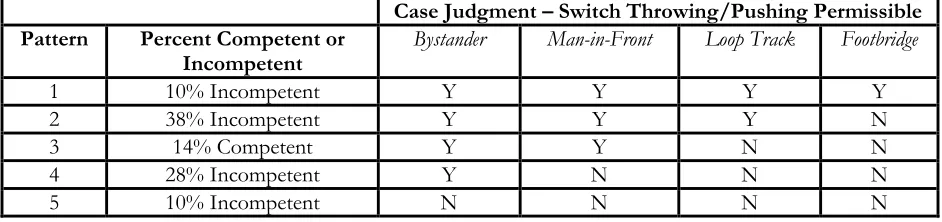
Imagine an individual, call him “Pete”, who judges that that Ian’s pushing the large man from the footbridge
is permissible, and that throwing the switch is permissible for Hank, Oscar, and Ned in Bystander,
Man-in-Front, and Loop Track, respectively. Based on the LA’s commitment to majority responses as considered
judgments, fully half of Pete’s judgments would be considered performance errors and ignored by the LA.
The same is true for another imagined person, call him “Manny”, who judges that it is morally impermissible
for Hank, Oscar, and Ned to divert the runaway train, and also judges that it is impermissible for Ian to push
the large man in Footbridge. As with Pete, the LA happily embraces half of Manny’s judgments as competent,
but dismisses his remaining judgments as performance errors. In both cases the defender of the LA is
committed to the claim that when Manny and Pete’s judgments diverge from the majority, those judgments
cannot be the result of the proper functioning of the human moral faculty regardless of whether or not Pete
and Manny would (or could) justify their judgments across these four cases in terms of a moral theory they
each hold.
Though I have focused on the minority modal responses as represented by Pete and Manny’s
imaginary judgments, as well as the judgments that Ned’s switch throwing is permissible and that Oscar’s is
impermissible, the general message should be clear: these modal minorities constitute potentially significant
moral judgment data for which any theory of moral cognition must account. Yet, the LA effectively ignores
these data by assuming that the majority response just is the competent or considered response (and the
that this message is generally noteworthy, it is particularly important given the role played by the majority
judgments on the Loop Track and Man-in-Front cases in supporting Mikhail’s claims that the PDE is among the
innate deontic principles that partly constitutes our moral grammar. Since people’s judgments about Loop
Track and Man-in-Front only support the LA if Mikhail’s view of competence is correct, should it turn out that
the minority modal responses undermine Mikhail’s view of competence, these responses will, in turn,
undermine his claims regarding our moral grammar’s contents. As I will argue in §4, these responses do in
fact call Mikhail’s view of moral competence into question, and thus undermine his broader account of moral
cognition.
3.2. Gendered Judgments
A second line of evidence that the LA fails to offer an adequate response comes from data on gender
and moral judgments. In the last twenty years multiple studies have found differences in moral judgment
across genders (Gilligan & Attanucci, 1988; Petrinovich et al., 1993; Petrinovich & O’Neill, 1996; Zamzow &
Nichols, 2009). Petrinovich and colleagues (1993; 1996) employed trolley variants modeled on those
discussed in Fischer & Ravizza (1992). They observed that women found throwing the switch in Bystander,
saving five people and killing one, significantly more permissible when the questionnaire materials employed
the term “Save” rather than “Kill” in describing the possible outcomes of acting or refraining from action.
Men’s responses, under the same conditions, varied less often, and did not vary significantly.
Zamzow & Nichols (2009) also found gender differences in a study involving Bystander case variants.
In this study, male and female subjects were asked to consider trolley cases structurally similar to Bystander,
and to evaluate the moral acceptability of throwing the switch, killing one and saving five, depending on the
description of the person on the side track. In one condition, the person on the side track was either
described as a stranger or as a 12 year old child. In another condition, this person was described as either the
subject’s brother or the subject’s sister. Males expressed greater agreement than did females that throwing the
greater agreement than did males that throwing the switch is morally acceptable in the brother and stranger
conditions (Zamzow & Nichols, 2009).20
Even Mikhail’s own research (2002) on moral judgment is consistent with this pattern of gender
differences. Mikhail (2002) reported significant differences in male and female permissibility judgments
regarding the Bystander case. While men, on average, rate switching the track, saving five people and killing
one, permissible 85% of the time, Mikhail found that 60% of female subjects rated switching as permissible.
Though the sample size in this study is modest, these gender differences are not only statistically significant,
they match a pattern found repeatedly in other studies (Gilligan & Attanucci, 1988; Zamzow & Nichols,
2009): though a substantial majority of males find diverting the trolley permissible in the standard Bystander
case, women systematically judge throwing the switch less permissible (though switch-throwing remains the
majority response among women).
Though the above mentioned studies (with the exception of Mikhail 2002) did not employ trolley cases
identical to those used by Mikhail, there is a clear pattern of systematic differences in moral judgment across
genders. This evidence is modest but mounting, and, at present, the LA is largely insensitive to it. Rather, the
LA currently reduces the complexity of the evidence by averaging men and women’s responses together, and
selecting the majority modal response as the competent response, thus constituting the response the LA must
account for. Conversely, regardless of gender, the minority responses are labeled performance errors and
rejected as data irrelevant to a theory of moral competence. This rejection, however, effectively eliminates a
significant proportion of women’s responses to specific cases (e.g., 40% of them in Mikhail’s Bystander case),
and ignores robust variability across genders. If we concede that this variability does not matter, then
Mikhail’s account of our moral grammar’s contents fits the data nicely, but, as I will argue in Chapter 4, there
is reason to resist this concession.
At this point, it is worth noting that the need to explain these data is not unique to the LA. Any
sufficiently general theory of moral cognition must also explain the differences in judgments across genders.
20 Subjects were asked to imagine themselves in the role of Bystander, and rate their agreement with the following question
This is especially true of the LA, since its goal is to offer a descriptively adequate account of human moral
competence. The LA does purport to be an account of women’s moral competence and men’s moral
competence. Thus, when gender judgments diverge significantly, the LA must successfully explain these
differences such that it preserves a tenable and unified account of the human moral endowment.
At first glance, it appears that the proponent of the LA can explain these gender differences as the
result of gender-specific performance errors. One strategy would be to claim that men are prone to ignore
relevant facts when faced with cases concerning the prospect of saving others, or, conversely, perhaps women
more often pay attention to irrelevant factors when considering these kinds of cases. In the next chapter I
consider this strategy, and what becomes of the LA if it is taken. I conclude that taking this strategy is
unpromising, since it fundamentally relies on the assumption that majority judgments are competent
judgments. As I will show, this assumption turns out to be deeply problematic for the LA, supporting my
conclusion that the LA is descriptively inadequate and cannot be rescued from this inadequacy by explaining
away the evidence presented here. Before turning to these arguments in detail, I will consider one last line of
evidence.
3.3. Patterns of Preference
In addition to the data on gender differences in moral judgment, there is a remaining line of evidence
for which the LA fails to offer an adequate response. Consider the following variant on the familiar Bystander
case. A bystander, Jayne, may choose to throw the switch or to refrain from doing so. As usual, throwing the
switch saves five and kills one. Imagine the five persons on the main track are undescribed strangers to Jayne,
whereas the individual on the side track is an elderly person. Is Jayne morally forbidden from throwing the
switch? What if the person on the side track is a toddler instead? Further, imagine variants in which five
undescribed strangers are on the main track, and the person on the side track is Jayne’s romantic partner or
Jayne’s genetic relative (but not both!). Again, is it permissible for Jayne to refrain from throwing the switch
under these conditions? Imagine Jayne in the Footbridge scenario. Imagine that she can push the large person
permissible for Jayne to push the large man from the footbridge? What if Jayne’s romantic partner is among
the five on the main track? Would it be permissible for Jayne to push the large man from the bridge to stop
the train if all five people on the tracks were Jayne’s relatives?
A recent study by Bleske-Rechek and colleagues (2010) tested participants using the Bystander
variations just mentioned.21 In brief, they found that, as compared to cases with an undescribed person on
the side track, participants were significantly more likely to throw the switch, directing the trolley toward
older persons or unrelated persons, and that participants were substantially less likely to throw the switch to
direct the trolley toward the younger or more genetically related the person on the side track. Subjects were
also substantially less likely to flip the switch if they were told to imagine their romantic partner on the side
track.
As Paul Bloom (2011) observes, going to great lengths on behalf of one’s own children, family, or
members of one’s community is prevalent. It is noteworthy that failures to go to similar lengths for strangers
(or out-group) members are seldom deemed moral failings (cf. Singer, 1972). But the reverse is also true
(Bloom, 2011). If, for example, I fail to help or care for my family in commonplace ways –failing to secure
medical treatment for my children, say– this is widely viewed as a moral failing. Further, it seems plausible
that normal (non-pathological) individuals who disagree that it is immoral not to care for one’s kin are
thought to be mistaken.
Viewed through the lens of evolutionary theory, though, these judgment tendencies are not
particularly surprising. In fact, one would predict these very responses in light of our evolutionary heritage (de
Waal, 2006), since it seems entirely plausible that our moral sensibilities first evolved in a way that singled out
the young as worthy of protection, and distinguished kin or in-group members as worthy of prosocial
treatment that was not extended to non-kin or out-group members.22
As with the differences in judgments across genders, the LA once more fails to successfully explain
these variations. As structured, the LA’s base data set is comprised of responses to trolley variants involving
victims who are unnamed (presumably adult), male strangers. To be clear, the data I discuss in this section –
patterns of kin, young, and in-group preferences in moral judgment– are not merely significant because the
LA does not yet say much about them, it is because they have the potential to present a problem whether or
not the advocate of the LA attempts to embrace them, or if she rejects them as the result of performance
errors. As I argue in the next chapter, explaining these data is difficult for the LA, since it cannot coherently
subsume these patterns of preference into its model, and it cannot offer a principled basis for rejecting these
data. In either case, this difficulty further supports the claim that the LA’s account of competence is
problematic, as well as my conclusion that the LA is the wrong model of our moral endowment.
3.4. Summary
These three lines of evidence pose a similar sort of challenge to the LA. On the face of it, the
challenge seems modest. I have simply claimed that the LA currently fails to offer an adequate response to
the evidence presented to this point. Naturally, the defender of the LA has two available responses. She can
make changes in order to accept this evidence, integrating it into her model’s base data set, or she can offer a
principled basis for rejecting it. However, I argue that the LA cannot successfully accept or reject these data.
As a result, the advocates of the LA can either admit that their moral grammar model assigns the wrong
contents (principles, rules, or concepts) to our moral faculty, or they can concede that the moral grammar
model is simply the wrong model of our moral endowment.
4. THE ANALOGY’S DILEMMA
In the previous section I presented three lines of evidence, and suggested they each present the same
sort of difficulty for the LA and its account of moral competence and performance errors. In this chapter, I
detail the nature of this difficulty, and its implications for the LA. As I emphasized previously, the LA
currently fails to provide adequate responses to a broad range of modal minority judgments, the differences in
judgments across gender lines, and patterns of preference toward kin, social in-group members, and the
strategy –acceptance or rejection– it adopts. I then show how both responses are problematic for the LA’s
account of the contents of our moral grammar, as well as its depiction of moral competence.
4.1. Explaining Modal Minorities
In §3.1., I introduced what I’ve termed ‘modal minority’ responses. For the purposes of this
discussion, these are the responses favored by the minority of subjects asked to offer permissibility or
impermissibility judgments about the trolley problems Mikhail uses to develop his model of moral cognition.
For example, the 48% of subjects who judge that Ned’s switch throwing is permissible in the Loop Track case
are offering the modal minority response, as compared to the 52% of subject who judge Ned’s switch
throwing impermissible. However, the notion of modal minority responses (MMR) can be extended to include
the minority response to any experimental probe used for the purposes of modeling our moral competence.
Just as with the other lines of evidence, the LA’s defenders face two options with respect to the
MMR evidence: accept it as reflecting our innate moral competence and thus part of its data set, or reject the
MMR as the result of performance errors thus excluding it as part of the data for which it must account.
Currently, the LA, as structured, pursues the latter strategy. The reason for this choice is straightforward. If
the advocates of the LA were to accept the MMR evidence as reflective of our innate moral competence,
while affirming that the evidence it currently accepts (the modal majority responses) also reflects the
undistorted operations of our innate moral faculty, the LA would be forced to attribute contradictory
contents (rules or principles) to our innate moral faculty.
For example, if the LA accepts that the 48% of subjects who respond that Ned’s throwing the switch
is morally permissible are making competent judgments, and also accepts that the 52% of subjects who judge
that Ned’s switch throwing is impermissible judge competently, then the advocates of the LA must conclude
that there both is and isn’t an innate prohibition against intentional battery (i.e., performing battery as a
means to some other end). Similarly, if the LA accepts as competent the responses of the 38% of subjects
who respond that Oscar’s switch throwing is permissible, then the LA must seemingly affirm that the PDE
(or a similar principle) is tacitly accepted in our moral grammar, and also that it isn’t.
So, by including the MMR and the modal majority responses, the LA cannot offer an internally
consistent depiction of its own core data set, since that data set involves contradictory deontic judgments
about identical cases. But, at minimum, for the idea of a universal human moral grammar to preserve its
promise of descriptive adequacy, and to be worth modeling, there must be a principled and non-contradictory
set of contents which partly constitute our moral grammar. If the Linguistic Analogy is left to conclude that
we do possess an innate battery prohibition and that we also do not –which it must, if it accepts both the
MMR and modal majority responses– the LA’s account of the contents of our innate grammar is either
vacuous, or requires giving up on the very notion of a universal moral grammar. On either conclusion, it isn’t
clear what explanatory or predictive value the LA retains as a model of moral cognition.
While this simplistic integration of the MMR data is unpromising, perhaps the LA has the resources
for a more sophisticated and compelling response. It seems plausible that the advocate of the LA can defuse
my worries in this section by offering the Plurality Response, which, in brief, proposes that since our moral
grammar is complex and encompasses more than one rule, in some instances different innate rules may be
responsible for different modal responses, and so this disagreement is not the result of performance errors.
Not only does the Plurality Response suggests that each person innately possesses multiple deontic rules and
that there are going to be cases to which more than one deontic rule is applicable, it also suggests that two
people’s competent judgments about such cases may disagree, since one person’s judgment reflects one
innate rule, and another’s judgment reflects a different rule.
So, for example, if Pete responds that it is morally permissible for Ned to throw the switch in Loop
Track, and Manny judges that it isn’t, perhaps it is because the Rescue Principle is driving Pete’s response,
while the prohibition against intentional battery is driving Manny’s response. Or, to be more precise, the
Rescue Principle has more weight for Pete’s decision making, while the intentional battery prohibition is
weightier for Manny. Thus, we may be able to conclude that both Manny and Pete have made competent
count as an error, since the difference in judgment can still be the result of Manny and Pete both structurally
representing the same case in the same way, and appropriately applying an innate deontic rule to that
structural representation.
To a first approximation, then, the Plurality Response seems to answer easily the concerns that the
MMR data raise for the LA. If so, then the MMR data do not challenge the contents the LA attributes to our
moral faculty, and these data do not motivate the conclusion that the moral grammar model is mistaken.
However, there are substantive reasons to think that this response is unavailable to proponents of the LA,
one of which comes directly from the Rawlsian commitments of Mikhail’s account.23
Though Mikhail (2011) does not discuss the Plurality Response, he very briefly considers how it
might be that, when one offers a competent judgment about a case, one innate deontic rule determines one’s
judgment, even though others are applicable. Once more, he calls on Rawls, specifically invoking the notion
of lexical priority (Mikhail, 2011, p. 146-152). In A Theory of Justice, Rawls (1971, p. 40-45) uses this notion to
address the challenges involved in ranking, or assigning the relative weight to, moral principles. In lexically
ordering our principles, the elements that have priority ‘trump’ those that do not. This ordering is one “which
requires us to satisfy the first principle in the ordering before we can move on to the second, the second
before we consider the third, and so on” (Rawls, 1971, p. 42). For example, Mikhail suggests that the innate
deontic rule against intentional homicide is lexically prior to the innate prohibition of intentional battery
(2011, p. 152). Similarly, the prohibition of intentional battery is lexically prior to the Rescue Principle. So,
using this ordering, we can explain how the innate rule against intentional battery gives rise to the judgment
that Ian’s pushing the large person from the footbridge is forbidden, even though the Rescue Principle
23 One might think that phenomenological considerations will help distinguish which cases of disagreement the Plurality