R E S E A R C H A R T I C L E
Open Access
Neuritogenic effect of standardized extract of
Centella asiatica
ECa233 on human
neuroblastoma cells
Oraphan Wanakhachornkrai
1, Varisa Pongrakhananon
2,3, Preedakorn Chunhacha
3, Aree Wanasuntronwong
4,
Anusara Vattanajun
5, Boonyong Tantisira
2,6, Pithi Chanvorachote
2,3*and Mayuree H Tantisira
2,7*Abstract
Background:In order to gain insight into neuroprotective effects of ECa 233, a standardized extract ofCentella asiatica, previously demonstrated in animal models of memory impairment induced by transient global ischemia or intracerebroventricular injection ofβ-amyloid, the effect of ECa 233 on neurite outgrowth of human IMR-32 neuroblastoma cell line was investigated.
Methods:Cells were seeded and incubated with various concentrations of ECa 233. Morphometric analysis was carried out by a measurement of the longest neurite growth of cells at 24 and 48 h. Contributing signaling pathways possibly involved were subsequently elucidated by western blot analysis.
Results:While ECa 233 had only limited effects on cell viability, it significantly enhanced neurite outgrowth of IMR-32 cells at the concentrations of 1–100μg/ml.Western blot analysis revealed that ECa 233 significantly upregulated the level of activated ERK1/2 and Akt of the treated cells suggesting their involvement in the neuritogenic effect observed, which was subsequently verified by the finding that an addition of their respective inhibitors could reverse the effect of ECa 233 on these cells.
Conclusions:The present study clearly demonstrated neurite outgrowth promoting activity of ECa 233. ERK1/2 and Akt signaling pathways seemed to account for the neurotrophic effect observed. In conjunction within vivo neuroprotective effect of ECa 233 previously reported, the results obtained support further development of ECa 233 for clinical use in neuronal injury or neurodegenerative diseases.
Keywords:Neurite outgrowth, Centella asiatica, ECa 233, ERK1/2, Akt, IMR-32 neuroblastoma
Background
Neurite outgrowth is an important initial step in the for-mation of neuronal network. Such neuronal behavior was also shown to implicate in neuronal regeneration and response to neural injury [1]. Mechanisms in regula-tion of neurite outgrowth have been intensively investi-gated and the most accepted concept involves MEK/ ERK and PI3K/Akt signaling pathways. Indeed, these molecular signals are triggered by tyrosine kinase recep-tor activation [2-6]. Several neurotrophic ligands for
tyrosine kinase receptors such as nerve growth factor (NGF), brain derived neurotrophic factor (BDNF) and neurotrophin-3 (NT-3) have been identified [7,8]. The activation of MEK/ERK and PI3K/Akt results in an increase in cell survival as well as an enhancement of neuronal growth and differentiation [9,10]. In this con-text, molecules or compounds that exhibit potent neuro-trophic activity are of great interest and may be useful for the treatment of stroke, brain or spinal cord injury and neurodegenerative diseases [11-13].
In search for potential neurotrophic activity from herbs acting on the central nervous system, the present study focused on the neurotrophic activity of Centella asiatica which has, for a long time, been claimed to be beneficial for managing disorders of the brain, skin and
* Correspondence:[email protected];[email protected]
2
Department of Pharmacology and Physiology, Faculty of Pharmaceutical Sciences, Chulalongkorn University, Bangkok 10330, Thailand
3
Cell-based Drug and Health Product Development Research Unit, Chulalongkorn University, Bangkok 10330, Thailand
Full list of author information is available at the end of the article
gastrointestinal tract [14]. Additionally, it was used as a brain booster for promoting brain growth and improving memory [12]. Like many other medicinal plants, C. asiatica contains several active compounds, including asiatic acid, madecassic acid, asiaticoside, and madecas-soside [15]. To avoid a large fluctuation in biological responses arising from variations of these bioactive con-stituents, we have established the standardized extract of C. asiatica, namely ECa 233. It is defined as a white to off-white extracted powder of C. asiatica containing triterpenoids not less than 80% and the ratio between madecassoside and asiaticoside was kept within 1.5 ± 0.5 [16]. Restorative and neuroprotective effects of ECa 233 have been demonstrated in animal models of learning and memory deficit induced by either a transient occlu-sion of common carotid arteries [17] or an intracerebro-ventricular injection of β-amyloid [18]. Protection of oxidative stress was proposed to be one of the possible underlying mechanisms. However, effect of ECa 233 on neurite outgrowth which could possibly be involved in its neurotrophic/neuroprotective effects has not yet been elucidated. Therefore, the present study aimed to inves-tigate the effect of ECa 233 on the neurite growth and its underlying mechanisms in IMR-32 human neuro-blastoma cells.
Methods
Cell culture and reagents
IMR-32 neuroblastoma cells were obtained from the American Type Culture Collection, ATCC (Manassas, VA, USA). Cells were cultured in DMEM/F12 supple-mented with 10% fetal bovine serum, 2 mmol/l L-glu-tamine and 100 units/ml penicillin/streptomycin in a 5% CO2at 37°C. BDNF, PD 098059, LY 294002 were
pur-chased from Sigma Chemical. Inc. (St. Louis, MO, USA). Resazurin was purchased from Invitrogen (Carlsbad, CA, USA). Specific antibody for phospho-Akt, Akt, phospho-ERK1/2, ERK1/2 and GAPDH were purchased from Abcam (Cambridge, MA, USA), and peroxidase conjugated anti-rabbit secondary antibody were pur-chased from Cell Signaling (Danvers, MA, USA).
Preparation of tested substances
ECa 233 containing madecassoside 52% w/w and asiaticoside 32% w/w was kindly supplied by Associate Professor Ekarin Saifah, Ph.D and collaborates, Faculty of Pharmaceutical Sciences, Chulalongkorn University. Thailand. It was suspended in sterile PBS at 10 mg/ml and served as stock solution. BDNF was dissolved in the sterile PBS to a stock solution at the concentration of 50 μg/ml. PD098059 and LY294002 were dissolved by DMSO to concentration of 0.344 and 0.267 mg/ml, respectively.
Cell viability assay
Cells were seeded in 96-well plates and incubated for 24 h. After incubation, the plating media were removed and replaced. The cell were subsequently incubated for 30 minutes then subjected to treatments. After 24 h, cells were incubated with 1:50 resazurin at 37°C for 30 minutes. The well-plate was transferred to a fluores-cence microplate reader with Softmax Pro software to measure fluorescence intensity of resorufin (resazurin product) at excitation wavelength of 530 nm and emis-sion wavelength of 590 nm. The percentage of cell via-bility was calculated and compared with non-treated control. All analyses were performed for at least three independent triplicate experiments.
Measurement of neurite outgrowth
IMR-32 cells were cultured in a 96-well culture plate. After 24 h cells were subjected to various concentrations of ECa 233 (0.1, 1, 10, 100μg/ml) or BDNF (100 ng/ml). A neurite was identified as a process equal to or longer than cell body diameter. The cells selected randomly from 3–4 fields of each well were photographed (phase contrast, Nikon, Inverted microscope ECLIPSE Ti-u) for morphometric analyses. The length of the longest neurite from each cell was measured using NIS-Element image software [19,20].
To test the involvement of MEK and Akt pathway, their respective inhibitors, PD098059 (5 μM) for MEK and LY294002 (7.5 μM) for PI3K/Akt, was added at 30 min prior to the test substance.
Western blot analysis
temperature. The immune complexes were detected by enhanced chemiluminescence substrate (Supersignal West Pico; Pierce, Rockford, IL, USA) and quantified using Image J software.
Data analysis
The results are expressed as mean ± S.D. or S.E. Simple comparison between two groups was performed usingt-test. Comparison of data between groups was performed using one-way ANOVA follow by Tukey’s post hoc test.P< 0.05 was considered statistically significant.
Results
Effect of ECa 233 on viability of IMR-32 cells
First, effect of ECa 233 on cell viability of IMR-32 cells was determined using Resazurin based assay. Cells were incubated in the presence or absence of ECa 233 (0.1, 1, 10 and 100μg/ml) for 24 and 48 h and percentage of cell viability was determined. Percentage of such cell viability was compared among groups as well as with non-treated control (p < 0.05) (Figure 1). The results show that cell via-bility was 106 ± 1.6, 95.6 ± 6.44, 102.4 ± 4.03 and 104.6 ± 7.48% of control in response to ECa 233 at the concentra-tions of 0.1, 1, 10 and 100μg/ml, respectively. In addition, cell viability at 48 h after treatment in all ECa 233-treated groups showed no significant change from that of non-treated control indicating that treatment with ECa 233 at the concentrations tested had neither cytotoxic nor prolif-erative effects on these neuroblastoma cells.
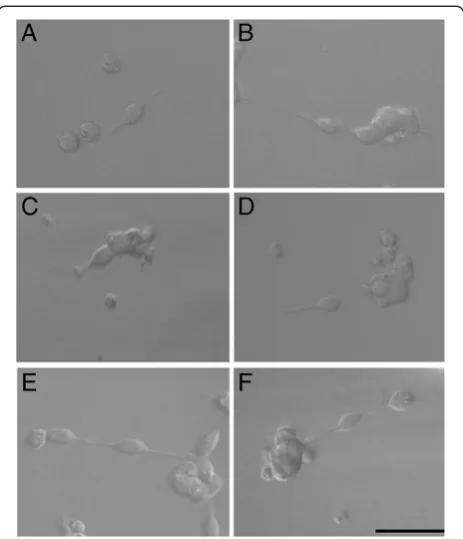
Neuritogenic activity of ECa 233 on neurite outgrowth The non-cytotoxic and non-proliferative concentrations of ECa 233 at 0.1, 1, 10 and 100μg/ml were further used in neurite outgrowth experiments. BDNF, a well-known trophic factor of neurite extension and neuronal survival was used as a positive control. We found that the addition of 100 ng/ml BDNF to the cells caused dramatic increase of the neurite outgrowth (Figure 2B). Likewise, cells
treated with ECa 233 at the concentrations of 1, 10 and 100μg/ml exhibited increased length of neurite compared to those of non-treated control (Figure 2D-F).
The morphometric analysis was carried out by meas-uring the longest neurite length per cell (Figure 3). After 24 and 48 h of treatment, the length of neurite obtain from cells treated with ECa 233 at the concentration of 0.1 μg/ml (23.02 ± 1.05 and 26.46 ± 0.87 μm) was not significantly different from those of non-treated cells (26.22 ± 1.19, 27.91 ± 1.01μm). Whereas, neurite lengths exposed to ECa 233 at the concentrations of 1, 10 and 100 μg/ml were significantly enhanced in a time-dependent manner (35.58 ± 2.61, 37.39 ± 2.69 and 39.9 ± 2.73 μm at 24 h, and 47.57 ± 2.84, 44.03 ± 1.66 and 46.52 ± 2.71 μm at 48 h). Similar results were obtained when the cell were treated with BDNF 100 ng/ml (35.83 ± 2.17 and 54.38 ± 4.06 μm). Notably, the effect of ECa 233 at 1, 10 and 100 μg/ml was comparable to that of BDNF with no significant difference.
Possible mechanisms of ECa 233-mediated neuritogenic activity
Effect of ECa 23 on ERK1/2 and Akt
[image:3.595.306.538.87.357.2]In order to provide the possible mechanism of ECa 233-mediated neurite outgrowth observed in IMR-32 cells,
[image:3.595.58.290.560.696.2]Figure 1Effects of ECa 233 on cell viability and proliferation of IMR-32 cells at 24 and 48 h after applying.There was no significant difference among groups.
Figure 2Representative photomicrograph of IMR-32 cells using phase contrast. (A)non-treated control,(B)BDNF 100 ng/ml,(C-F)
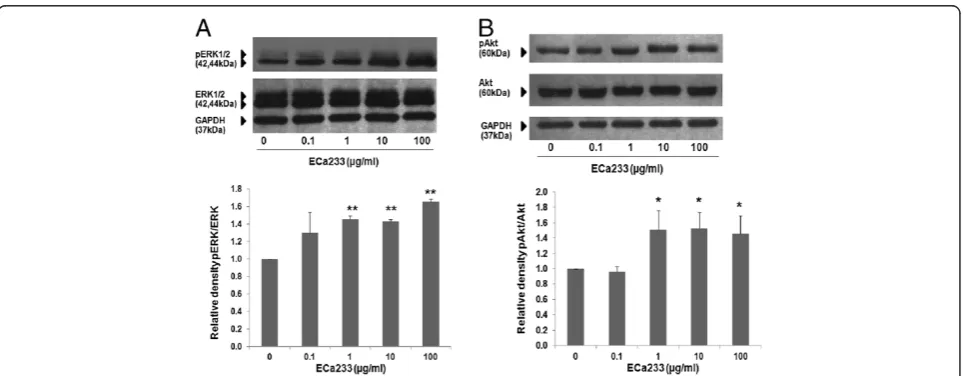
western blot analysis was carried out to determine whether ERK and Akt signaling were involved. Cells were treated with ECa 233 and the level of phosphory-lated ERK and phosphoryphosphory-lated Akt were determined. Figures 4A and B demonstrated that relative blot density of pERK/ERK and pAkt/Akt in response to ECa 233 at the concentration of 0.1 μg/ml was not different from that of non-treated group. However, ECa 233 at the concentrations of 1, 10 and 100 μg/ml significantly in-creased the level of phosphorylated ERK and phosphory-lated Akt, suggesting that ECa 233 could possibly increase the neurite outgrowth via these 2 major pathways.
Effect of ECa 233 on neurite outgrowth in the presence of PD098059 and LY294002
Subsequently, the involvement of ERK and Akt signaling pathways in the neurite outgrowth promoting activity of ECa 233 was confirmed by treatment of specific
[image:4.595.59.539.89.203.2]inhibitor of MEK (PD098059) or PI3K (LY294002) prior to the exposure to ECa 233. In comparison to neurite lengths of non-treated group which was 23.39 ± 0.54μm (Figure 5A), ECa 233 at the concentrations of 1, 10 and 100 μg/ml significantly enhanced the neurite outgrowth into 36.12 ± 1.53, 36.79 ± 1.60 and 36.69 ± 1.98 μm re-spectively. Pretreatment of the cell with PD098059 significantly decreased the neurite outgrowth of the re-spective concentrations of ECa 233 into 22.45 ± 0.65, 20.76 ± 0.532 and 21.83 ± 0.53 μm. Similar results were demonstrated by LY294002 which significantly decreased the ECa 233-induced neurite outgrowth into 20.83 ± 0.81, 20.03 ± 0.49 and 20.76 ± 0.53 μm, respectively (Figure 5B). As expected, PD098059 (5 μM) or LY294002 (7.5 μM) in the concentration that exhibited no significant effect on neurite outgrowth (23.52 ± 0.84 and 20.43 ± 0.54 μm, respectively) completely abolished neurite stimulating effect of ECa 233.
[image:4.595.58.540.497.685.2]Figure 3Morphometric analysis of IMR-32 cells affected by ECa 233.After cells cultured for 24 and 48 h in the presence of either ECa 233 (0.1, 1, 10 and 100μg/ml) or BDNF (100 ng/ml). Morphometric analysis was carried out by measuring neurites from 60 living cells per treated condition, (n = 3). Average of the neurite length was significantly increased after being treated with ECa 233 (1, 10 and 100μg/ml) or BDNF. The data presented as mean ± S.E. ** =p< 0.01, *** =p< 0.001 vs non-treated control.
Figure 4Relative blot density of pERK/ERK and pAkt/Akt in response to ECa 233 treatment. (A)ERK1/2 and ERK1/2 phosphorylation(B)
Discussion
Although the plant originated extracts have garnered attentions as important sources of drugs and health products, the inconsistency of main components found in such extracts limits their use as well as further de-velopment to clinical use. Establishment of standardized extract with consistency of its bioactive constituents could enhance reproducible biological responses and subsequently reliable use of herbal products [21]. Based on well-defined constituents and numbers of scientific evidence, EGb 761, a standardized extract of Chinese ancient plant,Ginko biloba, known as a brain tonic rem-edy, has been prescribed for memory deficit all over the world [22]. By the same analogy,C. asiatica which has long been used in Ayurveda to enhance memory was ex-tensively investigated [23]. In an attempt to make a reli-able herbal product, ECa 233, a standardized extract of C. asiatica, was established and investigated for its effect on brain function. We have found that ECa 233 could attenuate memory deficit and exerted anxiolytic effect in
animal models [16-18]. As administration of fresh leaf juice of C. asiatica was found to enhance dendritic aborization of hippocampal and amygdala neurons in neonatal and adult rats [24-27], we hypothesized that ECa 233 might enhance neurite outgrowth.
[image:5.595.63.538.88.431.2]As expected, the present study clearly demonstrated neuritogenic effect of ECa 233 in the range of 1–100 μg/ml. Further experiment was then conducted to gain an insight into signaling pathways possibly involved. Numerous signaling pathways involving in neurite out-growth have been proposed [2,5]. Among them, ERK and Akt activations have long been known to be import-ant for neurite elongation induced by certain neuro-trophic factors including NGF [28,29], neurotrophin-3 (NT-3) [30], BDNF [31] as well as natural compounds including FK506 [32,33], genipin [34], honokiol [4] and militarinone A [9]. In addition, ginsenoside, triterpe-noidglycoside from gingseng, has been shown to signifi-cantly increase the neurite outgrowth of neuroblastoma cells [35].
In line with the findings previously demonstrated by some other natural products mentioned above, western blot analysis demonstrated that administration of ECa 233 significantly increased the level of phosphorylated ERK and Akt in IMR-32 cells indicating their activation in the presence of ECa 233. In addition, contribution of ERK and Akt signaling pathways was subsequently con-firmed by the results that the neurite outgrowth promot-ing effect of ECa 233 was abolished by specific inhibitors of MEK (PD098059) or PI3K (LY294002) suggesting that ECa 233 promoted neurite outgrowth in human neuro-blastoma IMR-32 cells via MEK/ERK and PI3K/Akt-dependent mechanisms. Though, asiatic acid, one of chemical constituents present in C. asiatica has been proposed to elicit its effect via MAP kinase pathway [12], increases of phosphorylated ERK and Akt observed in the present study are likely to be attributable to madecassoside and/or asiaticoside, the major constitu-ents of ECa 233.
In agreement with the fact that C. asiatica is widely consumed as food, ECa 233 in the concentrations that promoted neurite outgrowth in human neuroblastoma IMR-32 cells had no effect on cell viability under the experimental condition indicating safety of ECa 233, a standardized extract derived from C. asiatica. Similarly, safety profiles of ECa 233 have been previously reported in both acute and sub-chronic toxicity testing. Oral ad-ministration of ECa 233 in the dose up to 10 g/kg did not cause any lethality and no significant adverse effects was observed in experimental animals receiving daily administration of ECa 233 in the dose range of 10– 1000 mg/kg/day [36]. In consideration to very favorable safety profiles and significantin vivo neuroprotective ac-tivity of ECa 233 [18], the results of the present study supports further development of ECa 233 for neuronal injury as well as neurodegenerative diseases in human.
Conclusions
The present study demonstrated the neurite outgrowth promoting activity of ECa 233 in human IMR-32 neuro-blastoma cell line. The neuritogenic effect observed seemed to be mediated via ERK1/2 and Akt signaling pathways. The results obtained support potential benefit of ECa 233 for the management of neuronal injury and neurodegenerative diseases. Further pharmacodynamic and pharmacokinetic studies of ECa 233 are needed to bring ECa 233 into clinical use.
Abbreviations
C. asiatica:Centella asiatica; MEK: Mitogen activated protein kinase; ERK: Extracellular signaling regulated kinase; PI3K: Phosphoinositide-3-kinase; NGF: Nerve growth factor; BDNF: Brain derived neurotrophic factor; NT-3: Neurotrophin-3; PD: PD 098059; LY: LY 294002.
Competing interests
All authors declare that they have no competing interests.
Authors’contributions
OW participated in design and conducting the experiments, analysis of data, drafting the manuscript. VP, PrC and AW participated in technical supports and interpretation of the data. AV and BT supervised, design of experiments, analyzed and interpretation of the data. PiC was a coordinator, designed the study, analysis and interpretation of data, and drafting the manuscript. MT supervised, conceived and designed the experiment, interpretation of the data and revision of the manuscript. All authors have read and approved the final manuscript.
Acknowledgements
The work was supported by The 90thAnniversary of Chulalongkorn University Fund (Ratchadaphiseksomphot Endowment Fund) and Ratchadaphiseksom-phot Endowment Fund for Cell-based Drug and Health Product Development Research Unit. The authors would like to thank Associate Professor Ekarin Saifah and collaborates for the provision of ECa 233.
Author details
1
Inter-disciplinary Program in Physiology, Graduate School, Chulalongkorn University, Bangkok 10330, Thailand.2Department of Pharmacology and
Physiology, Faculty of Pharmaceutical Sciences, Chulalongkorn University, Bangkok 10330, Thailand.3Cell-based Drug and Health Product Development
Research Unit, Chulalongkorn University, Bangkok 10330, Thailand.4Faculty of Dentistry, Mahidol University, Bangkok 10400, Thailand.5Department of
Physiology, Phramongkutklao College of Medicine, Bangkok 10400, Thailand.
6Faculty of Pharmacy, Silpakorn University, Nakonprathom 73000, Thailand. 7
Faculty of Pharmaceutical Scienccs, Burapha University, Chonburi 20131, Thailand.
Received: 1 March 2013 Accepted: 31 July 2013 Published: 4 August 2013
References
1. Plachez C, Richards LJ:Mechanisms of axon guidance in the developing nervous system.Curr Top Dev Biol2005,69:267–346.
2. Kaplan D, Miller F:Neurotrophin signaling transduction in the nervous system.Curr Opin Neurobiol2000,10:381–391.
3. Hur J, Lee P, Kim H, Kang I, Lee KR, Kim SY:(−)-3,5-Dicaffeoyl-muco-quinic acid isolated fromAster scabercontributes to the differentiation of PC12 cells: through tyrosine kinase cascade signaling.Biochem and Biophys Res Commun2004,313:948–953.
4. Zhai H, Nakade K, Oda M, Mitsumoto Y, Akagi M, Sakurai J, Fukuyama Y:
Honokiol-induced neurite outgrowth promotion depends on activation of extracellular signal-regulated kinases (ERK1/2).Eur J Pharmacol2005,
516:112–117.
5. Read DE, Gorman AM:Involvement of Akt in neurite outgrowth.Cell Mol Life Sci2009,66:2975–2984.
6. Takahashi K, Piao S, Yamatani H, Du B, Yin L, Ohta T, Kawagoe J, Takata K, Tsutsumi S, Kurachi H:Estrogen induces neurite outgrowth via Rho family GTPases in neuroblastoma cells.Mol Cell Neurosci2011,48:217–224. 7. Labelle C, Leclerc N:Exogenouse BDNF, NT-3 and NT-4 differentially
regulate neurite outgrowth in cultured hippocampal neurons.Brain Res Dev Brain Res2000,123:1–11.
8. Chao MV, Rajagopal R, Lee FS:Neurotrophin signaling in health and disease.Clin Sci (Lond)2006,110:167–173.
9. Küenzi P, Kiefer S, Koryalina A, Hamburger M:Promotion of cell death or neurite outgrowth in PC-12 and N2a cells by the fungal alkaloid militarinone A depends on basal expression of p53.Apoptosis2008,
13:364–376.
10. Wang X, Wang Z, Yao Y, Li J, Zhang X, Li C, Cheng Y, Ding G, Liu L, Ding Z:
Essential role of ERK activation in neurite outgrowth induced byα-lipoic acid.Biochim Biophys Acta1813,2011:827–838.
11. Horner PJ, Gage FH:Regenerating the central nervous system.Nat2000,
407:963–970.
12. Soumyanath A, Zhong YP, Gold SA, Yu X, Koop DR, Bourdette D, Gold BG: Centella asiaticaaccelerates nerve regeneration upon oral administration and contains multiple active fractions increasing neurite elongation in-vitro.J Pharm Pharmacol2005,57:1221–1229.
14. Brinkhaus B, Lindner M, Schuppan D, Hahn EG:Chemical, pharmacological and clinical profile of the East Asian medical plantCentella asiatica.
Phytomedicine2000,7:427–448.
15. Inamdar PK, Yeole RD, Ghogare AB, de Souza NJ:Determination of biologically active constituents inCentella asiatica.J Chromatography A 1996,742:127–130.
16. Wanasuntronwong A, Tantisira MH, Tantisira B, Watanabe H:Anxiolytic effects of standardized extract ofCentella asiatica(ECa 233) after chronic immobilization stress in mice.J Ethnopharmacol2012,143:579–585. 17. Tantisira MH, Tantisira B, Patarapanich C, Suttisri R, Luangcholatan S,
Mingmalailak S, Wanasuntronwong A, Saifah E:Effects of standardized extract ofCentella asiaticaECa 233 on learning and memory impairment induced by transient bilateral common carotid artery occlusion in mice.
Thai J Pharmacol2010,32:22–33.
18. Kam-eg A, Tantisira B, Tantisira MH:Preliminary study on effects of standardized extract ofCentella asiatica, Eca 233, on deficit of learning and memory induced by an intracerebroventricular injection of
β-amyloid peptide in mice.Thai J Pharmacol2009,31:79–82. 19. Fukuyama Y, Nakade K, Minoshima Y, Yokoyama R, Zhai H, Mitsumoto Y:
Neurotrophic activity of honokiol on the cultures of fetal rat cortical neurons.Bioorg Med Chem Lett2002,12:1163–1166.
20. Hur J, Lee P, Moon E, Kang I, Kim SH, Oh MH, Kim Y:Neurite outgrowth induced by spicatoside A, a steroidal saponin, via the tyrosine kinase A receptor pathway.Eur J Pharmacol2009,620:9–15.
21. Taylor JLS, Rabe T, McGaw LJ, Jäger AK, Staden Van J:Toward the scientific validation of traditional medicinal plants.Plant Growth Regul2001,34:23–37. 22. Eckert GP:Traditional used plants against cognitive decline and
alzheimer disease.Front Pharmcol2010,1:1–10.
23. Wattanatorn J, Mator L, Muchimapura S, Tongun T, Pasuriwong O, Piyawatkul N, Yimtae K, Sripanidkulchai B, Singkhoraard J:Positive modulation of cognition and mood in the healthy elderly volunteer following the administration ofCentella asiatica.J Ethnopharmacol2008,
116:325–332.
24. Rao SB, Chetana M, Uma Devi P:Centella asiaticatreatment during postnatal period enhances learning and memory in mice.Physiol Behav 2005,86:449–457.
25. Mohandas Rao KG, Muddanna Rao S, Gurumadhva Rao S:Centella asiatica
(L.) Leaf extract treatment during the growth spurt period enhances hippocampal CA3 neuronal dendritic arborization in rats.Evid Based Complement Alternat Med2006,3:349–357.
26. Mohandas Rao KG, Muddanna Rao S, Gurumadhva Rao S:Enhancement of amygdaloid neuronal dendritic arboritezation by fresh leaf juice of
Centella asiatica(Linn) during growth spurt period in rats.Evid Based Complement Alternat Med2009,6:575–611.
27. Gadahad MR, Rao M, Rao G:Enhancement of hippocampal CA3 neuronal dendritic arboritezation byCentella asiatica(Linn) fresh leaf extract in adult rats.J Chin Med Assoc2008,71:6–13.
28. Boglari G, Szeberenyi J:Nerve growth factor in combination with second messenger analogues causes neuronal differentiation of PC12 cells expressing a dominant inhibitory Ras protein without inducing activation of extracellular signal- regulated kinases.Eur J Neurosci2001,
14:1445–1454.
29. Tsuji M, Inanami O, Kuwabara M:Induction of neurite outgrowth in PC12 cells by alpha-phenyl-N-tert-butylnitron through activation of protein kinase C and the ras-extracellular signal-regulated kinase pathway.
J Biol Chem2001,276:32779–32785.
30. Aletsee C, Beros A, Mullen L, Palacios S, Pak K, Dazert S, Ryan AF:Ras/MEK but not p38 signaling mediates NT-3-induced neurite extension from spiral ganglion neurons.J Assoc Res Otolaryngol2001,2:377–387. 31. Bosco A, Linden R:BDNF and NT-4 differentially modulate neurite
outgrowth in developing retinal ganglion cells.J Neurosci Res1999,
15:759–769.
32. Price RD, Yamaji T, Matsuoka N:FK506 potentiates NGF-induced neurite outgrowth via the Ras/Raf/MAP kinase pathway.J Pharmacol2003,
140:825–829.
33. Gold BG, Zhong YP:FK506 requires stimulation of the extracellular signal regulated kinase 1/2 and the steroid receptor chaperone protein p23 for neurite elongation.Neurosignals2004,13:122–129.
34. Yamazaki M, Chiba K, Mohri T, Hatanaka H:Cyclic GMP-dependent neurite outgrowth by genipin and nerve growth factor in PC12h cells.
Eur J Pharmacol2004,488:35–43.
35. Rudakewich M, Ba F, Benishin CG:Neurotrophic and neuroprotective action of Ginsenosides Rb1 and Rg1.Planta Med2000,67:533–537. 36. Chivapat S, Chavalittumrong P, Tantisira MH:Acute and sub chronic
toxicity studies of a standardized extract ofCentella asiaticaECa 233.
Thai J Pharm Sci2011,35:55–64.
doi:10.1186/1472-6882-13-204
Cite this article as:Wanakhachornkraiet al.:Neuritogenic effect of standardized extract ofCentella asiaticaECa233 on human neuroblastoma cells.BMC Complementary and Alternative Medicine 201313:204.
Submit your next manuscript to BioMed Central and take full advantage of:
• Convenient online submission
• Thorough peer review
• No space constraints or color figure charges
• Immediate publication on acceptance
• Inclusion in PubMed, CAS, Scopus and Google Scholar
• Research which is freely available for redistribution