www.hydrol-earth-syst-sci.net/19/3925/2015/ doi:10.5194/hess-19-3925-2015
© Author(s) 2015. CC Attribution 3.0 License.
Definition of efficient scarcity-based water pricing policies through
stochastic programming
H. Macian-Sorribes1, M. Pulido-Velazquez1, and A. Tilmant2
1Research Institute of Water and Environmental Engineering (IIAMA), Universitat Politècnica de València, Valencia, Spain 2Department of Civil and Water Engineering, Université Laval, Québec City, Québec, Canada
Correspondence to: H. Macian-Sorribes ([email protected])
Received: 9 December 2014 – Published in Hydrol. Earth Syst. Sci. Discuss.: 19 January 2015 Revised: 2 September 2015 – Accepted: 7 September 2015 – Published: 23 September 2015
Abstract. Finding ways to improve the efficiency in water usage is one of the most important challenges in integrated water resources management. One of the most promising so-lutions is the use of scarcity-based pricing policies. This con-tribution presents a procedure to design efficient pricing poli-cies based on the opportunity cost of water at the basin scale. Time series of the marginal value of water are obtained us-ing a stochastic hydro-economic model. Those series are then post-processed to define step pricing policies, which depend on the state of the system at each time step. The case study of the Mijares River basin system (Spain) is used to illustrate the method. The results show that the application of scarcity-based pricing policies increases the economic efficiency of water use in the basin, allocating water to the highest-value uses and generating an incentive for water conservation dur-ing the scarcity periods. The resultdur-ing benefits are close to those obtained with the economically optimal decisions.
1 Introduction
One of the main challenges in integrated water resources management (IWRM) is improving the efficiency in water usage while balancing it with equity. Given that in the major-ity of the developed world the building of new water supply systems has well passed its zenith, water management strate-gies are now devoted to achieve better operating policies. Several criteria can be considered when designing a policy for water allocation: flexibility in the allocation, security of tenure for the users, real cost recovery, predictability of its performance, fairness and acceptability (Dinar et al., 2007). Each system has a unique configuration and, in consequence,
a unique combination of factors that lead to an adequate man-agement policy.
There are four major water allocation mechanisms: pub-lic water allocation, water markets, user-based allocation and marginal cost pricing. Public water allocation provides an ad-equate treatment of water as a public good, allows for the development of large-scale infrastructures often beyond the private investment capacity, and focuses on equity issues and non-economic objectives. However, it usually fails in achiev-ing optimal economic performance, leads to water prices which are below the water value, and provides no incentive to water saving and efficient use (Meinzen-Dick and Mendoza, 1996). Water markets encourage both sellers and buyers to use it efficiently, provide flexible allocation mechanisms and allow considering the real value of the employed resource. On the contrary, unique characteristics of water can turn mar-kets into a bad allocation mechanism if externalities are not adequately considered (Garrick et al., 2009). User-based al-location, in which water users regulate water resources by themselves, is especially suited for local needs in water man-agement and is likely to be accepted by the users. However, it may be inadequate in inter-sectorial allocation, requiring also a very transparent structure (Dinar et al., 2007).
in-volved in water allocation (Griffin, 2001). Calculating the marginal value of water is challenging as it varies in space and time according to supply–demand imbalances, requires adequate monitoring, and has some difficulties to deal with equity when water prices are beyond what lower-value users can afford (Dinar et al., 2007). Moreover, administrative con-straints on price charges can limit their benefits (Dandy et al., 1984). In Europe, the EU Water Framework Directive (Euro-pean Commission, 2000) calls for the implementation of new pricing policies that assure the contribution of water users to the recovery of the cost of water services (financial instru-ment) while providing adequate incentives for an efficient use of water (economic instrument). Not only financial costs should be recovered but also environmental and resource (op-portunity) costs. This issue has been addressed through the use of hydro-economic models as tools able to couple physi-cal and economic water resource aspects (Heinz et al., 2007; Pulido-Velazquez et al., 2008, 2013; Riegels et al., 2013; Ward and Pulido-Velazquez, 2008).
A pricing policy is efficient, according to economic the-ory, if the prices charged correspond to the marginal cost of water. Therefore, it must take into account supply costs, op-portunity costs and externalities (Rogers et al., 2002). Mea-suring the opportunity costs of scarce water is difficult: since water markets are usually absent or ineffective, scarcity val-ues are not reflected in the water prices. Given that opportu-nity cost depends on the alternative uses, an integrated basin-wide approach is needed to simultaneously account for all major competing water uses in the basin (Rogers et al., 2002; Pulido-Velazquez et al., 2013). The assessment of these op-portunity costs requires a systems approach and a proper method to estimate the value of water across the different users (Young, 2005; Pulido-Velazquez et al., 2008). If pricing policies reflect the entire basin-wide marginal opportunity costs, then they will act as an economic instrument for effi-cient water resources management, modifying the demand– supply interaction by acting on the demand side and support-ing water allocation to the most valuable users.
[image:2.612.311.549.69.201.2]The marginal resource opportunity cost (MROC), or marginal value of water, can be defined as the benefits that would have been obtained at one location and one time if the available resource at that location and time had been in-creased by one unit (Pulido-Velazquez et al., 2008, 2013; Tilmant et al., 2008, 2014). MROC can be derived from hydro-economic models. Pulido-Velazquez et al. (2013) de-veloped a method to obtain scarcity-based pricing policies using MROC values, in which the time series of MROC obtained after running a hydro-economic model are post-processed to derive step pricing policies whose performance can be simulated using a decision support system (DSS) shell. However, in those studies pricing policies were based on either priority-based simulation (which are not represent-ing an optimal policy) or deterministic hydro-economic opti-mization, with the inherent limitation of the perfect foresight (the optimization algorithm knows future flows in advance
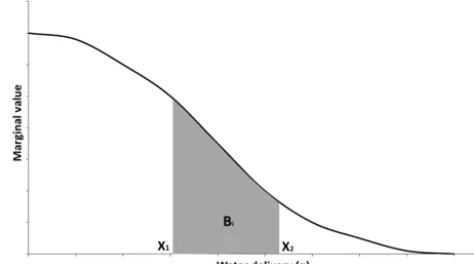
Figure 1. Benefits from an increase of water delivery fromx1tox2.
and, in consequence, it has an unrealistic advantage that di-minishes the applicability of the results) (Labadie, 2004).
The main purpose of this paper is to propose a method for the design of scarcity-based water pricing policies based on the MROC derived from a stochastic hydro-economic model. With stochastic programming procedures, uncertainty is taken into account in the optimization process. Therefore, it removes the effect that the “perfect foresight” phenomenon causes in the marginal values, which are flattened across time and thus lose an important part of their short-term variability. The marginal values obtained using stochastic programming are representative of an optimal policy while reflecting the future uncertainties in the system’s inflows. After describing the method to obtain the MROC values, we propose a method for the definition of a stochastic-programming-based water pricing policy. Finally, a case study is developed to prove and illustrate the methodology using a hydro-economic simula-tion model of the Mijares River basin system (Spain). Pric-ing policies are applied in this paper exclusively as economic instruments whose purpose is achieving an efficient use of water. Financial issues are not addressed.
2 Method and materials
2.1 Assessment of the marginal resource opportunity cost (MROC)
For a specific water demand, the benefit obtained by the user,
Bi, given a change in water delivery level fromx1tox2, can be calculated by integrating the demand curve (Di) (Fig. 1):
Bi= x2
Z
x1
Di(q)dq. (1)
Similarly, for a given locationL and time t, the benefit
value (or MROC) function:
Bt=
x2
Z
x1
MROCL,t(sL,t)ds. (2)
The MROC can be defined as the derivative of the ben-efit function with respect to the system state. Therefore, if the MROC integration obtains the system-wide benefits, the MROC can be calculated as
MROCL,t=
dBt(sL,t)
ds . (3)
The MROC value for a specific location and time can be estimated (1) under a simulation approach, as the ben-efits obtained by an increase of one unit in the available resource at that location and time (Pulido-Velazquez et al., 2008, 2013); and (2) under an optimization approach, as the shadow value, dual variable or Lagrange multiplier as-sociated with the mass-balance equation at the desired place and the specified time (Pulido-Velazquez et al., 2008, 2013; Tilmant et al., 2008).
2.2 MROC assessment through stochastic programming
Stochastic programming (SP) procedures are powerful and useful methodologies to derive optimal management of water systems with uncertain inputs (Tejada-Guibert et al., 1993). Various SP algorithms are available. Among them, stochastic dynamic programming (SDP) has been widely used in wa-ter resources management because (1) it is able to handle non-linearities in the objective function in an efficient way, (2) the inflow uncertainty representation is clear and simple, and (3) it treats the decision-making process sequentially, as done in real-life operation (Labadie, 2004). The SDP algo-rithm solves the Bellman’s recursive equation as follows:
Ft(St,Qt) (4)
=maxDt
Bt(St,Qt, Dt)+EQt+1|Qt{Ft+1(St+1,Qt+1)}
,
where Ft is the total benefit function, St the current (time t) system state vector,Qt the current inflow vector, Dt the decision made at time stept,Bt the immediate benefit func-tion,EQt+1|Qt the expectation operator between the current and future inflows, and Ft+1 the future benefit function or benefit-to-go function.
In the SDP method, the state variablesSt andQt are dis-cretized over all the state space forming a grid, allowing only transitions between grid points. The expectation operator is then defined by using a Markov chain that relates the current hydrological stateQt to all the possible future statesQt+1 through a set of transition probabilities.
With the application of Eq. (4), the optimal policies
Dt(St,Qt)and benefit-to-go functionFt(St,Qt)are calcu-lated at the grid points. Then, interpolation methodologies
can be applied to obtain the optimal policies Dt∗(St,Qt) and the optimal benefits Ft∗(St,Qt) over the entire state space. An alternative is to use a reoptimization approach as in Tejada-Guibert et al. (1993). With this approach, the Bell-man function is implemented forward with the SDP-derived benefit-to-go functions as inputs.
Ft(St,Qt) (5)
=maxDt
"
Bt(St,Qt, Dt)+ X
q n
ptp,q·Ft∗+1(St+1,Qt+1) o
#
,
whereSt and Qt are the simulated system state (storage) and inflows at staget, andpp,qt is the transition probability (Markov Chain) between inflow classpat time staget and inflow classqat time staget+1. TheSt+1andQtvalues are not subjected to a discrete grid. The reoptimization provides time series of allocation decisions and the correspondingλ
values associated with the system’s nodes, which correspond to the MROC.
2.3 From MROC values to pricing policies
vari-ables(t,St,Qt), in which a step function defines the price to be applied each time period. Those operations can be summarized as MROC values of aggregation/disaggregation, MROC statistical analysis, and step pricing policy construc-tion. Although the SDP method was used to obtain the MROC time series, the operations explained below can be used regardless of the algorithm employed (another stochas-tic one such as SDDP, determinisstochas-tic optimization or simula-tion) to provide MROC time series.
The aggregation/disaggregation of the MROC time se-ries previously obtained is required in order to derive pric-ing functions at a certain spatial and temporal scale. Re-garding the spatial dimension of the intended pricing pol-icy, different pricing schedules for raw water in different zones in the system will better capture the MROC spa-tial variability. However, the complexity of pricing poli-cies will probably imply greater implementation difficulties. With regard to the temporal scale, as stated earlier, pric-ing policies varypric-ing at a lower time resolution (seasonal or monthly) are more accurate than annual ones, although they might also face more implementation problems and higher uncertainty in future prices. Defining a general pro-cedure to aggregate/disaggregate MROC time series is diffi-cult, since it depends on the desired pricing policy features and each system’s unique features. An example of the aggre-gation/disaggregation process for the specific features of the desired pricing policy is shown in the case study section.
Once the aggregated MROC values are obtained, their cumulative probability distribution can be determined. Sev-eral characteristic values can then be chosen using different percentiles of the cumulative probability distribution. Those characteristic values can be used to estimate the MROC–state relationship by (1) sorting the time series of state variables obtained with SDP according to their respective aggregated MROC values, (2) selecting the MROC–state pairs in which the MROC value was a characteristic one, and (3) organizing the results in the form of state–MROC steps. To sum up, the method presented in this paper can be divided in the follow-ing steps:
1. definition of the main pricing policy features;
2. development of a hydro-economic stochastic program-ming model of the system;
3. determination of MROC (marginal water values orλ -values) time series at the reference nodes (e.g., main reservoirs);
4. aggregation/disaggregation of MROC time series to cal-culate the aggregated MROC values;
5. development of a statistical analysis over the aggregated MROC values to obtain their cumulative probability dis-tribution;
6. building ofksteps by
(a) choose k different cumulative probability values (characteristic values),
(b) sorting according to the aggregated MROC values the system state values obtained in the stochastic programming run,
(c) obtaining, for each characteristic value, the system states associated with it,
(d) summarizing all the possible state values associated with each characteristic value in the form of steps, 7. definition of several step pricing policies based on the
obtained steps.
Pricing policies can be simulated to assess their perfor-mance and to compare them to the SDP results and to other alternatives such as different operating rules. In case the pric-ing policies’ performance is found to be inadequate, the pro-cess must be restarted: the pricing policies’ features are re-assessed and the build-up and analysis stages must be redone. The most straightforward way to determine its adequacy is to quantify the forgone benefits that the users would be will-ing to accept as counterpart of uswill-ing a simpler pricwill-ing pol-icy. It is impossible to establish a unique threshold value since it totally depends on the system features. An alterna-tive approach, employed in the case study of this paper, is to compare the performance of the pricing policy with the one achieved by the optimal operating rules expressed by the SDP results. In that way, a pricing policy could be considered as adequate as long as it obtains similar economic returns than to for the optimal policy.
2.4 Case study: Mijares River basin (Spain)
The Mijares River basin is located in eastern Spain (Fig. 2). It is characterized by the existence of several relevant wa-ter springs at its headwawa-ter (Mas Royo and Babor), the im-plementation of conjunctive-use water strategies to improve water management (Andreu and Sahuquillo, 1987), and the existence of an allocation framework accepted by all the users (SCRM, 1974). Regulated by the Arenós (93 Mm3) and Sichar (49 Mm3) reservoirs, surface water is mostly devoted to agricultural purposes (mainly orange trees), with ground-water as complementary or substitutive resource, while ur-ban demands are entirely supplied using groundwater. There are 10.499 ha irrigated exclusively by surface water and 11.622 ha irrigated by surface and groundwater.
Figure 2. Mijares River basin location (eastern Spain).
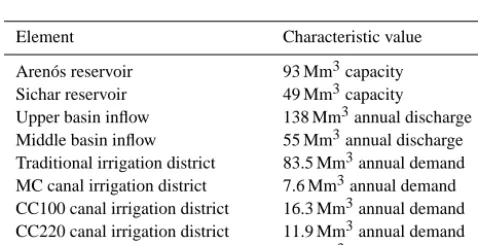
Table 1. Characteristic values of elements of the Mijares River net-work.
Element Characteristic value
Arenós reservoir 93 Mm3capacity Sichar reservoir 49 Mm3capacity Upper basin inflow 138 Mm3annual discharge Middle basin inflow 55 Mm3annual discharge Traditional irrigation district 83.5 Mm3annual demand MC canal irrigation district 7.6 Mm3annual demand CC100 canal irrigation district 16.3 Mm3annual demand CC220 canal irrigation district 11.9 Mm3annual demand Minimum flow downstream Sichar 0.2 Mm3annual requirement
[image:5.612.297.545.135.657.2]have not been considered, and the mixed-supplied demands have been reduced by an amount equivalent to its groundwa-ter supply. The characgroundwa-teristics of each element are shown in Table 1.
Current water management agreements give priority to the supply to the traditional irrigation district (ID), which has been using water since the 13th century, over the remaining IDs (established in mid 20th century). In year 1970, before the construction of the Arenós dam (with public funding), an agreement was signed between users to regulate the use of the Sichar reservoir (funded by the traditional ID) (SCRM, 1974). That agreement established a monthly storage limit for the Sichar reservoir below which only the traditional ID can be supplied (see Fig. 4). That agreement continued to be applied after construction of the Arenós reservoir, but re-ferred to the total system storage (Arenós and Sichar).
[image:5.612.46.285.334.456.2]2.5 SDP hydro-economic model of the Mijares River The SDP hydro-economic model comprises all the elements previously described and depicted in Fig. 4. A monthly time step was used. The hydrologic variables (qt, t=1, . . .,12) were discretized into four equally likely intervals per sub-basin, each one represented by a characteristic value. Water demand curves are derived from Alvarez-Mendiola (2012). The minimum flow requirement has been considered as a constraint. A lag-1 Markov chain captures the temporal per-sistence found in the inflow data. The discrete storage classes adopted were 13 (Arenós) and 7 (Sichar). Minimum flows, demand curves, evaporation and infiltration losses, stream capacities and benefits (obtained as the sum of integrations under all the demand curves) are also taken into account in the model. The model was built using a generalized SDP al-gorithm developed using GAMS software (Macian-Sorribes and Pulido-Velazquez, 2014). This model was optimized, for an infinite horizon, taking target storages as decision vari-ables.
3 Results
3.1 SDP-obtained benefits, policies and MROC values The monthly policies and benefits obtained depend on a vec-tor consisting of four variables: Arenós svec-torage, Sichar svec-tor- stor-age, upper basin inflow and middle basin inflow. The optimal decisions obtained with the algorithm followed the classic “rule of thumb” of reservoirs in series devoted to water sup-ply – fill the upper reservoirs first, and empty the lower reser-voirs first (Lund and Guzman, 1999) – as the results empty first Sichar (the lower reservoir) and fill first Arenós (the up-per reservoir). In addition, traditional ID users are subject to greater water deficits compared to the other ones, inverting the current criteria, caused by the river seepage in the lower Mijares streams.
A reoptimization procedure was applied to obtain the time series of MROC values at the Arenós and Sichar reservoirs, depicted compared with the sum of storages in Fig. 5. The plots show the same values during most of the historical time series. The slight differences between them found in certain time stages correspond to the opportunity cost of the CC220 ID delivery. Water values increase between 1977 and 1986, a period that corresponds to the largest drought suffered in the Mijares River basin. The average MROC value is equal to EUR 0.15 m−3, ranging from EUR 0 to 0.68 m−3. 3.2 Pricing policies in the Mijares River basin
Regarding the aggregation/disaggregation of the MROC time series at the Arenós and Sichar reservoirs, the pricing pol-icy used was defined at basin-wide scale. This decision has been made considering the proximity of the intakes for the demands and the possibility of releasing water from the two
reservoirs to satisfy almost all of them. The chosen temporal scale for the pricing policy was annual, with the same pric-ing policy for all the months. For simplicity, the state variable for defining the pricing schedule was the sum of the storage in the Arenós and Sichar reservoirs, without considering the corresponding monthly inflow. That departs from the SDP formulation but is consistent with the current management policies, based exclusively on storages. The aggregation op-eration driven by these features was simply a non-weighted average of the MROC values at the Arenós and Sichar reser-voirs, as the MROC values are almost coincident for both reservoirs.
Figure 6 shows the MROC cumulative probability distri-bution. To establish pricing policies, we sampled the 5th (EUR 0 m−3), 25th (EUR 0.06 m−3), 50th (EUR 0.13 m−3), 75th (EUR 0.24 m−3) and 95th (EUR 0.51 m−3) percentiles. The MROC–storage pairs were then organized in intervals (as depicted in Fig. 7). Each interval or step represents the range of storage values associated with that MROC.
The previous steps were used to define the pricing poli-cies. Firstly, the storage space was divided into intervals of 25 Mm3. A price was then defined for each interval as ei-ther the minimum or the maximum or the average over the MROC values associated with the steps found within the in-terval. As a result, a set of 15 pricing policies was obtained. Figure 7 shows some of them, corresponding to policies re-garding maximum between steps (pricing policy 1), average (pricing policy 2) and minimum (pricing policy 3). The re-maining pricing policies were based on different combina-tions between prices obtained in the first three.
3.3 Pricing policy performance by hydro-economic modeling
Figure 4. Current management rule curve established in the Mijares River basin.
Figure 5. MROC time series and storages in the Mijares River.
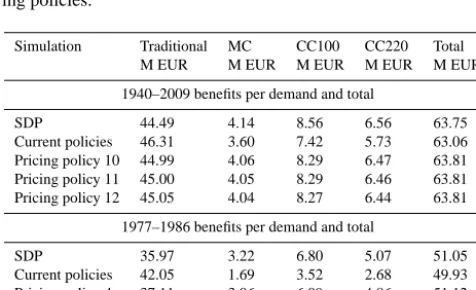
by Tejada-Guibet in 1993), current management rules and the best pricing policies for the 1940–2009 period.
Regarding Table 2 and Fig. 8a, only slight differences can be found between policies. All pricing policies increase the economic results of current management policies by around EUR 0.70 million per year, being similar to the ones obtained with the direct use of the SDP policies. For that reason, we consider those pricing policies to be adequate, as it was not necessary to test complex ones. This situation is caused by the natural robustness of the Mijares River water system and by the homogeneity of the cropping pattern (mainly citrus crops, mostly oranges) found in the basin. The improve-ment caused by pricing policies is due to temporal reallo-cations: the prices hedge the immediate supplies to allow for greater deliveries in the next months. In that way, the deficits and their induced scarcity costs are distributed over
several months of slight delivery reductions rather than a sin-gle large deficit. As the income losses are non-linear with respect to the deliveries, that deficit distribution improves the total economic return for the system. Despite having the same global benefits, the way they are distributed among the users’ changes for all the pricing policies tested; thus it is necessary to take them into account when deciding which one to be implemented.
[image:7.612.126.468.287.477.2]Figure 6. Combined MROC cumulative probability distribution.
[image:8.612.129.470.291.465.2]Figure 7. MROC-based pricing policies.
Table 2. Benefits for the 1940–2009 and 1977–1986 periods with stochastic optimization (SDP), current management rules and pric-ing policies.
Simulation Traditional MC CC100 CC220 Total M EUR M EUR M EUR M EUR M EUR
1940–2009 benefits per demand and total
SDP 44.49 4.14 8.56 6.56 63.75
Current policies 46.31 3.60 7.42 5.73 63.06 Pricing policy 10 44.99 4.06 8.29 6.47 63.81 Pricing policy 11 45.00 4.05 8.29 6.46 63.81 Pricing policy 12 45.05 4.04 8.27 6.44 63.81
1977–1986 benefits per demand and total
SDP 35.97 3.22 6.80 5.07 51.05
Current policies 42.05 1.69 3.52 2.68 49.93 Pricing policy 4 37.11 3.06 6.09 4.86 51.12 Pricing policy 5 37.11 3.06 6.09 4.86 51.12
would lead to a greater economic performance and to a more efficient water use.
4 Discussion and conclusions
[image:8.612.47.285.552.697.2]Figure 8. Annual total benefits comparison for the 1940–2009 period (a) and for the 1977–1986 drought (b).
The reason why a simple pricing policy is able to achieve a similar performance as that of a complex optimal operat-ing rule in this case study is due to the in-year time pattern possessed by this policy: the majority of the MROC values that determined the water prices for the lower storage levels correspond to start-of-refill ones, while the MROC values as-sociated with high storage levels are start-of-drawdown ones. For that, the prices triggered vary across time in accordance to the refill–drawdown cycle of the system, reproducing in some way the water value annual cycle.
Given the uncertainties associated with the inputs of the model, the predictions concerning the pricing policy perfor-mance are therefore uncertain. The most important source of uncertainty are the demand curves, since they directly affect the MROC values and the reliability of the simulated per-formance of a pricing policy. Given the strong influence of the demand curves in the results, demand curves should be properly estimated and tested. The robustness in the estima-tion of the demand curves will be subject to the availability
of the proper information for the economic characterization of the water uses in the basin as well as the suitability of the method used in the definition of those curves. This could be a limitation in the applicability of the method to certain cases. The resulting pricing policies should be in any case regarded just as a starting point for a negotiation process involving the users and policymakers to determine the final prices to be charged for water abstraction. On the other hand, the pric-ing policies defined in this paper are conceived exclusively as economic instruments for achieving an economically ef-ficient use of water. Financial issues (such as revenue suffi-ciency and cost recovery) and other goals of pricing policies like equity and environmental sustainability should be con-sidered as well.
The MROC values measure the opportunity cost associ-ated with water use. Therefore, in order to determine the final prices charged to the users, the cost recovery component of the supply costs (operation, maintenance and capital charges) and the environmental externalities should be added (Rogers et al., 2002). The main objective in the design of the pric-ing policies discussed here focuses on the use of water prices as economic instrument for an efficient management of the interaction between supply and demand. The role of pricing for the cost recovery of water services (pricing as financial instruments) will require a complementary analysis.
Comparing pricing policies with water markets, both will be theoretically valid approaches for enhancing economic ef-ficiency in water allocation in the system. Nowadays in Spain water markets are allowed by law but, in practice, only in a few occasions have they been operative and never in this system (Palomo-Hierro et al., 2015). Factors like high trans-action costs, farmers’ reluctance to participate, low physi-cal connectivity, etc., often prevent more transfers. While the experience and literature on water markets is more abun-dant, water pricing is clearly underused regarding its poten-tial for dealing with water scarcity. Despite its limitations, drawbacks, barriers and issues for its implementation, water pricing offers some interesting features: contributes to match supply and demand, generates revenues, and maintains cus-tomer choices (against command and control policies). On the other hand, the river basin authority holds the formal con-trol of the system, which is essential for addressing environ-mental requirements, third party effects and so on.
Regarding the established methodology and the case study, several conclusions can be drawn.
1. Stochastic programming is a useful tool for estimating optimal policies and MROC time series under hydrolog-ical uncertainty. These time series capture and summa-rize the overall performance of the optimization policies and can be therefore used to assess pricing policies able to be applied at the basin scale.
2. Pricing policies defined using MROC data series, after statistical analysis and step building, are adequate to en-hance a system’s global economic efficiency. They es-tablish a univocal relationship between the system state (storages and inflows) and a water price based on the marginal value of water in a reservoir, linking the price concept to the MROC one.
3. Participatory framework processes might be desirable to define the features and characteristics that the pricing policies should have, in order to find as much consensus as possible for its implementation.
4. The proposed methodology aims at designing efficient pricing policies. Other issues should be incorporated in the design of a final pricing policy, such as cost recovery of financial costs related to water services and of envi-ronmental cost (externalities), as well as equity issues
and other social objectives (eg. rural development and environmental protection).
5. Pricing policy is one of the economic policy instruments that can be implemented to adapt individual decisions to collective goals. We can also apply a mix of them (water markets, pollution taxes, etc.) in order to better reach the social and environmental targets in the management of water resource systems.
Acknowledgements. This study has been partially funded by the
European Union’s Seventh Framework Program (FP7) ENHANCE (number 308.438). In addition, the authors acknowledge the editor and reviewers for their helpful and constructive comments.
Edited by: F. Pappenberger
References
Alvarez-Mendiola, E.: Diseño de una política eficiente de precios del agua integrando costes de oportunidad del recurso a escala de cuenca, PhD dissertation, Universitat Politècnica de València, Valencia, Spain, 2012 (in Spanish).
Andreu, J., and Sahuquillo, A.: Efficient aquifer simulation in com-plex systems, J. Water Res. Pl.-ASCE, 113, 110–129, 1987. CHJ: Esquema provisional de Temas Importantes, Ministerio de
Medio Ambiente y Medio Rural y Marino, Confederación Hidro-gráfica del Júcar, Valencia, Spain, 2009 (in Spanish).
Dandy, G. C., McBean, E. A., and Hutchinson, B. G.: A model for constrained optimum water pricing and capacity expansion, Wa-ter Resour. Res., 20, 511–520, 1984.
Dinar, A., Rosegrant, M. W., and Meinzen-Dick, R.: Water Allo-cation Mechanisms – Principles and Examples, Agriculture and Natural Resources Department, World Bank, Washington, DC, USA, 2007.
European Commission: Directive 2000/60/Ec of the European Par-liament and of the Council, of 23 October 2000, establishing a framework for community Action in the Field of Water Pol-icy, Official Journal of the European Communities (OJL), 327, 1–73, 2000.
Fisher, F., Huber-Lee, A., and Amir, I.: Liquid Assets: An Economic Approach for Water Management and Conflict Resolution in the Middle East and Beyond, RFF Press, Washington, DC, USA, 2005.
Garrick, D., Siebentritt, M. A., Aylward, B., Bauer, C. J., and Purkey, A.: Water markets and freshwater ecosystem services: policy reform and implementation in the Columbia and Murray-Darling Basins, Ecol. Econ., 69, 366–379, 2009.
Griffin, R. C.: Effective water pricing, J. Am. Water Resour. As., 37, 1335–1347, 2001.
Griffin, R. C.: Water Resource Economics: The Analysis of Scarcity, Policies, and Projects, The MIT Press, Cambridge, USA, 402 pp., 2006.
Harou, J. J., Pulido-Velazquez, M., Rosenberg, D. E., Medellín-Azuara, J., Lund, J. R., and Howitt, R. E.: Hydro-economic mod-els: concepts, design, applications, and future prospects, J. Hy-drol., 375, 627–643, 2009.
Heinz, I., Pulido-Velazquez, M., Lund, J., and Andreu, J.: Hydro-economic modeling in river basin management: implications and applications for the European Water Framework Directive, Water Resour. Manag., 21, 1103–1125, 2007.
Howe, C. W., Schurmeier, D. R., and Shaw Jr., W. D.: Innovative approaches to water allocation: the potential for water markets, Water Resour. Res., 22, 439–445, 1986.
Johansson, R. C., Tsur, Y., Roe, T. L., Doukkali, R., and Dinar, A.: Pricing irrigation water: a review of theory and practice, Water Policy, 4, 173–199, 2002.
Karamouz, M., Houck, M. H., and Delleur, J. W.: Optimization and simulation of multiple reservoir systems, J. Water Res. Pl.-ASCE, 118, 71–81, 1992.
Kelman, K., Stedinger, J. R., Cooper, L. A., Hsu, E., and Yuan, S.-Q.: Sampling stochastic dynamic programming applied to reser-voir operation, Water Resour. Res., 26, 447–454, 1990. Labadie, J. W.: Optimal operation of multireservoir systems:
state-of-the-art review, J. Water Res. Pl.-ASCE, 130, 93–111, 2004. Lund, J. R. and Guzman, J.: Derived operating rules for reservoirs
in series or in parallel, J. Water Res. Pl.-ASCE, 125, 143–153, 1999.
Macian-Sorribes, H.: Utilización de Lógica Difusa en la Gestión de Embalses, Master Thesis dissertation, Universitat Politècnica de València, Valencia, Spain, 2012 (in Spanish).
Macian-Sorribes, H. and Pulido-Velazquez, M.: Hydro-economic optimization under inflow uncertainty using the SDP-GAMS generalized tool, in: Evoling Water Resources Systems: Under-standing, Predicting and Managing Water-Society Interactions, IAHS Press, Wallingford, UK, 410–415, 2014.
Massarutto, A.: El precio de agua: herramienta básica para una política sostenible del agua?, Ingeniería del Agua, 10, 293–326, 2003 (in Spanish).
Meinzen-Dick, R. and Mendoza, M.: Alternative water allocation mechanisms indian and international experiences, Econ. Polit. Weekly, 31, A25–A30, 1996.
Mousavi, J. J., Ponnambalam, K., and Karray, F.: Reservoir oper-ation using a dynamic programming fuzzy rule-based approach, Water Resour. Manag., 19, 655–672, 2005.
Nandalal, K. D. W. and Bogardi, J. J.: Dynamic Programming Based Operation of Reservoirs: Applicability and Limits, Cam-bridge University Press, CamCam-bridge, UK, 144 pp., 2007. Palomo-Hierro, S., Gomez-Limon, J. A., and Riesgo, L.: Water
Markets in Spain: Performance and Challenges, Water 2015, 7, 652–678, 2015.
Pulido-Velazquez, M., Jenkins, M., and Lund, J. R.: Economic val-ues for conjunctive use and water banking in southern California, Water Resour. Res., 40, W03401, doi:10.1029/2003WR002626, 2004.
Velazquez, M., Andreu, J., Sahuquillo, A., and Pulido-Velazquez, D.: Hydro-economic river basin modelling: the ap-plication of a holistic surface-groundwater model to assess op-portunity costs of water use in Spain, Ecol. Econ., 66, 51–65, 2008.
Pulido-Velazquez, M., Alvarez-Mendiola, E., and Andreu, J.: De-sign of efficient water pricing policies integrating basinwide re-source opportunity costs, J. Water Res. Pl.-ASCE, 139, 583–592, 2013.
Riegels, N., Pulido-Velazquez, M., Doulgeris, C., Sturm, V., Jensen, R., Moller, F., and Bauer-Gottwein, P.: Systems analy-sis approach to the design of efficient water pricing policies un-der the EU Water Framework Directive, J. Water Res. Pl.-ASCE, 139, 574–582, 2013.
Rogers, P., de Silva, R., and Bhatia, R.: Water is an economic good: How to use prices to promote equity, efficiency and sustainabil-ity, Water Policy, 4, 1–17, 2002.
SCRM: Convenio de Bases para la Ordenación de las Aguas del río Mijares, Ministerio de Obras Públicas, Transportes y Medio Am-biente, Confederación Hidrográfica del Júcar, Valencia, Spain, 50 pp., 1974 (in Spanish).
Stedinger, J. R., Sule, B. F., and Loucks, D. P.: Stochastic dynamic programming models for reservoir operation optimization, Water Resour. Res., 20, 1499–1505, 1984.
Tejada-Guibert, J. A., Johnson, S. A., Stedinger, J. R.: Compari-son of two approaches for implementing multireservoir operating policies derived using stochastic dynamic programming, Water Resour. Res., 29, 3969–3980, 1993.
Tilmant, A. and Kelman, R.: A stochastic approach to an-alyze trade-offs and risks associated with large-scale wa-ter resources systems, Wawa-ter Resour. Res., 43, W06425, doi:10.1029/2006WR005094, 2007.
Tilmant, A., Pinte, D., and Goor, Q.: Assessing marginal water values in multipurpose multireservoir systems via stochastic programming, Water Resour. Res., 44, W12431, doi:10.1029/2008WR007024, 2008.
Tilmant, A., Goor, Q., and Pinte, D.: Agricultural-to-hydropower water transfers: sharing water and benefits in hydropower-irrigation systems, Hydrol. Earth Syst. Sci., 13, 1091–1101, doi:10.5194/hess-13-1091-2009, 2009.
Tilmant, A., Arjoon, D., and Fernandes Marques, G.: Economic value of storage in multireservoir systems, J. Water Res. Pl.-ASCE, 140, 375–383, 2014.
US Army Corps of Engineers (USACE) Hydrologic Engineering Center (HEC): Developing Seasonal and Long-Term Reservoir System Operation Plans Using HEC-PRM, US Army Corps of Engineers, Hydrologic Engineering Center, Davis, California, USA, 1996.
Ward, F. and Pulido-Velazquez, M.: Efficiency, equity and sustain-ability in a water quantity-quality optimization model in the Rio Grande basin, Ecol. Econ., 66, 23–37, 2008.
Wurbs, R. A.: Reservoir-system simulation and optimization mod-els, J. Water Res. Pl.-ASCE, 119, 455–472, 1993.
Young, R. A.: Water economics, in: Water Resources Handbook, McGraw-Hill, New York, NY, USA, 3.1–3.57, 1996.