Open Access
Research article
Knowledge and beliefs concerning evidence-based practice amongst
complementary and alternative medicine health care practitioners
and allied health care professionals: A questionnaire survey
Julie Hadley*
1, Ismail Hassan
1and Khalid S Khan
1,2Address: 1The Education Resource Centre. Birmingham Women's Health Care NHS Trust, Edgbaston, Birmingham, B15 2TG, UK and 2The University of Birmingham, Edgbaston, Birmingham, B15 2TT, UK
Email: Julie Hadley* - [email protected]; Ismail Hassan - [email protected]; Khalid S Khan - [email protected] * Corresponding author
Abstract
Background: Evidence-based practice (EBP) has become an important competency in many allied and complementary and alternative medicine (CAM) health care practitioners' professional standards of proficiency.
Methods: To compliment an EBP course for allied health care professionals and CAM practitioners, we undertook a questionnaire survey to assess learning needs. We developed a questionnaire to measure allied health care professionals and CAM practitioners' basic knowledge, skills and beliefs concerning the main principles of EBP. The questionnaires were administered to all attendees of one-day EBP workshops.
Results: During 2004–5 we surveyed 193 allied health care professionals and CAM practitioners who attended one-day EBP courses prior to commencement of teaching. Of the respondents 121 (62.7%) were allied health care professionals and 65 (33.7%) practitioners stated that they work in the CAM field Our survey found that the majority of the respondents had not previously attended a literature appraisal skills workshop (87.3%) or received formal training in research methods (69.9%), epidemiology (91.2%) or statistics (80.8%). Furthermore, 67.1% of practitioners specified that they felt that they had not had adequate training in EBM and they identified that they needed more training and education in the principles of EBM (86.7%). Differences in knowledge and beliefs concerning EBP amongst allied and CAM practitioners were found and length of time since qualification was also found to be an important factor in practitioner's beliefs. More CAM practitioners compared to allied health professionals accessed educational literature via the Internet (95.3% v 68.1%, p = 0.008). Whilst, practitioners with more than 11 years experience felt that original research papers were far more confusing (p = 0.02) than their less experienced colleagues.
Conclusion: The results demonstrate that practitioner's learning needs do vary according to the type of profession, time since graduation and prior research experience. Our survey findings are exploratory and will benefit from further replication, however, we do believe that they warrant consideration by allied health care and CAM tutors and trainers when planning EBP teaching curricula as it is important to tailor teaching to meet the needs of specific subgroups of trainees to ensure that specific learning needs are met.
Published: 23 July 2008
BMC Complementary and Alternative Medicine 2008, 8:45 doi:10.1186/1472-6882-8-45
Received: 14 September 2007 Accepted: 23 July 2008
This article is available from: http://www.biomedcentral.com/1472-6882/8/45
© 2008 Hadley et al; licensee BioMed Central Ltd.
Background
Evidence-Based Practice (EBP) requires that decisions about health care are based on the best available, current, valid and relevant evidence. These decisions should be made by those receiving care, informed by the tacit and explicit knowledge of those providing care [1]. Regardless of speciality, teaching of evidence-based medicine (EBM) or EBP has become part of the core medical training in the United Kingdom [2] and has also become recognised as an important competency in many allied [3-10] and com-plementary (CAM) [11-13] health care practitioners' pro-fessional standards of proficiency. Furthermore, a report from the UK House of Lords [14] has recommended that that every therapist working in CAM should have a clear understanding of the principles of evidence-based health-care.
The opportunities for CAM practitioners to learn the prin-ciples of EBP are limited. We found no courses available in our region. As both allied health care professionals and CAM practitioners are not catered for in traditional EBM postgraduate medical training, we developed an EBP course for allied health care professionals and CAM prac-titioners. The course was designed so that it had a core cur-riculum, which could be adapted specifically to the individual needs of the students [15]. To ensure that rele-vant teaching and learning opportunities were realised, a needs assessment exercise was undertaken, as recom-mended by Harden [16] as an essential criteria which should be carried out when designing and developing any course and particularly because EBP has not been a man-datory requirement of their training until recently. The findings of such an exercise can provide critical evidence for development and tailoring of EBP curricula improving the effectiveness of teaching. We undertook a needs assessment exercise using a questionnaire survey of allied health care professionals and CAM practitioners' knowl-edge, skills and beliefs regarding EBP in the West Mid-lands region. This allowed us the opportunity to compare and contrast different needs of groups according to spe-cialty and time since qualification and to tailor our course to meet their specific needs
Methods
During 2004–5 we surveyed 193 allied health care profes-sionals and CAM practitioners who attended one-day EBP courses prior to commencement of teaching. Allied health care professionals included Physiotherapists, Chiropo-dists, Dentists, Nurses, Midwives, Sport injuries special-ists, Nursing assistants and Pharmacists. CAM practitioners included Osteopaths, Chiropractors, Alexan-der technique practitioners, Acupuncturists, Herbalists, Feng Chui practitioners, Homoeopaths, Hypnotherapists, Shiatsu practitioners, and Reflexologists. Invitations were sent out to all CAM practitioners and allied health care
professionals listed in a database of all registered practi-tioners that we developed by interrogating the West Mid-lands regional directory and relevant professional associations. In total 859, CAM practitioners and allied health care professionals were approached and 193 (22.5%) completed the questionnaire. Attendance to these courses was free and not mandatory. The courses were funded from a grant received from the Learning and Skills Council and European Social Fund (European Union Grant LSE31068WM2). The study was planned prospectively using recommended methods for educa-tional needs analyses[16] and questionnaire surveys [17]. Ethical approval for the study was not required. Partici-pants were made aware of the purpose of the survey, the anonymous nature of the dataset generated and the option to not respond if they so wished. This information served as the basis for an informed consent from each respondent.
We developed a questionnaire to measure allied health care professionals and CAM practitioners' basic knowl-edge, skills and beliefs concerning the main principles of EBP including questions from previously published and validated questionnaires [18-21]. The questionnaire included questions relating to the practitioners' self assessment of their literature searching behaviour, their self perceived knowledge of their own critical appraisal skills and beliefs. Multiple choice answers and six-point Likert scales were used to measure responses, without a 'don't know' or neutral point on the scale. However, par-ticipants were instructed to tick a box if they did not understand the question. Questions about knowledge included statements relating to how confident the respondents feel about assessing research methodology. The statements address perceived self-confidence in inter-preting statistical tests, evaluating bias and assessing sam-ple size. Answers were scored from '1' not confident at all to '6' very confident. Items on beliefs about EBP included statements such as 'EBP is essential in my practice', 'clini-cal judgement is more important than EBP' and 'I feel that I need more training in EBP'. Participants scored their answers on a range from '1–6', with '1' indicating that they disagreed strongly with the statement and '6' suggesting that they agreed strongly with the statement [see Addi-tional file 1].
Likert-type items or sets of items were compared using nonparametric statistical techniques (e.g. chi-square homogeneity tests, Mann-Whitney-Wilcoxon U test) [22]. Differences on categorical measures were reported as P value. The result was significant if P < 0.05. We compared responses from allied health care professionals with those from CAM practitioners.
Results
[image:3.612.85.440.331.667.2]In total, 193 allied health care professionals and CAM practitioners completed the questionnaire. Of the respondents 121 (62.7%) were allied health care profes-sionals and 65 (33.7%) practitioners stated that they work in the CAM field (7 missing responses). Furthermore, 91 (47.1%) had qualified or had been working in their cho-sen health care fields within the last 10 years, whilst 82 (42.5%) had been qualified or working for 11 years and over.
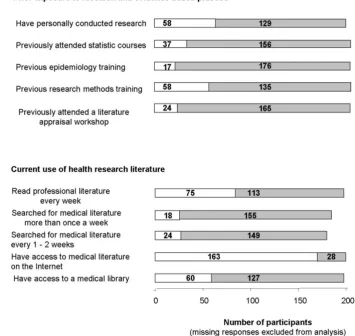
Figure 1 illustrates the respondents' background of expo-sure to research and EBP and current use of health research literature. It was found that the majority of the respondents had not attended a literature appraisal skills workshop (87.3%) or received formal training in research methods (69.9%), epidemiology (91.2%) or statistics (80.8%). However, 58 (31%) stated that they had actually been personally involved in conducting some research activity. Questions regarding the participants' access to medical literature and evidence showed that only 60 (32.1%) had access to a medical library. The majority of respondents stated that they did not search for medical lit-erature on a regular basis (86.1%), and only 75 (39.9%) respondents reported that they read every week regularly to keep up to date with their professional literature.
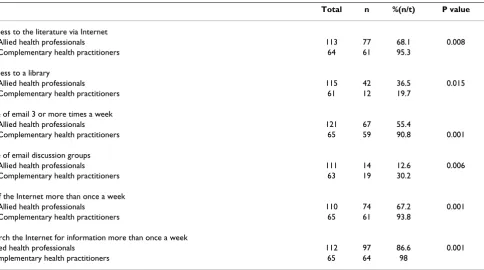
Table 1 illustrates computer usage by allied health profes-sionals and CAM practitioners. Far more CAM
[image:3.612.99.435.346.454.2]practition-Background of allied health care professionals and CAM practitioners' prior exposure to research and evidence-based practice and current use of health research literature
Figure 1
ers compared to allied health professionals accessed educational literature via the Internet (95.3% v 68.1%, p = 0.008), used email on a regular basis (90.8% v 55.4%, p = 0.001) and explored and searched the Internet for infor-mation more than once a week (93.8% v 67.2%, p = 0.001 and 98% v 86.6%, p = 0.001 respectively). However, both allied health professionals and CAM practitioners identi-fied that a vast majority of them did not have access to a library or used email discussion groups in their work.
Respondents generally indicated that the majority of them did not feel confident at assessing research study design, generalisability, evaluating bias, sample size and statisti-cal tests. Furthermore, 67.1% of practitioners felt that they had not had good or adequate training in EBM and 86.7%identified that they needed more training and edu-cation in the principles of EBM (Some confusion regard-ing the relationship between EBM and the process of clinical decision-making was found, with many practi-tioners feeling uncertain whether or not their own clinical judgement and patient choice should override the evi-dence. However, the majority of the practitioners agreed that they felt that EBM was essential to their practice (75.6%) and not a passing fashion (74.6%).
Respondents who reported that they had not previously attended a literature appraisal workshop stated that they felt that they needed more training in EBM compared to those that had (91.4% v 72.7%, p = 0.007), but felt that EBM has little impact on their clinical practice (26.4% v 50%, p = 0.33). The respondents who reported that they had not been involved in conducting any type of research also felt that they needed more training in EBM than those who had been involved in any research activity. However, the result was not statistically significant (91.2% v 84.5%, p = 0.09).
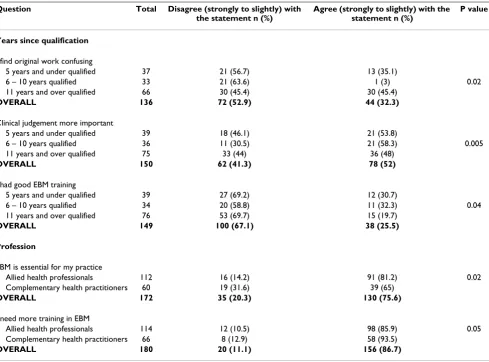
[image:4.612.71.555.99.369.2]Table 2 examines the effect of years since qualification on practitioners' beliefs relating to EBM. We used the thresh-old of 11 years and over as it is unlikely that CAM practi-tioners who have been qualified for over ten years would have received teaching in EBP as part of their initial train-ing. Practitioners with more than 11 years experience stated that they had not had good training previously in EBM (p = 0.04) and they felt that original research papers were confusing (p = 0.02) more often than their less expe-rienced counterparts. The more expeexpe-rienced practitioners also felt that clinical judgment was more important than EBM (p = 0.005) than those with shorter length of time since qualification. More allied health care professionals stated that EBM was essential for their clinical practice and Table 1: Background of allied health care professionals and complementary health practitioners concerning computer usage.
Total n %(n/t) P value
Access to the literature via Internet
Allied health professionals 113 77 68.1 0.008
Complementary health practitioners 64 61 95.3
Access to a library
Allied health professionals 115 42 36.5 0.015
Complementary health practitioners 61 12 19.7
Use of email 3 or more times a week
Allied health professionals 121 67 55.4
Complementary health practitioners 65 59 90.8 0.001
Use of email discussion groups
Allied health professionals 111 14 12.6 0.006
Complementary health practitioners 63 19 30.2
Surf the Internet more than once a week
Allied health professionals 110 74 67.2 0.001
Complementary health practitioners 65 61 93.8
Search the Internet for information more than once a week
Allied health professionals 112 97 86.6 0.001
Complementary health practitioners 65 64 98
Total = the total number of complete responses
n = the number of positive responses
also that they needed more training in EBM than CAM practitioners (p = 0.02 and p = 0.05 respectively).
Discussion and Conclusion
Our study identified several issues that require addressing in the provision of EBP training for allied health care pro-fessionals and CAM practitioners. Amongst allied and CAM practitioners the perceived need to obtain training in EBM was high and perception of competence was low. Comparatively, allied health care professionals and those with longer length of time since qualification fared worse than CAM practitioners and those with recent qualifica-tion respectively. Furthermore, learning needs varied according to the type of profession, time since graduation and prior research experience.
[image:5.612.63.552.109.471.2]To ensure the validity and generalisability of our findings, we selected questions from reliable and previously vali-dated questionnaires [18,19]. One of the strengths of our study is that we surveyed a large sample of both allied health care professionals and CAM practitioners from a variety of professions and with varying lengths of time since qualification. However, we did not employ a ran-dom sampling process and the sample was from partici-pants who voluntarily attended the courses. Therefore our sample was restricted to those individuals who may have been more aware and self-motivated than other practi-tioners. Furthermore, our respondents were all based within the West Midlands region and as such our findings may not entirely reflect the knowledge and beliefs of other allied health care professionals and CAM practitioners outside of the region. We, therefore, acknowledge that the generalisability of our findings may be limited but our Table 2: Effect of profession and years since qualification (<5 years, 6–10 years, 11 years and over) on allied health care professionals and complementary health practitioners' beliefs relating to Evidence-based Medicine (EBM)
Question Total Disagree (strongly to slightly) with
the statement n (%)
Agree (strongly to slightly) with the statement n (%)
P value
Years since qualification
I find original work confusing
5 years and under qualified 37 21 (56.7) 13 (35.1)
6 – 10 years qualified 33 21 (63.6) 1 (3) 0.02
11 years and over qualified 66 30 (45.4) 30 (45.4)
OVERALL 136 72 (52.9) 44 (32.3)
Clinical judgement more important
5 years and under qualified 39 18 (46.1) 21 (53.8)
6 – 10 years qualified 36 11 (30.5) 21 (58.3) 0.005
11 years and over qualified 75 33 (44) 36 (48)
OVERALL 150 62 (41.3) 78 (52)
I had good EBM training
5 years and under qualified 39 27 (69.2) 12 (30.7)
6 – 10 years qualified 34 20 (58.8) 11 (32.3) 0.04
11 years and over qualified 76 53 (69.7) 15 (19.7)
OVERALL 149 100 (67.1) 38 (25.5)
Profession
EBM is essential for my practice
Allied health professionals 112 16 (14.2) 91 (81.2) 0.02
Complementary health practitioners 60 19 (31.6) 39 (65)
OVERALL 172 35 (20.3) 130 (75.6)
I need more training in EBM
Allied health professionals 114 12 (10.5) 98 (85.9) 0.05
Complementary health practitioners 66 8 (12.9) 58 (93.5)
OVERALL 180 20 (11.1) 156 (86.7)
Total = total number of respondents with complete responses
n = number of responses
% = percentage of total with complete responses
study does provide a starting point for further research in these groups of practitioners. However, we feel that our findings do merit consideration by teachers and trainers in these health care fields and in particular those provid-ing continuprovid-ing professional development trainprovid-ing pro-grammes.
Our survey suggests that like previous studies [18,19,23] that found that medical doctors lack methodological competence in critical appraisal skills and EBM, CAM practitioners and allied health care professionals also need skills. Our survey also correlates with the findings of a previous study [19] where we examined medical doc-tors' knowledge and beliefs concerning EBM. We found that doctors within our deanery also reported that they did not feel confident at assessing study design, generalis-ability of the research or evaluating sample size and statis-tical tests. Furthermore, many junior doctors stated that they support the principles of EBM, but they are unde-cided regarding whether patient choice and their own clinical judgment are more important and should over-ride research evidence. The doctors were also in agreement with the allied health care professionals and CAM practi-tioners and confirmed that EBM was essential to their practice but they felt that they required further training in the subject. It is therefore, apparent that both groups have identified that EBP training is important and has not pre-viously met their needs.
Our survey findings are exploratory and will benefit from further replication, but it does provide information for allied health care professionals' and CAM practitioners' teachers and trainers. In particular, our findings should be taken into consideration when planning EBP curricula as it is important to tailor teaching to the needs of specific subgroups of trainees to ensure that specific learning needs are met.
Competing interests
The authors declare that they have no competing interests.
Authors' contributions
JH contributed to the questionnaire design, co-ordination and collection of the data and drafted the manuscript. IH performed the statistical analysis and helped to draft the manuscript. KSK conceived the study, and participated in its design and contributed to the write up of the script. All authors read and approved the final manu-script.
Additional material
Acknowledgements
The courses were funded from a grant received from the Learning and Skills Council and European Social Fund (European Union Grant
LSE31068WM2).
We would like to thank Dr James Davis, Dr Arri Coomarasamy and Miss Denise Hardy for all of their help and assistance in this project.
References
1. Dawes M, Summerskill W, Glasziou P, Cartabellotta A, Martin J, Hopayian K, Porzsolt F, Burls A, Osborne J: Sicily statement on evidence-based practice. BMC Medical Education 2005, 5:1. 2. The Foundation Programme Committee: Curriculum for the
foundation years in postgraduate education and training. Department of Health; 2005.
3. General Dental Council: Standards for Dental Professionals. 2005 [http://www.bda.org].
4. Health Professionals Council: Standards of proficiency: Arts therapists. [http://www.hpc-uk.org].
5. Health Professionals Council: Standards of proficiency: Dieti-tians. 2003 [http://www.hpc-uk.org].
6. Health Professionals Council: Standards of proficiency: Radiog-raphers. 2003 [http://www.hpc-uk.org].
7. Health Professionals Council: Standards of proficiency: Speech and language therapists. 2003 [http://www.hpc-uk.org]. 8. Health Professionals Council: Standards of proficiency:
Chiropo-dists/Podiatrists. 2005 [http://www.hpc-uk.org].
9. Health Professionals Council: Standards of proficiency: Physio-therapists. 2005 [http://www.hpc-uk.org].
10. Nursing and Midwifery Council: The NMC code of professional conduct: standards for conduct, performance and ethics. 2004 [http://www.nmc-uk.org].
11. General Osteopathic Council: Standard 2000: Standard of profi-ciency. 1999 [http://www.osteopathy.org.uk].
12. The Aromatherapy Council: National Occupational Standards for Aromatherapy. 2006 [http://www.aromatherapycouncil.co.uk/ ].
13. General Chiropractic Council: Code of Conduct and Standard of Proficiency. 2005 [http://www.gcc-uk.org].
14. House of Lords: Science and Technology - sixth report: Com-plementary and Alternative Medicine. 2000 [http://www.parlia ment.the-stationery-office.co.uk].
15. Hadley J, Davis J, Khan KS: Teaching and learning evidence-based medicine in complementary, allied and alternative health care: An integrated tailor-made course. Journal of Alter-native and Complementary Medicine 2007 in press.
16. Harden RM: Ten questions to ask when planning a course or curriculum. Med Educ 1986, 20:356-365.
17. Morrison J: ABC of learning and teaching in medicine: Evalua-tion. BMJ 2003, 326:385-387.
18. Awonuga AO, Dwarakanath LS, Khan KS, Taylor R: Post-graduate obstetrics & gynaecology trainees' views and understanding of Evidence-based Medicine. Medical Teacher 2000:27-29. 19. Hadley J, Wall D, Khan KS: Learning needs analysis to guide
teaching evidence-based medicine: knowledge and beliefs
Additional file 1
Copy of developed questionnaire. A copy of the developed questionnaire used to measure allied health care professionals and CAM practitioners' basic knowledge, skills and beliefs concerning the main principles of EBP.
Click here for file
Publish with BioMed Central and every scientist can read your work free of charge "BioMed Central will be the most significant development for disseminating the results of biomedical researc h in our lifetime."
Sir Paul Nurse, Cancer Research UK
Your research papers will be:
available free of charge to the entire biomedical community
peer reviewed and published immediately upon acceptance
cited in PubMed and archived on PubMed Central
yours — you keep the copyright
Submit your manuscript here:
http://www.biomedcentral.com/info/publishing_adv.asp
BioMedcentral
amongst trainees from various specialities. BMC Med Educ
2007, 7:11.
20. Taylor R, Reeves B, Mears R, Keast J, Binns S, Ewings P, Khan KS: Development and validation of a questionnaire to evaluate the effectiveness of evidence-based practice teaching. Medi-cal Education 2001, 35:544-547.
21. Fritsche L, Greenhalgh T, Falck-Ytter Y, Neumayer HH, Kunz R: Do short courses in evidence based medicine improve knowl-edge and skills? Validation of Berlin questionnaire and before and after study of courses in evidence based medicine. BMJ
2002, 325:1338-1341.
22. Clason DL, Dormondy TJ: Analyzing data measured by individ-ual likert-type items. Journal of Agricultural Education 1994, 35:31-35.
23. Olatunbosun OA, Edouard L, Pierson RA: Physicians' attitudes toward evidence based obstetric practice: a questionnaire survey. BMJ 1998, 316:365-366.
Pre-publication history
The pre-publication history for this paper can be accessed here: