ScholarWorks @ Georgia State University
ScholarWorks @ Georgia State University
Art and Design Theses Ernest G. Welch School of Art and Design
3-15-2010
In a Strange Place
In a Strange Place
Benjamin Goldman
Georgia State University
Follow this and additional works at: https://scholarworks.gsu.edu/art_design_theses
Part of the Art and Design Commons
Recommended Citation Recommended Citation
Goldman, Benjamin, "In a Strange Place." Thesis, Georgia State University, 2010. https://scholarworks.gsu.edu/art_design_theses/61
IN A STRANGE PLACE
by
BENJAMIN M. GOLDMAN
Under the Direction of Pam Longobardi
ABSTRACT
My work is about stress and strain in our modern times. I am using self portraiture as a way to discuss the world around me and hope that the viewer will relate to my experiences. Drawing, painting and video are used to convey different aspects of my observations, and old techniques are mixed with new technologies. Personal observations, artistic and scientific influences, and the art-making process have shaped this body of work.
IN A STRANGE PLACE
by
BENJAMIN M. GOLDMAN
A Thesis Submitted in Partial Fulfillment of the Requirements for the Degree of
Master of Fine Arts
in the College of Arts and Sciences
Georgia State University
Copyright by Benjamin M. Goldman
IN A STRANGE PLACE
by
BENJAMIN M. GOLDMAN
Committee Chair: Pam Longobardi
Committee: Teresa Bramlette Reeves
Joe Peragine
Electronic Version Approved:
Office of Graduate Studies
College of Arts and Sciences
Georgia State University
DEDICATION
To my Mother, Brenda Goldman, who helped me through the trials of daily life as I worked on this MFA.
To my brother, Tim Goldman, whose assistance and support was always an important part of this
ACKNOWLEDGEMENTS
I would like to thank my committee, Pam Longobardi, Teresa Bramlette Reeves and Joe Peragine for the
TABLE OF CONTENTS
ACKNOWLEDGEMENTS ... v
LIST OF FIGURES ... vii
1 INTRODUCTION ... 1
2 PERSONAL OBSERVATIONS ... 1
3 ARTISTIC INFLUENCES ... 3
4 THE ART-MAKING PROCESS ... 7
5 CONCLUSIONS ... 9
END NOTES ... 11
FIGURES ... 12
LIST OF FIGURES
1 Peter Paul Rubens, Fall of the Rebel Angels 12
2 Peter Paul Rubens, The Abduction of the Daughters of Leucippus by Castor and Pollux 13
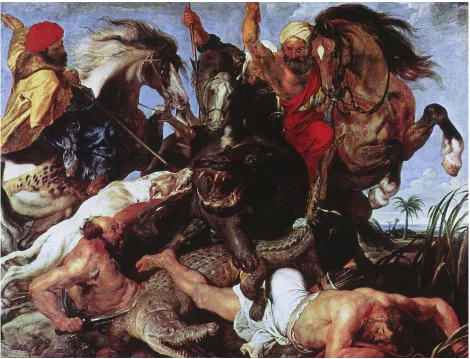
3 Peter Paul Rubens, Hippopotamus and Crocodile Hunt 14
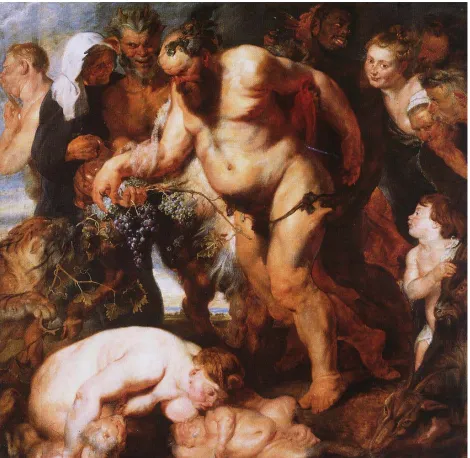
4 Peter Paul Rubens, The Drunken Silenus 15
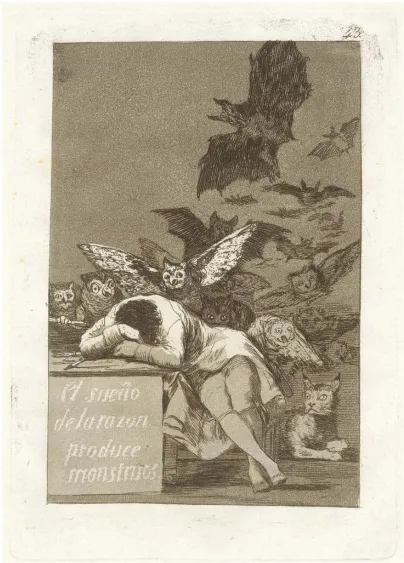
5 Francisco Goya, Sleep of Reason Produces Monsters 16
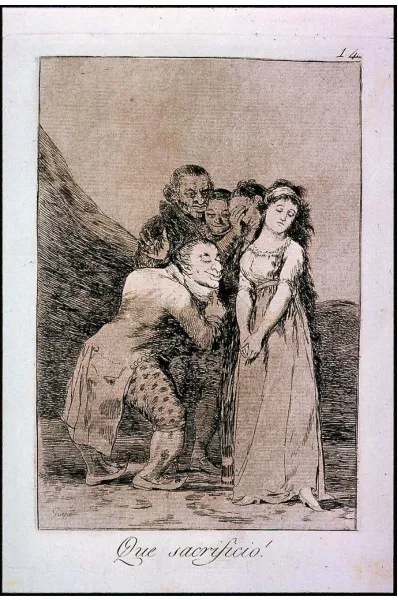
6 Francisco Goya, What A Sacrifice! 17
7 Francisco Goya, Nothing could be done... 18
8 Francisco Goya, The Same 19
1 INTRODUCTION
My work is about stress and strain in our modern times. The experiences of my life
in-form my art. Modern America is full of experiences that can create a very stressful world.
Work, bills, relationships, politics, a turbulent economy, war, and crime are just a few of the
daily stressors Americans contend with. Stress can cause many problems, from psychological to
physical health issues. Through direct observation I learn about how stress effects the Human
Animal. I watch myself and my reactions as much as I observe other people. Stress in my life
motivates me, drives me to work hard and perform at my best. It also weighs upon me, slows
me and drags me into dark moods. I am not alone in these behaviors and I seek to connect and
communicate with others about these modern stressors through my art. I use self portraits as a
way to show my experiences dealing with stress and hope that the viewer will relate the work
to their own lives. Drawing, painting and video are used to convey different aspects of my
ob-servations, and old techniques are mixed with new technologies. Personal obob-servations, artistic
influences, and the art-making process have shaped this body of work.
2 PERSONAL OBSERVATIONS
Stress causes Humans to act out in various ways, some good and some bad. My life
changed when my Father had heart surgery. In the hospital my Father suffered two strokes
that permanently damaged his brain. I spent the next ten years working and helping my
Mother take care of my Father until he died in the hospital in 2004. Since then I have struggled
with bills and debt, as well as the emotional response to the loss. These stressors have driven
every day I hear stories from people who are under a tremendous amount of stress. They
suffer negative physical responses such as sickness, depression, and premature aging. There
are many definitions of stress. Stephan Palmer of the Center of Stress Management in London
defines stress as, "the psychological, physiological and behavioral response by an individual
when they perceive a lack of equilibrium between the demands placed upon them and their
ability to meet those demands." Stress can come in physical and emotional forms. In the pop
culture "stress" has come to refer to any undesired or unpleasant event or aspect of a person's
life.
I am the son of a scientist, and was raised to observe and study things around me. My
Father studied animals and the environment. My Mother has a degree in Journalism, another
field that makes observations and then creates commentary. I was taught to observe life and
respond in writing and art. I grew up in university towns surrounded by scientists. My Father
taught and worked on insect studies at Yale University. He would show me the labs full of
re-search equipment and animals. I spent hours in the Peabody Museum at Yale University where
I would stare at the giant murals byThe Age of Reptiles is a 110' long by 16'
high mural painted in the dry fresco technique. This is one of my first exposures to art, and it is
one that still influences me. Giant dinosaurs are represented in their environment, behaving in
the way scientists of the 1950's theorized they would act. My work often is about depicting
animals in modern environments and how they behave. When my Father's job shifted to the
study of bats and sonar, I was exposed to animal behavioral studies. The lab where my Father
worked had many animal studies and I saw rooms of bats, owls, and insects. My exposure to
3 ARTISTIC INFLUENCES
I often look to see how previous artists conveyed man's struggles in life. Peter Paul
Rubens and Francisco Goya are two examples of classical masters that influence my work.
Rubens was a 17th century Flemish Baroque painter who filled his canvas with fleshy figures
and motion. Many of his paintings are allegorical and full of symbols. I try and use symbols and
allegory whenever possible because it is a way to add extra meaning to a simple work. Rubens
often paints fat, fleshy nudes. I use that imagery of fat people to discuss our modern obsession
with consumerism and consumption, two things that I feel contribute to the stress levels in our
society. Being overweight is a stressor that I, a slothful artist, must contend with. Rubens often
depicts fat people engaged in a struggle or a combat. The scenes are full of twisting figures and
motion, such as can be found in Fall of the Rebel Angels (Figure 1)and Castor and Pollux Abduct
the Daughters of Leukyppos (Figure 2). This depiction of conflict is a symbol I am trying to
in-corporate into my work as a way to show Americans everyday struggle through life. In some of
his paintings Rubens also depicts man engaged in combat with animals, such as Hippopotamus
and Crocodile Hunt (Figure 3). The use of animals as symbols is of great interest to me and I
often incorporate them in my art. Rubens also painted some excellent fat drunken people, such
as: The Drunken Silenus (Figure 4). The drunken fat figure is to me a symbol of modern man
and his overindulgences. I relate to the stumbling drunk in the paintings and feel that it
represents my stumbling through life. As I create more self portraits, I am looking at these
Francisco Goya created two series of prints, Los Caprichos and The Disasters of War . I
am influenced by these works and how Goya offers social commentary, often with satire. Los
Caprichos was published in 1799, and The Disasters of War was not published until 1863, long
after Goya's death. Goya created Los Caprichos to comment on the follies of his time.1 The
world he lived in was full of ignorance, corruption, crime and death. In this series of aquatint
etchings, Goya uses fantastical imagery to criticize the church and state. Sleep of Reason
Produces Monsters (Figure 5) is a self portrait of Goya, asleep at his desk. Behind him is an
attacking swarm of owls and bats. Owls are a symbol of stupidity, and bats are a symbol of the
devil.2 Goya is commenting on the lack of education in his country which during the time of the
Enlightenment caused great problems.3 He also uses the device of distortion to convey
mean-ing. Humans may be deformed with misshapen heads, looking like monsters. Goya used the
deformation of people as a metaphor to talk about their behavior in modern times,4 the
defor-mities reflect their inner nature. Physiognomy is the study of a person's outward appearances
to determine their inner nature. This was a popular belief in Goya's time. Examples of this kind
of distortion can be seen throughout Los Caprichos. What a sacrifice! (Figure 6) shows a rich
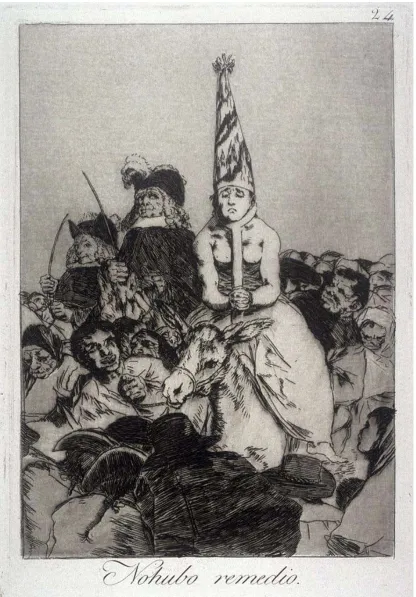
man as a hunchbacked monster.5 Nothing could be done... (Figure 7) shows a young woman
being punished by the Inquisition6. She rides on the back of a donkey but she is depicted as a
normal human. It is the crowd around her that Goya shows as ugly and grotesque, as a way to
discuss their inner ugly nature.7
Along with his use of distortion and fantasy scenes, Goya also provides realistic
depic-tions based on his observadepic-tions of life. The Disasters of War has many images that Goya
mass starvation that occurred in cities around Spain. Goya uses negative space as a way to
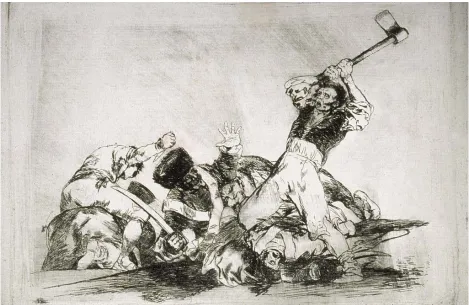
fo-cus the viewers attention on the events depicted in the prints. This can be seen in The Same
(Figure 8) , which shows figures engaged in combat in a white space. No effort was made to
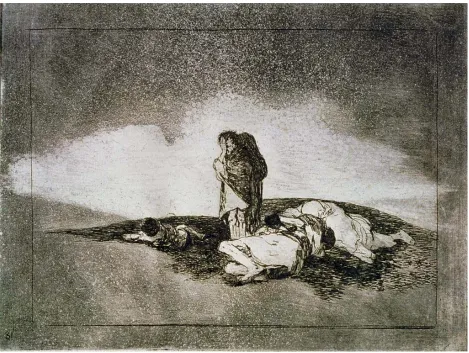
show the background as it was not necessary to convey the horrors of war. An excellent
exam-ple is the plate, titled There is no one to help them (Figure 9). It shows one figure with head in
hand, surrounded by corpses in an barren landscape. This minimal scene conveys a sense of
isolation and hopelessness. I am trying to use this simple compositional approach in my
draw-ings and paintdraw-ings to help convey the feeldraw-ings associated with many stressful situations. By
iso-lating myself in the image I can convey how I am feeling through simple actions and colors.
Another artist that uses distortion and simple compositions is Francis Bacon. Like Goya,
he shows the darker aspects of human nature through the distortion of the face and body. His
figures often scream, with teeth exposed, against simple colored backgrounds. The focus is on
the figures and their raw state of emotion. Bacon stated that he is painting the reality of the
moment.8 He paints the flesh in twisted, shifting forms that seem to be in motion. I relate to
the emotional energy he depicts. I often have figures in mid scream as they exhibit their raw
inner animal emotions. I am trying to inject that feeling into my self-portraiture. Study for a
portrait (Man in a blue box) conveys a sense of anxiety, stress and isolation that seems relevant
to my work. Self-portrait painted in 1971 shows Bacon's face, twisted and churning in a field of
black. The distortion of form depicted by Bacon is similar in feeling to the way I show myself
coming apart. There is a sense of trying to capture a shifting state in time, while trying to relate
how the subject is feeling at that moment. Study for a self-portrait Triptych painted in
chang-ing in each panel. This sequence of images is related to the photographs by Muybridge, which
Bacon often used as references.9 I also show changes through sequential drawings and
paint-ings.
Bill Plympton is an animator whose work I have been studying. Like Bacon, he also
dis-torts the figure, but in his case he is doing so for humor. Plympton creates strange animations
that are often in very minimal settings, which creates a strong sense of focus on the characters.
This was a necessity since he often hand animated his earlier works. He hand animated his
en-tire first full length feature film The Tune, which consists of over 30,000 animation cells.10
Another trick he uses to speed up the process of animating entire films is to only create only 3
to 4 frames per second rather than the standard 24 frames a second.11 This creates a strange
choppiness in his work, but it is enough to convey motion. I utilize both of these techniques
when creating my simple animations.
Bill Viola is a contemporary artist who makes simple and beautiful videos that often deal
with life, death and time. His videos are simple scenes that often are often shown in very slow
motion. The distortion of time creates a mystical quality and it allows the viewer to focus on
the work. He also often uses simple, saturated colors to convey feelings. In his work Five Angels
for the Millennium, Viola shows figures plunging into water in slow motion. The piece is
pro-jected onto five screens and each screen depicts one figure as they sink or rise in the water. The
piece is discussing life and death and rebirth. Through the imagery of water, bubbles, color and
reflection, Viola creates an ethereal experience. In Ocean Without a Shore, Viola uses three
The figures initially appear in a dark background, filmed in black and white grainy video. They
slowly walk towards the viewer and pass through a wall of glass-like water and emerge as high
definition color figures. This simple use of the black and white figures transforming into high
definition color is Viola's way of showing spirits returning to the world of the living. Viola's work
costs a great deal to create and display. The expenses of the materials he works with prohibit
me from utilizing some of his techniques, such as large immersive video screens, high definition
digital cameras and special effects. I am conscious of how his work looks and feels as I create
my own video work, but my process is very simple and inexpensive.
4 THE ART-MAKING PROCESS
My process for creating art effects the end results as much as the concepts for the work.
My observations of stress in modern times begin as quick sketches of ideas. Often I will then
photograph myself in poses that will work with the idea of the piece. I will either draw free
hand using the photo as reference, or I may actually transfer the main lines of the scene to
cap-ture a more realistic feel to the image. Depending on the feeling I am trying to convey I may ink
the figure and then add color. The inks and watercolors run and blend in unexpected ways. The
fluidity of the medium changes the feeling and may transform an initial idea into a piece of art
that represents something different. I realized that the reference photos were often as
interest-ing as the drawinterest-ings. I wanted to take the photo and add to it the element of the unexpected
results that came with the water-based medium. The reference photos are altered in
Photo-shop in various ways. Working with printed images that have less detail allows more room for
colors and planes, and then draw details back on top of the image. Some of the altered photos
are printed onto watercolor paper which allows me to distress the inkjet prints with water. The
wet inkjet ink blooms and runs in random patterns which I enhance with watercolors and inks.
The end result is an image that strives to convey a sense of coping with a stressful situation.
The use of controlled chaos adds a slight element of randomness that feels appropriate to the
subject matter.
I create my videos with animation or by rotoscoping my footage. Rotoscoping involves
tracing and painting over each frame in a movie to create a new effect. I shoot the videos with
small and inexpensive video cameras. These pocket sized cameras are easy to carry with me on
my daily routine. This allows me to concentrate more on what I am shooting, rather than get
bogged down in the technical aspects of more complex camera systems. My one button video
camera allows me to shoot video, watch it and then quickly reshoot material as needed. It is
small enough to be used with one hand, which has allowed me to film driving scenes, that
would otherwise require mounting systems. There are draw backs to these video cameras, such
as their limitation to the one small fixed lens that is built into the camera body. The sound
re-cording from these cameras is also very limited. However since sound is not an important part
of these videos at this time, this is not a problem. My ideas for videos have been altered to fit
the limitations of the cameras. I have to work close to the subjects since I have no options for a
telephoto lens, but this helps create a more personal space. I feel the tighter cropped shots also
my help convey a sense of stress. The video is transferred to the computer where I alter the
images and crop and edit the desired parts. Due to my lack of knowledge of video editing
pro-gram is often associated with digital painting, graphic design and manipulation of photographic
imagery. The new Photoshop allows importing of video. Every frame of the video is shown and
can be manipulated. This gives me the ability to slowly rotoscope the video. To do this I am
using a mix of common filters on the videos to create different moods. Some of the filters turn
the imagery into colored line work, that changes in every frame. I find it beautiful, strange and
sometimes visual confusing. This is appropriate to the way life flows around me as I travel
around the Atlanta metropolitan area. The filters also create a line drawing look, which ties in
with the drawings and paintings I make. The videos are movement and light, which
comple-ment the static nature of the other work. The video and animation process can be very time
consuming, which is frustrating when trying to convey different emotions each day, so I am
constantly trying to find ways to speed up the process. This is why I started to copy Bill
Plympton's technique of low frame rate animation.
5 CONCLUSIONS
This body of work about stress and modern life is evolving from my interests, influences
and daily art practice. I am using self portraiture as a way to discuss the world around me and
hope that the viewer will relate to my experiences. The shifting, swirling moments of the day
flow through colors around my figure in the paintings to show the passing of time. The
sensa-tion of being overwhelmed by the stress is conveyed by having my figure fade into the
back-ground. The animations show a world of colors and lines that pulse and vibrate with each new
frame. I am immersed in these confusing and beautiful environments. The animation also
more integral aspect of my art making. Utilizing a wide variety of tools to create my art allow
me to better convey my ideas. My art is about our society as well as being about our animal
END NOTES
1. Nancy Eickel. Washington D.C. :
The Trust For Museum Exhibitions, 1992),12.
2. http://www.worldandi.com/newhome/public/2004/february/bkpub1.asp
3. Nancy Eickel.Washington D.C. :
The Trust For Museum Exhibitions, 1992),12.
4. Sarah Symmons. Goya. (London, England:
5. Nancy Eickel. Washington D.C. :
The Trust For Museum Exhibitions, 1992),19.
6. Nancy Eickel. Washington D.C. :
The Trust For Museum Exhibitions, 1992),24.
7. Nancy Eickel. Washington D.C. :
The Trust For Museum Exhibitions, 1992),24.
8. The South Bank Show: "Francis Bacon", Interviewed by Melvyn Bragg, June 1985, YouTube, http://www.youtube.com/watch?v=QhaqwlZxJZI
9. The South Bank Show: "Francis Bacon", Interviewed by Melvyn Bragg, June 1985, YouTube, http://www.youtube.com/watch?v=QhaqwlZxJZI
10. Bill Plympton Studio. http://www.plymptoons.com/biography/bio.html
FIGURES
Figure 2: Peter Paul Rubens, The Abduction of the Daughters of Leucippus by Castor and Pollux, 1617 Source: ArtStor
REFERENCES
Belkin, Kristin Lohse . Rubens. London, England:
Bill Plympton Studio. http://www.plymptoons.com
, "Animator Bill Plympton on Independent Movies", http://hollywood-animated-films.suite101.com/article.cfm/animator_bill_plympton_on_independent_movies
Eickel, NancyWashington D.C. : The
Trust For Museum Exhibitions, 1992.
Symmons, Sarah. Goya.London, England:
Townsend, Chris. The Art of Bill Viola. London, England: Thames and Hudson, 2004
The South Bank Show: "Francis Bacon", Interviewed by Melvyn Bragg, June 1985, YouTube, http://www.youtube.com/watch?v=QhaqwlZxJZI