University of East London Institutional Repository:
http://roar.uel.ac.uk
This paper is made available online in accordance with publisher policies. Please
scroll down to view the document itself. Please refer to the repository record for this
item and our policy information available from the repository home page for further
information.
To see the final version of this paper please visit the publisher’s website.
Access to the published version may require a subscription.
Author(s):
Scandariato, Riccardo; Ofek, Yoram; Falcarin, Paolo; Baldi, Mario.
Article title:
Application-oriented trust in distributed computing
Year of publication:
2008
Citation:
Scandariato, R. (2008) ‘Application-oriented trust in distributed computing
,
’
IEEE, International Conference on Availability, Reliability and Security
(ARES 2008),
Barcelona (Spain) March 2008
.
pp. 434-439.
Application-oriented trust in distributed computing
Riccardo Scandariato
Katholieke Universiteit Leuven
Belgium
[email protected]
Yoram Ofek
Universit`a di Trento
Italy
[email protected]
Paolo Falcarin, Mario Baldi
Politecnico di Torino
Italy
[email protected]
Abstract
Preserving integrity of applications being executed in re-mote machines is an open problem. Integrity requires that application code is not tampered with, prior to or dur-ing execution, by a rogue user or a malicious software agent. This paper presents a methodology to enforce run-time integrity of application code by means of an integrity-preserving software component that is combined with the application. The software component is a trusted logic that can be replaced continuously from a remote location dur-ing run-time. For added assurance, the software component produces continuous sequence of proofs of its proper oper-ation that are verified remotely.
1. Introduction
Consequently to the convergence of networking and computing, software integrity is becoming a growing prob-lem. More and more often, applications are built out of several distributed components, possibly from different ad-ministrative domains, which collaborate through the net-work (e.g., web services). As a result, various trustworthi-ness issues emerge because of intentional misbehavior. Fur-thermore, machines connected to the Internet are exposed to malware (viruses and worms) and cannot be considered trustworthy, notwithstanding the owner is properly behav-ing. Therefore, from a server perspective, there is high risk in accepting service requests from either 3rd-party business components or end clients. First, the server can be attacked by its clients through legitimate, i.e., unfiltered communi-cation channels. Second, the service can be exploited as a vector to infect other parties. The recent proliferation of bots and viruses spreading through popular instant messen-gers is a clear testimony.
The general approach we propose is called remote en-trusting and uses trusted entities in the network (e.g., servers) in order to entrust selected software elements (e.g., applications) in otherwise untrusted machines across the
network, assuring their run-time functionality. Note that, in this paper, the notion of trustworthiness is related to in-tegrity of code, whereas data protection is out of scope.
Detection of run-time software changes (e.g., to circum-vent the license, or because of virus infestation) across the network is hard, since the entrusting entity cannot directly observe the software executing on the remote end. In order to solve the problem, the entrusting entity should receive some “proofs” that guarantee the run-time integrity of the software. The proofs are represented by tags that are em-anated from selected parts of the application on the remote environment, and they provide the identity of the running software. Thereby, they enable the entrusting entity (server) to entrust the software running on the opposite end (appli-cation). More specifically, this work addresses two research challenges: (1) how to enhance applications by binding a proofs-generating module that continuously emanates se-cure proofs, and (2) how to periodically replace the module during run-time in order to cap the time at hand for both tampering attempts and tag forgeries.
Another related challenge, which is part of remote en-trusting but outside the scope of this paper, is that reverse engineering of the proofs-generating module shall be hard to perform [2]. Further, proposing a code integrity check-ing scheme is not a goal for this paper. A simple scheme is used in our prototype. However more advanced code check-ers can be adopted from the extensive state of the art (e.g., [1]).
The paper is organized as follows. Section 2 introduces the principles of operation of the proposed methodology. Section 3 presents the prototype implementation, whose performance is experimentally assessed in Section 4. Fi-nally, Section 5 compares the remote entrusting to related work, while Section 6 presents the concluding remarks.
2. Remote entrusting
The solution to remote entrusting that we propose in this paper in intended for use in a setting where there is an ex-change of data from the to-be-trusted entity and the entrust-The Third International Conference on Availability, Reliability and Security
ing side. That is, there is a data flow going the opposite direction of the trust relationship. Instant Messaging (IM) services are a typical example of such architecture. For in-stance, the server can be interested in banning communica-tions coming from bot-infected clients, in order to block the spreading of malware via its channels. Furthermore, the ser-vice provider could be interested in forcing the adoption of a specific client because it may incorporate usage policies (e.g., limiting the message rate) to contain malign behavior, like spamming. In this respect, the IM server represents the entrusting side, which receives and relays messages from clients (the to-be-trusted entities). The above-mentioned scenario is used hereafter to illustrate the remote entrust-ing method in practical and more comprehensible terms. In the rest of the paper, some terms are be used according to a specific meaning: trustmeans reliance on integrity of code of an entity, e.g., an application,trustworthinessmeans de-serving trust, and entrustingis the act of according trust-worthiness.
The proposed solution is designed around some funda-mental principles:
1. Root of trust at remote location – The basic working assumption when dealing with trustworthiness is that some elements in the system are implicitly entrusted and the whole infrastructure founds on them. In this work, the root of trust is placed in a remote site across the network.
2. Continuous replacement – The root of trust deploys a software beach-head on the untrusted host that is responsible for preserving the integrity of the to-be-entrusted application. The beach-head can be replaced at any time by the root of trust.
3. Trustworthiness during run-time – This work intro-duces a protocol providing application-oriented trust-worthiness that is refreshed during run-time. This introduces an on-line and proactive method to avoid trustworthiness violations and application damage.
Trustworthiness establishment protocol. Proofs are pro-duced by the trusted replaceable beach-head on the client side and they are comprised of tags attached to data ex-changed from client to server. Each tag contains the out-come of a cryptographic algorithm tying together the ex-changed data and some secret information, which is hidden in the beach-head itself. For instance, the secret informa-tion could be a symmetric encrypinforma-tion key, shared between the beach-head and the root of trust. As long as the appli-cation under surveillance is in proper shape, the beach-head keeps producing tags correctly. Upon reception of a tagged message, the root of trust validates the tags and hence certi-fies the trustworthiness of of the application.
Note that the methodology that is presented here can be extended to other important application domains. For in-stance, remote entrusting could be used in Digital Right Management to enforce intellectual property rights. That is, the root of trust could be configured to act as a license man-ager. As a bonus, the license manager would also be able to prevent software corruption by malicious agents. Further-more, the client-server scenario could be applied the way around, i.e., to entrust on-line services from the client per-spective. For instance, a home-banking client could be very interested in verifying integrity of the server application it is connecting to, e.g., in order to avoid connection to a server that has been subverted or even spoofed.
Replacement. Protecting the trustworthiness of replace-able beach-head, both in terms of performed functionality and secrecy of information contained within, is key. In this respect, obfuscation have been proposed in the past to hin-der adversaries, but motivated and skilled individuals could eventually succeed in tampering with the application code. Our objective is to make it intractable, within a well-defined period of time, for a malicious agent to modify selected components of application without being detected by the root of trust. To this aim the client application is supple-mented with a software beach-head that both controls the application integrity and generates tags. The beach-head can be replaced by the root of trust at any time during the ap-plication run-time. The replacement beach-heads can con-tain new secret information (e.g., a fresh key), new integrity checking strategies, new algorithms for tag generation, and so on. The interval between two subsequent replacements is the time window that is left to the adversary to break the integrity of the software beach-head and, hence, of the ap-plication itself.
Replacement offers an additional degree of freedom to play with in protecting the application. The complexity of reverse-engineering the combined unit formed by the client application and the replaceable beach-head can be directly translated to the time an adversary needs in or-der to break it (trustworthiness window). As far as the beach-head is replaced at a pace that is faster than the in-verse of the trustworthiness window, the combined unit can be safely considered not tampered. Clearly, understand-ing the precise reverse-engineerunderstand-ing complexity of tamper-resistant software,e.g., software employing obfuscation [2] and white-box cryptography [6], is not a trivial job and the research field is still open to further study. Nonetheless, it is also possible to trade off between the complexity and the replacement rate. Hence, in case of sufficiently high replacement rate, the adoption of above-mentioned tech-niques could be taken down to the very minimum, if not avoided at all. This is good result if we take into consider-ation performance degradconsider-ation due to anti-tampering tech-niques.
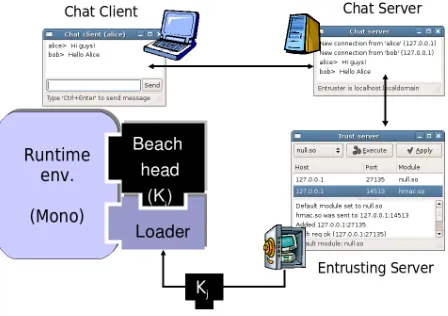
Figure 1: Prototype architecture
The performance overhead introduced by the replace-ment (and hence the limits to the replacereplace-ment rates) is in-vestigated in the next section.
3. Prototype
To show the feasibility of the proposed approach, we implemented the remote entrusting method for a chat-like messaging application. The prototype is written in C# pro-gramming language and runs on the Mono run-time. Figure 1 depicts the prototype architecture.
Chat client. The chat client is a C# object-oriented appli-cation representing the to-be-entrusted software. All meth-ods of all application classes are seamlessly intercepted by the entrusting infrastructure (loader and beach-head) as ex-plained hereafter.
Loader. The loader is a small user-space software com-ponent permanently installed in client environment. The loader functionality is very limited, and it needs not to be trustworthy. When the chat client is started, the loader is plugged in Mono run-time. Then, the loader executes the following communication protocol, also depicted in Figure 2a:
• The loader contacts the entrusting server, registers, and downloads the first integrity-preserving beach-head.
• The beach-head is plugged into the run-time, to be in-voked on each method execution.
• The loader opens a server socket and waits for replace-ment commands from entrusting server.
• The application is actually started.
• At any time, the loader can receive a new beach-head from entrusting server by means of a replacement com-mand. Of course, a new beach-head must be accepted only from an authenticated entrusting server, e.g., by means of an authenticated communication channel, or through signed beach-heads.
Beach-head.The replaceable beach-head shares a symmet-ric key with the entrusting server, and each beach-head in-stance has a different key. The beach-head is invoked by the Mono run-time before any application method is executed. The beach-head analyzes the code that the Mono run-time is going to interpret to execute the method. Hence, the in-tegrity of code is constantly check-pointed all over the ap-plication run-time. The beach-head calculates a keyed hash of the code and compares the computed checksum with the value that was pre-computed at the server side for a program copy that is known to be genuine. The pre-computed value is embedded in the beach-head itself. If the hash does not match the genuine copy, the key is randomly altered, so that valid tags will no longer be produced in the future.
Run-time. The Mono interpreter does not have a built-in functionality to intercept the methods conveniently. Hence, we extended the Mono code-base to serve our purposes. The changes are limited to about 300 LOC.
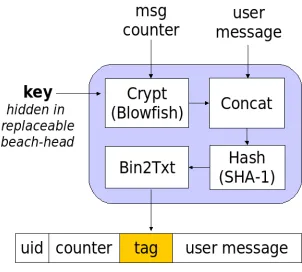
Tag generation.When the client sends a message, the cor-responding method call is intercepted to attach the tag, as depicted in the boxed part of Figure 2a. If at any time in the past the beach-head failed at authenticating the code of some method, the encryption key used to generate tags has been irrevocably invalidated and valid tags cannot be gen-erated. Supposing that all previous checks were successful, a valid tag is generated by the beach-head according to the algorithm of Figure 3. Note that tagged messages are se-quenced for two reasons. First, since the message counter is included in the message, loose synchronization is requested between the beach-head and the entrusting server. Second, this allows the entrusting server to defend against replay at-tacks.
Chat server. The chat server is a graphical application implementing the single chat-room logic. The server re-lays messages received by registered users to all connected clients. As shown in the bottom part of Figure 2b, before a message is accepted it is forwarded to the entrusting server in order to verify the validity of the attached tag.
(a) Initialization and check-summing (b) Tag generation and validation
Figure 2: Sequence diagram
Figure 3: Tag generation schema
server will be alerted and the message ignored. Addition-ally, at any time, the entrusting server can replace the cur-rent beach-head in a client by issuing a command.
4. Performance Analysis
Performance analysis was extensively carried out for our C# prototype. Tests were performed on a machine with a Pentium IV processor, clock speed of 3.2 GHz, 2048 KB cache, and 1 GB of RAM. The machine was running Linux, kernel version 2.6.12-10. We used the Mono run-time ver-sion 1.1.15 (patched). Measures where obtained by means of the application profiler included in the Mono run-time.
The application was configured so that the server, the client, and the entrusting server resided on the same test machine. All communication took place locally, in order to purge the (variable) influence of transmission delays from
collected data. During each test the chat client was started, it connected to the server, sending its nickname in order to register with the chat room, and, after the GUI had finished initializing, the client was terminated automatically. Each experiment was repeated 10 times.
We run four different experiments to test the client side: (1) measure of start-up overhead, which indirectly sizes the overall overhead due to entrusting infrastructure, (2) sure of methods checksum computation overhead, (3) mea-sure of combined overhead due to both checksum compu-tation and tag generation, and (4) measure of disruption of service during replacements.
Start-up overhead. This experiment is aimed at measur-ing the overhead due to the entrustmeasur-ing infrastructure on the start-up time of the client. First, we run 10 tests without installing any loader on the client (base line). Then, we re-peated the experiment with the presence of the entrusting infrastructure. In this case, the beach-head intercepts the method calls but do not execute any integrity check (null beach-head). Of course, in this second case there is an overhead due to the following causes: (1) during startup the initial beach-head must be downloaded, initialized, and installed by the loader, and (2) the beach-head is invoked each time any C# method is entered (including sub-calls to virtual machine methods). The second cause is largely pre-dominant. Finally, we executed a third series of tests with an integrity checking beach-head calculating cryptographic checksums with a 128 bits key (crypto beach-head). Note that in this case, each method call is intercepted and check-sum computed.
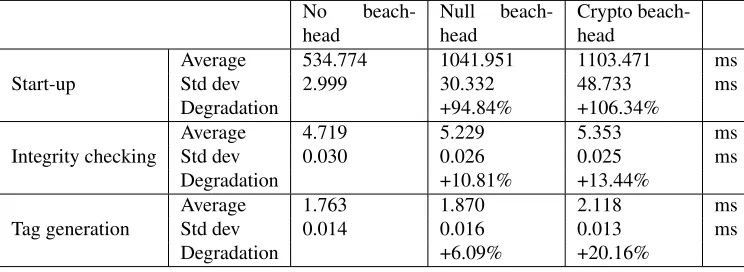
As shown in the first row of Table 1, in case of no en-trusting, the test executed in about 534.8 ms on average.
[image:5.612.102.253.318.454.2]No beach-head
Null beach-head
Crypto beach-head
Start-up
Average 534.774 1041.951 1103.471 ms
Std dev 2.999 30.332 48.733 ms
Degradation +94.84% +106.34%
Integrity checking
Average 4.719 5.229 5.353 ms
Std dev 0.030 0.026 0.025 ms
Degradation +10.81% +13.44%
Tag generation
Average 1.763 1.870 2.118 ms
Std dev 0.014 0.016 0.013 ms
[image:6.612.119.491.72.208.2]Degradation +6.09% +20.16%
Table 1: Summary of performance overhead
When entrusting infrastructure was enabled (i.e., the null beach-head is deployed in the client run-time), the perfor-mance deteriorated of about 95%. Finally, an additional 11% degradation is to be added when the real beach-head is deployed. In conclusion, the main performance degra-dation is due to the method interception mechanism in the Mono platform.
Integrity checking overhead. This experiment aims at highlighting the computational load introduced by the checksum calculation. As before, we run three series of tests: (1) the plain client, (2) the client with a null beach-head, and (3) the client with the crypto beach-head. Among all application methods, we monitored the output() method, a tiny method that performs console output only. The results are shown in the second row of Table 1.
We are interested in understanding the extra-overhead due to checksum computation (crypto beach-head), com-pared to the existing overhead of the interception mecha-nism (null beach-head). According to our experiment, the performance deteriorates of only 2.6%, which is an impor-tant result.
Tag generation overhead. This experiment monitors the Write() method, i.e., the method sending messages to the server over the network. In this case, the beach-head, not only checks the integrity of the send method itself, but also generates a tag and attaches it to the user message (in a transparent way). Similarly to previous experiments, we run three series of tests: (1) the plain client, (2) the client with a null beach-head, and (3) the client with the crypto beach-head.
The results are shown in the third row of Table 1. As before, we compared the performance values of last two columns and we observed a performance degradation of about 14%.
Replacement time and replacement rate. When the beach-head is replaced, the client application suffers a short disruption of service. Replacement time is measured as the
interval between the withdrawal of the old beach-head and the installation of the new one. Time needed to receive the replacement beach-head is not taken into account, because it does not cause any disruption, as the old beach-head is still in place. Replacement of the crypto beach-head takes 2.675 ms on average (standard deviation is 0.195 ms).
In conclusion, the interval during which the client is not responding because a replacement is tacking place is negli-gible. More importantly, since the size of the beach-head is tiny (134 KB) and the replacement time very small, the re-placement rate (from the server perspective) can scale up to few seconds, if the client network bandwidth is large enough.
5. Related work
The problem of executing software in a trustworthy com-puting environment has recently gained considerable atten-tion. The literature can be divided into either hardware-based or software-hardware-based solutions.
The Trusted Computing Group is defining a set of stan-dards to address the problem of executing software in a trustworthy computing environment from a hardware per-spective. The approaches under this umbrella [6, 8] build on top of a tamper-proof hardware component, e.g., the Trusted Platform Module, which is situated locally on the mother-board. Hardware components cannot be replaced in case of design glitches. Moreover, trustworthiness covers the ma-chine as a whole (including BIOS and OS) and cannot be granted at a fine-grain level, e.g., for selected applications. Finally, the integrity verification method is off-line and re-active, i.e., after the fact.
de-signed in such a way that an attempt to tamper with it results in slower computation. However, some assumptions in this approach are not realistic in most practical cases, and the ap-proach is not applicable on an Internet scale. For instance, verification function does not work on multi-processor or multi-core computer architectures. Furthermore, the veri-fication function and the attestation server must be wire-connected and the client must not communicate with any-body else during the challenge phase. Otherwise, in a LAN setting, special configuration is required for the switches.
Kennel et al. present an interesting software-based ap-proach to verify the trustworthiness of an OS kernel [5]. The OS trustworthiness is established by means of computation of cryptographic hashes over selected memory portions (via a challenge set by the attestation authority). Further, as-sumptions on slower computation of emulators are used to detect kernels that are running inside emulators. The work could be integrated in our approach in order to entrust the platform together with selected applications. Garay et al. present a similar approach where a trusted challenger sends a challenge to the potentially corrupted responder. The chal-lenge is an executable program that can execute any func-tion on the responder. To prove its integrity, the responder must compute the challenge within the time bounds set by the challenger.
Hohl presents an interesting approach in the area of pro-tection for software agents [3]. The central idea of the work is to generate an executable agent from a given agent spec-ification which cannot be attacked by read or manipulation attacks, i.e., a black-box. Further, the black-box is associ-ated with an expiration date limiting its validity over time. However, no practical implementation is investigated for the proposed approach.
Another relevant area of related work is represented by techniques to harden mobile agents [7, 9, 10], which can be applied to the proofs-generating module. Further, our periodic replacement strategy relies on the assumption that tampering attempts can be made hard if the lifetime of the proofs-generating module is limited. This approach has similarities with software aging, where new updates of a program are frequently distributed [4].
6. Conclusions
Computing entities continuously interact across the net-work, and, as a result, critical trustworthiness problems are emerging. According to the definition adopted in the con-text of this work, an application is deemed trustworthy if, and only if, its functionality has not been altered prior to or during execution. That is, the solution we propose puts particular accent on remotely verifiable guaranties that the software base running on clients is genuine. This work pre-sented the remote entrusting approach: a software-based,
low-cost solution that can be employed either to detect and contain malicious software agents (e.g., virus-born bots) trying to sneak in and compromise a network-connected computing environment, or to counter intentional tampering attempts with software, e.g., to obtain illegal access to ser-vices, to break the license, to circumvent hard-coded poli-cies, and so on.
References
[1] D. Aucsmith. Tamper resistant software: an implemen-tation. InInternational Workshop on Information Hiding, Cambridge, UK, May 1996.
[2] C. S. Collberg and C. Thomborson. Watermarking, tamper-proofing, and obfuscation - tools for software protection.
IEEE Transactions on Software Engineering, 28(8), August 2002.
[3] F. Hohl. Time limited blackbox security: Protecting mobile agents from malicious hosts. InMobile Agents and Security. Springer-Verlag, 1998.
[4] M. Jakobsson and M. Reiter. Discouraging software piracy using software aging. InACM Workshop on Digital Rights Management, Philadelphia, PA, November 2001.
[5] R. Kennell and L. H. Jamieson. Establishing the genuinity of remote computer systems. InUSENIX Security Symposium, Washington, DC, August 2003.
[6] P. C. V. Oorschot. Revisiting software protection. In Inter-national Conference on Information Security, Bristol, UK, October 2003.
[7] A. D. Rubin and D. E. Geer. Mobile code and security.IEEE Internet Computing, 2(6), November 1998.
[8] R. Sailer, X. Zhang, T. Jaeger, and L. van Doorn. Design and implementation of a TCG-based integrity measurement architecture. InUSENIX Security Symposium, San Diego, CA, August 2004.
[9] T. Sander and C. F. Tschudin. Protecting mobile agents against malicious hosts. In Mobile Agents and Security. Springer-Verlag, 1998.
[10] T. Sander and C. F. Tschudin. Towards mobile cryptography. InIEEE Symposium on Security and Privacy, Oakland, CA, May 1998.
[11] A. Seshadri, M. Luk, E. Shi, A. Perrig, L. van Doorn, and P. Khosla. Pioneer: verifying code integrity and enforcing untampered code execution on legacy systems. InACM Sym-posium on Operating Systems Principles, Brighton, UK, Oc-tober 2005.