How can project management add value on implementation of
strategy?: a study applying project management and OPM3 skills
during strategy implementation process.
Final dissertation of MSc Project Management University of East London – UEL
Supervisor: Paolo Taticchi
Author: Leonardo Guedes de Mello Uel: 1152833
MKM227 Postgraduate Dissertation
Student Number: 1152833
Comments Max
Mark
Actual Mark
Introduction
Identification of a valid topic, research question and objectives framed to Masters Level standard with academic rationale developed, clear industry contextualisation of the research topic
Supervisor Comments:
10%
2nd marker Comments:
Critical Literature Review Depth and breadth of literature search, engagement with seminal authors and papers, evidence of a critical approach toward the scholarly literature
Supervisor Comments:
25%
2nd marker Comments:
Research Methodology
Evaluation of research philosophies and perspectives. Justification of
methodological approach, sampling strategy, data analysis and reliability and validity measures as applicable
Supervisor Comments:
15%
Data Analysis and Interpretation
Evidence of rigor in data analysis and interpretation procedures, identification of key patterns and themes in the research data, integration of academic theory into explanation of findings
Supervisor Comments:
35%
2nd marker Comments:
Conclusions and Recommendations
Research question and objectives addressed with implications to theoretical and managerial concepts considered. Recommendations provided for theory, practice and future research
Supervisor Comments:
10%
2nd marker Comments:
Organisation, presentation and references.
Well structured and ordered dissertation with correct use of grammar and syntax. In-text citation and bibliography
conforming to “Cite Them Right”
Supervisor Comments:
5%
2nd marker Comments:
Total
First Marker Total
100%
Second Marker Total
Supervisor General Comments: Agreed Mark:
2nd Marker General Comments:
Supervisor’s Name: ……….. Signature: ………
2nd Marker’s Name: ………. Signature: ………
How can project management add value on implementation of
strategy?: a study applying project management and OPM3 skills
during strategy implementation process.
A dissertation submitted in partial fulfilment of the requirements of the Royal Docks Business School, University of East London for the degree of MSc Project Management
I declare that no material contained in the thesis has been used in any other submission for an academic award
Student Number:_____1152833 Date:_14/05/2013______________
Dissertation Deposit Agreement
Libraries and Learning Services at UEL is compiling a collection of dissertations identified by academic staff as being of high quality. These dissertations will be included on ROAR the UEL Institutional Repository as examples for other students following the same courses in the future, and as a showcase of the best student work produced at UEL.
This Agreement details the permission we seek from you as the author to make your dissertation available. It allows UEL to add it to ROAR and make it available to
others. You can choose whether you only want the dissertation seen by other students and staff at UEL (“Closed Access”) or by everyone worldwide (“Open Access”).
I DECLARE AS FOLLOWS:
That I am the author and owner of the copyright in the Work and grant the University of East London a licence to make available the Work in digitised format through the Institutional Repository for the purposes of non-commercial research, private study, criticism, review and news reporting, illustration for teaching, and/or other educational purposes in electronic or print form
That if my dissertation does include any substantial subsidiary material owned by third-party copyright holders, I have sought and obtained permission to include it in any version of my Work available in digital format via a stand-alone device or a communications network and that this permission encompasses the rights that I have granted to the University of East London.
That I grant a non-exclusive licence to the University of East London and the user of the Work through this agreement. I retain all rights in the Work including my moral right to be identified as the author.
That if the repository administrators encounter problems with any digital file I supply, the administrators may change the format of the file. I also agree that the Institutional Repository administrators may, without changing content, migrate the Work to any medium or format for the purpose of future preservation and accessibility.
That I have exercised reasonable care to ensure that the Work is original, and does not to the best of my knowledge break any UK law, infringe any third party's copyright or other Intellectual Property Right, or contain any confidential material. That I understand that the University of East London does not have any obligation
to take legal action on behalf of myself, or other rights holders, in the event of infringement of intellectual property rights, breach of contract or of any other right, in the Work.
I FURTHER DECLARE:
That I can choose to declare my Work “Open Access”, available to anyone worldwide using ROAR without barriers and that files will also be available to automated agents, and may be searched and copied by text mining and plagiarism detection software.
That if I do not choose the Open Access option, the Work will only be available for use by accredited UEL staff and students for a limited period of time.
Dissertation Details
Field Name Details to complete
Title of thesis
Full title, including any subtitle
How can project management add value on
implementation of strategy?: a study
applying project management and OPM3
skills during strategy implementation
process.
Author
Separate the surname (family name) from the forenames, given names or initials with a comma, e.g. Smith, Andrew J.
Leonardo Guedes de Mello
Supervisor(s)/advisor
Format as for author.
Paolo Taticchi Author Affiliation
Name of school where you were based
Qualification name
E.g. MA, MSc, MRes, PGDip
MSc Course Title
The title of the course e.g.
Project Management Date of Dissertation
Date submitted in format: YYYY-MM
2013-05
Do you want to make the dissertation Open Access (on the public web) or Closed Access (for UEL users only)?
Open Closed
By returning this form electronically from a recognised UEL email address or UEL network system, I grant UEL the deposit agreement detailed above. I understand inclusion on and removal from ROAR is at UEL’s discretion.
Name:
Signature: .Leonardo G. de Mello... Date: .14/05/2013
Abstract
Contents
1. Introduction ………9
2. Literature Review ………..12
2.1. Business strategy ………12
2.2. Development of strategy ………14
2.3. Implementation of strategy ……….16
2.4. Project management ………18
2.5. Project management OPM3 maturity model ……….…21
2.6. Implementation of strategy using project management ………23
3. Research Methodology ………29
4. Data analyzes ………32
5. Recommendations ……….45
6. Conclusion ………..46
7. Reference ……….…48
8. Appendices ……….…50
Figures Figure 1 - Matrix of interdependent factors of strategy development ……….16
Figure 2 - The basic implementation process (Lynch, R. 2006) ………...……….………17
Figure 3: Attractiveness/implementation difficulty (‘AID’) analysis ………26
Charts Chart 1: implementation rate of failure (Buys and Stander. 2010 pg. 6) ………...…18
Chart 2: Project implementation rate of failure (Buys and Stander. 2010 pg. 7) ………..21
Tables Table 1: Key factors of diagnosing strategic projects. Source Grundy (2005) ………...24
1. Introduction.
In today`s world corporations face changes, opportunities and challenges all the time, because of that, a dynamic and well planned actions have to be taken to cross all kind of environmental situations and possible development. According to Andrews ”Corporate strategy is the pattern of decision in a company that determines and reveals its objectives, purposes, or goals;” (Andrews K. 1987, pg. 2)
Trying to achieve strategic advantage in competitive economic environment, a contribution of PMBOOK Guide (2008) argues that the organizational project management is a collection of skills, tools, knowledge and techniques applied in a certain environment to reach the aims desired by the companies.
Based on the needed of changing strategies, companies day after day are searching for a magic portion to sort barriers when the strategy comes to be implemented. Furthermore, cost, time and quality are always issues to be taken on discussion by the board of directors to efficiently implement strategies.
However, in the past two decades, project management discipline has been spread its importance into business world, therewith, knowledge and skills involved in this practices have become more familiar into corporations place intending to achieve any competitive advantage, no matter what they are. One of the greatest milestones on project management field was in 1969 with the foundation of Project Management Institute, known as PMI.
According to Rad and Raghavan (2000), project management is one of the most increasing disciplines in todays world, but despite of the high increase utilization’s rates of project management, can also be seen high rates of failures in projects. Crawford (2000) justifies this inefficiency to a lack of adequate procedures and standards of management.
Therewith, project management activities emerge as organization’s unit responsible for organize and standardize practices to lead a better application to day-to-day business activities. Also communication of its practices throughout the hierarchical levels plays a significant importance on the development of project management skills into corporations, leading to decrease mistakes occurrence and prioritization of process to achieve targets desired on the strategy planning time.
Furthermore, identify strategy processes such as what strategy is about, development and implementation, project management skills and tools, including Organizational Project Management Maturity Model (OPM3), will raise issues to be discussed and, if possible, find some solutions to deal with difficulties during the implementation of strategy process.
The methodology chose to drive this research is literature review analyze, in which best practices and possible applicability are meant to be found on the discussion of this subject. Relevant authors were chosen to create a scenario of discussion of different point of views and knowledge to lead better solutions for the issues raised.
Also, the discussion of each discipline is designed separately to give a clear understanding of facts that are inherent to follow the logic of the discussion proposed in this study, in which at the end will be all combined to build a big picture of what is all about, leading the reader to chronological perception of the facts involved in the implementation of strategy using project management practices.
Key factors will be discussed together, linking their applicability on day-to-day environment of projects and possibly best solutions to deal with issues or barriers involved are meant to be suggested.
Beginning with explaining strategy and its core competence, highlighting key factors of this applicability and what it stands for is the first subject discussed on the literature review, after that development of strategy and implementation of strategy process are discussed to illustrate the steps that corporations have taken when come to gain strategic advantage of competitors.
However this approach can be said that is much more business as usual (daily corporations activities) than proper use of project management skills to introduce strategies to companies. Relevant authors are used to base the discussion, but no one of them relates to implementation of strategy with project management. The idea of that is to collide both methodologies at the end and suggest its applicability.
Further, project management approach is described as the same as strategy’s application (isolated) intending to clarify aspects inherent to what it stands for. Aspects such as cost, time, scope, quality, risk and benefits are explained to better understanding when the planning of implement strategy using project management comes to the discussion at the end of this study.
in this research intending to add best practices and knowledge already developed in use by corporations.
Moreover the combination of both knowledge areas, business strategy and project management comes to the end of the sub chapter of literature review giving a picture of what is all about, based on a relevant author Tony Grundy and his book “Implementing strategy through project management” the description of the process and relevant factors are made to base the findings of this research.
Therewith, best practices are meant to be suggested to better development of this combination of two important set of skills, in which can aggregate advantages, certainty and manageable process always intending to better achievements on core business of companies.
2. Literature Review.
As the proposal of this study is to analyze the aspects of implementation of strategy using project management and OPM3 (Organizational Project Management Maturity Model) inside companies, the structure of the literature review will focus on the main aspects of each discipline separately, high lightening key factors that play significant importance and attribute efficiency to the process as a whole.
Topics are separated into main fields involved will be developed to clear understand of the reader and also to raise main factors that could lead to answer the discussion raised in this research. Also the intention of this structure is to analyze aspects, which are part of the core of each discipline, therewith, show the importance of steps that should be raised during the planning process of this methodology.
Involving implementation of strategies in organizations using project management as a tool, the footpath chosen to illustrate and to base the knowledge is defining each discipline isolated, take key factors and relate them together to create a solid basement to the discussion afterwards. The combination of issues at the end will also help to develop links between each single discipline to the others, relating then together and analyzing possible advantages and disadvantages of the use of these methodologies.
Also contribution of authors, who have already been stepped on this field of research will be analyzed and included to give even more strength on the findings. The logical sequence of the topics were chosen according to relevance and needed to develop a sequential thought, they are:
Business strategy
Development of strategy Implementation of strategy Project management
Project management maturity model, OPM3
Implementation of strategy using project management
2.1. Business strategy
A summary statement of strategy according to Andrews K. (1987) shows that a specific product line and services offered or developed by the corporation, the market and market segments for which products or services are at this moment or will be designed for, the channels of logistic are needed to reach the market target, the financial aspects involved, mainly the return over the investment, are facts that corporations take as baseline to strategically reach their goals through the market battles.
More specifically Porter (2005) argues that strategy is about to differ from the competitors, choosing different ways to deliver a set of activities or abilities that can provide an unique value for the company, gaining advantage from the competitors into the market. In which could be specific product, price differentiation, distribution and attractive advertisement. However strategy can be defined as “a pattern in a stream of decisions” (Mintzberg, 1999). Also Andrews K. (1987, 2) adds, ”Corporate strategy is the pattern of decision in a company that determines and reveals its objectives, purposes, or goals;”
Also companies do not want only survive on the market, the nature of all business organizations is grow and prosper into the market segment, therewith, business strategy is also a way of achieving sustainable growth, increase profitability or even change the market segment. As Henry, A. (2008) argues, “firms must undertake an analysis of their external and internal environment, to ensure their own internal resources and capabilities are more than sufficient to meet the needs of the external environment”.
However, the contributions of the authors can lead to a clear draw of strategy, meaning that the join of a pre-established footway targeting the corporation’s goals and a set of decisions through the process of taking the company to the point desired can be considered as a business strategy. Also a set of decision throughout the way are part of strategy of any firm, they are also based on the business core and focus on the target pre established at the development of strategy time.
Due to this fact, the reinforcement of a flexible and manageable footpath can be classified as essential, as Henry, A. (2008) adds flexibility is the key to good strategy thinking, it is better go round of obstacles than try to go through them. The action of a flexible strategy management approach, in which Porter and Henry collides against to project management approach to management of scope, the need of a core to be followed and surely the planning process of project implementation.
However, as could be seen before, strategy is all about changes, not meaning changing targets desired, but when something changes the environment the likelihood of some respond it back is almost sure. Then can be said that the strategy should be manageable and flexible to cope with its environment occurrences, to better accomplish desired targets and results. What was left is, if the project management techniques can cope with inevitable changes during the process and if it is valuable the use of it to implement strategies in corporations, as according to PMBOOK (2005), a defined scope is required to plan the all project performance. That will be discussed further in this research.
2.2. Development of strategy
In the fast moving business world, corporations face changes and market needs in a daily basis, so the need for fast response to achieve market competitive is vital to every type of business. Although many managers have dreamed with perfect solution to keep their corporations fitted on the market, changes and improvements are essentially pushed to their desks to keep up with external needs.
For this, strategic changes are needed, Henry (2008) argues that: “strategic change is about changing the way in which an organization interacts with its external environment, it is about creating new and innovative ways of doing business”.
Recognizing the need for a strategy inside the corporation, the first step to go on, according to Porter, is identify the goal desirable by the company and the proposal of that, also matching with the company’s operations, market involved and customers need. Also Ohmae (1982) reinforces that three factors have to be considered while developing a strategy, they are: the corporation itself, the competition in which it is involved (market segment) and the customers target.
According to Porter, when a corporation chooses only one strategy, it is more likely to achieve competitive advantages and perform better than its competitors. However, if the same company applies more than one generic strategy at the same time, it will perform less efficiently. Porter referred to the latter type of corporation as being “stuck-in-the-middle”. Despite this, the spread of international competition is compelling more organizations to focus on a single combination of generic strategies (Harrison & St. John, 1998).
However, after decide which strategy fits the purpose and goals of the company, managers and strategy developers should take on board, in developing the scope, factors such as time-consuming of the implementation, cost-effective and alignment with corporate vision and mission also weighting the benefits against the effort spent on the implementation.
According to Dyson (1995), a strategy development is a management process that involves consultation, negotiation and analyzes of what is aimed by the company in the future to create a set of decisions to be made towards the target. Also points described below are variables playing together to well development of the strategy needed to achieve the corporation’s results. They are:
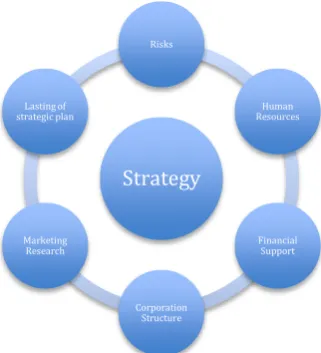
Duration of the strategy – mostly dependent on the rate of changes happening in the segment. E.g. technology devices industry tends to change faster than food industry;
Financial support – availability of financial resources for investment on the changes, commonly decided by the directors based on the return expected on the benefits of the strategy results of the corporation.
Human resources – Availability of human capital to perform the strategy’ needs, such as specific skilled work force, extra work force to expand the productivity, essential training and etc.
Marketing targets – must be researched based, factors such as size of the population of customers target, ethnical issues, acceptability of product or service, competitors, economic situation, are issues that can show if the strategy is achievable or not.
Corporation structure – capacity of production, efficiency, use of new technologies, resources, flexibility and many others.
Risk – evaluation of all main risks involved, assessment of the impacts on the strategy scope, risk response plan and likelihood of happening.
elaborate a panel of strategy options to ensure a safe and risk prevented implementation and results achievement.
[image:17.596.220.381.183.360.2]So an interdependent matrix can be developed based on the main factors of strategy formulation above:
Figure 3 - Matrix of interdependent factors of strategy development
Main factors of the strategy are known, the step forward of the corporation is how to implement it achieving all the targets wanted and planned by the company. Also, as Dyson argues that a range of strategies should be developed and left on the side as “second option” lead us to the question, how can the corporations manage with a plenty of different strategies into different areas inside the company, not being stuck in the middle as Porter says?
2.3. Implementation of strategy
As the aim of strategy implementation is to deliver the objectives and missions wanted by the corporation to reach the targets necessary, to be more competitive, cost efficient or increase the market target. The process, sometimes, can not roll out as smoothly as planned during the development process, in which can be assumed most of the time because of the constantly environment changes.
Furthermore, implementing strategy into corporation, is in fact a set of a work package - the identification of general strategic objectives; the formulation of specific plans; resource allocation and budgeting; monitoring and control procedures (Lynch, R. 2006, pg. 615) - that involves all the corporation’s departments. The figure below illustrates Lynch’s theory:
Strategy
Risks
Human Resources
Financial Support
Corporation Structure Marketing
Figure 4 - The basic implementation process (Lynch, R. 2006)
Also Lynch (2006) argues that there are three different types of strategy implementation process, they are:
Comprehensive implementation programmes - it is when corporations face a major change in the environment, subsequently having to suddenly change the strategy operating that moment. E.g. financial crisis usually make companies review their budgets for research and development or even suspend employees’ hires for some period of time. This type of implementation is completely time driven due to fast response to difficulties faced; also a close coordination is required for its success.
Incremental implementation programmes – it is usually linked to high levels of uncertainty in the market, surprised R&D results or rapidly changing markets segments are more likely to push corporations to use this approach. The uncertainty is managed by a flexible strategic approach to risks due to most of the activities are unclear till outcomes come up.
Selective implementation programmes – represents substantial changes in the company, can be used on the whole corporation or only into few departments, but with significant changes on the procedures, price, quality, market segment targets and so on. E.g. Lamborghini automobile on the early 60’s decided to produce sportive cars together with the already existed tractor industry.
Although many professionals might think that strategy is only concerns of the top management, contradicting the real situation, Rue and Holland (1989) says that: the process of implementing a strategy throughout the company involves the workforce as a whole, also they reinforce that the main factors, that are relevant for efficient implementation process, are mostly handle by the operational level into corporations.
Strategy choice
Main strategy objectives * Quantifiable * Non-quantifiable
Formulation of plans * Tasks * Deadlines * Reaponsabilities Resource allocation and
Budgetting Monitoring and control
In past research Buys and Stander developed a chart showing the main factors that affect the implementation process. See below:
Chart 1: implementation rate of failure (Buys and Stander. 2010 pg. 6)
As can be seen the two highest issues to implement strategy are pre occupied resource and daily work activities. Therewith the question that rises to our mind is: how can project management help to deliver strategy implementation successfully?
2.4. Project management
Project management can be considered as a new discipline due to its development, in which has been increasing since 1980’s with the proposal of set standards for managing projects successfully and constant improvements. Researchers and practitioners have been concerned with high levels of projects failure into corporations, so the development of the discipline is desired for almost every corporation in the world intending to minimize financial losses also maximize opportunities to increase business.
However, corporations have structures set for day to day business and daily management activities, that is what PRINCE2 calls business as usual (PRINCE2, 2009), as we know project is a temporary endeavor undertaken to create a unique product, service or result (PMBOK Guide, 2008), so the project management work comes across to the “business as usual” bringing up expertise and knowledge to deal with particular situation, in which corporations tend to undertake as parallel of day to day work intending to achieve some specific goals.
0% 5% 10% 15% 20% 25% 30%
Pre-occupied resources Daily work activities are not separated from strategic
"breakthrough" activities
Project are not aligned with the strategic intent of the organization
Project are not aligned with the strategic intent of the organization
Lack of periodic progress review and process improvement Our strategic plans are always implemented successfully Lack of operational data analysis during strategic planning
sessions
Vague vision statements with limited deployment in the organization
A statement produced by the APM (Association for Project Management) can better illustrate the meaning of this discipline:
“Project management is the process by which projects are defined, planned, monitored, controlled and delivered such that the agreed benefits are realized. Projects are unique, transient endeavors undertaken to achieve a desired outcome. Projects bring about change and project management is recognized as the most efficient way of managing such change”. (APM Body of knowledge, 2008, pg. 2)
Furthermore, project management can be named as the process of transforming inputs (business needs), using constraints and mechanisms (performance parameters, people, skills and tools) into outputs (project products/ services). Therewith, project management is nothing more than a “transformation” process, but what makes this transformation process so valuable as a management process to be performed?
Larson and Gray (2011), Pinto (2010), Shtub, Bard and Globerson (2005) state that the project process is a interaction of planning, scheduling, controlling, assessing and managing skills towards an objective. Taking the authors thoughts a sequential set of activities can be visualized on following, in which describes more clear the role process of managing a project.
1. Scoping the project: it is where the project starts, requirements for the project have to be clearly identified, viability of deliverables, specification of products/ services, pre-requisites for accomplishment, risks identification and impact on the project.
2. Planning the project: some the researchers usually mention this step as the most important during the life-cycle of a project, as they explain the importance of a well elaborated actions plan could definitely avoid some mistakes or uncertainty in the future. Also a well-developed plan adds value on the stage of controlling and managing the products as well as measurement tool, once the product can be only compared against something that was desired and developed before. Main factors are:
a. Budgeting the project: in where all the financial support are allocated to tasks needed, sources of support, stages of tasks, identification of critical spending, tolerances, procedures of authorization on possible tolerances break,
interruption, disagreements with quality standards required for full accomplishment of products.
c. Human resources: specialized skills are needed in almost every project, so the understanding of requirements to develop products and services during the delivery of projects have to be identified and organized to cope with necessities. Also availability of those skills has to be planned to avoid any interruption on performing the stages of projects.
d. Scheduling: it is the process to identify the length of tasks and predecessor of each of them and organize according to the corporation’s structure and needs. Scheduling is generally based on the PBS (product breakdown structure) and WBS (work breakdown structure), see more details in appendix 2.
3. Controlling the project: after all the planning stage have been completed, the controlling the project stage has more to do with the day-to-day work, in which the project manager, together with team members perform the work to deliver the project’s outcomes, using all tools and resources (already planned and scheduled) available to perform the work. Furthermore, it is part of this stage the assessment of projects accomplishment, in which the team management can compare the evolution and gain obtained during the stages against the plan developed to achieve them, as known projects are a collection of tasks and single products to achieve a final results. Pinto (2010).
4. Closing the Project: it is when the project approaches to the final results and accomplishment of the goals wanted, in this stage is the time of check the project plan against what has been produced. Also lessons from the project should be taken on board for possible future projects (PRINCE2, 2009). The hand over of the product/ service to the customer and realization of final improvements, if needed. Furthermore a detailed documentation of the process and activities is needed, intending to register benefits accomplished with the project.
Therewith combining the variables to be controlled in the project with the group of activities in order to manage them yet can be said that it is the fundamental set of skills and process to cope with any project in order to achieve desirables successfully.
Chart 2: Project implementation rate of failure (Buys and Stander. 2010 pg. 7)
According to the research developed by Buys and Stander, running too many projects at the same time and change the projects priorities are responsible for nearly three quarters of projects failure, so how can running parallel projects and changing priorities be avoided using project management during the process of strategy implementation?
2.5. Project management OPM3 maturity model
Known as OPM3, The Organization Project management Maturity Model is a standard developed by PMI (Project Management Institute) to help corporations understand organizational project management and its value on the implementation of organizational strategies (OPM3 guide, 2003 pg. 3).
As described before a project is a temporary endeavor undertaken to create a unique product, service or result (PMBOK Guide, 2008), as the same strategy implementation is a set of changes and tasks towards a desired goal by organizations. Therewith, the process of implementing strategies can be said that is a project with start and end pre established at the planning phase.
However, as project management has increased the adepts of its use on the past two decades, and also its approach of dealing with projects can be applied to every kind, size and complexity of projects, needing only to be tailored to projects needs, the creation of a standard for complex projects, such as corporate strategy implementation can also add valuable help to its performance.
Furthermore, organizations can also use the OPM3 method not only on the whole structure, but also as in specific departments of it, taking the point that some of departments
0% 5% 10% 15% 20% 25% 30% 35% 40% 45% 50% There are too many projects and too few
resources
Priorities of projects frequently change, with resources being reassigned
Senior managers unilaterally approve and release projects without regard for capacity
Project and resource managers often fight over resources
Projects are not linked to the goals of the organization
into corporations need a rapidly change or restructuration without move all the others around, the OPM3 or the others project management techniques, can simply help the designing and implement those changes required.
Yet, companies planning adopt the OPM3 together with day-to-day work, can gain value and implementing it step by step, in which according to organizational situation could be managed based on the its priorities, for example, starting with efficient sectors which could lead to capital savings, after invest this capital on the expansion of production, in which could increase revenues and so on.
One of the key points of using the organization project management maturity model is to identify inside the organization how it is the actual approach to project management, and then compare with desired goals in strategy implementation. Furthermore, the OPM3 method is based on best practices, already used in previous projects, and recognition of the corporation’s capabilities to deal with this practices.
Also OPM3 is a cyclic method of improvement, consisting on four base steps, standardize to measure to control and after continuously improve (OPM3 guide, 2003 pg. 6), to achieve this level three consistent interlocking elements are needed to be understood, they are: OPM3 guide (2003)
Knowledge – the users have to be aware of the best practices, methodologies and concepts of OPM3 and the organizational project management ideas.
Assessment – in this part the users are asked to identify the current position of the firm structure comparing to OPM3 best practices.
Improvement – after assessed the current position against the OPM3 practices, the improvement desired can be planned and implemented as a project.
It is valid to remember that this process can be applied over and over again till the company reaches the desired goals; the Project Management Institute also highlights that this is a cyclic methodology and none corporation can achieve the mature standard in just one go. But Kerzner (2005) adds that all the steps can be overlapped according to the company’s appetites for risk.
To achieve the OPM3 benefits into a defined corporation Kerzner (2005) has contributed developing a step sequential theory, in that he says that the best way of achieving excellence using the OPM3 method is comprised of five levels. They are:
better communicate the information throughout of the departments, minimizing risks of misunderstandings and lack of efficiency.
Level 2 – Common Process; the necessity of standardized processes is vital to evaluate how efficient is the applicability, leading to a constant improvement on that, in which can be set as baseline to future projects undertake by the corporation.
Level 3 – Singular Methodology; in this level, the company should combine all methodologies already in use to create a single way to deal with different tasks, as the two steps before this one should minimize the chances of mistakes and also facilitates the functional work, in which according to PMBOK Guide, projects are most dealt with cross-functional skills. (PMBOK Guide, 2004).
Level 4 – Benchmarking; the necessity of constant improvement was already highlighted before, so a comparison with best practices is vital to achieve competitive advantage. In this level executives have to decide what benchmark and who benchmark.
Level 5 – Continuous Improvement; the information of the benchmark is taken to evaluate and asses what the company has been achieved and what the desired targets are, also this last step can be performed with step before to keep moving the corporation’s processes to perfection, or at least to a constantly improvement.
(Kerzner, 2005, pg. 40 – 43).
However, the accomplishment of all those steps described above, does not guarantee the success of maturity achievement, but higher the chances significantly (Kerzner, 2005, pg. 40). Yet as mentioned before, the opportunity to overlap steps during the process implementation can be applied by using programme or portfolio management techniques, in which could save time for the company in the fast moving environment.
2.6. Implementation of strategy using project management
As project is defined as endeavor with an objective and end pre-established (PMBOK Guide, 2005), implementing strategy into any corporation can be said that fulfill all requirements to be manage as a project. Once, according to Potter (2005), the implementation of strategy is a process that leads the organization to achieve competitive advantage on its strategy performance. It is where companies gain value differing from competitors.
Johnson, Scholes and Whittington (2008) contribute that strategy project is usually organized in the shape of projects in order to involve teams of people committed to work on specific strategic issues during a defined period of time. Also they add saying: “projects can be instituted in order to explore problems or opportunities as part of the strategy development process, alternatively can be instituted to implement agreed elements of a strategy”. (Johnson, Scholes and Whittington. 2008, pg. 578)
Although all practices of implementing strategies are focus on the continuing business development and make clear the idea of constant improvement process, in which could go against the idea of projects description (temporary endeavor), the cycle of process could be broken down into smaller projects, but compounding a bigger project desired, classified as a programme or portfolio, then be managed constantly towards the goals desired. Appendix 1 clarifies the difference between the conventional project management approach and the “strategic project management”.
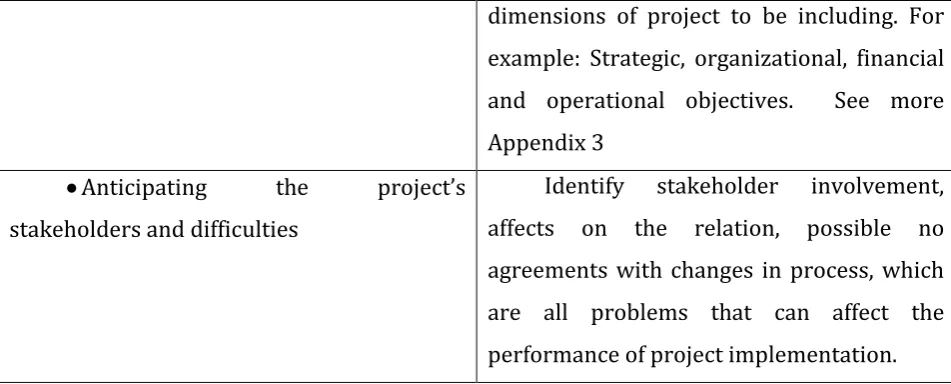
According to Grundy (2005) to make the use of the strategic project management on implementation of strategy process there are 4 key factors to be firstly developed when implementation of strategy comes to be done; he classifies them as solid base to walk through the process and as a “project diagnosis”, they are:
Scoping the project One of the biggest mistakes managing strategic projects is underestimate the scope. The scope is very much driven by three key elements: size, length and key interdependences of tasks or services.
Defining the key issues Should be done before projects objectives, as it needs to explore more about why need to look at the project at first. It requires a harder look on why current problems have place and are intended to change.
Techniques such as fishbone analysis and performance drivers are suggested to achieve good overview.
dimensions of project to be including. For example: Strategic, organizational, financial and operational objectives. See more Appendix 3
Anticipating the project’s stakeholders and difficulties
[image:26.596.52.528.78.270.2]Identify stakeholder involvement, affects on the relation, possible no agreements with changes in process, which are all problems that can affect the performance of project implementation. Table 1: Key factors of diagnosing strategic projects. Source Grundy (2005)
However Johnson, Scholes and Whittington (2008) go further of Grundy’s contribution, saying that all projects should also have:
Top management commitment, in which Finlay produced a statement describing the importance of top management.
“Knowing where and how to direct their efforts to best overcome resistance to change is an important attribute for the modern leader-manager, and the widespread use of project teams means that skills in project management have become a key requirement.” (Paul Finlay, 2000, pg. 401).
Milestones and review checkpoints, projects should have clear outset milestones scheduled, it provides opportunities for assessment of achievements also reviews and adjustments if required.
Appropriate resources allocation, strategy implementation and project management are areas which human resources is the most of resources needs, so identification skills need and availability of it, is a fundamental part of planning process, lack on resources (in this case human resources) can play great damages on the project delaying, over spending or even failing, in which can lead the corporation to losses or miss business opportunities.
Still following Grundy thoughts the next step to be taken to achieve effectiveness on the process is identify attractiveness of aspects that are inherent of decision making, he highlights that a series of questions could clarify the easier footpath to be taken also align with the Corporation’s capabilities to deal with certain aspects.
Attr
ac
ti
v
e
n
e
ss
*
study is the implementation difficult further information of the others aspects can be found on Appendix 4.
Implementation difficult comes as description of the factors involved in each strategy chosen by the company, Grundy (2005) argues that aspects like time, cost, effort and gains on the future have to be specifically identified and discussed before any decision be taken. Taking this thought can be assumed that the project design also depends on the choice of the strategy chosen.
Furthermore Grundy suggests the use of “the strategy option grid” (the Strategic Option Grid is a most valuable tool for appraising strategic projects options and evolve in its effectiveness, particularly through additional questioning) (Grundy, 2005, pg. 40), is a completely useful way to find out any possible mistakes before the implementation process takes place.
Key questions to be asked intending to develop the strategic option grid are: How inherently difficult is the strategy to implement over time?
Do we have all the key competencies to implement it? Is this the kind of strategy we naturally do well?
After the identification of key issues inherent to the strategy has been developed a matrix to appraisal the options is suggested to be created. Named “Attractiveness and implementation difficult” known as “AID” analyzes, it is based on scores given on the appraisal of each option evaluation. As it is shown on the example below.
Figure 3: Attractiveness/implementation difficulty (‘AID’) analysis
High
A
D
Medium
*Benefits minus cost
B
C
Low
Easy Difficult Very difficult
The process of selecting the strategy passed, now is the time of development of the project, not meaning the project management skills starts now, as could be seen it also helped on the development and selection of the best one which fits the corporation’s capabilities and goals.
Grundy (2005) recommends that the first step in this stage is use the work breakdown structure (see details Appendix 2), in which tasks are broken till reach single achievable tasks in order to complete the whole final desire, he also add that “This produces more and more details until a complete listing of activities is created. Whilst at this stage these activities are not phased over time, this should give a really detailed idea of project activities” (Grundy, 2005 pg. 51).
Furthermore, work breakdown structure helps on the fully understanding of resources and funding, leading to better identification of resource and financial tasks consumers. A detailed activity of the project is also gained developing the work breakdown of process needed to achieve the final results.
Once the breakdown has been created, the next stage is to begin to organize tasks over time; Gantt chart is the most used in this case. Gantt chart is consisted on organizing activities over time and identifies time consumption and predecessors’ tasks; also parallel tasks can be run as long as they have no dependencies on previous tasks (Grundy, 2005).
Yet, running tasks on parallel could save time on the project performance, on the other hand tasks can possible be delayed, possibly if a task is delayed, which might not be an obvious decision sometimes, some cases is wise to program new starts for the activity based on the accumulation of many tasks at the same period. Grundy (2005) alerts to when a high number of tasks are taken simultaneously efficiency can declines after certain point.
Following the work breakdown structure delegate roles and responsibilities is the step to be taken, definitions of who will be in charge to deliver what is the essential of carry the project out. Grundy (2005) adds that the first step in a project means half way and the enthusiasm is easily shared around, but the monitoring and continual management are vital to keep project’s members committed with what have to be delivered.
Grundy (2005) contributes that the closing project phase can be in two ways, assessing the achievements of what was planned then decide if any repair or complementary tasks have to be taken to achieve those goals or handle the outcomes of the project to the users. Taking these points can be said that the process is the same implanted on every project, as long as it reaches the final stage.
3. Research Methodology
Identifying how project management can add value to implementation of corporate strategies as main objective of this study, the methodologies used to achieve outcomes desired will be; literature review of main text books in the field, case studies related to the subject and articles describing any particular strategy used.
Fitting the processes of implementation of strategy in companies into a project environment can help identify all key aspects that can lead it to a successful project, in which according to PRINCE2 (2009) there are 6 subjective aspects, they are: risk, quality, time, cost, benefits and scope.
Applying aspects of project management such as; planning, implementing and controlling, to all stages of strategy changes will create framework of techniques that could be useful for further activities depending on the process of strategy changes desired.
Without basement to measure success in strategic plans, the only methodology to be applied in this study would be qualitative research approach, in which can provide previous experiences (by analyzing case study) and literature review of the author’s knowledge, trying to evaluate, highlight and analyze aspects inherent to the adoption of this methodology.
Analyzing the main points of the literature, this study intends to evaluate factors that are crucial to implement strategy using project management and further applying OPM3 best practices, as could be seen the structure of the literature review was developed splitting all the disciplines involved to achieve the best knowledge collection.
Beginning the discussion with strategy meanings could be figured that more than just a path chosen by corporations to achieve results in the future, strategies in general carry in its core a need for flexibility to deal with changes during the way to achievements. As Mintzberg (1999) adds Flexibility is the key for strategy.
Also during the development of strategy (subchapter after) an important point relevant for this study was identified, Porter (2005) highlights that many companies go for more than one generic strategy at the same time, in which according to him, would lead corporations to be “stuck in the middle” or in better words fail the tasks achievements.
qualitative method was used to better find best practices also a comparison with the ICI case experience will give more strength to the analyzes.
On the implementation of strategy area, are discussed the process of it highlighting the steps to be followed and what it stands for, based on the conventional approach, in which project management methods are not used, the use of a qualitative research developed by Buys and Stander the identification of main issues that leads strategy implementation to failure will be suggested based on project management skills and how to better avoid them.
The qualitative research developed by Buys and Stander is based on a survey applied in South Africa in where fifty companies from eight different sectors (engineering, mining, defense, medical, aerospace, information technology and telecommunication) were chosen to sample issues in their projects applicability. The survey was sent to 313 managers part of the companies and the rate of responses was 14% (44 responses from 32 organizations).
Furthermore, analyzing the literature two important questions to develop the logical approach were identified, they are:
How can corporations make the most of their workforce during the strategy implementation roll out process? And:
How can project management help to deliver strategy implementation successfully? Answering these question above will be developed by literature review where the suggestion of best practices are meant to be identified, surely matching the applicability with error avoidance during the process.
On the other hand as the intention of this research is to use project management, the explanation of the process of project management skills were identified during the literature review chapter, therewith some issues were identified in which could lead projects (any kind) to failure.
Also taking Buys and Stander previous quantitative research the two biggest factors that lead projects to fail were identified, according to that, before starting the application of project management skills and processes, suggestion of how to better deal with these issues must be made to minimize the risks of failure during the process. However based on the qualitative research of Buys and Stander a question was raised, that is: How can corporations run parallel projects and change priorities be avoided in the process of strategy implementation?.
points and ways to deal with that are intended to be found based on the previous experiences on the field.
The case of ICI experience, in which Grundy describes in his book (Strategy implementation through project management, 2005) and the quantitative research of Buys and Stander (Linking projects to business strategy through project portfolio management, 2010) are extensively used and valuable for this study.
As part of Grundy’s book the case of ICI describes the experience of the author within the company during change period, describing the challenges faced Grundy illustrates the whole environment and situations that happened, based on that the process of decisions and the way was planned all the actions give the perfect picture for relevant analyzes in this study.
4. Data analyzes
As mentioned before the market place now a days is a fever pitch in where companies fight for their “best piece of the stake” twenty-four hours per day, seven days per week, so a constant change environment is surely found no matter who the competitors are and what market segment the company is involved in, for this a flexible and risk forecasted strategy is more likely to beat the competitors on the game.
Yet, corporations are likely to develop their strategies in short term (one to three years) and long term (three to five or more years ahead), meaning that the forecast plays a significant importance on the development process, as no matter how the planning process takes care over unpredicted events and likelihood of risk, there will be always some threats trying to take the plan out of its rail.
However if a deviation is needed to better cope with uncertainties faced a revaluation of the projects scope can be made and alterations can be adapted and a new plan developed again (surely changes on the timescale, budget and quality will occur), in which Mintzberg, Quinn and Ghoshal (1999) call “Emergent strategy” companies usually evolve their strategy as they go along with the implementation process, meaning that adaptation is a continuous process to respond a changing environment and situations happening along the way.
But on the other hand contradicting the approach above, Chandler (1986) argues that first the strategy should be developed then the company tailored to accomplish the requirements for its implementation, also strategy is only able to fit the corporation based on the capabilities of doing what have to be done. In fact this approach would be much more suitable to apply project management techniques, in which describes a pre fixed scope, time scale and budget (PMBOOK, 2008), avoiding deviations and changes during the performance.
According to the discussion opened above, two approaches of project management can be taken to avoid misunderstandings on flexibility of projects, first as Mintzberg, Quinn and Ghoshal (1999) argue that the development of emergent strategy can be made based on uncertainties that might occur during the strategy implementation, taking this business approach an addition to a parallel project in which will compound a project portfolio allowing fast switch between them minimizing cost and scheduling impacts.
important to the success of strategy implementation that the middle management and project managers fully understand the parent organization’s objectives in undertaking the selected strategy and approach” (Meredith and Mantel, 2012 pg. 45).
However communicating the strategy goals during the development phase seems to be the most efficient and lower cost way to deal with flexibility issues on implementation phase. Empowering managers to make decisions based on the knowledge of strategy’s goals also can add value on the process, probably saving money and time on project and keeping up with opportunities faced.
As it could be seen before, strategy is the chosen way to do things happen inside a corporation towards its goals, so the development process of the strategy plays a big factor to the effectiveness of that, also in the implementation process and the success of its accomplishment.
The development of strategy starts with selection of the goals desired by the company aiming competitive business achievements, therewith the selection of possible strategies have to be evaluated and assessed against the firm’s capabilities.
According to Meredith and Mantel (2012) factors such as: cost of strategy, capability of the company undertaking the strategies, flexibility in dealing with possible challenges, convenience to implement and use benefits are players on the decision make time.
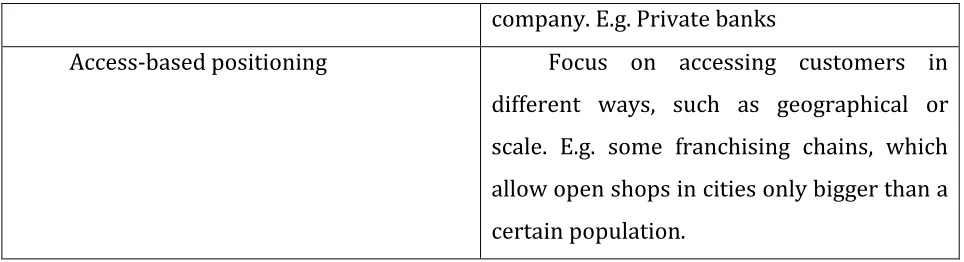
However the market segment the company is, there are three most popular different types of strategies as mentioned by Porter, as can be seen in the table below, in which he also adds that applying more than one of them together can lead to low performance of achievements.
Variety-based positioning Based on product or service, usually set by industry or service companies in general, providing product/service used as it is.
Neither focus on client nor customization.
E.g. mobile devices industries
company. E.g. Private banks
[image:35.595.58.540.71.202.2]Access-based positioning Focus on accessing customers in different ways, such as geographical or scale. E.g. some franchising chains, which allow open shops in cities only bigger than a certain population.
Table 2: Description of strategies according to Porter.
But on the other hand, Ohmae (1982) adds that if a corporation choses an identical approach that has been used by its competitors to reach the market goals a short cut has to be taken by the company to differ from its competitors, a example in which many companies tend to do is “price war” in which by his experience can lead to a short term advantage for customers but may be an income sorrow in the long term.
Furthermore the selection of just one of the strategies above is more likely to happen on small and medium size companies, as shown on the Sony case study (Appendix 7), large corporations tend to deal with large numbers of products in different segments, in which Sony’s new CEO Howard Stringer had to deal with transformations on different departments along implementing reduction of cost on process.
As seen before, strategies have to be flexible to deal with external and internal changes affecting its targets, so during the development process can be add two different hypothesis of dealing with changes combining project management and strategy work, they are:
Scenario 1
Taking Porter’s contribution that companies could “stuck in the middle” applying two or more strategies at the same time, as flexible core scope should be used, leading the project approach to the most common techniques in project, evaluating and managing the six subjects variables: scope, time, cost, quality, risk and benefits (PRINCE2, 2009). Allowing the project to be manageable between these areas and respond to changes more efficiently.
Scenario 2
Dyson argues that companies should have two or more strategies to be left on the side as second option, in which contradicts what Porter stands by, so two different approaches can be used in this scenario, the first one is to develop the same structured project (as described above) for every strategy plan, then if the first is going to fail the project can be closed and the other option overcome to fulfill the company’s need. Or a Programme can be developed to implement as many strategy’s project as desired by the company. As PMBOOK Guide (2008) describes programmes as group of distinct projects that in some way are linked or lead to a major product desired.
So taking the second scenario as valid for many large corporations how can
corporations manage with a plenty of different strategies into different departments inside them without being “stuck in the middle” as Porter says?
The characteristics of appliance different types of strategies are suitable to be
managed by using programme or portfolio management due to the complexity of tasks; high level of control needed and cross-functional activities. Also these two methods allow small projects be running in parallel achieving fast implementation and benefits realization.
As mentioned before a programme is the join of different projects deliveries compounding a bigger outcome at the end, the same is for portfolio in which can be compounded by programmes and projects aiming to achieve a bigger result at the end.
However, according to PMBOK guide (2008), portfolios and programmes are consistent by several different activities, following the thought that a small project has to take in consideration cost, scheduling, benefits, risk, quality and many others factors, programmes are the collection of projects with the same outcomes, predecessor tasks and towards the same strategies.
On the other hand, portfolios refer to programme or projects grouped together to facilitate management work and to meet strategic business objectives, also the main aim of portfolio is to use prioritization on projects deliveries to better deal with uncertainty and changes along the way.
To reinforce the acceptability of using portfolio management to manage different strategies an example extracted from PMBOK body of knowledge can simply explain the useful use of this methodology to add value on strategy implementation.
“For example, if an infrastructure company that has the strategic objective of
maximizing the return on its investments, may put together a portfolio that includes a mix of projects in oil and gas, power, water, roads, rail, and airports. From this mix, the company may choose to mange related projects as one programme. All of the power projects may be grouped together as a power programme. Similarly, all of the water projects may be grouped together as a water programme” (PMBOK body of knowledge, 2008, pg. 8).
However the fact that the use of portfolio management be considered a tool to
implement strategies in companies, the qualitative research developed by Buys and Stander (2010) still pointing out the difficult of deliver projects successfully. According to their research forty-seven percent of projects failure is due to running many projects with few resources and thirty percent is because of changes on priorities and resources reallocation.
Therewith how can deal with resources on running parallel projects? And how can change priorities without resources being reassigned in the process of strategy
implementation?
Starting with resources allocation, PMBOK guide (2008) adds that, after scope being developed and the work breakdown structure is designed the resources allocation can begging. It starts with estimating activities resources, where the identified tasks are planned and the resources are assemble to deliver the final products or services.
According to Buttrick (2005) in 1993 a research developed by the University of Southern California analyzing 165 teams in a number of successful organizations found out that there are two reasons for projects resources allocation failure, they are:
Project objectives unclear.
The right people were working on the project at the wrong time.
Also Buttrick (2005) highlights that resources are often reassigned to projects on the basis of good intention, rather than good information. Moreover, an effective resource allocation and commitment is, therefore, needed to meet three conditions according to Buttrick:
2. Have to have visibility of the resources available, or soon to be available, within the forecasting horizon of the company.
3. Commitment of resources should be based on clear information and forms the basis of an agreement between the departments providing the resources and the projects consuming the resources.” (Buttrick, 2005, pg. 221).
Therewith identifying the aspects described above by Buttrick and using the project management approach for resources allocation can avoid some mistakes during the
allocation of resources.
Meredith and Mantel (2012) suggest the using of the “resource loading method”, in which describes the individual resources amounts to an existing agenda requirements. Basically this method is based on the work breakdown structure and the schedule of tasks, it starts identifying needs of resources and when it will be consumed, consequently better understanding of allocation can be gained from using this tool.
Also scheduling deliveries of resources and/ or hiring workforce on the time of project needs avoids unnecessary money spending, even though many of the staff are part of the company, overbook their workable hours also can decrease productivity performing tasks, consequently leading the project to one more problem.
According to Pennsylvania Electric Company (more details see Appendix 6), just during pilot program to test the new planning software, was saved $300,000 (+/- £194,000) on a specific activity, which could use 40 percent less workforce but still deliver on the same time as before.
The new activities planning resource methodology had the intention to maximize operational activities and minimize use of resource, as that time the company was crossing expansions on activities that led to shortage of resources.
Headquartered in Johnstown and with over 574,000 customers, Pennsylvania Electric Company adopted this method through a special computerized system that is based on resource constraining module, which establishes labor requirements of all procedures. Can be said that the structure of resources allocation is similar to when the work breakdown structure and the activities plan are made. (Meredith and Mantel, 2012, pg. 409).
Therewith, minimizing the risks of failure in project and portfolio management, the essential of this discipline can add great value on its tools applied to strategy
However, how can corporation make the most of its workforce during the strategy roll out steps? Continuing follow Rue and Holland (1989) thoughts, an efficient way to make things happen inside a determined company is to communicate through hierarchical levels, making the communication flows either downward or upward are basically one of the best tools could be applied.
So taking this thoughts as baseline to develop a strategy implementation plan efficiently, what is necessary to have a effective communication system to make things change throughout levels to enforce the all strategy plan requirements have been achieved towards the target? Rue and Holland (1989), argues that, to have an efficient communication channel, the strategy plan has to be Comprehensive and Consistent to every level.
Comprehensive means according to Cambridge Dictionary: complete and including everything that is necessary, but Rue and Holland (1989) go further, comprehensive by their definition in this context refers to the all range of techniques used to achieve the strategy target, probably involving, increase on resources allocation, creation of a reward system to encourage people go through and do the job more efficiently, or even change the way activities are grouped and distributed over the departments, have to be clear and fixed into employees during the action.
Furthermore, Porter adds that to have rational and target’s driven decision making to cope with risks occurring during the day to day work, the strategic think has to be clear and understood by the person who is in charge to do it, otherwise a little step out of the line can damage the process as a whole.
Consistent, by Rue and Holland (1989) means that, to have a well successful implementation process, the footpath chosen must be solid and well known by every person involved, the techniques involved should be crystal clear exposed to all levels in which it belongs to. But on the other hand Porter’s thoughts go against saying that managers have to play new rules including make their corporations more flexible to respond more efficiently and rapidly to market changes.