0095-1137/08/$08.00⫹0 doi:10.1128/JCM.02058-07
Copyright © 2008, American Society for Microbiology. All Rights Reserved.
Genetic Classification and Distinguishing of
Staphylococcus
Species Based
on Different Partial
gap
, 16S rRNA,
hsp60
,
rpoB
,
sodA
, and
tuf
Gene Sequences
䌤
B. Ghebremedhin,*† F. Layer,† W. Ko
¨nig, and B. Ko
¨nig
Otto-von-Guericke University, Clinical Microbiology, Magdeburg, Germany
Received 23 October 2007/Returned for modification 7 December 2007/Accepted 24 December 2007
The analysis of 16S rRNA gene sequences has been the technique generally used to study the evolution and taxonomy of staphylococci. However, the results of this method do not correspond to the results of polyphasic taxonomy, and the related species cannot always be distinguished from each other. Thus, new phylogenetic markers forStaphylococcusspp. are needed. We partially sequenced thegapgene (⬃931 bp), which encodes the glyceraldehyde-3-phosphate dehydrogenase, for 27Staphylococcusspecies. The partial sequences had 24.3 to 96% interspecies homology and were useful in the identification of staphylococcal species (F. Layer, B. Ghebremedhin, W. Ko¨nig, and B. Ko¨nig, J. Microbiol. Methods 70:542–549, 2007). The DNA sequence simi-larities of the partial staphylococcalgapsequences were found to be lower than those of 16S rRNA (⬃97%),
rpoB (⬃86%), hsp60 (⬃82%), and sodA (⬃78%). Phylogenetically derived trees revealed four statistically supported groups:S. hyicus/S. intermedius,S. sciuri,S. haemolyticus/S. simulans, andS. aureus/epidermidis. The branching ofS. auricularis,S. cohniisubsp.cohnii, and the heterogeneousS. saprophyticusgroup, comprisingS.
saprophyticussubsp. saprophyticusandS. equorumsubsp. equorum, was not reliable. Thus, the phylogenetic
analysis based on thegapgene sequences revealed similarities between the dendrograms based on other gene sequences (e.g., theS. hyicus/S. intermediusandS. sciurigroups) as well as differences, e.g., the grouping ofS.
arlettaeandS. kloosiiin thegap-based tree. From our results, we propose the partial sequencing of thegapgene
as an alternative molecular tool for the taxonomical analysis ofStaphylococcusspecies and for decreasing the possibility of misidentification.
The genus Staphylococcus comprises 42 validly described species and subspecies of gram-positive, catalase-positive cocci (1, 21, 30), 10 of which contain subdivisions with subspecies designations (6, 10, 27, 30). Staphylococci, includingS. aureus, generally are opportunistic pathogens or commensals on host skin. However, they may act as pathogens if they gain entry into the host tissue through a trauma to the cutaneous barrier, inoculation by needles, the implantation of medical devices, or in cases in which the microbial community is disturbed or in immunocompromised individuals (17–19). Thus, the accurate species identification ofS. aureusas well as that of the other staphylococcal species in microbial communities is highly de-sirable to permit a more precise determination of the host-pathogen relationships of staphylococci (13, 15). The precise identification of these bacteria to the species level is quite laborious. Various molecular DNA-based methods for the identification ofStaphylococcusspecies have been developed. These methods typically require the use of several species-specific PCR primers, hybridization probes, or multiple restric-tion enzymes and usually are not designed to differentiate all known species simultaneously. 16S rRNA gene sequencing and PCR-restriction fragment length polymorphism (PCR-RFLP) analysis have been described forStaphylococcusspecies
iden-tification (2–4), but these methods do not differentiate between
Staphylococcus lentus and Staphylococcus sciuri. PCR-RFLP analysis of the 23S rRNA gene with two restriction enzymes is able to discriminate betweenStaphylococcus species (23), but the interpretation of the results is complicated by intervening sequences (9). More recently, amplified fragment length poly-morphism fingerprinting has proven to be useful for Staphylo-coccusspecies identification, but the method is time-consuming and expensive (34). Whole-genome DNA-DNA hybridization analysis (31) allows species identification, but the method is not suitable for routine use.
The use of nucleic acid targets, with their high sensitivity and specificity, provides an alternative technique for the accurate identification and classification ofStaphylococcusspecies. Be-sides the 16S rRNA gene (2–4), the 16S-23S rRNA intergenic spacer region (23), and the heat shock protein 60 (hsp60) gene (11, 12), other gene sequences have been used in genetic stud-ies: thefemAgene (35), thesodAgene (28), thetufgene (24), therpoBgene (5, 26), and thegapgene (36, 37).
In our study, we assessed the usefulness of the ⬃931-bp partial sequence ofgapfor the studied staphylococci (n⫽27) in species differentiation and for interfering interspecies phy-logenetic relationships. These are among the most commonly occurring species of greater clinical significance and are pref-erentially novobiocin-sensitive staphylococci: e.g.,S. aureus,S. epidermidis,S. warneri,S. haemolyticus, andS. lugdunensis. The other 15 species that were not subjects of this study are rarely associated with infections in humans; e.g.,S. pasteuri,S. vitu-linus, andS. saccharolyticus. Thegap gene encodes a 42-kDa transferrin-binding protein (Tpn) located within the cell wall of
* Corresponding author. Mailing address: Otto-von-Guericke University, Clinical Microbiology, Leipziger Str. 44, Magdeburg, Germany. Phone: 49-391-6713328. Fax: 49-391-6717802. E-mail: beniam.ghebremedhin@med .ovgu.de.
† These authors contributed equally to this work.
䌤Published ahead of print on 3 January 2008.
1019
on May 16, 2020 by guest
http://jcm.asm.org/
the staphylococci. Tpn is a member of the newly emerging family of multifunctional cell wall-associated glyceraldehyde-3-phosphate dehydrogenases, which is well known for its gly-colytic function of convertingD-glyceraldeyde-3-phosphate to
1,3-bisphosphoglycerate.gapcommonly has been considered a constitutive housekeeping gene (8, 25).
Yugueros and coworkers published the sequences of thegap
genes of 12 staphylococcal species relevant for humans (36). We extended these studies and sequenced the ⬃931-bp se-quence encoding a partial region of thegapgene from a total of 27 different staphylococcal species (22). We consider these species to be among the clinically significant species, as do other groups (2–5, 12, 28).
MATERIALS AND METHODS
Bacterial strains and growth conditions.All of the staphylococcal strains were grown on blood agar and incubated at 37°C for 18 to 24 h. Reference strains were selected from the German Collection of Microorganisms and Cell Cultures (DSMZ), the Czech Collection of Microorganisms (CCM), and the American Type Culture Collection (ATCC), and they included the following: Staphylococ-cus arlettaeDSM 20672T,S. aureusATCC 29213T,S. carnosussubsp.carnosus
DSM 20501T
,S. cohniisubsp.cohniiDSM 20260T
,S. delphiniDSM 20771T
,S. epidermidis DSM 20044T (CCM 2124T), S. equorum subsp. equorum DSM
20674T
,S. hyicusDSM 20459T
,S. intermediusDSM 20373T
(CCM 5739T
),S. kloosiiDSM20676T,S. lugdunensisDSM 4804T(ATCC 43809T),S. warneriDSM
20316 (CCM 2730T
),S. capitissubsp.capitisCCM 2734T
,S. capraeCCM 3573T
, S. chromogenesCCM 3387T,S. gallinarumCCM 3572T,S. haemolyticusCCM
1798T
,S. hominissubsp.hominisCCM 2732T
,S. lentusCCM 3472T
,S. muscae CCM 4175T,S. saprophyticussubsp.saprophyticusCCM 883T,S. sciuriCCM
3473T
,S. simulansCCM 2705T
,S. xylosusCCM 2725T
,S. auricularisATCC 33753T,S. felisATCC 49168T, andS. schleiferisubsp.schleiferiATCC 43808T.
Isolation of genomic DNA.Chromosomal DNA was isolated from overnight cultures grown on blood agar at 37°C. Genomic DNA was extracted by using the Qiagen DNA extraction kit according to the manufacturer’s suggestions (Hilden, Germany), with the modification that 20l of lysostaphin (1 mg/ml; Sigma) and 20l lysozyme (100 mg/ml; Qiagen) were added at the cell lysis step. The concentration of the DNA was assessed spectrophotometrically.
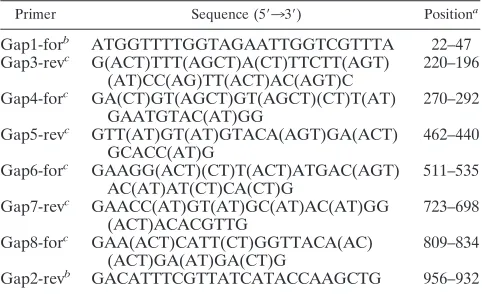
DNA sequencing.ConsensusgapPCR primers (Table 1) were used as previ-ously described (22). Gap1-for and Gap2-rev were used to amplify the⬃931-bp fragment as described before (37), and the PCR products were purified with the Qiagen gel extraction kit (Hilden, Germany). Partial reverse and forward se-quencing of the⬃931-bp fragment was obtained by using the consensus primers at 3.25 pmol (Table 1). Sequencing reactions were carried out with the BigDye Terminator v3.1 cycle sequencing kit (Applied Biosystems) according to the manufacturer’s instructions and using the previously described sequencing pro-tocols (22). The results were processed into sequence data with sequence analysis
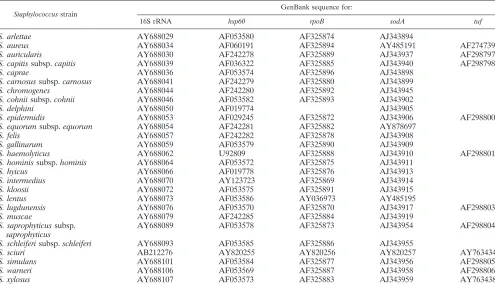
software (Applied Biosystems), and partial sequences were combined into a single consensus sequence with assembler software (Applied Biosystems) (22). The gene sequences other than that ofgapwere obtained from GenBank (Ta-ble 2).
Phylogenetic analysis.Sequences were aligned manually in Sequencher 3.0 (Gene Codes Corporation) to edit the sequences, if necessary, and to note which regions were to be excluded for the phylogenetic analysis. Multiple-sequence alignments and topology predictions were done with DNASISMAX, version 2.0.5 (2003) (Hitachi Software Engineering, Japan). Phylogenetic trees were generated with the neighbor-joining algorithm by using DNASISMAX. All trees were resampled with 1,000 bootstrap replications to ensure the robustness of the data (7). The phylogenetic analyses were displayed with the TreeView drawtree program, version 1.6.6 (http://taxonomy.zoology.gla.ac.uk/rod/treeview.html). The DNA sequence similarity analysis was performed with BioEdit, version 7.0.1 (14).
RESULTS
PCR, sequencing of the gap gene, and sequence similarity for the staphylococcal species.The amplification of the partial
gapgene for all of theStaphylococcusspecies yielded a single product of nearly 931 bp. The GenBank accession numbers are DQ321674 to DQ321700.
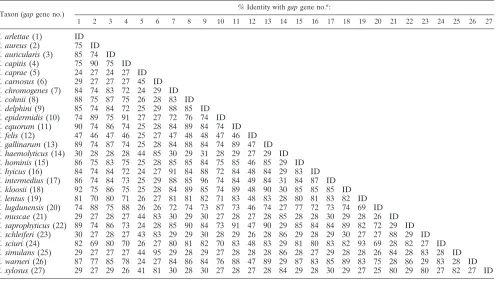
The sequence similarity of the gapsequences ranged from 24.3 to 96% (Table 3). The species S. lentus and S. sciuri
revealed a sequence similarity of 93% according to thegap
gene sequences, whereas the other gene-based similarities ranged between 88 and 98% (88% forhsp60, 88.9% forsodA, and 98% for 16S rRNA). The speciesS. capitisandS. caprae
revealed a sequence similarity of 27% according to thegap
gene sequences, whereas the other gene-based similarities ranged between 94 and 99% (94% for sodA, 95% for 16S rRNA, and 99% for hsp60). The species S. carnosus and S. simulansrevealed a sequence similarity of 95% according to thegapgene sequences, whereas the other gene-based similar-ities ranged between 86 and 98% (87 to 88% forrpoBand 96% for 16S rRNA).
The species S. chromogenes and S. hyicus revealed a se-quence similarity of 91% according to thegapgene sequences, whereas the other gene-based similarities ranged between 77.6 and 98% (77.6% forsodAand 98% for 16S rRNA).
Staphylococcus phylogeny derived from gapsequences.The
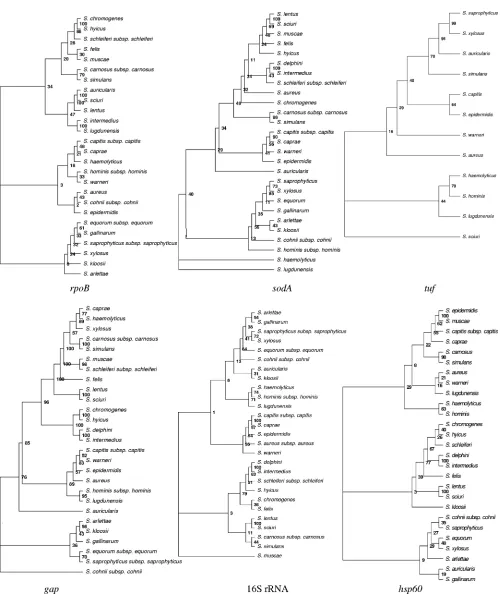
Staphylococcusspecies were divided into three clades (Fig. 1) with significant bootstrap values (⬎90%); the first contained the S. hyicus/S. intermedius group, comprising S. hyicus, S. chromogenes,S. delphini, andS. intermedius. The second clade contained two groups, theS. sciurigroup, comprisingS. sciuri
andS. lentus, and theS. haemolyticus/S. simulansgroup, com-prisingS. haemolyticus, S. xylosus, S. muscae, S. simulans, S. schleiferisubsp.schleiferi,S. carnosussubsp.carnosus,S. caprae, andS. felis.The third clade contained only one group, theS. aureus/S. epidermidis group, comprisingS. aureus, S. hominis
subsp. hominis, S. warneri, S. epidermidis, S. capitis subsp. capitis, andS. lugdunensis.The branching ofS. auricularis,S. cohnii, and the heterogeneousS. saprophyticusgroup, compris-ing S. saprophyticus subsp. saprophyticus, S. equorum subsp.
equorum,S. gallinarum,S. arlettae, andS. kloosii, was not reli-able (bootstrap values of 75, 75, and 29%, respectively).
[image:2.585.43.284.81.228.2]For thegapgene comparison betweenS. sciuriandS. lentus, a sequence similarity value of 82% (Table 3) was determined, as the position of these species in the phylogenetic tree is supported by a bootstrap value of 100% (see below).
TABLE 1. Primers used for sequencing thegapgene
Primer Sequence (5⬘33⬘) Positiona
Gap1-forb ATGGTTTTGGTAGAATTGGTCGTTTA 22–47
Gap3-revc G(ACT)TTT(AGCT)A(CT)TTCTT(AGT)
(AT)CC(AG)TT(ACT)AC(AGT)C
220–196
Gap4-forc GA(CT)GT(AGCT)GT(AGCT)(CT)T(AT)
GAATGTAC(AT)GG
270–292
Gap5-revc GTT(AT)GT(AT)GTACA(AGT)GA(ACT)
GCACC(AT)G
462–440
Gap6-forc GAAGG(ACT)(CT)T(ACT)ATGAC(AGT)
AC(AT)AT(CT)CA(CT)G
511–535
Gap7-revc GAACC(AT)GT(AT)GC(AT)AC(AT)GG
(ACT)ACACGTTG
723–698
Gap8-forc GAA(ACT)CATT(CT)GGTTACA(AC)
(ACT)GA(AT)GA(CT)G
809–834
Gap2-revb GACATTTCGTTATCATACCAAGCTG 956–932
aPosition relative to theS. aureus gapsequence. bPrimer sequences from Yugueros et al. (36). cDesigned primer sequences from this study.
on May 16, 2020 by guest
http://jcm.asm.org/
Comparative phylogeny based on various gene sequence-derived trees.Thegap-derived sequence similarity analysis for the staphylococcal species is given in Table 3. According to the staphylococcal gene sequences of gap, rpoB, and sodA, the speciesS. felisandS. muscaegrouped within the same cluster, whereas in the 16S rRNA- andhsp60-derived trees these two species did not show a close relationship.
The speciesS. hyicusandS. chromogenesclustered together according to the 16S rRNA,hsp60, andrpoBsequence analysis, but the clustering bysodAanalysis was less close. The grouping ofS. hyicusandS. chromogeneswas more affirmed by thegap
gene than by the other genes as well.
The grouping of S. arlettaeand S. kloosiiin thegap-based tree (with bootstrap values of 98%) was fairly supported by
hsp60-,rpoB-,sodA-, and 16S rRNA-derived trees (bootstrap values of⬍43%).
S. hominissubsp.hominisandS. lugdunensis clustered into the same group according togap(bootstrap value of 95%),tuf
(bootstrap value of 44%), andhsp60(bootstrap value of 29%) analyses, whereas this was not observed for 16S rRNA,rpoB, andsodAanalyses.
The grouping ofS. delphiniandS. intermediuswas supported bygap, 16S rRNA,hsp60, andsodAanalyses. The phylogenetic relationship ofS. chromogenesand S. hyicusin the gap- and
rpoB-derived trees (for each bootstrap value of 100%) was supported by low bootstrap values inhsp60-, 16S rRNA-, and
sodA-derived trees. The close relationship ofS. carnosussubsp.
carnosus and S. simulans in gap (bootstrap value of 100%),
hsp60,sodA(for each bootstrap value of 98%), andrpoB (boot-strap value of 79%) analyses was confirmed as well.S. delphini
and S. intermedius clustered together according to gap, 16S rRNA, sodA, and hsp60 analyses, with bootstrap values of 100% each.
DISCUSSION
Several molecular targets have been exploited for the mo-lecular identification of Staphylococcus species. Because a large amount of rrs sequence data is available in a public database, it is not surprising that the 16S rRNA gene has been an obvious choice. Gene sequence-based identification of bac-teria at the species level may require resolving the whole gene, yet in some cases, phylogenetically closely related bacterial species cannot be differentiated from each other. Although the comparison of the 16S rRNA gene sequences has been useful in phylogenetic studies at the genus level, its use has been questioned in studies at the species level. In this regard, the 16S rRNA sequence similarity has been shown to be very high, 90 to 99%, in 29Staphylococcusspecies (20).S. capraeandS. capitiscannot be distinguished by their 16S rRNA gene se-quences (34). Similarly, some Staphylococcus taxa have the same 16S rRNA gene sequences in variable regions V1, V3, V7, and V9, with identical sequences occurring in, e.g., S. vitulinus, S. saccharolyticus, S. capitis subsp. urealyticus, S. caprae, the two subspecies ofS. aureus, and the two subspecies ofS. cohnii(34). Other gene sequences have been used em-pirically in attempts to classify the Staphylococcus species, namely, thehsp60gene, thesodAgene, therpoBgene, and the
[image:3.585.45.540.81.368.2]tufgene. With regard to thehsp60gene, it should be noted that the cloned partialhsp60gene DNA sequences of nine isolates
TABLE 2. Partial gene sequences from GenBank used for phylogenetic tree
Staphylococcusstrain
GenBank sequence for:
16S rRNA hsp60 rpoB sodA tuf
S. arlettae AY688029 AF053580 AF325874 AJ343894
S. aureus AY688034 AF060191 AF325894 AY485191 AF274739
S. auricularis AY688030 AF242278 AF325889 AJ343937 AF298797
S. capitissubsp.capitis AY688039 AF036322 AF325885 AJ343940 AF298798
S. caprae AY688036 AF053574 AF325896 AJ343898
S. carnosussubsp.carnosus AY688041 AF242279 AF325880 AJ343899
S. chromogenes AY688044 AF242280 AF325892 AJ343945
S. cohniisubsp.cohnii AY688046 AF053582 AF325893 AJ343902
S. delphini AY688050 AF019774 AJ343905
S. epidermidis AY688053 AF029245 AF325872 AJ343906 AF298800
S. equorumsubsp.equorum AY688054 AF242281 AF325882 AY878697
S. felis AY688057 AF242282 AF325878 AJ343908
S. gallinarum AY688059 AF053579 AF325890 AJ343909
S. haemolyticus AY688062 U92809 AF325888 AJ343910 AF298801
S. hominissubsp.hominis AY688064 AF053572 AF325875 AJ343911
S. hyicus AY688066 AF019778 AF325876 AJ343913
S. intermedius AY688070 AY123723 AF325869 AJ343914
S. kloosii AY688072 AF053575 AF325891 AJ343915
S. lentus AY688073 AF053586 AY036973 AY485195
S. lugdunensis AY688076 AF053570 AF325870 AJ343917 AF298803
S. muscae AY688079 AF242285 AF325884 AJ343919
S. saprophyticussubsp.
saprophyticus
AY688089 AF053578 AF325873 AJ343954 AF298804
S. schleiferisubsp.schleiferi AY688093 AF053585 AF325886 AJ343955
S. sciuri AB212276 AY820255 AY820256 AY820257 AY763434
S. simulans AY688101 AF053584 AF325877 AJ343956 AF298805
S. warneri AY688106 AF053569 AF325887 AJ343958 AF298806
S. xylosus AY688107 AF053573 AF325883 AJ343959 AY763438
on May 16, 2020 by guest
http://jcm.asm.org/
ofS. aureusshowed a mean variability of only 2% (33). Also, cross-hybridization occurred in cloned partialhsp60 genes be-tween the DNAs fromS. intermediusandS. delphini(12). The
gap sequences were less conserved compared to the above-mentioned genes (sequence similarities, 24 to 96%). There-fore, thegapgene is rather more discriminative, as shown for
S. capraeandS. capitis, which were clearly distinguished from each other, in contrast to results from 16S rRNA gene analy-ses. For the sodA gene, a pairwise comparison of these se-quences revealed a mean sequence similarity of 81.5%, which was lower than that calculated for therrssequences of staph-ylococci (98%). The rpoB, hsp60, and tuf partial sequences showed interspecific similarity values of 71.6 to 93.6, 74 to 93, and 86 to 97%, respectively.
Thegap-based tree indicates the divergence of the selected staphylococcal species, which was well supported for most of the strains studied. We compared thegap-derived tree (Fig. 1) to those inferred from sequences of the 16S rRNA,rpoB,sodA,
hsp60, andtufgenes ofStaphylococcus species available from GenBank (Table 2). Earlier studies on the taxonomy of Staph-ylococcusspecies based on DNA-DNA reassociation indicated that in this genus there were eight distinct species groups, represented byS. epidermidis,S. saprophyticus,S. simulans,S. intermedius,S. hyicus,S. sciuri,S. auricularis, andS. aureus(17, 18). The same groups were identified in a study usinghsp60
(20) and thesodAgene sequence analysis (28). The phyloge-netic tree generated fromrpoBsequences revealed nine clus-ters, including an additional S. haemolyticusgroup. The 16S rRNA sequence-derived trees with 38 taxa of the genus Staph-ylococcus identified 11 genogroups (S. epidermidis, S.
sapro-phyticus, S. simulans, S. carnosus, S. hyicus/S. intermedius, S. sciuri,S. auricularis,S. warneri,S. haemolyticus,S. lugdunensis, andS. aureus) (32, 33). However, the bootstrap values for most of the nodes of the distinct clusters were low. With thegap
sequences and a bootstrap value of⬎90%, theStaphylococcus
species were divided into four well-supported clusters: theS. sciurigroup, theS. hyicus/S. intermediusgroup, theS. haemo-lyticus/S. simulans group, and the S. aureus/S. epidermidis
group.
Inhsp60-, 16S rRNA-,sodA-, andrpoB-generated trees, the
S. sciurigroup was formed by the two membersS. sciuriandS. lentuswith bootstrap values of⬎97%. All of the species from theS. sciurigroup, includingS. vitulinus(not included in this study), differ from the otherStaphylococcusspecies in several remarkable features. They are novobiocin resistant and oxi-dase positive, and they all share the same characteristic pattern of amino acid substitution in theirhsp60proteins (12, 20). The close relationship between S. sciuri and S. lentus was repro-duced in the results from our tree analysis based ongap se-quences. Thus, members of theS. sciurigroup form a constant cluster inhsp60, 16S rRNA,sodA,rpoB, andgapgene trees.
The S. hyicus/intermedius group, as defined by 16S rRNA sequence analysis and confirmed byrpoBandhsp60sequence analysis, includesS. hyicus, S. chromogenes, S. muscae,S. in-termedius,S. delphini,S. schleiferisubsp.schleiferi, andS. felis. TheS. intermediusgroup, as defined bysodAsequence analysis, consisted ofS. intermediusandS. delphini(bootstrap value of 100%). S. schleiferi subsp. schleiferiand S. felis were not in-cluded in this cluster. Moreover, the related speciesS. hyicus,
[image:4.585.47.545.81.362.2]S. muscae, andS. chromogenesdid not cluster to form an S. TABLE 3. DNA sequence identity matrix based on comparisons of thegapgene sequences of theStaphylococcusspecies
Taxon (gapgene no.)
% Identity withgapgene no.a:
1 2 3 4 5 6 7 8 9 10 11 12 13 14 15 16 17 18 19 20 21 22 23 24 25 26 27
S. arlettae(1) ID
S. aureus(2) 75 ID
S. auricularis(3) 85 74 ID
S. capitis(4) 75 90 75 ID
S. caprae(5) 24 27 24 27 ID
S. carnosus(6) 29 27 27 27 45 ID
S. chromogenes(7) 84 74 83 72 24 29 ID
S. cohnii(8) 88 75 87 75 26 28 83 ID
S. delphini(9) 85 74 84 72 25 29 88 85 ID
S. epidermidis(10) 74 89 75 91 27 27 72 76 74 ID
S. equorum(11) 90 74 86 74 25 28 84 89 84 74 ID
S. felis(12) 47 46 47 46 25 27 47 48 48 47 46 ID
S. gallinarum(13) 89 74 87 74 25 28 84 88 84 74 89 47 ID
S. haemolyticus(14) 30 28 28 28 44 85 30 29 31 28 29 27 29 ID
S. hominis(15) 86 75 83 75 25 28 85 85 84 75 85 46 85 29 ID
S. hyicus(16) 84 74 84 72 24 27 91 84 88 72 84 48 84 29 83 ID
S. intermedius(17) 86 74 84 73 25 29 88 85 96 74 84 49 84 31 84 87 ID
S. kloosii(18) 92 75 86 75 25 28 84 89 85 74 89 48 90 30 85 85 85 ID
S. lentus(19) 81 70 80 71 26 27 81 81 82 71 83 48 83 28 80 81 83 82 ID
S. lugdunensis(20) 74 88 75 88 26 26 72 74 73 87 73 46 74 27 77 72 73 74 69 ID
S. muscae(21) 29 27 28 27 44 83 30 29 30 27 28 27 28 85 28 28 30 29 28 26 ID
S. saprophyticus(22) 89 74 86 73 24 28 85 90 84 73 91 47 90 29 85 84 84 89 82 72 29 ID
S. schleiferi(23) 30 27 28 27 43 83 29 29 30 28 29 26 28 86 29 28 29 30 27 27 88 29 ID
S. sciuri(24) 82 69 80 70 26 27 80 81 82 70 83 48 83 29 81 80 83 82 93 69 28 82 27 ID
S. simulans(25) 29 27 27 27 44 95 29 28 29 27 28 28 28 86 28 27 29 28 28 26 84 28 83 28 ID
S. warneri(26) 87 77 85 78 24 27 84 86 84 76 88 47 89 29 87 83 85 89 83 75 28 86 29 83 28 ID
S. xylosus(27) 29 27 29 26 41 81 30 28 30 27 28 27 28 84 29 28 30 29 27 25 80 29 80 27 82 27 ID
aID, identical.
on May 16, 2020 by guest
http://jcm.asm.org/
FIG. 1. Neighbor-joining tree based on the 931- to 933-bpgapsequences and 16S rRNA,rpoB,sodA, andtufgene sequences showing the phylogenetic relationships among the staphylococcal species selected for this study. The value on each branch is the percent occurrence of the branching order in bootstrapped trees (7).
on May 16, 2020 by guest
http://jcm.asm.org/
hyicusspecies subgroup. Thegap-derived data support the idea thatS. chromogenesand the non-S. aureuscoagulase-positive staphylococci, such asS. intermedius,S. delphini, andS. hyicus, belong to the S. hyicus/S. intermedius species group. In our study,S. schleiferisubsp.schleiferiandS. muscaewere outside of the S. hyicus/S. intermedius group as well. Based on the
gap-derived data, S. schleiferi subsp.schleiferi and S. muscae
could be grouped into theS. haemolyticus/S. simulans group. According to the 16S rRNA gene sequence, the phylogenetic classification ofS. felisfell into the clade ofS. hyicus/S. inter-medius. However, based on DNA-DNA reassociation studies,
S. feliswas thought to be related to members of theS. simulans
group (17, 18). In ourgap-derived data,S. felisis outside of the
S. hyicus/S. intermediusgroup and is closely related to members of theS. simulansgroup.
In contrast to the 16S rRNA sequence-based phylogenetic tree but in accordance with thesodA, hsp60, and rpoBgene sequences, we did not divideS. simulansandS. carnosusinto two closely related groups by using thegap gene-derived se-quences.
TheS. saprophyticusgroup, as defined by 16S rRNA sequence analysis, includes the novobiocin-resistant and oxidase-negative speciesS. saprophyticussubsp.saprophyticus,S. arlettae,S. kloosii,
S. cohnii,S. gallinarum,S. equorumsubsp.equorum, andS. xylosus. TherpoB-derived data indicated thatS. cohniiis outside of theS. saprophyticusgroup. From thesodA-derived data, one could con-clude that the monophyly of this clade is uncertain, since it is associated with a bootstrap value of only 68%. In our study,S. cohniiandS. xylosusare clearly outside of theS. saprophyticus
group.S. cohniibelongs to theS. saprophyticusgroup according to the 16S rRNA andhsp60trees. Based ongap-derived sequences, the branching ofS. auricularis,S. cohnii, and the heterogeneousS. saprophyticus group, comprising S. saprophyticus subsp. sapro-phyticus,S. equorumsubsp.equorum,S. gallinarum,S. arlettae, and
S. kloosii, was not reliable (98, 70, 43, and 36%, respectively). Based on the 16S rRNA data, the S. epidermidis species group was divided into five cluster groups, as described by Kloos (16):S. lugdunensis,S. haemolyticus,S. warneri,S. epi-dermidis, andS. aureus(33). TheS. epidermidiscluster, com-posed ofS. epidermidis,S. capitis,S. caprae, andS. saccharo-lyticus(not included in our study), constitutes a monophyletic clade supported by a high bootstrap value (97%) on the basis of 16S rRNA sequence analysis (20). In the rpoB study, S. caprae and S. capitis appeared to be in the S. haemolyticus
group. Similarly to theS. saprophyticusgroup, theS. epidermi-disgroup did not form a clearly distinct lineage in thesodA -based study (bootstrap value of 38.9%). Similar results were obtained in our study usinggap-based sequences. Moreover, in our study,S. capraeshowed no close relationship toS. epider-midis orS. capitis. On the other hand, the association of S. warneri with theS. epidermidis group was inferred from our data as well as from therpoBtree analysis.
Obviously, the determination of the sequences of several genes is an important tool for pathogen identification and phylogenetic studies. Although each gene-derived tree will dif-fer from the others and will have difdif-ferent levels of statistical support, it has been found that groupings obtained with two different sequences with bootstrap values of⬎90% are stable and reliable (29). The data we present show that the sequence analysis of a 931-bpgapgene fragment is a suitable molecular
method for the identification ofStaphylococcusisolates at the species level.
Thegapgene sequence-based relationships of the staphylo-coccal species obtained were in accordance with phylogenetic trees published previously (37). In support of thegap-derived tree results, thetufgene sequence-derived tree indicates thatS. warneriis associated with theS. epidermidisgroup, which in-cludes S. capitis. This is in agreement with results described earlier for sequencing assays targeting thesodAgene (28). The
tuf gene-derived data often showed more intraspecies se-quence divergence than the 16S rRNA-derived data. Appar-ently, the 16S rRNA gene is more highly conserved than thetuf
gene. A pairwise comparison of the tuf gene sequences re-vealed that their mean identity (92.6%) is lower than the mean identity (95.9%) of 16S rRNA gene sequences. These results indicate that the tuf gene constitutes a more discriminatory target gene than the 16S rRNA gene to differentiate closely relatedStaphylococcusspecies.
The phylogenetic analysis of the staphylococcal gap se-quences yields an evolutionary tree having a topology similar to that of the tree constructed with the 16S rRNA sequences, although minor differences were observed (Fig. 1).
We have determined thegapsequences of 27Staphylococcus
type strains and demonstrated the usefulness of the gap
GenBank database for distinguishing the staphylococcal spe-cies and giving an approach for interpreting the phylogenetic relationship of the staphylococci. This method consists of a PCR carried out with a single pair of degenerate oligonucleo-tides for the amplification of a staphylococcal partialgapgene sequence and the direct sequencing of the amplicon. The se-quencing also can be performed with the two respective PCR primers instead of the eight primers, as was done in this study, since the sequencer is adjusted for sequence analysis. In our case, the sequencer also was used for terminal RFLP analysis, so that we had troubles with the sequencing of fragments of
⬎800 bp to obtain a confident sequence properly. The meth-odology might be useful in reference laboratories for the char-acterization of strains that could not be assigned to a species on the basis of their conventional phenotypic reaction and can stand on its own more effectively than 16S rRNA analysis, as this is a highly conserved gene and has limited discriminatory power compared to that of thegapgene, especially in closely related staphylococcal species. Shortening the region of inter-est within thegapgene sequence was not possible due to the scattering of the divergent regions throughout the whole se-quence. However,gapsequencing did not allow the detection of intraspecies polymorphism among the studied Staphylococ-cusspecies; e.g., forStaphylococcus epidermidis, the sequence similarity among different isolates of this species was more than 99%. This also was shown by the gap-based terminal RFLP analysis ofS. epidermidisisolates in our previous publi-cation (22).
ACKNOWLEDGMENT
This study was supported by the German Federal Ministry of Edu-cation and Research (BMBF NBL3).
REFERENCES
1.Bannerman, T. L.2003.Staphylococcus,Micrococcus, and other catalase-positive cocci that grow aerobically, p. 384–404.InP. R. Murray, E. J. Baron,
on May 16, 2020 by guest
http://jcm.asm.org/
J. H. Jorgensen, M. A. Pfaller, and R. H. Yolken (ed.), Manual of clinical microbiology, 8th ed. ASM Press, Washington, DC.
2.Becker, K., D. Harmsen, A. Mellmann, C. Meier, P. Schumann, G. Peters, and C. von Eiff.2004. Development and evaluation of a quality-controlled ribosomal sequence database for 16S ribosomal DNA-based identification of Staphylococcusspecies. J. Clin. Microbiol.42:4988–4995.
3.Bialkowska-Hobrzanska, H., H. V. Harry, D. Jaskot, and O. Hammerberg.
1990. Typing of coagulase-negative staphylococci by Southern hybridization of chromosomal DNA fingerprints using a ribosomal RNA probe. Eur. J. Microbiol. Infect. Dis.9:588–594.
4.De Buyser, M. L., A. Morvan, S. Aubert, F. Dilasser, and N. El Solh.1992. Evaluation of ribosomal RNA gene probe for the identification of species and sub-species within the genusStaphylococcus. J. Gen. Microbiol.138:889–899. 5.Drancourt, M., and D. Raoult.2002.rpoBgene sequence-based
identifica-tion ofStaphylococcusspecies. J. Clin. Microbiol.40:1333–1338.
6.Euze´by, J. P.1997. List of bacterial names with standing in nomenclature: a folder available on the internet. Int. J. Syst. Bacteriol.47:590–592. 7.Felsenstein, J.1985. Confidence limits on phylogenies: an approach using
the bootstrap. Evolution39:783–791.
8.Figge, R. M., and R. Cerff.2001. GAPDH gene diversity in spirochetes: a paradigm for genetic promiscuity. Mol. Biol. Evol.18:2240–2249. 9.Fujita, S., Y. Senda, T. Iwagami, and T. Hashimoto.2005. Rapid
identifica-tion of staphylococcal strains from positive-testing blood culture bottles by internal transcribed spacer PCR followed by microchip gel electrophoresis. J. Clin. Microbiol.43:1149–1157.
10.Garrity, G. M., J. A. Bell, and T. G. Lilburn.2004. Taxonomic outline of the prokaryotes.InBergey’s manual of systematic bacteriology, 2nd ed., release 5.0. Springer-Verlag, New York, NY.
11.Goh, S. H., S. Potter, J. O. Wood, S. M. Hemmingsen, R. P. Reynolds, and A. W. Chow.1996. HSP60 gene sequences as universal targets for microbial species identification: studies with coagulase-negative staphylococci. J. Clin. Microbiol.34:818–823.
12.Goh, S. H., Z. Santucci, W. E. Kloos, M. Faltyn, C. G. George, D. Driedger, and S. M. Hemmingsen.1997. Identification ofStaphylococcusspecies and subspecies by the chaperonin 60 gene identification method and reverse checkerboard hybridization. J. Clin. Microbiol.35:3116–3121.
13.Gribaldo, S., B. Cookson, N. Saunders, R. Marples, and J. Stanley.1997. Rapid identification by specific PCR of coagulase-negative staphylococcal species important in hospital infection. J. Med. Microbiol.46:45–53. 14.Hall, T. A.1999. BioEdit: a user-friendly biological sequence alignment
editor and analysis program for Windows 95/98/NT. Nucleic Acids Symp. Ser.41:95–98.
15.Kleeman, K. T., T. L. Bannerman, and W. E. Kloos.1993. Species distribu-tion of coagulase-negative staphylococcal isolates at a community hospital and implications for selection of staphylococcal identification procedures. J. Clin. Microbiol.31:1318–1321.
16.Kloos, W. E.1997. Taxonomy and systematics of staphylococci indigenous to humans, p. 113–137.InK. B. Crossley and G. L. Archer (ed.), The staphy-lococci in humans and disease. Churchill Livingstone, New York, NY, 17.Kloos, W. E., and K. H. Schleifer.1986. Genus IV.Staphylococcus, p. 1013–
1035.InP. H. A. Sneath, N. S. Mair, M. E. Sharpe, and J. G. Holt. (ed.), Bergey’s manual of systematic bacteriology, vol. 2. Williams & Wilkins, Baltimore, MD.
18.Kloos, W. E., and C. G. George.1991. Identification ofStaphylococcus spe-cies and subspespe-cies with the Microscan Pos ID and Rapid Pos ID panel systems. J. Clin. Microbiol.29:738–744.
19.Kloos, W. E., and T. L. Bannerman.1994. Update on clinical significance of coagulase-negative staphylococci. Clin. Microbiol. Rev.7:117–140. 20.Kwok, A. Y., S. C. Su, R. P. Reynolds, S. J. Bay, Y. Av-Gay, N. J. Dovichi, and
A. W. Chow. 1999. Species identification and phylogenetic relationships
based on partial HSP60 gene sequences within the genusStaphylococcus. Int. J. Syst. Bacteriol.49:1181–1192.
21.Kwok, A. Y., and A. W. Chow.2003. Phylogenetic study of Staphylococcus and Macrococcus species based on partialhsp60gene sequences. Int. J. Syst. Evol. Microbiol.53:87–92.
22.Layer, F., B. Ghebremedhin, W. Ko¨nig, and B. Ko¨nig.2007. Differentiation ofStaphylococcusspp. by terminal-restriction fragment length polymorphism analysis of glyceraldehyde-3-phosphate dehydrogenase-encoding gene. J. Microbiol. Methods70:542–549.
23.Maes, N., Y. De Gheldre, R. DeRyck, M. Vaneechoutte, H. Meugnier, J. Etienne, and M. J. Struelens.1997. Rapid and accurate identification of Staphylococcus species by tRNA intergenic spacer length polymorphism analysis. J. Clin. Microbiol.35:2477–2481.
24.Martineau, F., F. J. Picard, D. Ke, S. Paradis, P. H. Roy, M. Ouellette, and M. G. Bergeron.2001. Development of a PCR assay for identification of staphylococci at genus and species level. J. Clin. Microbiol.39:2541–2547. 25.Modun, B., A. Cockayne, R. G. Finch, and P. Williams.1998. The
Staphy-lococcus aureusandStaphylococcus epidermidistransferrin-binding proteins are expressed in vivo during infection. Microbiology144:1005–1012. 26.Mollet, C., M. Drancourt, and D. Raoult.1997.rpoBsequence analysis as a
novel basis for bacterial identification. Mol. Microbiol.26:1005–1011. 27.Place, R. B., D. Hiestand, H. R. Gallmann, and M. Teuber.2003.
Staphylo-coccus equorumsubsp. linens, subsp. nov., a starter culture component for surface ripened semi-hard cheeses. Syst. Appl. Microbiol.26:30–37. 28.Poyart, C., G. Quesne, C. Boumaila, and P. Trieu-Cuot.2001. Rapid and
accurate species-level identification of coagulase-negative staphylococci by using thesodAgene as a target. J. Clin. Microbiol.39:4296–4301. 29.Roux, V., and D. Raoult.2000. Phylogenetic analysis of members of the
genus Rickettsia using the gene encoding the outer-membrane protein rOmpB (ompB). Int. J. Syst. Evol. Microbiol.50:1449–1455.
30.Spergser, J., M. Wieser, M. Taubel, R. A. Rossello-Mora, R. Rosengarten, and H. J. Busse.2003.Staphylococcus nepalensissp. nov., isolated from goats of the Himalayan region. Int. J. Syst. Evol. Microbiol.53:2007–2011. 31.Svec, P., M. Vancanneyt, I. Sedlacek, K. Engelbeen, V. Stetina, J. Swings,
and P. Petras.2004. Reclassification ofStaphylococcus pulvereri Zakrzewska-Czerwinska et al. 1995 as a later synonym ofStaphylococcus vitulinusWebster et al. 1994. Int. J. Syst. Evol. Microbiol.54:2213–2215.
32.Takahashi, T., M. Kaneto, Y. Mori, M. Tsuji, N. Kikuchi, and T. Hiramune.
1997. Phylogenetic analyses ofStaphylococcusbased on the 16S rRNA se-quence and assignment of clinical isolates from animals. J. Vet. Med. Sci.
59:775–783.
33.Takahashi, T., I. Satoh, and N. Kikuchi.1999. Phylogenetic relationships of 38 taxa of the genusStaphylococcus based on 16S rRNA gene sequence analysis. Int. J. Syst. Bacteriol.49:725–728.
34.Taponen, S., H. Simojoki, M. Haveri, H. D. Larsen, and S. Pyorala.2006. Clinical characteristics and persistence of bovine mastitis caused by different species of coagulase-negative staphylococci identified with API or AFLP. Vet. Microbiol.115:199–207.
35.Vannuffel, P., M. Heusterspreute, M. Bouyer, B. Vandercam, M. Philippe, and J. L. Gala.1999. Molecular characterization offemAfrom Staphylococ-cus hominisandStaphylococcus saprophyticus, andfemA-based discrimina-tion of staphylococcal species. Res. Microbiol.150:129–141.
36.Yugueros, J., A. Temprano, B. Berzal, M. Sanchez, C. Hernanz, J. M. Luengo, and G. Naharro. 2000. Glyceraldehyde-3-phosphate dehydroge-nase-encoding gene as a useful taxonomic tool for Staphylococcus spp. J. Clin. Microbiol.38:4351–4355.
37.Yugueros, J., A. Temprano, M. Sanchez, J. M. Luengo, and G. Naharro.
2001. Identification of Staphylococcus spp. by PCR-restriction fragment length polymorphism ofgapgene. J. Clin. Microbiol.39:3693–3695.