6
I
January 2018
129
©IJRASET (UGC Approved Journal): All Rights are Reserved
Moving Boundary Problem Derived from
Heat Transfer in Solidification Process with
Convective Upper Boundary Condition
P. Bhargavi1, Radha Gupta2, Rama Narasimha3
1
Department of Mathematics, Jain University
2
Department of Mathematics, Dayanand Sagar Institute of Technology
3
Department of Mechanical Engineering, K.S. Institute of Technology
Abstract:Continuous change in the depths of the frozen and dehydrated regions during the process of solidification within their active layer is reduced to a moving boundary problem, which describes the dynamics of the positions of the moving inter phases. Treating the depths of frozen and dehydrated layers as moving interfaces governed by Stefan type boundary conditions, and convective upper boundary conditions as a function of time is considered on the fixed boundary. A series of numerical investigations are conducted to investigate the effect of heat transfer coefficient. The simulated frozen/dehydrated positions of the moving boundaries with a change in the upper boundary condition have the same period as that of the regular fixed boundary condition.
Keywords: Moving boundary problems, phase change, Heat transfer coefficient, frozen region, dehydrated region.
I. INTRODUCTION
The dynamics of freezing process is an important phenomenon which is widely encountered in nature and in many engineering systems. In general heat transfer problems, involving the change of phase, in which the boundary conditions are specified at the external stationary surface are usually referred as Stefan problems.(Stefan, 1891). Solving Stefan problems involve mathematical difficulties as the governing equations are highly non-linear and existence of continuously moving boundaries. Though tracing the moving boundaries is part of the solution, the quasi- steady solution reduces the complexity of the problem by reducing the given partial differential equations to ordinary differential equation. This approximation is often been used when modelling the freezing of high water content materials [2], [3].Simultaneous heat and mass transfer during the freezing of high water content materials, using semi-analytical approach is solved by [4]. Exact solutions for Stefan problems of melting/freezing were discussed with different control functions, which depends on the evolution of the heat flux at the extremum x=0, with similarity type solutions are reported by [5].Solidification Process in an unsaturated granular packed bed has been investigated theoretically and numerically, by considering the water transport towards the solidification interface due to the capillary action by [6]. Mathematical modeling of solidification/ melting problems with various mathematical formulations are reviewed by [7]. A two phase Stefan problem with variable latent heat of fusion, initial temperature and constant heat flux boundary condition has obtained a similarity type solution [8].This paper is an extension work of [4], with time dependent convective boundary condition at the fixed boundary x=0. The effect of mass transfer coefficient and the volume fraction of the frozen mass are taken as parameters to find the change in the positions of the boundaries of frozen and dehydrated regions and on their temperature fields[9].
130
©IJRASET (UGC Approved Journal): All Rights are Reserved
II. MOVING BOUNDARY PROBLEM WITH SURFACE ICE SUBLIMATION AND HEAT TRANSFER 1
x
s
,x
s
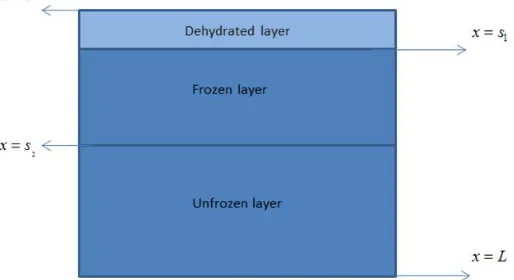
2 are the interface positions,T x t
1( , )
,T x t
2( , )
are the temperatures at the dehydrated and frozen regions [image:3.612.176.433.172.312.2]respectively. The whole calculation depth is divided into three layers, where we consider only dehydrated and frozen regions as the active regions for the discussions. We assume that in the frozen region conduction mode of heat transfer takes place and in the dehydrated region conduction followed by convective heat transfer at the boundary x=0 takes place. The governing differential equations that describe the system are:
Fig 1: Schematic representation of the model with two moving fronts.
Differential equations at the dehydrated region 2
1 1
1 1 1 2
,
T
T
C
k
t
x
0
x
s t
1( )
,t
0
(1)Differential equations at the frozen region: 2
2 2
2 2 2 2
,
T
T
C
k
t
x
s t
1( )
x
s t
2( )
,t
0
(2)Free bounary conditions at the moving sublimation front
x
s t
1( )
:1( 1( ) , ) 2( 1( ) , ) s u b( )
T s t t T s t t T t (3)
2 1 1 1
2 1 1 1 1
( ( ))
( ( ))
( )
T s t
T s t
k
k
L m s t
x
x
(4)1
1 1
( ( ), )
( )
ef
C s t t
D
m s t
x
(5)Where
C s t t
( ( ), )
1 is the equilibrium vapor concentration at the sublimation temperatureT
sub( )
t
and is given by( )
( ) 1
( )
( ( ), )
( )
( )
sub c b
T t
sat
sub sub
MP
T
Me
C s t t
RT
t
RT
t
(6)Here
P
sat( )
T
is the saturation pressure given by [10]131
©IJRASET (UGC Approved Journal): All Rights are Reserved
2( ( ), )
2 if,
T s t t
T
t
0
(7)2 2
2 2 2 2
( ( ), )
( ),
T
s t t
k
m L s t
x
t
0
(8)if
T
,T
s are the initial freezing temperature and the surrounding temperature.L
1,L
2,m
1,m
2,c
1,c
2,
1 ¸
2,k
1,k
2are latentheat , mass per unit volume, volumetric heat capacity, density and thermal conductivities in dehydrated and frozen regions, respectively. Convective boundary conditions at the fixed interface
x
0
1
1 1
(0, )
( (0, )
s)
T
t
k
h T
t
T
x
,t
0
(9)(0, )
( (0, )
)
ef m a
C
t
D
K
C
t
C
x
,t
0
Initial conditions at
t
0
:1
(0)
2(0)
0
s
s
(10) ifT
T
forx
0
(11)We assume temperature at the upper boundary to be:
1
(0, )
( )
T
t
f t
(12)By assuming quasi-steady approximation for temperatures
T
1,T
2 and for the vapor concentrationC x t
( , )
as1
( , )
( )
( )
T x t
A t
B t x
,0
x
s t
1( ),
t
0
(13)2
( , )
( )
( )
T x t
D t
E t x
,s t
1( )
x
s t
2( )
t
0
(14)( , )
( )
( ) ,
C x t
F t
G t x
0
x
s t
1( ),
t
0
(15) Using initial and boundary conditions we evaluate the constants as follows1 1
( )
sub( )
( )(
h
( ( )
s)
A t
T
t
s t
f t
T
k
(16)1
( )
h
( ( )
s)
B t
f t
T
k
(17)2 1 2 1
( ) ( )
( )
( )
( )
( )
sub ifT
t s t
T s t
D t
s t
s t
(18)2 1
( )
( )
( )
( )
if sub
T
T
t
E t
s t
s t
(19)( ) ( ) 1 1
( )
( )
( )
1
( )
sub c b T t m a
ef g sub
m
ef
K
e
C s t
Ma
D
R T
t
132
©IJRASET (UGC Approved Journal): All Rights are Reserved
( )
( )
1
( )
( )
1
( )
sub c b T t a g sub m m ef ef
e
Ma
C
R T
t
K
G t
K
D
s t
D
(21)Performing, mathematical calculations we get the following first order simultaneous differential equations for the two moving
fronts
s t
2( )
ands t
1( )
.
( )
( )
1 2
2 2 2 2
1
[
1]
( )
( )
[ ( )
]
1
( )
sub c b
T t
m a sub
s m
ef
Mae
K L
RC T
t
h
s t
f t
T
K
m L
s t
m L
D
(22) ( ) ( ) 1 1 1[
]
( )
( )
1
( )
sub c b
T t
a
m a sub
m
ef
Mae
C
K
RC T
t
s t
K
m
s t
D
(23) 2 22 2 2 1
( )
1
( )
( )
( )
sub if ifT
t
k T
T
s t
m L s t
s t
(24Choosing the following non-dimensional parameters as follows
2 2 1
2 if
m L
k T
, 2 1a m
m
C K
, 3 1 1 ifL m
hT
, 4a if
Ma
C RT
, 5 2 2 ifm L
hT
Equations (17) and (8) are reduced to the following non-dimensional form
( )
( )
3 4 2
2 5 5
1
(
1)
(
)
( )
( ( )
)
( )
1
( )
sub c b
T t
if sub s
m if
ef
e
T
T
t
f t
T
s t
K
T
s t
D
(25) ( ) ( ) 4 1 2 1(
1)
( )
( )
1
( )
sub c b T t if sub m ef
e
T
T
t
s t
K
s t
D
(26)2 1 2 1
( )
(1
( ) ( ( )
( )))
sub if
T
t
T
s t
s t
s t
(27)2
(0)
1(0)
0
133
©IJRASET (UGC Approved Journal): All Rights are Reserved
Expressions forT x t
1( , )
&T x t
2( , )
are as follows1 1
1
( , )
sub( )
h
(
( ))(( ( )
s)
T x t
T
t
x
s t
f t
T
k
0
x
s t
1( ),
t
0
(29)2
( , )
if[1
1 2( )( ( )
2)]
T x t
T
s t s t
x
s t
d( )
x
s t
f( )
t
0
(30)III. RESULTS AND DISCUSSIONS
Obtained results explains the influence of system parameters and freezing conditions on the characteristic dependent
variables
T
1( , )
x t
,T
2( , )
x t
,s t
1( )
,s t
2( )
.Heat transfer coefficient is a material Characteristic property, which increases with the thermal conductivity of the material. This coefficient gives the details the amount of diffusion of heat in frozen and dehydrated regions. Numerical simulations were performed by varying heat transfer coefficient and the surrounding temperature. The physical and thermal properties of the material considered are very close to the properties of water or ice. The calculations were performed under 1 atm pressure and in the time limit 7000s which is fair good to determine the system characteristics. Nomenclature and subscripts are same as in paper [9]. The values of the physical properties and other parameters in frozen and unfrozen zones are same as in the referred journal [4].We choose the function
( )
t iff t
T
e
t
0
(31)Fig2: The position of the freezing moving boundary at different time intervals with different heat transfer coefficients
134
©IJRASET (UGC Approved Journal): All Rights are Reserved
Fig2 and Fig3 show the same increasing trend of
s t
1( )
,s t
2( )
at different time intervals. Dehydrated moving boundary position is moving slowly compare to frozen zone boundary. This is due to smaller the value of h, lower is the heat diffusion, and in turn reduces the movement of dehydrated moving boundary. The diffusion of heat is lower in dehydrated region compared to frozen region, because of which the dehydrated region moves slower compare to the frozen region. Initially in the dehydrated region for different h the moving boundary positions are placed on the same line and at later time there is a slight increase in the position of the boundary. Also we can notice that the effect of heat transfer coefficient is not much on the moving interfaces. Where as in the freezing moving front positions are displaced at different positions for different h and we can observe that as h increases the depth of the frozen region increases. Fig 4 and fig 5 shows that for equal system characteristics and freezing conditions , value of ,dehydrated moving front,
s t
1( )
is lesser than at-least two orders of magnitude of, freezing moving front,s t
2( )
. Ice sublimation is a very thin surface layer under normal freezing times for any real system.Fig4: Temperature profile of the sublimation moving front for different heat transfer coefficients
135
©IJRASET (UGC Approved Journal): All Rights are Reserved
Fig6: Temperature profile in the frozen region for different heat transfer coefficients.
Fig7: Vapor concentration in the dehydrated region for different heat transfer coefficients.
Sublimation moving front temperature is influenced by the variation of h and higher h leading to lowering the sublimation
temperature (fig.4). We can see that both
T
1,T
2decreases linearly for very short times, but as the dehydrated layer grows, freezing and sublimation temperatures continue to decrease at steadily lower rates. This is due to the development of the dehydrated surfacelayer that has lower
k
andD
efthan the frozen zone, so lowering heat transfer. Vapor concentration in the dehydrated region showsa linear profile increasing the concentration of vapor with increase in ‘h’.
IV. CONCLUSION
136
©IJRASET (UGC Approved Journal): All Rights are Reserved
the moving boundaries and on the temperature fields. The simulated depth of both the regions depends upon the upper boundary conditions discussed.
V. ACKNOWLEDGMENT
The author gratefully acknowledges the support of everyone who has helped directly and indirectly to complete this work.
REFERENCES
[1] Clapeyron, B.P., Memoire sur la solidification par refroidissement dun globe liquide, Annales Chimie Physique, 47, 250-256 (1831). [2] Heat transfer with Freezing and thawing, Elesevier, London, 1-167(1991).
[3] R.A.Seban, Rate of ice formation , 65 , Trans. ASME 711-779(1943).
[4] M.C., Salvadori, V.O., Mascheroni, and R.H. Tarzia, D.A., An analytical solution for the coupled heat and mass transfer during the freezing of high-water content materials, Int. J. of Heat and Mass Transfer, 51, 4379- 4391.
[5] C Briozzo, Domigo A and Torzia, Exact solutions for non-classical Stefan problems, Int. J. of Differential Equations, (2010).
[6] P. Rattanadecho, Experimental and numerical study of solidification process in unsaturated granular packed bed, International Journal of Thermo Physics and Heat Transfer, 18 , (2004)
[7] Hu Stavros A and Argyropoulos, Mathematical Modelling of solidification and melting: a review, Modelling Simul. Mater. Sci. Eng, ,4, 371-396 (1996). [8] Nieves Salva, Domingo Alberto and Tarzia, Explicit Solution for a Stefan problem with variable latent heat and constant heat flux boundary condition, J. of
Mathematical Analysis and Applications, 379, 240-244 (2011).
[9] P. Bhargavi, Radha Gupta, and K. Rama Narasimha, Semi Analytic Investigation of Heat and Mass Transfer Modelling in Solidification, Indian Journal of Science and Technology,9, (2016