Enhancement of Index & Engineering Properties of
Black Cotton Soil Using Rice Husk Ash & Wheat
Husk Ash Including Lime
Santosh Prajapati 1, Dr. Shubha Khatri2 1
M.Tech.-Student, Department of Civil Engineering, Radharaman Engineering College, Bhopal, Madhya Pradesh, India 2
Professor, Department of Civil Engineering, Radharaman Engineering College, Bhopal, Madhya Pradesh, India
Abstract: In India, one-fifth of our land area is covered by Black Cotton Soil which is also known as expansive soil. These soils are mostly found in arid and semi-arid regions. These soils are found to be highly problematic in constructional activities. It causes severe damages to the structure because of its alternate swelling and shrinkage nature. This happens due to alternate drying and wetting of soil. To avoid these circumstances, soil must be stabilized and strength is to be increased. . In present investigation the type of solid wastage materials namely RICE HUSK ASH (RHA), WHEAT HUSK ASH (WHA) is selected to study the effects of the index and engineering characteristics of problematic soil LIKE BLACK COTTON SOILS. In order to utilize the rice husk ash & wheat husk ash for the improvement of problematic clay a detailed programmed studies have been formulated. In the longer term, LIME STABILIZATION provides performance benefits that reduce maintenance costs. In addition to stabilization of new materials, lime is an excellent choice for the reclamation of road bases. In this project work black cotton soil has been used for which soil stabilization has been done using Rice Husk Ash & Wheat Husk Ash with some percentage of lime content mixed in the soil to impart durability. Here, Index properties and Engineering properties of soil has been found out by using these above agricultural waste materials.
Keywords: Soil Stabilization, Black Cotton Soil, Index & Engineering Properties of Soil, Rice Husk Ash, Wheat Husk Ash,
Lime Stabilization
I. INTRODUCTION
In present scenario a lot of research work is being carried out in the area of using locally available materials in road construction which are not only available in nearby area of construction site but give good soil sub-grade strength also. With the increasing of population and the reduction of available land, more and more construction of buildings and other civil engineering structures have to be carried out on weak or soft soil. Owing to such soil of poor shear strength and high swelling & shrinkage, a great diversity of ground improvement techniques such as soil stabilization and reinforcement are employed to improve mechanical behavior of soil, thereby enhancing the reliability of construction. Black cotton soil is one of the major soil deposits of India. Several methods of soil improvement using pozzolanic materials have been developed and used successfully in practice regarding various civil engineering works. In recent years the use of various waste products in civil engineering construction has gained considerable attention in view of the shortage and high costs of conventional construction materials and the increasing costs of waste disposal and environmental constraints. India produces a huge amount of waste materials as by-products from different sectors like industrial, construction, agricultural, etc. These waste materials if not deposited safely, may be hazardous. In a fast developing country where almost each and every day construction activities takes place in a modern sense to improve the structural strength with economic value, uses of prior modern materials are required.
rice husk ash and waste tyres are used for this intended purpose with or without lime or cement. Disposal of these waste materials is essential as these are causing hazardous effects on the environment. With the same intention literature review is undertaken on utilization of solid waste materials for the stabilization of soils and their performance is discussed. Pravin Patel and Dr. H. K. Mahiyar (2014), an experimental investigation is carried out to study the effect of Rice husk ash, Fly ash and Lime on index and engineering properties of Black cotton soils. The properties of stabilized soil such as compaction characteristics, unconfined compressive strength and california bearing ratio were evaluated. Various percentage of Rice husk ash (5, 10, 15 &20), Fly ash (10, 15, 20 &25), Lime (2.4.6 & 8) have been used to improve the engineering properties of expansive black cotton soil. Muhammad Nawazish Husain , Praveen Aggarwal (2015), Various experimental investigations which include Index properties determination
(Specific gravity, Atterberg‟s limits and Wet sieve analysis), Modified Proctor Compaction tests and Unconfined Compressive
Strength (UCS) tests were conducted to observe the effects of mixing Straw ash and Crusher sand to silty soil. Straw ash and Crusher sand were mixed with silty soil in various proportions starting from 2 %, 4 %, 6 %, 8 % and 10 % by weight of soil. Experimental results revealed that as the content of Straw ash and Crusher sand is increasing, the Unconfined Compressive Strength of treated soil is also increasing. After comparing UCS value of Soil - Straw ash mixture with Soil - Crusher sand mixture, it can be said that Crusher sand helps more effectively in improving UCS value of silty soil as compared to Straw ash. Rathan Raj R, Banupriya S & Dharani R (2016), in this present investigation the type of solid waste namely Rice Husk Ash for stabilization is selected to study the effects of same on the index and engineering characteristics of problematic soil. The rice husk ash is mixed with soil in various proportions like 5%, 10%, 20%, 30%, 40%, 50% and 80%. The various tests were conducted on these proportions and optimized proportion is arrived. The liquid limit and the FSI of the soil decreased steeply with the increase in the % of RHA .In case of alluvial soil the liquid limit decreased from a value of 59% to 19.2% for the same quantum of addition of RHA. The decrease in the free swell Index was from 59% to 13.6%. The shrinkage limit of soil increased to 23.7 and 24.2% respectively for alluvial soil and clay soil from 12% initially for virgin soil. Jai Prakash, Kusum Kumari, Vijay Kumar (2017), in this paper researchers done experimental work and the rice husk ash is mixed in various proportions with soil like 5%, 10%, 15% and 20%. Various tests were also conducted on these mixes in order to find optimum proportion. The addition of RICE HUSK ASH alone to the test soil resulted in decrease in the value of liquid limit. The addition of RICE HUSK ASH alone to the test soil resulted in decrease in the value of MDD. On the basis of literature survey the objectives of the study have been decided. 1) Comparison Of Index Properties With And Without Using Rice Husk Ash & Wheat Husk Ash Including Lime As An Admixture In Case Of Stabilization Of Black Cotton Soil For Pavement And Foundation Construction Purpose. 2) To Find Out Engineering Properties Like Optimum Moisture Content, Maximum Dry Density By Compaction Test.
II. METHODOLOGY
In this research a methodology has been carried out to find the solution of expensive soil material like soil is stabilized by using agricultural waste bi-products such as Rice husk ash & Wheat husk ash with lime in the form of admixture for high performance of high rise structure constructed on BCS. BCS is also used for roads, highways, dams and columns etc. In this regard various tests have been performed in laboratory on BCS to find and improve INDEX PROPERTIES OF SOIL MASS and tests which have been performed are: Liquid Limit, Plastic Limit, Shrinkage Limit, Grain Size Analysis, Specific Gravity, and Moisture Content. Heavy compaction test is also carried out to find out optimum moisture content and maximum dry density.
Table 1: Index Properties of Black Cotton Soil (RGI, BHOPAL, M.P.)
Soil Properties Test Results
Specific Gravity 2.5
Liquid Limit % 33.91
Plastic Limit% 20.94
Plasticity Index% 21.81
Shrinkage Limit% 12.5
Free Swell Index% 20.5
I.S. Classification CH (High Plasticity)
Grain Size Analysis-% passing 75 micron sieve 99%
Optimum Moisture Content (OMC) % 12
Maximum Dry Density (MDD) g/cc 1.5
[image:4.612.66.550.282.406.2]California Bearing Ratio (CBR)% 2.05
Table 2: Chemical Composition of Rice Husk Ash (RHA) & Wheat Husk Ash (WHA)
Chemical Parameters RHA-Composition
Values %
WHA-Composition Values %
Silica 90.80 74.24
Alumina 3.5 1.35
Ferric Oxide 1.32 4.47
Calcium Oxide 1.57 6.69
Sodium 0.15 2.13
Potassium 0.24 6.68
Loss on Ignition 0.67 5.03
Table 3: Geotechnical Properties of Wheat Husk Ash (WHA) & Rice Husk Ash (RHA)
Properties Test Results WHA Test Results RHA
Specific Gravity 3.0 2.5
Liquid Limit % 20.04 17.5
Plastic Limit % 21.2 17.3
Plasticity Index % 22.05 19.01
Moisture Content % 35.3 30.07
Optimum Moisture Content (OMC) % 20.5 15.5
Maximum Dry Density (MDD) g/cc 2.02 1.3
III. EXPERIMENTALANALYSIS
[image:4.612.72.548.431.543.2]Figure 2: Liquid Lilmit Test
[image:5.612.186.426.185.365.2]Figure 3: Heavy Compaction Test
Table 4: Effect of RHA on Liquid Limit behaviour
Description Liquid Limit (%)
Black Cotton Soil (BCS) alone 33.91
BCS+5%RHA+10%LIME 25.5
BCS+10%RHA+10%LIME 15.4
BCS+15%RHA+10%LIME 12.6
BCS+20%RHA+10%LIME 10.97
Table 5: Effect of WHA on Liquid Limit behaviour
Description Liquid Limit (%)
Black Cotton Soil (BCS) alone 33.91
BCS+5%RHA+10%LIME 26.58
BCS+10%RHA+10%LIME 16.80
BCS+15%RHA+10%LIME 13.58
BCS+20%RHA+10%LIME 11.05
Table 6: Effect of WHA mixed Black cotton soils on OMC & MDD
Description OMC (%) MDD (g/cc)
Only Black Cotton Soils (BCS) 12.5% 1.71
BCS+5%WHA+5%LIME 18.1% 1.63
BCS+10%WHA+5%LIME 19.40% 1.52
BCS+15%WHA+5%LIME 22.02% 1.45
[image:5.612.69.549.406.712.2]Table 7: Effect of RHA mixed Black cotton soils on OMC & MDD
Description OMC (%) MDD (g/cc)
Only Black Cotton Soils (BCS) 12.5% 1.71
BCS+5%RHA+5%LIME 15% 1.5
BCS+10%RHA+5%LIME 18.05% 1.41
BCS+15%RHA+5%LIME 19% 1.32
BCS+20%RHA+5%LIME 21.89 1.23
NOTE: Liquid limit only for rice husk ash=17.5%, Liquid limit only for wheat husk ash=20.04%
IV. RESULTS&DISCUSSIONS
After conducting experimental analysis results are plotted in excel sheet and discussions have been made.
[image:6.612.48.538.231.390.2]A. A Comparison Study With Different Percentage Of Rha From 5-20% Including 10% Lime Content Mixed In Black Cotton Soils Shows The Impact On Liquid Limit
Figure 4: Effects of Rice Husk Ash Content with 5-20% including 10% Lime Content on Liquid Limit (%)
This test is done by liquid limit apparatus designed by A. Casagrande. Water content just sufficient to close the groove for 13mm length at 25blows gives liquid limit. Figure shows the effect of Liquid Limit behaviour on different percentage of RHA. It can be seen that with addition of RHA, the liquid limit continuously decreases from a water content of 33.91% to 10.97%. Figure 4 Shows the variation of liquid limit of a soil with increasing percentage of RHA. Increase or decreases in liquid limit highly affect the compressibility and swelling characteristics of soil. Generally reduction in the liquid limit means reduction in the compressibility and swelling characteristics which is beneficiary for sub grade soil. Increase or decrease in liquid limit mainly depends on clay minerals present in soil.
[image:6.612.96.537.559.713.2]B. A Comparison Study with Different Percentage Of Wha From 5-20% Including 10% Lime Content Mixed In Black Cotton Soils Shows The Impact On Liquid Limit
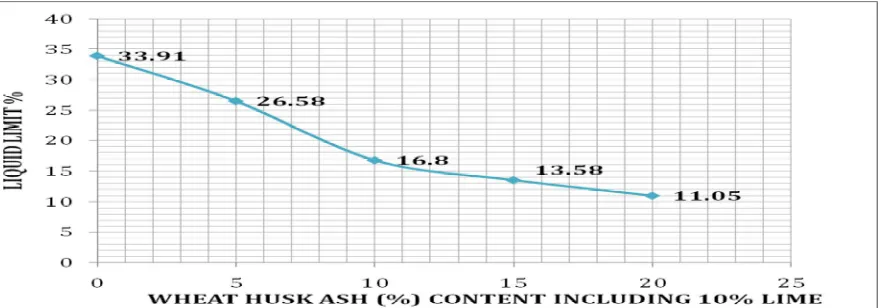
Figure 5 shows the impact of WHA including 10% lime content as an admixture mixed with black cotton soils on liquid limit. As compare to RHA, WHA absorb more water content so liquid limit percentage is increased for all the percentage amount of WHA. WHA is heavier and having high specific gravity and water content so liquid limit is also high for WHA as compare to RHA. But the graph pattern is same that by increasing the content of WHA+10% LIME liquid limit has been decreased.
[image:7.612.92.522.162.382.2]C. A Comparison Study With Different Percentage Of Rha From 5-20% Including 5% Lime Content Mixed In Black Cotton Soils Shows The Impact On Optimum Moisture Content %
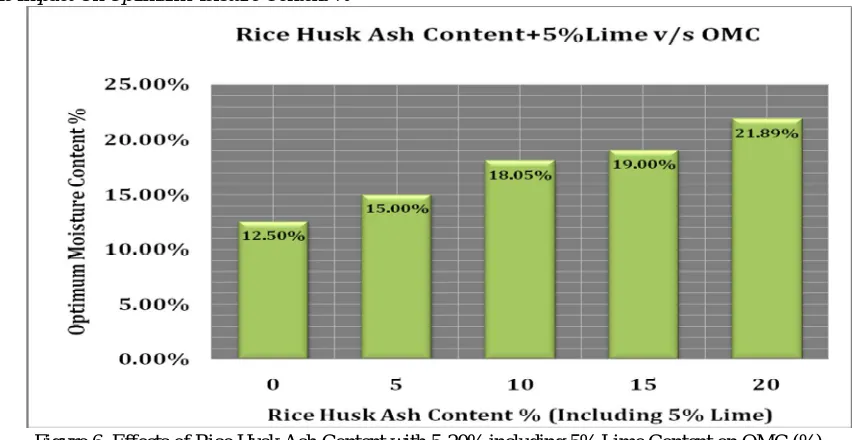
[image:7.612.81.521.505.716.2]Figure 6: Effects of Rice Husk Ash Content with 5-20% including 5% Lime Content on OMC (%)
Figure 6 shows Effect of RHA for Natural soil on OMC. The results were obtained for soil with 0, 5, 10, 15 and 20% of RHA plus 5% lime along with soil. Figure 2 shows the variation in OMC on adding RHA in different proportion. OMC is increased with increase in the RHA content including lime. The increment is due to the addition of RHA, which decreases the quantity of free silt and clay fraction and coarser materials with larger surface areas are formed. These processes need water to take place. This implies also that more water is needed in order to compact the soil-RHA mixtures.
D. A comparison study with different percentage of rha from 5-20% including 5% lime content mixed in black cotton soils shows the impact on maximum dry density (g/cc)
Figure 7 shows the Effects of Rice Husk Ash Content with 5-20% including 5% Lime Content on Maximum Dry Density (g/cc). The Dry density of soil sample increases with the increase in moisture content in natural soil to a certain limit and get decreased after reaching the maximum dry density value. When RHA mixed black cotton soil is compacted so maximum dry density decreases with increase in moisture content with increase in RHA content including 5% lime content. The decrement in Max Dry Density shows that the RHA is a light weight material with low specific gravity and more voids. So it absorbs water more in the void space provided. Hence more water is added to compact RHA mixed soil.
[image:8.612.86.527.193.467.2]E. A comparison study with different percentage of wha from 5-20% including 5% lime content mixed in black cotton soils shows the impact on maximum dry density (g/cc)
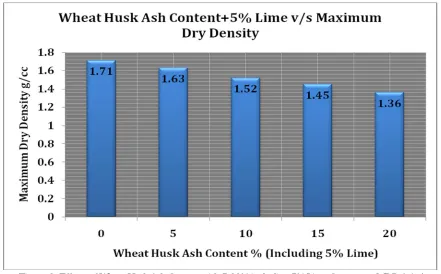
Figure 8: Effects of Wheat Husk Ash Content with 5-20% including 5% Lime Content on MDD (g/cc)
Figure 8 shows the decrement in Max Dry Density because WHA is heavier material with high specific gravity and more voids. So it absorbs water more in the void space provided. Hence more water is added to compact WHA mixed soil.
V. CONCLUSIONS
A. For only black cotton soil, liquid limit is found out as 33.91%. By increasing the rice husk ash content including 10% lime as an
admixture liquid limit (LL) is found out to be decreased. When RHA is mixed 5%+10% lime so LL is decreased by 24.80% and when RHA is increased up to 20%+10%lime so LL value is fond out to be decreased up to 67.64% as compared to 5%+10% lime content.
B. In place of RHA, when WHA has been used from 5%-20% including 10% lime content so liquid limit is decreased but as
compare to RHA its values are slightly increased because of heavy specific area and gravity of WHA as compare to RHA. When WHA is used only 5%+10% lime content so LL is found out to be decreased up to 26.58% from only black cotton soil LL which was 33.91% and difference is obtained as 21.61%.
When WHA is increased from 5%WHA+10%lime to 20%WHA+10%lime content so liquid limit has been decreased continuously and the difference is found out to be 67.41%.
C. Effects of RHA content including 5%lime content on optimum moisture content and maximum dry density was determined. It
10%RHA+5%LIME it was found out to be 30.74%, for 15%RHA+5%LIME it was found out to be 34.21% and for 20%RHA+5%LIME it was found out to be 42.89%.
D. Effect of RHA content including 5%lime content on maximum dry density was determined. It is concluded that when RHA
5%+5% LIME is mixed in black cotton soil so MDD is decreased as compare to only black cotton soil. When this amount of RHA for 10%-15%-20% including 5% lime content have been mixed in soil so MDD has been decreased continuously. Difference between only black cotton soil to 5%RHA+5%LIME has been found out as 12.28%, for 10%RHA+5%LIME it was found out to be 17.54%, for 15%RHA+5%LIME it was found out to be 22.8% and for 20%RHA+5%LIME it was found out to be 28.7%.
E. Effects of WHA content including 5%lime content on optimum moisture content and maximum dry density was determined.
From figure it is concluded that when WHA 5%+5% LIME is mixed in black cotton soil so OMC is increased as compare to only black cotton soil (i.e. from 12.5% to 18.10%) & it is also observed that OMC values are slightly higher than RHA-OMC VALUES because of heavy specific area of WHA. When this amount of RHA for 10%-15%-20% including 5% lime content have been mixed in soil so OMC has been increased continuously. Difference between only black cotton soil to 5%WHA+5%LIME has been found out as 30.93%, for 10%WHA+5%LIME it was found out to be 35.56%, for 15%WHA+5%LIME it was found out to be 43.23% and for 20%WHA+5%LIME it was found out to be 49.97%.
F. Effect of WHA content including 5%lime content on maximum dry density was determined. From figure it is concluded that
when WHA 5%+5% LIME is mixed in black cotton soil so MDD is decreased as compare to only black cotton soil. When this amount of WHA for 10%-15%-20% including 5% lime content have been mixed in soil so MDD has been decreased continuously. Difference between only black cotton soil to 5%WHA+5%LIME has been found out as 4.67%, for 10%WHA+5%LIME it was found out to be 11.11%, for 15%WHA+5%LIME it was found out to be 15.2% and for 20%WHA+5%LIME it was found out to be 20.46%.
REFERENCES
[1] M.S. Subrahmanyam, Lee Lih Cheran & Lee So Cheran, “Use of rice husk ash for soil stabilization”, Geol. Soc. Malaysia. Bulletin 14. December 1981; pp.
143-151.
[2] Dr. Robert M. Brooks, “Soil Stabilization With Flyash And Rice Husk Ash”, International Journal of Research and Reviews in Applied Sciences ISSN:
2076-734X, EISSN: 2076-7366 Volume 1, Issue 3(December 2009).
[3] Mandeep Singh, Anupam Mittal, “A Review on the Soil Stabilization With Waste Materials”, International Journal of Engineering Research and Applications
(IJERA) ISSN: 2248-9622 National Conference on Advances in Engineering and Technology (AET- 29th March 2014).
[4] Pravin Patel and Dr. H. K. Mahiyar, “A Experimental Study of Black Cotton Soil, Stabilized with Rice Husk Ash, Fly Ash and Lime”, International Journal of
Engineering Research & Technology (IJERT), ISSN: 2278-0181, IJERTV3IS110550 (This work is licensed under a Creative Commons Attribution 4.0 International License.), Vol. 3 Issue 11, and November-2014.
[5] Muhammad Nawazish Husain and Praveen Aggarwal, “Studying and Comparing the Effects of Straw Ash and Crusher Sand on UCS of Silty Soil”
International Journal of Innovative Research in Science, Engineering and Technology (An ISO 3297: 2007 Certified Organization), Vol. 4, Issue 8, August 2015.
[6] Rathan Raj R, Banupriya S & Dharani R, “Stabilization of soil using Rice Husk Ash”, International Journal of Computational Engineering Research (IJCER),
Volume 6, Issue 2, Feb 2016.
[7] Jai Prakash, Kusum Kumari, Vijay Kumar, “Stabilization of Soil Using Rice Husk Ash”, International Journal of Innovative Research in Science, Engineering