2018 International Conference on Computer, Electronic Information and Communications (CEIC 2018) ISBN: 978-1-60595-557-5
Improved Ant Colony Algorithm and Its Application on the QoS
Routing Problem
Hai YANG
College of Information Science and Electricity Engineering, Shandong Jiaotong University, Jinan, Shandong, China 250357
Keywords: Quality of service, QoS, Ant colony algorithm, Route optimization.
Abstract. Quality of service is particularly important for data transmission in computer network. In order to improve the stability of the network and reduce network consumption, an improved ant colony algorithm has been proposed in this paper for solving QoS routing problem. The new state transition strategy and new pheromone updating strategy have been brought into ACA-QoS so as to avoid to easily fall to local optimal solutions and increase the convergence speed. Experiment results shows ACA-QoS has higher efficiency for finding the optimal paths in QoS routing problem and higher practical value.
Introduction
With the development of Internet, variety of applications need to transmit mass multimedia data on the Internet. The quality of service (short for QoS) has played a very important role in computer networking. Because of the disadvantages of the network, there are always many problems in transmitting mass data, such as delay, delay jitter, packet loss, bandwidth limitation, cost and so on. These problems have a serious impact on the operating efficiency of the Internet[1]. So it’s always worth studying new algorithms for QoS routing problem to manage and utilize the network resource efficiently.
The quality of service routing problem (QoS), which searches the optimal path under various constraints, has been proved to be a NPC problem[2], which couldn’t be solved within polynomial time by traditional algorithms. Nowadays, most of researchers have used heuristic methods to solve QoS routing problem and presented several algorithms including neural network, genetic algorithm, ant colony algorithm etc[3].
Ant colony algorithm has some advantages, such as parallelism, robustness, ease of combining with other algorithms, but also has shortcomings like slow convergence and easy to stagnation. In this paper an improved ant colony algorithm has been presented for solving QoS routing problem. In order to improve the performance of the ant colony algorithm, the improved state transition strategy and pheromone updating strategy have been presented, which make the speed of convergence enhanced significantly.
The Qos Routing Problem
Introduction to QoS
Quality of service (QoS) is the description or measurement of the overall performance of a service, such as a telephony or computer network or a cloud computing service, particularly the performance seen by the users of the network. To quantitatively measure quality of service, several related aspects of the network service are often considered, such as packet loss, bit rate, throughput, transmission delay, availability, delay jitter, etc[4].
different applications, users, or data flows, or to guarantee a certain level of performance to a data flow.
Quality of service is particularly important for the transport of data in computer network. In particular, developers have introduced voice over IP technology to allow computer networks to become as useful as telephone networks for audio conversations, as well as supporting new applications with even stricter network performance requirements[5].
The Metrics of QoS
The network model of QoS routing problem can be denoted as a weighted graph G=(V,E), V is the set of network nodes, E is the set of network links, s∈V is the source node, and d∈{V −{s}} is the destination node. There are four metrics of every network node n∈V: let Delay(n) denote the time delay of node n, DJ(n) denote the delay jitter, Pl(n) denote the package loss, and Cost(n) denote the cost of data transmitting.
Meanwhile there are also four metrics of every network link e∈E: let Delay(e) denote the time delay of link e, DJ(e) denote the delay jitter, Bw(e) denote the bandwidth limitation and Cost(e) denote the cost of data transmitting through link e.
Let p(s,d) denote the set of all network links from the source node s to the destination node d, every metrics of QoS routing problem satisfy the following relationships:
∑
∑
∈ ∈ + = ) , ( ) , ( ) ( ) ( )) , ( ( d s p e d s p n e Delay n Delay d s pDelay (1)
∑
∑
∈ ∈ + = ) , ( ) , ( ) ( ) ( )) , ( ( d s p e d s p n e DJ n DJ d s pDJ (2)
∑
∑
∈ ∈ + = ) , ( ) , ( ) ( ) ( )) , ( ( d s p e d s p n e Cost n Cost d s pCost (3)
)) ( min( )) , (
(p s d Bw ei
Bw = , ei∈p(s,d) (4)
∏
∈ − − = ) , ( )) ( 1 ( 1 )) , ( ( d s p n n Pl d s pPl (5)
The objective of QoS routing problem is to find the optimal path from the source node s to the destination node d using the minimum cost under the following constraints:
))) , ( (
min(Cost p s d (6)
D d s p
Delay( ( , ))≤ (7)
B d s p
Bw( ( , ))≥ (8)
DJ d s p
DJ( ( , ))≤ (9)
L d s p
Pl( ( , ))≤ (10) Where D is the average maximum delay of network, B is the bandwidth limitation, DJ is the maximum delay jitter, and L is the maximum package loss.
Ant Colony Algorithm
their nest and a source of food. The original idea has since diversified to solve a wider class of numerical problems, and as a result, several problems have emerged, drawing on various aspects of the behavior of ants.
When ant colony algorithm starts, every ant moves randomly to find foods returning to their nest while laying down pheromone on the path it passed. If other ants find such a path, they are likely not to keep traveling at random, but instead of following the path, returning and reinforcing the density of pheromone of the path if they eventually find food. When the ant k moves to the next node j from node i, the node j can be decided with the probability Pijk(t) which can be calculated by formula
(11):
∈ =
∑
∈
otherwise A j t t
t t t
P k
A
s is is
ij ij k
ij
k
0
) ( ) (
) ( ) ( )
( α β
β α
η τ
η τ
(11)
Where τij(t) denotes the pheromone density, Ak is the set of optional nodes adjacent to node i. α
is the heuristic factor of pheromone. β is the heuristic factor of expectation. ηij(t) is the distance function which denotes the heuristic information of path[7]. ηij(t) is described as formula (12):
ij ij
d t) 1
( =
η (12)
Where dij denotes the distance from node i to node j.
Over time, however, the pheromone trail starts to evaporate, thus reducing its attractive strength. The more time it takes for an ant to travel down the path and back again, the more time the pheromones have to evaporate. A short path, by comparison, gets marched over more frequently, and thus the pheromone density becomes higher on shorter paths than longer ones. Pheromone evaporation also has the advantage of avoiding the convergence to a locally optimal solution[8]. If there were no evaporation at all, the paths chosen by the first ants would tend to be excessively attractive to the following ones. In that case, the exploration of the solution space would be constrained.
Local pheromone updating strategy is regarded as follows:
) ( ) ( ) 1 ( )
(t n ij t it t
ij ρ τ τ
τ + = − ⋅ +∆ (13) Where ρ is the evaporation rate of pheromone. ∆τit(t) denotes the increment of pheromone on path (i , j) during once iteration. ∆τit(t) can be gain by formula (14) as follows:
= ∆
otherwise j i L
Q
t k
it
0
) , ( /
) (
τ (14)
Where Q is the pheromone density and Lk denotes the total length of the route ant k passed by.
Improved Ant Colony Algorithm and Its Application on Qos Routing Problem
Improved State Transition Strategy
The QoS routing problem is different from the conventional path planning problem. The delay and delay jitter of network path should be considered when transmitting data. The improved state transition strategy of ACA-QoS algorithm is described as formula (15):
× × ≤
= ∈
otherwise formula
j i q q t t
j s allowedk is is
) 11 (
) , ( }
) ( ) ( { max
max τ α η β 0
(15)
Where constant q0∈[0,1] , q is an uniform random number between 0 and 1,
)) , ( ) , ( /(
1 Delay i j DJ i j
ij = +
η . The improved state transition strategy could ensure ants select the
paths with higher pheromone concentration when moving from node i to node j, avoiding to reach the globally optimal solutions.
Improved Pheromone Updating Strategy
In order to increase the convergence speed of ACA-QoS algorithm, the pheromone updating strategy considers not only the local pheromone updating, but also the global pheromone updating. When ant k moves from node i to node j, the pheromone of path (i,j) will be updated. After find the optimal path, the pheromones of every edge in this optimal path will be updated using formula (16):
Q t
n
t ij
ij
1 ) ( ) 1 ( )
( + = −ρ1 ⋅τ +ρ1⋅
τ (16)
The pheromones of rest edges which are not in optimal path will be updated using formula (17):
) ( ) 1 ( )
(t n 1 ij t
ij ρ τ
τ + = − ⋅ (17) Where,ρ1denotes the pheromone coefficient of links,
) , ( ) , ( )) ( ) , (
(Delay i j DJ i Bw i j Cost i j
Q=δ⋅ + + ⋅ .
Implementation Process of ACA-QoS Algorithm
The implementation process of ACA-QoS algorithm is described as follows:
Step 1: Construct the topology structure of simulation network under the NS2 simulation environment.
Step 2: Initialize all the metrics of every node and link.
Step 3: Delete the nodes and links which couldn't satisfy the the constraints of network so as to a reduced topology structure of simulation network can be gained.
Step 4: Initialize all parameters of ant colony algorithm. Set the number of ants m, pheromone density τij(0)=0, the heuristic factor of pheromone
α
, the heuristic factor of expectationβ , the distance function which denotes the heuristic information of path ηij(t), the evaporation rate of pheromone ρ , the increment of pheromone ∆τit(t) on path (i, j) during once iteration, the pheromone density Q and the maximum number of iterations Nmax.Step 5: Put m ants on the source node and then every ant moves to the next adjacent node according to the formula (15).
Step 6: Let every ant search the path from source node to the destination node separately and then update the pheromone density of every link in the path according to formula (16).
Step 7: If the number of iterations N is equal or greater than Nmax , the algorithm will be terminated. Otherwise, the number of iterations N =N+1.
Simulation Experiment
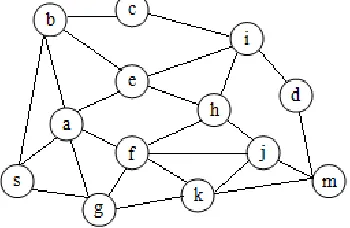
The simulation experiment is carried out under the NS2 simulation environment using the improved ant colony algorithm (ACA-QoS) and basic ant colony algorithm (ACA) separately. The topology structure of network is shown in Figure.1. Node s is the source node and the node d is the destination node. The experimental factors include: the number of ants m=20, the maximum number of iterations is 200, α=3, β=4, ρ=0.5, Q=100, bandwidth of network is 10 and time delay is 20.
Figure 1. The topology structure of experimental network.
[image:5.612.219.394.155.269.2]The results of 200 times experiments are shown in Table 1. The results reflect that the optimal solutions of ACA-QoS are superior to those of ACA. So ACA-QoS has higher efficiency for finding the optimal paths in QoS routing problem.
Table 1. Comparison of the experimental results.
Algorith
m Maximum Minimum
Average cost
Average number of
iterations
ACA-QoS 39.3 35.6
36.9 39
ACA 62 40.7 42.6 53
Conclusion
In this paper an improved ant colony algorithm for QoS routing problem is proposed which is named ACA-QoS. An improved state transition strategy and an improved pheromone updating strategy have been brought into ACA-QoS so as to avoid to easily fall to local optimal solutions and increase the convergence speed. Experiment results shows ACA-QoS has higher efficiency for finding the optimal paths in QoS routing problem.
References
[1] Lee. WC, Hluchyi. MG, Humblet. PA. Routing subject to quality of service constraints in integrated communication networks. IEEE Network, 1995, 9(4), pp. 46-55.
[2] Salman Yussof, Hang See Ong. A Robust GA-based QoS Routing Algorithm for Solving Multi-constrained Path Problem. Journal of Computers, 2010, 59, pp. 1322-1334.
[3] Mala, N Rajagopalan. Simulated Study of QoS Multicast Routing Using Particle Swarm Optimization. World Applied Programming, 2011, 1(3), pp. 176-182.
[4] X. C. Wang, S. Y. Jin, M. B. Xia. Web cluster of cybernetics QoS quantitative based on distributed control. Journal of software, 2007, 18(11), pp. 2810-2818.
[5] Jiang Yong. Rendezvous multicast: A novel architecture for MPLS QoS multicast. Journal of Software. 2010, 21(4), pp. 827-837.
[7] Wang Yunwu. Application of Chaos Ant Colony Algorithm in Web Service composition based on QoS. International Forum on Information Technology and Applications, 2009, 172 pp. 225-227.